
Bacterial canker on apricot: what Romagna showed
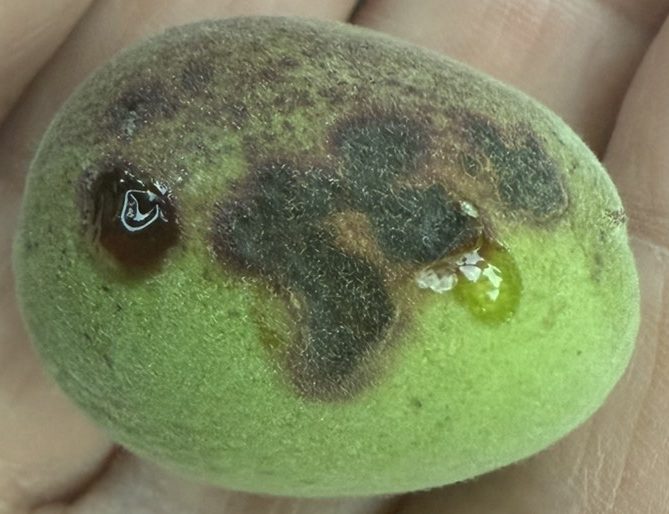
Photograph 1. An unripe apricot carrying extensive dark necrotic spots that have run together into continuous lesions, with a droplet of gum at the edge of one of them. This is exactly the picture the Italians describe as downgrading of the crop: the tree has not died, but the fruit has already lost its marketability. The lesions appear early and go on enlarging until colouring [1]. Photograph: Savvas Pastopoulos.
Savvas Pastopoulos, Agronomist, Pastopoulos Agronomics, Neos Mylotopos, Pella, Greece
In the Romagna region of Italy, whole young apricot orchards dried up within a few years, killed by a bacterium that until then had been regarded as a problem of sweet cherry. The cause was not a new pathogen; it was the change in the cultivar base. The new, early and vigorous cultivars planted from the late 1990s onwards proved barely tolerant of Pseudomonas syringae. That same plant material is being planted in Greece today.
Rates per unit area in this English edition are given per hectare, and spray volumes in litres per hectare. The Greek edition works in stremmata; one hectare equals 10 stremmata. Concentrations in the spray tank (g/hL) are the same in both editions.
- What happened in Romagna, and why it matters here
- The pathogen, two pathovars, one dominant
- The symptoms on apricot
- Why a bacterium makes ice
- The cultivars, the susceptibility list
- Where it gets in: plant material, pruning, site
- Copper: rates, timing and the 28-kilo ceiling
- What was tried as an alternative, and what worked
- Which of this applies in Greece
- The programme for a Greek apricot orchard
- Sources
1. What happened in Romagna, and why it matters here
The first reports of rapid and severe dieback of apricot trees came from the district of Imola and concerned the cultivar Aurora. The trees were dying within a few years, taking the productivity of entire young orchards with them. The disease then spread into the hill zone of Faenza, Forlì and Cesena [1] [9], and was later recorded in the Marche, in Trentino and in Piedmont [7].
The dominant picture was the appearance and the very rapid development of deep cankers on the main scaffolds or on the trunk. The cankers spread quickly both upwards and downwards, driving the wood of the tree into complete loss of function within a few months [1].
2. The pathogen, two pathovars, one dominant
The species Pseudomonas syringae contains more than fifty pathovars. Two of them matter on apricot [1] [3]:
| Pathovar | Where it occurs | On apricot |
|---|---|---|
| pv. syringae | In practically every agricultural environment, on herbaceous and on woody species | The dominant one. In Italian apricot orchards it prevailed in the isolations |
| pv. morsprunorum | Exclusively on Prunus species | Highly aggressive on sweet cherry and apricot, but distinctly less frequent. It too was found in Romagna |
The isolations yielded many different strains, with their own biochemical, metabolic and pathogenic characteristics [2]. This is not a uniform enemy but a mosaic of populations, which explains why the same strategy gives different results on neighbouring holdings.
3. The symptoms on apricot
The economic damage arrives in two stages, and the first is usually overlooked.
First stage: downgrading of the crop
Before the trees start to die, the fruit loses its marketability. Scabby blisters and spotting develop on the fruit. These lesions appear early and go on enlarging until colouring [1]. On the leaves it produces spotting, while bud death and wilting of the current season's shoots are also seen.
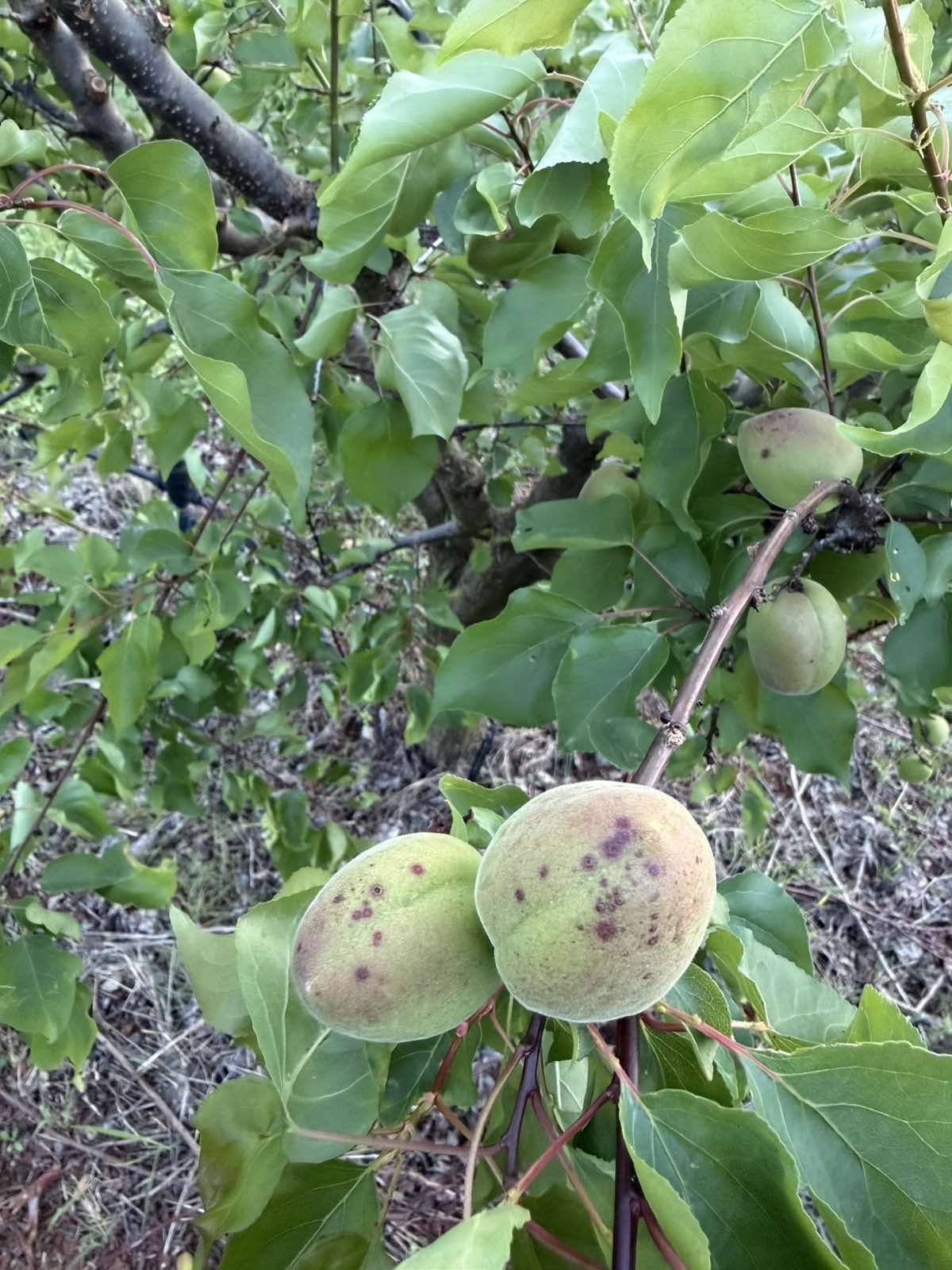
Photograph 2. The same attack in the field. The canopy looks healthy and the problem shows only when a fruit is taken in the hand, a spotted apricot can be made out at bottom right. This is why the disease is picked up late: by the time scaffolds start drying, the bacterium has been at work in the orchard for years. Photograph: Savvas Pastopoulos.
Second stage: the canker and the death of the tree
The canker on the scaffolds appears very extended lengthways. Over part of its length it is marked by a sunken bark, while elsewhere it opens right down to the heartwood. Characteristically, the Italian descriptions note that bacterial exudate was not always present, that is, the absence of gum does not rule out a bacterial infection [1].
With the bark cut away, the tissue underneath is necrotic, wet and without a clear margin, and gives off a smell of fermenting material. That smell is among the most reliable practical indicators in the field.
Sources: 1
4. Why a bacterium makes ice
This is the most misunderstood mechanism of the disease, and the reason why the choice of planting site counts for more than any spray.
P. syringae has the ability to nucleate ice, that is, to make the water around it crystallise at temperatures already close to zero [4]. In this way the pathogen generates micro-frost injuries in the susceptible tissues, in the buds and the flowers, and kills them [1].
The vicious circle in one sentence
The bacterium manufactures for itself the wounds through which it will invade. A tree carrying a large epiphytic population freezes at a higher temperature than it would without it. Hence the categorical Italian recommendation: apricot orchards should not be planted in damp, cold valley-bottom sites or in districts known for frequent frosts [1].
5. The cultivars, the susceptibility list
There is no resistant apricot cultivar today. There are, however, clear differences of degree, and the Italian list is the single most useful part of the whole study for anyone planning a planting [1].
| Category | Cultivars |
|---|---|
| Proved barely tolerant of the pathogen | Sungiant, Kioto, Carmen, Lady Cot, Wonder Cot, Sweet Cot, Rubista, Orange Ruby, Farbaly |
| Fruit lesions at a more sporadic frequency | Pricia, Faralia, Bora, Pink Cot, Luna, Primaya, Orangered |
| The cultivar of the first orchard losses | Aurora |
The second category does not mean resistance. It means that fruit lesions appeared less often under the particular conditions of Romagna. Behaviour under another climate and another inoculum pressure may differ.
Sources: 1
6. Where it gets in: plant material, pruning, site
Where it overwinters
On apricot the commonest overwintering site is inside the bud tissues and at the base of the bud itself, near the leaf abscission scar. The second overwintering site is the woody cankers on branches and scaffolds that were not removed carefully at pruning [1].
Primary inoculum may be present epiphytically, that is, on the outside, on wild herbaceous species as well as on tree crops. As an endophyte it is found in symptomatic and asymptomatic host tissue [1]. From this follows the recommendation for good weed management, with mowings that keep the weeds from growing away.
The propagating material
In modern nurseries the material is produced mainly by micropropagation and is phytosanitarily safe. The risk lies in the acclimatisation phase and in the growing-on of the young trees outdoors, where the nursery adjoins potentially infected orchards [1]. Italian law requires traded material to be free of P. syringae pv. syringae and pv. morsprunorum; the two pathovars are not quarantine organisms, but they are among the diseases that bear on quality.
Pruning, and which cuts are the most dangerous
Pruning operations play a decisive part in infection events. The pathogen can survive for hours on the cutting tools, and the cuts are easy routes of entry.
The most dangerous cuts appear to be those of formative pruning on young trees of 3 to 4 years, while they are in active growth [1]. Which is precisely where the grower cuts most and takes the least care.
Secondary spread is driven by rain and by spring and summer storms. Establishing new plantings in districts of intensive tree fruit growing, where plant pathogenic pseudomonads are endemic, is in itself a risk factor [1].
Sources: 1
7. Copper: rates, timing and the 28-kilo ceiling
Despite the existence of strains resistant to the copper ion, copper remains the only approved plant protection product with established bactericidal action [1].
The Italian programme
| Timing | What, how much and why |
|---|---|
| From the formative years onwards | Painting the pruning cuts and the base of the trunk and scaffolds with disinfectant pastes based on Bordeaux mixture |
| Late winter | Suppression of the bacterial propagules that make up the primary inoculum |
| Before flowering flower bud swell to white tip, that is, on a closed bud, before the flower opens and before any leaf emerges | Two applications of Bordeaux mixture, at a metallic copper concentration no higher than 125 g/hL. This is the last point in time at which that concentration may be used. From flower opening onwards, it stops. |
| Autumn October – November | Necessary wherever bud necrosis and dieback of shoot tips appeared during the growing season. 2 to 4 applications at 8 to 10 day intervals, again up to 125 g/hL |
This is the most dangerous point of misreading in the whole article, which is why it is set out separately. The 125 g/hL is a dormant rate. It is applied to bare wood and to a closed flower bud. Apricot flowers before it leafs out, so at white tip there is as yet no green tissue to burn.
From the moment the flower opens and the leaf emerges, that same rate will scorch and defoliate. Copper on stone fruit after leaf emergence causes leaf drop on peach, plum and apricot [13]. And it has been recorded: the Italian trials themselves recorded phytotoxicity on leaves and fruit of Robada from the caustic action of a copper concentration the cultivar would not tolerate [1].
The Italians acknowledge the problem themselves: when the emphasis shifts to spring applications against secondary inoculum, this "calls for the use of more restrained copper rates, or possibly for support from alternative products" [1]. In their experimental applications over green tissue the copper was at 20 to 30 g/hL, four to six times lower, and it still scorched.
Our own line is absolute: copper never goes on over green tissue. The 20 to 30 g/hL figure is given here because that is how the Italian experiment was run, not as a recommendation. On apricot, copper is a dormant-season tool.
The adjustment according to the symptom: where the symptoms concerned mainly the fruit, the autumn applications are reduced and the emphasis moves to spring, but at the reduced rate described above, not at 125 g/hL [1].
The calculation that has to come before the programme
The regulation permits at most 28 kg of copper per hectare over seven years, that is, an average of 4 kg per hectare per year [5]. The Italians give a concentration (g/hL), not a rate per hectare. The conversion depends entirely on the litres of spray liquid applied:
| Spray volume | Copper per spray | 4 sprays/year | 6 sprays/year |
|---|---|---|---|
| 600 L/ha | 0.75 kg/ha | 3.0 kg/ha, within | 4.5 kg/ha, over |
| 800 L/ha | 1.00 kg/ha | 4.0 kg/ha, borderline | 6.0 kg/ha, over |
| 1,000 L/ha | 1.25 kg/ha | 5.0 kg/ha, over | 7.5 kg/ha, over |
| 1,200 L/ha | 1.50 kg/ha | 6.0 kg/ha, over | 9.0 kg/ha, over |
At 1,000 litres per hectare, a common volume for a dormant spray in a mature apricot orchard, only 3 applications a year will fit at a concentration of 125 g/hL. The full Italian programme of six applications would come to 52.5 kg of copper per hectare over the seven years, nearly double the permitted amount.
- Reduce the spray volume, not the concentration. On bare wood, 600 litres per hectare with good distribution is sufficient and leaves room for five applications.
- Choose: autumn or spring. The Italians say so themselves, if the problem is on the fruit, the emphasis goes to spring; if it is on the buds and the shoot tips, to autumn. Both in full will not fit.
- Keep records. The ceiling runs over seven years. Without a record of kilos of metallic copper per year there is no way of knowing where the orchard stands.
The figures are indicative and come from Italian trials under different soil and climate conditions. The metallic copper content of each product differs and is stated on the label. The final rate and the number of applications are set after an on-site assessment by an agronomist, and always within the approvals in force [10].
8. What was tried as an alternative, and what worked
Under the Emilia-Romagna rural development programme 2014–2020, three field trials were carried out in the seasons 2016–2018 at Riolo Terme and Faenza, on the cultivars Primaya, Rubista and Pricia. The products were applied during the growing season, from the end of flowering to pit hardening, at intervals of 7 to 12 days, at a spray volume of 700 to 1,000 litres per hectare [1].
The results
2016 was hot and dry and allowed no distinction at all between treatments. The two seasons 2017 and 2018 gave conditions favourable to the pathogen [1].
| Treatment | Result |
|---|---|
| Peptides (2 kg/ha) | Essentially ineffective in 2017. Not repeated in 2018 |
| Bacillus subtilis strain QST 713 (4 kg/ha) | Essentially ineffective. See the box below |
| Carboxylic acids and oligo-polysaccharides (1 kg/ha) | Positive and statistically significant results, comparable with the reference copper. Among the best treatments in both seasons |
| Polyunsaturated fatty acids and peptides + copper 1 L + 0.25 L, that is, only 12.5 g/hL of copper | Positive and significant results. Described as promising, with phytotoxicity moderate and readily manageable |
| Chitosan (3 L/ha) | A contribution is recorded to a possible strategy complementary to copper |
| Copper from brochantite (reference standard) | Confirmed its bactericidal action in both years |
| Copper + mancozeb | The best result of 2018. Mancozeb enhances the efficacy of copper, a synergy known from twenty years of use against bacterial diseases [12]. Banned in the EU today [6] |
The phytotoxicity of copper
The researchers are categorical: phytotoxicity is inherent in the use of copper, and mixing it with substances of a different nature, carboxylic acids and oligo-polysaccharides, can amplify that unwanted effect [1]. The trials recorded very severe phytotoxicity symptoms on unripe Lady Cot fruit, attributed to technical errors in the use of the products, and phytotoxicity on leaves and fruit of Robada from the caustic action of a copper concentration the cultivar would not tolerate.
- A spray on trees carrying fruit can cause staining of the fruit and scorching of the foliage. The Italian trials themselves showed it on two cultivars.
- A prior test on a limited number of trees is required, with the same product and the same rate, and a wait of 5 to 7 days before the general application.
- The spray is applied in the late afternoon or early in the morning, never in extreme heat, never on foliage under water stress.
- Copper tolerance differs between cultivars. Robada proved particularly sensitive.
9. Which of this applies in Greece
| Treatment in the Italian paper | Status in Greece today |
|---|---|
| Copper (Bordeaux mixture, hydroxide, oxychloride, brochantite) | Approved, as a candidate for substitution, with the ceiling of 28 kg/ha over seven years [5]. The specific approval for each product and crop is to be checked in the Ministry database [10] |
| Mancozeb | BANNED. Approval not renewed from 4 January 2021, authorisations withdrawn by 4 July 2021, disposal of existing stocks ended 4 January 2022 [6] |
| Bacillus subtilis QST 713 | On the market, but without effect on the pseudomonads in the Italian trials [1] |
| Carboxylic acids, oligo-polysaccharides, chitosan, fatty acids with peptides | Most are sold as biostimulants or foliar fertilisers, not as plant protection products. The Italian paper itself points out that they must first be brought into the plant protection product category before they can legally enter a crop protection strategy [1] |
10. The programme for a Greek apricot orchard
Before planting, this is where the battle is won
- Site. Not on a valley bottom, not on damp and cold ground, not where frosts are frequent [1].
- Cultivar. The table in section 5 is consulted before the order goes in, not after.
- Plant material. Certified, from a nursery that does not adjoin problem orchards.
In an existing orchard, the annual routine
- Prune in dry weather. Never ahead of rain.
- Careful removal of cankers back to healthy wood. Cankers left in place are next season's reservoir [1].
- Painting of the cuts with a Bordeaux mixture paste, above all on the 3 to 4 year old trees being cut for shape.
- Mowing so that the weeds do not become a reservoir of epiphytic population.
- Copper in dormancy only, leaf fall, winter, and at the latest up to white tip, with the flower still closed. With the seven-year budget of 28 kilos kept in mind. Autumn where bud necrosis and shoot tip dieback were seen, pre-bloom where the problem was on the fruit.
- Copper never goes on over green tissue.
- Records. Which cultivar, which symptom, how many kilos of copper. Without that there is no improvement.
11. Sources
The numbers in the text refer to the list below.
- [1] Fagioli L., Franceschelli F., Ceredi G., Bugiani R., Tommasini M.G. and Stefani E. (2019). Cancro batterico dell'albicocco: dalla diagnosi alla difesa. L'Informatore Agrario 8/2019:31–35. In Italian. The principal source of this article: the history of the epidemic in Romagna, the cultivar susceptibility list, the overwintering sites, the part played by pruning cuts on trees of 3 to 4 years, the 125 g/hL copper programme, the protocol and results of the 2016–2018 trials, the phytotoxicity records, and the reddish russeting of Farbaly that is not bacterial.
- [2] Giovanardi D., Ferrante P., Scortichini M. and Stefani E. (2018). Characterisation of Pseudomonas syringae isolates from apricot orchards in north-eastern Italy. European Journal of Plant Pathology 151(4):901–917. Source for the identification of multiple genotypes and for the prevalence of pv. syringae over pv. morsprunorum in the apricot orchards of Romagna.
- [3] Bultreys A. and Kaluzna M. (2010). Bacterial cankers caused by Pseudomonas syringae on stone fruit species with special emphasis on pathovars syringae and morsprunorum race 1 and race 2. Journal of Plant Pathology 92(1 supplement):S1.21–S1.33. Source for the distinction between the two pathovars and for pv. syringae being far more frequent on stone fruit than pv. morsprunorum.
- [4] Hirano S.S. and Upper C.D. (2000). Bacteria in the leaf ecosystem with emphasis on Pseudomonas syringae, a pathogen, ice nucleus, and epiphyte. Microbiology and Molecular Biology Reviews 64:624–653. Source for ice nucleation at temperatures close to zero and for the epiphytic life of the bacterium.
- [5] Commission Implementing Regulation (EU) 2018/1981 of 13 December 2018 renewing the approval of the copper compounds as candidates for substitution. Source for the ceiling of 28 kg of copper per hectare over a period of seven years.
- [6] Commission Implementing Regulation (EU) 2020/2087 of 14 December 2020 concerning the non-renewal of approval of the active substance mancozeb. Source for the ban on mancozeb: approval expiring 4 January 2021, authorisations withdrawn by 4 July 2021, disposal of stocks ending 4 January 2022.
- [7] Morone C., Stefani E. and Vittone G. (2005). Il deperimento batterico dell'albicocco: una minaccia per gli impianti del Nord Italia. Rivista di Frutticoltura e Orticoltura 67(6):28–32. In Italian. Source for the spread of the disease to the Marche, Trentino and Piedmont.
- [8] Chen X.H. et al. (2009). Difficidin and bacilysin produced by plant-associated Bacillus amyloliquefaciens are efficient in controlling fire blight disease. Journal of Biotechnology 140:38–44. Source for the documented action of the bacteriocins against fire blight, which was not confirmed against the pseudomonads.
- [9] Bugiani R. et al. (2014). Come gestire il deperimento batterico dell'albicocco. L'Informatore Agrario 15:2–6. In Italian. Source for the spread from the district of Imola into the hill zone of Faenza, Forlì and Cesena.
- [10] Greek Ministry of Rural Development and Food, database of approved plant protection products. In Greek. The only authoritative source for what is permitted on apricot in Greece, at what rate and with what pre-harvest interval. It does not apply outside Greece.
- [11] Bacterial canker of stone fruit, Pseudomonas syringae, plantprotect.gr. The differential diagnosis with the knife, the nematode and bacterium complex, the difference between copper hydroxide and copper oxide, and the four reasons copper fails.
- [12] Lecigne P. et al. (2000). Mancozèbe, cuivre et bactérioses. Résultats sur tomate, melon, noyer, vigne. Phytoma, la Défense des Végétaux 531:13–16. In French. Source for the synergy of mancozeb and copper against bacterial diseases, to which the Italian paper refers.
- [13] Penn State Extension, Dormant copper sprays and orchard sanitation and University of Maryland Extension, Fungicides for fruit. Sources for copper being applied in the early period and avoided after leaf emergence, and for copper products causing leaf drop on peach, plum and apricot.
Plant protection products are used solely in accordance with the approvals in force and the instructions on the label. The rates and programmes given here come from Italian trials under different soil and climate conditions, are indicative and do not constitute a recommendation for application. Approvals of active substances change and differ from country to country and from crop to crop. The plant protection approvals referred to on this site are issued by the Greek Ministry of Rural Development and Food and are valid in Greece only; they do not apply in other countries.
For every spray on trees carrying fruit: there is a risk of staining of the fruit and scorching of the foliage. A prior test on a limited number of trees is required, with the same product and the same rate, and a wait of 5 to 7 days before the general application. The spray is applied in the late afternoon or early in the morning, never in extreme heat, never on foliage under water stress.
Every intervention is made at the user's own responsibility and following an on-site assessment by a licensed agronomist. Pastopoulos Agronomics accepts no liability whatsoever for damage or loss of crop arising from the application of the information above.
Related articles
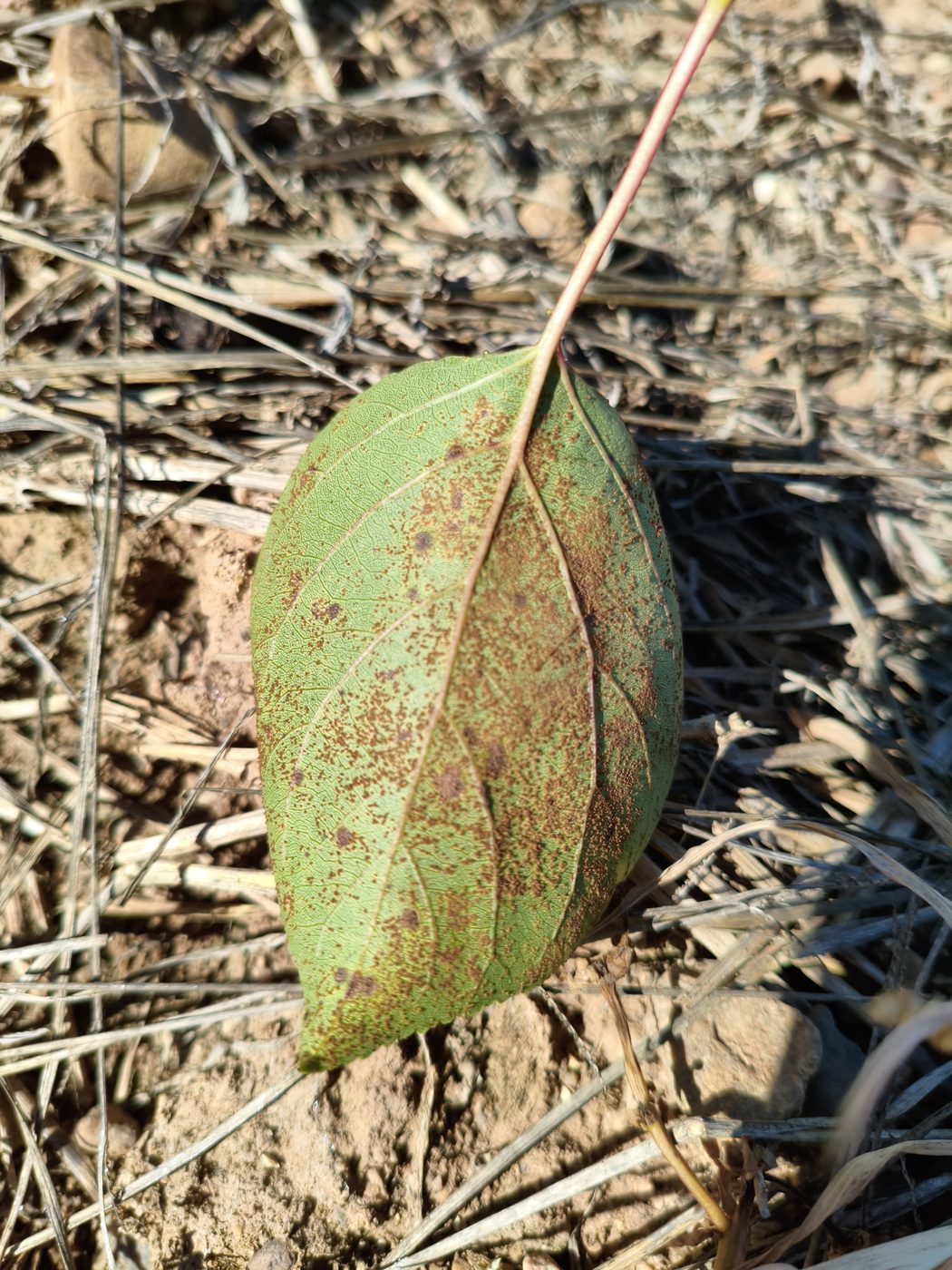
Apricot pests and diseases: identification from symptoms, with a diagnostic tool
Rust with field photographs, brown rot, shot hole, scab, powdery mildew, bacterial spot and canker, Eutypa dieback, silver leaf with and without a fungus, Phytophthora, Armillaria, plum pox and phytoplasma, and the pests: peach twig borer, oriental fruit moth, medfly, flatheaded root borer, mealybug, scale. The pruning dilemma, the three cuts that sort out a dead tree, and a tool that compares symptoms against the profiles of 34 causes.
Nutrient antagonisms and synergies, with a per-element tool
The arrow diagram in every fertiliser leaflet does not stand up scientifically. The antagonisms are real, but they act on two separate levels, in the soil and inside the plant, and the same element can be antagonistic on one and synergistic on the other. With a tool showing the documented relationships of each element.
Zeolite in agriculture: what is documented and what is not
It is a cation exchanger, it holds ammonium and potassium, not nitrate. The rates that work are tens of tonnes per hectare, not hundreds of kilos. And erionite is a Group 1 carcinogen.