
Pests and diseases of cucumber in Greece and Europe: symptom description, epidemiology and quarantine status

Savvas Pastopoulos, Agronomist MSc, Pastopoulos Agronomics, Neos Mylotopos, Pella, Greece
Cucumber is one of the few crops where identification can rest almost entirely on temperature. Scab, white rot and the root and crown rot caused by the Cretan forma specialis of Fusarium all stop above 22 to 32 degrees. Fusarium wilt, Pythium and Phytophthora start where those stop. Powdery mildew itself has two causal agents, one thermophilic and one cool-loving. What follows is what each agent shows on the plant, the conditions under which it advances, and what is documented for Greece and Europe, without figures from other climates passing through unmarked.
The approvals referred to in this article are those of the Greek Ministry of Rural Development and Food and are valid in Greece only. They do not apply in any other country. An active substance approved elsewhere is not approved in Greece, and the reverse is equally true. Readers outside Greece must check their own national register. No product, active substance or mode of action group is recommended anywhere in this article.
Almost all of the epidemiology of cucumber has been measured outside Greece: in France, the United States, Canada, China and India. No published Greek measurement of temperatures, wetness hours or relative humidity was found for any of the diseases described below. For that reason every figure is accompanied by the country and the host in which it was measured. The documented Greek contribution lies elsewhere and it is substantial: in the description of the pathogen, in grafting onto rootstocks, in the recording of fungicide and insecticide resistance, and in resistance genetics.
- What the article covers, and what is left out and why
- Downy mildew
- Powdery mildew, two agents with opposite temperatures
- Scab, or cladosporium rot
- Anthracnose
- Stem and fruit rot caused by Didymella bryoniae
- Grey mould, Botrytis
- White rot, or sclerotinia rot
- The two fusarium diseases of cucumber
- Root and crown rots caused by Pythium and Phytophthora
- Target spot and verticillium wilt, two diseases with no Greek record
- Angular leaf spot, the bacterial disease of cucumber
- The viruses transmitted by aphids
- The viruses transmitted by whitefly
- Green mottle mosaic, the virus that needs no insect
- The two whiteflies
- The two-spotted spider mite
- The thrips
- The aphids
- The leafminers
- The lepidoptera
- The root-knot nematodes
- What quarantine pest status means in practice, for cucumber
- Temperature as a key to identification
- The points that remain open
- References
1. What the article covers, and what is left out and why
The article covers the agents that are documented as present in Greece or in Europe and that concern Cucumis sativus. For each one it gives the description of the symptoms, the conditions under which it advances, and the state of its record in Greece.
Three agents that dominate the foreign handbooks are left outside the list of established problems, and the reason is worth stating because it explains a great deal of confusion:
- Bacterial wilt, Erwinia tracheiphila. In American factsheets it is the first disease of cucumber. The genomic survey of 88 strains from across the entire range of the pathogen concludes that all three lineages are geographically restricted to temperate eastern North America, and states explicitly that the bacterium was never observed in cucumber or squash plants in Spain or Germany [45]. EPPO does not even maintain a distribution dataset for it, and Greece does not appear even in the old aggregated compilations. Its vectors, the beetles Acalymma vittatum and Diabrotica undecimpunctata, are not established here. For the Greek greenhouse it has no practical significance.
- Target spot, Corynespora cassiicola. No published Greek record on cucumber was found, nor does the global checklist of the genus report any European datum under that name [26]. It is described below as an agent to watch, not as an established one.
- The thrips Thrips palmi. It is a Union quarantine pest, listed in Annex II Part A of Regulation (EU) 2019/2072, and in the EPPO database Greece is not mentioned at all on the distribution page, meaning that there is no recorded finding [48]. In the whole of the rest of Europe no entry is present: Cyprus is declared absent after survey, and the Netherlands, the United Kingdom and Portugal as absent after eradication. It remains in the article only because cucumber is its best host and because EFSA judges that greenhouse cucumber production would allow it to establish year round [47].
The chemical recommendations of foreign handbooks are not reproduced. Plant protection product approvals are national and are checked in the register of the Greek Ministry of Rural Development and Food, at fyto.plantprotect.gr, which is in Greek and is valid in Greece only. Everything reported below on resistance is a record of a finding, not a recommendation for application.
The whiteflies, the spider mite, the thrips and the aphids of cucumber are the same species that concern other greenhouse crops. The biology, the release rates and the timing of the predators and parasitoids that control them are analysed separately, in the article Beneficial insects, predatory mites and entomopathogenic nematodes. Here only the species that the sources link by name to each pest are mentioned. For Bemisia tabaci and for Botrytis there is additional material in the article on brassica vegetables.
2. Downy mildew
Pseudoperonospora cubensis. It starts on the older, lower leaves. On the upper surface, angular lesions form, at first chlorotic and water-soaked, later brown and necrotic. The diagnostic feature is not the colour but the shape of the margin: the lesion stops abruptly at the vein, so its outline is straight and polygonal. On the lower surface, directly beneath the lesion, a sparse greyish-violet sporulation appears, which requires high humidity to be visible and is often missing if the foliage has dried. The fruits are not infected directly. Damage to the fruit is indirect, from the defoliation and the sunscald that follow [1].
The conditions are measured and narrow. Sporangial germination and infection occur between 5 and 25 degrees, with an optimum range of 15 to 22 degrees and an optimum around 19. The minimum wetness for infection is two hours, and wetness of six hours or more facilitates new infections. Sporulation requires six hours of darkness or more for the sporangia to differentiate, with relative humidity above 90%. The latent period from infection to visible symptoms is 4 to 12 days, and sporangiophores appear 5 to 7 days after infection [1]. The French source gives a slightly wider infection range, 8 to 27 degrees with an optimum of 18 to 23, and infection within two hours at 20 to 25 degrees [2].
Three survival facts determine the management. Sporangia live up to 48 hours after detachment, and solar radiation inactivates them: a cumulative dose of 29.5 megajoules per square metre inactivates 95% on sunny days [1]. Oospores, by contrast, persist in the environment for more than ten months, with viability falling from 68% in November to about 20% in April and May, although the frequency of infection from oospores is below 0.2% [1]. In practice, the daily pressure comes from live foliage in the neighbourhood, not from the soil.
The critical window is the night and the dawn, because that is when darkness, humidity above 90% and temperature inside the optimum range coincide. Ventilation and heating that prevent condensation on the foliage, avoidance of evening irrigation, and drip rather than overhead irrigation work because they keep wetness below the two-hour limit [1].
One population datum deserves attention for Europe. The mean number of pathogenicity factors per isolate was calculated as 5.05 in the United States against 9.0 in Europe, meaning that European populations are more complex in their host range and in their capacity to overcome host resistance [1]. Yield losses of up to 80% are reported for central and northern Europe, that is, in climates more humid and cooler than the Greek one.
No published Greek measurement of epidemiological parameters was found. The Greek review of climate-driven pest and disease dynamics in greenhouse vegetables mentions cucumber downy mildew only qualitatively, as a problem of cool and humid environments with prolonged leaf wetness, without numerical limits [46].
3. Powdery mildew, two agents with opposite temperatures
Powdery mildew of cucumber has two causal agents, Podosphaera xanthii and Golovinomyces orontii. The picture on the plant is common to both: white, powdery, circular colonies, at first on the shaded lower leaves and on the petioles, often starting on the lower surface or on both. The colonies coalesce, the leaf becomes chlorotic, turns brown and dries, and either stays attached or falls. The petioles and the stem become covered. The fruit is rarely infected directly, but loses size and flavour because of the defoliation [3].
Cucumber powdery mildew is epiphytic, meaning that the colony is visible on the surface from the outset. This separates it from Leveillula taurica, which in Greece concerns mainly pepper, tomato and onion: that one is endophytic, produces chlorotic spots on the upper surface first, and its sporulation emerges from the stomata on the lower surface. The separation of the two genera of powdery mildew from each other cannot be made by eye. It requires a microscope, and the criterion is the fibrosin bodies in the conidia of Podosphaera [3] [4].
The practical significance of the distinction is temperature. Under controlled conditions, on cucumber leaf discs and at six constant temperatures from 10 to 35 degrees, the optimum temperatures for germination, infection and sporulation were found to be around 22 to 26 degrees for P. xanthii and around 15 to 18 for G. orontii, with germination almost nil at 35 degrees [6]. Only the abstract of that publication was read, so the figures are given as a range and not as exact values. The direction, however, is safe and sufficient for the field: P. xanthii is the thermophilic species and Golovinomyces the cool-loving one, and in Greek greenhouses in summer and in warm periods the first prevails.
The second thing worth knowing is the speed at which a fungicide is lost. In an experiment in a greenhouse in Beijing, the baseline sensitivity of 59 strains was 0.0105 micrograms per millilitre. After nine applications of a single fungicide of the QoI group, the mean value exceeded 0.9, that is, resistance factors of 164 to 294. The frequency of resistant individuals rose from 10% to more than 60% within five cycles even without selection pressure, and to about 100% under pressure [5]. In Spain, resistance to the same group is characterised as widespread in cucumber [3].
The genetic resistance of the cultivar is local and perishable. The Spanish collection of more than 1,500 isolates sets more than 30 sources of melon resistance against 28 putative races of the pathogen [3]. No published Greek record of powdery mildew species or races on cucumber was found.
4. Scab, or cladosporium rot
Cladosporium cucumerinum. On the leaves, small water-soaked spots appear, which become pale and grey, with the centre tearing and falling out. The leaf ends up perforated and ragged. On the petioles and stems, elongated water-soaked lesions form that deepen and can lead to the bending and death of the growing tip, and in high humidity they become covered with an olive-green to greyish-green velvety sporulation.
The symptom that gives the disease its name is on the fruit: sunken, crater-like lesions, as though gouged out, often with a gummy exudate, which heal over as corky scabs. Young fruits become deformed and curved. The sporulation on the fruit lesion is dark and velvety, and this separates scab from the two agents with which it is confused: Didymella produces water-soaked lesions with gummy material and black pycnidia but does not sink into craters, and anthracnose does sink the fruit but produces a pink, slimy sporulation instead of a dark dry one [20].

The conditions are distinctly cool. The cardinal temperatures for growth are 5 and 30 degrees, the optimum for spore germination and mycelial penetration about 17 to 20 degrees, and also favourable is the pattern of 15 degrees at night and 25 by day, that is, the diurnal range of the Greek winter greenhouse. Penetration occurs after a period of saturated humidity of six hours at night, or after three episodes of two hours, and the hyphae pass through the cuticle in less than nine hours. The first symptoms are sometimes visible in less than three days, and the epidemic cycle of the foliar infection is under seven days [20].
The most useful figure is the reverse one: the disease declines as soon as the temperature rises above 22 degrees and is almost not expressed at 30 [20]. Raising the temperature is in itself a cultural measure, and the fact that three interrupted two-hour periods of saturation are enough means that intermittent wetting is no safer than continuous wetting.
The fungus survives for more than three years in debris, in abandoned fruits and in the seed. The conidia are dispersed by air currents under the covers, but also on clothing and tools. And one point for the supply chain: scab develops on the fruits even during storage at low temperatures, for example between 2 and 8 degrees [20].
In Greece, cucumber scab was the subject of genetics research in Crete, with a published paper on the independence of scab resistance from morphological traits. That paper was not accessible, so no figures from it are reported. The Ccu gene is an established source of resistance in cucumber.
References: 20
5. Anthracnose
Colletotrichum orbiculare. On the leaves, circular to irregular water-soaked lesions that become brown to black, often with a darker margin, with the centre drying, tearing and falling out. On the petioles and stems, elongated sunken brown lesions. On the fruit, circular, clearly sunken lesions which in humid conditions become covered with a flesh-coloured to pink-orange slimy mass of conidia inside acervuli. That pink slimy mass is the decisive feature. The acervuli are visible as dark specks, often arranged in concentric rings [21].
The spores germinate from 5 to 30 degrees, the optimum infection range is 21 to 24, and infection is accomplished for example in 24 hours at 100% humidity and at temperatures of 19 to 24 degrees. Invasion takes place about 72 hours after the arrival of the spores, and acervuli form on the foliar lesions in about five days. The fungus survives up to five years in debris, and contaminated seeds contribute to dispersal, sometimes over long distances [21].
The numerical data for anthracnose come from humid, rainy and warm climates. The Chinese record gives optimum conditions of 25 to 30 degrees, plus 50 millimetres of rainfall and relative humidity above 80%. The Indian record, in the monsoon season, gives higher infection rates at 25 to 32 degrees with humidity above 90% in the morning and 80% in the evening, combined with rainfall [21]. The requirement for 24 continuous hours at 100% humidity is not easily met in a Greek greenhouse. In the Greek context anthracnose concerns mainly the open field and the rainy periods, and in the greenhouse it appears when condensation leaves a saturation window open for a whole day and night. No Greek or Mediterranean numerical record was found for cucumber.
References: 21
6. Stem and fruit rot caused by Didymella bryoniae
The pathogen is also referred to as Stagonosporopsis cucurbitacearum. On young plants it produces circular black or pale lesions on the cotyledons and stems. On cucumber leaves specifically, the description is irregular dark brown lesions starting at the leaf margin and enlarging rapidly until the whole blade is burnt.
On the stem, cankers develop in the cortical tissue and a brown, gummy exudate is produced on the surface. This is the symptom that gives the disease its name. On the fruit, small water-soaked spots appear, which enlarge indefinitely, exude gummy material and end in a black rot. Pycnidia and pseudothecia form directly inside the lesions and cankers, visible with a hand lens as black specks, and their presence confirms the diagnosis [12] [14].

The separation from Botrytis rests on two points: Botrytis produces an abundant grey mould in high humidity and advances from flowers and wounds, without gummy exudate and without black pycnidia. The separation from fusarium root and crown rot is equally clear: that one produces salmon and pink spore masses with white cottony mycelium on the crown, not black pycnidia [12].
The humidity requirement is the lowest of all the diseases in this article. Free moisture on the leaves for a single hour is sufficient for infection. The optimum infection temperature is 24 to 25 degrees on cucumber and watermelon, against 20 degrees on melon, meaning that cucumber is at the warm end [12]. The French source gives an optimum of about 23 degrees for cucumber, with growth and fruiting from 5 to 35 degrees, and adds that infections are rare at relative humidity close to 60% and that the disease becomes particularly damaging from 95% upwards, but chiefly in the presence of free water. Spore release normally takes place three hours after the wetting of the infected organs, and light or darkness does not appear to affect it. Fruit rot begins to develop about three days after infection, and the latent period for the appearance of symptoms ranges from three to more than ten days [12] [13].
Survival is threefold and every strand has a practical consequence. The fungus persists for more than a year in and on the soil in undecomposed plant debris, with chlamydospores and dormant mycelium resistant to cold, and it is found more or less deep inside the seeds of cucurbits, where it can persist for several months. A crop rotation of at least two years is judged essential. For stored fruits, black rot is strongly restricted below 7 degrees [12] [13].
The American synthesis on gummy stem blight names three regions where isolates of D. bryoniae resistant to benzimidazole fungicides have been detected: greenhouse cucumber in Greece, the Netherlands, and, more recently, cucurbit fields in the eastern United States [12]. For the Greek greenhouse this is not general information, it is a finding from the same crop. The choice of fungicide is made on the basis of the Greek Ministry approvals and an on-site assessment by an agronomist, and this record is the reason that assessment cannot rest on old habits.
Grafting onto rootstocks reduced disease severity by 44.6 to 57.3% in four experiments in China, where a significant difference in pathogenicity was also measured between 19 strains, with disease indices from 4.58 to 85.11 [14]. These figures are Chinese and are given as an indication of the magnitude of the expected benefit, not as a value for Greek conditions.
7. Grey mould, Botrytis
Botrytis cinerea. It almost always starts from dead or senescing tissue and from wounds: withered flowers, cut petiole stubs after pruning and leaf removal, harvest wounds, injuries. From the flower it advances into the young fruit, which softens, becomes necrotic at the distal end and is covered with a dense grey-brown mould. On the stem, brown water-soaked cankers form at the pruning points, which extend around the circumference and can girdle and kill the plant above that point. On the leaves, brown lesions with concentric zones appear, often from the margin or from a point of contact with an infected flower.
The diagnostic feature is the abundant grey, powdery mould that rises in a cloud when touched. On old lesions, small black sclerotia form. The French source notes explicitly that Botrytis on cucurbits is most to be feared in greenhouses and above all on cucumber, less so on melon and courgette, and is not normally a problem on winter squash [15].
The figures explain why grey mould is a disease of handling and climate rather than a disease of a season. Conidia germinate within a few hours, five hours at 20 degrees, on wet leaves or on senescing tissue, and with ambient relative humidity of at least 95%. Relative humidity around 95% with temperatures of 17 to 23 degrees are highly favourable conditions. Sporulation can begin three days after the initial infections, and under favourable conditions a complete cycle lasts about four days. Conidial germination is strongly affected above 30 degrees. The sclerotia remain in the soil for several years, and the species is polyphagous, able to colonise several hundred cultivated plants or weeds that maintain the pathogen [15].
The practical consequence is that pruning and leaf removal are the two points at which the extent of the disease is decided. Cutting in dry conditions and at hours when the wound will dry quickly, a clean cut close to the stem, immediate removal of the debris out of the greenhouse, removal of withered flowers, and avoidance of an abrupt temperature drop that brings the foliage to dew point.
For B. cinerea there are extensive Greek numerical resistance data, but not on cucumber. In 1,160 single-spore isolates from strawberry and greenhouse tomato, in Crete the prevailing phenotype was double resistance to benzimidazoles and anilinopyrimidines at 48.9%, in Preveza single resistance to benzimidazoles at 57.4%, and in Kyparissia sensitive isolates prevailed at 57.4% [17]. In 515 isolates tested against nine fungicides, multiple resistance was 7.8% on strawberry and 13.4% on tomato, but 31.3% in rootstock seedlings, and multidrug resistance was 26% on strawberry against 87% in rootstocks [16]. This last figure concerns grafted cucumber directly, because it means that the planting material can introduce into the greenhouse Botrytis populations with a very high frequency of non-target resistance mechanisms. The percentages from the other crops do not transfer to cucumber, but the rootstock finding concerns the same material that enters the cucumber greenhouse.
8. White rot, or sclerotinia rot
Sclerotinia sclerotiorum. In the early stages, water-soaked lesions appear. There follows a dense, cottony, white mycelium on the affected parts, which is the most easily recognisable feature. The affected tissue decomposes into a watery rot and the plants collapse. Hard, black sclerotia the size of a clod form characteristically inside the stem, and externally on the surface.
This is the decisive feature against Botrytis, which makes much smaller sclerotia and, above all, makes an abundant grey sporulation. Sclerotinia does not sporulate on the plant. On cucumber the infection typically starts at the point of contact between the stem and the soil, or from withered flowers and pruning wounds [18].
The disease is classically cool-loving. If the optimum lies a little below 20 degrees, growth is possible from 4 to 30 degrees, and dispersal takes place especially at low temperatures, between 8 and 16 degrees. Millions of ascospores are released from the apothecia into the air over a period of two to three weeks [18]. Twenty degrees is considered optimal for the formation of the sclerotia, which is more restricted above 25 and below 20 degrees, and the biotrophic phase begins about 12 to 24 hours after infection [19].
Two facts make crop rotation insufficient on its own. The sclerotia persist in the soil for 8 to 10 years, and the pathogen has been reported on more than 400 different plant species, both cultivated and weeds. When crop debris is incorporated into the soil, 70% of the sclerotia are found in the top 8 centimetres, which is exactly the zone from which infection takes place [18]. The choice of soil cultivation system and the control of weed hosts therefore count for more than the length of the rotation.
In the greenhouse, the measures that follow are the avoidance of condensation and prolonged moisture at the stem base, the avoidance of contact between foliage and soil, the removal of withered flowers, and the immediate removal of infected plants together with their soil before the sclerotia mature. No Greek or Mediterranean numerical record was found for sclerotinia rot on cucumber.
9. The two fusarium diseases of cucumber
Cucumber has two different diseases caused by the same fungal species, Fusarium oxysporum. They differ in their symptoms, they differ in temperature, and in the Greek greenhouse they appear in different seasons. One of them, moreover, was first described in Greece.

Fusarium wilt, f.sp. cucumerinum
This is a vascular disease. It begins with loss of turgor in the shoots and one-sided leaf wilting, followed by chlorosis and progressive drying from the base towards the top. In the section of the crown and the stem, a brown discolouration of the vascular tissue is visible, which rises high up the stem. In humid conditions, mycelium emerges directly from the xylem vessels within 24 to 48 hours. Its intensity depends on the inoculum level, the environment, the nutrition and nitrogen in particular, and the susceptibility of the plant [10].
It is a disease of the warm season. Fusarium diseases are generally more severe in light, sandy, slightly acid soils when temperatures are 25 to 27 degrees [10]. In a pot experiment in India, infection by soil temperature was nil at 15 degrees, 16.66% at 20, 100% at 25, 70.16 at 30 and 64.57 at 35. At 15 degrees there was no progression even 21 days after inoculation. As regards soil moisture, maximum infection was at 45% with 74.99%, and it fell to 22.91% when moisture reached 75 [11].
The fact that determines the management is survival. Chlamydospores can survive dormant in the soil for 15 to 20 years. The minimum inoculum for wilt was calculated at 166 colony-forming units per gram of soil, and 367 units per gram are enough for wilt in 50% of the plants, values within the range of 100 to 1,200 measured in 73% of the fields examined [10]. The formae speciales are host-specific in the field and rarely cross-infect, and they are seed transmitted, with an extent of contamination that varies widely.
Root and crown rot, f.sp. radicis-cucumerinum
Wilting appears at the fruiting stage, especially in warm weather and with a heavy fruit load. The outer tissue at the crown becomes yellowish to pale before a white mycelial growth appears, and the fungus moves up the stem before symptoms appear. Later the internal tissue of the stem disintegrates, allowing secondary bacterial infection, and heavily affected stems become fibrous, with salmon to pink-orange spore masses and a white cottony growth.
The roots remain firm. This is the critical feature against rot caused by Pythium, where the root is soft and the cortex sloughs off, leaving the central cylinder bare. Cucumber and melon are highly susceptible, watermelon is susceptible, and winter squash and courgette show only mild symptoms [9].
Fusarium oxysporum f.sp. radicis-cucumerinum was described as a new forma specialis by D.J. Vakalounakis, in Heraklion, Crete, in 1996. In that work, 18 cultivated species from six botanical families were inoculated, and two cucurbits, melon and loofah, showed similar symptoms. The optimum temperature for disease development was found to be close to 17 degrees [7]. Six years later, the same group characterised it as a damaging new greenhouse disease of cucumber in Greece, evaluated nine commercial Cucurbita rootstocks, selected six resistant ones and showed three to be superior under Cretan growing conditions. The work was carried out in response to the anticipated withdrawal of methyl bromide in Greece from 1 January 2005 [8]. The same group later made the first identification of the forma specialis on cucumber in China [32]. It is one of the few cases where the Greek literature does not transfer but defines.
In Canada, where it was recorded in British Columbia in 1994 and in Ontario in 2000, yield losses were 10% and 25 to 35% respectively. Twenty degrees favours the infection of young plants and the disease does not develop at 32. Infection is most likely in the first four weeks of growth. And one fact that changes the priority of hygiene: aerial dispersal of the spores reaches 1 to 2 metres at most, meaning that inside the greenhouse dispersal takes place chiefly in the water, not in the air [9]. Recirculating irrigation systems, the drip lines and the flushing of the lines at the end of the season are the points that count.
Root and crown rot has an optimum around 17 to 20 degrees and stops at 32. Fusarium wilt has an optimum of 25 to 27 degrees, with maximum infection at 25 and none at 15. Within the same Greek greenhouse season the two diseases are complementary in time: the first belongs to winter and spring, the second to summer. A wilt that appears in January and a wilt that appears in July are not the same disease, even if the plant looks the same.
10. Root and crown rots caused by Pythium and Phytophthora
With Pythium spp., in the nursery the picture is damping off of seedlings before and after emergence. In the established crop, wilting during the warm hours with recovery at night, which later becomes permanent. On cucumber the affected crown turns orange-brown, often with a soft rot at the base, and the brown lesions extend up to 10 centimetres above the stem base. The roots become brown and water-soaked, soft, and the cortex sloughs off leaving the central cylinder bare. The fine rootlets are lost [22].
With Phytophthora capsici, crown and root rot, wilting and rapid death, with infections particularly severe in very wet, poorly drained or over-irrigated soils. On cucurbits it also produces fruit rot where the fruit touches the soil, with a dense white growth [23].
Both are thermophilic, and this is the point that places them at the opposite pole from fusarium root rot and from scab. For Pythium, warm growing conditions above 28 degrees favour the fungus, along with low light, low pH and high salts. The species named on greenhouse cucumber, pepper and tomato are P. aphanidermatum, P. irregulare and P. ultimum, the document giving no temperature preferences per species. The recommended irrigation water temperature is 18 to 22 degrees, warm and aerated, and the moisture of the rockwool block 70 to 75% between irrigations. For pasteurisation of the nutrient solution, 95 to 97 degrees for 30 seconds, or 85 degrees for 3 minutes, are given [22].
For Phytophthora, the thermal range for growth is 8 to 37 degrees and infections are particularly severe in rainy and warm periods, at temperatures of 24 to 32 degrees. It attacks more than fifty species, which also ensure its multiplication and maintenance, among them pepper, so that rotation with pepper or tomato does not function as a rotation. The oospores persist for 2 to 12 years [23].
In practice, in Greek hydroponic systems and in rockwool, Pythium is a problem of the recirculating solution, while Phytophthora is a problem of soil-grown crops with poor drainage. Fungus gnats and shore flies carry Pythium and for that reason belong in the same list of measures as the disinfection of the solution [22]. No Greek numerical record was found for either on cucumber, nor optimum infection temperatures per Pythium species.
11. Target spot and verticillium wilt, two diseases with no Greek record
These two diseases enter the article for the opposite reason to the preceding ones: not because they are established, but because they appear in foreign handbooks and in their photographs, and are therefore diagnosed in Greece more often than the documentation justifies.
Target spot, Corynespora cassiicola
Many circular, cream to light brown spots on the leaves, often angular and delimited by the veins, reaching up to 4 millimetres in diameter on cucumber. The leaves dry and fall prematurely. The cucumber fruit is not affected [25].
The angular, vein-delimited form brings it close to downy mildew and to bacterial angular leaf spot. The differences are three: it does not produce the greyish-violet sporulation of downy mildew on the lower surface, its lesion has a pale, dry, papery centre, and it often shows concentric zonation, from which it took its name. From Didymella it differs because it produces neither gummy exudate nor black pycnidia, and it does not attack the fruit.
Spore production peaked at 25 degrees on cucumber leaf extract agar, on detached leaves and on living plants, and 100% humidity gave the most spores. The larger spores caused more severe disease, while the small ones were not infective [24]. Only the abstract of that publication was read.
No published Greek record of C. cassiicola on cucumber was found. The global checklist of the genus reports no European datum under that name. The only European links are through two synonyms that the checklist equates with the species, and both are from England [26]. The nearest Mediterranean record is Italian, from 2007, on greenhouse basil in Liguria, with more than 50% of the plants affected. On cucumber the disease is documented as serious chiefly in eastern Asia. For Greece it is an agent to watch, not an established problem.
Verticillium wilt, Verticillium dahliae
A vascular wilt, with chlorosis and wilting often one-sided or confined to part of the plant, progressing from the lower leaves. Brown discolouration of the vascular tissue in the section of the crown and the stem, which usually does not reach as high as in the fusarium disease. Progressive decline without tissue rot and without external mycelium or sporulation, and this differentiates it from fusarium root rot, which produces white cottony mycelium and salmon spore masses on the crown [27].
The microsclerotia perpetuate it for more than fifteen years, they form in the tissue at temperatures of 10 to 20 degrees, and growth is strongest in soils at 22 to 27 degrees [27]. On courgette and winter squash the reports are recent, from Trinidad and Tobago in 2006 and from Italy, with up to 30% of the plants affected in certain plots.
Verticillium wilt is not documented as a significant disease of cucumber. The records on cucurbits concern courgette and winter squash, not Cucumis sativus, and no Greek record on cucumber was found. In Crete there is systematic Greek work on V. dahliae, with papers on the host range in cultivated species and in weeds and on the characterisation of the Cretan population, but none of these was accessible and none of them concerns cucumber by name. The Cretan paper on the host range is the one that would answer the question directly, and until it is obtained no statement is written about Greek verticillium wilt of cucumber.
12. Angular leaf spot, the bacterial disease of cucumber
Pseudomonas syringae pv. lachrymans. On the leaves, small angular or circular brown or straw-coloured spots form with a yellow halo. The spots enlarge and become water-soaked, and they are angular because they are delimited by the veins of the leaf. The water-soaked tissue turns grey and becomes necrotic, and the dead tissue shrinks, tears and falls out, leaving large irregular holes. This is the origin of the frayed, ragged appearance of the leaf [28] [29].

The second feature is the exudate. In wet weather a bacterial exudate appears in droplets on the lower surface of the leaf, which in dry weather dries into a whitish crust. On the fruit the spots are small, circular, usually superficial and smaller than those on the leaves; later they turn white and crack, allowing fungi and other bacteria to rot the fruit, and the bacteria can reach the seed. In severe cases the growing shoot tips become systemically infected, turn water-soaked and yellow and stop growing [28] [29].
The three keys to identification are therefore the strict delimitation of the lesion by the veins, the white dry exudate on the lower surface, and the loss of tissue that leaves holes. In relation to downy mildew, which is also angular, the differences are that downy mildew produces a greyish-violet sporulation and does not leave holes, and that the bacterial disease does not sporulate at all [1] [28].
There is no insect vector. The routes of transmission are four. The bacteria survive on infected seed beneath the seed coat, and the primary infections appear on the seedlings during germination. Splashing water, from rain, overhead irrigation or sprinklers, carries the bacteria to the cotyledons and the leaves, where they enter through stomata, hydathodes and small wounds and spread systemically. The hands and clothing of workers, the tools and the machinery move the sticky exudate from plant to plant, and this is particularly critical in the greenhouse during harvest. Finally, the bacteria overwinter in infected plant debris in the field for up to two years, without the pathogen appearing to be truly soil-borne [28] [29].
The figures are few and that is worth stating. No incubation period was found. The only relevant number is that in artificial inoculation tests on cucumber cotyledons the assessment is made 6 to 8 days after inoculation, without any statement of when symptoms first appear [29]. No seed transmission rate was found in any source. For heat treatment of the seed it is reported that 20 minutes at 50 degrees, with calcium propionate or acid cupric acetate, reduced the frequency in the seedlings but did not completely eliminate the pathogen, and that hot water alone is not effective [28]. A rotation of 2 to 3 years away from cucurbits is recommended, and it is noted that seed infection can prevent phytosanitary certification and seed export [30].
Greece is explicitly included in the European distribution list of the American pest rating document for this pathogen, together with nineteen other European countries, on the basis of aggregated data [30]. Because the bacterium is not a regulated pest, however, EPPO does not maintain a distribution dataset for it, so there is no official confirmation from EPPO or from the Greek competent authority, and no date of first record in Greece was found [31]. There is a secondary Greek indication, from an undergraduate thesis in which isolates from diseased watermelon seedlings were identified as P. syringae pv. lachrymans, but that is a low-weight source which does not stand as primary documentation.
As regards the regulatory status, the bacterium is neither a Union quarantine pest nor a regulated non-quarantine pest. The relevant EPPO project examined the combination with Cucumis sativus and concluded that, although it meets all the criteria, it is not recommended for listing, on the grounds that the requirement of absence of visible symptoms in the traded material is sufficient [31]. There is no notification obligation.
13. The viruses transmitted by aphids
Four viruses of cucumber are transmitted by aphids. The first three in a non-persistent manner, meaning that the virus adheres to the aphid's stylet and is lost after one or two probes. This has one consequence that determines everything: transmission takes place within one to two seconds of probing, so no insecticide can forestall the initial infection, however quickly it kills the aphid [35].
Cucumber mosaic virus, CMV
The first symptom on cucurbits is vein clearing, followed by mosaic, that is, a mottling of yellow-green and green on the leaves. Added to this are epinasty of the petioles, meaning a downward bending, stunting, reduction of leaf size and distortion. Mottling appears on the fruits, and the fruits often acquire a bitter taste. In pickling they become soft and watery [29] [33].
The virus is transmitted by more than 80 aphid species, the principal ones being Myzus persicae and Aphis gossypii, and all nymphal stages of the aphids are effective vectors. It is also transmitted mechanically in sap. It has more than 1,000 host species, and it overwinters in cultivated plants and weeds that act as reservoirs and that at the same time harbour the aphids [33]. It is not seed transmitted in cucumber or melon, with possible transmission in winter squash and in certain weeds. Losses of 10 to 20% are common, and in some cases infection approaches 100% and the crop is abandoned [33]. In Greece EPPO records it as present and widespread, assessed on information from 2015 [34]. No incubation period in days was found in any source.
Zucchini yellow mosaic virus, ZYMV
On the leaves it produces mosaic, distortion, blistering, a marked reduction in leaf size and stunting of the plant. On cucumber fruits, mottled skin, uneven colouring and knobbly, raised areas that cause severe deformation. The knobbly deformation of the fruit together with the blistering and the severe shrinkage of the leaf is the characteristic of ZYMV. Its yellow mosaics are more violent than the simple mosaic of CMV, and the criniviruses described in the next section never cause fruit deformation [35].
Transmission is non-persistent, by Aphis gossypii, Myzus persicae, Aphis craccivora and other species. The aphid acquires the virus within one to two seconds of probing an infected plant and transmits it within one to two seconds to a healthy one [35].
Beyond the aphids, the virus is readily transmitted mechanically: on footwear, on cutting tools and on machinery that wounds infected leaves. The virus survives for several hours on metal, plastic, rubber and cotton fabric [35]. In a cucumber greenhouse, where there is continuous pruning, leaf removal and daily harvesting with the same hands and the same shears across all the rows, this is the route that can become the principal one. Disinfection of tools, management of gloves, and marking of diseased plants so that work in their zone is done last cost time, but they are the only measures that act on this route.
For seed transmission the picture is instructive and must be given precisely. In an experiment on Cucurbita pepo ssp. texana, the proportion of infected seeds was 21.9%, but transmission from seed to seedling was only 1.6% in the first generation and 1.8% in the second, meaning that there is a strict bottleneck, and all the vertically infected plants were symptomless [37]. No figure specific to Cucumis sativus seed was found. Losses depend entirely on the timing of infection: infection before flowering reaches up to 100%, infection before or during fruit set leaves most fruits unmarketable, and infection after fruit set gives smaller losses [35].
In Greece, ZYMV is recorded as present, assessed on information from 2006, and the reference recorded by EPPO is a Greek paper on its transmission by colonising and non-colonising aphids [36].
Watermelon mosaic virus, WMV
For cucumber specifically, the sources that were read do not describe symptoms, mentioning it only as a host, and this is stated rather than filled in with generalities. Generally on cucurbits, certain strains and in particular the EM strains that appeared in south-eastern France in the early 2000s cause severe mosaic and distortion of the foliage, as well as discolouration or deformation of the fruit. It is transmitted by at least 38 aphid species in a non-persistent manner, and mechanically. It is not known to be seed transmitted [38] [39].
In a French survey from 2004 to 2008 with 2,660 samples, WMV was the most frequent virus of cucurbits, present in more than 82% of the samples overall. The frequency per crop, however, was about 94% in courgette, 85% in winter squash, 78% in melon and only 14% in cucumber, which is grown chiefly under cover. In the same survey ZYMV was found in 3% of the cucumber samples [38]. The measurement is French, but the cause is shared with Greece: the aphid-transmitted viruses of cucurbits press mainly on open-field cultivation, and in the greenhouse the balance shifts towards the viruses of the whitefly.
Greece is explicitly included in the European distribution list for WMV, together with Bosnia and Herzegovina, Bulgaria, Cyprus, Italy, Spain and Ukraine. No date of first record in Greece was found [39].
The fourth one, CABYV
Cucurbit aphid-borne yellows virus is transmitted by aphids and not by whitefly, and this is the information that has practical significance, because its symptom is generalised yellowing and it is therefore confused with the criniviruses of the whitefly [40]. A diagnosis based on yellowing that leads to whitefly management may be targeting the wrong insect.
References: 29 33 34 35 36 37 38 39 40
14. The viruses transmitted by whitefly
In the cucumber greenhouse the heaviest virological pressure comes not from the aphids but from the whitefly. Four viruses are transmitted in this way, and two of them produce a picture that cannot be separated without a laboratory.
Cucurbit yellow stunting disorder virus, CYSDV
It is the most widespread virus of cucurbits in Greece. The symptom begins as a scattered interveinal chlorotic mottle on the older, lower leaves and intensifies as the leaf ages, ending in intense yellowing with stunting of the plant. It does not produce mosaic and it does not produce fruit deformation, and that is where the distinction from CMV, ZYMV and WMV lies [41].
EPPO states explicitly that the symptoms of CYSDV are indistinguishable from those caused by Beet pseudo-yellows virus, which is transmitted by the greenhouse whitefly, or by Cucurbit chlorotic yellows virus. Laboratory identification is required [41]. To these is added the aphid-transmitted CABYV, which also produces generalised yellowing [40]. A diagnosis of yellowing made by eye names neither a virus nor a vector. On the older leaves, magnesium deficiency is the fourth source of confusion, and it is distinguished because it is symmetrical within the plant and uniform across the greenhouse, whereas the virus appears in patches.
The vector is Bemisia tabaci, in the cryptic species MEAM1 and MED. EPPO does not use the terms persistent or semi-persistent, but gives the data: the virus does not circulate and does not multiply in the insect, yet it is retained in the vector for at least nine days, with a half-life of 72.2 hours. For transmission above 80% on melon, an acquisition period of 18 hours or more and an inoculation period of 24 hours or more are needed, but transmission was also recorded with periods of two hours. The incubation period is 14 to 20 days, measured in experimental transmission on melon. It is not seed transmitted. The principal route of spread between countries is the international trade in young cucurbit plants for planting [41].
The losses reported are 30 to 50% in Spain and Lebanon. In the Arizona outbreak of 2006 the estimated reduction was 60% of the marketable melon crop. In Cyprus it was detected in 88% of the cucumber samples in a survey of 2,993 cucurbit samples [41].
For Greece the documentation is clear. EPPO records it as present and widespread, assessed on information from 2019, in mainland Greece and Crete. The first records concern cucumber and melon on Rhodes, on Poros and at Leonidio in the eastern Peloponnese, and later Crete and Arcadia. In the Greek survey cited by EPPO, CYSDV was the most widely distributed virus at 49.9%, and it has replaced Beet pseudo-yellows virus in Greece and Cyprus [41].
As regards status, CYSDV has been on the EPPO A2 list since 2004, meaning that it is recommended for regulation, but it is not a Union quarantine pest and there is no Union notification obligation. This is logical, since it is already widely established in Greece, Spain, Portugal, Sardinia and Cyprus [41].
Cucumber vein yellowing virus, CVYV
This one has not been recorded in Greece, and it is the reason why the young plant that enters the greenhouse deserves attention. On cucumber it causes intense vein clearing, chlorosis and ultimately general necrosis of the plant, with a light to dark green mosaic and chlorotic spots on the fruit, and stunting with a corresponding reduction in yield. EPPO states verbatim that vein clearing or vein yellowing on cucumber and melon is considered a distinctive symptom of CVYV [42].
There is one point that concerns Greek greenhouse practice directly: parthenocarpic cucumbers develop severe symptoms, while non-parthenocarpic ones have been reported as symptomless carriers [42]. In a crop that includes both types, the absence of symptoms in one does not mean the absence of the virus.
The vector is Bemisia tabaci, in a semi-persistent manner. Adults acquire the virus by feeding for at least 30 minutes, the virus does not circulate and does not multiply in the insect, transmission efficiency declines after 4 to 12 hours and the virus is retained for less than 12 hours. The aphids Aphis gossypii and Myzus persicae are not vectors. It is not seed transmitted. It survives in weeds and in volunteer plants of the previous crop [42].
Greece is not included in the distribution of CVYV. In the EPPO region the virus is recorded in Cyprus, Israel, Jordan, mainland Portugal, mainland Spain, Tunisia and Türkiye [42]. Two of these are neighbours. It has been on the EPPO A2 list since 2003, and the recommended phytosanitary measures for cucurbit plants for planting from areas where it occurs are freedom of the crop or the place of production from the virus and the exclusion of B. tabaci. The main pathway of introduction is the international trade in young plants. It is also noted that the virus is latent in some hosts and may need time to express symptoms, which is why visual inspection may fail to detect infections. In Jordan it was detected in 43% of the cucumber crops sampled under plastic in 1992, and in Spain in 2000 infected plants were destroyed over 70 hectares of greenhouses [42].
Tomato leaf curl New Delhi virus, ToLCNDV
It is the only one of the organisms in this article that is a Union quarantine pest, and the only one for which there is a notification obligation. In Europe the strain in circulation is ToLCNDV-ES [49].
The first signs appear on the youngest, apical leaves: curling, distortion and blistering. On cucurbits it produces discolouration, chlorotic mottle and vein banding, and subsequently the older leaves curl upwards and acquire a generalised chlorosis. For cucumber specifically, yellowing and upward leaf curling are described. Infection reduces flowering and fruit set, and the fruits may be small, discoloured, blistered and tasteless, and may drop prematurely [43] [50].
The localisation on the young apical leaves is the feature that separates it from the criniviruses, which produce yellowing on the old lower leaves, and from CVYV, which produces vein yellowing. EFSA notes, however, that the symptoms resemble those of other begomoviruses, so laboratory confirmation is required [43].
The vector is Bemisia tabaci, in the MED and MEAM1 species, in a persistent circulative manner. The virus circulates in the insect but does not multiply in it, the vector remains infective for its whole life, and transmission is very efficient even with few individuals. The acquisition and inoculation periods are short, under 30 minutes. The incubation period is 10 to 14 days after feeding by the vector. Mechanical transmission is considered rare and achievable only experimentally, improbable under field conditions. For seed transmission, EFSA concludes that it is possible but improbable in commercial production and reports that the virus has never been found in commercial seed lots [43].
The scale of the problem is apparent from Spain. In south-eastern Spain, since 2013, ToLCNDV has been the prevailing virus and has replaced the aphid-transmitted ZYMV as the main viral pathogen of courgette. Almost 100% of the symptomatic plants were positive in every field examined in Málaga, Almería and Murcia, and the frequency exceeded 50% of the symptomatic plants in the affected courgette and melon crops [49]. In open-field melon production in central Spain, losses of up to 20% are reported [50].
EPPO records it as present with few occurrences, with 2018 as the year of first record. The chronology is specific: October 2018, first detection at one site in a cucurbit crop in the Regional Unit of Ileia. In 2019 it was confirmed in courgette crops in the areas of Ileia and Messinia, with sampling from Tragana in Ileia, and the status became present, only in some areas. In 2021 the Greek competent authority declared it present, under eradication in some parts of the country, and the first find in the Regional Unit of Trifylia and Messinia came from the annual official surveys of open-field Cucurbita pepo [43] [44]. Türkiye is also recorded as present with limited spread. As a Union quarantine pest of Annex II Part B of Regulation (EU) 2019/2072, there is an obligation to notify, an obligation to carry out official surveys and an obligation to apply eradication measures [83]. The diagnosis is not made by the grower or their agronomist: a suspicious picture means notification to the competent authority and laboratory confirmation by that authority.
The fourth one, BPYV
Beet pseudo-yellows virus is transmitted by the greenhouse whitefly, Trialeurodes vaporariorum, in a semi-persistent manner, and produces a generalised yellowing of the leaves starting from the oldest. It is the same virus that was formerly called Cucumber chlorotic spot virus, Cucumber infectious chlorosis virus and Cucumber yellows virus [40]. In Greece and Cyprus it has receded, replaced by CYSDV [41], but its presence is the reason why the greenhouse whitefly is not virologically innocent.
References: 40 41 42 43 44 49 50 83
15. Green mottle mosaic, the virus that needs no insect
CGMMV is the virus that needs no vector, and for that reason its recognition is epidemiological rather than symptomatological.
On the young leaves, light yellow-green spots and vein clearing appear, which develop into a chlorotic mottle, with distortion of the young leaves, blistering and twisting, and stunting. In late stages necrosis appears, and the mature leaves may become bleached. Fruit drop is common. Some strains cause severe mottling and fruit deformation with blistering, but the typical strain usually causes no symptoms on the cucumber fruit. After the fruit drop, the remaining small fruits can show a yield reduction of up to 25% [51].
The most important distinction is not on the leaf. CGMMV is not transmitted by aphids, whiteflies or mites, so it does not appear with the pattern of insect-borne spread. It appears in patches that spread along the rows of work and follow the handling operations. The routes of transmission are mechanical contact, through pruning or harvest wounds, handling, contaminated tools and leaf contact, the recirculating nutrient solution, the seed, the soil and debris, water, and chewing insects. Artificial pollination of cucumber flowers with infected pollen led to infection of up to 51.2% of the fruits, but natural dispersal by pollen has not been demonstrated. Sowing in soil mixed with infected debris gave 18% transmission in Lagenaria siceraria. The latent period reaches 14 days before visible symptoms appear on cucumber [51].
For seed transmission the reported rates vary very widely, from less than 0.1% up to 76.7%, with most studies reporting about 1%. Infected seed is considered the most likely principal route of spread between countries [51]. The virus is not a Union quarantine pest, is not a regulated non-quarantine pest, and is not on an EPPO A1 or A2 list, so there is no notification obligation in the Union [53].
In Greece the disease appeared as a serious problem only on grafted watermelon, in northern and central Greece, in 1999 and 2000. The symptoms were chlorotic mottle, then necrosis of the peduncle and finally deterioration of the fruit interior, and the causal agent was identified as CGMMV by electron microscopy, DAS-ELISA and RT-PCR. The Greek strains were closely related to the Israeli variant, caused more severe symptoms and had a wider host range than other described strains, and the virus was also found in weeds, in Amaranthus blitoides, A. retroflexus, Heliotropium europaeum, Portulaca oleracea and Solanum nigrum [52]. Only the abstract of that publication was read. The second Greek datum sits inside the Australian risk analysis: in Greece the virus remained infective in naturally infested soil kept at 4 degrees for at least ten months [51]. It means that the cold period between two crops does not clean the soil.
16. The two whiteflies
Two species occur in Greek greenhouses, the greenhouse whitefly Trialeurodes vaporariorum and the tobacco whitefly Bemisia tabaci. Their direct damage is similar. Their virological significance is not similar at all, and that is why the distinction is worth the effort.
The direct damage is sap feeding from the lower surface of the leaves, yellowing and mottling of the blade at high populations, and weakening of the plant. Honeydew is abundant and sooty mould develops on it, which hinders photosynthesis and soils the fruit. The nymphs of B. tabaci additionally cause silverleaf in courgette and stem blanching in winter squash, a symptom that T. vaporariorum does not produce [54] [55].
How they are separated
In the adult, the criterion is the position of the wings at rest. T. vaporariorum is about 1.6 millimetres, white and powdered, and holds its wings flat over the body. B. tabaci is about 1 millimetre, smaller and more yellowish, and holds its wings at an angle of about 45 degrees and close to the body [54] [55].
The safest criterion, however, is the fourth instar nymph, the puparium. In T. vaporariorum it is white, pork-pie shaped, with straight vertical walls and a fringe of waxy filaments, usually twelve long waxy setae. In B. tabaci it is about 0.7 millimetres long, flat and irregularly oval, pancake shaped, with sloping walls, and it bears shorter and thinner setae. On smooth leaves it has no enlarged dorsal setae, whereas on hairy leaves it bears two to eight long dorsal setae. The B and Q biotypes of B. tabaci cannot be separated morphologically, only by molecular analysis [54] [55].
Two practical details from the puparium: red eyes in the nymph mean imminent adult emergence, and the exit hole of the adult is T-shaped, whereas that of the parasitoid is round. The second allows the proportion of the colony that has been parasitised to be estimated without a laboratory [54].
The biology in figures
For T. vaporariorum, in laboratory measurements in the United States, the lower threshold for development is 8.3 degrees and the total requirement from egg to adult about 380.7 degree-days. In a Peruvian study, development was completed between 15 and 28 degrees but not at 10 nor at 32, with a duration from egg to adult of 46.7 days at 15 degrees and 21.9 days at 28. Maximum fecundity was about 42.3 eggs per female at 20 degrees, and the generations per year were 11 in lowland conditions in Peru and 7.4 in highland ones. At about 21 degrees, the total from egg to adult is 32 days and adult life 5 to 40 days [54].
For B. tabaci, the datum that concerns Greece most directly is Italian. In a colony of biotype B, the lower thermal threshold was calculated at 11.53 degrees and the requirement at 307 degree-days from egg to adult, with a duration of about 70 days at 16 degrees and 22 days at 26 and above. Outdoor populations were found only south of the 41st parallel, in areas with fewer than five frost days per winter and a mean annual temperature above 16 degrees [57]. Only the abstract of that publication was read. The criterion is Italian and does not transfer as it stands, but it shows how the Mediterranean is divided: where the tobacco whitefly overwinters outdoors, the greenhouse does not start clean. EPPO gives a general figure of 11 to 15 generations per year and up to 300 eggs per female [55].
A quantitative published record of the ratio of B. tabaci to T. vaporariorum specifically in Greek cucumber greenhouses was not found. There is only a geographical pattern, from a survey of 2009 to 2012 recorded by EPPO: in northern Greece the principal species is T. vaporariorum, in southern Greece B. tabaci prevails with the B and Q biotypes. The source is a conference abstract and gives no figures [55] [56]. That pattern has a virological consequence, because CYSDV, CVYV and ToLCNDV are transmitted only by B. tabaci, whereas T. vaporariorum transmits BPYV and does not transmit ToLCNDV, with zero transmissions in twenty plants in two experiments [54].
Monitoring and resistance
A documented numerical action threshold for cucumber was not found for either species. A documented sampling scheme exists only for tomato in Florida, which does not transfer to cucumber without a datum of its own [77]. The monitoring method described is weekly, with yellow sticky traps at a density of about one per 93 square metres, with additional traps near doors and ventilation openings, replacement every week and tracking of the trend, together with random plant inspection and marked indicator plants. It is recorded which stage prevails, because the eggs and the puparia withstand many insecticides [54].
In B. tabaci populations from Ierapetra, Episkopi and Malades, on aubergine, open-field melon and ornamentals, the most resistant population showed resistance factors of 80-fold to pyrethroids, 18-fold to organophosphates, 58-fold to cyclodienes and 730-fold to neonicotinoids. Another population from Ierapetra showed 210-fold to neonicotinoids. One outdoor population with no prior treatment was more sensitive than the sensitive reference strain, and the authors interpret it as a local refuge of susceptibility. The mechanisms are attributed to target-site mutations and to enhanced detoxification [58]. More recently, in six populations from the Peloponnese and Crete in the years 2023 to 2025, from aubergine, tomato, cucumber, melon and pepper, the F331W mutation conferring resistance to organophosphates and carbamates was found at a frequency of 89.3 to 95.56% in most populations, and A2083V at 71.43 to 92.74% in five populations [59]. The latter work is a preprint that has not been peer reviewed and is declared as such. These figures are a record, not a recommendation. EPPO also notes that the MED group, that is, biotype Q, is considered more resistant than MEAM1 to neonicotinoids and to growth regulators [55].
Among the beneficials, the sources link by name to T. vaporariorum the egg parasitoid Encarsia formosa, and to B. tabaci the predatory mite Amblyseius swirskii, the parasitoids Eretmocerus spp. and Encarsia spp., predatory Miridae and the entomopathogenic fungi Lecanicillium lecanii and Beauveria bassiana [55] [82]. EPPO notes explicitly that the beneficials do not reduce the population enough to stop virus transmission [55], and that is the most important sentence of this section for anyone relying on biological control in a greenhouse with a history of CYSDV.
References: 54 55 56 57 58 59 77 82
17. The two-spotted spider mite
Tetranychus urticae. The damage begins as a fine yellowish-white stippling, first on the lower surface of the leaf, and develops into a pale and bronzed blade, drying and leaf fall. In heavy infestations a web forms, full of cast skins, dust and debris. The web is an exclusive feature of the spider mite [61].
The separation from thrips is made on the excreta and is easy with a hand lens: thrips leave wet dark droppings that give a dark green fleck, whereas the spider mite leaves black granules. The adult is about 1.5 millimetres, with a colour from greenish to pink or cream and black spots of varying size, and it bears four pairs of legs. The stages are an oval translucent egg, a six-legged larva, an eight-legged immature and an eight-legged adult. The overwintering individuals hide in cracks and cavities of the structure, and this explains why a clean new crop can have spider mite from the first week [61].
The biology has been measured on cucumber specifically, in a laboratory in Slovakia, and this is useful because the host changes the rate. The mean of three hosts from egg to adult was 16.23 days at 15 degrees, 12.06 at 20, 9.27 at 25, 6.93 at 30 and 6.50 at 35. On cucumber specifically, development took 10.26 days, against 9.42 on bean and 10.92 on pepper. Fecundity peaked at 30 degrees with 89.10 eggs per female and fell to 71.08 at 35, and on cucumber the mean was 71.22 eggs per female [60]. In California a generation is completed in 5 to 7 days in midsummer and in about a month in cool periods [61]. No lower thermal threshold for development and no degree-day requirement were found, nor generations per year under Greek conditions.
No documented numerical threshold for cucumber was found. The American cucurbit management guidelines state explicitly that no threshold is established and recommend starting monitoring at the vegetative stage and intervening before a web forms, unless predatory mites or predatory thrips are present. For assessing the predators, dead shrivelled mites are looked for [61].
Among the beneficials, the sources single out the specialist Phytoseiulus persimilis, which survives only on spider mite, requires relative humidity above 75% and temperatures above 20 degrees, has difficulty above 30, and whose eggs shrivel below 60% humidity. Neoseiulus californicus is slower but active from 8 to 35 degrees and from 40 to 80% humidity, and therefore more suitable when conditions fluctuate. The predatory gall midge Feltiella acarisuga completes its cycle in 10 days at 27 degrees and in 34 days at 15, with an optimum humidity of about 80%. It is also noted that Neoseiulus cucumeris, Amblyseius swirskii and Orius sp. feed on spider mite but are not reliable for control [82].
For resistance, the Greek sampling of 2023 to 2025 covered Achaia, Argolis, Messinia, Heraklion and Lasithi, in greenhouses and in the open, with cucumber among the crops, in a total of 19 populations. Most gave a corrected mortality of 87.57 to 100%. Three populations gave very low mortality, with mite growth inhibitors at 0.28 to 14.44% and avermectins at 13.10 to 36.99% as their signature. Four populations carried none of the mutations tested, meaning that resistance is not generalised [59]. That work too is a preprint that has not been peer reviewed.
18. The thrips
On cucumber, thrips are not one pest among others. They are the pest with the greatest recorded damage in greenhouse vegetables: on cucumber the damage of the western flower thrips is characterised as the most severe of all greenhouse crops, with the flowers destroyed to the point where no fruit sets, and with severe deformation of the fruits that do set [62].
Western flower thrips, Frankliniella occidentalis
On the leaves it produces discolouration of the upper surface, pitting, silvering, distortion and halo spotting, that is, small dark scars surrounded by whitish tissue. On the petals it produces scarring and discolouration, and when the infestation occurs before opening it produces bud distortion. In British Columbia a yield loss of 20% in greenhouse cucumber in 1985 was attributed to it. It is a vector of TSWV [62].
The adult is under 2 millimetres, slender, with narrow fringed wings. The females are yellow to brown with a rounded abdomen ending in a point, the males smaller and pale yellow to almost white. The egg is opaque, kidney-shaped, about 0.2 millimetres, and is laid inside the parenchyma of leaves, flowers or fruits. The first larva is translucent, the second golden yellow. Two immobile pupal stages are passed in the soil, at a depth of 1.5 to 2 centimetres, or in plant debris, and this explains why a measure that acts only on the foliage leaves part of the population untouched. At genus level, the distinction is made from the antennae: eight segments in the genus Frankliniella against seven in the genus Thrips [62].
Development from egg to egg takes 44.1 days at 15 degrees, 22.4 at 20, 18.2 at 25 and 15 at 30. Oviposition is 20 to 40 eggs per female, with a maximum record of 95.5 hatched eggs at 20 degrees. The life of the female is about 40 days in the laboratory, up to 90, and the males live half as long, with a ratio of about four females per male. In greenhouses in the United States, up to 12 to 15 generations per year are reported. It is polyphagous on at least 244 plant species from 62 families [62]. Generations under Greek conditions and the lower thermal threshold were not found.
The western flower thrips was recorded in Greece for the first time in early February 1988, in the Ierapetra area of Crete, on greenhouse pepper [63]. The following year it appeared on many greenhouse plants in Crete, within two years it had covered the island, and it then passed into open-field crops and into mainland Greece. EPPO today records it as present in mainland Greece and Crete [62]. Thirty-eight years after the first record, documented resistance data for Greek populations of the species were not found in any accessible source. EPPO reports that chemical control is hampered by the cryptic habits and by the development of resistance, without detail by mode of action group.
For monitoring, cucumber is one of the few cases where a published scheme exists specifically for the crop. It is a sequential sampling plan for greenhouse cucumber, with adults per flower as the counting unit, validated at densities of 1.25 to 12.95 adults per flower across nine datasets [64]. The numerical values of the action threshold were not accessible, since the full text is closed, and for that reason no threshold figure is reported. The counting unit, however, is the useful information: on cucumber, thrips are counted in the flower, not on the leaf, because that is where they are and that is where they do the damage. The American cucurbit management guidelines give no numerical threshold and recommend yellow or blue sticky traps from the seedling stage to flowering [65].
Among the beneficials, Neoseiulus cucumeris is named explicitly for thrips control on greenhouse cucumber, prefers the cooler locations and is distributed into the foliage in vermiculite. Typhlodromips montdorensis prefers warmer conditions and is applied directly to the leaves. Stratiolaelaps miles feeds on thrips pupae in the substrate, that is, it acts at the stage a spray does not reach. Orius spp. and Amblyseius swirskii act as generalist predators. It is noted that the nymphs and adult females of the thrips themselves are omnivorous and eat mite eggs [82].
Onion thrips, Thrips tabaci
It produces whitish spots and dry yellowish areas, silvery streaks that later dry and yellow, and brown blisters with feeding scars in heavy infestations. The young apical leaves become distorted, with a crinkled surface and a blade that curls inwards. It is also a vector of TSWV. No documented description of damage specifically on cucumber was found in any accessible source, and from the symptoms it cannot be reliably separated from F. occidentalis. The distinction is morphological, from the seven antennal segments. The adult female is about 1.1 to 1.2 millimetres, yellow with brownish spots on the thorax and in the middle of the abdomen, and the males are rare, because reproduction is mainly parthenogenetic and field populations are predominantly female [66].
The lower thermal threshold for development is about 11.5 degrees, with a requirement of 191 degree-days. Six to ten generations per year are reported in one source and five to eight in another, with one generation taking about 20 days and up to 35 days at 15 degrees. An unmated female lays on average 37.4 eggs, with a range of 20 to 200. The last two larval stages develop in the soil without feeding, and overwintering takes place as adult and larva in the soil or in plant debris [66]. No threshold for cucumber was found. No specific Greek data on distribution or on the ratio to F. occidentalis in cucumber greenhouses were found.
19. The aphids
Two species matter, the melon or cotton aphid Aphis gossypii and the green peach aphid Myzus persicae. Their direct damage counts for less than their role as vectors, which was analysed in section 13.
The first symptom of A. gossypii on cucurbits is downward curling and crinkling of the blade, with the leaves appearing thicker and sticky. There follows yellowing and finally leaf necrosis at high populations. Honeydew is abundant, sooty mould develops, and ants are attracted which protect the colonies and move them. Heavy infestations on very young plants kill them [67].
The curling with a sticky surface and the presence of colonies on the lower surface separate the aphid from thrips and from spider mite. The apterous female is 1 to 2 millimetres and the colour varies greatly, from white and yellowish to dark green or almost black, the commonest form being light green with dark green mottling. The siphunculi are always black, and that is the key diagnostic feature separating it from M. persicae, whose siphunculi are not consistently black. The first individuals to colonise are usually winged, apterous ones follow, and new winged forms are produced with crowding or with the decline of the plant [67].
The apterous female gives birth to live offspring for about 15 days, with about 70 to 80 offspring per female, and about one week elapses from birth to the reproductive adult. A mean temperature of 26 to 27 degrees is characterised as highly favourable [67]. In Greece reproduction is predominantly asexual, which makes resistance management harder because resistant genotypes are maintained [69]. The lower thermal threshold and the generations under Greek conditions were not found.
For thresholds, the documentation concerns open-field cucurbits. In Florida a threshold of a mean above 5 to 10 aphids per leaf is given, from a sample of 20 to 50 leaves scattered across the field, with inspection of the lower surface [68]. In fields in Massachusetts an alternative threshold of 20% or more of the shoots carrying live aphids is given [67]. No threshold specifically for greenhouse cucumber was found.
Molecular monitoring of A. gossypii in Greece, from 2021 to 2025, in citrus, cotton and cucurbits, found the highest resistance levels in cucurbits. The S431F mutation, which concerns the dimethyl carbamates, was fixed in seven populations with an overall frequency of 75% in cucurbits. M918L, which concerns the pyrethroids, was found at 49%, and A302S, which concerns organophosphates and carbamates, at 40%. R81T, which concerns the neonicotinoid group, was low, at 9%, and A2666V was not detected. The authors attribute the picture to intense selection pressure from the insecticides used in these crops [69]. Only the abstract of that publication was read. The figures are a record and not a recommendation, and the choice of product is made on the basis of the Greek Ministry approvals and an on-site assessment by an agronomist.
For M. persicae the picture is different and the distinction is worth making. The Greek long-term resistance monitoring of the species was carried out on tobacco and peach, not on cucumber, and the percentages do not transfer as they stand to greenhouse cucumber. The kdr and MACE mechanisms and carboxylesterase-based resistance were found at high frequency in all the years studied, and about half of the clones tested with a diagnostic dose of a neonicotinoid were tolerant, with overexpression of CYP6CY3 in 58.6% of a subset of 29 clones, at levels of 9 to 36-fold. The R81T mutation was not found in any sample. The authors point out that the mechanisms are maintained even without pressure from certain insecticides [70]. Only the abstract of that publication was read. No documented description of damage by M. persicae specifically on cucumber, separating it from that of A. gossypii, was found.
Among the beneficials, the sources link to A. gossypii the parasitoid Aphidius colemani, the predatory gall midge Aphidoletes aphidimyza, which enters diapause when the photoperiod falls below 15 hours, that is, from September to March, the green lacewings, which abandon the crop above 35 degrees, and the entomopathogenic fungi Beauveria bassiana and Isaria fumosoroseus. For M. persicae, Aphidius colemani, Aphidius matricariae and Aphidoletes aphidimyza are named explicitly as effective. A banker plant system is also described, with wheat or barley and the aphid Rhopalosiphum padi, which feeds only on cereals, with replacement of the plants every two weeks [82].
20. The leafminers
Three Liriomyza species occur in Greece, and their Greek distribution has been measured. The damage in all three is larval mines inside the blade, which reduce photosynthetic capacity and in heavy infestations lead to leaf fall. Added to this are adult feeding punctures, as irregular white specks, and oviposition punctures, smaller and rounder. Fungi and bacteria enter through the punctures. The mine is irregularly linear, whitish, with dark frass traces along its margins [71].
The shape of the mine is not sufficient for separating the species, because it is affected by environmental factors. Beyond that, the females can be identified only to genus, the males are identified from the structure of their genitalia, and the immature stages have no keys at species level [71]. In the field, therefore, the diagnosis reaches as far as the genus. The only macroscopic feature that differentiates is that the mature larva of L. huidobrensis and of L. bryoniae bears a yellow-orange dorsal spot at the anterior end, which is not reported for L. trifolii.
L. huidobrensis is the species that matters for cucumber, and its Greek history begins in exactly that crop. It was recorded for the first time in mid-autumn 1992, in Crete, on greenhouse cucumber, melon and bean, as well as on open-field bean, broad bean and lettuce, in the Messara valley, at Filissia and at Platanias and Kokkini Hani. By 1993 it had spread across the whole island, and in the same period it was found on melon leaves from Pyrgos in the Peloponnese and on potato leaves from Chalkida [72].
The Greek survey of 1996 to 1997, with 89 leaf samples from mainland Greece and the islands, gave the ratio of the three species, and it is the most useful Greek datum of this section:
| Species | Samples containing the species | Individuals | Hosts where it was found | Distribution |
|---|---|---|---|---|
| Liriomyza huidobrensis | 52 of 89, about 58% | 836 | tomato, bean, potato, cucumber, courgette, celery | all areas sampled, fields and greenhouses |
| Liriomyza bryoniae | 16 of 89, about 18% | 141 | tomato, bean, cucumber, okra | northern Greece and the Cyclades, absent from Thessaly and the Ionian islands |
| Liriomyza trifolii | 4 of 89, about 4.5% | 37 | bean and tomato, not cucumber | southern mainland Greece and Crete |
Data from a Greek survey of 1996 to 1997, 89 leaf samples from mainland Greece and the islands [73]. The percentages concern the frequency of occurrence in the samples, not population density.
L. bryoniae is characterised explicitly as a pest of tomato and cucurbits, both in the open and under glass, and in heavily infested tomato greenhouses the yield loss reached 17%. The egg stage lasts 4 to 8 days at a mean temperature of 20.6 degrees, oviposition is 1 to 10 eggs per day depending on the host, and the three larval stages last 7 to 13 days. It overwinters as a pupa, in diapause or with retarded development [71].
For L. huidobrensis, oviposition averages 8 to 14 eggs per day, and the female makes up to 277 punctures per day, but eggs are placed in only 5 to 10% of them [71]. That figure explains why the extent of the white specks on the foliage is not a measure of the larval population.
In Crete, indigenous larval parasitoids were recorded that contributed to control, Diglyphus isaea and Dacnusa sibirica. In samples from the eastern Aegean islands three braconids were recorded, Opius pallipes, Dacnusa sibirica and Dacnusa austriaca, which the authors judged too scarce to limit the density of the leafminer [72] [73]. EPPO names commercially available Diglyphus species and reports that Liriomyza spp. readily develop insecticide resistance, unlike their local parasitoids, which can lead to severe outbreaks [71]. No action thresholds for cucumber were found for any of the three species.
21. The lepidoptera
Three species concern Greek greenhouses, and their separation is made from the type of damage, not from the colour of the larva, which varies greatly in all three.
| Species | Type of damage | Larval feature | Mature larva | Greece |
|---|---|---|---|---|
| Spodoptera littoralis | consumes the blade, defoliates, attacks growing points, shoots and fruits | complete set of prolegs, two dark crescent-shaped spots on each segment | 40 to 45 mm | frequent pest in southern Greece, on alfalfa, potato and turf |
| Helicoverpa armigera | bores into the fruit, with frass at the rim of the hole | narrow dark mid-dorsal band, pale lateral band with distinct spiracles | 30 to 40 mm | present in mainland Greece, overwinters only in the southern part of the EPPO region |
| Chrysodeixis chalcites | scrapes and skeletonises the blade, leaving the epidermis, rolls leaves with silk | only three pairs of prolegs, walks with a looping gait | 34 to 38 mm | recorded in Crete, the Cyclades and the Dodecanese |
Data from the EPPO datasheets for the first two species and from an American datasheet for the third [74] [75] [76].
For S. littoralis, the egg is spherical, about 0.6 millimetres, and is laid in batches of one to three layers covered with hairs from the female's abdomen, which give them a felted appearance. The female can lay more than 3,000 eggs. Two to seven generations per year are reported depending on the climate, without diapause, and EPPO reports up to eight in warm areas and at least two in southern Europe. In an Egyptian study, the lower thermal threshold for the whole generation was calculated at 10.5 degrees with a requirement of 480.6 degree-days [84]. Only the abstract of that publication was read, and the figure is Egyptian. In southern Greece pupae are found in the soil after November, and in Crete it overwinters at that stage [74].
For H. armigera, up to 12 generations per year are reported under optimal conditions, but on average three to five in Mediterranean and subtropical regions, and about 3,000 eggs per female. The lower thermal threshold for larval development is 11 degrees, the optimum is at 32.5, and development from egg to adult takes about 11 to 15 days. EPPO does not describe damage on cucurbits for this species, and that is stated: the description of fruit boring comes from tomato [75]. No specific figure for the number of generations in Greece was found.
For C. chalcites, the last two larval stages are the most voracious, and up to eight or nine generations per year are reported in Egypt, with continuous reproduction and without diapause in warm climates. Egg incubation averages 4.5 days at 20 degrees, 3.0 at 25 and 2.0 at 30, and the pupa 8.8 days at 25. The adult has a golden forewing with two oval silver spots which may be joined. Cucumber is listed among the crops it attacks in Bulgaria and Türkiye, but without a description of damage specifically on cucumber [76].
For monitoring all three, the method is pheromone traps. For S. littoralis, delta traps are attractive for about two weeks, with a decline after three to four, placed at 1.7 metres, at a density of two per hectare in vegetable-growing areas, and at least 20 metres away from traps for other lepidoptera [74]. For H. armigera the traps are placed at a height of 1.5 to 1.8 metres, and EPPO reports that an economic threshold exists but gives no figure [75]. No numerical threshold for cucumber was found for any of the three species. The only documented thresholds concern tomato in Florida, one larva per six plants before flowering and one egg or larva per sample after flowering [77], and they do not transfer to cucumber.
Among the beneficials, for S. littoralis EPPO reports the parasitoids Cotesia marginiventris and Hyposoter didymator, the tachinid Exorista larvarum, Bacillus thuringiensis products, entomopathogenic fungi and nematodes, and the virus SpliMNPV [74]. For H. armigera, egg parasitoids of the Trichogrammatidae are reported, with Trichogramma pretiosum commercially available for greenhouses, predators of the Chrysopidae, Anthocoridae and Miridae, and pathogens, among them a nuclear polyhedrosis virus and Bacillus thuringiensis [75]. For greenhouse lepidoptera generally, the entomopathogenic nematode Steinernema feltiae is also reported for use in the substrate [82].
22. The root-knot nematodes
Meloidogyne incognita and Meloidogyne javanica. All cultivated cucurbits are characterised as highly susceptible to both species [80].

The above-ground symptoms are patches of uneven growth within the greenhouse, stunted, chlorotic or wilted plants, reduced leaf size and flower number. Two features mark the picture out: the plants wilt readily even with adequate soil moisture, and the chlorosis is not corrected by fertilisation. Below ground, the characteristic galls on the roots can exceed 2.5 centimetres in diameter and severely restrict the transport of water and nutrients. Young seedlings are particularly sensitive, and high densities kill them. The damage is greater in warm regions and in coarse-textured soils, sand or sandy loam [80] [81].
Only the second-stage juvenile is infective. It hatches and enters the roots at a soil temperature above 18 degrees with adequate moisture, and inside the root it becomes immobile and passes through three further moults. In the optimum range of 25 to 28 degrees the cycle is completed in three to four weeks, and in another source it can be as short as two weeks. Each female produces an egg sac with 500 to more than 1,000 eggs, and the eggs survive at least one year in the soil under favourable conditions [80] [81]. Generations per year in Greek greenhouses were not found.
For sampling, the samples are taken in the zone of the main root system, at a depth of 5 to 40 centimetres. The site is divided into units no larger than 2 hectares, each homogeneous with respect to cropping history, appearance of damage and soil texture. Several random subsamples are taken per unit, mixed, and give a composite sample of about 500 cubic centimetres, with the addition of roots from symptomatic plants. The samples are kept at 12 to 15 degrees and sent immediately to a laboratory [80].
The damage threshold is one of the few numerical thresholds that exist for cucurbits, and it is strikingly low. For M. incognita on melon, the threshold at planting lies close to the limit of detection, at 1.6 second-stage juveniles per 100 cubic centimetres of soil, and a density of 40 per 100 cubic centimetres before planting is expected to cause a yield loss of at least 30%. Courgette, winter squash and cucumber have not been studied directly, but the thresholds are thought likely to be similar [80]. This last point is stated as the estimate of the source and not as a measurement on cucumber.
Historically, from 1963 to 1994, six Meloidogyne species have been reported in Greece. In Crete, M. javanica, M. incognita and M. arenaria were found throughout the coastal zone below 200 metres altitude. In 26 isolates identified by esterase phenotypes, 19 were M. javanica, 5 M. incognita and 2 M. arenaria, meaning that M. javanica clearly predominates [78]. The critical point, however, is another. From 1994 to 2013, 13 populations capable of reproducing on resistant tomato carrying the Mi gene had been recorded, from Crete, Epirus, Thrace, the Peloponnese and Macedonia. In a sampling of 2013 to 2014, six more were added, all from Crete, of which four from Ierapetra, which is the major greenhouse vegetable zone of Crete. It was the first record of such populations there [79]. Only the abstracts of these two publications were read. Many of the resistance genes lose their effectiveness at high temperatures, and for cucurbits the American management guidelines state that no resistant cultivars are available [80]. For grafted cucumber, therefore, the resistance of the rootstock to nematodes is neither given nor permanent.
The separation of the two species cannot be made macroscopically. In Greece, esterase phenotypes were used, with J3 typical of M. javanica, I1 of M. incognita and A2 of M. arenaria [78]. Among the beneficials, nematode-trapping fungi are reported, Arthrobotrys spp. and Monacrosporium spp., parasites of eggs and females, Pochonia chlamydosporia and Purpureocillium lilacinum, and the bacteria Pasteuria penetrans and Bacillus spp., with the note that producing sufficient quantities for large areas is difficult [81].
23. What quarantine pest status means in practice, for cucumber
The term is used loosely and that creates two opposite errors: obligations that do not exist, and obligations that are ignored. For cucumber the picture is clear and worth setting out separately.
The EPPO A1 and A2 lists are a recommendation. EPPO proposes to its member countries that an organism be regulated. The law of the Union is made by Commission Implementing Regulation (EU) 2019/2072 [83]. The two sets of lists do not coincide, and among the organisms in this article the difference is large.
| Organism | Union quarantine pest | EPPO | Greece |
|---|---|---|---|
| ToLCNDV | Yes, Annex II Part B, with notification obligation, official surveys and eradication measures | A2 since 2022 | present, few occurrences, first record 2018 in Ileia, under eradication |
| Thrips palmi | Yes, Annex II Part A, that is, a pest not known to occur in the territory of the Union | A1 since 1988 | no record, not mentioned at all on the distribution page |
| CVYV | No | A2 since 2003 | not recorded, present in Cyprus and Türkiye |
| CYSDV | No | A2 since 2004 | present, widespread |
| CMV | Regulated non-quarantine pest, but only for Ribes and Rubus, not for Cucumis sativus | not on A1 or A2 | present, widespread |
| ZYMV, WMV, CGMMV | No, no notification obligation | not on A1 or A2 | ZYMV and WMV present, CGMMV recorded on watermelon |
| P. syringae pv. lachrymans | No. The combination with Cucumis sativus was examined and not recommended for listing | not on A1 or A2 | in aggregated compilations, without official confirmation |
| Bemisia tabaci | Regulated, as a virus vector | recorded | present, widespread, B and Q biotypes in the south |
Status as recorded in the EPPO database and in Regulation (EU) 2019/2072, in the sources that were checked [31] [34] [41] [42] [43] [48] [53] [55] [83]. The status changes, and the current version is checked before any action.
Three practical consequences follow. First, only for ToLCNDV is there a notification obligation to the competent authority, and its diagnosis is not made by the grower or their agronomist but confirmed in the laboratory by the authority. Second, for the organisms on the EPPO A2 list that are not Union quarantine pests, such as CYSDV and CVYV, there is no legal obligation, but there is an EPPO recommendation and, in the case of CVYV, specific recommended measures for young plants for planting. Third, the fact that an organism is on no list at all does not mean it is harmless: CGMMV, which is not regulated anywhere, was the one that caused the Greek epidemic of 1999 and 2000 on grafted watermelon.
References: 31 34 41 42 43 48 53 55 83
24. Temperature as a key to identification
Cucumber is the crop in which the season rules agents out. The table below gathers the optima and the humidity requirements reported in each section, with the country of measurement in the source column. Its usefulness is not to give a diagnosis, but to show which agents are improbable in a given season.
| Agent | Infection optimum | Humidity requirement | Season in the Greek greenhouse | Source and country |
|---|---|---|---|---|
| Sclerotinia sclerotiorum | below 20 °C, dispersal 8 to 16 | no figure found | winter, early spring | France [18], Hungary [19] |
| Golovinomyces orontii | about 15 to 18 °C | low requirement | cool period | Czechia and Italy [6] |
| F. oxysporum f.sp. radicis-cucumerinum | about 17 °C, 20 for young plants, none at 32 | soil-borne | winter to spring | Greece, Crete [7], Canada [9] |
| Cladosporium cucumerinum | 17 to 20 °C, favourable at 15 by night and 25 by day, stops above 22 | 6 hours of saturation, or three two-hour periods | cool period | France [20] |
| Pseudoperonospora cubensis | 15 to 22 °C, optimum about 19 | 2 hours of wetness minimum, humidity above 90%, 6 hours of darkness for sporulation | cool and humid period | USA [1], France [2] |
| Botrytis cinerea | 17 to 23 °C, suppressed above 30 | humidity 95% and above, germination 5 hours at 20 | winter to spring | France [15] |
| Colletotrichum orbiculare | 21 to 24 °C | 24 hours at 100% | open field and rainy, not typically a greenhouse disease | France, with data from China and India [21] |
| Podosphaera xanthii | about 22 to 26 °C | no numerical limit found | warm period | Czechia and Italy [6] |
| Didymella bryoniae | 24 to 25 °C on cucumber, about 23 according to the French source | 1 hour of free water, humidity above 95% | spring to summer | USA [12], France [13] |
| Corynespora cassiicola | about 25 °C on a living plant | 100% for maximum sporulation | warm and humid, no Greek record | China [24] |
| F. oxysporum f.sp. cucumerinum | 25 to 27 °C, maximum infection at 25, none at 15 | soil moisture about 45% | summer | USA [10], India [11] |
| Phytophthora capsici | 24 to 32 °C, growth range 8 to 37 | over-irrigation, poor drainage | summer, soil-grown crops | France [23] |
| Pythium spp. | favoured above 28 °C | saturated substrate | summer, hydroponics | Canada [22] |
Every value is accompanied by the country of measurement. No published Greek epidemiological measurement was found for any of these diseases on cucumber, with the exception of the temperature for root and crown rot, which was measured in Crete.
The table also explains the survival times, which are the second axis of management. Fusarium chlamydospores live 15 to 20 years in the soil [10], Verticillium microsclerotia more than 15 [27], Phytophthora oospores 2 to 12 [23], Sclerotinia sclerotia 8 to 10 [18], Colletotrichum up to 5 years in debris [21] and Cladosporium more than 3 [20]. Downy mildew sporangia, by contrast, live up to 48 hours after detachment [1]. The first group cannot be addressed by crop rotation within the working life of a holding. The second is addressed by whatever interrupts the daily flow of inoculum from neighbouring foliage.
25. The points that remain open
The following were sought and not found in any accessible source. They are declared as gaps, because a gap that is declared is a research question, whereas a gap filled with a foreign figure is an error that will be repeated.
- A Greek epidemiological measurement, that is, temperatures, wetness hours and relative humidity, for any of the fungal diseases of cucumber. The documented Greek contribution lies in the description of the pathogen, in grafting onto rootstocks, in resistance recording and in resistance genetics.
- A quantitative ratio of Bemisia tabaci to Trialeurodes vaporariorum in Greek cucumber greenhouses. Only the north-south geographical pattern exists, from a conference abstract. It is the gap with the greatest practical significance, because the virological exposure of the crop depends on it.
- Numerical action thresholds for greenhouse cucumber for whitefly, thrips, spider mite, aphid, leafminer and lepidoptera. The only published scheme specific to cucumber is the sequential sampling plan for thrips in adults per flower, whose threshold values were not accessible.
- Generations per year under Greek conditions for spider mite, western flower thrips, greenhouse whitefly and Helicoverpa armigera. Lower thermal threshold for development for spider mite, western flower thrips and Chrysodeixis chalcites.
- Resistance of Greek populations of western flower thrips, Spodoptera littoralis and Helicoverpa armigera.
- A description of damage specifically on cucumber for onion thrips, Spodoptera littoralis, Chrysodeixis chalcites and the virus WMV. They are listed as hosts without a description of symptoms.
- An incubation period in days for CMV, ZYMV, WMV, CVYV and for angular leaf spot. A seed transmission rate for angular leaf spot.
- A date of first record in Greece for WMV and for angular leaf spot.
- A Greek record of Corynespora cassiicola and of Verticillium dahliae on cucumber. The Cretan paper on the host range of V. dahliae in cultivated species is the one that would answer the second, and it was not accessible.
- The full text of the paper on the temperature optima of powdery mildew [6], so that exact values can be given instead of a range. Only the abstract of that publication was read.
- Optimum infection temperatures per Pythium species, saturation hours for zoospore production and survival time of the oospores in the soil.
Two points of caution about the data that were used. The Greek work on the resistance of spider mite and of Bemisia tabaci for the years 2023 to 2025 is a preprint that has not been peer reviewed [59], and it is declared as such at every mention. And the Greek resistance study of Myzus persicae was carried out on tobacco and peach, not on cucumber [70], in contrast to that of Aphis gossypii, which included cucurbits and gave the highest percentages there [69].
26. References
The numbers within the text refer to the list below. For each reference it is stated explicitly whether the full text or only the abstract was used.
- [1] Kikway I., Keinath A.P. and Ojiambo P.S. (2025). A comprehensive review of Pseudoperonospora cubensis: biology, epidemiology, and disease management. Frontiers in Horticulture 4: 1636345. DOI 10.3389/fhort.2025.1636345. Full text. Source for the optimum infection range of 15 to 22 °C, the minimum wetness of 2 hours, the 6 hours of darkness required for sporulation, the latent period of 4 to 12 days, sporangial survival of up to 48 hours, inactivation by solar radiation, oospore viability, and the 9.0 pathogenicity factors per European isolate.
- [2] INRAE Ephytia and PICLEG. Melon, Pseudoperonospora cubensis, Biology and epidemiology. Full text. Source for the French infection values of 8 to 27 °C with an optimum of 18 to 23, and for infection within 2 hours at 20 to 25 °C.
- [3] Pérez-García A., Romero D., Fernández-Ortuño D., López-Ruiz F., De Vicente A. and Torés J.A. (2009). The powdery mildew fungus Podosphaera fusca (synonym Podosphaera xanthii), a constant threat to cucurbits. Molecular Plant Pathology 10(2): 153-160. DOI 10.1111/j.1364-3703.2008.00527.x. Full text. Source for the symptoms of powdery mildew, the conidial morphometry, the 28 putative races of the pathogen against 30 sources of resistance, and for the statement that QoI resistance is characterised as widespread in cucumber in Spain.
- [4] Wu T.Y. and Kirschner R. (2017). A brief global review on the species of cucurbit powdery mildew fungi and new records in Taiwan. Mycologia Iranica 4(2): 85-91. DOI 10.22043/MI.2018.117266. Full text. Source for the morphological separation of Podosphaera xanthii from Golovinomyces orontii.
- [5] Peng Q., Fan J., Wang M., Liu Z., Miao J., Cai M., Huang Z. and Liu X. (2022). Evaluation of the risk of development of resistance to QoI fungicide in Podosphaera xanthii under greenhouse conditions. Phytopathology Research 4: 18. DOI 10.1186/s42483-022-00123-3. Full text. Source for the baseline sensitivity of 0.0105 micrograms per millilitre, the resistance factors of 164 to 294 after nine applications, and the rise in resistant frequency from 10 to more than 60% within five cycles without selection pressure. Experiment in a greenhouse in Beijing.
- [6] Trecate L., Sedlakova B., Mieslerova B., Manstretta V., Rossi V. and Lebeda A. (2019). Effect of temperature on infection and development of powdery mildew on cucumber. Plant Pathology 68(6): 1165-1178. DOI 10.1111/ppa.13038. Abstract only, the full text being behind a subscription. Source for P. xanthii being the thermophilic species, with optima of about 22 to 26 °C, and G. orontii the cool-loving one, with optima of about 15 to 18 °C. Controlled conditions, cucumber leaf discs, laboratories in Czechia and Italy.
- [7] Vakalounakis D.J. (1996). Root and stem rot of cucumber caused by Fusarium oxysporum f. sp. radicis-cucumerinum f. sp. nov. Plant Disease 80: 313-316. Abstract only, the full text being behind a subscription. Source for the first description of the forma specialis in Heraklion, Crete, for the optimum close to 17 °C, and for the inoculation of 18 species from six families.
- [8] Pavlou G.C., Vakalounakis D.J. and Ligoxigakis E.K. (2002). Control of root and stem rot of cucumber, caused by Fusarium oxysporum f. sp. radicis-cucumerinum, by grafting onto resistant rootstocks. Plant Disease 86(4): 379-382. Abstract only. Source for the evaluation of nine commercial Cucurbita rootstocks under Cretan conditions, for the selection of six resistant and three superior ones, and for the link between the work and the withdrawal of methyl bromide from 1 January 2005.
- [9] Ontario Ministry of Agriculture, Food and Agribusiness. Fusarium stem and root rot of greenhouse cucumber. Full text. Source for the 20 °C that favours infection of young plants, the absence of development at 32 °C, infection in the first four weeks, aerial dispersal of 1 to 2 metres, and yield losses of 10 and 25 to 35% in Canada.
- [10] Egel D.S. and Martyn R.D. (2007, updated 2013). Fusarium wilt of watermelon and other cucurbits. The Plant Health Instructor, American Phytopathological Society. Full text. Source for the 25 to 27 °C, for chlamydospore survival of 15 to 20 years in the soil, for the minimum inoculum of 166 units per gram and the 367 units per gram causing wilt in 50% of plants, and for the symptoms of fusarium wilt.
- [11] Sharma D., Shukla A. and Gupta M. (2023). Role of soil moisture and temperature on development of Fusarium wilt in cucumber. International Journal of Economic Plants 10(4): 291-294. DOI 10.23910/2/2023.4918d. Full text. Source for infection by soil temperature, nil at 15 °C and 100% at 25, and by soil moisture, maximum 74.99% at 45% moisture. Pot experiment, India.
- [12] Sitterly W.R. and Keinath A.P. (2000). Gummy Stem Blight. APSnet Features, American Phytopathological Society. Full text. Source for the limit of one hour of free water, for the optimum of 24 to 25 °C on cucumber against 20 on melon, for fruit rot beginning three days after infection, for the necessary two-year rotation, and for the detection of benzimidazole-resistant isolates in greenhouse cucumber in Greece.
- [13] INRAE Ephytia and PICLEG. Zucchini and squash, Didymella bryoniae, Biology and epidemiology. Full text. Source for the optimum of about 23 °C on cucumber, for infections being rare at humidity close to 60%, for spore release three hours after wetting, for the latent period of 3 to more than 10 days, for survival of more than one year in debris and inside the seeds, and for the restriction of rot below 7 °C.
- [14] Luo Q., Tan G.-F., Ma Y.-Q., Meng P.-H. and Zhang J. (2022). Cucurbitaceous Vegetables' Gummy Stem Blight Research. Agronomy 12(6): 1283. DOI 10.3390/agronomy12061283. Full text. Source for the formation of pycnidia and pseudothecia inside the lesions, for the difference in pathogenicity among 19 strains with indices of 4.58 to 85.11, and for the reduction of severity by 44.6 to 57.3% through grafting onto rootstocks. China.
- [15] INRAE Ephytia and PICLEG. Zucchini and squash, Botrytis cinerea, Biology and epidemiology, and the corresponding page for melon. Full text. Source for conidial germination in 5 hours at 20 °C, for the requirement of at least 95% humidity, for the favourable conditions of 17 to 23 °C, for the suppression of germination above 30 °C, for sporulation beginning three days after infection, for the four-day cycle, and for Botrytis on cucurbits being most to be feared in greenhouses and above all on cucumber.
- [16] Sofianos G., Samaras A. and Karaoglanidis G.S. (2023). Multiple and multidrug resistance in Botrytis cinerea: molecular mechanisms of MLR and MDR strains in Greece. Frontiers in Plant Science 14: 1273193. DOI 10.3389/fpls.2023.1273193. Full text. Source for the 515 Greek isolates tested against nine fungicides, and specifically for the 31.3% multiple resistance and 87% multidrug resistance in rootstock seedlings, which concerns grafted cucumber directly.
- [17] Kalogeropoulou P., Veloukas T. and Karaoglanidis G.S. (2015). Resistance of Botrytis cinerea populations from strawberry and greenhouse-grown tomato to botryticides. Abstracts of the 16th Hellenic Phytopathological Congress, Hellenic Plant Protection Journal special issue, Benaki Phytopathological Institute, p. 84. Conference abstract, no full text exists. Source for the 48.9% double resistance in Crete, the 57.4% single benzimidazole resistance in Preveza, and the 57.4% sensitive isolates in Kyparissia, on greenhouse tomato.
- [18] INRAE Ephytia and PICLEG. Zucchini and squash, Sclerotinia sclerotiorum, Biology and epidemiology. Full text. Source for sclerotial survival of 8 to 10 years, for the more than 400 hosts, for dispersal at 8 to 16 °C, for the optimum a little below 20 °C with a range of 4 to 30, and for 70% of the sclerotia being in the top 8 centimetres after incorporation of debris.
- [19] Boldizsár Z.A., Vörös L., Kabato W.S., Kukorelli G. and Molnár Z. (2026). A Comprehensive Review of White Rot Caused by Sclerotinia sclerotiorum: Pathogenicity, Epidemiology and Management. Agronomy 16(7): 688. DOI 10.3390/agronomy16070688. Full text. Source for 20 °C being optimal for sclerotial formation and for the biotrophic phase of 12 to 24 hours after infection. Review, Hungary.
- [20] INRAE Ephytia and PICLEG. Melon, Cladosporium cucumerinum, Biology and epidemiology. Full text. Source for the cardinal temperatures of 5 and 30 °C, for the optimum of 17 to 20 °C and the 15 by night and 25 by day pattern, for penetration after six hours of saturation or three two-hour periods, for the decline above 22 °C and the absence of expression at 30, for the epidemic cycle under seven days, for survival of more than three years and in the seed, and for the development of rot at 2 to 8 °C during storage.
- [21] INRAE Ephytia and PICLEG. Zucchini and squash, Colletotrichum orbiculare, Biology and epidemiology. Full text. Source for spore germination from 5 to 30 °C, for the optimum infection range of 21 to 24 °C, for infection in 24 hours at 100% humidity, for invasion 72 hours after the arrival of the spores, for survival of up to 5 years in debris, and for the Chinese and Indian data on rainfall and humidity.
- [22] Sabaratnam S. (2024, June). Pythium Diseases of Greenhouse Vegetables. British Columbia Ministry of Agriculture and Food. Full text. Source for the brown lesions extending up to 10 centimetres above the stem base, for the warm conditions above 28 °C that favour Pythium, for the three species named on greenhouse cucumber, for the irrigation water temperature of 18 to 22 °C, and for the pasteurisation of the nutrient solution.
- [23] INRAE Ephytia and PICLEG. Zucchini and squash, Phytophthora capsici, Biology and epidemiology. Full text. Source for the thermal range of 8 to 37 °C, for severe infections at 24 to 32 °C with over-irrigation, for oospore survival of 2 to 12 years, and for the more than fifty hosts.
- [24] Zhao Q., Shi Y., Wang Y., Xie X., Li L., Fan T., Guo L., Chai A. and Li B. (2022). Temperature and Humidity Regulate Sporulation of Corynespora cassiicola That Is Associated with Pathogenicity in Cucumber. Biology 11(11): 1675. DOI 10.3390/biology11111675. Abstract only. Source for the peak of sporulation at 25 °C on living cucumber plants, for maximum spore production at 100% humidity, and for the small spores not being infective. Beijing, China.
- [25] Jackson G. (2021). Cucumber target spot (189). Pacific Pests, Pathogens and Weeds, Lucid Central. Full text. Source for the spots of up to 4 millimetres on cucumber, for the cucumber fruit not being affected, and for the three-year rotation.
- [26] Kumar S., Singh R. and Kamal (2021). Global diversity and distribution of distoseptosporic micromycete Corynespora Güssow: an updated checklist with current status. Studies in Fungi 6(1): 1-63. DOI 10.5943/sif/6/1/1. Full text. Source for the absence of European data for C. cassiicola under that name, and for the only European links being through two synonyms, both from England.
- [27] INRAE Ephytia and PICLEG. Zucchini and squash, Verticillium dahliae, Biology and epidemiology. Full text. Source for the symptoms of the vascular wilt, for microsclerotial survival of more than fifteen years, for their formation at 10 to 20 °C, for the strongest growth in soils at 22 to 27 °C, and for the recent records on courgette and winter squash with up to 30% of plants affected.
- [28] Pacific Northwest Plant Disease Management Handbook. Cucumber (Cucumis sativus), Angular Leaf Spot. Full text. Source for the symptoms of angular leaf spot, for the bacterial exudate drying into a whitish crust, for the systemic infection of the shoot tips, for overwintering in debris for up to two years, and for the seed heat treatment of 20 minutes at 50 °C which does not completely eliminate the pathogen.
- [29] NC State and USDA Cucumber Disease Handbook. Pages on angular leafspot and on cucumber mosaic virus. Full text. Source for the assessment of artificial inoculations 6 to 8 days after inoculation, and for the symptoms of CMV on cucumber, the vein clearing, the petiole epinasty and the bitter taste of the fruit.
- [30] California Department of Food and Agriculture (2020). Pseudomonas syringae pv. lachrymans Pest Rating Proposal. Full text. Source for the European distribution list that explicitly includes Greece, for the 2 to 3 year rotation, and for seed infection being able to prevent phytosanitary certification and seed export.
- [31] EPPO Global Database, Pseudomonas syringae pv. lachrymans (PSDMLA), taxon page and categorization page, and the RNQP project summary sheet for the combination with Cucumis sativus. Full text. Source for EPPO not maintaining a distribution dataset for the pathogen, hence no official confirmation for Greece, and for the combination not being recommended for listing as a regulated non-quarantine pest.
- [32] Vakalounakis D.J., Wang Z., Fragkiadakis G.A., Skaracis G.N. and Li D.-B. (2004). Characterization of Fusarium oxysporum isolates obtained from cucumber in China by pathogenicity, VCG, and RAPD. Plant Disease 88(6): 645-649. Abstract only. Source for the first identification of f.sp. radicis-cucumerinum on cucumber in China by the Greek group, in 34 isolates.
- [33] INRAE Ephytia. Cucumber mosaic virus (CMV). Full text. Source for the more than 1,000 hosts, for transmission by more than 80 aphid species in a non-persistent manner, for the virus not appearing to be seed transmitted in cucumber or melon, and for losses of 10 to 20%.
- [34] EPPO Global Database, Cucumovirus CMV (CMV000), categorization and distribution in Greece. Full text. Source for the status present and widespread in Greece assessed on information from 2015, and for CMV being a regulated non-quarantine pest only for Ribes and Rubus and not for Cucumis sativus.
- [35] INRAE Ephytia. Zucchini yellow mosaic virus (ZYMV). Full text. Source for the knobbly raised areas on the fruit, for acquisition and transmission within one to two seconds, for the virus surviving for several hours on metal, plastic, rubber and cotton fabric, and for the dependence of losses on the timing of infection.
- [36] EPPO Global Database, Potyvirus cucurbitaflavitesselati (ZYMV00), categorization and distribution in Greece. Full text. Source for the status present in Greece assessed on information from 2006, for the virus not being on any EPPO list nor in the Annexes to the Regulation, and for the Greek reference by Katis and co-workers (2006) on its transmission by colonising and non-colonising aphids.
- [37] Simmons H.E., Dunham J.P., Zinn K.E., Munkvold G.P., Holmes E.C. and Stephenson A.G. (2013). Zucchini yellow mosaic virus: vertical transmission, seed infection and cryptic infections. Virus Research 176: 259-264. DOI 10.1016/j.virusres.2013.06.016. Full text. Source for the 21.9% of infected seeds against 1.6 and 1.8% transmission to the seedling, and for all vertically infected plants being symptomless. Experiment on Cucurbita pepo ssp. texana, not on cucumber.
- [38] INRAE Ephytia. Watermelon mosaic virus (WMV). Full text. Source for the EM strains, for transmission by at least 38 aphid species, and for the French survey of 2004 to 2008 with 2,660 samples, in which WMV was found in 94% of the courgette samples and in only 14% of the cucumber samples, and ZYMV in 3% of the cucumber samples.
- [39] California Department of Food and Agriculture (2020). Watermelon mosaic virus Pest Rating Proposal. Full text. Source for WMV not being known to be seed transmitted, and for the European distribution list that explicitly includes Greece.
- [40] INRAE Ephytia. Viruses of cucurbits, BPYV, CYSDV and CABYV. Full text. Source for BPYV being transmitted by Trialeurodes vaporariorum in a semi-persistent manner and producing generalised yellowing, for its former synonyms, and for CABYV being transmitted by aphids and not by whitefly.
- [41] EPPO Global Database, datasheet on Crinivirus cucurbitae (CYSDV0) and distribution in Greece. Full text. Source for the symptoms being indistinguishable from those of BPYV and CCYV, for retention in the vector for at least nine days with a half-life of 72.2 hours, for the incubation period of 14 to 20 days, for the status present and widespread in Greece with the first records on Rhodes, Poros and at Leonidio, for the 49.9% of the Greek survey by Orfanidou and co-workers (2019), and for the 88% in cucumber in Cyprus.
- [42] EPPO Global Database, datasheet on Ipomovirus cucumisvenaflavi (CVYV00) and categorization page. Full text. Source for vein clearing being considered a distinctive symptom of CVYV, for the severe expression in parthenocarpic cultivars and symptomless carriage in non-parthenocarpic ones, for the acquisition period of at least 30 minutes and retention of less than 12 hours, for the aphids not being vectors, and for Greece not being included in the distribution while the virus occurs in Cyprus and Türkiye.
- [43] EPPO Global Database, datasheet on Begomovirus solanumdelhiense (TOLCND), categorization page and distribution in Greece. Full text, with the distribution section updated on 3 July 2025. Source for the symptoms on the young apical leaves, for the persistent circulative mode of transmission and the retention of vector infectivity for life, for the incubation period of 10 to 14 days, for the status of Union quarantine pest of Annex II Part B, and for the Greek chronology from 2018 to the declaration of under eradication in 2021.
- [44] EPPO Reporting Service no. 07-2019, article 2019/147. First report of Tomato leaf curl New Delhi virus in Greece. Full text. Source for the first detection in October 2018 at one site in the Regional Unit of Ileia, and for the 2019 confirmation in courgette crops in Ileia and Messinia, with sampling from Tragana.
- [45] Shapiro L.R. et al. (2018). An Introduced Crop Plant Is Driving Diversification of the Virulent Bacterial Pathogen Erwinia tracheiphila. mBio 9(6). Full text, from the preprint version, since only the abstract was available from the journal. Source for all three lineages being geographically restricted to temperate eastern North America, and for the explicit statement that the bacterium was never observed in cucumber or squash plants in Spain or Germany.
- [46] Fanourakis D. et al. (2026). Climate-Driven Pest and Disease Dynamics in Greenhouse Vegetables: A Review. Horticulturae 12(4): 415. DOI 10.3390/horticulturae12040415. Full text. Greek review, from the Hellenic Mediterranean University, the Agricultural University of Athens and ELGO Dimitra. Source for the qualitative mention of cucumber downy mildew in cool and humid environments with prolonged leaf wetness, without numerical limits.
- [47] EFSA Panel on Plant Health (2019). Pest categorisation of Thrips palmi. EFSA Journal. Full text, with the final 5,771 characters not retrievable. Source for cucumber being the best host of the species, for the judgement that greenhouse cucumber production would allow year-round establishment, and for the outbreaks eradicated in the Netherlands, Germany and the United Kingdom.
- [48] EPPO Global Database, Thrips palmi (THRIPL), categorization and distribution. Full text. Source for the listing in Annex II Part A of Regulation (EU) 2019/2072 and on the EPPO A1 list since 1988, and for Greece not being mentioned at all on the distribution page while Cyprus, France, the Netherlands, Portugal and the United Kingdom are declared absent.
- [49] Fortes I.M., Sánchez-Campos S., Fiallo-Olivé E., Díaz-Pendón J.A., Navas-Castillo J. and Moriones E. (2016). A Novel Strain of Tomato Leaf Curl New Delhi Virus Has Spread to the Mediterranean Basin. Viruses 8(11): 307. DOI 10.3390/v8110307. Full text. Source for the ToLCNDV-ES strain, for the frequency exceeding 50% of symptomatic plants in affected courgette and melon crops, and for almost 100% of symptomatic plants testing positive in every field examined in Málaga, Almería and Murcia.
- [50] Cai L., Mei Y., Ye R. et al. (2023). Tomato leaf curl New Delhi virus: an emerging plant begomovirus threatening cucurbit production. aBIOTECH 4: 257-266. DOI 10.1007/s42994-023-00118-4. Full text. Source for the yellowing and upward leaf curling specifically on cucumber, for the tasteless fruits, for losses of up to 20% in open-field melon in central Spain, and for the replacement of ZYMV by ToLCNDV in south-eastern Spain since 2013.
- [51] Australian Government, Department of Agriculture. Final pest risk analysis for Cucumber green mottle mosaic virus. Full text of the first 100,000 of 111,601 characters. Source for the symptoms on the young leaves and the fruit drop, for the latent period of up to 14 days, for seed transmission from less than 0.1 to 76.7% with most studies at about 1, for the 51.2% fruit infection by artificial pollination, for the 18% transmission from infected debris in the soil, and for the Greek finding that the virus remained infective in naturally infested soil at 4 °C for at least ten months.
- [52] Boubourakas I.N., Hatziloukas E., Antignus Y. and Katis N.I. (2004). Etiology of leaf chlorosis and deterioration of the fruit interior of watermelon plants. Journal of Phytopathology. Only the metadata and the full abstract were read; the volume and pages are not given on the repository page. Source for the disease appearing only on grafted watermelon in northern and central Greece in 1999 and 2000, for the identification of CGMMV by three methods, for the relatedness to the Israeli variant and the more severe symptoms, and for the five weed hosts.
- [53] EPPO Global Database, Tobamovirus viridimaculae (CGMMV0), categorization and taxon page. Full text. Source for CGMMV not being a Union quarantine pest, not being a regulated non-quarantine pest, not being on an EPPO A1 or A2 list, and there being no notification obligation in the Union.
- [54] UConn Greenhouse IPM (2023). Whiteflies factsheet. Full text. Source for the separation of the two species by wing position and by the puparium, for the T-shaped exit hole against the round one of the parasitoid, for the duration of the stages at 21 °C, for the 380.7 degree-days and lower threshold of 8.3 °C for T. vaporariorum, for the Peruvian fecundity and generation data, for traps at one per 93 square metres, for transmission of BPYV, and for the non-transmission of ToLCNDV by T. vaporariorum.
- [55] EPPO Global Database, datasheet on Bemisia tabaci (BEMITA) and distribution in Greece. Full text. Source for silverleaf in courgette caused by the nymphs of biotype B, for the morphology of the puparium, for the 11 to 15 generations and up to 300 eggs per female, for the status present and widespread in Greece with B and Q biotypes in the south, for the greater resistance of the MED group, for the beneficials, and for the explicit note that the beneficials do not reduce the population enough to stop virus transmission.
- [56] EPPO Global Database, Trialeurodes vaporariorum (TRIAVA), distribution in Greece. Full text. Source for the geographical pattern of the 2009 to 2012 survey, with T. vaporariorum the principal species in northern Greece and B. tabaci prevailing in the south. The underlying reference is a conference abstract and gives no figures.
- [57] Bosco D. and Caciagli P. (1998). Bionomics and ecology of Bemisia tabaci in Italy. European Journal of Entomology 95(4): 519-527. Abstract only. Source for the lower thermal threshold of 11.53 °C and the 307 degree-days from egg to adult, and for outdoor populations being found only south of the 41st parallel in Italy, in areas with fewer than five frost days per winter.
- [58] Roditakis E., Roditakis N.E. and Tsagkarakou A. (2005). Insecticide resistance in Bemisia tabaci populations from Crete. Pest Management Science 61: 577-582. DOI 10.1002/ps.1029. Full text. Source for the resistance factors of 80-fold to pyrethroids, 18 to organophosphates, 58 to cyclodienes and 730-fold to neonicotinoids in populations from Ierapetra, Episkopi and Malades, and for the outdoor population that was more sensitive than the reference strain.
- [59] Evolving resistance patterns in Tetranychus urticae and Bemisia tabaci in Greece. Preprint, bioRxiv 2025.05.31.656940. Full text. PREPRINT, NOT PEER REVIEWED. Source for the 2023 to 2025 sampling in the Peloponnese and Crete with cucumber among the crops, for the frequencies of the F331W and A2083V mutations in B. tabaci, and for the 19 spider mite populations, the three with very low mortality and the four carrying none of the mutations tested.
- [60] Praslička J. and Huszár J. (2004). Influence of temperature and host plants on the development and fecundity of the spider mite Tetranychus urticae. Plant Protection Science 40: 141-144. Full text. Source for the duration of development by temperature, and specifically for the 10.26 days and 71.22 eggs per female on cucumber, against bean and pepper. Laboratory, Slovakia.
- [61] UC IPM Pest Management Guidelines, Cucurbits, Spider Mites. Full text. Source for the symptoms and the separation from thrips by the excreta, for the 5 to 7 day generation in midsummer in California, and for the explicit statement that no action threshold is established for cucurbits.
- [62] EPPO Global Database, datasheet on Frankliniella occidentalis (FRANOC). Full text. Source for the damage on cucumber being the most severe of all greenhouse crops, for the 20% loss in greenhouse cucumber in British Columbia in 1985, for the symptoms and the halo spotting, for the two pupal stages in the soil at a depth of 1.5 to 2 centimetres, for the eight antennal segments, for the duration from egg to egg by temperature, and for the at least 244 hosts.
- [63] Roditakis N.E. (1991). First record of Frankliniella occidentalis in Greece. Entomologia Hellenica 9: 77-79. DOI 10.12681/eh.13995. Full text. Source for the first record in early February 1988 in the Ierapetra area of Crete, on greenhouse pepper, and for the spread across the island within two years.
- [64] Wang K. and Shipp J.L. (2001). Sequential sampling plans for western flower thrips on greenhouse cucumbers. Journal of Economic Entomology 94(2): 579-585. DOI 10.1603/0022-0493-94.2.579. Abstract only; the full text is closed, and for that reason the numerical threshold values are not reported. Source for the existence of a published sequential sampling plan specifically for greenhouse cucumber, with adults per flower as the counting unit, validated at densities of 1.25 to 12.95 adults per flower across nine datasets. Harrow, Ontario, Canada.
- [65] UC IPM Pest Management Guidelines, Cucurbits, Thrips. Full text. Source for the absence of a numerical threshold for cucurbits and for the use of yellow or blue sticky traps from the seedling stage to flowering.
- [66] University of Wisconsin Vegetable Entomology, Onion thrips, and University of Minnesota, North Central IPM, Onion Thrips. Full text. Source for the symptoms of Thrips tabaci, for the seven antennal segments, for the lower thermal threshold of about 11.5 °C with a requirement of 191 degree-days, for the six to ten generations per year, for the 37.4 eggs on average per unmated female, and for the parthenogenetic reproduction.
- [67] UMass Extension Vegetable Program, Melon Aphid. Full text. Source for the downward curling and crinkling of the blade, for the black siphunculi as the key diagnostic feature, for the 70 to 80 offspring per female in 15 days, for the one week to the reproductive adult, and for the threshold of 20% of shoots with live aphids in fields in Massachusetts.
- [68] Qureshi J.A., Seal D. and Webb S.E. (revised 2020). Insect Management for Cucurbits, ENY-460, University of Florida IFAS. Full text. Source for the threshold of 5 to 10 aphids per leaf in open-field cucurbits, from a sample of 20 to 50 leaves scattered across the field.
- [69] Margaritopoulos J., Mavridis K., Ilias A., Papapostolou K.M., Tsingene A., Skouras P., Papadopoulos N. and Vontas J. (2026). Molecular monitoring of insecticide resistance in Aphis gossypii from different crops in Greece, using novel ddPCR diagnostics. Bulletin of Entomological Research, pp. 1-6. DOI 10.1017/S0007485326101175. Abstract only. Source for the frequencies of S431F at 75%, M918L at 49, A302S at 40 and R81T at 9% in cucurbits in Greece, for the non-detection of A2666V, for cucurbits giving the highest resistance levels, and for reproduction in Greece being predominantly asexual.
- [70] Voudouris C.C., Kati A.N., Sadikoglou E., Williamson M., Skouras P.J., Dimotsiou O., Georgiou S., Fenton B., Skavdis G. and Margaritopoulos J.T. (2016). Insecticide resistance status of Myzus persicae in Greece: long-term surveys and new diagnostics for resistance mechanisms. Pest Management Science 72(4): 671-683. Abstract only. Source for the Greek study having been carried out on tobacco and peach and not on cucumber, for the high frequency of the kdr, MACE and carboxylesterase mechanisms, for about half of the clones being tolerant to the diagnostic dose of a neonicotinoid, for the overexpression of CYP6CY3 in 58.6% of a subset of 29 clones, and for the non-detection of R81T.
- [71] EPPO Global Database, datasheets on the three leafminer species: Liriomyza huidobrensis, Liriomyza bryoniae and Liriomyza trifolii. Full text. Source for the type of mine, for females being identifiable only to genus and the immature stages having no species-level keys, for the yellow-orange dorsal spot of the mature larva, for the up to 277 punctures per day with eggs in only 5 to 10% of them, for the 17% loss in heavily infested tomato greenhouses caused by L. bryoniae, and for the commercially available Diglyphus species.
- [72] Roditakis N.E. (1998). First record of the South American leafminer Liriomyza huidobrensis in Greece. Entomologia Hellenica 12: 81-83. Full text. Source for the first record in mid-autumn 1992 in Crete, on greenhouse cucumber, melon and bean, for the sites in the Messara valley, at Filissia, Platanias and Kokkini Hani, for the spread across the whole island in 1993, for the findings at Pyrgos and Chalkida, and for the indigenous parasitoids Diglyphus isaea and Dacnusa sibirica.
- [73] Souliotis C., Grosomanidi P. and Süss L. (1998). Contribution to the knowledge of Agromyzidae (Diptera) in the cultivated vegetables of Greece. Bollettino di Zoologia agraria e di Bachicoltura, Ser. II, 30(1): 117-123. Full text. Source for the Greek survey of 1996 to 1997 with 89 samples, for the frequency of the three species, 58% for L. huidobrensis, 18 for L. bryoniae and 4.5 for L. trifolii, for the hosts in which each was found, and for the three eastern Aegean braconids judged too scarce.
- [74] EPPO Global Database, datasheet on Spodoptera littoralis (SPODLI), and USDA APHIS CPHST (2014), Spodoptera littoralis Datasheet. Full text. Source for the damage to the blade and the growing points, for the felted appearance of the egg batches, for the more than 3,000 eggs per female, for the two to seven generations without diapause, for the 40 to 45 millimetres of the mature larva and the crescent-shaped spots, for the status in Greece and overwintering in Crete, and for the pheromone traps at 1.7 metres at a density of two per hectare.
- [75] EPPO Global Database, datasheet on Helicoverpa armigera (HELIAR). Full text. Source for the boring of the fruit, for the 30 to 40 millimetres of the mature larva and the constant banding pattern, for the three to five generations on average in Mediterranean regions, for the about 3,000 eggs per female, for the lower threshold of 11 °C and the optimum of 32.5, for EPPO not describing damage on cucurbits, and for an economic threshold being mentioned without a figure.
- [76] USDA APHIS CPHST (2015). Chrysodeixis chalcites Datasheet. Full text. Source for the skeletonising of the blade, for the three pairs of prolegs only and the looping gait, for the two silver spots on the forewing, for the eight or nine generations in Egypt, for egg incubation by temperature, for the record in Crete, the Cyclades and the Dodecanese, and for cucumber being listed as a crop it attacks in Bulgaria and Türkiye without a description of damage.
- [77] Schuster D.J. and Smith H.A. (revised 2015). Scouting for Insects, Use of Thresholds, and Conservation of Beneficial Insects on Tomatoes, ENY-685, University of Florida IFAS. Full text. Source for the documented action thresholds on tomato in Florida, cited explicitly as not transferable to cucumber: for whitefly, for leafminer, and for the lepidoptera one larva per six plants before flowering and one egg or larva per sample after.
- [78] Tzortzakakis E.A., da Conceição I.L.P.M., dos Santos M.C.V. and de O. Abrantes I.M. (2011). Root-knot nematodes (Meloidogyne spp.) in Greece. Hellenic Plant Protection Journal 4: 25-30. Abstract only. Source for the six species reported in Greece from 1963 to 1994, for the presence of M. javanica, M. incognita and M. arenaria throughout the coastal zone of Crete below 200 metres, for the predominance of M. javanica in 19 of 26 isolates, and for the esterase phenotypes J3, I1 and A2.
- [79] Tzortzakakis E.A., Vieira dos Santos M.-C. and Conceição I. (2016). An update on the occurrence of resistance-breaking populations of root-knot nematodes on resistant tomato in Greece with six new records from Crete. Hellenic Plant Protection Journal 9(2): 60-65. DOI 10.1515/hppj-2016-0007. Abstract only. Source for the 13 populations overcoming the Mi gene from 1994 to 2013, and for the six new ones from the 2013 to 2014 sampling, all from Crete, with four from Ierapetra, which was the first record of such populations there.
- [80] UC IPM Pest Management Guidelines, Cucurbits, Nematodes. Full text. Source for all cultivated cucurbits being highly susceptible, for sampling at a depth of 5 to 40 centimetres with a composite sample of 500 cubic centimetres kept at 12 to 15 °C, for the threshold of 1.6 second-stage juveniles per 100 cubic centimetres on melon and the 40 per 100 cubic centimetres for a loss of at least 30%, for the statement that cucumber has not been studied directly, and for the statement that no resistant cucurbit cultivars are available.
- [81] APS Education Center. Root-knot nematode, Plant Disease Lesson. Full text. Source for the hatching and entry of the second-stage juveniles at soil temperatures above 18 °C, for the three to four week cycle at 25 to 28 °C, for the 500 to more than 1,000 eggs per female, for the galls exceeding 2.5 centimetres, and for the antagonistic micro-organisms.
- [82] NSW Department of Primary Industries and Regional Development. Biological control agents and beneficials in greenhouses, and UConn Greenhouse IPM, Biological Control of Spider Mites and Biological Control of Aphids. Full text. Source for the temperature and humidity ranges of Phytoseiulus persimilis and Neoseiulus californicus, for the cycle of Feltiella acarisuga, for the explicit note that Neoseiulus cucumeris, Amblyseius swirskii and Orius sp. are not reliable for spider mite control, for Neoseiulus cucumeris on greenhouse cucumber, for the diapause of Aphidoletes aphidimyza below a photoperiod of 15 hours, and for the banker plant system with Rhopalosiphum padi.
- [83] Commission Implementing Regulation (EU) 2019/2072, Annex II Part A and Part B, and Annex IV Parts H and J. Source for the legal framework of Union quarantine pests and regulated non-quarantine pests, and for the distinction from the EPPO A1 and A2 lists, which are recommendations and not law.
- [84] Allam E.A.Y., Manaa S.H., Dahi H.F., Ahmed A.M.M. and Yones M.S. (2021). Threshold Temperatures and Thermal Requirements of Cotton Leafworm, Spodoptera littoralis. Egyptian Academic Journal of Biological Sciences A, Entomology 14(3): 103-113. Abstract only. Source for the lower thermal threshold of 10.5 °C and the 480.6 degree-days for the whole generation. Egypt.
This article is informational and does not constitute a recommendation for application. No product, no active substance and no mode of action group is recommended. The references to fungicide and insecticide groups are a record of published resistance findings and nothing more.
The use of plant protection products is governed exclusively by the approvals of the Greek Ministry of Rural Development and Food and by the instructions on the product label. Those approvals are valid in Greece only and do not apply in any other country. They are checked in the register at fyto.plantprotect.gr, which is in Greek. An active substance approved in another country is not approved in Greece, and the reverse is equally true. The chemical recommendations of the foreign handbooks cited in the references do not apply here. Readers outside Greece must consult their own national register.
The numerical thresholds, temperatures and durations reported come from the sources in the list, were measured in the countries stated, and are indicative. They do not replace an on-site assessment. Errors or omissions in the data of this article cannot be ruled out.
In any foliar spray applied over plants carrying fruit there is a risk of staining on the fruit and of burning on the foliage. A preliminary test on a limited number of plants, with the same product and the same rate, and a wait of 5 to 7 days before general application, are required. The spray is applied in the late afternoon or early morning, never in a heatwave and never on foliage under water stress.
For quarantine pests, the diagnosis is made only by the competent authority. A suspicious picture of ToLCNDV means notification and laboratory confirmation by that authority, not action on one's own initiative.
Every intervention is carried out at the user's own responsibility, following an on-site assessment by a licensed agronomist. Pastopoulos Agronomics accepts no liability for the use of the information in this article.
Read also
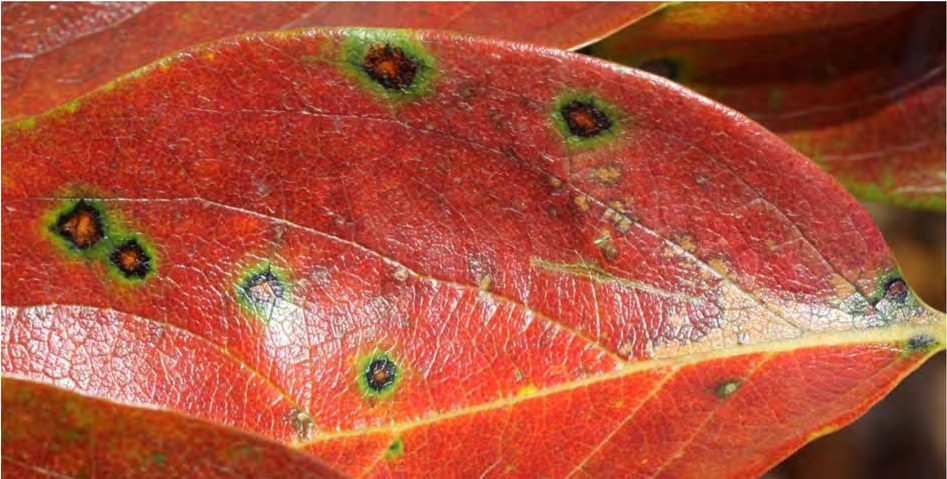
Pests and diseases of persimmon (Diospyros kaki) in Europe and Greece: epidemiology, differential diagnosis and action thresholds
Circular leaf spot (Plurivorosphaerella nawae), the pathogen that adapted to the semi-arid climate of Valencia and is not a quarantine organism, with the comparison between Spain and Korea and the role of drip irrigation. Angular leaf spot, Pestalotiopsis, anthracnose, and the twelve species of Diaporthe, Eutypella and Botryosphaeriaceae identified inside the wood. Postharvest rots: why Alternaria black spot became the limit of storage life after 1-MCP, and how extra irrigation before harvest is paid for in the cold room two months later. Crown gall, vascular wilt, root rots and phytoplasmas. Mealybugs and ants, wax scale, mussel scale, the orange spiny whitefly as a quarantine organism, fruit flies. Herbicide toxicity mistaken for a fungal leaf spot, a differential diagnosis table with fifteen pairs, action thresholds with the sampling method, and the four exotic pathogens threatening the Mediterranean. Thirteen photographs, five from Greek orchards.
The white Mediterranean snail in tree crops
Theba pisana is native to the Mediterranean, not invasive, so there is no eradication programme to wait for. Identification, life cycle, the damage in tree crops, the single approved target in the Greek register, and why the nematode Phasmarhabditis killed the snail only at five times the label rate.
The Meda sweet cherry series
Six club varieties selected for at least 35 to 40 days of post-harvest life, for sea freight to China. Ripening, size, sugars and S genotypes as published, the two pairs that cannot pollinate each other, chilling figures with no model stated, and the fact that every measurement comes from covered plantings outside Greece.