
Nutrient antagonisms and synergies, with a per-element tool
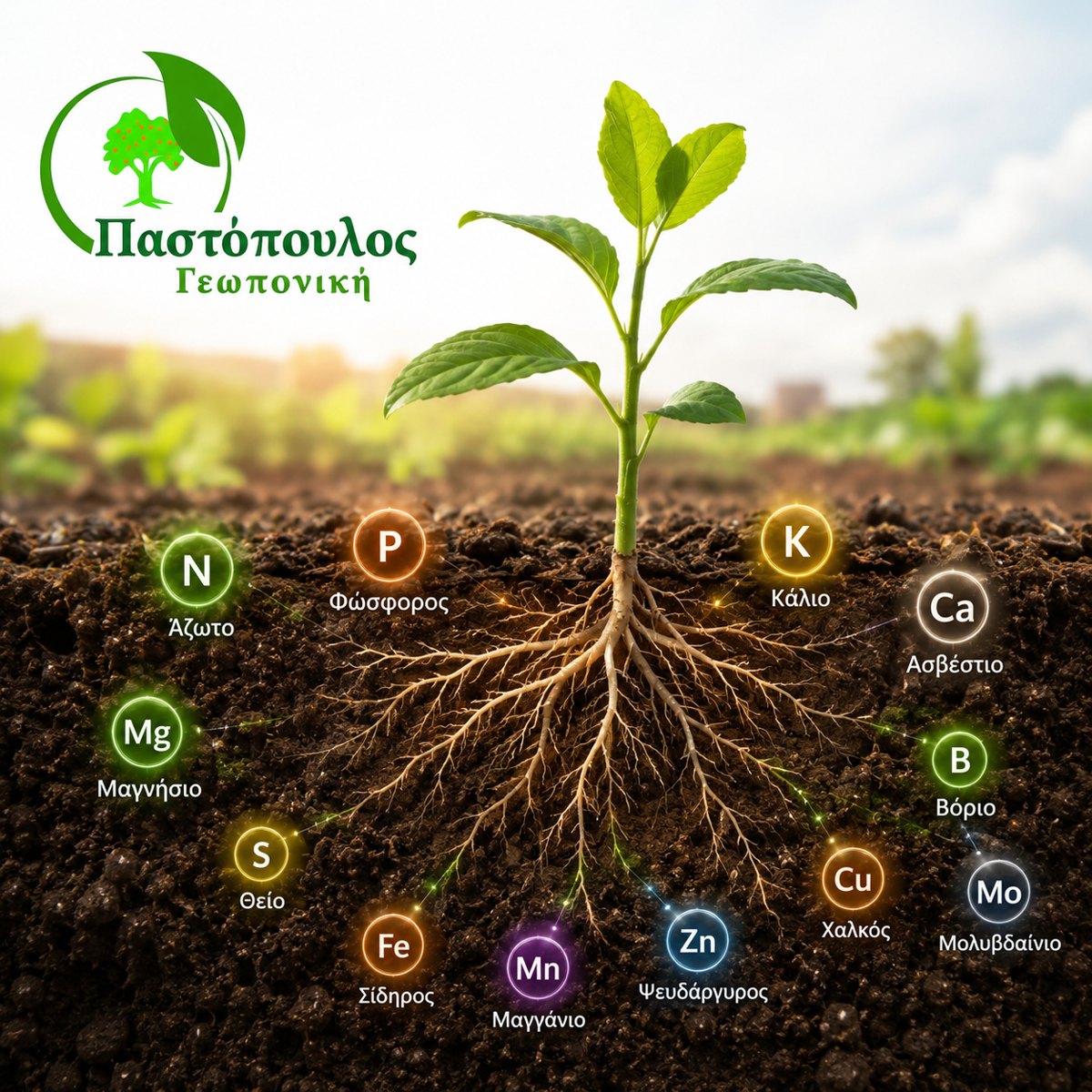
Savvas Pastopoulos, Agronomist MSc, Pastopoulos Agronomic P.C., Neos Mylotopos, Pella, Greece
The diagram that appears in every fertiliser leaflet, with arrows between the nutrients, does not stand up scientifically in the form in which it is presented. At the same time, the antagonisms are entirely real, measured, and in some cases explained down to the level of the gene. This text separates the two, and comes with a tool in which an element is selected and its documented relationships appear, separately for the soil and separately inside the plant.
The well-known "Mulder diagram" was published in 1953 by the Dutch scientist D. Mulder and was based on early observations. It has been reproduced everywhere since, but it became established without strong scientific foundation [1].
Two points are rarely mentioned. First, the various versions of the diagram in circulation do not agree with each other: arrows present in some are missing in others. Second, plant nutrition specialists have pointed out that the diagram was not originally designed for plant nutrition.
This does not mean the interactions are imaginary. It means that an arrow in a diagram is not proof, and that every relationship has to be checked separately, with a mechanism and a measurement. That is what this text attempts.
1. Two completely different levels that are constantly confused
The greatest source of confusion is that all the diagrams show one network of relationships, whereas in reality there are two independent levels with different mechanisms and often a different outcome.
| Level | Where it happens | Mechanism |
|---|---|---|
| In the soil | In the soil solution and on the colloids, before the element reaches the root | Precipitation into insoluble compounds, fixation by oxides, competition for exchange sites, changes in pH |
| Inside the plant | At the root transporters and in movement within the plant | Competition for the same transport protein, regulation of gene expression, charge balance, metabolic dependencies |
Ammonium nitrogen is the cleanest example. Inside the plant it competes with potassium, calcium and magnesium for uptake [3]. In the soil, however, its nitrification acidifies the rhizosphere and increases the availability of phosphorus, iron, manganese and zinc.
The same element is therefore simultaneously antagonistic at one level and synergistic at the other. A diagram with a single arrow cannot express that, which is why the tool below shows them separately.
2. The tool
Select an element. Red means antagonistic, green synergistic, grey means that no consistent interaction is documented, and note carefully, that is not the same as "proven to have no relationship".
Interactions by element
Select one element or ion. The relationships are shown separately in the soil and inside the plant, because they are different mechanisms and they do not always coincide.
3. The mechanisms, why they happen
Antagonisms are not random. They fall into a few clearly distinguishable categories, and anyone who understands those can predict what will happen without memorising tables.
3.1 A shared transporter, the cleanest case
Micronutrients enter the root through specific proteins. The transporter IRT1 is broad-spectrum and carries iron, zinc, manganese, cobalt and cadmium [4]. When two metals compete for the same site, an excess of one reduces the entry of the other. At equimolar concentrations of iron and manganese, manganese inhibits the uptake and transport of iron [4].
3.2 Competition for the soil exchange sites
The cations, potassium, calcium, magnesium, ammonium, sodium, are held on the negatively charged colloids. The sites are finite: whatever one occupies, another is denied. This is why over-fertilising with potassium displaces magnesium, and why sodium in saline soils displaces both.
3.3 Precipitation into an insoluble compound
The classic phosphorus and zinc antagonism has a dual nature. In the soil, phosphorus reacts with soluble zinc and forms insoluble zinc phosphates [5]. Inside the plant, regulation runs through the factor PHR1, which also controls the zinc genes ZIP2 and ZIP4 [5].
The conclusion matters: the antagonism is not a property of the pair, it is a property of the situation. In a sufficient soil it does not appear. So there is no point avoiding phosphorus "because it locks up zinc", the point is to check the zinc.
3.4 Charge balance, the source of the synergies
When the root takes up the negatively charged nitrate, it must also take up positively charged ions to maintain electrical balance. This is why nitrate nutrition favours the uptake of potassium, calcium and magnesium. Ammonium nutrition does the opposite: the positively charged ammonium competes with those same cations [3].
3.5 Metabolic dependence, the genuine synergy
Some relationships are neither antagonism nor facilitation, but absolute dependence. Molybdenum is essential for nitrate reductase, the enzyme that reduces nitrate so it can be used. Without molybdenum, nitrate nitrogen accumulates unused, however much the field is fertilised.
Similarly, calcium and boron act as partners in the structure of the cell wall and both are needed for either to work [6]. Boron, however, competes with phosphorus, because borate and phosphate share an absorption and transport system [6].
4. pH, the biggest "antagonist" of them all
In Mediterranean calcareous soils, most of what is attributed to competition between elements is simply pH. It is not calcium "stealing" the iron; it is the high pH making the iron insoluble.
| Element | What high pH does |
|---|---|
| Phosphorus | Reacts with calcium, precipitates and is fixed. Soluble phosphorus in a calcareous soil stays available for only a short period [7] |
| Iron | Becomes practically unavailable. Aggravated by bicarbonates in the irrigation water |
| Manganese, Zinc, Copper | Availability falls as pH rises [7] |
| Boron | Reduced availability, with easier leaching at the same time |
| Molybdenum | The opposite of all the others: it becomes more available at high pH |
Practical consequence: in a calcareous soil, correcting an iron or zinc deficiency by soil fertilisation is a waste. Whatever is added gets fixed. There are two roads: chelated forms resistant to high pH, or foliar application which bypasses the soil entirely.
5. What it means in practice
The six rules that follow
- Antagonism only shows at the extremes. In a balanced, sufficient soil most pairs coexist without a problem. Zinc deficiency from phosphorus appeared only where zinc was already low [5].
- pH first, elements second. In a calcareous soil, correcting the pH of the rhizosphere returns more than any micronutrient addition.
- The nitrate to ammonium ratio is a lever, not a detail. It controls calcium and magnesium uptake [3].
- Potassium hits magnesium, not the other way round. The antagonism is one-sided [2]. Over-fertilising with potassium creates a magnesium problem; over-fertilising with magnesium does not create a corresponding potassium problem.
- A leaf analysis is read as a whole. A high figure may be a consequence of another element's deficiency, not an excess [4].
- No correction without analysis. The relationships in this text explain why something happens; they do not say how much a particular field needs.
6. Summary table of the pairs that matter most
| Pair | Level | What happens |
|---|---|---|
| K → Mg | Plant | Strong one-sided antagonism. The reverse is not consistently confirmed, because magnesium uptake systems are not specific [2] |
| NH₄⁺ → K, Ca, Mg | Plant | Negative effect on uptake, stronger at a low nitrate to ammonium ratio [3] |
| P → Zn | Soil and plant | Insoluble zinc phosphates in the soil, PHR1 regulation in the plant. Only where zinc is already low [5] |
| Fe ↔ Mn ↔ Zn | Plant | Shared IRT1 transporter. Manganese inhibits iron at equimolar concentrations [4] |
| Cl⁻ → NO₃⁻ | Plant | High chloride from saline water inhibits nitrate uptake |
| S → Mo | Soil and plant | Sulphate competes with molybdate. Under sulphur deficiency, molybdenum and zinc rise substantially |
| Cu ↔ Mo | Plant | Mutual antagonism. An excess of molybdenum also affects iron |
| Ca + B | Plant | Synergy: partners in the cell wall, both are needed [6] |
| B ↔ P | Plant | Antagonism: shared absorption and transport system [6] |
| Mo + NO₃⁻ | Plant | Absolute dependence: without molybdenum, nitrate reductase does not work |
7. How this text was checked
- Mechanism. Every relationship recorded comes with an explanation of how it happens. Relationships without a mechanism were left out, however often they are reproduced.
- Level. Every relationship is explicitly assigned to the soil or the plant. Where it applies to both, it is recorded twice with the corresponding mechanism.
- Condition. Where the interaction appears only under particular conditions, as with phosphorus and zinc, which shows up only at low available zinc, the condition is stated.
- It gives no quantitative thresholds. It does not say at what K to Mg ratio the problem appears, because that differs by crop, cultivar, rootstock and soil.
- It does not cover every pair. Fifteen elements give more than a hundred pairs; fewer than half are documented here.
- Most studies are on herbaceous plants. Much of the mechanistic knowledge comes from Arabidopsis, barley and maize. Transferring it to tree crops is reasonable, not proven.
- The relationships do not add up. Three elements together do not behave like three separate pairs.
8. The key points
What to retain
- The Mulder diagram is not proof. It became established in 1953 without strong foundation and its versions do not agree with each other [1].
- There are two levels, not one. The same element can be antagonistic in the plant and synergistic in the soil, as ammonium is.
- Antagonism is a state, not a property. It appears at the extremes; under sufficiency it often does not appear at all [5].
- In calcareous soils the main "antagonist" is pH, not calcium as such. Molybdenum is the exception that proves it.
- Potassium reduces magnesium one-sidedly [2].
- A low value can show up as a high one elsewhere. Zinc deficiency increases iron [4].
- Grey means ignorance, not absence of a relationship.
9. Sources
The numbers in the text refer to the list below.
- [1] Mulder, D. (1953), and the later critical assessment of the diagram by plant nutrition specialists. Source for the facts that the diagram was published in 1953, was based on early observations and became widely established without strong scientific foundation, and that the versions in circulation do not agree with each other.
- [2] Synergistic and antagonistic interactions between potassium and magnesium in higher plants. The Crop Journal. Source for the strong and one-sided antagonism of potassium towards magnesium, and for the finding that the reverse effect is not consistently confirmed because magnesium uptake systems are not specific.
- [3] Effects of Nutrient Antagonism and Synergism on Yield and Fertilizer Use Efficiency (2017). Communications in Soil Science and Plant Analysis. Source for the negative effect of ammonium nitrogen on calcium, magnesium and potassium uptake, for the dependence of its intensity on the nitrate to ammonium ratio, and for the documented ammonium-potassium antagonism in barley and Arabidopsis.
- [4] Iron homeostasis in plants and its crosstalk with copper, zinc, and manganese. Plant Stress. Source for IRT1 as a broad-spectrum transporter of iron, zinc, manganese, cobalt and cadmium, for the inhibition of iron uptake by manganese at equimolar concentrations, and for the increase in iron accumulation under zinc deficiency.
- [5] Phosphate and zinc interaction in soil and plants: a reciprocal cross-talk (2024). Plant Growth Regulation. Source for the formation of insoluble zinc phosphates in the soil, for regulation through PHR1 and the ZIP2 and ZIP4 genes, and for the critical finding that the deficiency appeared only in calcareous soils with low available zinc, while plants with adequate zinc responded positively to higher phosphorus rates.
- [6] Interaction between Boron and Other Elements in Plants (2023). Genes 14(1):130. Source for the partnership of calcium and boron in cell wall structure and for the boron-phosphorus antagonism, attributed to the shared absorption and transport system of borate and phosphate.
- [7] Extension service fact sheets on the effect of pH on nutrient availability. Source for the fixation of phosphorus by calcium at high pH and the short availability of soluble phosphorus in calcareous soils, and for the decline in availability of zinc, copper, iron and manganese as pH rises.
This text and the tool are informational and do not constitute a fertilisation programme or a recommendation for application. The relationships presented are qualitative: they explain why a problem may appear, they do not determine quantities, ratios or thresholds for a particular field.
The intensity of each interaction depends on the crop, the cultivar, the rootstock, the pH, the texture, the organic matter and the irrigation water. Much of the mechanistic knowledge comes from herbaceous plants and transferring it to tree crops is a reasonable assumption, not a proven fact. The label "no documented consistent interaction" means absence of documentation, not absence of a relationship.
For every foliar spray: application to plants carrying fruit can cause fruit marking and leaf burn. A prior test on a limited number of plants is required, with the same product and the same rate, and a wait of 5 to 7 days before general application. Spraying is done in the late afternoon or early morning, never in a heatwave and never on foliage under water stress.
Every fertilisation programme is drawn up after soil and leaf analysis and an on-site assessment by a licensed agronomist. Fertiliser and plant protection approvals referenced on plantprotect.gr are valid in Greece only; in every other country the corresponding national register applies. Pastopoulos Agronomic P.C. accepts no liability for the use of the information in this text or the tool.
Related articles
Zeolite in agriculture: what is documented and what is not
It is a cation exchanger, it holds ammonium and potassium, not nitrate. The rates that work are tens of tonnes per hectare, not hundreds of kilos. And erionite is a Group 1 carcinogen.
Leonardite in agriculture: properties, rates and what the law says
Leonardite is oxidised lignite with up to 85% humic acids, but pH below 3, up to 6% sulphur and almost no phosphorus. What the analyses and meta-analyses show, where it delivers and where it does not, and what Regulation (EU) 2019/1009 and the organic farming rules require.
Biostimulants: what the science says and what the EU regulation requires
The seven categories, the molecular mechanisms, the EU legal framework since 2022, and the six questions to ask a supplier before buying.