
Calcium and postharvest physiology in sweet cherry
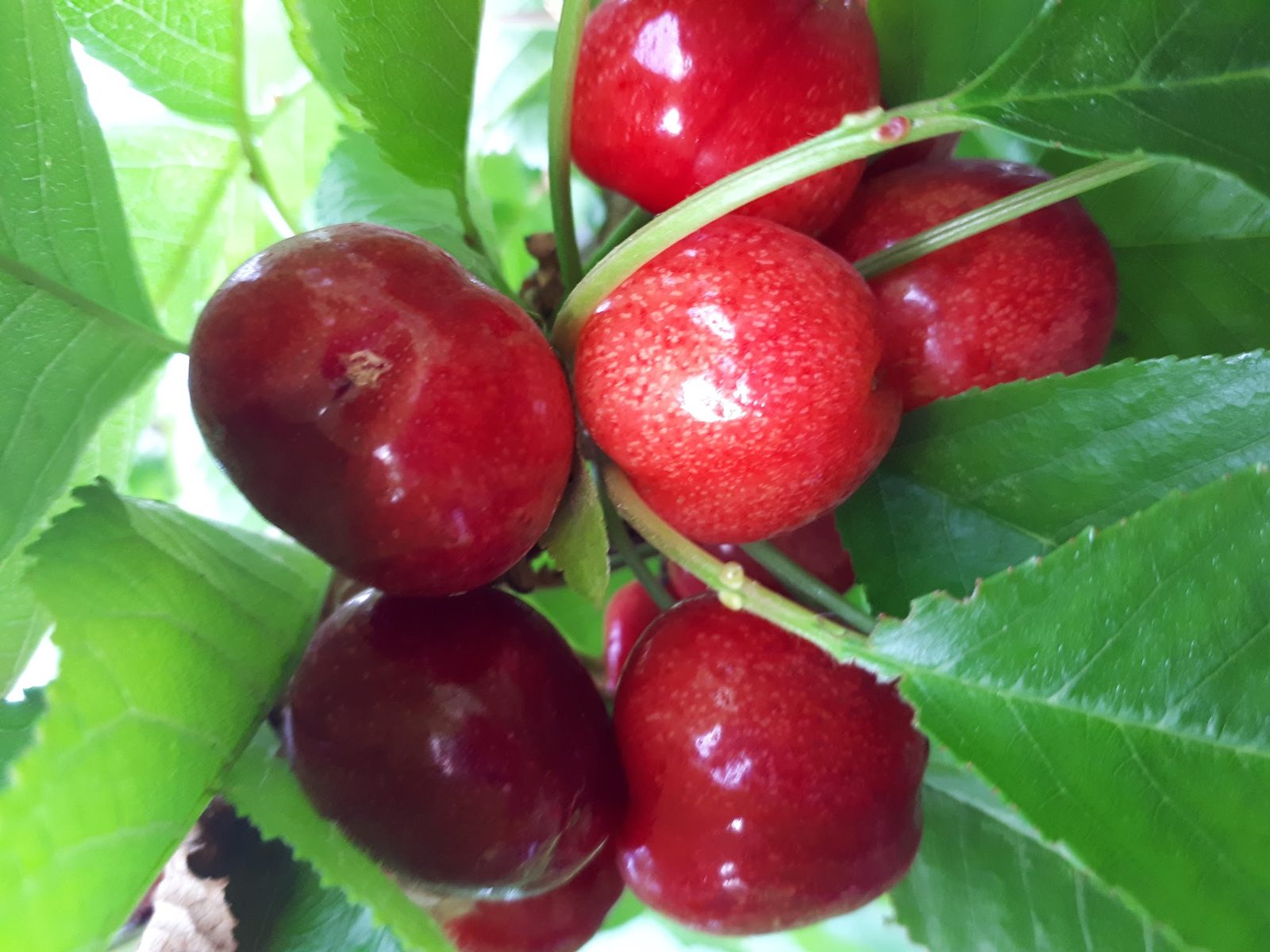
Savvas Pastopoulos, Agronomist MSc, Pastopoulos Agronomics, Neos Mylotopos, Pella, Greece
Calcium in sweet cherry is the element with the widest gap between what the market promises and what the studies show. There is, however, a physiological mechanism that explains why half the studies show an effect and the other half show nothing, and once it is understood, it becomes clear which sprays are worth making and which are money thrown away.
Calcium moves within the plant exclusively in the xylem. It is not translocated in the phloem [2].
Up to the third stage of fruit development, the xylem contributes more than 80% of total inflow to the cherry. From the third stage onwards, however, that share declines progressively and at ripening reaches almost zero, as xylem conductance falls [2].
In practice, a calcium spray close to harvest has no road to follow. Whatever calcium is going to enter the fruit must enter early.
1. Why calcium struggles to reach the fruit
Three reasons, and they are cumulative.
1.1 It travels only with the transpiration stream
Calcium moves with the xylem stream and is not redistributed through the phloem [2]. Whatever does not enter the fruit while the xylem of the fruit pedicel is active will not enter later from somewhere else.
1.2 The leaves win the competition
Soil solution ≈ 0 MPa → apoplast of a transpiring leaf ≈ −0.8 MPaFlow follows the potential gradient [2]. Leaves have a far greater surface-to-volume ratio and far higher transpiration than fruit, so they draw most of the calcium to themselves. For that reason the fruit gets what is left.
1.3 The point in time when supply through the xylem of the pedicel stops
Sweet cherry fruit growth follows a double sigmoid curve and is divided into three stages [1]. The third stage is the rapid swelling before harvest, and precisely then xylem conductance collapses and inflow falls to zero [2].
2. How much calcium the fruit needs
The calcium concentration limit is at least 600 ppm in the fruit for the production of quality cherries [1].
The relationship with firmness is among the cleanest in the literature. Across a range of flesh calcium from 400 to 2,400 ppm and firmness from 1.5 to 4.5 kg/cm, the correlation was found to be linear and strongly significant, with r² = 0.88 [2].
The quantitative significance for the orchard. Annual removal of calcium oxide from an orchard has been estimated in kilograms per hectare: pear 200, apple 180, peach 150, grapevine 60 to 130, olive 35 to 70, kiwifruit 55 to 60 [9]. These are quantities that cannot be covered by foliar sprays, they are covered from the soil.
3. Foliar sprays, experimental data
Here lies the most honest statement in the whole literature, and it comes from the review itself: "for every parameter examined there are studies that showed a positive effect and studies that showed no correlation at all" [1]. Preharvest sprays and postharvest dips sometimes raise fruit calcium and sometimes do nothing [2].
| Application | Result | Source |
|---|---|---|
| 3 applications of 0.5% CaCl₂, three-year trial, 'Merton Premier' | +26% fruit calcium | Wojcik et al. [1] |
| 3 applications, 'Van' | +65% calcium concentration | via [1] |
| CaCl₂ 58.5 mM, 2nd and 3rd stage, 'Vogue' | Increase in calcium | via [1] |
| 1% Ca(OH)₂ at fruit set, two cultivars | Increase in only one of the two | Landi et al. [1] |
| Ca(NO₃)₂ 0.75 g/L at 21, 35 and 42 days after full bloom | No increase | Nagy et al. [1] |
| 1 kg/ha Ca(NO₃)₂, 12 replicates, 'Grace Star' | No increase | Measham et al. [1] |
| Various forms, 'Lambert', 'Ron's Seedling', 'Supreme', 'Van' | No effect | Koffmann et al. [1] |
| 6 calcium applications | From 450 to 650 ppm, that is, past the 600 threshold | Wang et al. [1] |
4. Fruit cracking
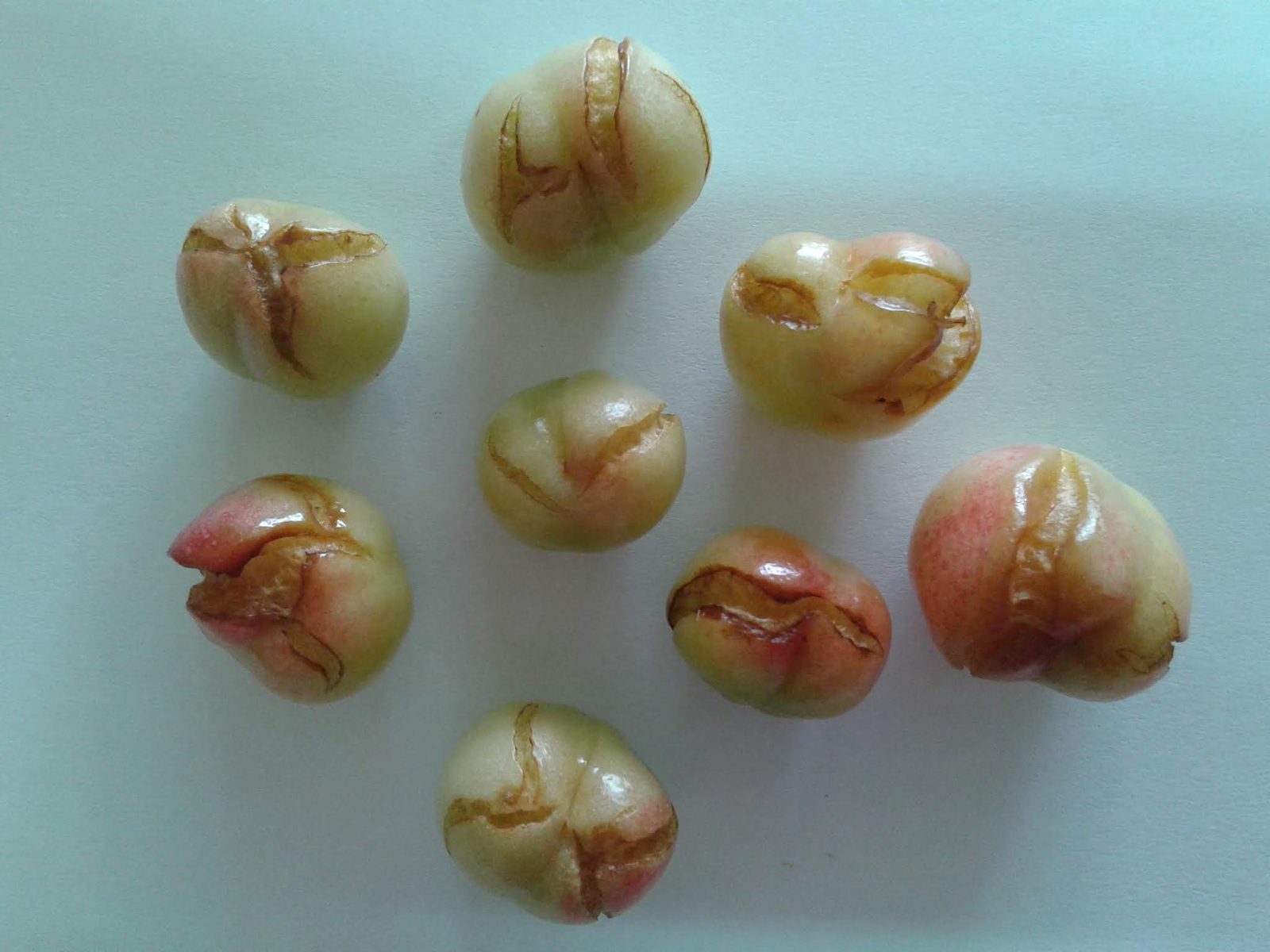
4.1 How it is measured
Christensen (1996) established a measurement protocol, the Cracking Index. Harvested fruit are immersed within one hour in deionised water. At two, four and six hours they are removed, checked for cracks, and the sound ones returned to the solution [1]:
CI = (5a + 3b + c) × 100 / 2504.2 What the studies achieved
| Treatment | Reduction in cracking |
|---|---|
| 2% calcium acetate | From 80% to 32% cracked fruit [1] |
| 3 applications of 0.7% Ca(OH)₂ | Index reduced by 82% [1] |
| Ca(OH)₂ foliar, '0900 Ziraat' | 66%, the most effective in the trial [4] |
| CaCl₂ foliar, '0900 Ziraat' | 62% [4] |
| Calcium caseinate | About 50%, but with a white film on leaves and fruit [4] |
| CaCl₂ through overhead sprinklers, during the rain | 80% fewer cracked fruit [1] |
| Mean of trials with moderate baseline damage | Only 13%, range 4 to 31% [1] |
The impressive figures, 82%, 66%, 62%, come from trials with very high baseline damage. Where damage was moderate, the mean reduction fell to 13% [1].
This is the same pattern that appears with every nutrient: the intervention pays where there is a problem, not where things are already going well. In an orchard that does not crack, calcium will not deliver a 60% improvement.
4.3 The mechanism in the cell wall
Calcium holds the pectins of the cell wall together. In studies with EGTA, a chelator with high affinity for calcium, removing calcium from the wall increased the cracking index and the release of soluble pectin, while CaCl₂ reduced both [2]. A wall without calcium swells and loses its cohesion.
5. Postharvest, where the numbers are cleaner
After harvest the problem is no longer transport within the tree. The fruit is immersed in a solution and calcium enters through the skin. That is why results here are far more consistent.
Three problems limit postharvest quality [2]: loss of firmness, wilting and browning of the stem, and decay.
5.1 Calcium in the hydro-cooling water
In work in Oregon, in the United States, with CaCl₂ added to hydro-cooling water at 0 °C for 5 minutes, in the commercial cultivars 'Sweetheart' and 'Lapins' [3]:
| Measurement | Result |
|---|---|
| Tissue calcium, 'Sweetheart' | Increase of 29 to 85%, logarithmically with dose |
| Tissue calcium, 'Lapins' | Increase of 39 to 188%, linearly with dose |
| Respiration rate | Reduced |
| Ascorbic acid degradation | Reduced |
| Membrane lipid peroxidation | Reduced |
| Total phenolics and antioxidant capacity | Increased |
| Firmness and resistance to pitting | Increased |
| Loss of acidity and decay | Reduced, in both cultivars |
Stem browning was inhibited by CaCl₂ at 0.2% and 0.5%. At the higher doses, however, 1.0% and 2.0%, it INCREASED, probably through modification of membrane lipid peroxidation [3].
The curve therefore reverses. A grower who doubles the dose "to be safe" gets the opposite result in exactly the character that decides the commercial appearance of a cherry, the green, turgid stem. It is the strongest practical finding in this whole text.
5.2 Firmness, what the consumer wants
Firmness is unquestionably the most important quality attribute at the point of sale [2]. Consumers want firm fruit, with firmness above 4.75 N. The range 2.52 to 4.75 N is regarded as acceptable [2]. Below that, the fruit is rejected.
5.3 Decay
After artificial inoculation with Botrytis cinerea, the proportion of affected fruit was significantly reduced following a dip in a 1% solution of various calcium forms, CaCl₂, Ca(NO₃)₂, Ca(OH)₂, and five days of incubation [1].
5.4 The stem
It is common, after removal from cold storage, for the stems to have browned and dried out [1]. The stem is the first thing the buyer looks at and the last thing the grower notices. The calcium dose in hydro-cooling is the direct lever, subject to the reversal described above.
6. Nitrogen, the competitor
6.1 Autumn foliar urea
Autumn urea sprays, alone or combined with zinc sulphate, have been tested for their effect on the following spring's bloom development in 'Bing', alongside manual defoliation [7]. The logic is that the nitrogen stored in autumn is what will feed the spring.
Seasonal uptake, storage and remobilisation of nitrogen is critical in cherry, where new growth and fruit development occur simultaneously, within a short period from bloom to ripening [5]. Trees on dwarfing rootstocks such as Gisela 5 and 6 tend to give heavy crops but smaller fruit when the crop load is not balanced by sufficient leaf area [5].
The conclusion is not that urea does not work. It is that it does not work for everything: replenishing nitrogen reserves is one thing, fruit firmness, which is decided by calcium, is another.
6.2 Nitrogen, potassium and fruit minerals
In a two-year trial with '0900 Ziraat' on 'Gisela 5', nitrogen and potassium rates of 0, 50, 125 and 250 g per tree were tested [8]. The main conclusion of the work is that unbalanced fertilisation adversely affects the nutrient content of the fruit, that is, more fertiliser does not mean a richer fruit.
7. The measurement trap
In calcium analysis by spectrophotometry, phosphorus in the sample interferes and binds the calcium. The interference is suppressed by adding lanthanum. When this is omitted, calcium is underestimated by about 50%.
In ripe 'Staccato' fruit the measurements were 0.65 ± 0.07 mg/g dry weight with lanthanum against 0.32 ± 0.03 without [2].
What this means for the grower: an analysis result showing calcium deficiency may be a method error. Before a calcium programme is decided on the basis of an analysis, the laboratory should be asked for explicit confirmation that lanthanum was used. The same interference has led to significant underestimation in published work as well.
8. What actually makes the difference
The order of priority
- The soil first. Corrections are made before planting: drainage, pH, incorporation of calcium where needed [10]. Annual calcium removal from an orchard is measured in hundreds of kilograms per hectare [9] and cannot be covered by sprays.
- Early, not late. Whatever calcium enters the fruit enters while the xylem is functioning, that is, before the third stage [2].
- Control the nitrogen. Excessive nitrogen fertilisation actively competes with the calcium supply to the fruit [1].
- Watch for rain after spraying. Five millimetres is enough to remove 62% [1].
- Hydro-cooling is the most reliable opportunity. There the calcium genuinely and measurably enters, but at a low dose [3].
- The rootstock matters. It affects calcium uptake from the soil and its concentration in the scion [9], although further research is needed [1].
9. The key points
What to take away
- Calcium travels only in the xylem. Inflow to the fruit exceeds 80% up to the third stage and falls almost to zero at ripening [2]. Late sprays have no road.
- Threshold of 600 ppm in the fruit, with a strong correlation between calcium and firmness, r² = 0.88 over the range 400 to 2,400 ppm [1] [2].
- 5 mm of rain washes off 62% of the applied calcium [1].
- In postharvest hydro-cooling the dose response reverses. At 0.2 and 0.5% the stem is protected; at 1.0 and 2.0% it gets worse [3].
- The large reductions in cracking apply to orchards with a large problem. With moderate damage the mean falls to 13% [1].
- Nitrogen competes with calcium through increased leaf transpiration [1].
- Analysis without lanthanum underestimates calcium by 50% [2]. Ask the laboratory explicitly.
- The honest picture: for every parameter there are studies with a positive result and studies with none at all [1] [2].
10. Sources
The numbers in the text refer to the list below. Sources [1] to [4] and [5] to [8] were read in full.
- [1] Pastopoulos S., Kazantzis K., Sotiropoulos T. (2020). The physiology of calcium in cherry and its relation to fruit quality parameters (in Greek). Georgia - Ktinotrofia 11/2020:26-31. The entry is given as published in the list of publications of the Department of Deciduous Fruit Trees, Naoussa, ELGO "DIMITRA". Source for the 600 ppm threshold, the 62% washed off by 5 mm of rain, the cracking index and its formula, the reduction from 80% to 32% with calcium acetate, the 82% reduction with three applications of 0.7% Ca(OH)₂, the mean reduction of 13% with a range of 4 to 31%, the 80% reduction with sprinklers during rain, the double sigmoid growth curve, the antagonism of nitrogen, the results of Wojcik, Landi, Nagy, Measham, Koffmann, Ippolito and Wang, and the statement that for every parameter there are studies with a positive and studies with a nil result.
- [2] Winkler, A. and Knoche, M. (2019). Calcium and the physiology of sweet cherries: A review. Scientia Horticulturae 245:107-115. Source for calcium transport exclusively in the xylem, for the xylem contributing more than 80% up to the third stage and falling almost to zero at ripening, for the 0 MPa of the soil solution against −0.8 MPa in the apoplast of a transpiring leaf, for the correlation r² = 0.88 over the range 400 to 2,400 ppm and 1.5 to 4.5 kg/cm, for the firmness limits of 4.75 N and 2.52 to 4.75 N, for the role of calcium in the pectins and the EGTA study, and for the 50% underestimation without lanthanum, 0.65 against 0.32 mg/g dry weight in 'Staccato'.
- [3] Wang, Y., Xie, X. and Long, L. E. (2014). The effect of postharvest calcium application in hydro-cooling water on tissue calcium content, biochemical changes, and quality attributes of sweet cherry fruit. Food Chemistry 160:22-30. Source for the application of CaCl₂ in hydro-cooling water at 0 °C for 5 minutes, for the increase in tissue calcium of 29 to 85% logarithmically in 'Sweetheart' and 39 to 188% linearly in 'Lapins' as the dose rose from 0.2% to 2.0%, for the reductions in respiration, ascorbic acid degradation and lipid peroxidation, for the increases in phenolics, antioxidant capacity, firmness and pitting resistance, and above all for the reversal of the stem response: browning inhibited at 0.2 and 0.5% but increased at 1.0 and 2.0%.
- [4] Gholinezhad, E. et al. (2014). Effects of different foliar calcium compounds on fruit cracking and quality of sweet cherry cv. '0900 Ziraat'. Notulae Botanicae Horti Agrobotanici 42(1). Source for the reduction of the cracking index by 38 to 66%, for the superiority of Ca(OH)₂ at 66% and CaCl₂ at 62%, for the roughly 50% reduction with calcium caseinate, and for the white film that covered leaves and fruit.
- [5] Foliar Applications of Urea Affect Nitrogen Reserves and Cold Acclimation of Sweet Cherry. Source for the importance of seasonal uptake, storage and remobilisation of nitrogen in cherry, where vegetative growth and fruit development occur simultaneously within a short period, and for the tendency of trees on the dwarfing rootstocks Gisela 5 and 6 to carry heavy crops with smaller fruit when crop load is not balanced by leaf area.
- [6] Bulletin UASVM Horticulture 69(1)/2012. Effect of urea applications at 10 litres per hectare in four cherry cultivars, Cluj-Napoca, Romania, 2010-2011. Source for the negative result: no difference in fruit firmness relative to the unsprayed control, and for the superiority of two applications over one.
- [7] Effects of fall applications of urea and zinc sulfate to 'Bing' sweet cherry spring budbreak (2005). Source for the trial of autumn urea sprays with zinc sulphate and manual defoliation, and for their effect on the following spring's bloom development.
- [8] Effect of nitrogen and potassium rates on the nutrient content of the fruit, '0900 Ziraat' on 'Gisela 5', two-year trial. AcademicPres. Source for the rates of 0, 50, 125 and 250 g of nitrogen and potassium per tree, and for the conclusion that unbalanced fertilisation adversely affects the nutrient content of the fruit.
- [9] Calcium in fruit trees. Source for annual removal of calcium oxide in kilograms per hectare, pear 200, apple 180, peach 150, grapevine 60 to 130, olive 35 to 70, kiwifruit 55 to 60, and for the effect of the rootstock on calcium uptake and its concentration in the scion.
- [10] Cherry nutrition, agronomic principles. Source for the principle that soil corrections, drainage, pH and calcium incorporation are done before planting.
This text is informative and is not a fertilisation programme nor a recommendation to apply. The concentrations, rates and timings cited come from experimental trials on particular cultivars, rootstocks, soils and climates and do not transfer unchanged to every orchard. The contradictory evidence in the literature is stated explicitly in the text and should not be disregarded.
For every foliar spray: application to trees carrying fruit can cause fruit marking and leaf burn, a risk that is higher with calcium products, which may leave a visible white film. A prior trial on a limited number of trees is required, with the same product at the same rate, followed by 5 to 7 days of observation before general application. Spray in the late afternoon or early morning, never in a heatwave and never on foliage under water stress.
Plant protection and fertiliser products may be used only in accordance with the approvals of the competent authority of the country of use and with the product label. The approvals listed at fyto.plantprotect.gr are issued by the Greek Ministry of Rural Development and Food and are valid in Greece only.
Every nutrition programme is drawn up after leaf and soil analysis and an on-site assessment by a licensed agronomist. Pastopoulos Agronomics accepts no liability for the use of the information in this text.
Related articles
The white Mediterranean snail in tree crops
Theba pisana is native to the Mediterranean, not invasive, so there is no eradication programme to wait for. Identification, life cycle, the damage in tree crops, the single approved target in the Greek register, and why the nematode Phasmarhabditis killed the snail only at five times the label rate.
The Meda sweet cherry series
Six club varieties selected for at least 35 to 40 days of post-harvest life, for sea freight to China. Ripening, size, sugars and S genotypes as published, the two pairs that cannot pollinate each other, chilling figures with no model stated, and the fact that every measurement comes from covered plantings outside Greece.
Chilling hours: the three models and when each one tells the truth
Chilling Hours, Utah Chill Units or Dynamic Chill Portions, what each measures, which suits which climate and season, why a chill portion does not convert into hours, and how the divergence between the three is read. The calculation itself lives in a separate tool.