
Tomato diseases: diagnosis, causes and control
Savvas Pastopoulos, Agronomist MSc, Pastopoulos Agronomics, Neos Mylotopos, Pella, Greece
Tomato is attacked by more pathogens than any other vegetable crop in the Mediterranean, and most of them produce a similar picture on the foliage. What follows organises the diseases not alphabetically but by the way they are diagnosed: where the symptom starts, how it spreads within the plant, and what a cut through the stem reveals. It covers fungi, oomycetes, bacteria, phytoplasmas, viruses and viroids, with an explicit distinction between the open field and the greenhouse, where the same diseases behave differently.
- The method: three questions before any diagnosis
- Differential diagnosis table
- Blossom-end rot, a disorder, not a disease
- Leaf spot diseases
- Grey mould and the rots
- The soil-borne wilts
- Bacterial diseases
- Phytoplasmas, stolbur
- The viruses
- Viroids
- The vectors: thrips, whiteflies, aphids
- Hygiene and prevention in the greenhouse
- What climate change changes
- The key points
- Sources
1. The method: three questions before any diagnosis
The commonest mistake in tomato diagnosis is trying to identify the pathogen from the shape of the lesion. Dozens of different causes produce a brown spot on a leaf. The distinction comes from three questions, in this order.
Question 1, Which organ started it?
Leaves from the base upwards, the young growing point, the stem, the root or the fruit. The starting point immediately narrows the list: the soil-borne wilts start from the lower leaves, viruses almost always from the top, and the leaf spot diseases from the older leaves, where moisture lingers longest.
Question 2, How is it distributed within the plant and within the field?
Evenly over the whole plant, or on one part of it only? A one-sided, sectorial infection is characteristic of the vascular wilts. Within the field: scattered individual plants point to an insect vector or a soil-borne pathogen, whereas infection running along the row points to mechanical transmission by hands and tools.
Question 3, What does a longitudinal cut through the stem show?
Brown discolouration of the xylem means a vascular disease: Fusarium, Verticillium or bacterial canker. Clean wood rules out all three and turns the suspicion towards a foliar pathogen, a virus, or a nutrient deficiency. It is the cheapest and the most overlooked examination there is.
Sources: 1
2. Differential diagnosis table
The table groups by where the symptom starts. The markers OUTDOOR GREENHOUSE show where each disease matters most.
| Picture | Likely cause | The feature that separates it |
|---|---|---|
| Sunken, dry, leathery brown lesion at the blossom end of the fruit | Blossom-end rot, a physiological calcium disorder | Always at the blossom end, with a sharp boundary and healthy foliage. Not a pathogen, see section 3 |
| Brown spots with concentric rings on the lower leaves | Early blight, Alternaria solani OUTDOOR | The target-like rings, with a chlorotic halo around them. Moves upward from older to younger leaves |
| Small circular spots, light grey centre, dark margin | Septoria leaf spot, Septoria lycopersici OUTDOOR | Black pycnidia in the centre of the lesion, visible with a hand lens. No rings |
| Large water-soaked brown areas, white downy growth on the underside | Late blight, Phytophthora infestans OUTDOOR | Spreads very fast in cool, wet weather. Also attacks the fruit, with a firm brown rot |
| Chlorotic patches on the upper surface, white growth on the lower | Powdery mildew, Leveillula taurica GREENHOUSE | In L. taurica the sporulation is on the lower surface. In Oidium neolycopersici it is on the upper |
| Grey fuzzy mass on stem wounds, soft rot | Grey mould, Botrytis cinerea GREENHOUSE | Almost always starts from a wound or from dead tissue. On green fruit it produces the «ghost spots» |
| Yellowing of lower leaves on one part of the plant only, brown xylem | Fusarium wilt, F. oxysporum f. sp. lycopersici | The sectorial, one-sided picture. Discolouration running high up the stem |
| Crown and root rot, brown discolouration 20 to 30 cm above the soil | Crown rot, F. oxysporum f. sp. radicis-lycopersici | The discolouration stops low down. Adventitious roots often appear above the crown |
| Wilting with desiccation running from the leaf tip towards the petiole | Verticillium wilt, Verticillium dahliae | Starts on the oldest leaves. Vascular discolouration milder than in Fusarium |
| Leaf margins rolled upward, one-sided wilting, yellow-brown streaks on the stem | Bacterial canker, Clavibacter michiganensis GREENHOUSE | On the fruit, small dark spots with a bright halo, the «bird's-eye» spot. A quarantine organism |
| Small angular dark spots with a chlorotic halo, specks a few millimetres across on the fruit | Bacterial speck, Pseudomonas syringae pv. tomato | The spots are angular, bounded by the veins. Favoured by cool, wet weather |
| Small distorted leaves, intense yellowing, sometimes reddening | Stolbur, Candidatus Phytoplasma solani OUTDOOR | Flowers distorted and sterile. Linked to field bindweed on the margins of the field |
| Bronze-purple discolouration of young leaves, necrotic rings on the fruit | TSWV, tomato spotted wilt virus | The «bronzing» of the foliage. At first it resembles cold injury |
| Leaflet margins yellow and curled upward, plant dwarfed and bushy | TYLCV / TYLCSV, yellow leaf curl GREENHOUSE | The leaflet resembles a small cup. Whiteflies present. Flower drop and failure to set fruit |
| Mosaic, blistering of the lamina, necrosis on stem and calyx, marbled fruit | ToBRFV GREENHOUSE | Overcomes Tm-2² resistance. Spreads along the row, from the hands. A quarantine organism |
| Mosaic and fern-leaf, without stem necrosis | ToMV / CMV | CMV also produces the fern-leaf form. Without the necrotic picture of ToBRFV |
| Yellow-green mosaic, marbled fruit ripening, spread within the row | PepMV GREENHOUSE | Purely mechanical transmission. Symptoms appear 2 to 3 weeks after infection |
The table directs the suspicion. It does not replace laboratory identification, which is essential for the bacteria, the viruses and the viroids.
3. Blossom-end rot, a disorder, not a disease
Before looking for any pathogen, this picture has to be ruled out. It is the commonest misdiagnosis in tomato, and it leads to sprays that have no chance whatever of working.

3.1 The mechanism, why the fruit loses the contest
Calcium moves through the plant almost exclusively via the xylem, and its movement depends on transpiration. It is therefore driven towards the organs with the highest transpiration rate, that is, the leaves [8]. The fruit transpires very little and so loses the contest for the same xylem stream.
The essence of the disorder is therefore a transport failure, not a shortage of supply: factors such as erratic irrigation, high humidity and root stress prevent calcium from reaching the fruit [8].
3.2 How it is told apart from a pathogen rot
| Feature | Blossom-end rot | Pathogen rot |
|---|---|---|
| Position | Always at the blossom end | Anywhere: on the cheek, at the peduncle, at a wound |
| Texture | Dry, leathery, sunken, with a sharp boundary | Soft and watery, with a diffuse boundary |
| Sporulation | None at first | Grey for botrytis, white for late blight |
| Distribution | Over a whole truss or a whole age class of fruit | Random, or on fruit that touch one another |
| Foliage | Healthy, without lesions | Usually with symptoms on the foliage too |
3.3 What actually reduces it
The four levers
- Stability in irrigation. Abrupt swings between drought and saturation interrupt the xylem flow exactly when the fruit needs it [8].
- Control of nutrient solution salinity. High conductivity reduces water uptake and with it calcium transport.
- Cation balance. Excess ammonium nitrogen, potassium and magnesium competes with calcium at uptake. The subject is treated in nutrient antagonisms and synergies.
- A healthy root system. Any root damage, asphyxia, nematodes, a soil-borne pathogen, reduces calcium transport before any other symptom appears [8].
The same transport mechanisms explain other physiological fruit disorders as well, such as cracking from an abrupt change in water status, and sunscald on fruit left exposed after de-leafing.
Sources: 8
4. Leaf spot diseases
4.1 Early blight, Alternaria solani
It is among the most important foliar diseases throughout the Mediterranean basin [1]. It produces dark spots with concentric rings, often surrounded by a chlorotic halo. As it develops it causes defoliation starting from the older leaves and moving towards the younger ones, while necrotic lesions also appear on flowers, stems and fruit, where they expand from the point of peduncle insertion [1].

Resistance management matters particularly here: resistant strains have been recorded, especially against the respiration inhibitors, and the literature stresses the need for rotation of modes of action with an emphasis on multi-site products [1].
4.2 Septoria leaf spot, Septoria lycopersici
It produces circular to oval necrotic lesions with a light grey centre and dark margins. On older leaves the lesions are surrounded by a chlorotic halo, and pycnidia form in their centre, the feature that separates it from early blight [1].
The lesions coalesce, the leaf becomes chlorotic and falls, and the fruit is left exposed to the sun. Losses reach around 50% once defoliation touches 75% of the plant [1]. The pathogen overwinters on wild solanaceous hosts, black nightshade and related species act as an inoculum reservoir, so clearing the field margins is part of control [1].
4.3 Late blight, Phytophthora infestans
It is not covered by the Mediterranean review, but it is the disease that can destroy an open-field crop within a few days. It is an oomycete, not a fungus, a fact with direct practical consequences for the choice of active substances.
It requires cool to moderate temperatures, 10 to 22 °C, together with high humidity and leaf wetness [5]. With relative humidity above 90% and temperatures in roughly the 15 to 26 °C range, infection is completed in about 10 hours; at 20 to 25 °C some 12 hours of wetness are needed [5] [6].
Lesions appear 3 to 5 days after infection, with the shortest incubation period at 22 °C [6]. So, by the time the symptoms show, infection has already occurred and the next generation of spores is on its way.
The picture is characteristic: large, water-soaked, brown areas on the leaf, often with white downy growth on the underside under humid conditions. On the fruit it produces a firm, brown, irregular rot. Nights with heavy dew and fog are as dangerous as rain.
4.4 Powdery mildew, Leveillula taurica and Oidium neolycopersici
Two different pathogens with a different picture, and telling them apart is simple:
| Feature | Leveillula taurica | Oidium neolycopersici |
|---|---|---|
| Where the white growth forms | On the lower surface of the leaf | On the upper surface |
| What is seen first | Light green to chlorotic patches on the upper surface, with no visible fungus | White powdery growth, visible immediately |
| Development | The leaf browns and shrivels quickly, staying on the plant | Chlorosis and desiccation, generally milder |
For L. taurica, conidial germination occurs over a range of 10 to 37 °C with an optimum at 20 °C, while leaf colonisation is optimal at 15 to 25 °C [7]. Symptom severity is high where prolonged periods of 10 to 15 °C coincide with daytime relative humidity of 85 to 95% [7].
5. Grey mould and the rots
Botrytis cinerea attacks more than 200 plant species and occurs both in the field and under protection, with the damage inside greenhouses distinctly more serious [1].
The classical one: mild temperatures of 15 to 20 °C with relative humidity above 90%. There the losses, typically around 20%, reach 40% [1].
The less familiar one: severe infections also develop at 25 °C, when stem wounds combine with a high concentration of air-borne conidia [1]. That is, after de-leafing or side-shooting in a warm greenhouse with a high inoculum load, the risk exists even without cool conditions.
The typical symptoms are soft rots, water-soaking of the parenchyma and grey masses of conidia. Stem lesions can lead to complete collapse of the plant [1]. On ripe fruit the soft rots occur mainly postharvest, while on unripe fruit it produces the «ghost spots» a host defence response that makes the fruit hard to market [1].
Transmission is mainly by air-borne conidia from infected plants or plant debris. No seed transmission has been reported. The fungus overwinters as sclerotia in the soil and in decayed residues, lasting until the following growing season [1].
Sources: 1
6. The soil-borne wilts
The vascular bundle has two parts, and distinguishing them determines what is looked for and in which tissue.
- Xylem. Carries water and mineral nutrients upwards from the root to the leaves. This is where Fusarium, Verticillium and bacterial canker move, and where the brown ring of the cross-section appears.
- Phloem, the sieve tissue. Carries the products of photosynthesis downwards. This is where aphids and the other sucking insects feed, where stolbur and the persistent circulative viruses transmitted by whiteflies establish, and the reason why calcium is not redistributed within the plant.
The term «vascular bundle» is used only where both parts are meant together, never as a synonym for the xylem.
Three pathogens, one picture to the eye, wilting with yellowing from the bottom, and three different decisions. The distinction is made by where the discolouration stops.
6.1 Fusarium wilt, Fusarium oxysporum f. sp. lycopersici
It is among the most widespread soil-borne diseases of tomato across the Mediterranean and attacks both transplants and established plants, in the greenhouse and in the open field [1].
The first symptoms are yellowing of the lower leaves, often confined to one part of the plant only because of the sectorial spread of the pathogen within the xylem [1]. After penetrating the root, the fungus colonises the cortex and enters the xylem, producing the characteristic dark brown discolouration that extends high up the stem and leads to wilting and death [1].
Losses reach 45 to 55% and can extend to 70% under favourable conditions, that is at 27 to 30 °C [1]. In the Mediterranean, races 1 and 2 predominate; race 3 has a more limited distribution, mainly in Turkey, Egypt and Algeria [1]. This has direct practical value, because cultivar resistance is race-specific.
6.2 Crown and root rot, F. oxysporum f. sp. radicis-lycopersici
It is one of the most destructive soil-borne diseases and is today present in most Mediterranean countries, infecting plants at transplanting or during cultivation [1].
Losses range from 20 to 60% and can reach 90% under conditions optimal for the pathogen [1].
6.3 Verticillium wilt, Verticillium dahliae
The fungus moves acropetally through the xylem vessels and causes a vascular wilt, with brown discolouration visible when the plant is cut. Symptoms start on the older leaves and progress to the younger, with desiccation extending from the leaf tip towards the petiole [1]. The plant reacts by forming barriers within the xylem vessels, but it is precisely these occlusions that lead to withering [1].
Losses reach 20 to 50%, with the greatest impact in the 21 to 30 °C range, which is optimal for the pathogen [1].
Sources: 1
7. Bacterial diseases
7.1 Bacterial canker, Clavibacter michiganensis subsp. michiganensis
It is the most important bacterial disease of tomato worldwide and is included in the EPPO A2 list. The EPPO list is a recommendation to member countries and not law: in Union legislation, under Regulation (EU) 2019/2072, the bacterium is not a Union quarantine pest but a regulated non-quarantine pest for tomato seed and propagating material [1].
Because the bacterium colonises the xylem, symptoms appear over the whole plant: the leaf margins roll upward, wilt and dry, with the wilting affecting either parts or the whole plant. On the stem, yellowish or brown longitudinal streaks appear, at which tumour-like structures may form. On the fruit, tiny dark lesions surrounded by bright halos develop, the characteristic «bird's-eye» spots [1].
7.2 Bacterial speck, Pseudomonas syringae pv. tomato
It attacks tomato in the greenhouse and in the open field. Two races, 0 and 1, have been identified, based on the response of cultivars carrying or lacking the Pto resistance gene; the more virulent race 1 has been reported in Italy, Portugal and Tunisia [1].
On the leaves, water-soaked angular spots appear first, converging, darkening and becoming surrounded by a chlorotic halo. On the stems it produces elongated necrotic lesions, while on the fruit it produces tiny rounded dots a few millimetres across with a green halo, which immediately reduce marketable value [1].
Seedling losses reach 20 to 25%, while with early infection yield losses can reach 75% [1].
Sources: 1
8. Phytoplasmas, stolbur
Stolbur is caused by Candidatus Phytoplasma solani and during outbreaks can cause yield reductions of up to 80% [1].
The leaves are reduced in size, distorted and curled, showing yellowing and in some cases reddening [1]. The flowers are distorted and remain sterile.
The measures are healthy propagating material, constant monitoring of the vectors and of symptom onset, timely detection and removal of infected plants and of the spontaneous reservoirs of inoculum [1].
Sources: 1
9. The viruses
Here the logic changes. For viruses there is no curative treatment. Management means healthy material, vector control, hygiene and roguing. The table summarises the mode of transmission, because that determines what has to be done.
| Virus | How it is transmitted | Losses and the critical point |
|---|---|---|
| TSWV spotted wilt | Exclusively by thrips, in a circulative and persistent manner. Main vector Frankliniella occidentalis | 40 to 90% of yield, up to 95% of marketable value. Present in every Mediterranean country except Morocco |
| CMV cucumber mosaic | By more than 80 aphid species, non-persistently. Also by seed and by dodder | Up to 100%. The necrogenic strain kills the plant in 2 to 3 weeks. Over 1,200 hosts |
| TYLCV / TYLCSV yellow leaf curl | Exclusively by the whitefly Bemisia tabaci, circulative and persistent. Not by seed, not mechanically | Early infection: almost 100%. Late infection: prevents the setting of new fruit |
| ToBRFV | Mainly mechanically; also by seed and fruit, by propagating material and by bumblebees | Up to 100%. Overcomes Tm-2² resistance. EPPO A2 list. In the EU a regulated non-quarantine pest since 2025, not a quarantine pest |
| ToMV tomato mosaic | By seed (external contamination) and easily from plant to plant during cultural operations | 25 to 70%. Remains active in the infected seed for at least ten years |
| PMoV parietaria mottle | Through Parietaria officinalis, which transmits it by its own seed | Incidence 3 to 30%, probably underestimated because of confusion with other viruses |
| PepMV pepino mosaic | Contact and mechanically: tools, shoes, clothing, hands. Also by grafting | 30 to 80%. Stays infectious for ~14 days on surfaces and ~4 weeks in dry debris and roots |
9.1 TSWV, tomato spotted wilt virus
The first leaf symptoms are confused with cold injury, as the young leaves take on a purple colouration on the lower laminas. Chlorotic spots then appear, become necrotic and merge, giving the leaf a brown-violet colour, the characteristic «bronzing» [1]. The necrosis extends onto petioles, stems and flowers. On the fruit, light green spots of around one centimetre form and later become necrotic, sunken and brownish, with a corky texture and deep longitudinal cracks near the peduncle, leading to early fruit drop [1].
TSWV is temperature-sensitive: the thermal inactivation points range from 40 to 46 °C with an exposure time of approximately 10 minutes, depending on the isolate [1].
Under protected cultivation, excluding the vectors requires close mesh nets of 40 mesh or greater [1]. That is a specific requirement, not a general recommendation.
Where positive plants are found, all symptomatic plants and their neighbours, weeds included, are removed and destroyed [1]. There are many strains and they recombine frequently, generating new variants that overcome the genetic resistance bred into commercial cultivars [1], which explains why a resistant cultivar can fail.
9.2 CMV, cucumber mosaic virus
A virus with a wide host range: it infects more than 1,200 plant species and is transmitted by more than 80 aphid species in a non-persistent manner [1]. The most efficient vectors are Myzus persicae and Macrosiphum euphorbiae. It is also transmitted by seed and through ten species of dodder [1].
With early infections, within 15 to 20 days of transplanting, leaf malformations, stunted growth and apical dwarfing occur, giving the plant a bushy appearance [1]. The most destructive symptom is the lethal necrosis caused by the necrogenic strain, which leads to decay and death within 2 to 3 weeks of infection [1]. Losses reach 100% [1].
9.3 TYLCV and TYLCSV, yellow leaf curl
At least two viruses are responsible for the disease, and genetic recombination between them occurs frequently, giving rise to new hybrid genomes [1].
The leaflets have their margins visibly yellowed and turned upward, resembling a small cup, with reduced surface and distortion [1]. The plant takes on a bushy appearance with upright axillary and apical shoots. Flower abscission, failure to set fruit and the production of unmarketable fruit follow, because of small size or pale colour [1]. In colder periods the yellow takes on purple shades resembling cold damage [1].
- The minimum acquisition period for the whitefly is 15 to 30 minutes.
- Transmission is circulative and persistent, with a latency of 17 to 21 hours and persistence of 7 to 20 days.
- Females transmit up to six times more efficiently than males.
- It is neither seed nor mechanically transmitted, the whole epidemiological cycle depends on the vector [1].
That last point is the good news: because transmission runs exclusively through the whitefly, vector control and netting are genuinely effective. Bemisia tabaci is a complex of almost 40 cryptic species and transmits over 40 different viruses [1]. Commercial cultivars with varying degrees of resistance are today the main tool for containing the damage [1].
9.4 ToBRFV, the newest and most serious threat
It was first identified in Israel and Jordan in 2014 to 2015, spread rapidly, and was soon assigned as an EPPO A2 quarantine pathogen [1].
In practice the weight moved from eradication to the cleanliness of propagating material and seed. The virus remains on the EPPO A2 list, which is a recommendation and not law. On any suspicion, the regional agricultural directorate remains the point of contact.
Symptoms vary widely with cultivar and conditions, and the variation is associated with the photoperiod, the temperature and the age of the plant at infection [1]. The commonest are leaf deformation, mosaic and blistering, interveinal yellowing especially in young leaves, longitudinal stem necrosis, suberification and necrosis of the sepals, necrosis on pedicels and petioles, fruit abscission and marbling of the fruit [1].
Transmission is basically mechanical, but it also occurs through contaminated seed or fruit [1]. Spread within the crop occurs by direct contact, through infected sap from operators, clothing, pots, working tools and nutrient solutions, through propagating material, and through bumblebees (Bombus terrestris) [1].
9.5 ToMV, tomato mosaic virus
It attacks mainly solanaceous hosts, with losses of 25 to 70% [1]. It is easily transmitted by seed, as external contamination, and in smaller quantities in the endosperm, but never in the embryo. It remains active in the infected seed for at least ten years [1].
It is also transmitted very easily from plant to plant during cultural operations. No insect vector has been demonstrated [1]. Before sowing, thermotherapy at 70 °C for 24 hours or seed dressing can be applied to eliminate the virus [1].
9.6 PepMV, pepino mosaic virus
Losses range from 30 to 80% [1]. Symptoms appear 2 to 3 weeks after infection and spread within the row, a picture that in itself indicates mechanical transmission [1].
For seed, dry heating at 72 to 74 °C for 2 to 3 days or disinfection are effective [1].
9.7 PMoV, parietaria mottle virus
Its incidence ranges from 3 to 30%, but is considered underestimated because of confusion with the symptoms of TSWV, ToMV and CMV [1]. Parietaria officinalis plays a key role in the epidemiology, because it transmits the virus by its own seed; eliminating the weed from the margins of tomato fields is essential [1].
Sources: 1
10. Viroids
Potato spindle tuber viroid (PSTVd) causes losses in tomato of 50 to 90%, depending on the cultivar [1].
Management rests on certified propagating material, removal of infected or suspect plants, control of aphid vectors and of spontaneous hosts, and disinfection of tools and machinery between operations [1].
Sources: 1
11. The vectors: thrips, whiteflies, aphids
In tomato, insect control is not a separate chapter from the plant protection of the virus diseases, it is the same chapter. The table shows how much vector control delivers in each case.
| Vector | What it transmits | How much its control delivers |
|---|---|---|
| Thrips Frankliniella occidentalis | TSWV, circulative and persistent | High. Persistent transmission takes time, so controlling the population and using 40 mesh nets has a real effect |
| Whiteflies Bemisia tabaci | TYLCV, TYLCSV and over 40 other viruses | High and decisive. Since there is no other route of transmission, the vector is the whole problem |
| Aphids Myzus persicae and others | CMV, non-persistently | Limited. Transmission takes seconds. Priority goes to weed reservoirs and healthy seed |
| Planthopper Hyalesthes obsoletus | Stolbur | Indirect. The key is the field bindweed, from which the insect acquires the phytoplasma |
| Bumblebees Bombus terrestris | ToBRFV, inside the greenhouse | Not controllable, they are the pollinators. The defence is never to let the virus into the unit |
For Greece there is a measurement. In 53 populations of B. tabaci biotype Q from Crete, in the years 2005 to 2007, resistance factors were 38 to 1,958 fold for imidacloprid and 30 to 600 fold for alpha-cypermethrin, while for pirimiphos-methyl they stayed below 12. Resistance to imidacloprid correlated with the number of neonicotinoid applications [11]. The figures concern Crete and those years, but they show what repeating the same mode of action costs.
11.1 The two whitefly species, and why the distinction changes the diagnosis
In tomato there is no single "whitefly". Two species occur together, Bemisia tabaci and the glasshouse whitefly Trialeurodes vaporariorum, and they do not transmit the same viruses. In a survey across Greece, from 2009 to 2012, T. vaporariorum was the most widespread species, at 80%, and B. tabaci, biotypes B and Q, the remaining 20% [9]. The same work found TICV in 62.5% and ToCV in 20.5% of the tomato samples, with ToCV confined to southern Greece [9].
The survey covers the years 2009 to 2012. No more recent published Greek record of the species composition in tomato was found, so the 80 to 20 ratio is read as an order of magnitude for its period and not as a current value for any particular holding.
| Bemisia tabaci | Trialeurodes vaporariorum glasshouse whitefly | |
|---|---|---|
| Frequency in Greece, 2009 to 2012 | 20% of the samples [9] | 80% of the samples [9] |
| Adult, wing posture | Held tent-like above the body and slightly apart, so that the yellow body is apparent. About 1 mm long [10] | Held at a shallower angle, so that the body is often hidden [10] |
| Puparium on the leaf the safer character | Oval, narrowing posteriorly, about 0.7 mm. Without marginal wax filaments and without dorsal wax rods [10] | Cream coloured, oval, with marginal wax filaments and often long dorsal wax rods [10] |
| TYLCV and TYLCSV yellow leaf curl | Yes, the sole vector | No |
| TICV one of the two yellowing viruses | No [9] | Yes, the sole vector [9] |
| ToCV the second yellowing virus | Yes [9] | Yes [9] |

The adult flies off as soon as the plant is disturbed, and the posture of the wings needs a lens and good light. The puparium stays put on the underside of the leaf and carries the clearer character: wax filaments around the margin mean Trialeurodes, a bare margin means Bemisia [10]. The check is made with a hand lens, on leaves from the middle and lower part of the plant.
What it changes. If the population is only Trialeurodes, TYLCV does not enter from it, and the question becomes the two yellowing viruses. If Bemisia is present, then what section 9.3 says applies: vector control and netting are the entire defence against TYLCV. Identification to species, where a decision depends on it, is done by a laboratory.
12. Hygiene and prevention in the greenhouse
The three pathogens that today decide the fate of a greenhouse unit, ToBRFV, PepMV and ToMV, share one characteristic: they are transmitted by contact. No treatment addresses them. What follows is not a set of good-practice recommendations; it is the plant protection programme itself.
At the entrance to the unit
During operations
- Tool disinfection per row, not per day. PepMV stays infectious on the hands for approximately 14 days [1].
- Work starts in the clean compartments and finishes in the suspect ones, never the reverse.
- No wounds where avoidable. Grey mould and bacterial canker enter through the cuts.
At the end of the crop
- Complete removal of debris and roots. PepMV survives in them for about 4 weeks [1], grey mould as sclerotia for the whole season [1].
- Cleaning and disinfection of structures, pots, irrigation systems and nutrient solution [1].
- Staff training in symptom recognition. Early reporting is worth more than any treatment [1].
Sources: 1
13. What climate change changes
The review devotes a separate chapter to the subject, and its conclusions are not generalities.
High temperatures stimulate the development of fungal, viral and viroid diseases, while increased CO₂ levels have been shown to exacerbate disease caused by grey mould [1]. Overall, for a series of pathogens, among them grey mould, F. o. f. sp. radicis-lycopersici, Verticillium, TSWV, ToMV, PepMV and PSTVd, increased pathogenicity or enhanced transmission rates have been reported [1].
For ToBRFV and PMoV no such reports are yet available [1]. The review notes that their spread is probably linked to other trends, chiefly the globalisation of the seed industry [1], a distinction worth holding on to, because it shows the problem is not solved by climate measures but by checks on the material.
Sources: 1
14. The key points
Twelve conclusions
- The stem cut is the cheapest examination. Brown xylem means Fusarium, Verticillium or bacterial canker. Clean wood rules out all three.
- Discolouration that stops at 20 to 30 cm is crown rot, not Fusarium wilt [1].
- The one-sided, sectorial infection is the signature of a vascular wilt [1].
- Infection running along the row means mechanical transmission, the hands and the tools, not an insect.
- ToBRFV overcomes Tm-2² resistance [1]. The resistance relied upon does not cover it.
- ToMV survives ten years inside the seed [1]. Old seed is not safer seed.
- TYLCV is transmitted neither by seed nor mechanically [1]. Whitefly control is the entire battle.
- CMV is not stopped by insecticides, because transmission is non-persistent. Priority to weeds and to seed.
- Nets of 40 mesh or greater is the specific requirement for thrips and whiteflies [1].
- Powdery mildew infects even at 50% relative humidity [7]. Drying the foliage does not protect against it.
- Late blight wants 10 to 22 °C and about 10 hours of wetness [5]; early blight wants 24 to 29 °C [1]. Two opposite weather scenarios, two different states of readiness.
- Mild winters multiply the vectors, with more generations per year [1]. Virus pressure rises without anything changing in the field.
- Nutrient deficiencies: what leaves show, many virus symptoms are confused with deficiencies
- VPD: vapour pressure deficit, managing humidity in the greenhouse
- Plant protection products authorised in Greece, searchable by crop and target, in Greek
15. Sources
The numbers in the text refer to the list below.
- [1] Panno, S., Davino, S., Caruso, A.G., Bertacca, S., Crnogorac, A., Mandić, A., Noris, E. & Matić, S. (2021). A Review of the Most Common and Economically Important Diseases That Undermine the Cultivation of Tomato Crop in the Mediterranean Basin. Agronomy 11(11):2188. The principal source of this article, specific to the Mediterranean: all the loss percentages, the temperatures, the vector transmission times, the symptoms of each pathogen, the seed thermotherapy requirements and the chapter on climate change.
- [2] EPPO Global Database, Clavibacter michiganensis subsp. michiganensis. Source for the A2 quarantine status and the distribution.
- [3] EPPO Global Database, Tomato brown rugose fruit virus (ToBRFV). Source for the EPPO A2 listing and for the spread of ToBRFV in the EPPO region.
- [4] Greek Ministry of Rural Development and Food, Plant Protection Products Database. The only valid source for which products are permitted on tomato in Greece, at what rate and with what pre-harvest interval. In every other country the national authorisations apply.
- [5] Late Blight, Tomato, UC IPM Pest Management Guidelines, University of California Statewide IPM Program; and Late blight of tomato and potato, University of Minnesota Extension. Sources for the 10 to 22 °C range, for infection in about 10 hours at relative humidity above 90%, and for the ~12 hours of wetness at 20 to 25 °C.
- [6] Effects of Temperature on Events in the Infection Cycle of Two Clonal Lineages of Phytophthora infestans Causing Late Blight on Tomato and Potato in Brazil. Plant Disease 93(5):459. Source for lesions appearing in 3 to 5 days and for the shortest incubation period at 22 °C.
- [7] Powdery mildew on tomatoes, Cornell University, Long Island Horticultural Research and Extension Center; and Powdery mildew, University of Florida IFAS. Sources for the distinction between Leveillula taurica and Oidium neolycopersici as to the sporulating surface, for conidial germination at 10 to 37 °C with an optimum at 20 °C, for colonisation at 15 to 25 °C, and for infection even at 50% relative humidity.
- [8] Managing Blossom End Rot in Tomatoes and Peppers, Iowa State University Extension and Outreach; and Blossom-end rot: a century-old problem in tomato (Solanum lycopersicum L.) and other vegetables. Sources for its characterisation as a physiological disorder rather than a disease, for calcium transport through the xylem under the control of transpiration, for the fact that raising soil calcium does not necessarily reduce the disorder, and for the role of erratic irrigation, humidity and root stress.
- Photographs: archive of Pastopoulos Agronomics.
- [9] Orfanidou, C.G., Dimitriou, C., Papayiannis, L.C., Maliogka, V.I. & Katis, N.I. (2014). Epidemiology and genetic diversity of criniviruses associated with tomato yellows disease in Greece. Virus Research 186:120-129. The Greek source for the composition of the whitefly species: a survey from 2009 to 2012 across Greece, T. vaporariorum the most widespread species at 80% and B. tabaci, biotypes B and Q, at 20%. Also for the frequency of the two criniviruses in tomato, TICV 62.5% and ToCV 20.5%, for ToCV being confined to southern Greece, and for TICV being transmitted only by T. vaporariorum while ToCV is transmitted by both species. Abstract only.
- [10] Defra, Plant Pest Factsheet: Bemisia tabaci, February 2017, United Kingdom. Source for the characters separating the two species: in B. tabaci the wings are held tent-like and slightly apart so that the yellow body is apparent, and the adult is about 1 mm long, while in T. vaporariorum they are held at a shallower angle with the body hidden. Also for the puparia: that of T. vaporariorum cream coloured and oval with marginal wax filaments and often long dorsal wax rods, that of B. tabaci oval and narrowing posteriorly, about 0.7 mm, without marginal filaments and without dorsal rods. The same factsheet notes that the adults and early instars of the two species are difficult to distinguish in the field. Full text.
- [11] Roditakis, E., Grispou, M., Morou, E., Kristoffersen, J.B., Roditakis, N., Nauen, R., Vontas, J. & Tsagkarakou, A. (2009). Current status of insecticide resistance in Q biotype Bemisia tabaci populations from Crete. Pest Management Science 65(3):313-322. A Greek measurement of resistance: 53 biotype Q populations from Crete, 2005 to 2007, resistance factors of 38 to 1,958 for imidacloprid and 30 to 600 for alpha-cypermethrin, below 12 for pirimiphos-methyl, and a correlation of imidacloprid resistance with the number of neonicotinoid applications. Abstract only.
- [12] Commission Implementing Regulation (EU) 2024/2970 of 29 November 2024, amending Implementing Regulation (EU) 2019/2072 as regards measures to prevent the presence of ToBRFV on certain plants for planting. Source for the listing of the virus as a regulated non-quarantine pest applying from 1 January 2025, and for the emergency measures of Regulation (EU) 2023/1032 ceasing to apply on 31 December 2024.
- [13] Commission Implementing Regulation (EU) 2019/2072, consolidated version, Annex IV. Source for Parts F and I, for the 0 per cent threshold and for the exclusion of pepper varieties known to be resistant.
This article is general technical information and not individual agronomic advice. No commercial products, active substances or rates are named. The plant protection products authorised for tomato in Greece, with their rates, pre-harvest intervals and application stages, are held in the authorisation database of the Greek Ministry of Rural Development and Food [4]; in every other country the national authorisations apply. The label always overrides every other source of information.
Every foliar spray on plants carrying fruit carries a risk of fruit marking and leaf scorch. A prior trial on a limited number of plants is required, with the same product at the same rate, and a wait of five to seven days before the general application. Spraying is done in the evening or early in the morning, never in a heatwave and never on foliage under water stress.
ToBRFV ceased to be a Union quarantine pest: since 1 January 2025 it is a regulated non-quarantine pest in Annex IV of Regulation (EU) 2019/2072, with a 0 per cent threshold on propagating material and seed. The same applies to bacterial canker. The EPPO A2 list is a recommendation, not law, and is not the same thing as Union quarantine status. Where they are suspected, the obligation to notify and the actions that follow are determined by the competent national plant health authority. Accurate diagnosis requires laboratory confirmation. Every treatment is carried out at the user's own responsibility, following on-site assessment by a licensed agronomist. Pastopoulos Agronomics accepts no liability for damage or loss of production arising from the application of this information without individual technical guidance.
Related articles
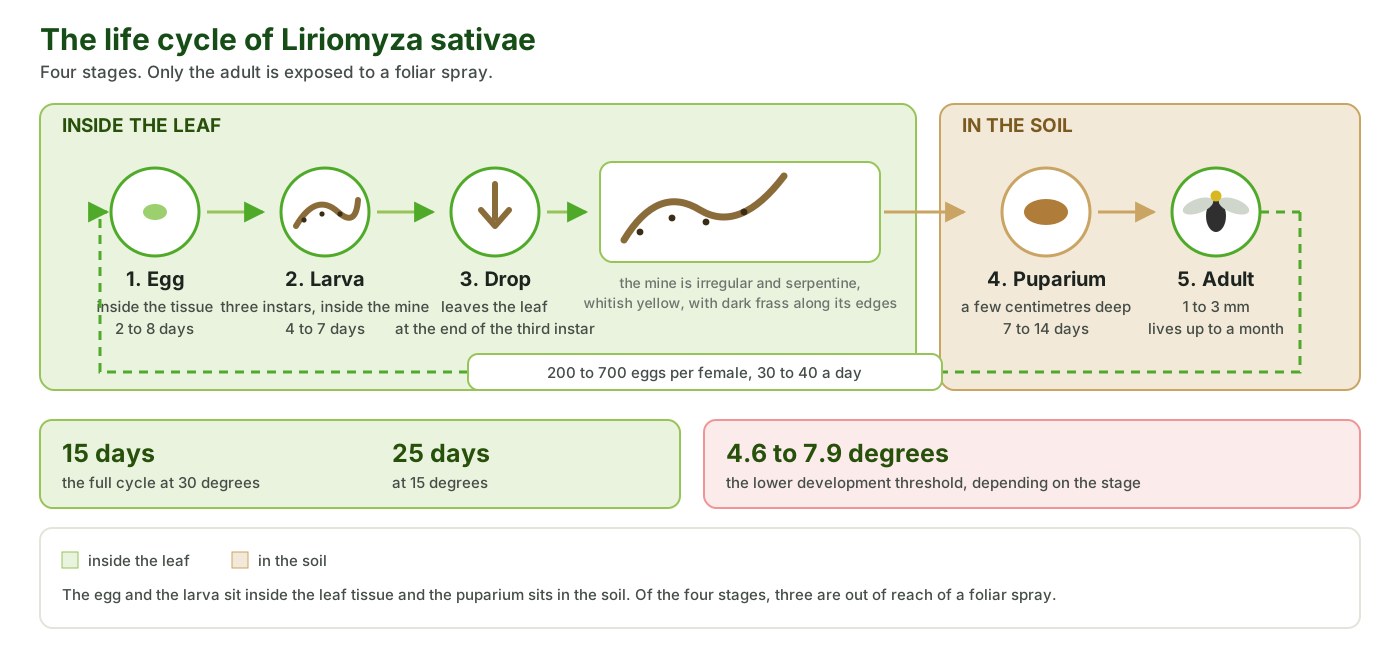
Liriomyza sativae: first record in Greece, life cycle, hosts and management
A Union quarantine pest, the fourth leafminer of the genus to reach the country. What was found, how the cycle closes in fifteen days, and where insecticide sprays fail…