
VPD: vapour pressure deficit, calculation, measurement, limits
Savvas Pastopoulos, Agronomist, Pastopoulos Agronomic P.C.
Vapour pressure deficit, VPD, is the force with which the air pulls water out of the leaf. What is decisive is neither humidity nor temperature but their combination, and it explains why a well-watered tree can close its stomata and stop growing its fruit within two hours. What follows is what it exactly is, how it is calculated by hand, how it is measured correctly in the field, which range is acceptable, and what happens when that range is exceeded.
VPD calculator
Air temperature and relative humidity in, vapour pressure deficit out.
The calculation follows the FAO Paper 56 equation given in section 2. It concerns the VPD of the air; at the leaf surface the value differs, as explained in section 4.
- What VPD exactly is
- The calculation, step by step
- Why relative humidity misleads
- Air VPD or leaf VPD, which one actually counts
- How it is measured in the field
- The acceptable range
- What the plant does as VPD rises
- Midday wilting with a full soil
- VPD and calcium in the fruit
- Low VPD is also a problem
- Practical management
- VPD is rising and will keep rising
- The key points
- Sources
1. What VPD exactly is
Air at any given temperature can hold a maximum amount of water vapour. This maximum is called the saturation vapour pressure and is written SVP. The amount it actually carries at that moment is the actual vapour pressure, AVP. Their difference is the vapour pressure deficit:
VPD = SVP − AVP, in kilopascals (kPa)This is essentially the "empty space" of the air. The more empty space there is, the harder the air pulls water from any wet surface, and the interior of the leaf is such a surface, saturated with water vapour. VPD is therefore the driving force of transpiration: not a condition that accompanies it, but its very cause.
Two factors raise it: temperature, because warm air holds far more water vapour, and dryness of the air. What is critical is that the relationship with temperature is exponential, not linear. At 20 °C saturated air carries 2.34 kPa of vapour; at 30 °C it carries 4.24 kPa; at 40 °C it reaches 7.38 kPa [3]. That is, twenty degrees more triples the demand.
2. The calculation, step by step
Nothing is needed beyond temperature and relative humidity. The equation for saturation vapour pressure is that of Tetens, the same one FAO uses in Paper 56 for evapotranspiration [3]:
SVP = 0.6108 × e(17.27 × T) / (T + 237.3)where T is temperature in °C and the result is in kPa
Then:
AVP = SVP × (RH / 100)VPD = SVP − AVP = SVP × (1 − RH/100)
An example with numbers
A July afternoon in Pella, northern Greece: 35 °C and 30% relative humidity.
- SVP at 35 °C = 0.6108 × e(17.27×35)/(35+237.3) = 5.62 kPa
- AVP = 5.62 × 0.30 = 1.69 kPa
- VPD = 5.62 − 1.69 = 3.94 kPa
Almost four kPa. That is double the threshold at which most tree crops have already closed their stomata [6].
A table for quick reading
| Temperature / Humidity | SVP (kPa) | AVP (kPa) | VPD (kPa) | What it means |
|---|---|---|---|---|
| 15 °C / 95% | 1.71 | 1.62 | 0.09 | Practically zero transpiration. Fungal risk, condensation on the leaves |
| 20 °C / 80% | 2.34 | 1.87 | 0.47 | Very good zone. Maximum stomatal conductance in most species |
| 20 °C / 70% | 2.34 | 1.64 | 0.70 | Ideal. Transpiration runs without stress |
| 25 °C / 60% | 3.17 | 1.90 | 1.27 | Partial stomatal regulation begins |
| 30 °C / 70% | 4.24 | 2.97 | 1.27 | Same VPD as the previous row, ten degrees apart, analysed in section 3 |
| 30 °C / 40% | 4.24 | 1.70 | 2.55 | Above the threshold. Stomata close, photosynthesis falls |
| 35 °C / 30% | 5.62 | 1.69 | 3.94 | Severe stress. Risk of xylem embolism |
| 38 °C / 25% | 6.62 | 1.66 | 4.97 | Extreme. The plant is in purely defensive mode |
The SVP values were calculated with the Tetens equation and verified numerically. The VPD concerns the air; for leaf VPD, section 4 applies.
3. Why relative humidity misleads
Two rows of that table deserve a second look. At 25 °C with 60% humidity, VPD is 1.27 kPa. At 30 °C with 70% humidity, that is, with higher humidity, VPD is again 1.27 kPa. Exactly the same water demand, with ten percentage points of difference in humidity.
And the reverse: at the same 70% humidity, VPD goes from 0.70 kPa at 20 °C, to 1.27 kPa at 30 °C, to 1.69 kPa at 35 °C. The humidity meter did not move at all, and water demand more than doubled.
In practice this means that irrigation and spraying decisions based on relative humidity are wrong decisions. The greenhouse literature has stated it explicitly for decades: VPD gives more information about transpiration and water loss than temperature and humidity separately [5].
Sources: 5
4. Air VPD or leaf VPD, which one actually counts
The equation in section 2 uses the temperature of the air. But the surface the water leaves from is not the air, it is the leaf. And the leaf rarely has the temperature of the air.
The correct quantity is the leaf VPD:
VPDleaf = SVP(Tleaf) − AVP(air)A leaf that is actively transpiring is cooled by evaporation and is usually 1 to 3 °C below air temperature [5]. A leaf that has closed its stomata, however, or one in full sun without wind, can be several degrees warmer than the air.
The difference matters in practice. At 30 °C with 40% humidity:
| Calculation | Leaf temperature | VPD |
|---|---|---|
| Air VPD | 30 °C (same as the air) | 2.55 kPa |
| Leaf VPD, transpiring leaf | 28 °C | 2.08 kPa |
| Leaf VPD, sunlit leaf with closed stomata | 35 °C | 3.93 kPa |
From 2.08 to 3.93 kPa, almost double, with the same air. And note the vicious circle: as soon as the stomata close, evaporative cooling stops, the leaf warms, leaf VPD rises further, and the stress feeds itself.
Sources: 5
5. How it is measured in the field
What is needed in the minimum version
A temperature and relative humidity sensor, correctly positioned. With those two and the equation of section 2, air VPD follows. Critical points of placement:
- Inside the canopy, at the height of the fruiting foliage, not above the trees and not at the edge of the field. The microclimate inside the canopy differs substantially from that two metres above the ground.
- In a radiation shield (white, louvred, naturally ventilated). A sensor exposed to the sun reads its own temperature, not the air's, and overestimates VPD.
- Away from drippers and microsprinklers. A sensor inside the wetted zone shows a VPD lower than the real one for the whole canopy.
- Logging at least every 15 minutes. The VPD peak lasts two or three hours and one reading a day misses it.
What an infrared thermometer adds
A handheld infrared thermometer gives leaf temperature, hence leaf VPD. It costs little and changes the quality of the information. Practical guidance:
- Measurement on sunlit leaves and on shaded leaves separately, their difference shows how well transpiration is working.
- Emissivity is set to 0.95 to 0.98, typical for a plant surface. Cheap devices are locked at 0.95 and that is acceptable.
- The measurement is taken from a short distance, so that the field of view is covered by leaf only and not by soil or sky.
- The leaf minus air difference is itself a stress indicator. A negative difference means active transpiration; a difference near zero or positive means the stomata have closed.
Common measurement errors
| Error | What it causes | Correction |
|---|---|---|
| Sensor in the sun | Overestimation of temperature and therefore of VPD, often by 1 kPa or more | Radiation shield |
| A single sensor in a large field | Differences between ridges, hollows and edges are lost | Two to three points at representative positions |
| Uncalibrated hygrometer | Capacitive sensors drift over the years, especially in dust | Check or replace every 2 years |
| Using data from a distant station | A station 10 km away, over bare ground, gives a different VPD from the orchard itself | Sensor inside the canopy |
| Measuring only air VPD during a heatwave | Underestimation of the real stress on the canopy | Infrared thermometer during the critical hours |
6. The acceptable range
There is no single number for all plants and all stages. There are, however, well-documented ranges.
What orchard data show
Across eight hazelnut orchards on three continents, maximum canopy conductance occurred on average at 0.57 kPa, and the range over which conductance stays above 80% of maximum extended on average to 1 kPa [4]. That is, maximum gas exchange occurs at a lower VPD than most people assume.
The same work notes that many other fruit trees, olive, walnut, apple, reach their maximum conductance at a somewhat higher VPD, in the region of 1 to 2 kPa [4].
| VPD zone | What happens | What is required |
|---|---|---|
| Below 0.4 kPa | Transpiration nearly stops. Insufficient calcium transport. Condensation on the leaves and favourable conditions for fungi | Ventilation in a greenhouse; outdoors, control of leaf wetness duration |
| 0.45 to 1.0 kPa | The zone of maximum stomatal conductance for most tree crops [4] | Nothing. The desired zone |
| 1.0 to 1.5 kPa | Good productivity. Stomatal regulation has begun but is mild | Monitoring and full water availability at the root |
| 1.5 to 2.0 kPa | Noticeable reduction in conductance and photosynthesis. Fruit growth rate slows | Shading, windbreaks, avoidance of sprays and handling |
| Above 2.0 kPa | Stomatal closure independent of irrigation [6]. Zero CO2 uptake | No intervention on the foliage. Cooling if the infrastructure exists |
| Above 3.0 kPa | Risk of xylem embolism and permanent hydraulic damage [8] | Protection: shade netting, canopy cooling, no operations at all |
In the greenhouse
For fruiting vegetables, the practical range worked with in the Dutch school of climate management is 0.3 to 1.5 kPa, with management changing according to stage and time of day [15]. The value of stability is greater than the value of the absolute figure: in lettuce, minimising VPD fluctuations maintained higher stomatal conductance and higher photosynthesis than a mean VPD of the same value but with large swings [10].
7. What the plant does as VPD rises
The curve has a peak, not a slope
As VPD rises, transpiration initially increases, there is a greater force pulling water. But this holds only up to a point. Beyond it, the plant closes its stomata and transpiration levels off or even falls, although atmospheric demand keeps rising [1] [11].
The inflection point is not the same for everything. In kiwifruit, VPD above 2.0 kPa caused stomatal closure independently of the irrigation regime [6]. In hazelnut, a reduction in conductance was recorded above 2.3 kPa over the daily cycle [4].
How sensitive the stomata are, a number worth keeping
The same regularity holds across all plants. If stomatal conductance is written as
gs = gsref × [1 − m × ln(VPD)]where gsref is conductance at 1 kPa, then the sensitivity coefficient m is about 0.6 × gsref, and this holds regardless of species and measurement method [2]. In desert species the coefficient falls to 0.4.
In practice this means that a plant that opens its stomata widely under mild conditions also closes them more abruptly as VPD rises. The strong "breathers" are also the most vulnerable at the peak. This is not a design flaw, it is the mechanism that keeps leaf water potential within safe limits.
The chain of consequences
- Stomatal closure → CO2 entry stops → zero photosynthesis during the hours with the most available sunlight.
- Reduced leaf area development and a shortened growing season [12].
- Hydraulic damage. At elevated temperature and VPD, xylem embolisms are recorded with no soil drought at all [8]. This damage is partly permanent.
- Metabolic disruption. In durum wheat, only a brief exposure to high VPD severely disrupted carbon and nitrogen metabolism, again without edaphic water stress [9].
8. Midday wilting with a full soil
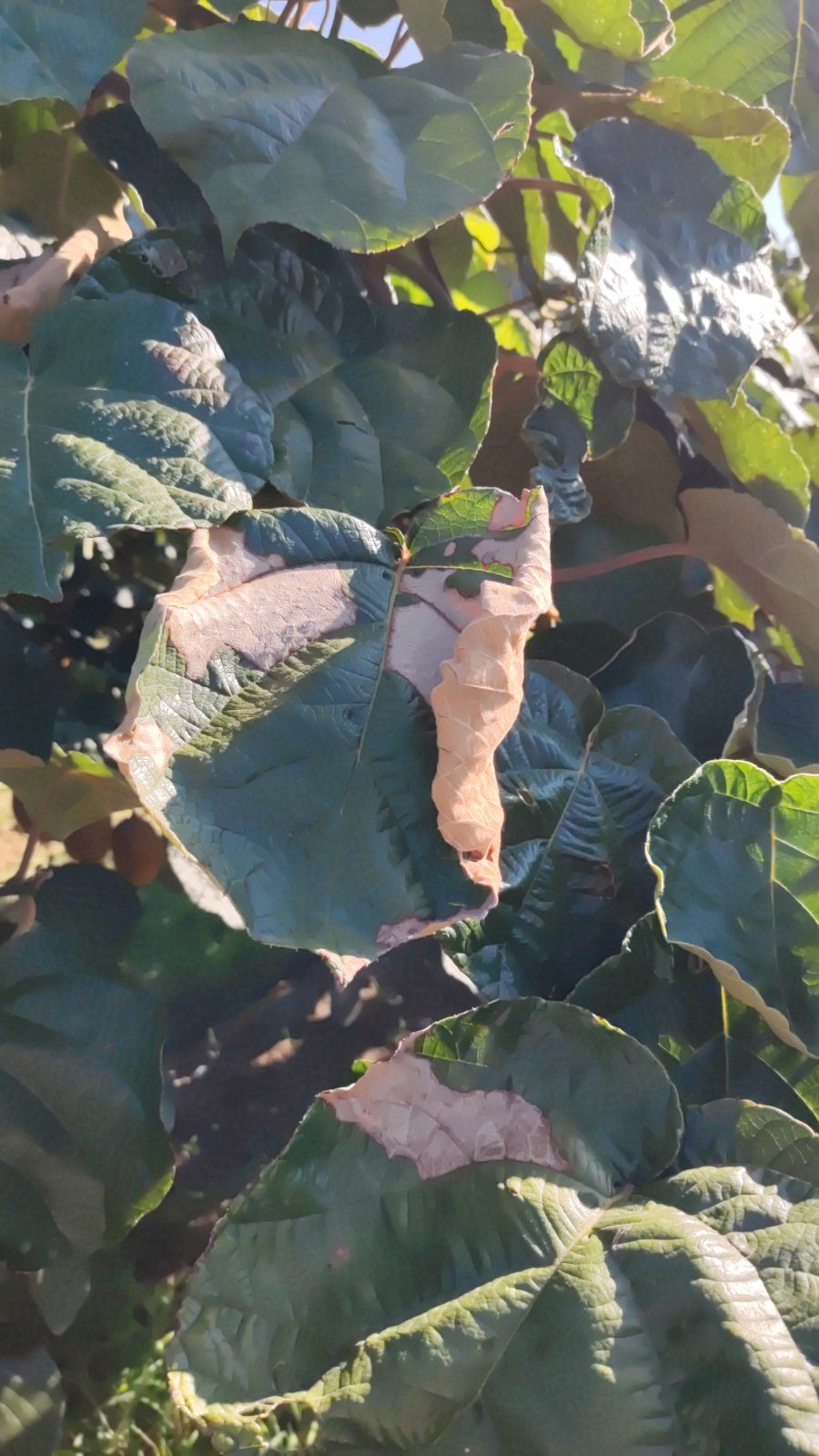
The scene is familiar to every grower. Irrigation ran normally the previous evening. The soil at 30 cm is moist, it looks it, it feels it, and the sensor says so. At two in the afternoon the leaves are hanging.
This is not thirst. It is hydraulic congestion. The water is there, but the path root → trunk → shoot → leaf has a finite conductance. When VPD shoots up, demand exceeds that conductance and the leaf loses turgor, whatever the root does.
The proof that the air and not the soil is at fault is that the phenomenon is reproduced experimentally in fully watered plants: high atmospheric VPD on its own causes stomatal closure, a drop in photosynthesis, and at extreme values embolism, with no edaphic water stress at all [8] [9].
- consumption of water that is not used
- soil saturation and lack of oxygen at the root, at the very moment the root is respiring more intensely because of temperature
- leaching of nitrate below the root zone
- in susceptible species, conditions for Phytophthora
9. VPD and calcium in the fruit
Here VPD connects with something that costs quality directly. Calcium moves only through the transpiration stream, in the xylem, and is not redistributed afterwards. If there is no transpiration towards the fruit, there is no calcium in the fruit, however much fertiliser is applied.
The problem is that the fruit is a poor competitor. It has few stomata and loses its transpiring capacity early in its development, while the leaf transpires at full power until the end. Therefore:
- At very high VPD, the transpiration stream, and the calcium with it, is directed overwhelmingly to the leaves and bypasses the fruit.
- At very low VPD, especially at night, transpiration stops altogether and with it the supply of calcium to the fruit.
Both extremes give the same result: cracking, softening, bitter pit, blossom end rot, brown leaf margins. In strawberry in fact, the most effective way of reducing tipburn proved to be not increasing daytime transpiration but managing night-time VPD [16].
10. Low VPD is also a problem
The discussion about VPD focuses on the summer peak, but the other extreme costs just as much.
Below 0.4 kPa transpiration nearly falls to zero. The consequences:
- Calcium transport stops, with everything that implies (section 9).
- Prolonged leaf wetness. When the temperature falls and the air reaches saturation, water vapour condenses on the leaves. This film of water is the precondition for spore germination in most fungal diseases.
- Reduced nutrient uptake in general, since mass flow towards the root weakens.
The critical periods in Greece are spring with cool damp mornings and the still, humid nights after rain. These are exactly the conditions that favour brown rot in stone fruit during flowering and bacterial canker in kiwifruit.
11. Practical management
Outdoors
| Measure | How it acts on VPD | Note |
|---|---|---|
| Shade netting | Reduces radiation, hence leaf temperature, hence leaf VPD. It is the most direct intervention | Shading of 15 to 20% costs nothing in production; above 30% it starts to limit photosynthesis |
| Windbreaks | Reduce removal of the humid boundary layer around the leaves, keeping local humidity higher | A dry north wind raises VPD even at moderate temperature |
| Over-tree cooling | Directly lowers leaf temperature and raises humidity | Requires good water quality; hard water leaves salt deposits on the fruit |
| Irrigation timing | Does not change VPD, but brings the tree into the peak with fully hydrated tissues | Irrigation early in the morning or at night, never in the middle of the peak |
| Keeping ground cover in the rows | Reduces reflection and radiated heat from bare soil | Managed, with mowing before it competes for water |
| Kaolin or antitranspirants | A reflective layer that lowers leaf temperature | The foliar spray warning below applies |
In the greenhouse
- Smoothness over absolute values. Large swings cost more than a steadily slightly higher value [10].
- Night-time management. On a clear spring night the canopy "sees" the cold roof, its temperature falls, VPD goes to zero and calcium transport stops, while the root, warm, keeps feeding growth. Light ventilation on both sides maintains mild transpiration.
- High-pressure fog for the peak, taking care that VPD does not fall below 0.4 kPa for a prolonged period.
A simple monitoring protocol
- Logging of temperature and humidity inside the canopy, every 15 minutes.
- Calculation of VPD with the equation of section 2, a spreadsheet is enough.
- Counting the hours per day above 2.0 kPa. That number, summed over the season, is the best available stress index at no cost.
- On critical days, measurement of leaf temperature in sun and in shade with an infrared thermometer. If the difference from the air is not negative, the stomata have closed.
- Combination with soil moisture data. Wet soil and wilting at the same time means VPD, not thirst.
12. VPD is rising and will keep rising
This is not a forecast, it is a measured trend. As the atmosphere warms without a corresponding addition of water vapour, VPD rises exponentially, and it has been recognised as an increasingly important factor in plant function worldwide, as well as a key contributor to recent drought-driven tree mortality [1].
The magnitude of the effect is surprising. In an analysis of global yields, the VPD increase accompanying 2 °C of warming caused a greater yield loss (12.9 ± 1.8%) than the warming itself (8.5 ± 1.4%) [13]. That is, the hidden part of the damage is larger than the visible part.
For the Mediterranean specifically, mean annual temperature is expected to increase by 3 to 4 °C, and the increased evapotranspiration from temperature and higher VPD is a key limiting factor for crop production [13].
13. The key points
Eight conclusions
- VPD is the cause of transpiration, not an accompanying index. It is calculated from temperature and humidity with one equation.
- Relative humidity misleads. The same humidity percentage at a different temperature means a completely different water demand.
- Leaf VPD is what counts, not air VPD. The difference can reach a factor of two, and once the stomata close, it worsens by itself.
- The 0.45 to 1.0 kPa zone is where tree crops have near-maximum stomatal conductance [4].
- Above 2.0 kPa the stomata close independently of irrigation [6]. Extra water solves nothing.
- Wet soil and wilted foliage at the same time means VPD. The right response is shading, cooling and timing, not more water inside the peak.
- Very low VPD also costs, calcium in the fruit and fungal disease.
- The trend is upward and the damage from VPD can exceed the damage from temperature itself [13].
- Calcium and fruit that crack and soften (in Greek), why transpiration determines fruit calcium and what the time windows are
- Kiwifruit fruit physiology (in Greek), fruit growth, dry matter and the role of water
- Approved plant protection products (Greece), checking approvals before any intervention
14. Sources
The numbers in the text refer to the list below.
- [1] Grossiord, C. et al. (2020). Plant responses to rising vapor pressure deficit. New Phytologist 226(6):1550-1566. The reference review: exponential rise of VPD, decline in stomatal conductance, the threshold beyond which transpiration stops increasing, and the role of VPD in tree mortality.
- [2] Oren, R. et al. (1999). Survey and synthesis of intra- and interspecific variation in stomatal sensitivity to vapour pressure deficit. Plant, Cell & Environment 22:1515-1526. Source for the sensitivity coefficient m ≈ 0.6 × gsref and for the reduced value of 0.4 in species of dry environments.
- [3] The Tetens equation for saturation vapour pressure, as used in FAO Irrigation and Drainage Paper 56. Source for the formula SVP = 0.6108 × e^((17.27T)/(T+237.3)) and for the SVP values at 20, 30 and 40 °C.
- [4] Marchesini, R. et al. (2021). Assessment of Canopy Conductance Responses to Vapor Pressure Deficit in Eight Hazelnut Orchards Across Continents. Frontiers in Plant Science 12:767916. Source for maximum canopy conductance at 0.57 kPa, for the VPD80 range extending to 1 kPa, for the conductance decline above 2.3 kPa, and for the observation that olive, walnut and apple peak at 1-2 kPa.
- [5] e-GRO Alert 816. VPDleaf vs. VPDair, Two different ways to determine VPD. Source for the difference between air VPD and leaf VPD, for the 1-3 °C leaf temperature depression from transpirational cooling, and for the working assumption of 2 °C when no infrared thermometer is available.
- [6] Kiwifruit ecophysiological adaptations under moderate and severe deficit irrigation (2025). Scientia Horticulturae. Source for the threshold: atmospheric VPD above 2.0 kPa causes stomatal closure in kiwifruit independently of the irrigation treatment.
- [7] Bourbia, I. et al. (2024). Stomatal response to VPD is not triggered by changes in soil-leaf hydraulic conductance in Arabidopsis or Callitris. New Phytologist. Source for the finding that the stomatal response to VPD is not triggered by a change in soil-leaf hydraulic conductance.
- [8] Sapes, G. and Sala, A. (2023). Increasing temperature and vapour pressure deficit lead to hydraulic damages in the absence of soil drought. Plant, Cell & Environment. Source for embolism and hydraulic damage at high VPD without soil drought.
- [9] Sehgal, A. et al. (2021). Short-Term Exposure to High Atmospheric Vapor Pressure Deficit Severely Impacts Durum Wheat Carbon and Nitrogen Metabolism in the Absence of Edaphic Water Stress. Frontiers in Plant Science. Source for the disruption of carbon and nitrogen metabolism by brief exposure to high VPD, without edaphic water stress.
- [10] Hu, X. et al. (2021). Minimizing Vapor Pressure Deficit Fluctuations Maintains Higher Stomatal Conductance and Photosynthesis. Frontiers in Plant Science. Source for the finding that VPD stability matters more than its mean value.
- [11] Fletcher, A.L. et al. (2007). Transpiration responses to vapor pressure deficit in well watered 'slow-wilting' and commercial soybean. Field Crops Research. Source for the existence of a breakpoint in the transpiration-versus-VPD curve in fully watered plants.
- [12] Maize yield under a changing climate: The hidden role of vapor pressure deficit. Agricultural and Forest Meteorology. Source for reduced leaf area development and a shortened growing season under high VPD.
- [13] Climate change increases the interannual variance of summer crop yields globally through changes in temperature and water supply (2025). Science Advances. Source for the finding that the VPD rise with +2 °C costs 12.9 ± 1.8% of yield against 8.5 ± 1.4% from the warming itself, and for the 3-4 °C projection for the Mediterranean.
- [14] A high resolution, gridded product for vapor pressure deficit using Daymet (2025). Scientific Data. Source for the availability of high-resolution VPD data and for the importance of local measurement over distant stations.
- [15] VPD in the Greenhouse: What It Is and How to Steer It. Source for the practical 0.3-1.5 kPa range in fruiting vegetables and for night-time VPD management in relation to calcium.
- [16] Ohio State University, Controlled Environment Berry Production: Tipburn. Source for the finding that in strawberry, tipburn reduction is achieved through night-time VPD rather than through increased daytime transpiration.
- [17] Plant Protection Products Database, Greek Ministry of Rural Development and Food. The official source of approvals for any product mentioned or implied in this article.
This article is general technical information and not individualised agronomic advice. Every orchard differs in cultivar, rootstock, soil, microclimate and the nutritional status of the trees.
Plant protection products are used exclusively on the basis of national approvals and the product label. Any values and ranges mentioned are indicative and do not constitute a recommendation for application. The approvals in the plantprotect.gr database are valid in Greece only; in every other country the corresponding national register applies.
For every foliar spray: spraying trees carrying fruit can cause fruit marking and leaf burn. A prior test on a limited number of trees is required, with the same product and the same rate, and a wait of 5 to 7 days before general application. Spraying is done in the late afternoon or early morning, never in a heatwave and never on foliage under water stress.
Every intervention is carried out at the user's own responsibility, following an on-site assessment by a licensed agronomist. Pastopoulos Agronomic P.C. accepts no liability for damage or loss of production arising from application of this information without individualised technical guidance.
Related articles
Nutrient antagonisms and synergies, with a per-element tool
The arrow diagram in every fertiliser leaflet does not stand up scientifically. The antagonisms are real, but they act on two separate levels, in the soil and inside the plant, and the same element can be antagonistic on one and synergistic on the other. With a tool showing the documented relationships of each element.
Zeolite in agriculture: what is documented and what is not
It is a cation exchanger, it holds ammonium and potassium, not nitrate. The rates that work are tens of tonnes per hectare, not hundreds of kilos. And erionite is a Group 1 carcinogen.
Leonardite in agriculture: properties, rates and what the law says
Leonardite is oxidised lignite with up to 85% humic acids, but pH below 3, up to 6% sulphur and almost no phosphorus. What the analyses and meta-analyses show, where it delivers and where it does not, and what Regulation (EU) 2019/1009 and the organic farming rules require.