
Kiwifruit decline syndrome (KVDS): hydraulic failure, not a pathogen
Savvas Pastopoulos, Agronomist MSc, Pastopoulos Agronomics, Neos Mylotopos, Pella, Greece
Kiwifruit vine decline syndrome, moria del kiwi in Italian, KVDS or KiDS internationally, is not a disease with one microorganism and one product. It is hydraulic failure: the vine ceases to be able to lift water, and it wilts within a few weeks while the orchard is irrigated. What follows is what is documented today, what remains open in the literature, and what has actually been tested as an intervention.
A note on nomenclature: both acronyms occur in the international literature. KVDS (Kiwifruit Vine Decline Syndrome) is the prevailing one in Italy and in the more recent work; KiDS (Kiwifruit Decline Syndrome) also occurs, less often. They are the same thing.
Where this article refers to approvals, those of the Greek Ministry of Rural Development and Food are valid in Greece only and say nothing about what is permitted in any other country. No active substance and no dose is named anywhere in this article. Almost every measurement quoted was made in Italy or New Zealand and carries its origin inside the sentence; areas and yields are given in hectares and tonnes as the sources give them.
The aetiology of the syndrome remains an open field of research. The 2026 review puts it as follows: "despite significant progress, major gaps remain in clarifying the precise aetiology and in identifying the primary pathogens" [2]. The 2024 microbiome review is even more categorical: "to date no single, common causal agent has been found, and the syndrome is characterised as multifactorial" [3]. The Italian national guidelines themselves describe the cause as unresolved [11].
What follows is deliberately separated into what has been measured and what is still a supposition. Wherever a practice is proposed, it is stated whether it has been tested and with what result.
- How large the problem is
- How it is recognised in the orchard
- The mechanism: from the root to the collapse
- Why kiwifruit is so vulnerable
- The figures behind the vulnerability
- The factors that converge
- Which pathogens are involved
- Before planting: the soil decides
- What can be done
- Rootstocks and breeding
- What applies in Greece
- What does not solve the problem
- What the Italian experience shows
- Sources
1. How large the problem is
The first record of such a decline was not made in Italy: it was made in New Zealand, after a cyclone that caused heavy and prolonged flooding in kiwifruit plantings [1]. The Italian epidemic is more recent. The first cases appeared in 2012 in Veneto, in 2015 in Piedmont and in 2017 in Lazio and Calabria [2].
The first estimates spoke of about 10% of the Italian plantings, around 2,900 hectares [2]. By 2020 the record had risen to 6,560 hectares, that is 26% of the total Italian area [11]. The distribution was very uneven: in the province of Verona 2,000 of the 2,500 hectares had been affected, in Lazio 2,000 to 3,000 of the 9,500, in Friuli only 60 of the 650 [11]. At regional level, CREA gives for 2020 Veneto 80%, Piedmont 60%, Friuli 10% [12].
The figure for Piedmont is often cited as "over 70%". The publication of the very research centre that monitors the region gives 60% for 2020 [12], and the national guidelines give 3,180 hectares for the same year [11]. The lower, documented value is kept here.
In October 2025 the record speaks of more than 8,000 hectares lost, about 30% of the cultivated area, chiefly green-fleshed and in part yellow-fleshed; for the yellow-fleshed, about 600 hectares are reported and damage of the order of 180 million euro for the whole chain [13].
The 2026 review values the losses at 85 million euro of gross production value and 47 million euro of operating margin, with annual yield reductions of 50% or more in the heavily affected areas [2].
For a sense of scale: Italian kiwifruit production was recorded at 537,867 tonnes on 26,947 hectares in the agricultural census of 2021 [12]. Italy remains today the principal producer of yellow-fleshed kiwifruit of the northern hemisphere, with about 100,000 tonnes, while Hayward production is in retreat [17].
2. How it is recognised in the orchard
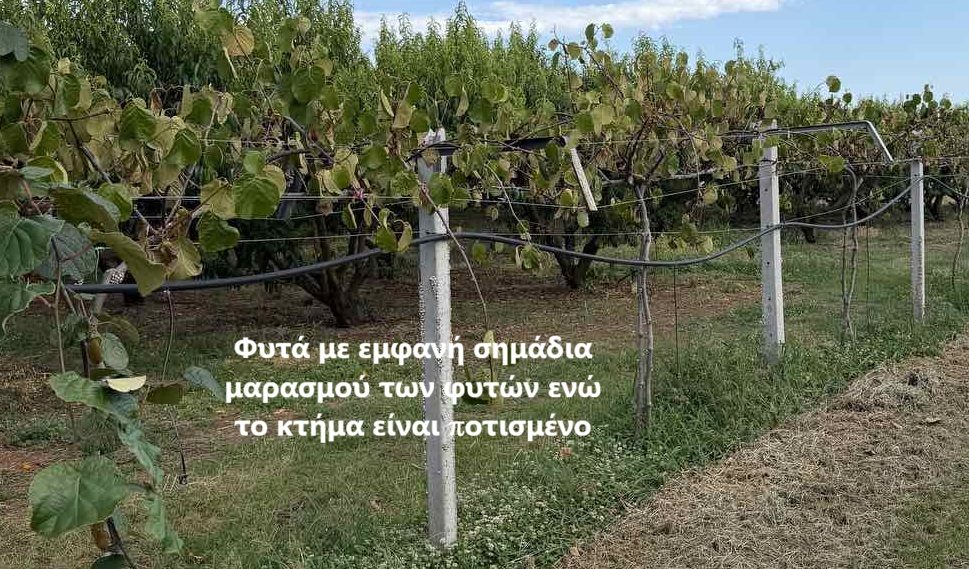
The progression is rapid and usually irreversible. The description in the literature is that "vines that do not collapse completely within twelve months usually die the following year" [1], that is one to two years from the appearance of the first symptoms. The main signs:
- Disappearance of the feeder roots. This is the first and the most revealing. In kiwifruit about 95% of the total length of the root system consists of fine, fibrous roots [1]; losing them is equivalent to losing the whole absorbing capacity.
- Separation of the root cortex from the central cylinder. The epidermis "slips" and comes off like a sock; it is recorded as a characteristic symptom on the secondary roots [11].
- Brown, soft, wet areas of rot on the thick roots, with an initially reddish-brown discolouration of the main root [11].
- Sudden necrosis and leaf fall, often without a preceding phase of yellowing.
- Wilting and dieback of shoots in the middle of summer, while the orchard is being irrigated normally.


3. The mechanism: from the root to the collapse
The chain of events is the part of the syndrome that has been documented best, because it has been measured directly:
- Damage to the root. The feeder roots are lost, through waterlogging, soil-borne pathogens, poor soil structure or a combination of these.
- Functional drought. The vine does not take up water although the soil is wet. The understanding of the syndrome rests on this.
- Cavitation. The water column in the xylem vessels breaks and air enters. In affected vines both cavitation and implosion of xylem vessels were recorded [8].
- Blockage. Tyloses and exudates plug the xylem vessels, making the damage permanent.
- Collapse. Wilting, dieback, death of the vine.
The CREA team measured these stages in a planting of Actinidia chinensis var. deliciosa cv. Hayward in Italy, comparing an affected with a healthy orchard. In the vines of the affected orchard the following were recorded:
| Measurement | Affected orchard | Healthy orchard |
|---|---|---|
| Leaf temperature | Above 39 °C on 18 days (2021) and 24 days (2022); maximum 40 °C | Maximum 34 °C |
| Stomatal conductance | Below 0.20 mol H₂O m⁻² s⁻¹ | Significantly higher throughout the period |
| Stem water potential | −0.9 to −1.2 MPa | −0.4 to −0.7 MPa |
| Cumulative sap flow (2022) | 90 to 204 litres | 263 to 653 litres |
| Daily variation in trunk diameter | High | Low |
That is clear water stress, with the orchard irrigated, and with the sap flow in the affected orchard about three times lower than in the healthy one [8].
Sources: 8
4. Why kiwifruit is so vulnerable
The question "why us and not apple" has an answer, and it is anatomical. Actinidia has a large demand for water but is at the same time extremely sensitive to waterlogging of the root and to anaerobic soil conditions [1].
- Very wide xylem vessels. They secure a large water supply when all goes well, but they are prone to cavitation when the tension rises. In the Italian measurements, a marked narrowing of the xylem vessels was observed in all the vines, with the greatest frequency in the 30 to 45 µm class, an adaptation that reduces the risk of embolism but costs in supply [8].
- Delayed stomatal closure. This is not a field impression but a measurement: "all the kiwifruit vines in the experimental orchards showed very low stomatal sensitivity to VPD, irrespective of the treatment" [9]. The vine "insists" on transpiring while the atmospheric demand shoots up; in the same work days with VPD above 4.0 kPa and a maximum of 4.66 kPa were recorded.
- Large leaves, high transpiration. The surface that loses water is disproportionate to the root system.
- Shallow, fleshy roots, 95% of them fibrous. Low tolerance of anoxia and of mechanical stress [1].
5. The figures behind the vulnerability
5.1 Root density: kiwifruit is off the scale
Because it explores the soil volume slowly, kiwifruit develops a root density higher than that of the other fruit crops: the roots are crowded into a small volume of soil and compete with each other for the same oxygen [19].
| Species | Root length density (cm of root per cm³ of soil) |
|---|---|
| Olive | 0.014 to 0.04 |
| Apple | 0.04 to 0.20 |
| Peach | 0.05 to 0.56 |
| Sweet cherry | 0.10 to 0.50 |
| Pear | 0.12 to 0.56 |
| Kiwifruit | 0.56 to 1.60 |
Table after [19]. The source writes the unit simply as "cm⁻³"; the quantity that takes these values in the literature is root length density, in centimetres of root per cubic centimetre of soil, and it is rendered that way here.
5.2 The "lungs" of the root are four times smaller
The intercellular space of the roots, the aeration porosity, that is the space between the cells, acts as a store of air, in effect as the "lung" of the root system. In kiwifruit this space is reported to represent only 2% of the total root volume [19].
For comparison, in citrus rootstocks the same space is reported at 7% to 11%: Rough Lemon 7.2%, Troyer citrange 9.4%, Trifoliate orange 9.8%, Sweet orange 10.9%. Among peach rootstocks, Mr.S. 2/5 reaches about 11.5%, Monegro 7% and Nemared 5.5% [19]. Those "lungs" give the other species autonomy under conditions of excess moisture. Kiwifruit does not have it.
5.3 Oxygen demand and the five-hour rule
- Kiwifruit roots are reported to have a higher oxygen consumption than peach and apple: at a soil temperature of 30 °C the demand is given as about twice that of peach and three times that of apple [19]. The absolute values of the source (0.18 against 0.10 and 0.06 milligrams of oxygen per litre per hour) are not reproduced here, because the source does not state a litre of what, of soil, of soil solution or of root volume.
- Under conditions of soil saturation, all the available oxygen is exhausted within 5 hours, and after a corresponding interval of excess moisture the first symptoms of stress appear on the leaves: reduced transpiration and photosynthesis, a rise in leaf temperature [19].
- The five hours were not verified in an original work, and the most recent independent measurement gives days, not hours: in the 2025 waterlogging study, on vines with A. chinensis var. deliciosa rootstocks, stomatal conductance fell below 0.05 mol m⁻² s⁻¹ and photosynthesis was reduced by 47% to 63% within four days of waterlogging [14].
- In warm and poorly aerated soils, a few days with excess water in the middle of summer are enough for the available oxygen to be consumed and for the renewal of the root system to be prevented [19].
5.4 The soil volume the root explores
The soil volume occupied by the root system in the first four years after planting, as the Greek source gives it [19]:
| Species and rootstock | Year 1 | Year 2 | Year 3 | Year 4 |
|---|---|---|---|---|
| Peach on MISSOUR | 1.22 m³ | 3.39 m³ | 3.60 m³ | 3.60 m³ |
| Peach on Mr.S. 2/5 | 0.56 m³ | 1.97 m³ | 2.80 m³ | 2.80 m³ |
| Kiwifruit Hayward | 0.13 m³ | 0.83 m³ | 1.35 m³ | 1.41 m³ |
5.5 The vine wilts well before the "wilting point"
The water the vine can actually use without suffering stress, the so-called readily available water, is given as only 30% to 40% of the total available water, that is of the range between field capacity and the wilting point [19].
5.6 When exactly the vines collapse
The vines start the first part of the annual cycle well, with no signs of distress, because evapotranspirative demand is still low and the leaf area limited [19]. As temperature and leaf area increase, the vines collapse, and death occurs in the summer months.
The damage, however, was not done in summer: it was done earlier, during the rainy period or through mistaken management of the irrigation [19]. The ratio of roots to foliage has already been altered, and summer merely presents the bill, a picture consistent with the measurements of sap flow and water potential in the affected vines [8], which record the summer condition without dating the onset of the damage.
6. The factors that converge
| Factor | What it does |
|---|---|
| Waterlogging and poor drainage | Anoxia in the rhizosphere and destruction of the feeder roots. It is characterised explicitly as the main trigger of the syndrome: "waterlogging caused either by excessive irrigation or by rainfall proved to be the main driver of KVDS" [5]. |
| Soil-borne oomycetes | Phytopythium spp., Pythium spp. and Phytophthora spp. attack the already weakened root system [2]. Neither of the two factors on its own produced symptoms; only their combination did, in 90% of the vines [4]. |
| High VPD and temperature | Atmospheric demand for water increases, the leaf overheats and the tension in the xylem vessels rises, with cavitation even when there is enough water in the soil, and with stomata that do not react in time [9]. |
| Soil structure | Compacted or heavy soils limit aeration and drainage; it is the reason raised beds were tested as an intervention at all [11]. |
| Climate change | Alternation of prolonged drought with torrential rain. The syndrome has spread also to plantings where waterlogging is prevented or is caused only occasionally by intense local rainfall, an indication that water alone does not explain everything [1]. |
It is the cleanest study in the literature. Vines were placed in three conditions: waterlogging in sterilised soil, non-sterilised soil without waterlogging, and waterlogging in non-sterilised soil.
Symptoms appeared only in the vines of the third group, at a frequency of 90%. The two other groups showed no symptom at all [4]. Both the water and the microorganism are needed.
Nematodes are often cited as an aggravating factor. In the works checked here, no measurement was found that quantifies their contribution to the syndrome, and for that reason they are not included in the table above. Their presence remains an independent problem of the crop.
7. Which pathogens are involved
This is exactly where the literature has not reached a conclusion. The causes of the syndrome have been disputed since 2012, and in 2026 the review still writes that "major gaps remain in clarifying the precise aetiology and in identifying the primary pathogens" [2].
The microorganisms that have been linked with the syndrome, as the 2026 review records them [2] and as the isolation studies give them [5] [6]:
- Oomycetes: Phytopythium vexans, P. litorale, P. chamaehyphon, P. helicoides, Globisporangium spp., Pythium dissotocum, Phytophthora spp.
- Fungi: Desarmillaria tabescens, found "exclusively in the roots of symptomatic vines", Fusarium solani, Ilyonectria and Dactylonectria spp.
- Bacteria: Clostridium bifermentans and C. subterminale, isolates of which "were able to induce symptoms when inoculated under controlled conditions" [2].
The critical finding of the microbiome work is that Phytopythium spp. were found in healthy as well as in diseased orchards, which "suggests that the onset of KVDS is most probably related to a shift in the wider microbial community rather than being due exclusively to these oomycetes" [3].
For years the discussion turned on the genus Phytophthora. The research of the last five years has moved the centre of gravity to the related genus Phytopythium:
- Systematic isolation from Italian plantings found four species, P. vexans (52 isolates), P. litorale (10), P. chamaehyphon (7) and P. helicoides (2) [6].
- Pathogenicity was confirmed by controlled inoculations on one-year-old vines of cv. Hayward, with 72 hours of waterlogging two days after inoculation. At 26 days, the severity on a 0 to 4 scale was 2.17 ± 0.58 for the P. vexans strain PP1 and 2.67 ± 0.29 for P. chamaehyphon PH6 [6].
- P. vexans was found "in about 55% of the symptomatic vines" [2], and the integrated microbiome analysis characterises it as the "main candidate agent", while adding explicitly that "several questions remain unanswered" [7].
First, the study that identifies P. vexans as the main candidate found at the same time that "KVDS has little effect on the bacterial, fungal and oomycete communities" of the soil and the roots, with "weak traces of possible dysbiosis" [7]. The idea that the syndrome is accompanied by a large-scale overturning of the microbiome is not confirmed by that work.
Second, in the first systematic isolation of pathogens from Italian plantings, bacteria were not identified as pathogens [5]. That same work was confined to three orchards in the province of Verona and the authors note explicitly that extension to more orchards and to other geographical areas is needed, which means that the geographical differentiation of the oomycetes remains an open question, not a finding.
The practical significance remains the same: oomycetes are not fungi, and the common fungicides do not reach them. Products with documented activity against oomycetes are needed, and, above all, removal of the condition that favours them, namely standing water [4].
No active substance and no dose is named here. The choice and the dose of any product are checked each time in the database of approved plant protection products of the Greek Ministry of Rural Development and Food for kiwifruit, because approvals change, and that database is valid for Greece only; in any other country the national register of that country applies.
8. Before planting: the soil decides
The investment cost of a new kiwifruit planting is given in the Greek source at 60,000 to 70,000 euro per hectare [19]. No published Greek costing of establishment, with local labour, pergola materials and nursery stock, was found; the figure concerns the Italian situation and does not transfer unchanged. At that level of investment, in any case, there is no room for wrong choices.
- Depth without impermeable layers. A compact layer at shallow depth is enough for the subsurface water table to rise and for "pools" to form that rot part of the root system. With a root system that in the fourth year explores barely 1.41 m³ [19], there is no room for escape downwards.
- Excellent drainage. It is the only applicable condition that breaks the chain: without waterlogging, the syndrome was not expressed even in the presence of the soil microorganisms [4]. The study also achieved it by sterilising the soil, which is not an option in the orchard.
- High organic matter. It is not a luxury: it contributes to the structure and to the hydraulic conductivity of the soil, hence to the speed at which water leaves the root zone [19].
9. What can be done
There is no cure for an affected vine. There is, however, prevention, and there are interventions that have been tested with measurements. Below they are kept separate from those that are merely recommended.
9.1 Water, the first priority
- Drainage before anything else. If the orchard holds water after heavy rain, no other intervention has any meaning until that is solved. It is the only one of the two necessary conditions of the study, waterlogging and the presence of soil-borne microorganisms [4], that the grower can remove in the orchard, and waterlogging is characterised as the main driver of the syndrome [5].
- Irrigation with measure and measurement. The documented recommendation is localised irrigation with daily amounts calculated on actual consumption, so that the soil stays steadily at field capacity without stagnation [1]. "More water because it is wilting" feeds the cycle.
Raised beds are cited everywhere as the solution, and they do help, but they do not solve the problem. The wording of the review is precise: "the raised bed proved effective in reducing KVDS symptoms and in improving vine growth, but it did not prevent KVDS from being induced" [2].
The Italian national guidelines reach the same conclusion, describing the practice as "not resolutive" although beneficial on heavy soils [11]. It is an intervention that delays the problem without preventing it.
9.2 Microclimate control, the line with the cleanest results
An study of 2022 and 2023 in Piedmont, in a Hayward planting, compared a control, shade netting alone, and shade netting together with over-canopy microsprinklers (from mid June to August, three times a day for seven minutes). The measured results of the combination, against the control [10]:
| Measurement | Control | Shade plus over-canopy irrigation |
|---|---|---|
| Maximum leaf temperature | Above 40 °C (2022 and 2023) | 35.1 °C (2022) and 35.9 °C (2023) |
| Stem water potential | −0.63 MPa | −0.28 MPa |
| Root starch | 21.51% | 43.59% |
| CO₂ assimilation and transpiration | Lower at the peak hours | Significantly higher |
Root starch is the "fuel" with which the vine refills its xylem vessels after cavitation; and its doubling within the summer shows that recovery is feasible. The study was done in Piedmont, in northern Italy, on Hayward; no corresponding trial under Greek conditions was found.
9.3 Soil and root
- Organic matter at planting and thereafter, for structure and hydraulic conductivity [19].
- Decompaction with a ripper at the right moisture conditions, for aeration without injury to the root system.
- Correction of pH and nutrition, so that the root is not already weakened when the pressure arrives.
For commercial microbial products and biostimulants as an intervention against the syndrome, no field trial with a measurable result was found. At research level there are measurements: the 2026 review reports biofumigation with rocket extract that reduced severity by 70% to 80% and characterises the bacterium Pseudomonas asplenii strain Pa4A7 as "highly effective in preventing the appearance of symptoms" [2], research data, not a commercially available solution.
10. Rootstocks and breeding
Kiwifruit is a special case among the fruit crops: until recently the crop rested essentially on a single commercial cultivar, with no use of rootstocks [19]. In China the revision of the genus recognises 48 species of Actinidia [15], a reservoir of genetic material that was left unexploited for resistance to biotic and abiotic stress. That omission has consequences today.
10.1 What is being tested now
The 2026 review collects the rootstocks with documented tolerance [2]:
- Actinidia macrosperma, three genotypes, Ma176, Ma183 and Bounty 71, are characterised as "particularly tolerant of KVDS".
- Actinidia valvata, KR5 showed greater tolerance than Hayward under waterlogging stress.
- The hybrid Z1 (A. chinensis var. deliciosa P1 × A. arguta "Gemma"), with good graft compatibility on green-fleshed and yellow-fleshed cultivars, "showed promising tolerance of KVDS".
10.2 Bounty 71: what the measurement shows
It is the rootstock with the cleanest experimental data. In an study in southern Italy, three rootstocks in pots, Bounty 71 (A. macrosperma), D1 and Hayward (both A. chinensis var. deliciosa), grafted with "Zesy 002", were subjected to nine consecutive days of substrate saturation [14]:
| Rootstock | Stomatal conductance and transpiration | Photosynthesis on day 4 |
|---|---|---|
| Bounty 71 (A. macrosperma) | Values similar to the well watered vines, with no significant difference | No effect from the waterlogging |
| D1 (A. chinensis var. deliciosa) | Below 0.05 mol m⁻² s⁻¹ and 1 mmol m⁻² s⁻¹ | Reduction of about 63% |
| Hayward (A. chinensis var. deliciosa) | Below 0.05 mol m⁻² s⁻¹ and 1 mmol m⁻² s⁻¹ | Reduction of about 47% |
The conclusion of the researchers is carefully worded: Bounty 71 "can cope with short-term and temporary waterlogging and improve the tolerance of the grafted vines" [14]. Short-term and temporary, not permanent.
In the Greek source Bounty 71 is attributed to Actinidia macrosperma and at the same time described as a selection from Actinidia polygama seedlings, selected in New Zealand in 1997 and trialled from 1997 to 2007 against the rootstock Bruno [19]. Those trials and that chronology could not be verified and are not reproduced here as data. The taxonomic attribution to A. macrosperma is confirmed by the 2025 experimental work [14] and by the 2026 review [2].
No rootstock has shown that it withstands soil asphyxia for a long period. Bounty 71 withstands temporary waterlogging [14]; the raised bed reduces the symptoms but does not prevent the syndrome [2]; and for the remaining rootstocks the data are still early [11].
Without correct irrigation and correct soil management, none of the other interventions has anything to hold on to. That is worth reading twice by anyone who expects the solution to come in a container.
10.3 What needs care with the new plants
For most rootstocks there are not yet sufficient data for their commercial release on a large scale to be proposed; the Italian guidelines characterise them as "under evaluation, without sufficient data as yet" [11]. Years of evaluation in different soil and climate environments are needed, and verification of compatibility with the cultivars.
Soil ripping in kiwifruit orchards, when and how it is done correctly. Commentary in Greek.
Kiwifruit on soil with a high pH and a medium to heavy texture: is it worth it? Commentary in Greek.
11. What applies in Greece
A search of the Greek and the international literature found no published record of KVDS in a Greek planting. The most recent international review of the syndrome mentions Greece only as a producing country, with no case [2].
That does not mean the syndrome is absent. It means it has not been recorded and published. The difference is material and it is written here explicitly instead of being covered with a guess.
Kiwifruit is a major crop in Pieria, Imathia and Arta, and it has expanded into other districts as well, often onto heavy and poorly drained soils. The phenomenon of sudden dieback has been discussed in Greek growing circles for years: in a recent agronomic presentation it is described as a "long-standing problem" with a peak in July and August, and is attributed to a combination of causes, excessive or insufficient irrigation, root pathogens, nematodes, a high water table, salinity [16]. It is not identified as KVDS in any of the Greek references that were checked.
While Italian Hayward production is in retreat, Greek production is rising, to the point where total European availability remains essentially stable [17]. Exact Greek production figures by year could not be verified and are not cited here.
That advantage is not a given. The Italian "Recupero Radici" programme for tackling the moria has already been extended with new experimental sites in France and in Greece [13], an indication that the matter is no longer regarded as exclusively Italian.
12. What does not solve the problem
- More irrigation. It worsens a root that is already asphyxiating; waterlogging is the main driver of the syndrome [5].
- "General purpose" fungicides. Oomycetes are not fungi, and, above all, with the waterlogging removed the syndrome was not expressed at all in the controlled study [4], so the priority is the water and not the product.
- Raised beds alone. They reduce the symptoms but do not prevent the syndrome [2].
- Replacing a vine in the same position, without changing the soil conditions. The new vine goes into the same conditions that killed the previous one.
- Fertilisers as "tonics" on a vine that has lost its absorbing roots, 95% of whose length consists of fibrous roots [1]. There is no mechanism left to take them up.
13. What the Italian experience shows
The syndrome changed Italian kiwifruit growing within thirteen years: from the first cases in Veneto in 2012 [2] to more than 8,000 hectares lost in 2025 [13]. And the cause was not a new pathogen that arrived from abroad: the microorganisms under suspicion are found in healthy orchards as well [3].
The most uncomfortable observation in the literature is this one: the syndrome has spread also to plantings where waterlogging is prevented or is caused only occasionally by intense local rainfall [1]. That is, drainage, which is the first and the soundest answer, is not a complete answer. Something else has changed in the relationship between the vine, the soil and the atmosphere, and that something, to date, has not been identified.
What can be said with certainty is far narrower, but also far more useful: without waterlogging the syndrome was not expressed in the controlled study [4], and protecting the foliage from overheating doubled the starch reserve in the root [10]. In the water and in the microclimate, then, there is proven margin. In "the product" there is none.
Recovery will require a re-examination of the way the whole system is managed, and in particular of the relationships between nutrition, water, soil and the root system. It is not a matter of one product or one technique. It is a matter of how the orchard is planted, how it is irrigated and what is left behind in the soil.
Related: wood rot of kiwifruit, another serious threat to the vines. Commentary in Greek.
14. Sources
The numbers within the text refer to the list below. Where only the abstract and not the full text was used, this is stated explicitly.
- [1] Bardi, L. (2020). Early Kiwifruit Decline: A Soil-Borne Disease Syndrome or a Climate Change Effect on Plant-Soil Relations? Frontiers in Agronomy 2:3. Source for the first record in New Zealand after a cyclone and flooding, for the finding that the pathogens "were not considered the primary cause", for the 95% of fibrous roots, for the death of the vine within twelve months or in the following year, for the recommendation of daily localised irrigation at field capacity, and for the spread into plantings where waterlogging is prevented. Full text.
- [2] Malacrinò, A. et al. (2026). Kiwifruit Vine Decline Syndrome: etiology, mechanisms, and management of a multifactorial disease. Plant Stress 20:101298. The principal review of the subject and source for the chronology of the spread (Veneto 2012, Piedmont 2015, Lazio and Calabria 2017), for the initial 10% and the 2,900 hectares, for the statement that "major gaps remain in clarifying the precise aetiology", for the list of microorganisms including Clostridium bifermentans and C. subterminale, for the finding that the raised bed "did not prevent KVDS from being induced", for the rootstocks Ma176, Ma183, Bounty 71, Z1 and KR5, for the losses of 85 and 47 million euro, and for the absence of Greek cases. Full text.
- [3] Guaschino, M., Garello, M., Nari, L., Zhimo, V.Y., Droby, S., Spadaro, D. (2024). Soil, rhizosphere, and root microbiome in kiwifruit vine decline, an emerging multifactorial disease. Frontiers in Microbiology 15:1330865. Source for the statement that "to date no single, common causal agent has been found" and for the finding that Phytopythium spp. were found in healthy as well as in diseased orchards. Full text.
- [4] Savian, F. et al. (2020). Studies on the aetiology of kiwifruit decline: interaction between soil-borne pathogens and waterlogging. Plant and Soil 456:113-128. The controlled study showing that symptoms appeared only in the combination of waterlogging and non-sterilised soil, at a frequency of 90%, while waterlogging in sterilised soil and non-sterilised soil without waterlogging gave no symptom at all. Full text.
- [5] Donati, I. et al. (2020). Pathogens Associated to Kiwifruit Vine Decline in Italy. Agriculture 10(4):119. Source for the statement that "waterlogging caused either by excessive irrigation or by rainfall proved to be the main driver of KVDS", and for the pathogens isolated in Italy, where no bacterium was identified as a pathogen. Full text.
- [6] Prencipe, S., Schiavon, G., Rosati, M., Nari, L., Schena, L., Spadaro, D. (2023). Characterization of Phytopythium Species Involved in the Establishment and Development of Kiwifruit Vine Decline Syndrome. Microorganisms 11(1):216. Source for the four species and the number of isolates, and for the controlled inoculations on one-year-old Hayward with 72 hours of waterlogging: severity 2.17 ± 0.58 for P. vexans PP1 and 2.67 ± 0.29 for P. chamaehyphon PH6 on a 0 to 4 scale. Full text.
- [7] Mosca, S., Malacrinò, A. et al. (2025). Integrated analyses of the plant and soil microbiome identify Phytopythium vexans as agent of the Kiwifruit Vine Decline Syndrome. Plant and Soil 509:729-742. Source for the characterisation of P. vexans as the "main candidate agent" together with the admission that "several questions remain unanswered", and for the finding that the syndrome has little effect on the microbial communities, with weak traces of dysbiosis. Full text.
- [8] Mandalà, C., Monaco, S., Nari, L., Morone, C., Palazzi, F., Bencresciuto, G.F., Bardi, L. (2024). Xylem Hydraulic Conductance Role in Kiwifruit Decline Syndrome Occurrence. Horticulturae 10(4):392. Source for all the measurements in the table of section 3, on cv. Hayward in Italy: leaf temperature above 39 °C with a maximum of 40 °C against 34 °C, stomatal conductance below 0.20 mol H₂O m⁻² s⁻¹, stem water potential −0.9 to −1.2 MPa against −0.4 to −0.7 MPa, cumulative sap flow 90 to 204 against 263 to 653 litres, cavitation and implosion of xylem vessels, and vessel narrowing with the greatest frequency in the 30 to 45 µm class. Full text.
- [9] Bardi, L., Nari, L., Morone, C., Solomita, M., Mandalà, C., Faga, M.G., Migliori, C.A. (2022). Kiwifruit Adaptation to Rising Vapor Pressure Deficit Increases the Risk of Kiwifruit Decline Syndrome Occurrence. Horticulturae 8:906. Source for the measured "very low stomatal sensitivity to VPD" in all the vines and for the extreme VPD values, with a maximum of 4.66 kPa and days above 4.0 kPa. Full text.
- [10] Mandalà, C. et al. (2025). Orchard Microclimate Control as a Way to Prevent Kiwifruit Decline Syndrome Onset. Plants 14(7):1049. The trial documenting section 9.2: Piedmont, cv. Hayward, 2022 and 2023, shade netting with over-canopy microsprinklers three times a day for seven minutes; leaf temperature 35.1 and 35.9 °C against above 40 °C in the control, stem water potential −0.28 against −0.63 MPa, root starch 43.59% against 21.51%. Full text.
- [11] Linee guida "Moria del kiwi" (2021), protezionedellepiante.it, in Italian. The Italian national guidelines. Source for the 6,560 hectares and the 26% of the Italian area in 2020, for the distribution by district (Verona 2,000 of 2,500 hectares, Lazio 2,000 to 3,000 of 9,500, Friuli 60 of 650, Piedmont 3,180), for the root symptoms with cortex detachment and reddish-brown discolouration, for the characterisation of the aetiology as unresolved and multifactorial, for the raised beds as a "not resolutive" practice, and for the rootstocks as "under evaluation, without sufficient data as yet". Full text.
- [12] Bardi, L. (2022). Moria del kiwi: colpa anche della siccità. CREA Futuro, 28 September 2022, in Italian. Source for the percentages by region in 2020, Veneto 80%, Piedmont 60%, Friuli 10%, and for the Italian production of 537,867 tonnes on 26,947 hectares. Full text.
- [13] Morìa del kiwi, 8.000 ettari persi in Italia: Zespri risponde con l'innovazione. Italiafruit News, 14 October 2025, in Italian, with figures from the Zespri press office. Source for the "more than 8,000 hectares lost, about 30% of the cultivated area" in 2025, for the roughly 600 hectares of yellow-fleshed and the damage of 180 million euro, and for the extension of the "Recupero Radici" programme with new sites in France and in Greece. Full text. An industry trade source, not a scientific publication.
- [14] Calabritto, M., Mininni, A.N., Di Biase, R., Petrozza, A., Summerer, S., Cellini, F., Dichio, B. (2025). Physiological and image-based phenotyping assessment of waterlogging responses of three kiwifruit rootstocks and grafting combinations. Frontiers in Plant Science 16:1499432. The rootstock trial of section 10.2, in southern Italy: Bounty 71 (A. macrosperma), D1 and Hayward with the scion "Zesy 002", nine days of saturation; Bounty 71 maintained stomatal conductance, transpiration and photosynthesis at the levels of the well watered vines, while in D1 and Hayward the conductance fell below 0.05 mol m⁻² s⁻¹ and photosynthesis was reduced by 63% and 47% respectively. Full text.
- [15] Li, J.-Q., Li, X.-W., Soejarto, D.D. (2007). A Revision of the Genus Actinidia from China. Acta Horticulturae 753. Source for the number of Actinidia species recognised in China: 48. Abstract only.
- [16] Απότομες ξηράνσεις στην ακτινιδιά: αίτια και τρόποι αντιμετώπισης ("Sudden dieback in kiwifruit: causes and ways of dealing with it"). Thessaliki Gi, 7 September 2026, in Greek, with information from the agronomist V. Exarchos. Source for the fact that in the Greek discussion the phenomenon is described as a "long-standing problem" with a peak in July and August and is attributed to a combination of causes, without being identified as KVDS. Full text. A journalistic source, not a scientific publication.
- [17] Italy second-largest golden kiwifruit producer after New Zealand with 100,000 tonnes. Fruitnet / Eurofruit. Source for the statement that "while Hayward kiwifruit has retreated in Italy, Greek production has risen, keeping total availability essentially stable", and for Italy's roughly 100,000 tonnes of yellow-fleshed kiwifruit. Full text. An industry trade source.
- [18] The Nobel Peace Prize 1970. NobelPrize.org. Source solely for the fact and the reasoning of the award to Norman E. Borlaug: for having given "a well-founded hope, the green revolution". Full text.
- [19] Xyloyiannis, C. and Xyloyiannis, E. (2026). «Κατάρρευση της καλλιέργειας της ακτινιδιάς στην Ιταλία, η σιωπηλή κρίση κάτω από τους ιταλικούς οπωρώνες» ("The collapse of kiwifruit growing in Italy, the silent crisis beneath the Italian orchards"). Georgia-Ktinotrofia, issue 04/2026, pages 42-47, published by AgroTypos, in Greek. A print source for the quantitative data of section 5: root density, aeration porosity of the roots, oxygen demand and the five-hour rule, soil volume by year, readily available water, the wilting point at 10 to 12 atmospheres, and also for the establishment cost, the three soil analyses and the potted plants. A print publication: its figures could not be verified electronically in the original works and for that reason they are attributed to it explicitly within the text, instead of being presented as common ground in the literature.
Christos Xyloyiannis is an agronomist and a former professor at the University of Basilicata (Matera, Italy). Evangelos Xyloyiannis is an agronomist and technical director of RS Fruit S.A. in Naoussa, Greece.
- The work of Polat et al. in Pest Management Science on the comparative aggressiveness of P. vexans and P. litorale in Turkey did not open, either as full text or as an abstract. It was removed, and with it the claim that P. litorale is "significantly more aggressive".
- The work of Tacconi et al. (2015) in Acta Horticulturae 1096 did not open and was removed.
- The review on authorea was replaced by its published form in Plant Stress [2].
- The list headed "Bibliography cited by the above article" was removed: these were citations at second hand, none of which was opened directly.
Photographs: archive of Pastopoulos Agronomics, from orchards in the district.
Plant protection products are used only on the basis of the approvals of the Greek Ministry of Rural Development and Food and in accordance with what is stated on their labels: approved crops, doses, maximum number of applications, re-entry intervals and pre-harvest intervals. Those approvals are valid in Greece only and say nothing about what is authorised in any other country; in every other country the national register of that country applies.
Any spray on vines carrying fruit can cause staining of the fruit and burning of the foliage. A prior test on a limited number of vines with the same product and the same dose, and a wait of 5 to 7 days before general application, are required. Spraying is done in the late afternoon or early in the morning, never in a heatwave and never on foliage under water stress.
This is informative and educational material and summarises published findings. It is not an individualised agronomic recommendation. Almost all the measurements cited were made in Italy or New Zealand and do not transfer unchanged to a Greek orchard; where a figure could not be verified in an original publication, this is stated at the point where it appears. Any intervention is made at the responsibility of the user, following an on-site assessment by a licensed agronomist. Pastopoulos Agronomics bears no responsibility for damage that may arise from the use of the information herein.
Related articles
Copper nanoparticles for kiwifruit bacterial canker
A Chinese study compared three copper nanomaterials with a conventional bactericide. On the plate they needed concentrations at least sixty four times lower. On the plant the control efficacies fell into the same range…
Training kiwifruit: T-bar and pergola
The architecture of the kiwifruit vine and why both training systems follow from it. T-bar and pergola with their dimensions, advantages, costs and a comparison in numbers. Training from the day of planting: planting high, a first season for the root with tipping at one metre, cutting back low the following spring and taking the trunk up in the second season, leaders, winter and summer pruning, males and the support structure. Three diagrams, a table of mistakes, and the gaps that remain for Greece. A field observation from Giannitsa on planting distances.
Chilling hours: the three models and when each one tells the truth
Chilling Hours, Utah Chill Units or Dynamic Chill Portions, what each measures, which suits which climate and season, why a chill portion does not convert into hours, and how the divergence between the three is read. The calculation itself lives in a separate tool.