
Regulated deficit irrigation in peach and nectarine
Regulated deficit irrigation (RDI) is the controlled imposition of water stress on peach at one very specific point in the season: while the fruit is not growing. Applied correctly it saves water, curbs vegetative vigour and improves quality. Applied badly it costs fruit size, and sometimes trees.
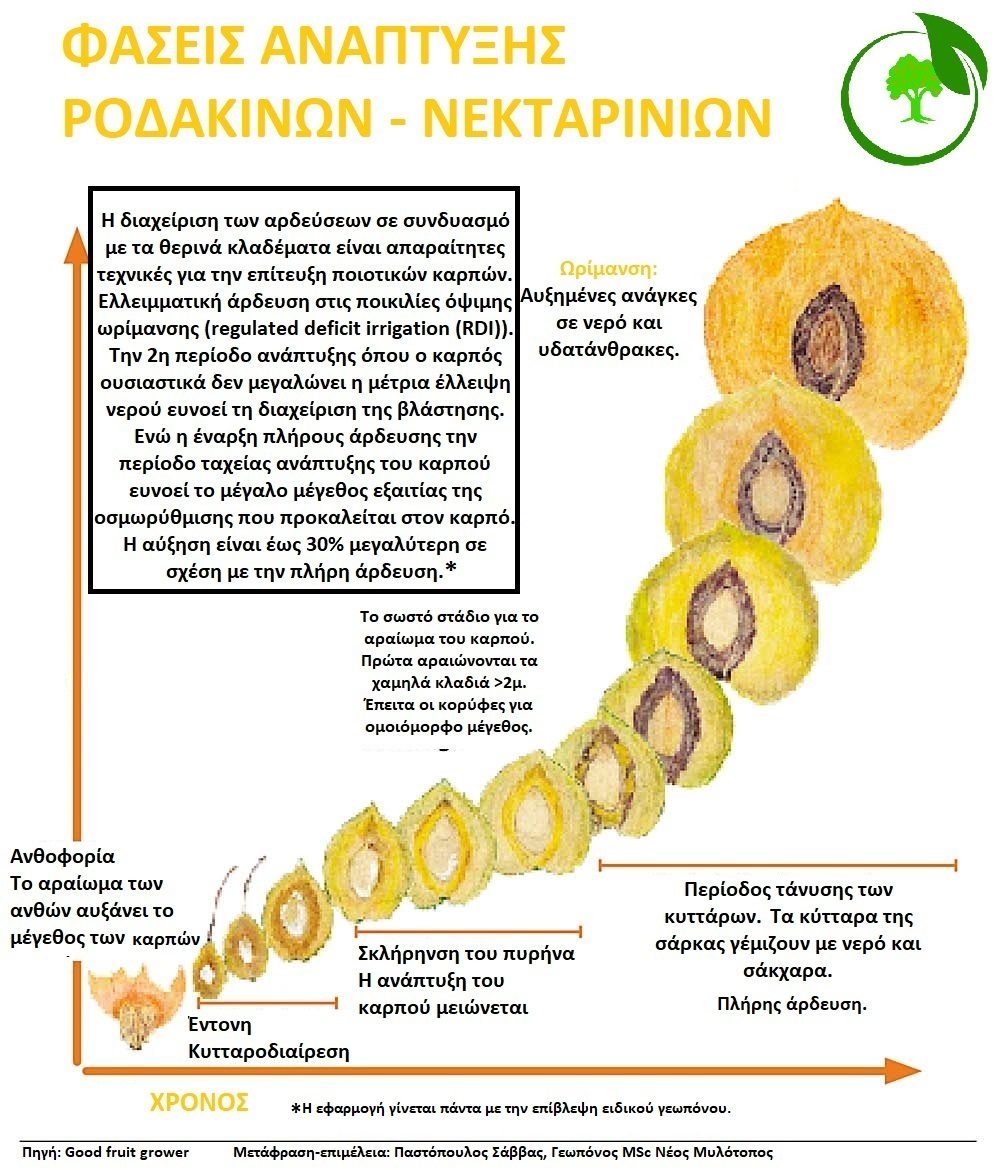
The curve that explains everything
Peach fruit does not grow at an even rate. It follows a double sigmoid curve, that is, three distinct stages:
| Stage | What is happening | Irrigation |
|---|---|---|
| I | Intense cell division. The number of cells is set here, and with it the potential size of the fruit. | Full. This is not the place to study. |
| II | Pit hardening. The fruit essentially stops growing, while the tree carries on putting out vigorous shoots. | Deficit. This is where the intervention is made. |
| III | Cell expansion. The flesh cells fill with water and sugars. Very rapid growth, peak demand. | Full. No restriction whatsoever. |
The logic is simple: during stage II the water applied does not go into the fruit. It goes into water sprouts. So it is withheld there, and restored in full as soon as cell expansion begins.
What is gained
- Vigour control without the secateurs. Less vegetative growth means better light penetration and air movement through the canopy.
- Less fruit rot and therefore lower plant protection product use, a direct consequence of the improved air movement.
- Substantial water saving. The international literature reports improvements in water use efficiency of up to 60% with no yield penalty; in trials under Mediterranean conditions outside Greece, total irrigation water fell from 3,000 to 1,400 cubic metres per hectare with no effect on yield. The size of the benefit depends on the cultivar, the soil and the course of the season.
- Better quality. Moderate stress triggers osmotic adjustment, a concentration of solutes in the fruit, which favours sugars and flavour.
- Compensatory growth. Once irrigation is restored the fruit growth rate accelerates, and that is where the large size advantage over permanently full irrigation comes from.
Where it fits and where it does not
This is the point that decides whether it works, and it is the one most often left out.
Late cultivars, this is where it works
In late-maturing cultivars stage II is long. There is time to impose the stress, let it act on shoot growth, and then allow the tree to recover fully before cell expansion begins. The literature consistently shows reduced vegetative growth with no loss of crop.
Early cultivars, here, caution
In early cultivars stage II is very short. Withholding water during pit hardening alone does not have time to work, while extending it into stage III, and that is the temptation, costs fruit size immediately. For early cultivars classical RDI is not the right strategy; other approaches are being examined, such as mild continuous deficit irrigation or post-thinning stress.
How it is measured, do not do this by eye
The margin between useful stress and damaging stress is narrow. It cannot be judged from the appearance of the foliage, because by the time wilting is visible it is already too late.
- Pressure chamber (Scholander chamber) for midday stem water potential on a shaded leaf. This is the most reliable indicator.
- Tensiometers or soil moisture sensors at two depths at least.
- Shoot growth monitoring: length of new shoots per week.
- Fruit measurement with callipers on permanently marked trees, to confirm that stage II has in fact begun.
Sources
- Chalmers D.J., Mitchell P.D., van Heek L. (1981), the foundational paper that introduced the concept of regulated deficit irrigation in peach.
- Girona J. et al. (1993, 2005), a series of papers on RDI in peach under Mediterranean conditions, showing increased water use efficiency with no effect on yield or quality.
- Sustainability of regulated deficit irrigation in a mid-maturing peach cultivar. Irrigation Science (2016).
- From water scarcity to fruit quality: continuous deficit irrigation in early-maturing peaches. Agricultural Water Management, on the limits of classical RDI in early cultivars.
- Scheduling deficit irrigation of fruit trees for optimizing water use efficiency. FAO.
- Yield and fruit quality of almond, peach and plum under regulated deficit irrigation. Frontiers of Agricultural Science and Engineering.
Diagram: Pastopoulos Agronomics, based on material from Good Fruit Grower.
Related articles

The dry shoot disease of peach
Dead annual shoots with the leaves still attached, buds that fail to break, and since 2021 an epidemic on the plain of Giannitsa. The cause is the fungus Diaporthe amygdali. In detail: the distinction from the blind shoot, the fusicoccin that kills the shoot, the entry points at leaf fall, the susceptibility of ten clingstone cultivars and the year’s programme.

Peach diseases and pests: identification from symptoms, with a diagnostic tool
Brown rot, leaf curl, shot hole, scab, rust, bacterial spot and canker, Armillaria, Phytophthora, Diaporthe amygdali, plum pox, and the pests: peach twig borer, oriental fruit moth and summer fruit tortrix with degree-days from orchards in Pella, spider mites, Comstock mealybug, flat-headed root borer, goat moth. A tool that compares field symptoms against the profiles of 33 causes, with photographs and the one feature that separates them.
Chilling hours: the three models and when each one tells the truth
Chilling Hours, Utah Chill Units or Dynamic Chill Portions, what each measures, which suits which climate and season, why a chill portion does not convert into hours, and how the divergence between the three is read. The calculation itself lives in a separate tool.