
Pruning Rojo Brillante persimmon: the Mataix method

Pruning persimmon Rojo Brillante & Ribera Sun
The Mataix method as taught by the agronomist Vito Vitelli, set out in detail by tree age
- The logic of the method
- Anatomy of the canopy, what is cut and why
- The target shape: three production zones
- Year 1, building the framework
- Year 2, low and middle zone
- Year 3, high zone
- Year 4–5 and beyond, full production
- Old, neglected or badly pruned trees
- Summer (green) pruning, in detail
- Winter pruning, in detail
- The seven classic mistakes
- Calendar of operations
- Ribera Sun, what changes
- Sources, videos and PDFs
- Disclaimer
1. The logic of the method
Before any figure and any centimetre, the Mataix method starts from a change in the way pruning itself is understood.
"Pruning is not about cutting branches, but a moment of dialogue with the plant, in which you give it a series of stimuli in order to provoke responses."
Emilio Mataix-Gato
The sentence is not decorative. It describes a very specific way of working: every cut is a question put to the tree and the regrowth is the answer. Once the desired answer is known, a fruiting shoot, a new scaffold branch, or height, the place and the moment of the cut are known as well. What the grower expects from this dialogue is high fruit quality and quantity, within a very short time.
Four principles separate the method from traditional pruning:
1.1 Persimmon fruits on shoots of the current season
Everything else follows from this. Unlike trees that build permanent fruiting structures and keep them for years, persimmon produces its fruit on shoots that emerged in the same spring. So the question is not "how are the fruiting branches maintained", but "how are new, strong fruiting branches produced every year in the right position". Whatever is cut is rebuilt, and rebuilt easily, because cut persimmon branches have a very high capacity for regeneration.
1.2 The water sprout is not an enemy, it is the raw material
In the old view, the vigorous upright shoot (the water sprout, succhione in Italian) was a curse: it drained vigour from the rest of the growth and was cut out without a second thought. In modern canopy management systems the water sprout is a major asset, because it is precisely the material from which both the fruiting units and the framework of the canopy itself are renewed.
The key lies in the timing and the extent of the intervention. A water sprout headed back at the right moment of the summer stops running in length, begins to store reserves and to differentiate flower buds. The following year it is a strong, short, productive branch. The same water sprout, left free, will reach three metres and will fruit only at its tip, with small fruit that is out of reach at harvest.
1.3 The substantive work is done in summer
Persimmon pruning is carried out in two periods, the spring-summer period and dormancy, but the two are not equivalent. Summer shapes the tree; winter selects and cleans. The reason is physiological: heading back a water sprout in winter, while the plant is asleep, releases reserves that in spring translate into even more water sprouts. The same cut in summer, with the tree in full growth, drives the plant towards storage and flower bud differentiation instead of new growth.
1.4 The tree is worked from the ground
The final height is set at 2.5–2.8 metres and the trunk at 40–60 cm. This is not an aesthetic choice: every operation that requires a ladder or a platform, pruning, thinning, harvesting, multiplies the cost per hectare and slows down the harvest, which in persimmon is critical because it is done in several passes.
2. Anatomy of the canopy, what is cut and why
Without recognising the five types of structure, pruning becomes random. This is the language of the "dialogue" with the tree.
| Structure | Dimensions | Role and handling |
|---|---|---|
| Trunk | height 40–60 cm (maximum) | The "bridge" between the root system and the aerial part. A low trunk means a low centre of gravity, better resistance to wind and work from the ground. |
| Main scaffold branches | 4–5 of them | Together with the trunk they form the load-bearing structure. They start from the trunk at different heights, this distributes the weight of the canopy better and avoids splitting. A slight lean towards the alley (the inter-row) keeps the row passable. |
| Thin shoot (brindillo) |
10–13 cm, thin, flexible | In its first year: it gives fruit of good size. In its second year: it gives fruit of downgraded quality and for that reason it is removed at winter pruning. This is one of the most frequently overlooked points. |
| Mixed shoot (flower buds + wood buds) |
length 60–100 cm base diameter 7–10 mm |
The ideal fruiting shoot. Large leaves, long internodes, quality fruit. At its base (first and second leaf) there are only wood buds; from the second or third leaf upwards 5–7 flower buds differentiate along the axis, while the shoot terminates in a wood bud. |
| Water sprout (succhione) |
1–3 m, upright | Very large leaves, long internodes, erect habit. It appears on young trees and on mature trees that are in good vegetative-productive balance, that is, its presence is a positive sign. It is not removed; it is headed back. |
How the fruit is actually formed
The flower bud does not give a flower directly. The following year it gives a small twig ("tralcetto", the short lateral shoot of the Italian terminology) 15–20 cm long, and 4–5 flowers sit on that twig. This one-year delay explains why the summer pruning of June to August is not paid for in the current season but in the next one, and why one year of lost work costs two seasons.
2.1 The position rule for wood buds
A wood bud can give either a thin shoot or a vigorous shoot, depending on its position on the branch. The buds located at the base of any type of branch always give vigorous shoots. And they break when the branch is headed back.
This rule is the whole lever of the method: cutting a branch at a given length effectively selects what kind of growth will appear below it. A high cut gives thin shoots; a low cut gives vigorous shoots that renew the scaffold branch.
3. The target shape: three production zones
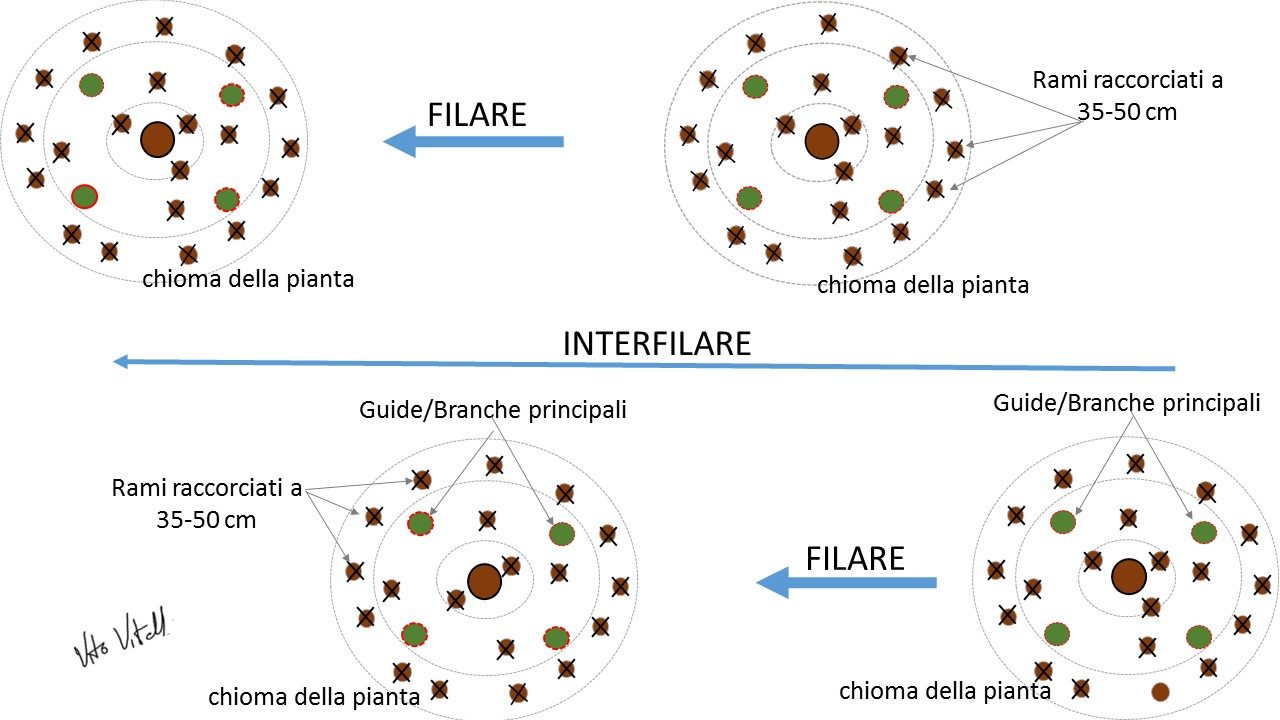
Within the first three years three superimposed fruiting zones are built, low, middle, high, and the tree is closed off at 2.5–2.8 metres.
The logic of the zones solves a practical problem: if the tree is left to build itself freely, the fruit concentrates at the periphery and at the top, where the light reaches. Building three defined levels keeps the whole height of the tree productive, with even light and even fruit.
The numbers that matter
Trunk 40–60 cm 4–5 scaffold branches at different heights 4 leaders, in pairs Water sprouts headed back to 30–50 cm Leaders: cut 40–50 cm above the previous zone Final height 2.5–2.8 m 3 zones in 3 years Full production in year 4–53.1 The repeating cycle
The mechanism is the same every year, and once it is understood there is no further need for year-by-year instructions:
- Summer: the vigorous shoots are headed back to 30–50 cm. By autumn these store reserves and differentiate flower buds → they form one production zone for the following year.
- At the same time, 4 shoots are left completely free, the leaders, to extend in height all summer long.
- Winter: the 4 leaders are cut 40–50 cm above the zone that has just been created. This cut wakes the wood buds at the base.
- The following spring: each leader pushes 3–5 new vigorous shoots. One of them continues as the leader; the rest are headed back in summer and form the next zone.
3.2 Selection and placement of the leaders
The four leaders are not chosen at random. They are selected among the upright shoots of the middle part of the canopy, are placed in pairs and are given a slight lean towards the alley (the inter-row). That lean is deliberate: it opens the centre of the tree to the light and keeps the row accessible to machinery.
4. Year 1, building the framework
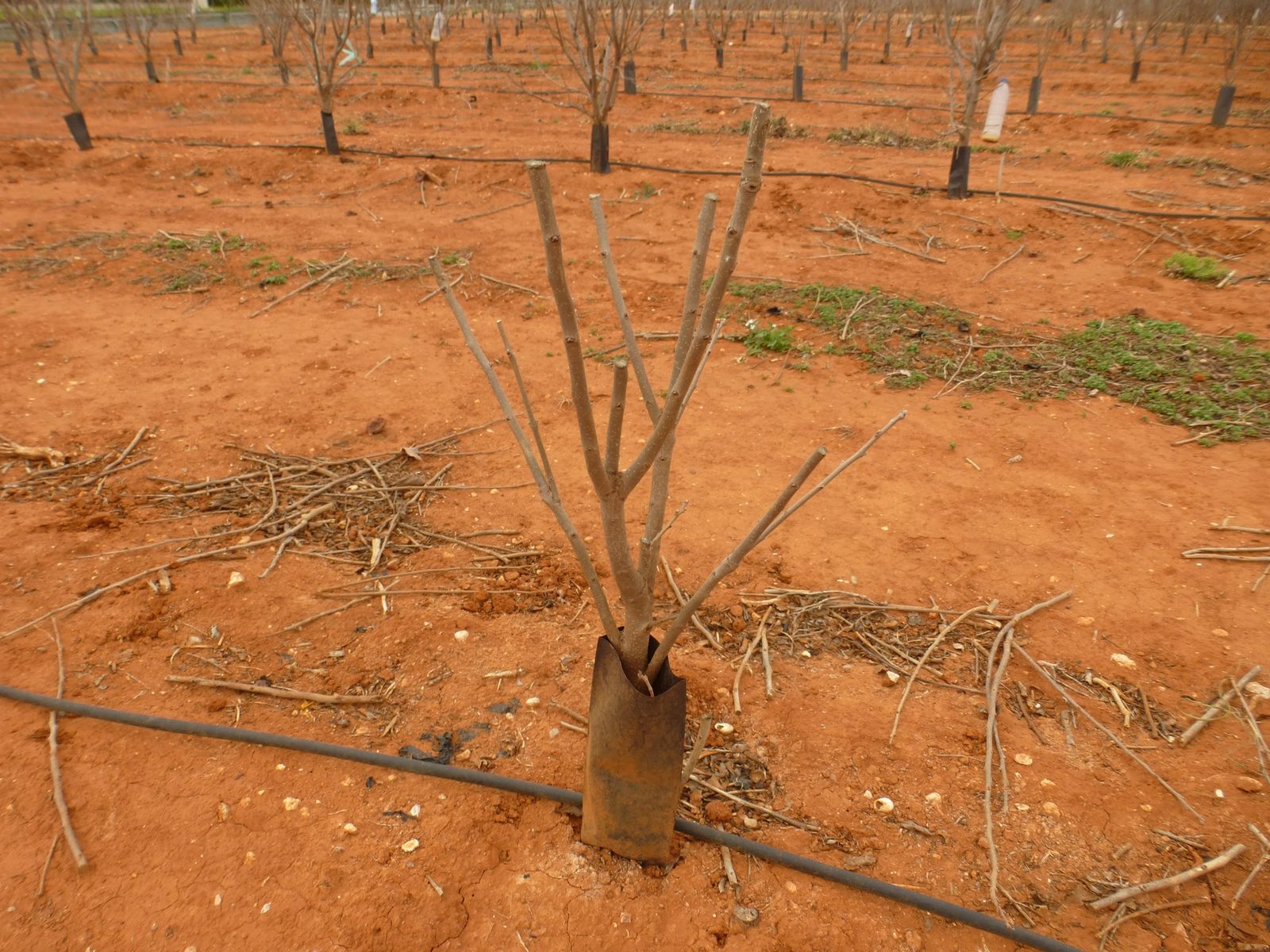
Objective: a low trunk, enough scaffold branches, four leaders
Winter (January–February)
Winter pruning is carried out from the very first year and here it has one purpose only: to make sure that the young tree starts with enough scaffold branches, low down.
- The trunk is set at 40–60 cm, never higher.
- If the plant has not reached a satisfactory number of scaffold branches: a cut-back pruning is made, taking everything down to 15–20 cm. The cut looks brutal, but it is deliberate: "strong interventions will stimulate the emergence of 10–15 vigorous shoots"and those shoots are exactly the material to be worked with.
- If the plant already has 4–5 good scaffold branches, placed at different heights, they are kept and nothing is done.
Spring, observation
Nothing is cut. The vigorous shoots are left to develop and the ones best placed to become leaders are identified: upright, in the middle part, so that they can be arranged in pairs leaning towards the alley.
Summer (June–August)
- Four leaders are selected. These remain completely untouched for the whole growing season.
- All the remaining vigorous shoots are headed back to 35–50 cm, and at different heights from one another, not all at the same level. This unevenness creates depth in the zone and improves light penetration.
- The work is done in 3 passes 21 days apart (in detail in section 9), never all at once.
Result at the end of the first year: a population of headed-back shoots at 35–50 cm that will form the low production zone, plus four long, free leaders.
5. Year 2, low and middle zone
Objective: the low zone comes into production, the middle one is built
Winter
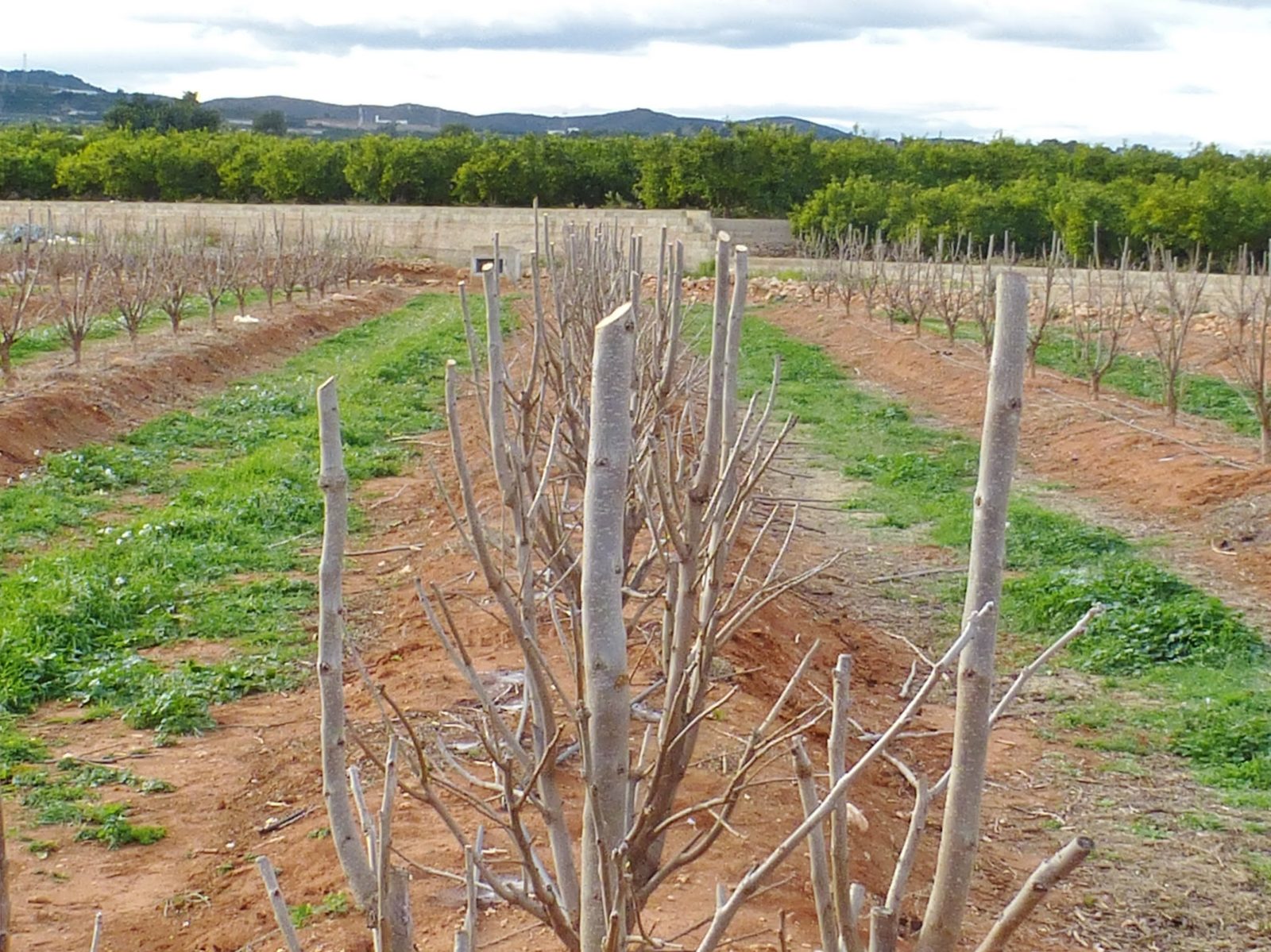
- The 4 leaders are cut 40–50 cm above the low production zone. This is the intervention that will give the middle zone.
- Selection of the fruiting units: the thin shoots and the mixed shoots are selected now. Thin shoots in their first year are kept; those entering their second year are removed, because their fruit will be downgraded.
- Every removal leaves a stub of at least 3–5 cm, never a flush cut.
Spring–summer
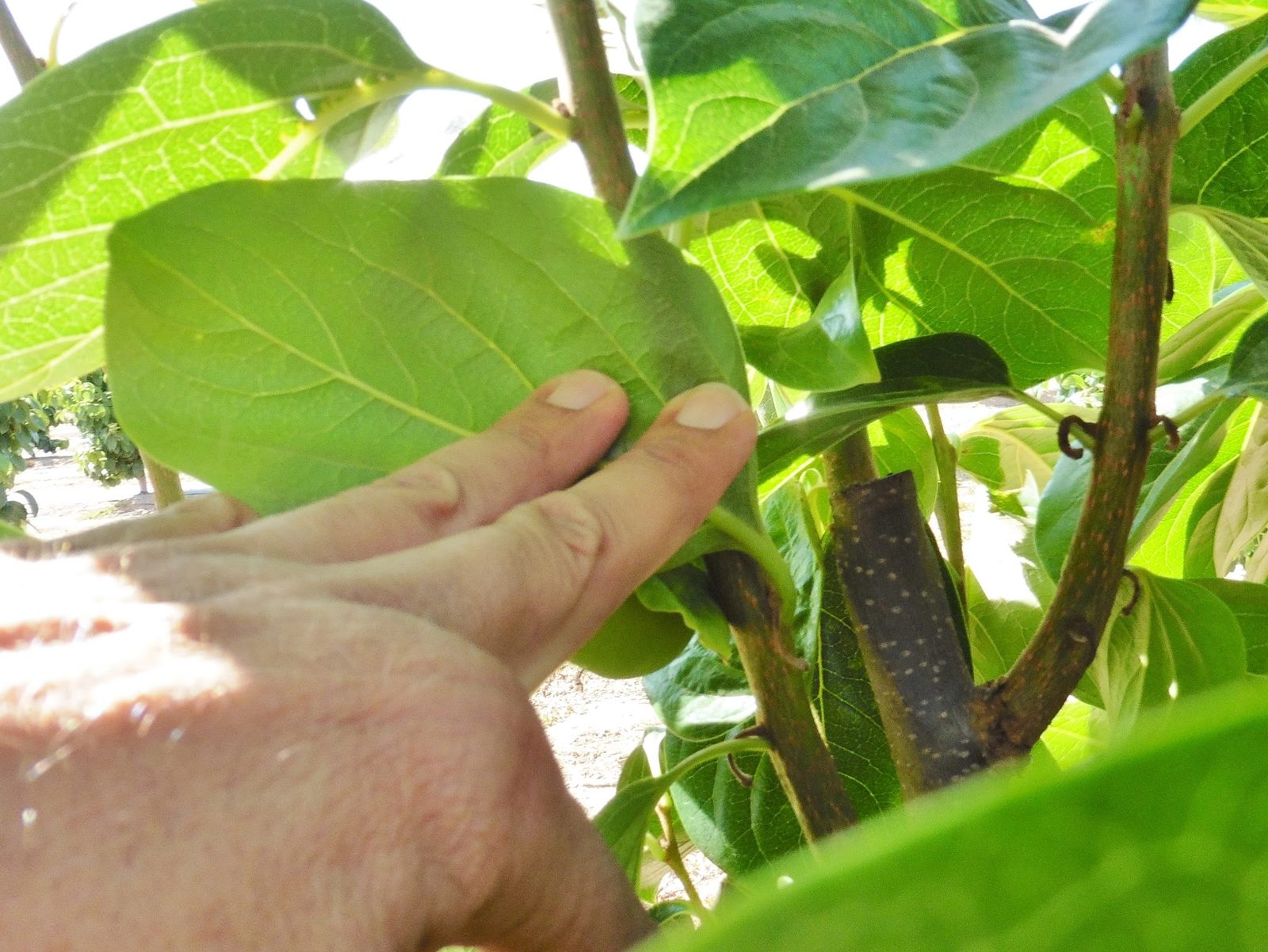
- From each cut leader 3–5 vigorous branches emerge.
- One of them is selected as the extension of the leader and is left free.
- The rest follow the normal pattern of green pruning (heading back to 30–50 cm in 3 passes) and form the middle production zone.
- The low zone is kept active, it already bears fruit. On the fruit-bearing branches the special treatment for fruit sizing is also applied (section 9.3).
6. Year 3, high zone
Objective: completion of the canopy, first serious crops
- Exactly the same pattern: in winter the leaders are cut 40–50 cm above the middle zone. The new vigorous shoots that follow build the high zone.
- A critical difference: from the spring of the third growing season the tree already carries fruit. The handling of the vigorous shoots stays the same, but cutting in instalments (one third at a time) becomes essential, because on bearing trees abrupt vegetative imbalances cause heavy fruit drop.
- Harmonious distribution: the branches must be spread evenly, without tangles and overlaps. The purpose is twofold, development of the fruit, and sufficient aeration and lighting of the canopy.
At the end of the third year the tree has all three zones. What follows is no longer construction, but maintenance and renewal.
7. Year 4–5 and beyond, full production
Objective: continuous renewal, no longer training
- In the fourth to fifth year the tree has reached the desired height, has all three fruiting zones and enters full production.
- The pruning of the following years aims at continuous renewal and at stimulating vigorous structures. In practice, every year a proportion of the fruiting units is replaced by the headed-back water sprouts of the previous season.
- The mature tree now has a stable balance: the water sprout that emerges this year is next year's fruiting branch and the renewer of the scaffold branch two years from now.
Secondary benefits that show up in the accounts
- Headed-back branches are sturdier and less prone to splitting or breaking under the weight of the fruit.
- The fruit, better protected inside the canopy, suffers less damage from wind and sunburn.
- Better aeration and light penetration reduce the use of plant protection products.
Evidence from practice (orchard at Tursi, Matera, 3,000 trees, technical support by Vitelli): with full application of the method, fruit of 420–500 g is harvested. Summer pruning there is carried out in late August and does a double job, greater sizing of the current season's fruit and flower bud induction exactly at the cut points, which secures a steady crop the following year on short, sturdy and productive fruiting units.
8. Old, neglected or badly pruned trees
The most common case in practice, and the most expensive one, if it is left alone.
In the case documented by Vitelli, a grower in Basilicata started with persimmon more than ten years ago, at a time when the crop was barely known in the area and clear guidance on training the plant was missing. The result was early pruning mistakes that translated into lost income and increased cost per hectare. The recovery was made by combining three things:
- Renewal pruning (potatura di riforma): a strong intervention to rebuild a correct framework. In essence a return to the logic of Year 1, cut-back pruning and selection of new scaffold branches and leaders among the water sprouts that follow.
- Application of the Mataix method from the following season onwards and systematically every year, not once.
- Patience: about four years were needed from the first application for the growth of the plants and of the fruiting units to stabilise.
The most serious mistake in the method, irreversible
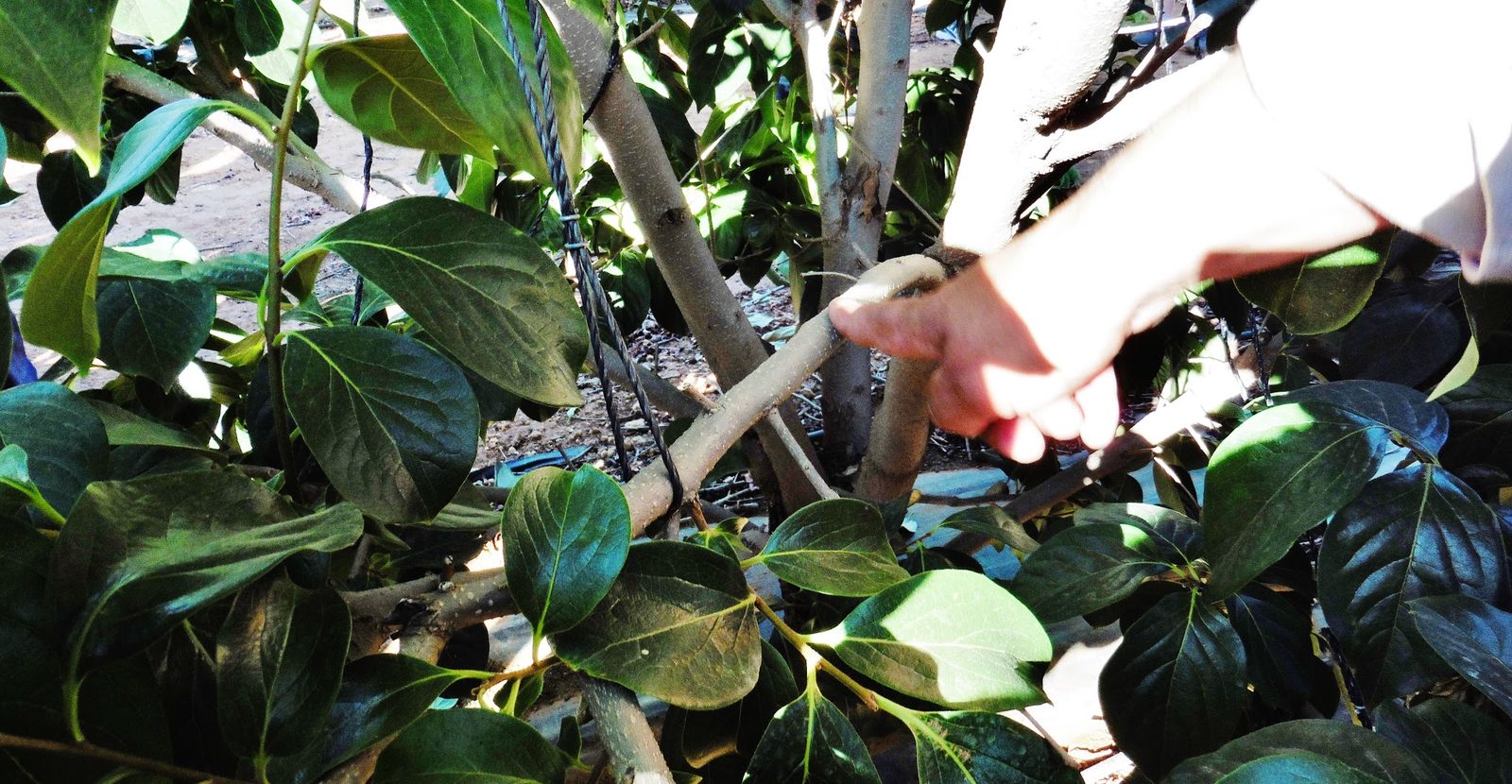
The total suppression of a water sprout by a flush cut, whether in the spring-summer period or in winter, deprives the main scaffold branch of its capacity to regenerate, with the consequence of permanent loss of the fruiting capacity of that branch. This is not damage that is corrected by pruning the following year, the scaffold branch simply stops producing.
And the second major mistake
Heading back to 30–50 cm during dormancy causes, the following spring, the emergence of further vigorous, unproductive water sprouts, which are responsible for excessive internal shading of the canopy. This opens a vicious circle: the more winter pruning is done, the more water sprouts follow.
9. Summer (green) pruning, in detail
This is where the method is decided. It is carried out during the growing season, from June to August.
The rule of three
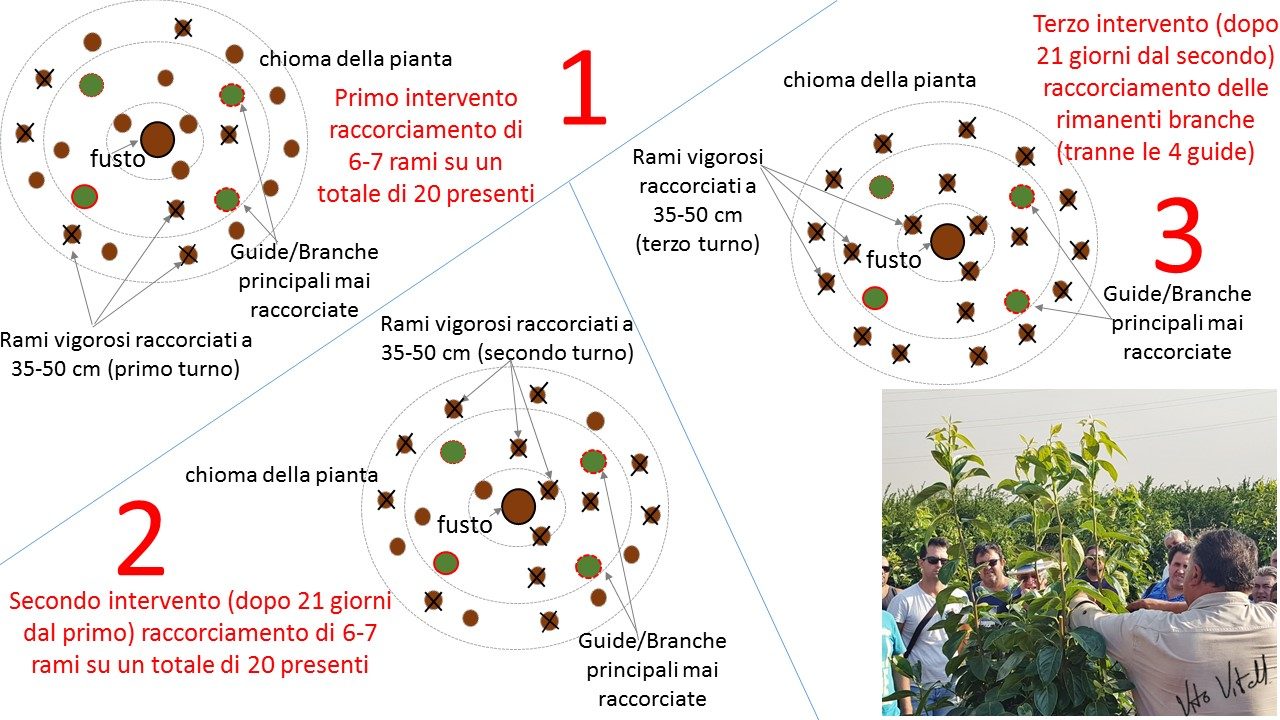
3 passes, 3 weeks (21 days) apart from one another, starting in June. The last intervention is in August. At each pass only one third of the total population of water sprouts is headed back.
9.1 When a water sprout is ready to be headed back
Not everything in sight is cut. A water sprout must meet at least one of the following three criteria:
- Length 70–90 cm.
- Base diameter around 5 mm, roughly the diameter of a cigarette. This is the easiest practical indicator in the field.
- Over the first 35–45 cm the colour has begun to turn from green to brown, that is, lignification has begun.
Why this matters: a shoot that has not reached this stage does not have the maturity to store reserves and to differentiate flower buds. If it is cut prematurely, it will simply grow again.
9.2 How and how much is cut
- Heading back to 30–50 cm. For the vigorous shoots that will form a production zone, Vitelli gives the range 35–50 cm, at different heights from one another.
- Exception: the 4 leaders. They are not touched at all, they grow freely for the whole growing season.
- Only one third of the population at a time. It is very important that the entire "community" of water sprouts is not headed back at the same time. On bearing plants, the vegetative imbalances that follow translate into heavy fruit drop.
9.3 The special treatment for larger fruit
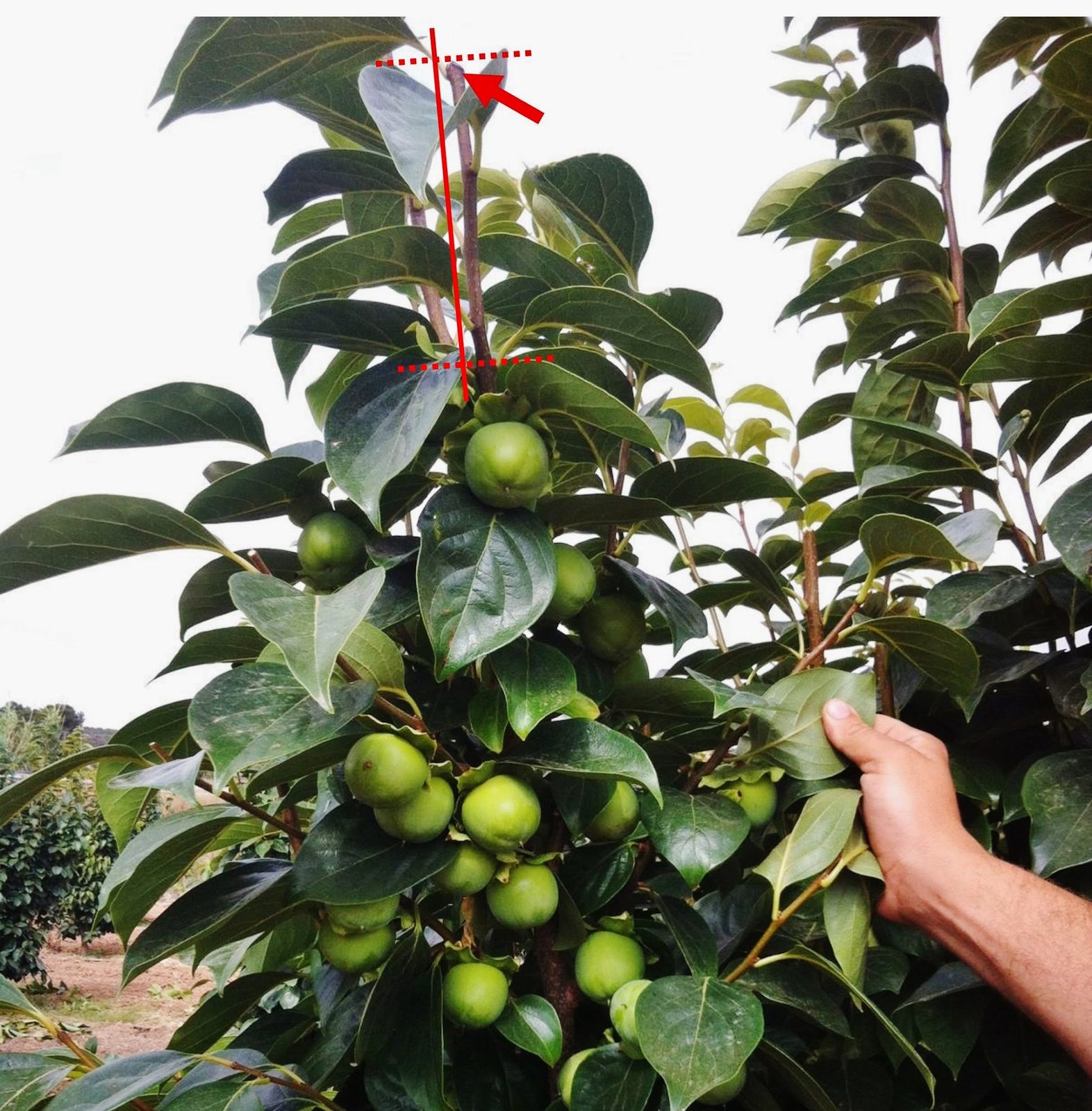
On branches that already carry fruit a different rule applies. Heading back is done above the fourth or fifth leaf after the last (highest) fruit.
The physiology behind this: the tip of the shoot works like a pump that draws sap in order to keep growing. By interrupting the pull of sap by the growing tip, the sap is redirected to the fruit, both fruit set and sizing of the existing fruit are favoured.
9.4 The intervention on mature, bearing trees
On trees in full production, the summer intervention of late August combines two moves:
- Suppression of the internal branches, the ones that shade and do not produce.
- Heading back of the external vigorous shoots, the ones that will become next year's fruiting units.
The main objective is to secure flower bud induction exactly where the cuts are made, so that the following year rests on short, sturdy and productive fruiting units.
What summer pruning delivers
- All the vigorous shoots headed back in the spring-summer period accumulate reserves and differentiate flower buds. The following year they become sturdy fruiting structures that give high quality fruit.
- Vigorous, "useless" growth is converted into fruiting branches instead of being thrown away.
- Better aeration and light penetration → reduced use of plant protection products.
- Stronger branches, fewer breakages, less damage from wind and sunburn.
10. Winter pruning, in detail
It is carried out in dormancy, in January and February, from the very first year. It is pruning by selection, not by training.
10.1 What it does
- Selection of the fruiting units: the thin shoots and the mixed shoots are selected in the winter period. The best placed and correctly sized ones are kept.
- Removal of second-year thin shoots, which would give fruit of poor quality.
- Selection and removal of the unproductive, dry and greyed branches.
- Restoration of volume and shape to the canopy.
- Cutting of the 4 leaders 40–50 cm above the last production zone (until the three zones are complete).
10.2 The cutting technique
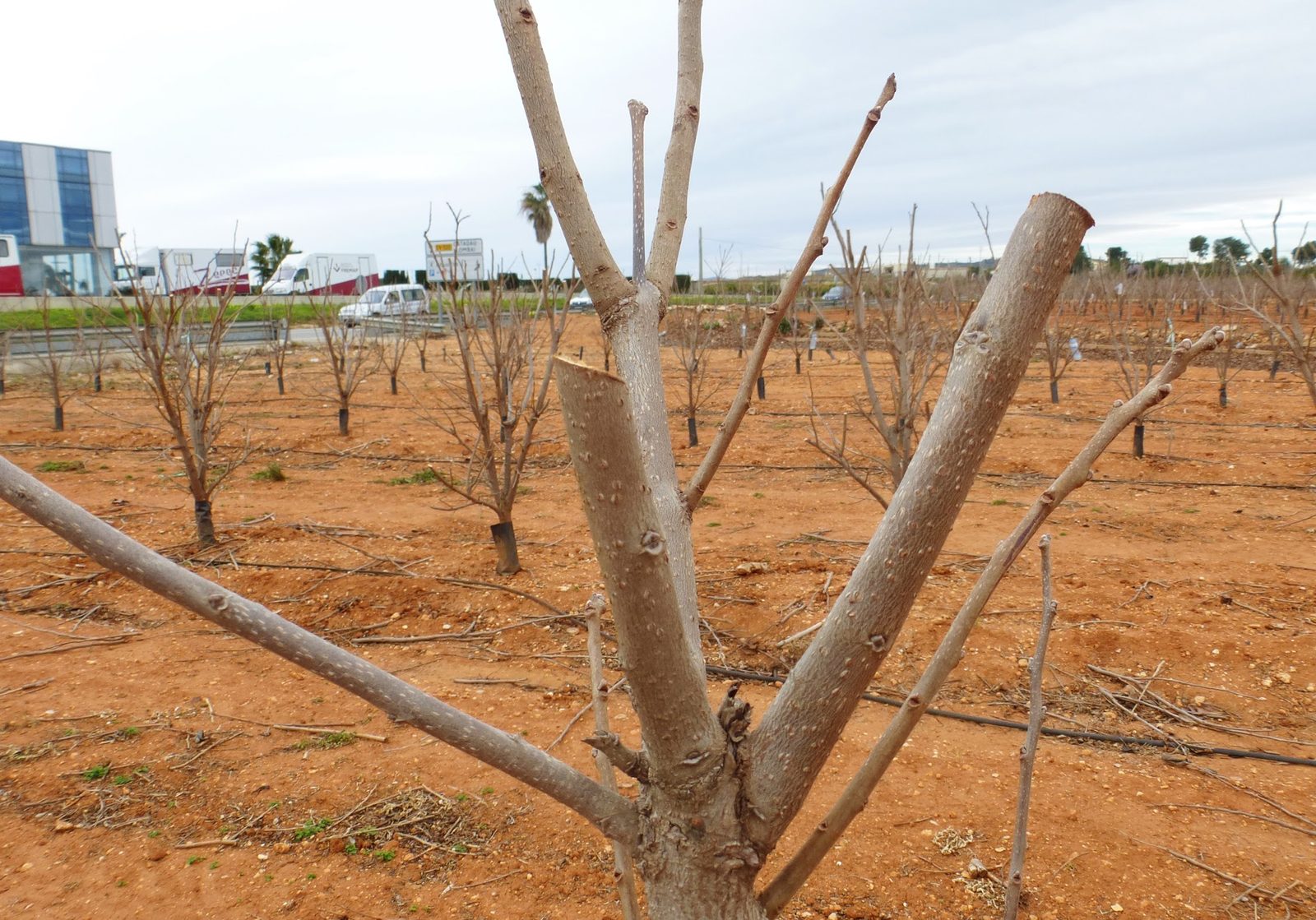
The removal of surplus branches is done with a stub of at least 3–5 cm and never with a flush cut. The reason connects to section 8: the stub keeps at the base the wood buds that will give the new vigorous growth, that is, it preserves the capacity for regeneration of the scaffold branch. A flush cut abolishes it permanently.
What is never done in winter
Water sprouts are not headed back to 30–50 cm. If that is done, the following spring brings further vigorous, unproductive water sprouts, which will shade the interior of the canopy excessively. Heading back water sprouts belongs exclusively to summer.
11. The seven classic mistakes
| Mistake | What it causes |
|---|---|
| Cutting a water sprout flush | The scaffold branch loses its capacity for regeneration, and therefore for fruiting, permanently. Irreversible. |
| Heading back water sprouts in winter | In spring still more water sprouts appear, unproductive, with excessive internal shading of the canopy. |
| Cutting all the water sprouts at once | Vegetative imbalance → heavy fruit drop on bearing trees. |
| Leaving a water sprout free | It reaches 3 m, produces thin shoots only in its last section and fruits only at the top. The fruit is of poor quality and difficult to harvest. |
| A high trunk | Management from the ground is lost. Labour cost for pruning and harvesting rises. |
| Keeping second-year thin shoots | Small fruit of downgraded quality, it pulls down the average of the batch. |
| A tangled, overlapping canopy | Less light and air → smaller fruit, more disease, more plant protection products. |

12. Calendar of operations
| Period | Operation | Details |
|---|---|---|
| January–February | Winter pruning | Selection of the fruiting units. Removal of second-year thin shoots and of dry, grey and unproductive branches. Cutting of the 4 leaders 40–50 cm above the last zone. All cuts with a stub of 3–5 cm. |
| Spring | Observation | Emergence of the water sprouts. Selection of the shoots that will become leaders. No cutting of water sprouts yet. |
| June | 1st summer pass | Heading back of one third of the water sprouts that meet the criteria, to 30–50 cm, at different heights. |
| July (+21 days) | 2nd pass | The next third, again after checking the criteria (length, diameter, lignification). |
| August (+21 days) | 3rd pass, the last | The remaining third. On bearing trees: suppression of internal branches and heading back of the external vigorous shoots, for fruit sizing and flower bud induction. |
| October–December | Harvest | Persimmon keeps best on the tree itself. Rojo Brillante is flexible in the way it enters ripening, which allows a staggered harvest without loss of quality. With delaying techniques the period extends to the end of December. |
| After harvest | Astringency removal | Both cultivars are astringent: they require astringency removal (the CO₂ technique) in order to be eaten crisp. |
The months correspond to southern Italy and Valencia. In Greece they shift, and unevenly at that: the northern and mountainous parts of the country run appreciably later than the southern and island areas, so that a single calendar does not hold for the whole territory, and correct practice is always to judge by the criteria of the shoot itself, length, diameter, lignification, and not by the calendar. The calendar gives the framework; the shoot gives the order.
13. Ribera Sun, what changes
- Ribera Sun® arose as a spontaneous mutation of Rojo Brillante. In Italy it is distributed by Geoplant Vivai.
- Its main advantage is size: according to the figures of the Italian nursery that distributes it, it gives fruit that is about 30% larger in volume and weight than classic Rojo Brillante.
- The pruning shape is identical. The same Mataix method, the same zones, the same cutting dimensions, the same calendar. There is no separate pruning protocol.
- Practical consequence of the larger fruit: greater weight per fruiting unit. Therefore the feature of the method that makes branches shorter and sturdier, and so less prone to splitting, counts even more here.
- Both cultivars are astringent and require astringency removal after harvest.
14. Sources, videos and PDFs
The main articles by Vito Vitelli
- La potatura del kaki. I fondamenti, the central, complete article, with all the photographs and the embedded videos. In Italian.
- La potatura verde del kaki (Diospyros kaki), supplementary, focused on summer pruning. In Italian.
- vitovitelli.blogspot.com, his blog; there is no other site. Contact: vitovitelli@tiscali.it, WhatsApp +39 339 2511 629.
- YouTube channel "Vito Vitelli agronomo"all the videos.
Handouts in PDF (Emilio Mataix / IVIA)
- Dispense "Fondamenti di potatura del kaki" (PDF)
- Dispense "Potatura del kaki" (PDF)
- Folder with photographs and videos of summer pruning
- A second folder of related videos
The pruning videos
- Summer pruning, young trees
- Summer pruning (supplementary)
- Summer pruning, mature trees
- Winter pruning, trees in their second leaf
- Winter pruning, trees in their third leaf
Additional sources
- Gestione avanzata del kaki Rojo Brillante, FreshPlaza, October 2025. Application on 3,000 trees in Basilicata with technical support by Vitelli: renewal pruning + the Mataix method + a delaying technique; fruit of 420–500 g.
- A scuola da Emilio Mataix-Gato (IVIA-Spagna): fondamenti di potatura del kaki, FreshPlaza.
- Kaki Ribera Sun® conferma il suo potenziale, AgroNotizie.
- Ribera Sun® il kaki Extra, Geoplant Vivai.
- Kaki, tra varietà e tecnica di coltivazione, Plantgest.
- "El cultivo del caqui", Generalitat Valenciana, 2015 (collective work), the bibliographic basis cited by Vitelli.
15. Disclaimer
This text is general technical information and not individual agronomic advice. The figures, the cutting dimensions and the calendar of operations come from published material by the agronomist Vito Vitelli and by Emilio Mataix-Gato (IVIA, Generalitat Valenciana) and refer to the conditions of southern Italy and Valencia.
The behaviour of every orchard differs according to the cultivar, the rootstock, the soil, the climate, the age and the nutritional status of the trees. Before any intervention, and especially before renewal pruning or a strong cut-back pruning, an on-site assessment by an agronomist is recommended. Where plant protection products are mentioned, it should be noted that the approvals issued by the Greek Ministry of Rural Development and Food (YPAAT) are valid in Greece only and do not apply in any other country; outside Greece only the products authorised nationally, and their own labels, apply.
Pastopoulos Agronomics accepts no liability for damage, loss of production or financial harm that may arise from applying the information in this text without individual technical guidance.
Copyright: the photographic documentation belongs to Agronomo Vito Vitelli and refers back to his original blog; it is used here exclusively for educational and informational purposes, with explicit attribution to the source. The diagrams, the English adaptation and the editing are original and belong to Pastopoulos Agronomics. Republication of the original Italian material requires the written permission of its author.
Related articles
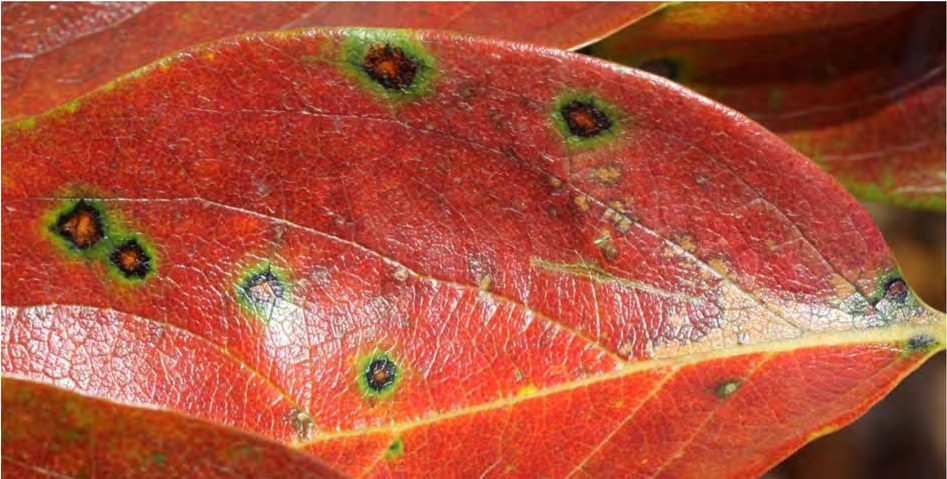
Pests and diseases of persimmon (Diospyros kaki) in Europe and Greece: epidemiology, differential diagnosis and action thresholds
Circular leaf spot (Plurivorosphaerella nawae), the pathogen that adapted to the semi-arid climate of Valencia and is not a quarantine organism, with the comparison between Spain and Korea and the role of drip irrigation. Angular leaf spot, Pestalotiopsis, anthracnose, and the twelve species of Diaporthe, Eutypella and Botryosphaeriaceae identified inside the wood. Postharvest rots: why Alternaria black spot became the limit of storage life after 1-MCP, and how extra irrigation before harvest is paid for in the cold room two months later. Crown gall, vascular wilt, root rots and phytoplasmas. Mealybugs and ants, wax scale, mussel scale, the orange spiny whitefly as a quarantine organism, fruit flies. Herbicide toxicity mistaken for a fungal leaf spot, a differential diagnosis table with fifteen pairs, action thresholds with the sampling method, and the four exotic pathogens threatening the Mediterranean. Thirteen photographs, five from Greek orchards.
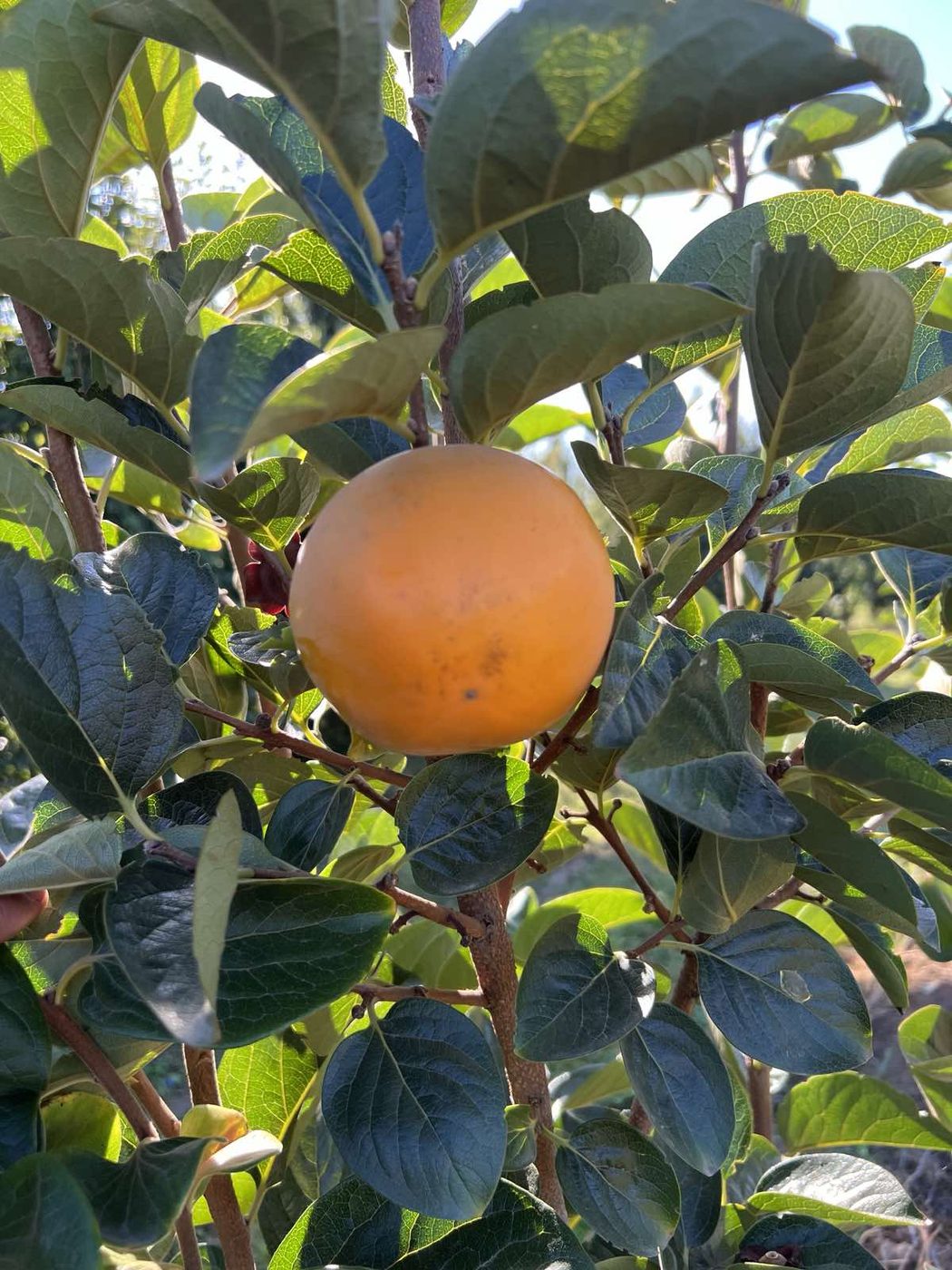
The Maxim persimmon cultivar: rights, ripening and key information
A protected Spanish cultivar of the Genesis Exotic group, distributed under licence. The fruit is not astringent at any stage, not even unripe, so no deastringency chamber is needed, the tree resembles Jiro and ripening falls in mid-September.
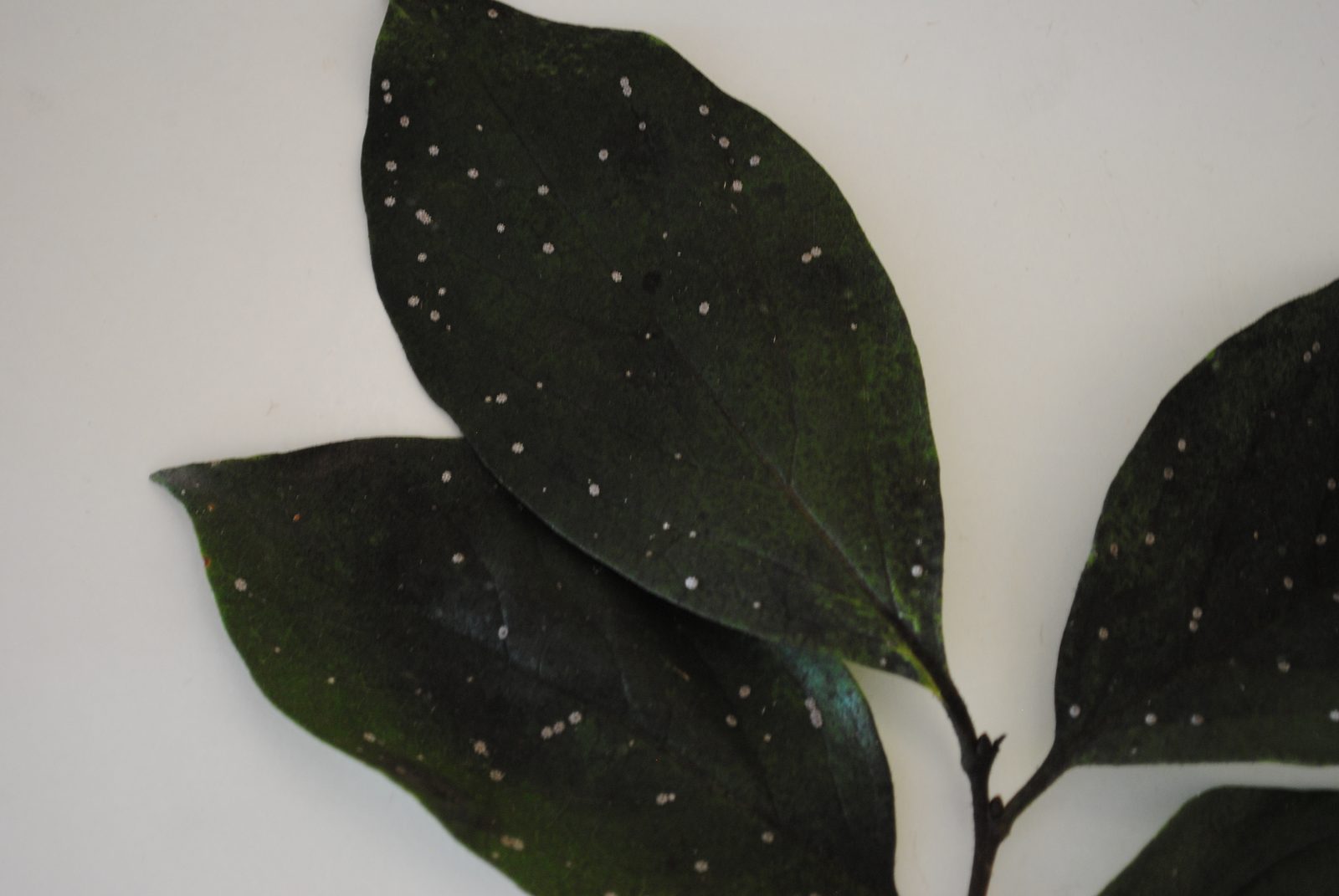
The fig wax scale, Ceroplastes rusci, on fig and persimmon
No synthetic active substance is authorised against it on fig or persimmon in Greece - only paraffin oils, maltodextrin and potassium salts of fatty acids, all of which act physically. That makes the crawler stage the whole of the treatment window, and coverage more important than dose.