
The Maxim persimmon cultivar: rights, ripening and key information

Savvas Pastopoulos, Agronomist MSc, Pastopoulos Agronomics, Neos Mylotopos, Pella, Greece
Maxim® is a persimmon cultivar covered by a plant variety right, distributed under licence and promoted on two claims: early ripening and fruit that needs no deastringency. Both are borne out in the Giannitsa district of northern Greece, where the fruit is not astringent even when unripe, and the cultivar solves precisely the problem that makes Rojo Brillante difficult for the smaller grower, namely dependence on a carbon dioxide chamber. What follows separates what is documented, what is commercial information and what was observed in the field.
Giannitsa district
per the distributor
at the CPVO
deastringency chamber
1. Who holds the rights
The cultivar is marketed as Maxim® and carries a Community plant variety right. The distributor states a registration at the Community Plant Variety Office (CPVO) dated 15 October 2015 under file number 20152399, and gives Spain as the country of origin [1]. The variety belongs to the Spanish group Genesis Exotic, and it is released with a limited number of plants per country [6].
In Italy the distribution rights are held exclusively by Comercial Gallo, based in Massafra in the province of Taranto, which announced in 2019 a planting programme of 500 hectares across the Italian peninsula, starting in Apulia and extending to Emilia, Veneto, Basilicata and Sicily [2] [3].
Anyone considering a planting should ask the supplier in writing who holds the right, how long it runs, what exactly the licence permits and whether there is a limit on the number of plants, because propagation of a protected cultivar without authorisation is not allowed.
2. The tree and the fruit
| Character | Value per the distributor |
|---|---|
| Origin | Spain, Genesis Exotic group |
| Fruit weight | 250 to 350 grams |
| Diameter | 70 to 90 millimetres |
| Skin | Thin, orange |
| Shape | Spherical [6] |
| Flesh | Firm, eaten crisp, with good shelf life [6] |
| Seeds | Seedless, no pollinator required |
| Tree | Medium vigour, regular habit |
| Yield per tree | 60 to 70 kilograms |
| Yield per hectare | In full production at a density of 600 trees per hectare, about 45,000 kg per hectare, picked in passes every 15 days [6] |
All of the above are statements by the distributor [1]. The yields refer to trees in full production under Italian conditions and do not transfer as a forecast to a new Greek planting.
That the fruit is seedless without a pollinator matters in practice and matches the behaviour of Rojo Brillante, where the presence of pollen is a defect rather than an advantage, because seeds create brown areas in the flesh. The logic of orchard design is set out in the article on the Rojo Brillante cultivar.
3. When it ripens
Earliness is the main commercial argument for the cultivar. The distributor gives a harvest window from 25 August to 15 October [1], the Italian trade press describes it as very early, harvested in late August and early September [4], and the first Italian presentations reported harvest in the first half of September [2] [6]. The first Italian plantings were made in 2016 and gave their first crop in 2018 [6].
Closer to Greek reality is the Spanish date, since that is where the cultivar comes from: in Valencia the Maxim harvest starts in mid-September [7]. Against the Giannitsa observation the difference is then only ten days.
Even so, the cultivar remains clearly earlier than Rojo Brillante and Karaliok, which in the same district are picked from mid-October onwards. That is its real value for the Greek grower: it reaches the market when there is no domestic persimmon yet.
The Italian dates do not transfer to Greece. Every new planting needs two or three seasons of records to establish its own harvest window, and the difference between northern and southern Greece is expected to be appreciable.
4. The cultivar is not astringent
Maxim fruit is not astringent. It is not astringent even when unripe, it needs no deastringency chamber and it needs no treatment at all before it leaves the field for the market. This is borne out in the samples from the Giannitsa district as well.
The distributor states the same [1], the Italian press repeats the same, describing fruit that is edible with firm flesh and no treatment [3], and a Valencia trading company found the same at the start of the September 2023 harvest, that the fruit comes off the field sweet, with no astringency to remove [7].
This is where the substantial difference from Rojo Brillante lies, since that is an astringent cultivar [5] and depends entirely on the carbon dioxide chamber, that is on the main investment that makes it difficult for the smaller grower. For comparison, the full deastringency process is described in the article The deastringency process of Rojo Brillante persimmon.
5. The micro-cracks in a circular pattern

The fruit showed superficial micro-cracks arranged in a circular pattern, which darken with ripening and become conspicuous. The picture is the same as that shown by Karaliok in the same district.
For the grower the question is commercial rather than academic: if it affects a few fruit it is a grading matter; if it affects a large proportion it downgrades the batch. The answer requires records on marked trees, with the percentage of affected fruit measured per tree and over at least two seasons. Until then the observation is recorded as it stands.
The cultivation of persimmon under Greek conditions in general, from the soil and the rootstocks to nutrition and the cold store, is covered in a separate article.
6. Sources
The numbers in the text refer to the list below.
- [1] Comercial Gallo. MAXIM, cultivar data sheet [in Italian]. Commercial leaflet of the distributor. Source for the CPVO registration dated 15 October 2015 under file number 20152399, for the Spanish origin, for the harvest window of 25 August to 15 October, for the weight of 250 to 350 g and the diameter of 70 to 90 mm, for the thin skin and firm flesh, for the fruit being seedless and needing no pollinator, for the yield of 60 to 70 kg per tree and for the statement that no deastringency is required.
- [2] Kaki Maxim®: new plants scheduled to go live next year in Emilia and Veneto. FreshPlaza, 26 November 2019. Trade press. Source for the exclusive distribution in Italy by Comercial Gallo of Massafra, Taranto, for the 500 hectare programme, for harvest in the earliest days of September and for the average weight of 250 to 300 g, with statements by general manager Aldo Gallo.
- [3] Kaki Maxim, Open Day: il successo della pugliese Comercial Gallo. Agenfood [in Italian]. Trade press. Source for the expansion of plantings in Apulia, Basilicata, Emilia Romagna and Sicily, for the plantings of 2018 to 2020 and for the statement that the fruit is eaten with firm flesh without deastringency treatments.
- [4] Kaki, tra varietà e tecnica di coltivazione. Plantgest, Image Line Network, 16 October 2020 [in Italian]. Technical trade article. Source for the description of Maxim as very early, harvested in late August and early September, and for the firm and sweet flesh.
- [5] Besada, C. and Salvador, A. (2015). Tecnología poscosecha del caqui. Chapter 12, Instituto Valenciano de Investigaciones Agrarias (IVIA) [in Spanish]. Source for the classification of cultivars into the PCNA, PCA, PVA and PVNA astringency groups and for the placing of Rojo Brillante in the PVA group, that is astringent when the fruit is seedless.
- [6] Maxim®, early persimmon: first production of 2016 plants. FreshPlaza, 2018. Trade press. Source for the cultivar belonging to the Spanish Genesis Exotic group and being released with a limited number of plants per country, for harvest in the first half of September, for the diameter of 70 to 80 mm and the weight of 250 to 300 g, for the spherical shape, the firm flesh and the good shelf life, for the 45,000 kg per hectare at a density of 600 trees picked in passes every 15 days, and for the first Italian plantings of 2016 with their first crop in 2018.
- [7] Spanish persimmons much better than last season. FreshPlaza, 13 September 2023. Trade press, with statements from a Valencia trading company. Source for the start of the Maxim harvest in Spain in mid-September and for the observation that the fruit comes off the field sweet, with no astringency to remove.
The cultivar characteristics given here come from commercial leaflets and from the trade press, are not published experimental data, and have not been verified under Greek conditions. Ripening dates, fruit size and yields depend on the site, the rootstock, the age of the planting and the season.
Maxim® is a protected cultivar. Propagation and distribution of plant material without the authorisation of the holder of the right is not permitted.
Every planting decision is made at the grower's responsibility, following an on-site assessment by a licensed agronomist. Pastopoulos Agronomics accepts no liability for the use of the information in this article.
Related articles
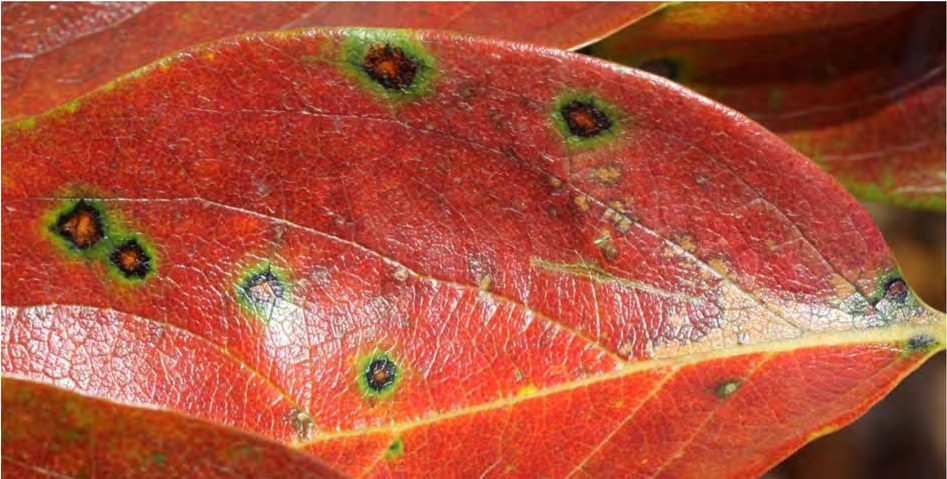
Pests and diseases of persimmon (Diospyros kaki) in Europe and Greece: epidemiology, differential diagnosis and action thresholds
Circular leaf spot (Plurivorosphaerella nawae), the pathogen that adapted to the semi-arid climate of Valencia and is not a quarantine organism, with the comparison between Spain and Korea and the role of drip irrigation. Angular leaf spot, Pestalotiopsis, anthracnose, and the twelve species of Diaporthe, Eutypella and Botryosphaeriaceae identified inside the wood. Postharvest rots: why Alternaria black spot became the limit of storage life after 1-MCP, and how extra irrigation before harvest is paid for in the cold room two months later. Crown gall, vascular wilt, root rots and phytoplasmas. Mealybugs and ants, wax scale, mussel scale, the orange spiny whitefly as a quarantine organism, fruit flies. Herbicide toxicity mistaken for a fungal leaf spot, a differential diagnosis table with fifteen pairs, action thresholds with the sampling method, and the four exotic pathogens threatening the Mediterranean. Thirteen photographs, five from Greek orchards.
Growing avocado in Greece: cultivars, soil, climate, diseases and pests
Three botanical races, and the Mexican one supplies frost tolerance while the West Indian one supplies tolerance of lime and salt: Greece asks for both at once. With Greek data from ELGO Chania: across ten orchards over six years Fuerte met the dry matter threshold in only two seasons and Zutano in none. In detail: synchronous dichogamy and the cultivars one by one, the temperature limits, soils at pH up to 8.3 and calcium carbonate up to 20.7 per cent, eleven rootstocks, planting distances and training.
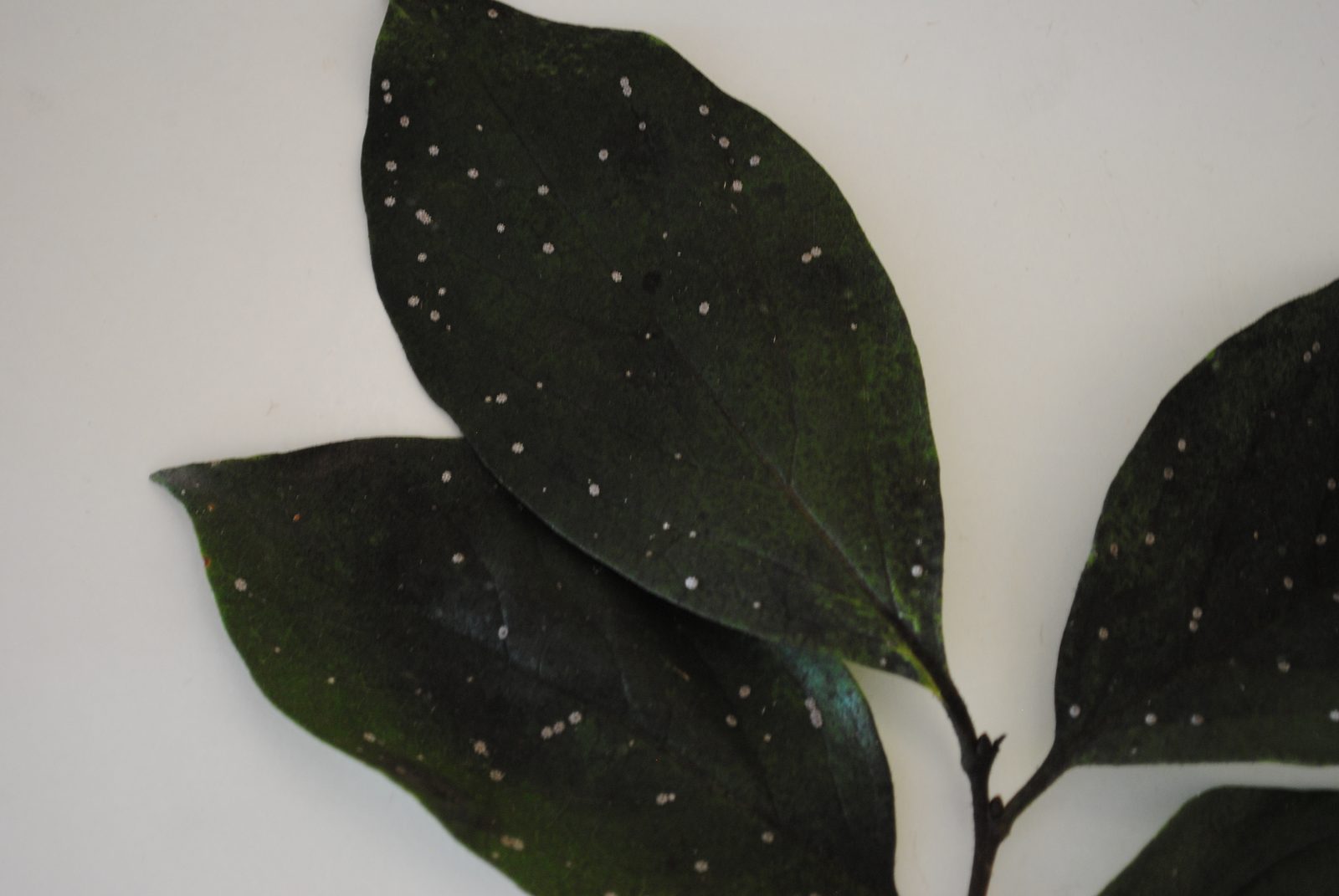
The fig wax scale, Ceroplastes rusci, on fig and persimmon
No synthetic active substance is authorised against it on fig or persimmon in Greece - only paraffin oils, maltodextrin and potassium salts of fatty acids, all of which act physically. That makes the crawler stage the whole of the treatment window, and coverage more important than dose.