
Growing avocado in Greece: cultivars, soil, climate, diseases and pests

Savvas Pastopoulos, Agronomist MSc, Pastopoulos Agronomics, Neos Mylotopos, Pella, Greece
Avocado growing is expanding in Greece, and the decisions taken now, cultivar, rootstock, site and tree shape, commit the orchard for twenty years. This text examines the races and the cultivars, the soil and the water, the temperatures, the rootstock, the spacing and the training, and finally the diseases and pests. The conclusion that keeps returning is that there is no single correct choice, there is the correct choice for the particular site.
- Where the crop stands in Greece today
- The three races, the key to everything else
- The cultivars, one by one, and the flowering type
- The temperature limits of flowering
- Frost, with the limits by race
- Soil and lime, with Greek measurements
- Irrigation water and salinity
- The rootstock, one by one
- Planting distances and training
- The diseases
- The pests
- Sources
1. Where the crop stands in Greece today
The centre of Greek avocado growing is Chania and western Crete more generally. Press reports from May 2026 state that the area on the island exceeds 1,500 hectares [12]. The value comes from the press, not from an official statistical series, and is given only as an order of magnitude. For the real area, the correct reference points are the Hellenic Statistical Authority and the single area declarations.
There is, however, published Greek research, and it is not a single paper. The Institute of Olive Tree, Subtropical Crops and Viticulture of ELGO Dimitra, at Chania, has published a series of studies on avocado under Greek conditions. Three of them are used here:
- Fertiliser experiments in four orchards of western Crete, at Souda and Vatolakkos near Chania, with Fuerte, Hass and Lamb Hass, describing the region explicitly as cool subtropical [15]. From that work come the soil data in chapter 6, the rootstocks actually in use on Crete in chapter 8, and the yields per tree.
- Monitoring of maturation in ten orchards, across five areas of Chania, over six years, in relation to air temperature [22]. By the authors' own statement these are the first data on avocado maturation in relation to temperature, and they change cultivar choice for Greece. They are set out in chapter 3.
- A salinity experiment on Fuerte plants, showing where chloride toxicity first appears within the leaf [23]. It is set out in chapter 7.
The same institute also runs a laboratory service analysing avocado maturity for growers [24], described in chapter 3.
The geography is not accidental. Western Crete combines a winter without serious frost with spring temperatures close to the operating limit of flowering. As the crop moves further north or higher in elevation, the binding limit shifts from the soil to frost.
2. The three races, the key to everything else
Avocado does have cultivars, hundreds of them. Its peculiarity is something else: those cultivars do not come from a single gene pool. They come from three botanical races, with different geographical origins, different morphology and very different tolerances, and many commercial cultivars are hybrids of two of them. That is why two avocado cultivars can behave more differently in the field than two separate species in another genus.
| Characteristic | West Indian race | Mexican race | Guatemalan race |
|---|---|---|---|
| Botanical name | P. americana var. americana | P. americana var. drymifolia | P. nubigena var. guatemalensis |
| Origin | Caribbean, West Indies | Mexico, Central America | Subtropical regions |
| Fruit shape | Variable | Small, elongated | Large, round |
| Fruit skin | Leathery, glossy | Thin, smooth, green, membranous | Thick |
| Oil content | Low | High | High |
| Leaf | No distinctive odour, normal green | Anise or sassafras odour, juvenile leaves glaucous | Not reported |
| Cold tolerance | Sensitive, damaged below -1 to -2 °C | Tolerant, withstands as low as -4 °C | Moderate |
| Lime tolerance | The best, some selections highly resistant | Intermediate sensitivity | The most susceptible to chlorosis |
| Salt tolerance | The best | Low to moderate | Intermediate |
Morphology, origin, leaf, oil content and damage temperatures by race from the review [14]. The ranking for lime and chlorosis from [17], for salt from [8] and [17].
The contradiction that has no solution, and that defines the Greek problem
Reading the last two rows of the table, it becomes clear that the two properties a Greek grower needs sit at opposite ends. The Mexican race supplies frost tolerance and is moderate to poor on calcareous and alkaline soils. The West Indian race tolerates lime and salt and is the most sensitive to cold.
Greek soils are largely calcareous and alkaline, and irrigation water in coastal zones carries chloride. In other words Greece asks for both extremes at once. The answer is not one cultivar or one rootstock, but a ranking per site: which of the two limits binds first on the particular field.
And one warning that costs years: hybrids are not a compromise. Hybrids of the Guatemalan and West Indian races, such as Lula, Hall, Colinson and Booth 8, behaved with respect to chlorosis more or less like their Guatemalan parent, and their use was discontinued [17].
3. The cultivars, one by one, and the flowering type
The phenomenon is called synchronous dichogamy. The avocado flower opens twice, once as female and once as male, at different times of day, and all the flowers on a tree do it in step. Type A opens first in the morning as female, closes at midday and reopens as male in the afternoon of the following day. Type B does the reverse [6]. The practical consequence is that a tree rarely self-pollinates, because at the moment its flowers are female it has no pollen of its own.
Type A cultivars
| Cultivar | Race and fruit | What sets it apart |
|---|---|---|
| Hass | Hybrid. 170 to 395 g. Pebbly skin, green turning black at ripeness [18] | The leading commercial cultivar in California [18]. The only one with a black skin at ripeness, which makes it identifiable on the shelf. Type A in every source [2] [18] |
| Lamb Hass | Hybrid, related to Hass. 285 to 510 g. Pebbly skin, black even before ripeness [18] | Matures later than Hass [18]. An upright tree form, which brings it into consideration for close spacing [2] |
| Gwen | Hybrid. 170 to 425 g. Pebbly skin, green also at ripeness [18] | Picked from April through October in California, a very long window [18]. Together with Lamb Hass it belongs to the genetic line that often flowers already in the second year after planting [2] |
| Anaheim | Guatemalan. 510 to 905 g, the largest fruit in this table. Medium rough, glossy green skin [18] | Very prolific and regular, bearing up to 100 kg per tree annually [18]. Being Guatemalan, it is the worst choice for calcareous soil [17] |
| Hazzard | Guatemalan. 340 to 455 g. Rough green skin [18] | A dependable producer, but unsuited for commercial packing [18]. Its flowering type is disputed, see the box below |
| Reed | Guatemalan. Round, thick green skin [3] | One of the type A cultivars that responded better to low temperatures during flowering [3], which is exactly the Greek question |
| Pinkerton, Wurtz, Rincon, Jalna | Not sufficiently documented | Recorded as type A [2] [3]. Wurtz, Rincon and Jalna belong to the same group that tolerated cool flowering better [3]. For Jalna no other documented description was found beyond the flowering type |
Type B cultivars
| Cultivar | Race and fruit | What sets it apart |
|---|---|---|
| Bacon | Mexican. 285 to 510 g. Smooth skin, green also at ripeness [18] | The most important cultivar in this table for Greece. A consistent, heavy producer with excellent frost tolerance [18], and the single exception among type B cultivars, keeping a high proportion of female-stage flowers at 17 °C [3] |
| Fuerte | Mexican by Guatemalan hybrid. 255 to 455 g. Medium skin texture, green [18] | For decades the Californian commercial cultivar, valued for its winter season [18]. But its flowering is disrupted above 30 °C or below 20 °C, and at maxima of 18 to 21 °C with minima of 7 to 12 °C no female flower opened at all [2] [3] |
| Ettinger | Mexican. 255 to 565 g. Smooth and thin green skin. Flesh clear light yellow, free of fibre, soft [18] | Of Israeli origin. The large seed is loose in the cavity and the seedcoats adhere to the flesh [18] |
| Edranol | Hybrid. 255 to 510 g. Medium skin texture, green [18] | Excellent flavour and frost resistant, but the skin russets badly in interior areas and it performs better near the coast [18]. This is exactly the kind of constraint that never appears in a nursery catalogue |
| Zutano, Whitsell, SirPrize, Ryan, Sharwil | Not included in the variety collection consulted | Recorded as type B [2] [3]. Ryan, Edranol and Sharwil showed female sterility at 17 °C [3]. Zutano is also used as a seedling rootstock, see chapter 8 |
Ettinger is type B, and it is documented. It is recorded as type B in the avocado variety collection of the University of California, Riverside [18], although it is absent from the two principal flowering sources [2] [3].
Hazzard has a contradictory record. The Riverside collection gives it as type A [18], while the experimental flowering work places it among the type B cultivars that showed female sterility at 17 °C [3]. The contradiction is not resolved by the available data and is recorded as it stands. Before trees of any cultivar are bought, the flowering type is to be requested from the nursery in writing.
The practical consequence of the distinction is orchard layout. The recommendation is a pollinizer row at least every fourth row, and yield is better when type A and type B trees are one or two rows apart [2]. The growing guide of the Municipality of Kissamos gives a ratio of about 8 to 1 in favour of the main cultivar [1].
Maturation, and the Greek finding that changes cultivar choice
A cultivar is not judged by its flowering alone. It is also judged by whether its fruit has time to mature on that particular site. Avocado does not soften on the tree, so harvest maturity is defined legally by the dry matter content of the fruit. Regulation 387/2005 of the European Union sets minimum thresholds [24].
| Cultivar | EU minimum dry matter | What was found in ten orchards near Chania, 2017 to 2022 |
|---|---|---|
| Hass | 21% | Consistently exceeded it in December, in every year [22] |
| Fuerte | 20% | Reached it in October in only two of the six years, 2018 and 2019 [22] |
| Zutano | 19% | Did not reach it in October in any year [22] |
The two years in which Fuerte met the threshold were exactly the years with the highest mean October temperature. The year with the lowest October mean, 18.4 °C in 2017, gave the lowest dry matter values in both Fuerte and Zutano [22]. In other words maturation on Crete is marginal and year-dependent, not assured.
The practical consequence is harsh and useful: an early cultivar under Greek conditions may not have legally marketable fruit in its own season. Fruit below the threshold is not merely unripe, it fails the marketing standard. For Zutano in particular, the finding means that as a fruiting cultivar it is a doubtful choice for western Crete, regardless of its wide use as a rootstock, see chapter 8.
4. The temperature limits of flowering
This is the most important part of the crop for Greece, and the least obvious. The A and B mechanism requires warmth in order to work.
The second, independent source agrees and adds the more important part: in controlled experiments, type B cultivars showed female sterility at a day temperature of 17 °C, with Bacon the exception. Type A cultivars tolerated low temperatures better, although their cycles lengthened considerably. For Fuerte, day temperatures above 30 °C or below 20 °C disrupted flowering. The optimum for pollen tube growth is 25 °C [3].
The figures above were measured in California [2] and under controlled conditions [3], not in Greece. The parameter driving them, however, is temperature, which is directly measurable at the planting site, so the limits transfer as a check criterion, not as a prediction.
The check is specific: for the orchard site, the mean night minimum during the flowering period, that is in spring, is compared against 21 °C. The Greek lowlands do not reach that in spring in any zone of the country, so the realistic question is not whether the cycle will be irregular, but by how much.
The consequence changes a decision: a type B pollinizer is no guarantee in a cool Greek spring, since at 17 °C type B can be functionally sterile in the female stage [3]. The same low temperature, however, causes overlap of the male and female stages within the same tree, which helps fertilisation in a planting of pure type A [2]. In other words the cold limit gives with both hands. If a pollinizer must nevertheless be chosen for a cool spring, Bacon is the only type B with documented function at 17 °C [3].
There is an upper limit too. Young Hass plants show a heat damage threshold between 49 and 51 °C under low-light conditions, and 60 per cent shade netting reduces leaf and canopy temperature by up to 4 °C during extreme heat events [20]. The growing guide of the Municipality of Kissamos separately reports that strong northerly winds and high temperatures in early summer cause significant fruit drop, and sets temperatures above 37 °C as adverse [1]. That value is a Greek field observation and is given as such.
5. Frost, with the limits by race
Frost hardiness is the criterion that rules sites out, and it differs by race and by cultivar. Two independent sources give values, and they do not fully agree.
| Race or cultivar | Damage temperature | As given in the source | Source |
|---|---|---|---|
| West Indian | -2.2 to -1.7 °C | 28 to 29 °F | California [4] |
| West Indian | -1 to -2 °C | same | Review [14] |
| Guatemalan | -2.8 to -1.7 °C | 27 to 29 °F | California [4] |
| Hass | -3.9 to -1.7 °C | 25 to 29 °F | California [4] |
| Mexican | -6.1 to -2.8 °C | 21 to 27 °F | California [4] |
| Mexican | down to -4 °C | same | Review [14] |
The order in which tissues are damaged, from the most sensitive to the most resistant, is: new growth and flowers, young fruit, one to two year old twigs, mature leaves, mature fruit, and last of all the large scaffold limbs and the trunk [4].
The practical conclusion for site selection is that the difference between the Mexican and the West Indian race is of the order of two to four degrees, depending on the source, and those degrees are usually the difference between damage and destruction on a cold Greek night.
6. Soil and lime, with Greek measurements
The first requirement is not chemical but physical. Avocado needs deep, well aerated soil with excellent drainage. For southern California the requirement is quantified: free drainage to a depth of at least 90 cm, three feet in the source, with no clay layer, hardpan or solid rock, although cracked or fissured rock allows adequate drainage [13]. The reason appears in the chapter on diseases: the main disease of the crop is soilborne and is favoured by standing water.
What the sources say about pH
| Source | What it gives | The reason |
|---|---|---|
| The natural habitat of the species [17] | In its native lands avocado grows on acidic soil, pH 3.5 to 5.5 | Shows which way the species leans physiologically |
| Review on iron nutrition [5] | Ideal 5.5 to 6.5. Above pH 7, iron deficiency is likely | High pH locks up iron and produces chlorosis |
| Hawaii manual [6] | Optimum 6.2 to 6.5. Below 6.2, Phytophthora is favoured | Low pH favours the soilborne pathogen and hinders calcium uptake |
| University of California, field experience [19] | Preference 5.5 to 6.5, "although they grow under many other situations" | Limestone holds pH above 7, usually around 7.5 and up to 8.3 |
The synthesis, and why the window is not a limit
The sources converge on an optimum near 6.2 to 6.5: above it the iron problem begins, below it Phytophthora is favoured. That, however, is the optimum, not the limit beyond which the crop stops. The same source that gives 5.5 to 6.5 adds that the trees grow elsewhere too [19].
Practice in two countries shows it. In southern Florida the entire avocado production area sits on highly calcareous soils with a pH of 7.4 to 8.5, where iron deficiency is the most common and costly nutritional deficiency of the crop and is dealt with by compulsory chelated iron [16]. And on Crete, one of the four orchards in the published Greek work had a pH of 8.3 and calcium carbonate of 20.7 per cent, with nine-year-old trees yielding 64.0 kg per tree for Hass and 63.9 for Fuerte [15].
So the right way to read a soil analysis is not "inside or outside the window". It is which side of the optimum the field sits on, and what that costs every year, because the two sides call for opposite actions and opposite rootstocks.
The Greek numbers
The published Greek work gives the range in which avocado is already being grown in western Crete [15].
| Orchard | pH | CaCO3 | Organic matter | Conductivity |
|---|---|---|---|---|
| Experiment 1, western Crete | 7.41 | 0.37% | 4.29% | 0.17 mS/cm |
| Souda, Chania | 7.54 | 1.09% | 1.88% | 0.37 mS/cm |
| Vatolakkos, Chania | 6.27 | 0.25% | 2.41% | 0.11 mS/cm |
| Experiment 3, western Crete | 8.30 | 20.70% | 6.72% | 0.53 mS/cm |
How critical the rootstock becomes is shown by a single sentence: trees grafted on one rootstock stay green even when soil calcium carbonate reaches 60 per cent, while trees on another are chlorotic already at 3 per cent [17]. The twentyfold difference is not due to the cultivar, nor to fertilisation. It is due to the root.
7. Irrigation water and salinity
Avocado is among the most salt sensitive of fruit trees, and the growing guide of the Municipality of Kissamos states this explicitly [1]. The measured values give the magnitude.
| Water class | Conductivity | Total salts |
|---|---|---|
| Excellent | up to 0.25 mmhos/cm | up to 175 ppm |
| Good | 0.25 to 0.75 | 175 to 525 ppm |
| Permissible | 0.75 to 2.0 | 525 to 1,400 ppm |
| Unsuitable | above 3.0 | above 2,100 ppm |
The effect of the rootstock is measured and large. When chloride in the irrigation water is 100 ppm, production on West Indian and on Mexican rootstock is approximately equal. When it reaches 300 ppm, Hass production on West Indian rootstock was approximately double that on Mexican [21].
The value is diagnostic: the first visible sign of chloride toxicity is burn at the leaf tip, not general chlorosis. When it appears, the question is not nutritional but one of water quality, and the answer is water analysis and leaching, not fertiliser.
8. The rootstock, one by one
Rootstock choice is the only decision that addresses Phytophthora, salt and lime at the same time. It is also the decision where the international literature answers only two of the three.
Tolerance of root rot. How well the rootstock's roots withstand attack by the soilborne oomycete Phytophthora cinnamomi, the disease of chapter 10. A 5 means the tree stays healthy and productive in infested soil. A 0 means the tree is lost in infested soil. It does not cover collar rot or trunk canker, which are separate problems.
Tolerance of salt. How well the roots hold back the chloride and sodium of the irrigation water so that they do not reach toxic levels in the leaf. A 5 means the tree produces normally on brackish water. A 1 means leaf burn, defoliation and yield loss on water that other rootstocks tolerate. This is the column that decides a coastal borehole.
The ratings are a relative ranking between rootstocks, not a prediction of percentage loss. A 3 does not mean 60 per cent survival, it means "better than the 2s and worse than the 4s" in the same trials.
| Rootstock | Race and propagation | Tolerance of root rot caused by Phytophthora cinnamomi, 0 to 5 | Tolerance of salt in the irrigation water, 0 to 5 | What the grower needs to know before ordering |
|---|---|---|---|---|
| Dusa (Merensky 2) |
Mex. x Guat., clonal | 5 | 4 | The most widely used clonal rootstock internationally. Yet in trials on high pH soils it developed heavy chlorosis requiring chelated iron [19]. In other words it solves Phytophthora and salt, not lime |
| Latas (Merensky 1) |
Mex. x Guat., clonal | 4.5 | 5 | The highest salinity rating in the table [8]. No published value for calcareous soil was found |
| Uzi | Mexican, clonal | 5 | 4 | Its salinity rating is disputed by later trials, see the box below |
| Zentmyer | Mexican, clonal | 5 | 1 | Top of the class on Phytophthora, among the worst on salt [8]. The wrong choice for a coastal borehole |
| Martin Grande (G755) |
P. americana x P. schiedeana, clonal | 5 | 2 | Three of its clones developed chlorosis and failed to produce normal yields [17]. It also has the lowest frost rating in the table [8] |
| Thomas | Mexican, clonal | 4.5 | 1 | The same trap as Zentmyer |
| Duke 7 | Mexican, clonal | 3 | 3 | The first widely used clonal rootstock. Already in use on Crete [15] |
| Toro Canyon | Mexican, clonal | 2.5 | 3 | Moderate against soil Phytophthora, but the best in the table against P. mengei [8] |
| G-6 | Mexican, from seed | 2 | 2 | Already in use on Crete, in two of the four orchards in the Greek work [15], despite its low rating on both counts |
| Borchard | Mexican, clonal | 0.5 | 3 | Essentially defenceless against Phytophthora [8]. Only for soil that genuinely drains |
| Topa Topa | Mexican, from seed | 0 | 2 | A nursery-convenience seedstock, not a performance rootstock |
| Zutano | Mex. x Guat., from seed | not rated | not rated | It does not appear in the ratings table at all [8]. Already in use on Crete, in the orchard with 20.7 per cent calcium carbonate [15]. As a rootstock it is widespread, but as a fruiting cultivar it did not reach the dry matter threshold in any year near Chania, see chapter 3 [22] |
Ratings are on a scale of 0 to 5, where 5 is the greatest tolerance, from the table of the Statewide IPM Program of the University of California [8]. They represent a relative ranking from American trials, not an absolute prediction in Greek soil.
The ratings table has no column for calcareous soil. Neither has the corresponding handbook chapter. Modern clonal rootstocks were selected for Phytophthora and, some of them, for salinity. None was selected for lime.
The answer that exists in the literature is at the level of the race, not the rootstock: West Indian seedling rootstocks are resistant to lime-induced chlorosis, some of them highly resistant, the Mexican race is of intermediate sensitivity, and the Guatemalan is the most susceptible [17]. In Israel, West Indian rootstocks of the Nachlat group and Maoz are used in commercial orchards on soils containing 50 per cent or more calcium carbonate [5].
So for a Greek calcareous field the question to the nursery is not only which clonal rootstock, but of which race. And the honest position is that a rootstock solving Phytophthora, salt and lime at once is not yet commercially available.
Three things the ratings do not show
- Clonal or from seed, and why it matters. Phytophthora tolerance is inherited reliably only through clonal propagation. A seedling raised from the same tree gives unpredictable progeny. That is why Dusa, Latas, Duke 7 and Toro Canyon are clonal, whereas Topa Topa, G-6 and Zutano, raised from seed, are cheap and uniform in the nursery but carry no tolerance.
- The salinity rating of Uzi is contested. The table gives it 4 [8], but later trials under saline conditions place it among the worst. Where water is the binding limit, that figure should not be taken for granted.
- What is actually done on Crete is not what the table recommends. In the four orchards of the Greek work the rootstocks were G-6 from seed, Duke 7 clonal and Zutano from seed [15]. No Dusa, no Latas. The distance between the literature and the Greek nursery is real and worth asking about before ordering.
9. Planting distances and training
In the wild the avocado reaches 20 metres. In commercial cultivation it is pruned to stay under 5 metres, so that harvesting, pruning and fertilising remain feasible. On shallow soils it reaches about 9 metres, while on deep, moist clay loams it can extend to 18 metres [14]. Spacing and training are the answer to that size.
The distances, from measured sources
| System | Distance | Trees per hectare | Source and context |
|---|---|---|---|
| Traditional square | 6.1 x 6.1 m | 269 | California, 109 trees per acre [13] |
| Traditional rectangle | 4.6 x 6.1 m | 359 | California, 145 trees per acre, with thinning planned [13] |
| Optimum for Hass | 6.0 x 5.0 m | 333 | Experimentally optimal for yield and quality [14] |
| Optimum for Hass | 5.0 x 5.0 m | 400 | The same experiment [14] |
| High density | 2.3 x 2.3 m | 1,914 | California, only for cultivars with a single dominant trunk, Lamb Hass, Reed, Gwen [13] |
| General range | 3 to 12 m | 69 to 1,111 | According to cultivar vigour, with wider spacing for Fuerte [14] |
Training
Training an avocado starts early and has a definite shape. The first three to four years are the decisive ones for the framework of the tree, and the system widely recommended is the central leader, that is a central axis with the scaffold limbs distributed along it [14]. The choice of shape is influenced by field orientation, row direction relative to the wind, soil characteristics, the irrigation system, the cultivar, the spacing and the harvesting method [14].
After establishment, pruning divides into two entirely different operations [14]:
- Annual maintenance pruning, which removes central or lateral branches so that light enters and pest risk falls. It is carried out after harvest and before flowering, and it improves yield, tree health and the practicality of harvesting and spraying.
- Renewal pruning, roughly every ten years, which removes major limbs or whole trees for orchard renovation. Recovery of production after such an intervention may require several growing seasons.
At scale the work is mechanical. In Florida, most growers apply mechanical topping to 4 to 7 metres and hedging to maintain a 2.5 metre row middle, pruning alternate rows in any one year. More recently the mechanical work is combined with hand pruning that removes selected major limbs, so that light returns to the lower inside of the canopy and new productive growth develops there [16].
The distances and training systems come from California, Florida and from an international review. No published Greek trial of spacing or training was found. The growing guide of the Municipality of Kissamos gives distances of 4 to 5 metres on berms [1], a figure compatible with the experimental optimum of 5.0 by 5.0 metres [14], and it is quoted here as field information.
10. The diseases
Root rot caused by Phytophthora cinnamomi
This is the disease that defines the crop. It is described as a limiting factor of production in most avocado growing countries [9]. Affected trees show small, pale leaves, progressive defoliation and dieback of branches, while the root system rots.
Management is preventive and it has an order of priority: drainage and avoidance of over irrigation, a tolerant rootstock, healthy planting material, avoidance of moving soil and water from infested sites, gypsum and organic mulch [9].
The international literature reports for root rot phosphorous acid, potassium phosphonates, fosetyl-Al and metalaxyl, applied to the soil, as a foliar spray, with the irrigation water, as a trunk paint or by trunk injection [9].
The first two of those are authorised in Greece for avocado. The Ministry authorisations database lists eleven products with Phytophthora as a target on the crop, with the active substances fosetyl and potassium phosphonates, applied as a foliar spray at defined growth stages [11]. Metalaxyl was not found as a target on the crop. The current picture, with rates, number of applications and pre harvest intervals, is at fyto.plantprotect.gr, which is in Greek and valid in Greece only.
Avocado sunblotch viroid
The EPPO Global Database records the viroid as present in Greece, with a few occurrences, and explicitly on Crete [10].
The viroid is transmitted by grafting and by seed, that is by the planting material itself, it cannot be controlled once established, and infected trees may show no symptoms while still transmitting. For a crop that is starting out, this means one thing: certified, tested material, with documents. It is the cheapest insurance in the whole establishment and the only one that cannot be bought after the fact.
Anthracnose and fruit rots
Anthracnose, caused by Colletotrichum species, is internationally the main postharvest rot of avocado, and it is managed culturally by pruning that opens the canopy [20]. In the Ministry authorisations database no target was found for anthracnose on the crop, nor for Rosellinia, nor for wood boring insects [11]. The absence of a target does not mean the problem does not exist. It means that, should it appear, there is no legal chemical answer and the response will be entirely cultural.
11. The pests
The check was made along two lines: what the EPPO Global Database records for Greece, and what the Ministry authorisations database recognises as a target on the crop.
| Pest | Status in Greece according to EPPO [10] | Significance |
|---|---|---|
| Mediterranean fruit fly Ceratitis capitata |
Present, widespread | The main fruit pest under Greek conditions, and the target with the most entries in the authorisations database [11] |
| Persea mite Oligonychus perseae |
Present, restricted distribution, with a record for Crete | The mite specific to this crop, already established where the crop is |
| Avocado lace bug Pseudacysta perseae |
Not recorded in Greece. In Europe only in Portugal | There is no record of it, yet it already exists as an authorised target on the Greek label [11]. That footprint is regulatory and is not evidence of presence |
| Shot hole borer Euwallacea fornicatus |
Not recorded in Greece | The borer associated with Fusarium fungi that has caused severe damage to avocado elsewhere. Monitoring, not intervention |
Beyond these, the authorisations database recognises on the crop mealybugs, aphids, thrips, whiteflies, scale insects and spider mites, that is the usual complex of Mediterranean evergreen fruit trees [11]. The thrips Heliothrips haemorrhoidalis stands out with a large number of authorised products.
12. Sources
The numbers in the text refer to the list below.
- [1] Avocado, a growing guide, Municipality of Kissamos, Office of Rural Development, in Greek. Full text. A Greek field source with no reference to experimental data. Quoted as information, not as documentation: the limit of 20 per cent total calcium and of 10 per cent with alkaline pH, the pollinizer ratio of 8 to 1, the spacing of 4 to 5 metres, the 37 C limit and the fruit drop caused by northerly winds.
- [2] Avocado Flowering and Pollination, Book 1 Chapter 3, University of California Agriculture and Natural Resources. Full text. Source for the classification into types A and B, for the 21 C limit, for zero fruit set below 16 C, for the absence of female flowering in Fuerte at maxima of 18 to 21 C with minima of 7 to 12 C, for the pollinizer row every fourth row, and for the early flowering of the Gwen line. California.
- [3] Flowering, pollination and fruit-set of avocado, Sedgley M., Proceedings of the First World Avocado Congress. Full text. An independent second source for the A and B classification. Source for female sterility of type B at 17 C with Bacon the exception, for the better tolerance of type A cultivars to low temperature, for the disruption of Fuerte flowering above 30 C or below 20 C, and for the 25 C optimum for pollen tube growth. Controlled conditions.
- [4] Effects of Freezes on Avocado Trees, California Avocado Commission. Full text. Source for the damage temperatures by race and for the order in which tissues are damaged. The source itself describes the values as general indications. California.
- [5] Iron nutrition and deficiency: a review with emphasis on avocado, Revista Chapingo. Full text. Source for the ideal pH of 5.5 to 6.5 and for iron deficiency above pH 7, and for the Israeli West Indian rootstocks of the Nachlat group and Maoz in commercial orchards with 50 per cent and more calcium carbonate.
- [6] Avocado, HC-4, College of Tropical Agriculture and Human Resources, University of Hawaii. Full text. Source for the mechanics of A and B flowering, and for the optimum pH of 6.2 to 6.5 with the observation that below 6.2 Phytophthora is favoured. Hawaii.
- [7] Strategies in managing salinity for avocado production, University of California. Full text. Source for the loss threshold at 0.75 dS/m with 100 ppm chloride, for the inhibition of water uptake at 4 dS/m, and for the classification of irrigation water quality. California.
- [8] Rootstock Tolerance to Disorders and Pathogens, Avocado, UC Statewide IPM Program. Full text. Source for the 0 to 5 ratings of rootstocks against Phytophthora, salinity and frost, for the race of each and for the method of propagation, clonal or from seed. The table does not rate tolerance of calcareous soil and does not include Zutano. California.
- [9] Avocado Root Rot and Management, University of California. Full text. Source for the description of the disease as a limiting factor of production in most countries, for the order of preventive measures, and for the active substances used internationally: phosphorous acid, potassium phosphonates, fosetyl-Al and metalaxyl, with their application methods.
- [10] EPPO Global Database, distribution pages for Phytophthora cinnamomi (PHYTCN), Avocado sunblotch viroid (ASBVD0), Oligonychus perseae (OLIGPA), Ceratitis capitata (CERTCA), Pseudacysta perseae (PSEYPE) and Euwallacea fornicatus (XYLBFO). Source for the status of each in Greece and for the separate records for Crete. EPPO maintains distribution data only for the organisms it monitors, so the absence of a page does not mean the absence of the organism.
- [11] Hellenic Ministry of Rural Development and Food, database of authorised plant protection products, as published at fyto.plantprotect.gr, in Greek, valid in Greece only. Reading of the crop ΑΒΟΚΑΝΤΟ, data release of 28 September 2026. Source for the eleven products with Phytophthora as a target and their active substances, for the absence of a target for anthracnose, Rosellinia and wood boring insects, and for the recognised pests of the crop. Authorisations change and are always checked live.
- [12] Greek press reports, May 2026, on the area of the crop on Crete, for example Eleftheria, in Greek. A secondary source. Given only as an order of magnitude. No accessible primary statistical series was found.
- [13] Planting the Avocado Tree, Book 1 Chapter 6, University of California Agriculture and Natural Resources. Full text. Source for the planting distances of 20 by 20 and 15 by 20 feet with 109 and 145 trees per acre, for high density planting at 7.5 by 7.5 feet and its limitations, for the intention to thin and the consequences of not doing so, and for the requirement of free drainage to a depth of three feet, that is 91 cm. California.
- [14] Patra S. et al. (2025). Unlocking the Potential of Avocado in India: Exploring Diversity, Cultivation Practices, and Pathways to Progress. Applied Fruit Science 67:154. Full text. Peer-reviewed review. Source for the table of characteristics of the three races, for tree height in the wild and in cultivation, for the spacing range of 3 to 12 metres, for the experimental optima of 6.0 by 5.0 and 5.0 by 5.0 metres in Hass, for the central leader system in the first three to four years, and for the distinction between annual maintenance pruning and renewal pruning.
- [15] Tzatzani T.T., Psarras G., Scuderi D., Kokolakis E. and Papadakis I.E. (2022). Effect of Organic Fertilizers on Avocado Trees (Cvs. Fuerte, Hass, Lamb Hass) in Western Crete, a Cool Subtropical Region. Sustainability 14(19):12221. Full text. The only published Greek experimental work located for this crop. Source for the soil data of four orchards in western Crete, for the rootstocks in use there, and for the yields of nine-year-old trees.
- [16] Crane J., Evans E. and Balerdi C. (2007). A Review of the Florida Avocado Industry. Proceedings of the Sixth World Avocado Congress, University of Florida IFAS. Full text, from a file supplied. Source for the calcareous soils of the Florida production area at pH 7.4 to 8.5 and the compulsory use of chelated iron, and for the three pruning systems: topping to 4 to 7 metres, hedging to a 2.5 metre row middle, and the combination with hand pruning.
- [17] Ben-Ya'acov A. and Michelson E. (1995). Avocado Rootstocks. Horticultural Reviews 17:381-429. Full text. Source for the acidic pH 3.5 to 5.5 of the natural habitat of the species, for the ranking of the three races with respect to lime-induced chlorosis, for the comparison of 60 per cent against 3 per cent calcium carbonate depending on the rootstock, for the behaviour of Guatemalan by West Indian hybrids, and for the chlorosis of the G755 clones.
- [18] Avocado Variety Collection, Variety List, University of California, Riverside. Full text. Source for the race, flowering type, fruit weight, skin texture and description of the cultivars Hass, Lamb Hass, Gwen, Anaheim, Hazzard, Bacon, Fuerte, Ettinger and Edranol. The cultivars Reed, Pinkerton, Zutano, Whitsell, SirPrize, Wurtz, Rincon, Jalna, Ryan and Sharwil are not included in that list.
- [19] Questions and answers on avocado varieties and rootstocks, Arpaia M.L. and Faber B., University of California Agriculture and Natural Resources. Full text. Source for the stated preference of pH 5.5 to 6.5 with the explicit reservation that the trees grow under many other situations, for the observation that limestone holds pH at 7.5 to 8.3, and for the documented chlorosis of the Dusa rootstock on high pH soils requiring chelated iron. Researchers' field observation, not a published experiment.
- [20] Ramirez-Guerrero T. et al. (2023). Agroclimatic and Phytosanitary Events and Emerging Technologies for Their Identification in Avocado Crops: A Systematic Literature Review. Agronomy 13(8):1976. Full text, from a file supplied. Peer-reviewed systematic review. Source for the heat damage threshold of 49 to 51 C in young Hass plants, for the reduction of leaf and canopy temperature by up to 4 C with 60 per cent shade netting, and for the use of pruning as a cultural measure against anthracnose through improved airflow.
- [21] Avocado Rootstocks, Book 1 Chapter 4, Bender G., University of California Agriculture and Natural Resources. Full text. Source for the effect of rootstock race on yield under salinity: equivalence of West Indian and Mexican at 100 ppm chloride, and approximately double production on West Indian at 300 ppm. California.
- [22] Tzatzani T.T., Morianou G., Tul S. and Kourgialas N.N. (2023). Air Temperature as a Key Indicator of Avocado (Cvs. Fuerte, Zutano, Hass) Maturation Time in Mediterranean Climate Areas: The Case of Western Crete in Greece. Agriculture 13:1342. Institute of Olive Tree, Subtropical Crops and Viticulture, ELGO Dimitra, Chania. Full text. Greek experimental work, ten orchards of nine-year-old trees across five areas of Chania, 2017 to 2022. Source for the dry matter thresholds and whether they are met on Crete by cultivar and by year, for the mean October temperature of 18.4 C in 2017 and 20.1 C in 2019, for the maximum of 43 C in north-west Crete in the summer of 2021, and for the stress limits of a 25 C mean and a 35 C maximum. By the authors' statement, the first data on avocado maturation in relation to temperature.
- [23] Nastou A., Tzatzani T.T. and Chatzistathis T. (2021). The influence of NaCl stress on plant tissue nutrient concentrations and compartmentalization of Na and Cl within leaf surface area of Persea americana Mill. Fresenius Environmental Bulletin 30:11663-11669. Abstract only, not the full text. A Greek 75 day experiment on Fuerte plants with six NaCl levels from 0 to 30 meq per litre. Source for the concentration of chloride at the apex of the blade in mature leaves and for the absence of a corresponding difference in sodium.
- [24] Avocado maturity analyses, Subtropical Crops Laboratory, Institute of Olive Tree, Subtropical Crops and Viticulture, ELGO Dimitra, Chania, in Greek. Source for the existence and content of the dry matter and oil analysis service, for the assessment against Regulation 387/2005 of the European Union, and for the issue of a certificate within one to four working days.
Plant protection products are used exclusively in accordance with the authorisations of the Hellenic Ministry of Rural Development and Food and with the product label, as they stand at the moment of the intervention. Those authorisations are valid in Greece only and do not apply to any other country: a reader outside Greece checks the authorisations of their own national authority, because a substance authorised here may be prohibited there and the reverse. The active substances quoted from foreign literature are given as information on what is used internationally and are not a recommendation for application. The current authorisation picture is at fyto.plantprotect.gr.
The soil, water, temperature and spacing values are indicative and the suitability of a site is judged after analysis of the soil and the irrigation water and an on site assessment. With any foliar spray, application onto trees carrying fruit can cause blemishes on the fruit and burns on the foliage: a prior trial on a limited number of trees is required, with the same product and the same rate, and a wait of five to seven days before general application. Spraying is done in the late afternoon or early in the morning, never in extreme heat and never on foliage under water stress.
Most of the quantitative data comes from California, Florida, Hawaii and from international reviews, and the origin is stated at each point. The Greek experimental data come from the Institute of Olive Tree, Subtropical Crops and Viticulture of ELGO Dimitra at Chania and cover soils, yields, maturation in relation to temperature, and behaviour under salinity. No Greek trial of rootstocks, spacing or training was found, and no Greek measurement of fruit set. Every intervention is carried out at the user's own responsibility, following an on site assessment by a licensed agronomist. Pastopoulos Agronomics accepts no liability for the use of this information.
Related articles
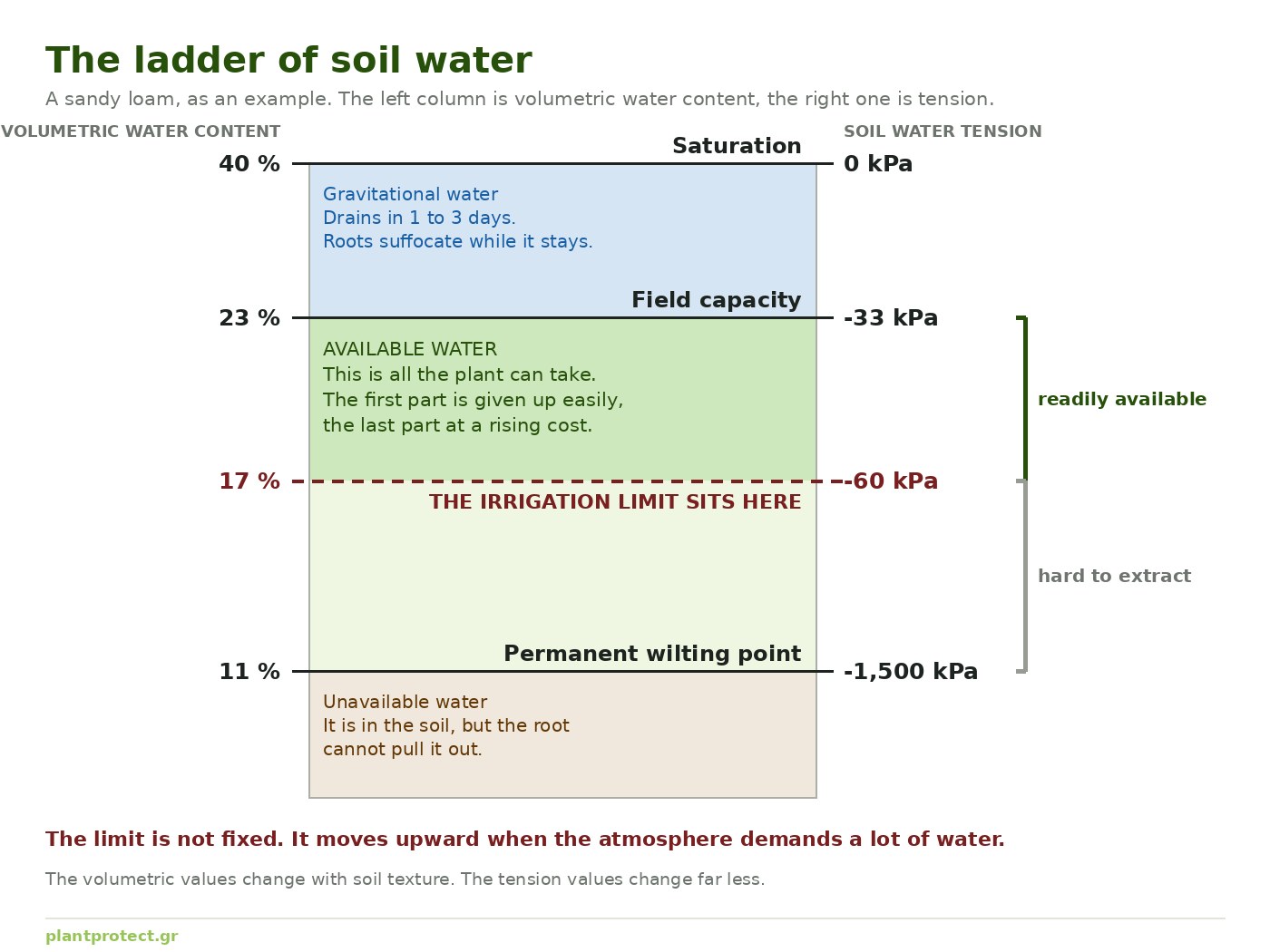
Soil moisture: what the station shows, when the field needs irrigating, and how it binds to evapotranspiration and VPD
The percentage on the screen is not a decision. With the four different meanings of the word “moisture”, the error of factory calibration, the irrigation limits, a full chapter on FAO-56 evapotranspiration, the vapour pressure deficit, and two calculators.
The Maxim persimmon cultivar: rights, ripening and key information
A protected Spanish cultivar of the Genesis Exotic group, distributed under licence. The fruit is not astringent at any stage, not even unripe, so no deastringency chamber is needed, the tree resembles Jiro and ripening falls in mid-September.
Attapulgite: what it actually does to soil, at what rate, and what its use costs
A Greek mineral with a specific surface area of 220 m2/g and an exchange capacity of 57 meq/100 g. What the field trials on sandy soils showed, why the rate threshold is 6,000 kg per hectare, what the IARC fibre classification means, which particle grade for which use, and why the rise in pH is the main argument against it on Mediterranean calcareous soils.