
Attapulgite: what it actually does to soil, at what rate, and what its use costs

Savvas Pastopoulos, Agronomist MSc, Pastopoulos Agronomics, Neos Mylotopos, Pella, Greece
Attapulgite is a fibrous clay mineral with an exceptionally large specific surface area, and Greece holds the only active deposit in Europe, in the Ventzia basin near Grevena. Its measured field benefits are real and substantial, but they come from sandy soils with poor retention, at rates starting at 6,000 kg per hectare. Below that level the same research found no statistically significant difference. What follows separates what has been measured from what has been promised.
- What attapulgite is and where it is found
- The Greek measurements: attapulgite from the Ventzia basin
- The mechanism: why it holds water and nutrients
- What the field showed: maize on sandy soil
- What it did to soil structure and carbon
- The rate threshold, and why it is the most important number
- Composite materials are not attapulgite
- Particle grades: which one for which use
- What transfers to Mediterranean fields and what does not
- Problems arising from its use
- The regulatory position in Greece
- What remains open
- Sources
1. What attapulgite is and where it is found
Attapulgite, known mineralogically as palygorskite, is a hydrated magnesium aluminium silicate with the chemical formula Mg1.5Al0.5Si4O10(OH)·4H2O [1]. It belongs to the clay minerals, but it does not have the sheet structure of bentonite. It has an inverted 2:1 structure that creates parallel channels inside the crystal, and the crystals are needle shaped rather than platy [1].
That morphology is the cause of every property described below. The needles are about 1 µm long and about 0.01 µm wide, an aspect ratio of roughly 100 to 1 [1][2]. They interlock like felt, and the space between them fills with water.
Unlike bentonite, attapulgite does not swell when wetted. This has a direct practical consequence: a granular attapulgite product does not collapse into mud on irrigation and does not seal the soil pores the way a swelling bentonite does.
Palygorskite deposits are few worldwide. Greece holds the only active deposit in Europe, in the Ventzia basin at Knidi near Grevena, with declared attapulgite and saponite reserves above 50 million tonnes [3]. The material is therefore domestic, not imported.
2. The Greek measurements: attapulgite from the Ventzia basin
Most published property tables describe American material from Florida and Georgia. For the Greek deposit there are measurements on Ventzia samples, and the values are appreciably higher [2].
| Property | Ventzia attapulgite [2] | American material [1] |
|---|---|---|
| Specific surface area (BET, N₂) | 220 m²/g | 150 m²/g |
| Cation exchange capacity | 51 to 64 meq/100 g, mean 57 | 30 to 50 meq/100 g |
| Water absorption | 110 to 150% of its weight | up to 100% of its weight |
| Apparent density | 0.40 to 0.70 g/cm³ | specific gravity 2.0 to 2.3 g/cm³ |
| pH | not stated | 7.5 to 8.5 |
| Fibre dimensions | about 1 µm long, 0.01 µm wide | about 1 µm long, 0.01 µm wide |
Purity varies. Ventzia samples were measured at 60 to 95% attapulgite, the remainder being mainly smectite with some quartz and traces of serpentine. One representative sample gave 91% attapulgite, 6% smectite and 3% quartz [2].
Chemical analysis of samples containing 90 to 95% attapulgite gave SiO₂ 58.5 to 60%, MgO 6.34 to 12.6%, Fe₂O₃ 6.3 to 8.2% and Al₂O₃ about 6.5% [2].
3. The mechanism: why it holds water and nutrients
Three measured quantities explain everything that follows.
Specific surface area. At the 220 m²/g of the Greek material, one kilogram of attapulgite presents 220,000 square metres of contact surface, that is 22 hectares [2]. Water is held on that surface by capillary forces.
Cation exchange capacity. The 57 meq per 100 g represent sites where calcium, magnesium, potassium and ammonium are held instead of leaving with drainage water [2]. For comparison, a sandy Mediterranean soil may have a total exchange capacity below 10 meq per 100 g.
Absence of swelling. The granule keeps its shape and acts as a skeleton within the soil. In a clayey soil stabilisation test, adding attapulgite raised strength through the internal friction angle, that is through mechanical interlocking of particles, and not through cohesion [6].
4. What the field showed: maize on sandy soil
The clearest field trial ran for two years on newly reclaimed sandy farmland in the Linze oasis, Gansu province, north-western China, under flood irrigation, on soil of pH 8.90 to 9.15 [5].
Attapulgite powder was applied at three rates, 1,500, 3,000 and 6,000 kg per hectare, two days before sowing, on top of a common fertiliser dressing of 320 kg N, 240 kg P₂O₅ and 200 kg K₂O per hectare. Compared with fertiliser alone [5]:
- yield rose by 4.9 to 14.9%
- above ground biomass rose by 6.1 to 32.3%
- irrigation water productivity rose by 0.03 to 0.13 kg per cubic metre
- nitrogen use efficiency rose by 10.8 to 54.0%
- agronomic efficiency of nitrogen rose by 15.5 to 49.5%
The most interesting result for input cost: in a treatment with fertiliser reduced by 20%, that is 256 kg N per hectare instead of 320, together with 6,000 kg of attapulgite per hectare, yield was 6.6% higher than the treatment with full fertiliser and the same attapulgite [5]. The mineral allowed less fertiliser and more yield at the same time, under conditions where leaching was the dominant constraint.
The mechanism the authors record is an increase in field water capacity, retention of nutrients in the 0 to 40 cm layer, and reduced leaching to deeper layers [5].
Sources: 5
5. What it did to soil structure and carbon
A second two-year trial, by the same group in the same area, measured what changes in the soil itself. At 6,000 kg per hectare for two consecutive years, in the 0 to 20 cm layer [4]:
| Measure | Before | After | Change |
|---|---|---|---|
| Bulk density | 1.55 g/cm³ | 1.47 g/cm³ | down 3.6% |
| Soil pH | 8.59 | 8.84 | up 3.7% |
| Organic carbon | baseline | raised | up 4.52% |
| Inorganic carbon | baseline | raised | up 5.23% |
| Total nitrogen | baseline | raised | up 6.22% |
| Macro-aggregates 2 to 0.25 mm | baseline | raised | up 3.5% |
| Micro-aggregates 0.25 to 0.053 mm | baseline | raised | up 5.2% |
Aggregates matter because that is where carbon is stored. A sandy soil lacks the cementing material that binds particles together, and attapulgite acts as exactly that. The authors note that the effect accumulates with years of application, so it is not complete in the first season [4].
The second half of that table deserves attention: pH rose, from 8.59 to 8.84. On an alkaline desert sand the authors did not treat this as a problem. On a Mediterranean calcareous soil with already high pH it is a risk, and section 10 returns to it.
Sources: 4
6. The rate threshold, and why it is the most important number
The finding that changes the discussion is not a percentage gain. It is one sentence in the abstract of that same paper.
Six tonnes per hectare per year, for two years, is the real size of the intervention, and it is the figure missing from most commercial material.
In the maize trial the picture is gentler: yield rose at 1,500 and at 3,000 kg per hectare too, but the gain scales with rate, and the range of 4.9 to 14.9% covers all three rates together [5]. The 4.9% belongs to the low rate and the 14.9% to the high one.
The economic test is simple arithmetic and each grower does it with the bulk price quoted by the supplier. Retail packaging is not a basis for comparison: in 4 kg and 20 kg packs, the price per kilogram makes a 6,000 kg per hectare rate prohibitive. The question to put to the supplier is the price per tonne delivered to the field, and then the comparison against the gains in sections 4 and 5.
7. Composite materials are not attapulgite
Striking figures circulate in the literature that do not describe plain attapulgite and must not be attributed to it.
In a spinach trial under saline and alkaline stress, a hydrogel of attapulgite grafted with acrylic acid and acrylamide, at 0.2%, raised leaf area by 91% and leaf weight by 95.69%, and cut sodium accumulation in roots by 61.12% [7]. The numbers are real, but the material is a synthetic polymer with attapulgite as a skeleton, tested in pots. It is not the mineral a grower buys in a bag.
Likewise, the soil stabilisation study combines polyvinyl alcohol with attapulgite at 2 to 8% replacement, for the restoration of exposed rock slopes, not for cropping [6]. Useful for the mechanism, irrelevant to fertilisation.
8. Particle grades: which one for which use
Attapulgite is sold in clearly distinct grades, and the choice is not a matter of preference. Grades are quoted in mesh, the number of openings per inch: the larger the number, the smaller the particle. A 325 mesh screen corresponds to roughly 44 µm.
| Grade | Particle size | Typical use |
|---|---|---|
| Fine powder | 92% passing 325 mesh, roughly below 44 µm | inert carrier and filler, carrier for feed additives [8] |
| 200 mesh | up to 2% passing 200 mesh | coarser powder for natural clay applications [8] |
| 30/60 | granules from 30 to 60 mesh | high liquid holding, filtration [8] |
| 24/48 | 90% within 24 to 48 mesh | absorbent for animal litter, oils, spills [8] |
| 16/30 | 92% within 16 to 30 mesh | general purpose granule [8] |
| 8/16 and 12/24 | coarse granule | where resistance to breaking apart in water is needed [8] |
| 5/20 | very coarse granule | drying agent, maximum liquid holding [8] |
- Incorporation into field soil: powder or fine granule, so that it mixes through the soil mass and acts as a cement between particles. The trials in sections 4 and 5 used powder finer than 250 mesh [5].
- Growing media, pots, seedbeds: granular, because it does not collapse and keeps aeration. Greek commercial attapulgite amendments are offered as granules with low dust content [9].
- Pesticide carrier: fine powder or granule according to the formulation, and this is among the oldest established uses of the mineral [1].
9. What transfers to Mediterranean fields and what does not
The mechanism transfers safely. Specific surface area, exchange capacity and absence of swelling are properties of the mineral and were measured on a Greek sample [2]. They hold wherever it is applied.
Targeting sandy soils transfers, with reservation. Sandy Greek fields in Imathia, Pella and coastal areas share the basic problem of Linze: low retention of water and nutrients and rapid nitrogen leaching. The direction of the benefit is plausible. Its size is not, because irrigation, climate and organic matter all differ.
The irrigation does not transfer. The Chinese trial used flood irrigation, the worst case for leaching. In a Mediterranean field under drip irrigation, much of the benefit has already been captured by the irrigation system. The margin for improvement is smaller, and the rate is correspondingly harder to pay back.
The pH effect does not transfer at all. At Linze the rise from 8.59 to 8.84 was a neutral finding. In Greece, where calcareous soils above pH 7.8 are the norm and iron and zinc lock-up is already the commonest nutritional problem, the same change is a liability.
"It improves any soil" does not transfer. No field trial on a medium or heavy textured soil shows a benefit. Adding clay to a soil that already has clay has no basis.
10. Problems arising from its use
Raising pH on an already alkaline soil
The mineral itself has a pH of 7.5 to 8.5 [1], and its application raised soil pH by 3.7% over two years [4]. On a calcareous soil at pH 8.0 and above, this worsens the availability of iron, zinc and manganese. Before any application at field scale, a soil analysis with pH measurement.
Dust and fibres
This is the point that demands precision, because both exaggeration and dismissal circulate.
The International Agency for Research on Cancer evaluated palygorskite in 1997 and arrived at two separate classifications according to fibre length [10][11]:
| Material | IARC classification | Meaning |
|---|---|---|
| Palygorskite, long fibres, above 5 µm | Group 2B | possibly carcinogenic to humans |
| Palygorskite, short fibres, below 5 µm | Group 3 | not classifiable as to carcinogenicity |
The practical conclusion comes from the technical report of the United States Department of Agriculture: fibre lengths in commercial samples are generally below 5 µm [1]. Measurements on Greek samples agree, giving needle lengths of about 1 µm [2]. Commercial material therefore falls in Group 3, not Group 2B.
Three things follow that matter in the field:
- A particulate filter mask whenever powder is handled, above all indoors, in a store or when mixing growing media.
- Granular form preferred wherever the job allows. Granules do not become airborne.
- Application in still air and immediate incorporation, not broadcasting into wind.
Heavy metals and contaminants
This is a mined mineral, not a manufactured product of constant composition. For one commercial fuller's earth product, limits of arsenic at 0.5 mg/kg, lead at 1 mg/kg and mercury at 0.3 mg/kg are reported [1]. These are low, but they describe one product from one deposit. The batch certificate of analysis should be requested from the supplier, in particular for cadmium, the metal with the strictest limits in fertilising products.
The rate as a problem in itself
At 6,000 kg per hectare the material is not an additive, it is earthworks. It requires transport of six tonnes per hectare, even spreading and incorporation by plough or rotary cultivator. At field scale that is machinery and labour, not only the price of the material.
11. The regulatory position in Greece
Regulation (EU) 2019/1009 on fertilising products provides a separate product function category for inorganic soil improvers, with its own contaminant limits in Annex I. A CE marked product must meet those limits [12]. The exact numerical limits should be read from the Annex itself rather than reproduced at second hand.
In the Greek Ministry of Rural Development and Food register of new-type fertiliser authorisations, as published at threpsi.plantprotect.gr, there is no entry containing attapulgite. This does not mean the material is unlawful: that register of 2,943 entries covers fertilisers and contains no soil improver category at all, no zeolite, no perlite and no other clay [13]. Soil improvers reach the market by another route.
- attapulgite content as a percentage, and the remaining mineralogy
- particle grade, in mesh or millimetres
- pH of the material
- batch certificate of analysis for heavy metals
- the marketing route, that is whether it carries CE marking as an EU fertilising product or is placed on the market under national rules
- safety data sheet, for handling the dust
12. What remains open
Gaps are declared, not filled with foreign numbers.
- There is no Greek field trial. Not in tree crops, not in vegetables, not in arable crops. The Greek data that exist are mineralogical and physicochemical, not agronomic.
- There is no measured effect on medium or heavy textured soil. All the positive evidence concerns sands.
- There is no measured effect under drip irrigation. Both trials used flood irrigation, the maximum leaching scenario.
- There is no evidence beyond two years. The authors state that the benefit accumulates, without saying when it levels off.
- There is no independent confirmation. The two field studies come from the same group in the same location.
What to take away
- Attapulgite is a retention amendment, not a fertiliser, and a Greek mineral with a measured specific surface area of 220 m²/g and exchange capacity of 57 meq/100 g.
- The measured benefit concerns sandy soils that leach: maize yield up 4.9 to 14.9% and nitrogen use efficiency up 10.8 to 54.0%.
- The rate threshold is 6,000 kg per hectare. At 1,500 and 3,000 no significant effect on soil properties was found.
- The rise in pH is the main argument against it on Mediterranean calcareous soils.
- The IARC Group 2B classification applies only to fibres above 5 µm. Commercial material sits below that threshold, but the dust still calls for a mask.
- In pots, seedbeds and growing media the quantity is small and the risk limited. In the field, trial it on a limited area first, with soil analysis before and after.
13. Sources
The numbers in the text refer to the list below.
- [1] USDA Agricultural Marketing Service (2015). Attapulgite. Technical Evaluation Report, National Organic Standards Board. Source for the chemical formula, structure and needle crystal dimensions, specific surface area of 150 m²/g, exchange capacity of 30 to 50 meq/100 g, pH 7.5 to 8.5, use as a pesticide carrier, the occupational exposure limits of 15 and 5 mg/m³, the statement that commercial fibre lengths are generally below 5 µm, and the arsenic, lead and mercury figures. Full text used.
- [2] Diploma thesis (2015). Attapulgite of the Ventzia basin, Grevena: mineralogy and properties. National Technical University of Athens, in Greek. Source for the Greek data: attapulgite content of 60 to 95%, a sample with 91% attapulgite and 6% smectite, specific surface area of 220 m²/g, exchange capacity of 51 to 64 meq/100 g, water absorption of 110 to 150%, apparent density of 0.40 to 0.70 g/cm³, chemical analysis and fibre dimensions. Full text used.
- [3] Geohellas S.A. Technical clays. Source for the location of the deposit at Knidi, Grevena, reserves of attapulgite and saponite above 50 million tonnes, and the statement that this is the exclusive European source of attapulgite. Commercial source, used only for deposit and production data.
- [4] Niu, Z., Su, Y., Li, J., An, F. and Liu, T. (2023). Effect of Attapulgite Application on Aggregate Formation and Carbon and Nitrogen Content in Sandy Soil. Sustainability 15(16):12511. Source for the fall in bulk density from 1.55 to 1.47 g/cm³, the rise in pH from 8.59 to 8.84, the increases in organic carbon of 4.52%, inorganic carbon of 5.23% and total nitrogen of 6.22%, the aggregate percentages, and above all for the finding that rates of 1,500 and 3,000 kg per hectare had no significant effect. Full text used.
- [5] Liu, T., Su, Y., Niu, Z. and An, F. (2023). Attapulgite application improves maize yield, water, and fertilizer utilization efficiency in newly cultivated sandy farmland in northwestern China. Arid Land Research and Management 37(3):408 to 426. Source for the three rates, the yield increase of 4.9 to 14.9%, biomass of 6.1 to 32.3%, the further 6.6% with fertiliser reduced by 20%, water productivity of 0.03 to 0.13 kg per cubic metre, nitrogen use efficiency of 10.8 to 54.0%, the powder grade finer than 250 mesh, and the authors' statement that leaching was not fully prevented. Full text used.
- [6] He, C. et al. (2022). Using PVA and Attapulgite for the Stabilization of Clayey Soil. Polymers 14(21):4752. Source for the strengthening mechanism through internal friction angle rather than cohesion, and for the replacement rates of 2 to 8%. Concerns slope restoration, not cropping. Full text used.
- [7] Wang, Y. et al. (2025). Effects and Mechanisms of Attapulgite Clay-g-(AA-co-AAm) Hydrogel (ACH) in Alleviating Saline Stress in Spinach. Plants 14(21):3330. Source for the hydrogel results on spinach under saline stress, with the explicit note that the material is a composite polymer containing attapulgite and not the plain mineral. Full text used.
- [8] CB Minerals. Attapulgite grades. Source for the commercial particle grades, from 325 mesh fine powder to the 5/20 granule, and for the use of each grade. Commercial source, used only for grade specifications.
- [9] Geohellas. Soil improvers. Source for the availability of Greek attapulgite soil improvers in granular and powder form. The page gives neither rates nor particle grades, and that is stated.
- [10] IARC (1997). Palygorskite (Attapulgite). IARC Monographs on the Evaluation of Carcinogenic Risks to Humans, Volume 68. Source for the dual classification by fibre length. Evaluation summary used.
- [11] IARC. Agents Classified by the IARC Monographs. Source for the exact wording of the two entries: long fibres above 5 µm in Group 2B and short fibres below 5 µm in Group 3, both from Volume 68.
- [12] Regulation (EU) 2019/1009 of the European Parliament and of the Council of 5 June 2019 laying down rules on the making available on the market of EU fertilising products. Source for the existence of an inorganic soil improver category and the obligation to meet the contaminant limits of Annex I. The numerical limits are not reproduced here.
- [13] Register of new-type fertiliser authorisations, Greek Ministry of Rural Development and Food, as published at threpsi.plantprotect.gr. Valid in Greece only. Source for the finding that none of the 2,943 entries in the register contains attapulgite, and that the register includes no soil improver category. Checked against the data edition of 10 December 2025.
This text is informational and is not a recommendation to apply anything. Attapulgite is a soil improver, not a fertiliser or a plant protection product. The rates quoted come from specific trials on sandy alkaline soils in north-western China and are given as evidence, not as instructions for any particular field.
Any application at field scale presupposes soil analysis, pH measurement and a trial on a limited area first. On calcareous soils above pH 7.8, the possible further rise in pH is assessed before any other criterion.
Handling powder requires respiratory protection with a particulate filter mask, above all indoors. The product safety data sheet applies.
Plant protection products that may accompany soil applications are used only in accordance with their approvals and labels. Plant protection approvals issued by the Greek Ministry of Rural Development and Food are valid in Greece only and do not apply in other countries. Every intervention is at the user's own responsibility, following on-site assessment by a licensed agronomist. Pastopoulos Agronomics accepts no liability for the use of this information.
Related articles
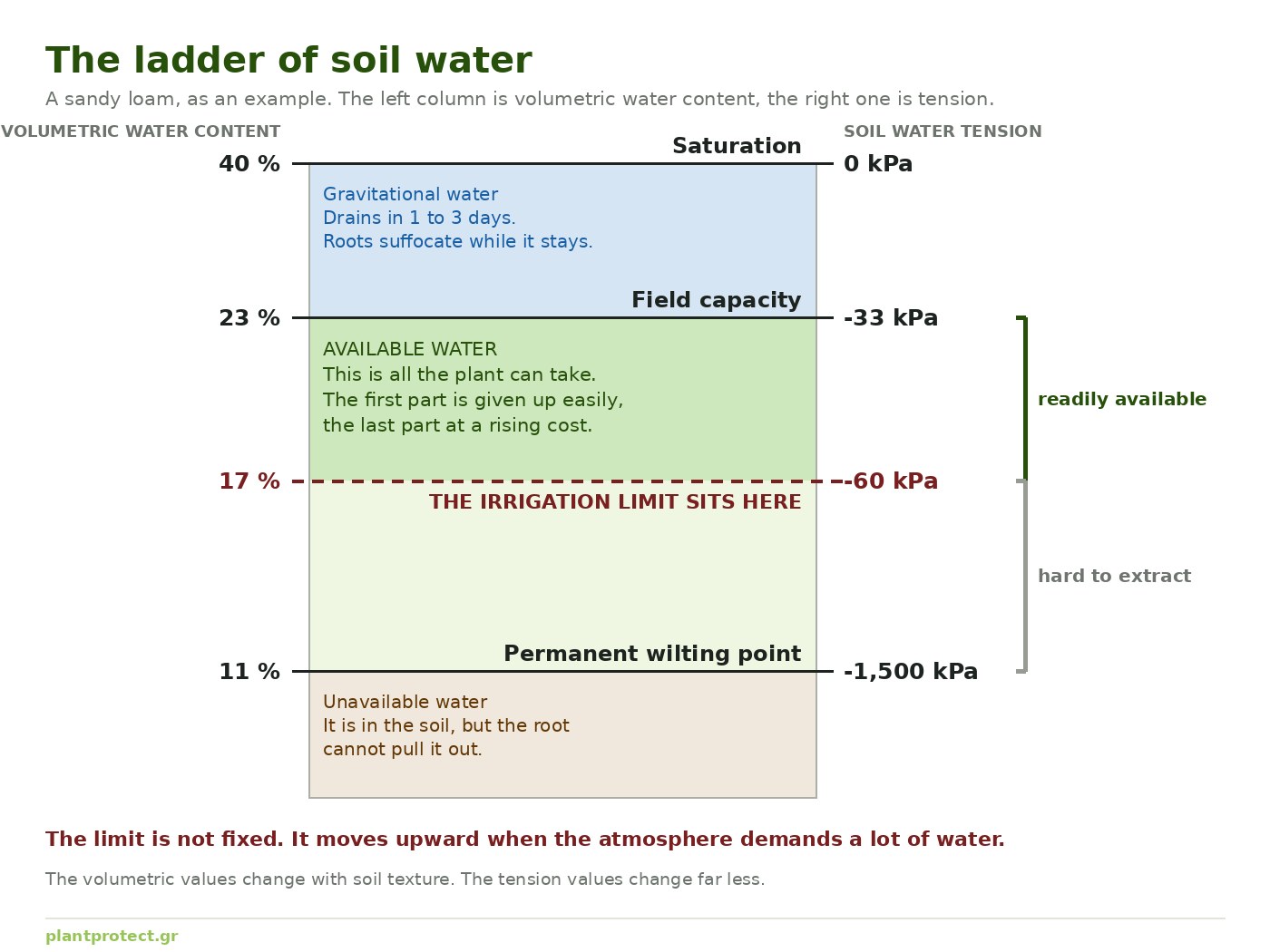
Soil moisture: what the station shows, when the field needs irrigating, and how it binds to evapotranspiration and VPD
The percentage on the screen is not a decision. With the four different meanings of the word “moisture”, the error of factory calibration, the irrigation limits, a full chapter on FAO-56 evapotranspiration, the vapour pressure deficit, and two calculators.
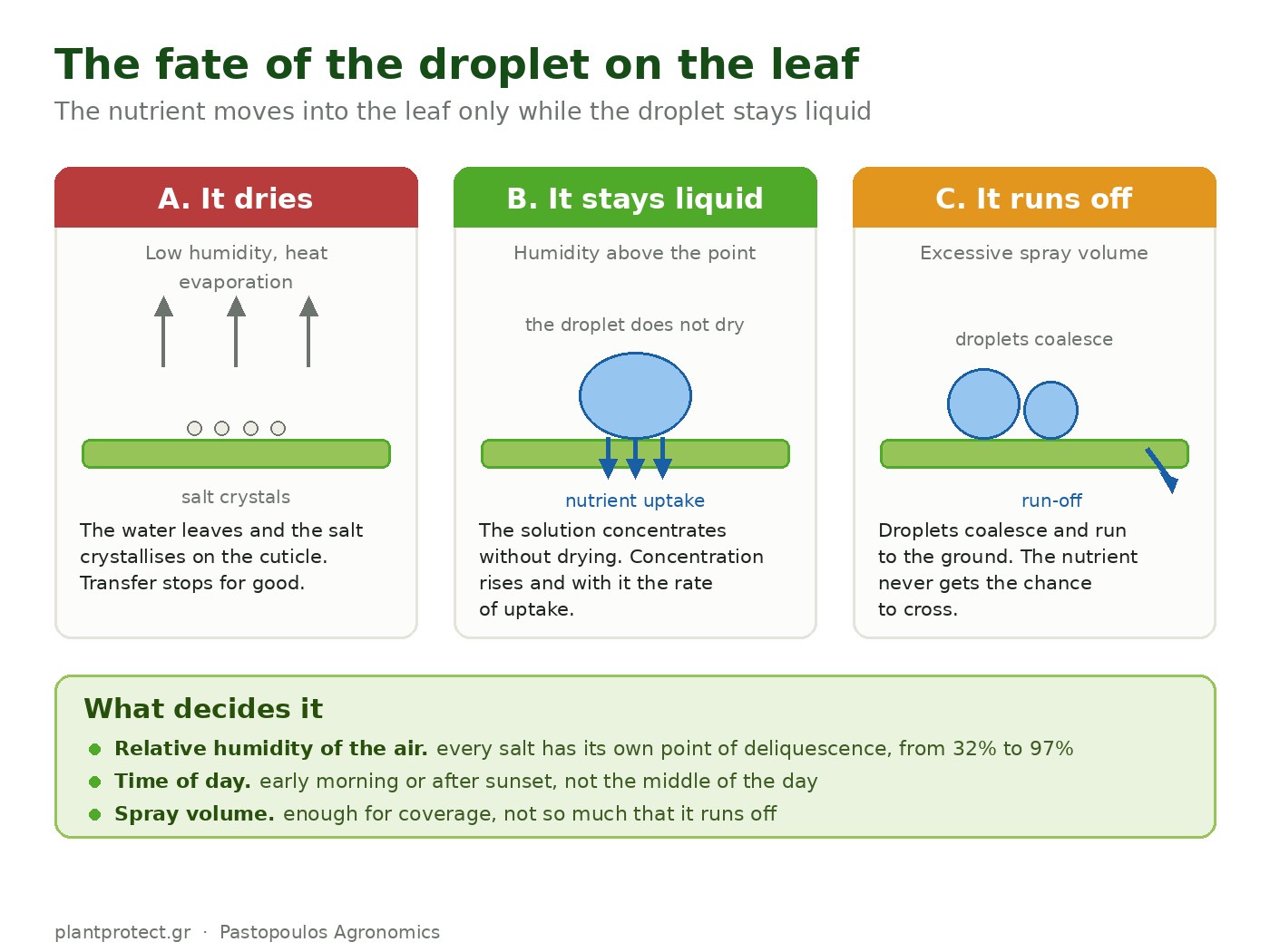
Foliar sprays: the time of day, the reactions in the tank and the mixing order
The nutrient moves into the leaf only while the droplet stays liquid, and relative humidity decides that. With the point of deliquescence by salt, the reactions of calcium with phosphates and sulphates, the optimum pH values, the tank loading order.
Growing avocado in Greece: cultivars, soil, climate, diseases and pests
Three botanical races, and the Mexican one supplies frost tolerance while the West Indian one supplies tolerance of lime and salt: Greece asks for both at once. With Greek data from ELGO Chania: across ten orchards over six years Fuerte met the dry matter threshold in only two seasons and Zutano in none. In detail: synchronous dichogamy and the cultivars one by one, the temperature limits, soils at pH up to 8.3 and calcium carbonate up to 20.7 per cent, eleven rootstocks, planting distances and training.