
Pests and diseases of walnut: identification from the symptoms, with a diagnostic tool

Savvas Pastopoulos, Agronomist MSc, Pastopoulos Agronomics, Neos Mylotopos, Pella, Greece
Walnut has few genuinely dangerous enemies and a great many that merely look alarming. The problem is not a shortage of products; it is that most of the symptoms resemble one another, and a wrong identification leads to a programme that never works. This text brings together twenty causes, each with the one feature that separates it in the field, and a tool that compares the symptoms against the profile of every one of them.
- Where the crop is actually lost
- The identification tool
- Diseases and pests that get confused with one another
- Leaves and nuts: anthracnose, blight, brown apical necrosis
- The pests of the nut
- Mites and aphids
- The branch dieback complex
- The cankers of the trunk
- Crown, roots and the whole tree
- Blackline at the graft union
- The quarantine risk
- What is permitted in Greece
- The annual programme
- Sources
1. Where the crop is actually lost
In a walnut orchard the losses arrive from three different directions, and each calls for a different kind of thinking.
The three categories
- What attacks the nut within the season. Anthracnose, walnut blight, brown apical necrosis, codling moth. The damage is annual, reversible, and answered with timing.
- What eats the wood. Botryosphaeria and Phomopsis, branch wilt, wood-boring insects, bacterial cankers. The damage is cumulative: every season in which the dead wood was not removed is inoculum for the next.
- What kills the tree from below. Phytophthora, Armillaria, nematodes, crown gall, blackline. Here there is no treatment worth having; there is only the right decision before planting.
The practical consequence is that the diagnosis decides whether the problem is solved this season, in five years, or never. An orchard sprayed for three seasons against blight while it is dying of Phytophthora has lost both the products and the trees.
Four of the subjects in this list already have an article of their own, with far more depth. The tool links to them, and only the features needed for identification are kept here:
- Walnut anthracnose, biology, temperatures, cultivar susceptibility, spray programme.
- Walnut blight, the disease cycle, brown apical necrosis, vertical oozing canker, the limits of copper.
- Phytophthora and collar rots in fruit trees, the diagnosis made with a spade.
- The goat moth, how the two wood borers are told apart, the gallery, the pheromone and the trap density.
For establishment, spacing, irrigation and nutrition there is the article on cultural practices, and for the cuts themselves pruning the walnut tree. Both bear directly on what follows: most diseases of the wood enter through a pruning cut, through sunburn, or through standing water, that is, through decisions about how the orchard is grown, not through bad luck.
Sources: 5
2. The identification tool
Identification from symptoms is probabilistic, never certain. Different causes produce similar pictures, the symptoms change with cultivar, age and season, and two problems can perfectly well occupy the same tree, on walnut that is the rule rather than the exception.
For quarantine organisms the diagnosis is made only by the competent authority. No output of this tool substitutes for laboratory identification.
Select the symptoms
Organ first, then symptoms. The results refresh on their own.
Sources: 1 2 3 4 6 7 8 9 11 12 13 15
3. Diseases and pests that get confused with one another
The table is the tool in a form that can be read without a screen. Each row is a pair that gets confused in practice, and the third column is the one feature that settles it.
| Looks like | But is | The feature that separates them |
|---|---|---|
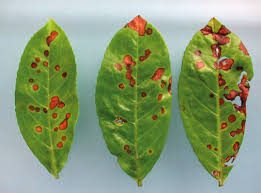
| Anthracnose | Walnut blight | With a hand lens, inside the leaf necrosis: anthracnose shows black acervuli, blight never does. Blight instead gives a water-soaked halo and attacks the catkins |
| Walnut blight at the tip of the nut | Brown apical necrosis | The picture on the nut is identical. Brown apical necrosis gives itself away through heavy nut drop despite a correct copper programme, and is confirmed only in the laboratory [15] |
| Botryosphaeria | Branch wilt | Both leave the foliage hanging. Branch wilt gives a black dusty spore mass under the bark; Botryosphaeria gives pycnidia on the surface of the bark [1] [4] |
| A branch killed by a fungus | A wood-boring insect | The borer leaves a tunnel in the wood and sawdust at the hole, and the branch snaps at exactly that point |
| Deep bark canker | Shallow bark canker | The deep one gives reddish-brown ooze from vertical cracks and a necrosis reaching the phloem, that is the sieve part of the bundle; the shallow one gives scattered dark spots that do not pass the outer bark [13] |
| A bacterial canker of the trunk | Vertical oozing canker (VOC) | VOC is vertical and elongated and is caused by the same bacterium as blight of the nuts, so it sits alongside a history of nut infection |
| Phytophthora | Armillaria | The pattern in the field: Phytophthora strikes in patches, where water stands; Armillaria strikes isolated trees, in a field with a woodland history. And only Armillaria gives white mycelial fans |
| Phytophthora | Root-lesion nematode | With nematodes the crown is clean. The trees simply never get going. The diagnosis requires a sample of soil and roots together [12] |
| Decline from the root | Blackline | The graft union: a black line in the union zone, vigorous growth below it, leaf fall above it [11] |
| Dieback from the top | Thousand cankers disease | The many tiny bark beetle holes, each with a canker around it. A quarantine organism: the diagnosis is made only by the competent authority [9] |
| Leaf spotting | Salinity or boron | Toxicity starts at the margins and works inwards, uniformly across the whole tree. It has no defined lesions and does not stop at the veins |
4. Leaves and nuts: anthracnose, blight, brown apical necrosis
Between them these three account for the overwhelming majority of lesions on leaf and husk, and between them they are confused.


How they divide in practice
- Anthracnose. It needs prolonged leaf wetness. It produces lesions on the leaves, on the petiole and on the green husk, and a heavy attack ends in defoliation during the summer. The confirmation is the acervuli inside the necrosis.
- Walnut blight. It starts from inoculum overwintering inside the buds, not from fallen leaves. It hits the catkins and the female flowers first, and the damage to the nut begins at the stigma. Early-leafing cultivars pay the most [2].
- Brown apical necrosis. The same picture at the tip of the nut, but a complex of the same bacterium with fungi of the genera Fusarium and Alternaria. Its signature is heavy nut drop in spite of correct sprays [15].
5. The pests of the nut
Codling moth
It is the most serious insect pest of walnut, with two to four generations a year in California; the number on a Greek holding follows from local traps and from the bulletins of the Agricultural Warnings service. The first generation attacks the nutlets and drops them, with frass visible at the blossom end. Later generations feed on the kernel in nuts that stay on the tree, and the damage is only discovered at harvest [3].

Monitoring is by pheromone trap. In the American protocols the treatment threshold is an average of two moths per trap per night with a standard 1 mg lure [3]. The timing, however, comes not from the catches but from the temperature.
The degree-day model
The thresholds of the model are a lower limit of 10 °C and an upper limit of 31.1 °C. The accumulation starts at the biofix, that is, the first sustained catch of adults in the pheromone traps [3].
- First generation. Egg hatch begins 111 to 167 degree-days after the biofix.
- Second generation. A new biofix roughly 589 degree-days after the first, with egg hatch 139 degree-days after that.
- Third generation. A new biofix 611 to 667 degree-days after the second, with egg hatch 111 to 139 degree-days after that.
The original figures are given in Fahrenheit degree-days, with thresholds of 50 and 88 °F, and were converted here to Celsius degree-days by dividing by 1.8: 200 to 300 °F become 111 to 167 °C, 1,060 °F becomes 589 °C, 250 °F becomes 139 °C, and 1,100 to 1,200 °F become 611 to 667 °C.
The importance of codling moth does not stop at the kernel. Every larval entry is a wound, and wounds are the main route by which the Botryosphaeria fungi enter the nut [1].
Walnut husk fly, what it would look like if it arrived
Rhagoletis completa does not appear in the Greek distribution of the EPPO database [7]. It is, however, established in fifteen European countries and is described as widespread in Germany, Slovenia and Switzerland. The invasion began in Switzerland in 1988 and Italy in 1991 [6].
The three facts worth knowing in advance
- One generation a year. In northern Italy the adults appear from early July to late August, correlating with the ripening of the cultivar [6].
- The pupa stays in the soil for 291 to 328 days, and in European populations 8.8% of pupae emerged after two years. An introduction therefore does not show itself at once [6].
- Untreated, infestation at harvest has exceeded 74% in European records. With correct timing, a single insecticide spray per season held the damage at an acceptable level [6].
Since the insect is not present here, the practical consequence is not a treatment but recognition: a husk that is black and slimy, with no entry hole and legless maggots inside. Faced with that picture the right move is a sample and a notification to the plant protection authority, not a spray. The first focus is dealt with cheaply; the tenth is not.
6. Mites and aphids
The two most visible and the two least dangerous problems of walnut. They earn a place in this article precisely because they cause more sprays than they justify.
The blister mite
Aceria erinea overwinters in the buds and moves onto the new leaves at bud break. It produces blisters on the upper surface and a felty erineum on the lower, with several generations a year. It is classed as a pest of minor significance [14]. On a bearing tree it does not justify a targeted treatment; in a nursery and on young trees in the first two years the picture changes, because there every square centimetre of foliage counts.
The two aphids
The small aphid Chromaphis juglandicola lives on the lower leaf surface, the large Panaphis juglandis in characteristic rows along the midrib of the upper surface. The direct feeding damage is small. The real damage is honeydew and sooty mould, which cut photosynthesis and stain the husk.
7. The branch dieback complex
Botryosphaeria and Phomopsis
This is not one pathogen but a group: Neofusicoccum, Diplodia, Dothiorella, Lasiodiplodia, Botryosphaeria dothidea and Diaporthe species [1]. They overwinter on dead branches and shoots, and the pycnidia persist on the diseased wood all year round.
Infection is mainly indirect, through wounds: pruning cuts, sunburn, leaf scars and peduncle scars. A pruning cut remains susceptible to infection for four months [1].
The consequence is that pruning is judged not only by where the cut is placed but by the season and the weather. Pruning shortly before a wet period means an open door for a quarter of the year.
On the nuts the infection appears at maturity, in California in August and September, in Greece depending on cultivar and region, up to harvest: the husk decays, the lesion passes to the peduncle and the spur, and black cankers with dead buds are formed. It is on exactly those spurs that a dense layer of pycnidia develops, the inoculum for the following season [1].
Branch wilt
Neoscytalidium dimidiatum enters exclusively through splits, frost injury and sunburn [4]. The leaves of the outer branches yellow and wilt in mid to late summer and stay attached well after the healthy leaves have fallen. Under the bark there is a black dusty mass of spores, and the wood discolouration runs in as a wedge towards the centre.
The wood borers
The leopard moth and the goat moth tunnel in the wood. The feature is sawdust at the edge of the hole and a branch that snaps precisely at the tunnel. How the two are told apart, by position of attack and by the larva itself, is set out in the separate article on the goat moth.
What correct removal means
- Cut at least 5 to 8 cm (2 to 3 inches) below the lowest point of the canker, into healthy wood [1] [4].
- Remove and destroy the dead wood in dry weather. Dead wood left on the ground remains a source of spores.
- Control scale insects, because their wounds are entry points [1].
- Watch the sprinklers. Wetting the foliage with overhead irrigation multiplies both anthracnose and Botryosphaeria [1].
8. The cankers of the trunk
The vascular bundle has two parts, and distinguishing them determines what is looked for and in which tissue.
- Xylem. Carries water and mineral nutrients upwards from the root to the leaves. This is where the vascular wilts and the vascular bacterial diseases move, and where the brown ring of the cross-section appears.
- Phloem, the sieve tissue. Carries the products of photosynthesis downwards. This is where aphids and the other sucking insects feed, where inner-bark bacteria such as Brenneria rubrifaciens live, and the reason why calcium is not redistributed within the plant.
The term «vascular bundle» is used only where both parts are meant together, never as a synonym for the xylem.
Three different bacteria produce three pictures that in the field all look like "the trunk is running". The distinction is made with a knife and with the calendar.
| Disease | Ooze and position | Depth of necrosis | Where it has been recorded |
|---|---|---|---|
| Deep bark canker Brenneria rubrifaciens | Reddish-brown to black, from vertical cracks on trunk and scaffolds. Starts towards the end of spring | Deep. The dark streaks lie within the inner bark, in the region of the phloem; in the xylem beneath the canker only small dark spots appear [24] | Spain, Italy, France [13]. First European report in 2002 [19] |
| Shallow bark canker Brenneria nigrifluens | Dark brown spots, scattered over the surface of the bark | Superficial. Does not penetrate deeply | Italy, France, Spain, Hungary, Iran [13], and Serbia [20] |
| Vertical oozing canker Xanthomonas arboricola pv. juglandis | Wet ooze from vertical cankers on trunk and scaffolds | An elongated canker, on a holding with a history of blight on the nuts | Identified in France as a specific genetic lineage [15] |
The deep canker mainly affects trees over fifteen years old and causes a chronic loss of vigour that can end in death. The shallow one kills more slowly, by accumulation [13].
9. Crown, roots and the whole tree
Phytophthora
Recent European work describes Phytophthora plurivora as a serious challenge for the cultivation of Juglans regia in Europe [8]. It is not the only species: in Italy P. megasperma has been associated with decline and death of walnut trees, while P. nicotianae and P. citricola have also been reported in European walnut decline.
The diagnostic step is always the same and is never made from the canopy: dig at the base and cut into the bark. The dead tissue is brown, wet, with a sharp margin against the healthy tissue, and it smells sour. The method is set out in the article on collar rots.
Armillaria
It survives for decades on roots left in the soil. The feature is the white mycelial fans between bark and wood, with a strong mushroom smell. The pattern in the field is isolated, scattered trees, in contrast with the patches of Phytophthora. The history of the parcel, woodland or an old orchard, is among the strongest pieces of evidence in the diagnosis.
Crown gall
Agrobacterium tumefaciens enters through wounds at the crown and on the roots. The bacterium has been shown to be detectable in and on the seed of Paradox rootstocks collected from commercial nurseries, which explains why the problem so often appears in the very first year [21]. Prevention is material from a reliable source and avoiding injury to the crown at planting and during cultivation.
Root-lesion nematode
Pratylenchus vulnus produces elongated brown lesions in the inner root tissue, visible once the outer root bark is removed. The above-ground symptoms are slow growth, dieback of the upper branches and chlorosis, occurring in patches [12].
The abiotic causes
Walnut is among the species most sensitive to salt, chloride and boron. The subject is developed in the water quality section of the article on cultural practices. The diagnostic feature is that the necrosis begins at the margins and is uniform, with no defined lesions.

10. Blackline at the graft union
This is the disease that punishes a nursery decision fifteen years later, and for that reason it earns a section of its own.
The cause is a strain of Cherry leaf roll virus. The virus lives exclusively in the scion of Juglans regia and not in the rootstock. Where the rootstock is another species, black walnut or Paradox, the rootstock cells in the union zone react hypersensitively and die. A black line forms that constricts the conducting tissue in both of its parts, xylem and phloem [11].
The order of the symptoms
- Poor shoot development.
- Premature yellowing and leaf fall, over part or all of the canopy.
- At the graft union, a water-soaked brown zone that constricts the conducting tissue.
- Vigorous suckering below the union, while the canopy sheds its leaves.
- Death within three to five years of the first symptoms [11].
The virus is transmitted in pollen under natural conditions, which means proximity to infected trees matters and that the disease appears once the trees have come into flowering [11]. For valuable individual trees there is the technique of inarch grafting with J. regia, to bridge the dead zone.
Sources: 11
11. The quarantine risk
Thousand cankers disease is caused by the fungus Geosmithia morbida, carried by the bark beetle Pityophthorus juglandis. Every beetle tunnel becomes a small canker; the cankers coalesce and girdle the branch.

The feature in the field is the number of holes. A wood-boring moth leaves a few large holes with sawdust. This bark beetle leaves many, very small ones, and around each of them, if the bark is scraped, a small sharply bounded brown canker appears. The dieback begins at the top of the canopy.
12. What is permitted in Greece
Walnut is a minor crop where approvals are concerned. The foreign guidelines are rich in active substances that do not exist here, and two of the most frequently cited are illegal in the EU today.
| Recommendation in a foreign text | Status in the European Union |
|---|---|
| Copper (Bordeaux mixture, hydroxide, oxychloride) | Approved, as a candidate for substitution, with a ceiling of 28 kg/ha over seven years [18]. The approval for each product and crop is checked in the Ministry database [23] |
| Mancozeb tank-mixed with copper, against blight [2] | BANNED. Approval not renewed from 4 January 2021, authorisations withdrawn by 4 July 2021, disposal of existing stocks ended 4 January 2022 [17] |
| Kasugamycin, as an alternative where copper-resistant populations occur [2] | NOT AN APPROVED active substance in the EU [16] |
| Preplant soil fumigation for nematodes [12] | The products named in the American guidelines do not correspond to Greek authorisations. Each product is checked in the Ministry database [23] |
13. The annual programme
Before planting, half the outcome is decided here
- Drainage. The only real measure against Phytophthora. No treatment corrects a field where water stands.
- History of the parcel. Woodland or an old orchard means a risk of Armillaria. A nematode analysis from soil and roots.
- Rootstock. The choice decides blackline, tolerance of Phytophthora and susceptibility to crown gall. It is a decision measured in decades.
- Water quality. An analysis for salt, chloride and boron before any other consideration.
Winter
- Removal of dead wood and cankers in dry weather, cutting into healthy wood.
- Inspection of the trunks for ooze, galls, holes, and the graft union zone.
- Removal of mummified nuts and fallen leaves, which are inoculum for anthracnose and Botryosphaeria.
Bud break and spring
- The treatments against blight belong at bud break, when the inoculum comes out of the buds. Later they do not catch it.
- Watch the wetness: every rain at bud break is an infection event.
- Codling moth pheromone traps from the start of the season, to set the starting point for the degree-day count.
Summer
- No treatment for aphids without visible sooty mould over a large part of the canopy.
- Inspection for sunburn on the exposed scaffolds.
- Marking of branches that wilt suddenly, so that they are removed in winter.
Harvest and after
- A sample of 100 nuts from different points, cut open, to record what actually caused the season's damage.
- Records by cultivar and by block. Without them, next season's programme is a repetition rather than an improvement.
- Has the cause been identified, or has a symptom merely been recognised?
- Is there an approval for walnut and for that specific pest in the national database?
- Is this the right moment, or has the window already closed and the spray is being made for peace of mind?
14. Sources
The numbers in the text refer to the list below. Where no authors are given, the source is the collective work of an institution or the full citation could not be verified; the link leads to the original.
- [1] Botryosphaeria and Phomopsis Cankers, Walnut. UC Statewide IPM Program, Pest Management Guidelines. Source for the genera involved, for the four months of susceptibility of a pruning cut, for infection of the nuts in August and September, for the pycnidia on dead spurs, for the role of sprinkler irrigation and of scale insects, and for cutting back into healthy wood.
- [2] Walnut Blight, Walnut. UC Statewide IPM Program, Pest Management Guidelines. Source for overwintering of the bacterium inside dormant buds, for the greater susceptibility of early-leafing cultivars, for the commonness of copper resistance, and for the mancozeb and kasugamycin recommendations that do not apply in the European Union.
- [3] Codling Moth, Walnut. UC Statewide IPM Program, Pest Management Guidelines. Source for the two to four generations, for the degree-day model, and for the threshold of two moths per trap per night with a 1 mg lure.
- [4] Branch Wilt, Walnut. UC Statewide IPM Program, Pest Management Guidelines. Source for Neoscytalidium dimidiatum, for entry exclusively through splits, frost damage and sunburn, for the leaves that stay attached, and for the black dusty spore mass beneath the bark.
- [5] Walnut, Agriculture: Pest Management Guidelines. UC Statewide IPM Program. Source for the full list of pests, diseases and nematodes of walnut, from which the structure of this article's list was derived.
- [6] Biology, ecology, and management of walnut husk fly (Diptera: Tephritidae). Journal of Integrated Pest Management 16(1):pmaf043. Source for the univoltine biology, for the pupal period of 291 to 328 days, for the 8.8% of pupae emerging after two years, for adult emergence from July to August in northern Italy, and for infestation above 74% without treatment.
- [7] EPPO Global Database, Rhagoletis completa, world distribution. Source for the fifteen European countries where the species is recorded, for it being widespread in Germany, Slovenia and Switzerland, and for Greece not appearing in the distribution list.
- [8] Phytophthora plurivora: A Serious Challenge for English Walnut (Juglans regia) Cultivation in Europe. Microorganisms 13(9):2094 (2025). Source for the emergence of P. plurivora as a serious threat to walnut growing in Europe.
- [9] First Record of Thousand Cankers Disease Fungal Pathogen Geosmithia morbida and Walnut Twig Beetle Pityophthorus juglandis on Juglans regia in Europe. Plant Disease. Source for the first European record of thousand cankers disease on Juglans regia, in Italy.
- [10] Saurat C. et al. (2023). First report of thousand cankers disease caused by the fungus Geosmithia morbida and its vector Pityophthorus juglandis on Juglans regia in France. New Disease Reports. Source for the spread of the disease to France.
- [11] Walnut (Juglans spp.), Blackline. Pacific Northwest Plant Disease Management Handbook. Source for the virus residing only in the scion, for the order of the symptoms, for death within three to five years, for transmission in pollen, and for Juglans regia on a Juglans regia seedling rootstock not expressing the disease.
- [12] Walnut (Juglans spp.), Nematode, Root-lesion. Pacific Northwest Plant Disease Management Handbook. Source for Pratylenchus vulnus, for the elongated brown lesions in the inner root tissue, for the above-ground symptoms in patches, for the requirement to sample soil and roots together, and for the seasonal swing in populations.
- [13] Review of diagnosis techniques for Brenneria spp. in walnut (Juglans regia). Revista Mexicana de Fitopatología (2016). Source for separating deep from shallow bark canker: colour and position of the ooze, depth of necrosis, season, the effect on trees over fifteen years old, and the countries of record.
- [14] Aceria erinea, Walnut leaf gall mite. Atlas of Forest Pests. Source for the blisters and the erineum, for overwintering in the buds, for the several generations a year, and for its classification as a pest of minor significance.
- [15] Walnut blight, Xanthomonas arboricola pv. juglandis, plantprotect.gr. Source for brown apical necrosis as a complex with Fusarium and Alternaria, and for vertical oozing canker as a specific genetic lineage of the same bacterium, identified in France.
- [16] Kasugamycin. Pesticide Properties Database, University of Hertfordshire. Source for kasugamycin not being an approved active substance under Regulation (EC) 1107/2009.
- [17] Commission Implementing Regulation (EU) 2020/2087 of 14 December 2020 concerning the non-renewal of approval of the active substance mancozeb. Source for the ban on mancozeb and for the three dates: expiry of approval, withdrawal of authorisations, and end of disposal of stocks on 4 January 2022.
- [18] Commission Implementing Regulation (EU) 2018/1981 of 13 December 2018 renewing the approval of the copper compounds as candidates for substitution. Source for the ceiling of 28 kg of copper per hectare over a period of seven years.
- [19] First Report of Bacterial Deep Bark Canker of Walnut Caused by Brenneria (Erwinia) rubrifaciens in Europe. Plant Disease 86(6):696 (2002). Source for the first European report of deep bark canker.
- [20] First Report of Brenneria nigrifluens as the Causal Agent of Shallow-Bark Canker on Walnut Trees (Juglans regia) in Serbia. Plant Disease. Source for the record of shallow bark canker in the Balkans.
- [21] Incidence of Agrobacterium tumefaciens Biovar 1 in and on 'Paradox' (Juglans hindsii × Juglans regia) Walnut Seed Collected from Commercial Nurseries. Plant Disease. Source for detection of the bacterium in and on the seed of Paradox rootstocks from commercial nurseries.
- [22] Thousand Cankers Disease Caused by Geosmithia morbida and Its Insect Vector Pityophthorus juglandis First Reported on Juglans nigra in Tuscany, Central Italy. Plant Disease. Source for the spread of the disease into central Italy.
- [23] Greek Ministry of Rural Development and Food, database of approved plant protection products. In Greek. The only authoritative source for what is permitted on walnut in Greece, at what rate and with what pre-harvest interval. It does not apply outside Greece.
- [24] UC IPM. Walnut Pest Management Guidelines, Deep Bark Canker. University of California Agriculture and Natural Resources. Source for the dark streaks of deep bark canker lying within the inner bark, in the region of the phloem, and for only small dark spots appearing in the wood beneath the canker.
Plant protection products are used solely in accordance with the approvals in force and the instructions on the label. The active substances, thresholds and programmes mentioned here come from foreign guidelines and published work under other soil and climate conditions, are indicative, and do not constitute a list of approved products nor a recommendation for application. The plant protection approvals referred to on this site are issued by the Greek Ministry of Rural Development and Food and are valid in Greece only; they do not apply in other countries.
For every spray on trees carrying fruit: there is a risk of staining of the nuts and scorching of the foliage. A prior test on a limited number of trees is required, with the same product and the same rate, and a wait of 5 to 7 days before the general application. The spray is applied in the late afternoon or early in the morning, never in extreme heat, never on foliage under water stress.
On the diagnostic tool specifically: identification from symptoms is probabilistic, and errors or omissions in the tool's own data cannot be ruled out. For quarantine organisms, and for thousand cankers disease above all, diagnosis and management rest with the competent authority alone, following notification.
Every intervention is made at the user's own responsibility and following an on-site assessment by a licensed agronomist. Pastopoulos Agronomics accepts no liability whatsoever for damage or loss of crop arising from the application of the information above.
Related articles
Walnut blight, Xanthomonas arboricola pv. juglandis
An aggressive disease that can take more than half the crop. The correct name of the pathogen, overwintering inside the dormant buds and why that load can be measured, the brown apical necrosis and vertical oozing canker forms, the per-tree risk scale counted in June, and the prayer-stage timing that is usually missed by ten days.

Walnut anthracnose: diagnosis and control
The most important fungal disease of walnut in Greece, found on almost every holding and capable of taking the whole crop. The correct name of the pathogen, the scale of the losses, differential diagnosis, the temperatures and humidity it needs, cultivar susceptibility and where Chandler stands, and the cultural measures without which the sprays do not hold.
Walnut cultural practice: establishment, spacing, irrigation and nutrition
Establishment decisions lock in the yield ceiling for forty years. In detail: the soil specifications, rootstock choice by problem, lateral bearing, why Chandler is protandrous and what that means for the pollinizer, the rule of 112 kg per hectare for each 1% of light intercepted, irrigation by stem water potential, the nitrogen and potassium budgets, and the three findings that overturn common practice.