
Pruning the walnut tree

Savvas Pastopoulos, Agronomist MSc, Pastopoulos Agronomics, Neos Mylotopos, Pella, Greece
Walnut has been grown in Greece for a long time, but the area planted has expanded sharply in recent years. Growers see it as an easy alternative crop that can pay better than the usual field crops. The biggest problem they run into is that nobody has told them how a walnut tree is pruned. Most rely either on older growers or on whatever they find online and in books. What follows sets out the pruning methods as the literature and field experience define them, and two points on which recent research has overturned what was long held to be correct.
in Chandler
of a scaffold limb
from the vertical
susceptible to
infection
young Fernor
trees
- Where the walnut actually bears
- Terminal and lateral bearing, and why they govern everything
- The cultivars grown here and their pollination
- Training to an open vase
- Training to a pyramid (central leader)
- Angles and the arrangement of the scaffolds
- The finding that overturns the rule: young trees do not need pruning
- Pruning bearing trees
- The bearing zone that keeps moving outward
- The timing of pruning and the limits it sets
- Cut size, wound closure and tools
- The pruner's working checklist
- Sources
1. Where the walnut actually bears
The walnut (Juglans regia) is a nut tree. Every pruning decision rests on one single fact, which has to be completely clear before the secateurs are picked up:
The practical consequence: cutting last year's shoots is not cutting "old wood". It is cutting exactly the buds from which this year's crop would have come. Whether that is right or wrong depends entirely on the cultivar, and that is explained immediately below.
One point of physiology is worth adding, because it explains much of what is seen in the field. Annual shoot growth in walnut is biphasic. The first part of the shoot is preformed: it had already been laid down inside the bud during the previous season and completes its extension by early May. The second part is neoformed and is produced from June through to autumn. That is why a tree that appears to have "stopped" in May can start again in June, and why summer nutrition and irrigation have a direct effect on shoot length.
2. Terminal and lateral bearing, and why they govern everything
Pruning walnut presupposes knowing the physiology of both the species and the individual cultivar. The one thing a pruner must know is where each cultivar sets its crop.
- Terminal bearing. The mixed buds sit only at the tip, at the apex of last year's shoots.
- Lateral bearing. The mixed buds sit both laterally and terminally along last year's shoot.


3. The cultivars grown here and their pollination
| Cultivar | Bearing habit | What it means for pruning |
|---|---|---|
| Chandler | Lateral bearing, with 85–90% lateral bud fertility | Tolerates heading during the training phase. On mature trees it does not, see chapter 8. |
| Franquette | Terminal bearing, late leafing | Never head one-year-old shoots. Thinning cuts only. |
| Fernor | Lateral bearing (Franquette × Lara cross) | As Chandler. Vigorous, responds well to light pruning. |
| Fernette | Lateral bearing | Used mainly as a polleniser for Fernor. |
| Lara | Lateral bearing, early leafing | Susceptible to late frosts because it leafs out early. |
Walnut is monoecious and wind-pollinated: the male flowers (catkins) and the female flowers are borne on the same tree. It is also dichogamous, pollen is shed at a different moment from the one at which the female flowers are receptive.
Both cultivars are protandrous: they shed pollen before their own female flowers become receptive. For Chandler the official cultivar description gives first pollen shed 17 to 29 days and full female bloom 34 to 48 days after Payne leafs out, which means its own pollen has essentially gone by the time its own female flowers open, and pollen from another source is required.
Franquette does not solve the problem by having the opposite type of dichogamy, it is protandrous as well. It solves it because its whole bloom period is shifted much later in the calendar: it leafs out in the last ten days of April and sheds pollen in the first ten days of May. That is precisely when the female flowers of Chandler are receptive. What matters in any cultivar-and-polleniser combination is therefore the overlap in the calendar, not the opposite type of dichogamy.
Two points require attention. First, the relationship is not symmetrical, Franquette pollinates Chandler, not necessarily the other way round. Second, in unusually warm seasons Franquette can shed all of its pollen before most of its own female flowers become receptive, giving low yields, particularly on young Franquette trees, where the two bloom periods are shorter and overlap less. As the tree ages, male and female bloom both last longer and overlap better.
For a full treatment of dichogamy, polleniser percentages, the distance pollen travels and pistillate flower abortion from excess pollen: Walnut cultivation practices.
4. Training to an open vase
Young walnut trees destined for an open vase are trained from the very first year.
The height of the first cut
On the height of the first cut, the one that establishes the trunk, opinions differ, and the answer depends on how the crop will be harvested:
- Where a trunk shaker will be used, the first cut is made above 130 cm (up to 180 cm), so that the shaker head grips clean trunk.
- Where harvest is by hand, with or without knocking, the first cut can be made as low as 60 cm, so that the bearing zone stays low.
International practice converges: the heading cut is made at about 2.4 m, so that there is enough trunk length for the scaffolds to spread, and never below 2 m, because the lowest scaffold must sit at least 1.5 m above the ground to stay clear of machinery. In hedgerow planting systems these heights drop to 1.8 m for the heading cut and 1.2 m for the lowest scaffold.
Selecting the scaffolds
After the heading cut, 3 to 4 vigorous shoots are selected to become the main scaffolds of the tree. These shoots can in turn be headed at 90 cm to force lateral branches.
Current practice selects 4 to 6 main scaffolds over the second and third seasons, heading them back by one quarter to one third of the current year's growth, according to vigour and cultivar. On very vigorous cultivars a simple tipping is enough, or no heading at all.
If growth in the first year is not sufficient for the heading cut to be made at the right height, then it is made in the second year.
5. Training to a pyramid (central leader)
Another training form for walnut is the pyramid. The fruiting shoots are carried on scaffolds distributed around a central trunk that continues up the full height of the tree. The system is seen mainly in the United States and in Turkey.
The first cut is again made at up to 1.5 m, and in addition to the 3 to 4 surrounding scaffolds a vertical extension of the central trunk is retained. Research shows that this form improves light penetration into the interior of the tree, raising the quality of the final product in both organoleptic characteristics and size.

6. Angles and the arrangement of the scaffolds
This is where the mistakes that cannot be corrected later are made. Two entirely different angles need to be kept apart, because they are frequently confused:
The crotch angle, how open the scaffold is
This is the angle the scaffold makes with the vertical trunk. A scaffold should sit at roughly 45° to the vertical.
- A narrower angle means a narrow crotch, often with included bark inside it. Such unions are poorly anchored and will not carry a heavy crop. This is exactly what splits trees in two in a heavy year.
- A wider angle, that is, a very open, nearly horizontal scaffold, produces a limb that never grows vigorously and falls behind.
Getting the crotch angle right is essential, so that the angle does not end up too narrow and the tree too upright.
Radial arrangement, how the scaffolds share the trunk
This is the angle at which the scaffolds are distributed around the trunk, seen from above. Where three scaffolds are selected they are spaced 120° apart; where four are selected, 90°. The aim is to leave no empty quadrant and to avoid crowding two scaffolds on the same side.
The scaffolds are placed spirally around the trunk, with at least 20 cm of vertical spacing between them. Two scaffolds must never start directly opposite each other at the same height, because the central leader is then choked between them and stops growing.
7. The finding that overturns the rule: young trees do not need pruning
For decades it was believed that lateral-bearing cultivars left unpruned in their early years would stall, because they would crop too soon. Research carried out from 2004 onwards overturned that assumption.
The eight-year California trial
In a young orchard of the cultivar Howard, comparing pruned and unpruned trees over eight years, the result was unambiguous. Pruning changed the shape of the canopy, but it did not increase canopy development, yield or nut quality. At the end of the eight years there was no statistically significant difference in tree height, nut quality or cumulative yield.
The unpruned trees in fact yielded more in the early years and were matched only from the fourth season onwards. A second finding is perhaps more important still: the pruned trees developed a denser canopy and showed more dieback of interior and lower branches from shading, already by the fifth and sixth season.
Confirmation on Fernor, under conditions closer to ours
In a trial in Turkey on young Fernor trees, cumulative two-year yield was 6,036 g under minimum pruning against 9,866 g on unpruned trees, an increase of roughly 63%, with better water use efficiency at the same time.
- Heavy pruning is wrong in every case. Heavily pruned trees ended up smaller, with lower early yields, and it is not recommended.
- An unpruned tree requires adequate irrigation and nutrition. Where "no pruning" is combined with a shortage of water or insufficient fertiliser, the losses in growth, yield and nut quality are substantial.
- The method is not changed halfway through. Starting with pruning and stopping in the third year risks scaffold breakage, because the tree has already built a different structure.
And a final recommendation from the researchers themselves: anyone wanting to try it should start on a small block and compare it against their own method before applying it across the holding.
Even for those unwilling to go all the way to no pruning at all, the message stands: in walnut, the less that is cut in the early years, the better. Pruning or tipping is generally unnecessary after the fifth growing season, provided the trees have filled their space. In every case, pruned or unpruned, rootstock suckers are always removed.
8. Pruning bearing trees
In pruning a bearing walnut, all dead and diseased wood is removed first. Next to go are the interior watersprouts that shade the bearing zones of the tree, together with branches that reach well away from the scaffolds. The aim throughout is the best achievable light, air movement and cropping potential.
On a young bearing tree of a cultivar with more than 70% lateral bearing, it is sound practice to head last year's growth back by about one quarter to one third, so as to strike the right balance between crop, growth and nut quality, for as many years as pruning remains practicable.
On mature Chandler trees, a study of how the crop is distributed showed that the overwhelming majority of nuts are carried on shoots that broke from the terminal buds of short shoots, up to 10 cm long, and this is because more than 90% of the growth on a mature tree consists of such short shoots.
For the grower, on a mature tree, even of a lateral-bearing cultivar, heading last year's growth across the board removes precisely the bearing positions. Heading by one quarter to one third belongs to the training phase and to the first bearing years, while the tree is still making long shoots. On mature trees the work is done with thinning cuts, not with heading cuts.
9. The bearing zone that keeps moving outward
Walnut is a species that is pruned very lightly, avoiding large cuts because the wounds close slowly.
The greatest problem in walnut is that the bearing zone moves steadily away from the centre of the tree. Each year the crop sits a little further out, while the interior goes bare, becomes shaded and eventually dies back. The effect worsens as the canopy thickens, and that is exactly why light, thinning pruning is preferable to repeated heading, which builds dense clusters of growth.
At wide planting distances, of the order of 12 × 12 m, the tree is pruned mainly during the first decade, and very little or not at all thereafter. By contrast, on lateral-bearing cultivars and in planting systems closer than 10 × 10 m, wide spreading of the trees should not be encouraged, because they will grow rapidly sideways and close the orchard in. In modern hedgerow systems the logic is different: 2 to 4 lateral scaffolds oriented along the row are selected, and branches reaching into the alleys are removed.
10. The timing of pruning and the limits it sets
If there is one point where the mistake costs not a crop but trees, this is it. A pruning cut is an open wound, and in walnut it closes slowly.
The fungi of the family Botryosphaeriaceae and of the genus Phomopsis, which cause cankers and branch dieback in walnut, infect through wounds, pruning cuts above all, but also sunburn, leaf scars and peduncle scars. A pruning wound remains susceptible to infection for about four months.
Experimental inoculations showed that entirely fresh cuts, one day old, give distinctly longer lesions than older ones. In experiments in Chile, Diplodia mutila produced lesions of 51.8 mm, Neofusicoccum parvum 46.2 mm and N. nonquaesitum 42.1 mm on one-day-old cuts. The first days after pruning are therefore the critical window.
The four rules of timing
- Prune in dry weather. This is the most important rule of all. Fungal spores are released and carried by rain. Pruning shortly before rain means offering a fresh wound at the moment of maximum inoculum pressure.
- The main pruning is done in dormancy. That is the time to take out diseased and dead wood, crossing branches and narrow crotches.
- Pruning in spring, with the sap moving, is avoided. Walnut bleeds heavily when cut during the growing season, the wound stays permanently wet and the tree is stressed.
- On young trees there is no hurry. Young walnut wood is sensitive to frost, which can damage or kill it. It is preferable for training cuts to be deferred towards the end of winter, once the risk of low temperatures has passed.
A light summer pruning also has its place: it serves to check excessively vigorous growth and to open the canopy to light. It is not, however, the moment for large cuts, nor for establishing scaffolds.
11. Cut size, wound closure and tools
- Thinning cuts are preferred. The natural appearance and the health of the tree are better preserved by cuts made close and parallel to the parent branch, or beside a lateral.
- No stubs are left. The remaining piece does not heal; it dies back and becomes a bridge for decay into the interior of the scaffold.
- Fine bearing wood is thinned moderately throughout the tree, with small cuts on branches of about 2.5 cm in diameter.
- Diseased sections are removed back into healthy wood. The cut is made to the point where the wood is no longer discoloured. At least 5 cm beyond the lower margin of the canker is enough to take the pathogen out.
- Tools are disinfected, secateurs, saws, chainsaws, after every cut into diseased wood, and regularly during the work.
- Prunings are taken out of the orchard, the diseased ones above all, because spores for the following season are produced on them.
12. The pruner's working checklist
Before going into the tree
- Which cultivar is it? Terminal or lateral bearing? If that is unknown, one-year-old shoots are not cut.
- How old is it? In training, young bearing, or mature? The rules differ in all three phases.
- How will it be harvested? By shaker or by hand? This sets the trunk height.
- What is the weather doing, and what is it about to do? Dry weather, with no rain in the days ahead.
In order, once in the tree
- Dead, diseased and broken wood, always first.
- Rootstock suckers and interior watersprouts that shade.
- Crossing branches and narrow crotches.
- Branches reaching far from the scaffolds or spreading into the alleys.
- Moderate thinning of the fine bearing wood.
- Heading cuts only if the cultivar is lateral bearing and the tree is still in training or young bearing.
- Dressing of the large cuts.
13. Sources
- Hasey, J., Lampinen, B. and Jarvis-Shean, K. (2018). Training Young Walnut Trees: No Pruning/No Heading vs. Minimum Pruning Compared. Sacramento Valley Orchards, University of California Cooperative Extension. Source for the heading-cut heights, the 45° angle, the 20 cm spacing, the necked buds and the one-quarter to one-third heading.
- Lampinen, B.D., Edstrom, J.P., Metcalf, S.G., Stewart, W.L., Negron, C.M. and Contador, M.L. (2015). Howard walnut trees can be brought into bearing without annual pruning. California Agriculture 69(2):123–128. doi:10.3733/ca.E.v069n02p123. The eight-year trial. Source for the absence of differences in height, quality and cumulative yield, and for the shading dieback of interior branches on the pruned trees.
- Narbayeva, A. and Akça, Y. (2024). Comparison of Different Pruning Methods for Training Young Fernor Walnut Trees. Journal of Agricultural Faculty of Gaziosmanpaşa University 41(1):25–32. Source for the 6,036 g against 9,866 g of cumulative two-year yield and for the requirement of adequate irrigation and nutrition.
- Olson, W.H., Ramos, D.E., Ryugo, K. and Snyder, R.G. (1990). Annual and biennial pruning of mature lateral-bearing English walnuts. HortScience 25(7):756–758. Source for mature trees: no significant difference in yield, smaller nuts on unpruned trees, but no economic benefit from pruning.
- Regents of the University of California. Walnut tree, 'Chandler'. US Plant Patent PP4,388. Source for the protandry of Chandler: first pollen shed 17–29 days and full female bloom 34–48 days after Payne leafs out.
- SENURA. Le noyer, physiologie. Station d'expérimentation nucicole Rhône-Alpes, France. Source for the protandry and phenology of Franquette: leafing out in the last ten days of April and pollen shed in the first ten days of May.
- Olsen, J. (2006). Growing Walnuts in Oregon. Oregon State University Extension Service, EM 8907. Source for the behaviour of Franquette in unusually warm seasons and for the improvement in male and female bloom overlap as the tree ages.
- UC Statewide IPM Program. Pruning walnut trees. University of California. Source for the 10 cm diameter rule, the prohibition on stubs and the thinning cuts.
- UC IPM Pest Management Guidelines: Walnut, Botryosphaeria and Phomopsis Cankers. Source for the four-month susceptibility of the cut, the removal of diseased branches in dry weather, and the 5 cm into healthy wood.
- Vulnerability of Walnut Pruning Wounds to Fungal Trunk Pathogens and Seasonal Conidial Dynamics of Botryosphaeriaceae in the Maule Region, Chile (2025). Microorganisms 13(10):2407. Source for the lesion lengths on one-day-old cuts: Diplodia mutila 51.8 mm, Neofusicoccum parvum 46.2 mm, N. nonquaesitum 42.1 mm.
- Topological and spatial analysis of within-tree fruiting characteristics for walnut trees. Scientia Horticulturae (2024). Source for the position of the mixed buds on one-year-old wood and for the finding that more than 90% of the growth on a mature Chandler consists of short shoots up to 10 cm.
- Sabatier, S. and Barthélémy, D. (2001). Bud structure in relation to shoot morphology and position on the vegetative annual shoots of Juglans regia L. (Juglandaceae). Annals of Botany 87:117–123. Source for the preformed and neoformed components of shoot growth.
- Bernard, A., Lheureux, F. and Dirlewanger, E. (2018). Walnut: past and future of genetic improvement. Tree Genetics & Genomes 14:1. Source for the origin of Fernor and Fernette from the Franquette × Lara cross and for their characterisation as lateral bearing.
- Growing Walnuts in Oregon. Oregon State University Extension Service, EM 8907. Source for dichogamy, monoecy and the need for a second cultivar to overlap bloom.
- Ramos, D.E. (ed.) (1998). Walnut Production Manual. University of California, Agriculture and Natural Resources, Publication 3373. The reference text for the crop.
Related articles
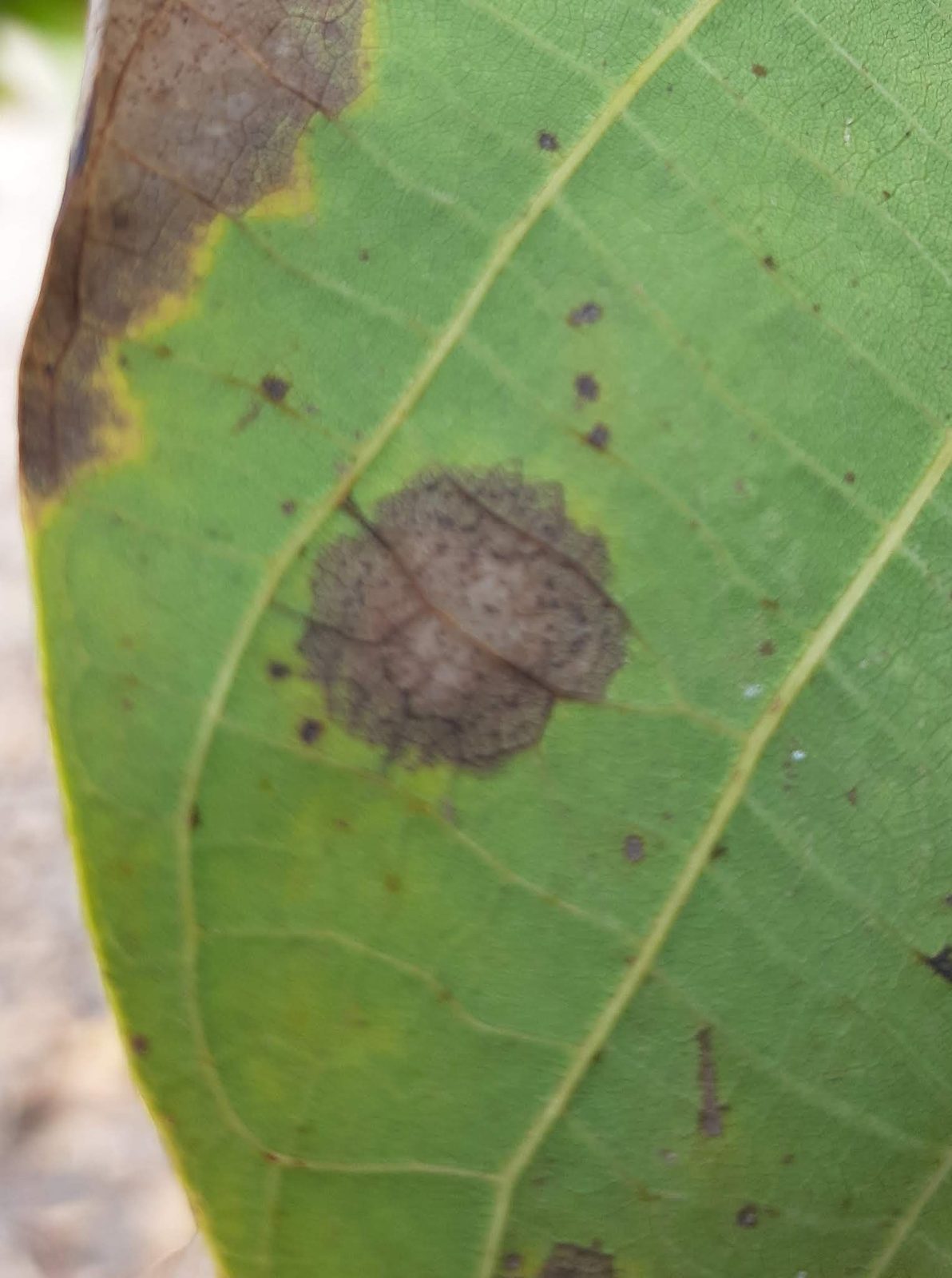
Pests and diseases of walnut: identification from the symptoms, with a diagnostic tool
Twenty causes, each with the one feature that separates it in the field: anthracnose and blight that produce the same lesion, brown apical necrosis, the pests of the nut, mites and aphids, the branch dieback complex, the cankers of the trunk, blackline at the graft union and the quarantine risk. With a tool that compares the symptoms against the profile of every cause, and two foreign recommendations that are illegal in the European Union today.
Walnut blight, Xanthomonas arboricola pv. juglandis
An aggressive disease that can take more than half the crop. The correct name of the pathogen, overwintering inside the dormant buds and why that load can be measured, the brown apical necrosis and vertical oozing canker forms, the per-tree risk scale counted in June, and the prayer-stage timing that is usually missed by ten days.

Walnut anthracnose: diagnosis and control
The most important fungal disease of walnut in Greece, found on almost every holding and capable of taking the whole crop. The correct name of the pathogen, the scale of the losses, differential diagnosis, the temperatures and humidity it needs, cultivar susceptibility and where Chandler stands, and the cultural measures without which the sprays do not hold.