
The persimmon cultivar Rojo Brillante
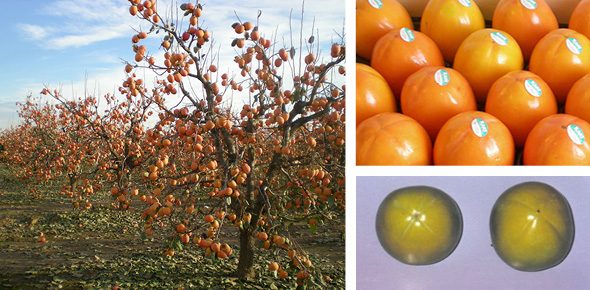
Savvas Pastopoulos, Agronomist MSc, Pastopoulos Agronomics, Neos Mylotopos, Pella, Greece
Persimmon is a crop that has been gaining ground in Greece in recent years. Of the cultivars grown here, Jiro and Karaliok have persisted to this day. Rojo Brillante is now available in Greek nurseries as well, the cultivar that redrew the world map of persimmon. It is also the cultivar that cannot be sold crisp without a deastringency chamber, and that is something to establish before planting, not after.
weight
always requires
deastringency
production
chilling injury
develops
- Where the cultivar came from
- The tree
- The fruit
- Why the fruit is seedless
- Astringency: why it is not like Karaliok
- When it is harvested
- Deastringency with carbon dioxide
- Cold storage and chilling injury
- Soil, rootstocks and climate
- The problem that travelled with the cultivar
- What must be answered before planting
- Sources
1. Where the cultivar came from
Rojo Brillante originates in Spain. It was selected by local growers in the 1960s among wild persimmons of the Ribera del Xúquer area, south of Valencia. It is therefore a chance seedling that stood out and was propagated, not the product of a breeding programme [1].
Although it has existed there for over sixty years, its spread effectively began in the 1990s, when the exceptional quality of the fruit led to explosive expansion of the crop in the province of Valencia. Today Rojo Brillante from the Ribera del Xúquer area accounts for about 83% of total Spanish persimmon production and is protected by a Protected Designation of Origin under the name Kaki Ribera del Xúquer [2].
2. The tree
The cultivar gives a vigorous, upright tree in its early years, of high vigour. It comes into bearing early, but requires 6 to 7 years to reach full production [1].
- Size. Trained as an open vase it reaches 3 to 3.6 m in height and a similar spread.
- Vigour. High. Productivity very high.
- Flowering. It bears female flowers only, very abundantly, with high fruit set and relatively little fruit drop [1].
- Cropping regularity. No marked biennial bearing has been observed under Spanish conditions.
3. The fruit
| Character | Value |
|---|---|
| Shape | Very broadly ovate to elongated, with a blunt apex and slight grooves |
| Size | Uniform and large, on average 250 to 300 g, with a mean diameter of at least 61 mm. The largest fruit comfortably exceed 350 to 400 g. |
| Skin colour at harvest | Yellow to orange-yellow, hue angle 66 to 75° |
| Colour after ripening | Intense red-orange, hue angle 43 to 57° |
| Flesh colour | Uniform yellow-orange, without brown patches when the fruit is seedless |
| Calyx | Large, wider than the fruit diameter, horizontal |
| Taste | Astringent in the ripe fruit, very sweet after deastringency |
The morphological characters in the table come from the official cultivar description [1].
4. Why the fruit is seedless
The cultivar is seedless and parthenocarpic. The reason is simple and lies in flower morphology: the tree bears only female flowers and produces no pollen at all. If no other pollen-bearing cultivar is present in the orchard, no fertilisation takes place, and the fruit sets and grows without seeds, and with high productivity at that.
Fruit is also borne on shoots of the current season. The shoot that grows this year is the one that will carry the flowers and the fruit.
In practical terms, a kiwifruit orchard needs males; a Rojo Brillante persimmon orchard does not want pollinators. If other pollen-producing persimmon cultivars, or male trees, exist on neighbouring holdings, this has to be taken into account when planning the planting.
5. Astringency: why it is not like Karaliok
Persimmon cultivars are classified on two questions: is the fruit astringent at harvest, and does the astringency change when the fruit acquires seeds? The combinations give four groups.
| Group | What it means | Examples |
|---|---|---|
| PCNA | Non-astringent, regardless of seeds. Eaten crisp straight from the tree. | Jiro, Fuyu |
| PVNA | Becomes non-astringent when seeds form, and the flesh darkens. | Karaliok (Chocolate persimmon), Kaki Tipo |
| PCA | Always astringent, regardless of seeds. | Hachiya, Giombo |
| PVA | Astringent when seedless; seeds darken the flesh around them but do not remove the astringency of the fruit. | Rojo Brillante, Tonewase |
The classification into the four groups follows the IVIA postharvest technology handbook [3].
Both cultivars are pollination-variant: when seeds form, the flesh around them darkens and turns brown. Up to this point the behaviour is indeed the same.
The difference is what the astringency does. In Karaliok, which belongs to the PVNA group, the seeds remove the astringency and the fruit is eaten firm, without any treatment. In Rojo Brillante, which belongs to the PVA group, the astringency remains: seeds do not make the fruit edible, they only make it uglier.
That is precisely why Rojo Brillante is deliberately grown seedless and deastringed artificially. The only route to crisp, marketable fruit is the treatment.
6. When it is harvested
The fruit is harvested before it is fully ripe, when it is light orange with a little green. The index is skin colour: at harvest the hue angle lies at 66 to 75°, that is yellow towards orange-yellow. Deep red-orange, around 43 to 57°, is the colour of the already ripe fruit, and by then it is too late to market it as a crisp product [1].
7. Deastringency with carbon dioxide
The fruit is astringent at harvest and requires deastringency in carbon dioxide chambers. The astringency is due to soluble tannins in the flesh. The treatment does not destroy them: it converts them to an insoluble form, so that they are no longer perceived in the taste [3].
| Parameter | Value |
|---|---|
| CO₂ concentration | 95 to 98% |
| Duration | 24 hours (12 hours in some protocols) |
| Temperature | 20 °C |
| Relative humidity | 90% |
Protocol after IVIA [3]. Commercial protocols give 90 to 95% CO2 for 20 to 24 hours at 20 to 24 °C [3].
The same treatment also ripens the fruit, so its timing and its conditions determine whether crisp or soft fruit comes out.
Temperature is decisive. The same treatment at 15 °C proves clearly less effective, with astringency remaining. And the temperature both during and immediately after the treatment affects the appearance of internal brown discolouration of the flesh after cold storage.
The fruit is ready to eat 1 to 2 days after deastringency [3].
8. Cold storage and chilling injury
Here lies the peculiarity of the cultivar that costs money when it is ignored. Rojo Brillante develops chilling injury symptoms when stored at temperatures below 11 °C [11]. The standard recommended storage temperature for persimmon is 0 °C, but most cultivars, Rojo Brillante among them, are sensitive and develop physiological disorders below a critical temperature [11].
The main symptoms are a drastic loss of firmness and gelling of the flesh, together with compacted flesh zones and internal browning [11]. They do not appear in the cold store but when the fruit is moved from cold storage to shelf temperature. The trader takes delivery of an apparently sound load and the product collapses on the shelf. Susceptibility is higher in fruit picked at an early maturity stage [11].
The periods that follow from Spanish postharvest research depend on three things: whether 1-MCP has been applied, on the temperature, and on when deastringency is carried out relative to chilling.
| Conditions | Period | What decides it |
|---|---|---|
| With 1-MCP, at 0 to 1 °C | Up to 40 days | Standard Spanish commercial practice. In trials, 30 days at 0 °C and 41 days at 1 °C with quality preserved [11] [5] |
| Without 1-MCP, at 0 °C, deastringency after chilling | Two weeks | Commercial quality for two weeks. This is also the organic case, where 1-MCP is not permitted [11] |
| Without 1-MCP, at 15 °C, deastringency before chilling | Three weeks | The better option without 1-MCP, because at 15 °C there is no chilling injury [11] |
| Without 1-MCP, at 0 °C, deastringency before chilling | Not advisable | Severe chilling injury symptoms and unacceptable quality [11] |
| Without 1-MCP, at 15 °C, deastringency after chilling | Not advisable | Deastringency fails and the fruit stays astringent, because CO2 does not diffuse into flesh that has lost its structure [11] |
Besides 1-MCP, its combination with a low oxygen atmosphere has also been studied, and it further limits softening and gelification [6]. The controlled atmosphere given for persimmon is 3 to 5% oxygen and 5 to 8% carbon dioxide below 5 °C, with a response that varies appreciably between cultivars [3].
The above comes from a doctoral thesis of the IVIA institute in Valencia and refers to Spanish production and handling conditions [11]. Fruit harvested with a firmness below 30 N cannot be stored at all, because it softens immediately after harvest [11].
When prolonged cold storage is expected, deastringency is carried out after chilling and not before. High carbon dioxide, besides insolubilising the tannins, also degrades cell membranes, which aggravates softening in the cold store [11].
When the order cannot be reversed, as in container shipments where the fruit has to leave already deastringed, a 24 hour attemperation period at 20 °C is inserted between the CO2 chamber and the cold store. Fruit transferred directly into chilling showed internal flesh browning after 41 days at 1 °C, whereas with the 24 hour period the disorder did not appear [11].
In organic production 1-MCP is not permitted, and that is the main constraint on the storage of organic persimmon [11].
9. Soil, rootstocks and climate
It thrives on fertile, adequately drained soils. The Spanish recommendations give pH 6 to 7.4 as the favourable range, the values of the soils of the Ribera del Xúquer. On the calcareous soils of Greece, where pH usually runs higher, the crop is not excluded; what becomes critical there is the choice of rootstock and the management of iron deficiency. The need for good drainage, by contrast, is not a politeness and applies everywhere: persimmon does not tolerate standing water in the root zone.
The rootstocks
The cultivar is compatible with the rootstocks Diospyros lotus and Diospyros virginiana, and is also grafted on Diospyros kaki. D. lotus is the predominant rootstock in Spanish orchards [1].
The climate
Persimmon breaks bud late, which protects it to a large extent from spring frosts. In Greece the issue is not so much spring as autumn: harvest is late and an early frost finds the fruit still on the tree. When selecting the plot, positions where cold air settles must be avoided. The general cultivation of persimmon under Greek conditions, from the soil to the cold store, is covered in a separate article.
10. The problem that travelled with the cultivar
When a cultivar expands at the rate of Rojo Brillante, its problems travel with it. The most serious one has a name.
The fungus Plurivorosphaerella nawae, formerly known as Mycosphaerella nawae, was recorded for the first time in Spain in August 2008 [7], in commercial orchards of the province of Valencia, following a mild and rainy spring. The symptoms are circular necrotic leaf spots and heavy defoliation.
It has become the most important limiting factor of persimmon growing in Spain. The critical epidemiological fact: all infections come from ascospores formed on the fallen leaves on the ground, and under the conditions of Valencia the ascospores are released mainly in April and May [8]. The dates are Spanish; in Greek orchards the corresponding window is set by the phenology of the tree and by the rainfall of the district.
The practical consequence is immediate: managing the leaf litter, removing it or accelerating its breakdown, is a preventive measure, not housekeeping. And protecting the foliage makes sense in spring, not in the summer when the spots become visible [8] [9]. The active substances approved on persimmon in Greece are checked in the Greek Ministry database, which is in Greek and valid in Greece only [10].
11. What must be answered before planting
- Where will my fruit be deastringed? Without access to a CO₂ chamber, Rojo Brillante cannot be sold crisp. It is the first question, not the last.
- Is there persimmon pollen in the area? If there is, seeded fruit with brown patches in the flesh will result.
- Does the plot drain? Fertile soil and reliable drainage. The Spanish range of pH 6 to 7.4 indicates favourable conditions rather than a limit: on the calcareous soils of Greece what becomes critical is rootstock choice and iron deficiency.
- How will the fruit reach the market? Chilling below 11 °C causes injury that is not visible in the chamber but on the customer's shelf. With 1-MCP before chilling, storage at 0 to 1 °C reaches forty days; without it the margin is two to three weeks, and only if deastringency is done in the right order [11].
12. Sources
The numbers in the text refer to the list below.
- [1] Crisosto, C.H. (2009). Persimmon tree named 'Nuevo Rojo Brillante'. US Plant Patent PP20729. Official description of the cultivar. Source for the selection of Rojo Brillante in the 1960s in the Ribera del Júcar, for the mean weight of 250-300 g, the 61 mm diameter, the hue angles of 66-75° and 43-57°, the exclusively female flowers, the 6-7 years to full production, compatibility with D. lotus and D. virginiana, and the characteristics of the Nuevo Rojo Brillante selection. The storage periods stated in the patent are not used here: they come from a cultivar description rather than from storage trials, and they do not agree with the postharvest literature of sources [3] and [5].
- [2] Evolution of production of the 'Rojo Brillante' cultivar in Spain and its impact on markets. Acta Horticulturae 1195. Source for the expansion of the crop from the 1990s, for the share of the Ribera del Xúquer district in Spanish production and for the Protected Designation of Origin.
- [3] Besada, C. and Salvador, A. (2015). Tecnología poscosecha del caqui. Chapter 12, Instituto Valenciano de Investigaciones Agrarias (IVIA) [in Spanish]. Full chapter text. The main postharvest source of this article: the PCNA, PCA, PVA and PVNA classification; the conversion of soluble tannins into an insoluble form; the CO2 deastringency protocol and the recommended temperature of 20 °C; the statement that chilling injury appears after exposure to temperatures below 10 to 15 °C, a range that contains the 11 °C threshold of source [11]; the greater difficulty of deastringency after a prolonged stay at 15 °C; the 40 days with 1-MCP before cold storage; the controlled atmosphere of 3 to 5% oxygen and 5 to 8% CO2 below 5 °C.
- [4] Salvador, A., Arnal, L., Monterde, A. and Cuquerella, J. (2004). Reduction of chilling injury symptoms in persimmon fruit cv. 'Rojo Brillante' by 1-MCP. Postharvest Biology and Technology 33(3):285-291. Source for the action of 1-MCP on firmness and calyx drop, and for the softening and gelification of the flesh appearing on the shelf rather than in the cold store. For the temperature threshold source [11] is used, which is later and gives 11 °C.
- [5] Salvador, A., Arnal, L., Navarro, P. and Martínez-Jávega, J.M. (2006). Estado actual en la conservación de caqui 'Rojo Brillante'. Revista Iberoamericana de Tecnología Postcosecha 7(2):86-92 [in Spanish]. Source for the storage limits: about 20 days at 15 °C, under 15 days at 1 °C and up to 40 days with 1-MCP. Also the source for the greater susceptibility of early-season fruit.
- [6] Effect of a low oxygen atmosphere combined with 1-MCP pretreatment on preserving the quality of 'Rojo Brillante' and 'Triumph' persimmon during cold storage. Scientia Horticulturae 179:51-58 (2015). Source for the combination of a low oxygen atmosphere with a 1-MCP pre-treatment and for the limitation of softening and gelification.
- [7] Berbegal, M. et al. (2010). First Report of Circular Leaf Spot of Persimmon Caused by Mycosphaerella nawae in Spain. Plant Disease 94(3):374. Source for the first record of circular leaf spot in August 2008 in commercial orchards of Valencia.
- [8] Vicent, A. et al. (2012). Inoculum and disease dynamics of circular leaf spot of persimmon caused by Mycosphaerella nawae under semi-arid conditions. European Journal of Plant Pathology 134:289-299. Source for the origin of all infections from ascospores on the leaf litter, for their release mainly in April and May under the conditions of Valencia, and for the fact that protection is worthwhile before the spots appear.
- [9] Vicent, A. et al. (2011). Evaluation of fungicides to control circular leaf spot of persimmon caused by Mycosphaerella nawae. Crop Protection 30(11):1461-1465. Source for the timing of the sprays and for the importance of protecting the foliage during the period of ascospore release.
- [10] Database of approved plant protection products, from the register of the Greek Ministry of Rural Development and Food [in Greek]. Source for the authorisation status on persimmon in Greece. Authorisations are national: a substance approved in Spain is not necessarily approved in Greece.
- [11] Fathi Najafabadi, A. (2021). Optimization of postharvest technology for 'Rojo Brillante' persimmon and introduction of new varieties in the Mediterranean area. Doctoral thesis, Universitat Politècnica de València, supervised by A. Salvador and C. Besada, Instituto Valenciano de Investigaciones Agrarias. Full text. The main source of the cold storage section: the appearance of chilling injury below 11 °C; the symptoms, that is loss of firmness, flesh gelling, compacted zones and internal browning, and their manifestation on the shelf; the greater susceptibility of early harvested fruit; the commercial practice of storing and shipping at 0 to 1 °C after 1-MCP at 500 nL/L for 24 hours; the trials of 30 days at 0 °C and 41 days at 1 °C; the limits for organic production without 1-MCP, that is two weeks at 0 °C with deastringency afterwards and three weeks at 15 °C with deastringency beforehand; the 30 N firmness threshold at harvest; the rule that deastringency follows chilling when long storage is planned; and the 24 hour attemperation period at 20 °C after the CO2 chamber, which prevented internal flesh browning after 41 days at 1 °C.
Plant protection products are used solely on the basis of the authorisations of the Greek Ministry of Rural Development and Food and the label instructions, for the approved crop, dose and pre-harvest interval. Those authorisations are valid in Greece only and do not apply in other countries. Active substances mentioned in foreign work are not necessarily approved in Greece.
The postharvest periods and temperatures come from Spanish work and are indicative. The outcome depends on harvest timing, fruit firmness, orchard management and chamber equipment, and is confirmed by a trial on a small batch before any general application.
Every intervention is made at the user's responsibility, following an on-site assessment by a licensed agronomist. Pastopoulos Agronomics accepts no liability for the use of the information in this article.
Related articles
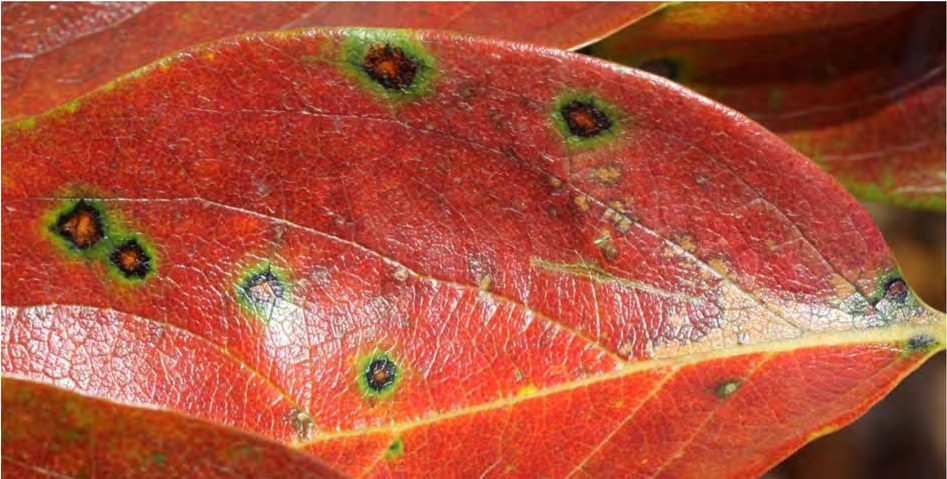
Pests and diseases of persimmon (Diospyros kaki) in Europe and Greece: epidemiology, differential diagnosis and action thresholds
Circular leaf spot (Plurivorosphaerella nawae), the pathogen that adapted to the semi-arid climate of Valencia and is not a quarantine organism, with the comparison between Spain and Korea and the role of drip irrigation. Angular leaf spot, Pestalotiopsis, anthracnose, and the twelve species of Diaporthe, Eutypella and Botryosphaeriaceae identified inside the wood. Postharvest rots: why Alternaria black spot became the limit of storage life after 1-MCP, and how extra irrigation before harvest is paid for in the cold room two months later. Crown gall, vascular wilt, root rots and phytoplasmas. Mealybugs and ants, wax scale, mussel scale, the orange spiny whitefly as a quarantine organism, fruit flies. Herbicide toxicity mistaken for a fungal leaf spot, a differential diagnosis table with fifteen pairs, action thresholds with the sampling method, and the four exotic pathogens threatening the Mediterranean. Thirteen photographs, five from Greek orchards.
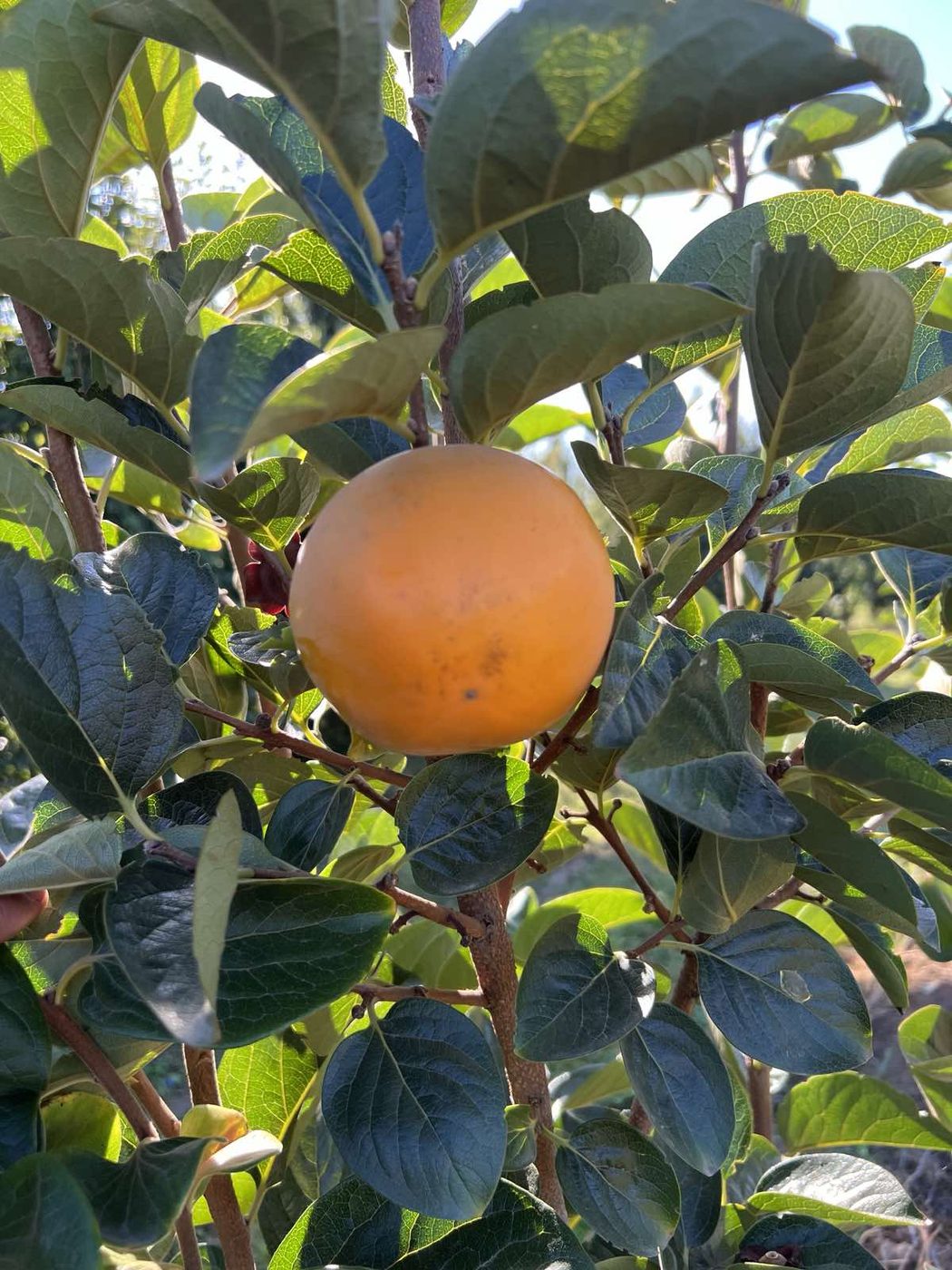
The Maxim persimmon cultivar: rights, ripening and key information
A protected Spanish cultivar of the Genesis Exotic group, distributed under licence. The fruit is not astringent at any stage, not even unripe, so no deastringency chamber is needed, the tree resembles Jiro and ripening falls in mid-September.
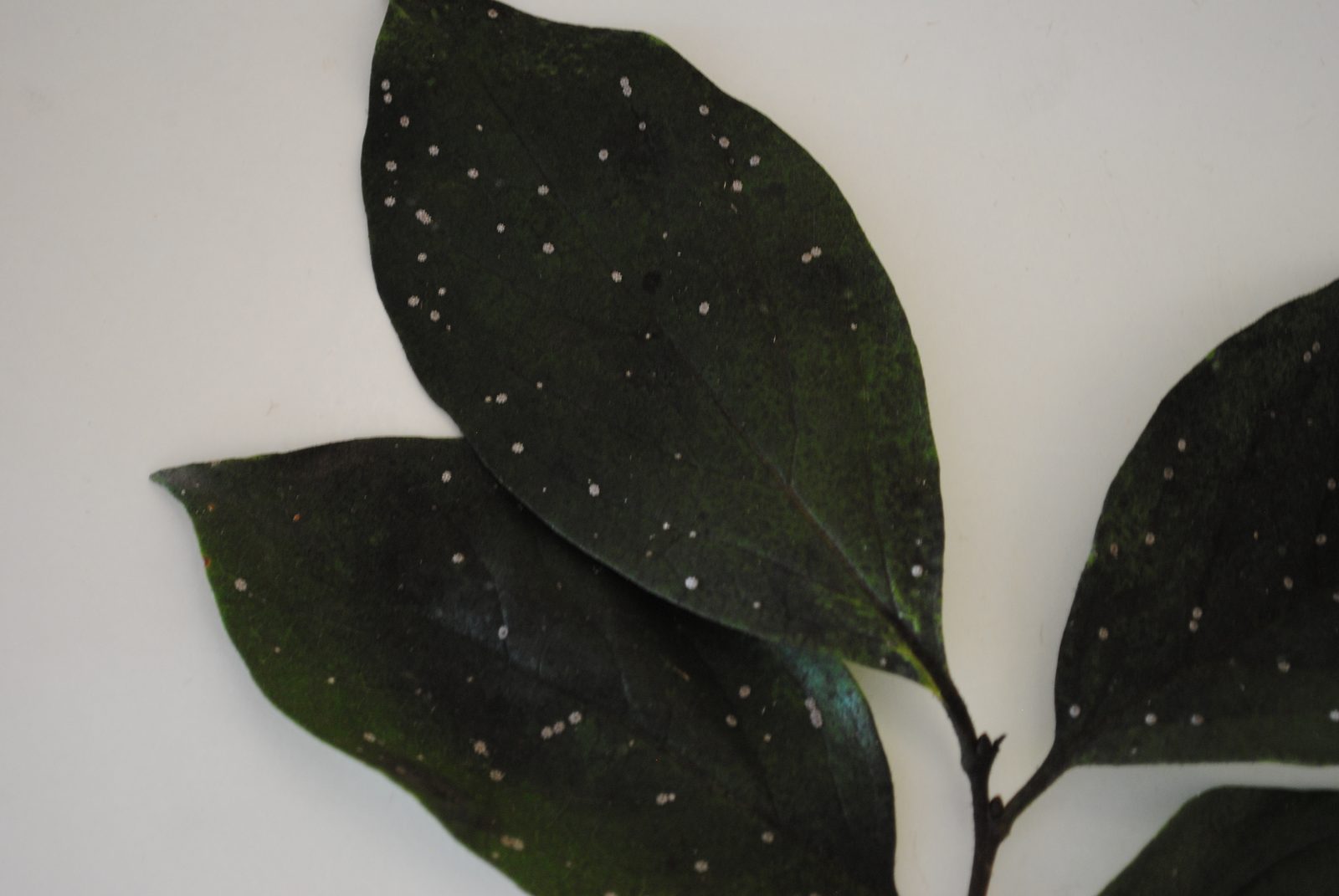
The fig wax scale, Ceroplastes rusci, on fig and persimmon
No synthetic active substance is authorised against it on fig or persimmon in Greece - only paraffin oils, maltodextrin and potassium salts of fatty acids, all of which act physically. That makes the crawler stage the whole of the treatment window, and coverage more important than dose.