
The fig wax scale, Ceroplastes rusci, on fig and persimmon
Savvas Pastopoulos, Agronomist MSc, Pastopoulos Agricultural Ltd, Neos Mylotopos, Pella
The fig wax scale does not kill the tree. It downgrades the crop indirectly: it excretes honeydew, sooty mould develops on the honeydew, the sooty mould blackens leaves and fruit, and the fruit loses its market value before it even reaches the packhouse. What is striking is what may be used against it in Greece: on fig and persimmon, no synthetic active substance carries an authorisation against the fig wax scale: only paraffin oils, maltodextrin and potassium salts of fatty acids. That is, products with a physical mode of action, which work only if they land on the right stage of the insect.
- What the fig wax scale is
- How it is recognised at each stage
- The life cycle and the generations
- The damage: honeydew and sooty mould
- Ants, the insect's silent ally
- Monitoring: when the crawlers emerge
- The treatment window
- Where the authorised products are found
- The oils: how they work and when they burn
- Cultural measures
- The natural enemies
- The mistakes that cost money
- Sources
1. What the fig wax scale is
Ceroplastes rusci (Linnaeus, 1758), Hemiptera: Coccidae. Known internationally as the fig wax scale. African in origin, it is today distributed throughout the Mediterranean and has been recorded in Algeria, Cyprus, Egypt, Greece, Israel, Italy, Lebanon, Morocco, Spain, Tunisia, Turkey and India [1] [2].
It is strongly polyphagous. Beyond fig, which is the principal host, it attacks citrus, olive, bay laurel, oleander, pittosporum, palms, poplars, planes, strawberry tree, mulberry, grapevine, avocado, mango, litchi and a great many ornamentals [2] [1]. On persimmon its presence is officially recognised: the Greek Ministry database includes authorisations against Ceroplastes sp. in the persimmon crop [6].
2. How it is recognised at each stage
Recognition is easy, provided one knows what to look for. The insect changes its appearance completely from stage to stage.
| Stage | Size | Appearance | Where it is found |
|---|---|---|---|
| Egg | 0.32 × 0.23 mm | Oval, at first pale yellow, later rust or cinnamon coloured | In a chamber beneath the body of the female, with no protective ovisac |
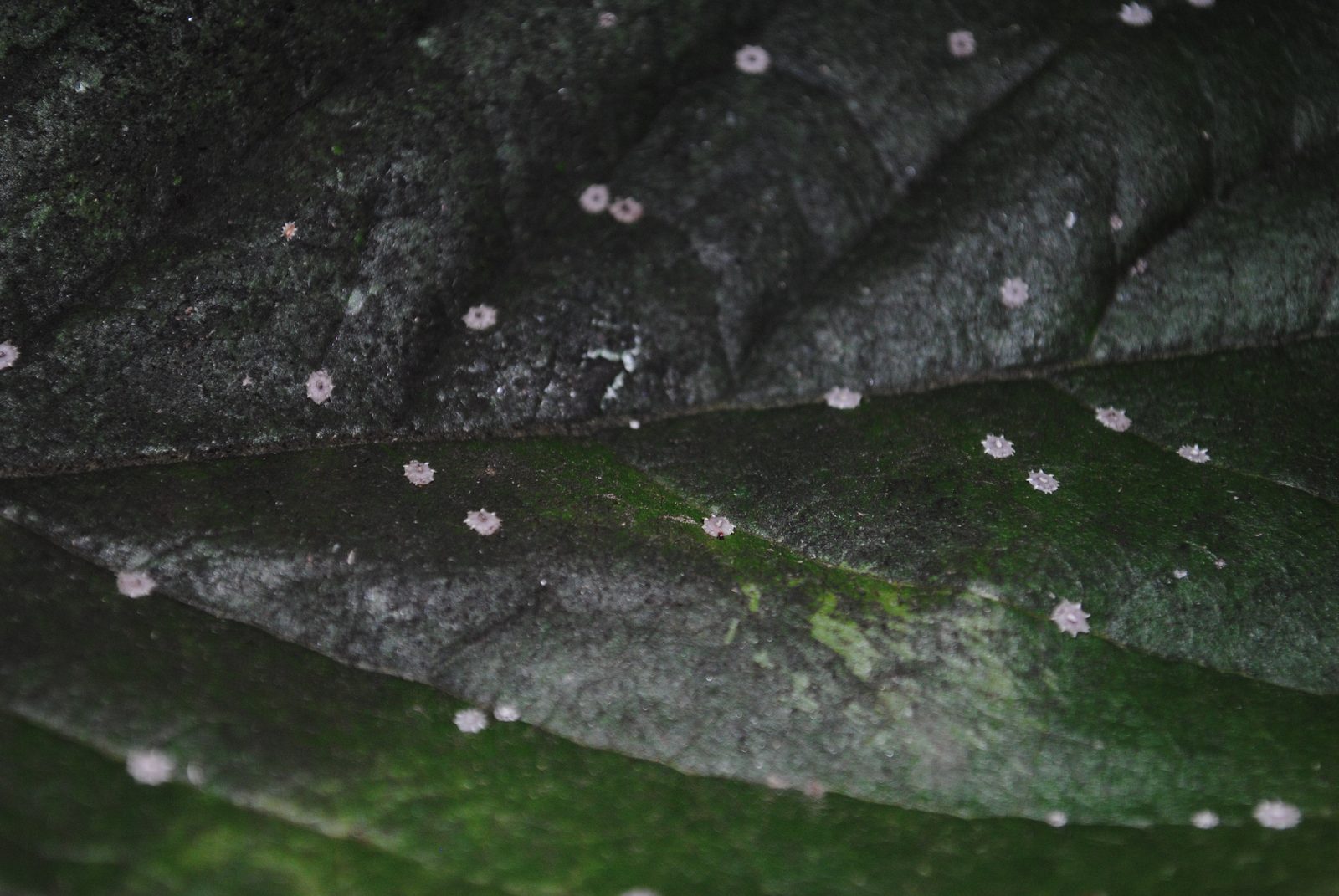
| Nymph (three instars) | 1 to 1.3 mm | Brown to yellowish-red, with a star-shaped arrangement of wax around it | Upper leaf surface in the early stages |
| Young female | not given | Waxy test, greyish | Leaf petioles, new shoots |
| Ovipositing female | 4 to 5 × 3 to 4 mm | Waxy test, brick red; nine plates, one polygonal dorsal plate and eight around it | Twigs and scaffold limbs |
| Male | 1.3 mm | Winged, with an elongate white covering and 15 waxy rays | Rarely found in the field |
Morphological data from sources [1] [2]. The antennae are six-segmented in the female and ten-segmented in the male; identification to species level is done on adult females.
3. The life cycle and the generations
The fig wax scale completes one generation a year. In warm southern and island microclimates a second generation has been recorded, starting in July or August [2]. Internationally, one to two generations a year are reported [1].
| Period | What happens |
|---|---|
| Winter | Overwinters as a third-instar nymph or adult female, on the twigs |
| April | Egg laying begins, on average 1,000 to 1,500 eggs per female |
| Spring | The crawlers hatch, move about and settle on the upper leaf surface |
| About a month later | The nymphs migrate to the leaf petioles and to the new shoots |
| From August | Movement onto the wood for overwintering |
| July to August | Start of the second generation, where one occurs |
Phenology from sources [1] [2]. The dates come from Italian manuals of applied entomology and from an American diagnostic guide, not from Greek records. They shift with the region, the altitude, the aspect and the season, and are always verified by observation in the field. Greek phenological data for the wax scale were not located, and the gap is stated here explicitly.
4. The damage: honeydew and sooty mould
The direct damage from sap feeding does exist, but it is rarely what decides the crop. Under heavy infestation, reduced vigour, chlorotic spotting, premature leaf fall, wilting and shoot dieback are recorded [3].
The real cost, however, is indirect and comes as a chain:
honeydew → development of sooty mould → blackening of leaves and fruit → reduced photosynthetic area and loss of market value [1] [3]Sooty mould is not a pathogen. It is saprophytic fungi growing on the sugars of the honeydew. It does not invade the tissue, but:
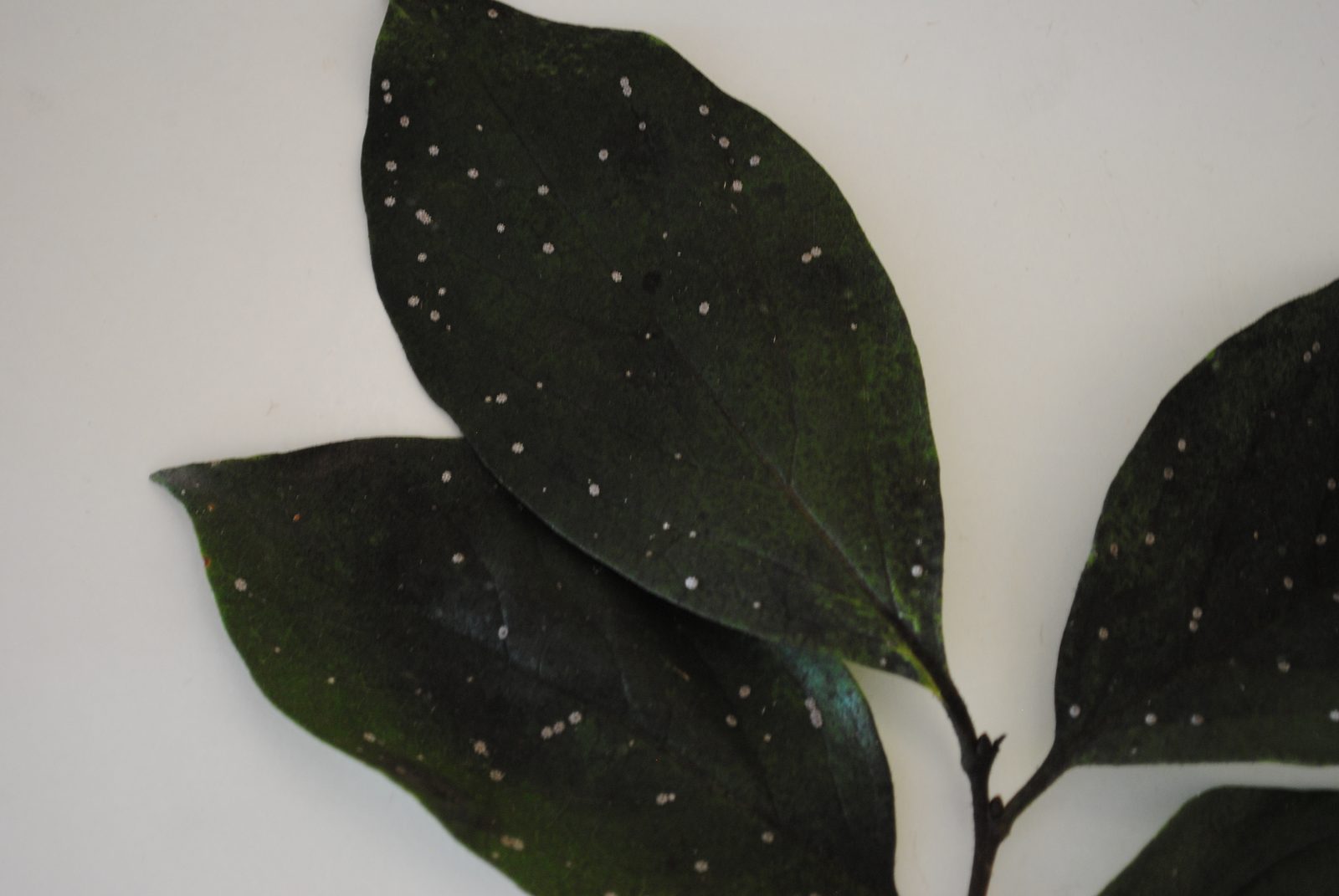
- It reduces photosynthesis, because it shades the blade. In the photograph at the top, the foliage is not dark green. It is blackened.
- It downgrades the fruit. Fruit with sooty mould is commercially second grade, even if it is faultless inside.
- It requires washing at the packhouse, with additional cost and additional mechanical handling.
5. Ants, the insect's silent ally
Every insect that produces honeydew can be “farmed” by ants. The ants feed on the honeydew and actively protect the scale from its natural enemies. That protection can cancel out an entire biological control programme [1].
In practice, when heavy ant traffic is seen on the trunk of a tree, expectations of natural population control have to be lowered. Blocking their ascent of the trunk with sticky bands is a measure that costs almost nothing and helps the beneficials do their work.
Sources: 1
6. Monitoring: when the crawlers emerge
The entire strategy rests on one thing: detecting egg hatch. There is no pheromone trap for the fig wax scale; monitoring is visual, and it is not difficult.
How it is done
- Marking indicator trees. Four to six trees with a known infestation from the previous year are selected, from different parts of the orchard.
- Checking from mid-April. The waxy test of the overwintering females is lifted with the point of a knife. The eggs are visible beneath: pale yellow means there is still time, rust or cinnamon colour means hatch is approaching [1].
- Examining the young leaves. The crawlers settle on the upper surface of the leaf [2]. With a ×10 lens they are visible as minute moving brown particles, before they begin producing wax.
- Sticky tape around infested twigs. The crawlers stick to it as they move and give a picture of the timing of hatch.
- Recording the date. The date of the peak is recorded per block and per year. After two or three seasons the orchard has its own calendar and monitoring becomes targeted.
7. The treatment window
The authorised products act physically, not neurotoxically. That determines absolutely when they work.
| Insect stage | Sensitivity to oil or soap | Why |
|---|---|---|
| Egg beneath the female | Very low | The body of the mother female acts as a shield |
| Crawler | Very high | Naked body, no wax, exposed and moving |
| Young nymph on the leaf | High | Thin waxy covering, easily accessible position |
| Third-instar nymph on the wood | Low | Thick wax, position sheltered in the bark |
| Adult female | Very low | Nine wax plates; the covering is genuine armour |
The ranking follows from the mode of action of the products and the morphology of the stages [1] [2]. It is not a recommendation for application.
8. Where the authorised products are found
This article does not recommend products, active substances or doses. Authorisations change constantly, and the only valid source is the national authority of the country concerned.
The plant protection products authorised in Greece for fig and persimmon against the fig wax scale, with their doses, pre-harvest intervals and application stages, are found in the authorisations database of the Greek Ministry of Rural Development and Food, searching by crop and by the specific target [6]. Outside Greece, the corresponding national register applies.
There are products authorised against scale insects that nevertheless carry no authorisation against the fig wax scale. Others cover a different scale species, such as San Jose scale or Lecanium corni.
An authorisation is granted for a combination of crop and specific pest, not for a category of pests. Using a product against a pest that is not named on the label is not permitted, even if it is the same active substance from the same company. The check is always made per crop and per target, in the official register.
9. The oils: how they work and when they burn
Paraffin oils act physically. They form a thin film that blocks the insect's respiratory spiracles and causes asphyxiation. There is no biochemical target, so no resistance develops, but neither is there any residual activity. Whatever was not wetted, survived.
The same property that makes them safe also makes them dangerous to the foliage under the wrong conditions.
- Spraying trees carrying fruit can cause marking of the fruit and scorching of the foliage. Summer oils carry an increased risk of this.
- A prior test on a limited number of trees is required, with the same product and the same dose, and a wait of 5 to 7 days before general application.
- Spraying is done in the late afternoon or early morning, never in extreme heat, never on foliage under water stress.
Practical rules for the oils
- Irrigate before spraying. A tree under water stress scorches far more easily.
- Avoid combining with sulphur. An interval of several weeks is kept between oil and sulphur, as the label specifies.
- Good agitation throughout the spray operation. The emulsion separates, and the last tankfuls come out with an excessive oil concentration.
- Plenty of water. The aim is coverage, not concentration.
10. Cultural measures
These are not supplementary. In a crop where chemical intervention is limited to oils and soaps, cultural measures are half the result.
- Winter brushing of the infested scaffold limbs after pruning. Mechanical removal of the overwintering females, a measure explicitly recommended in Mediterranean practice [2].
- Removal and disposal of the most heavily infested branches at pruning. They are not left on the orchard floor.
- Opening the canopy. A dense, shaded canopy means high humidity, favourable conditions for sooty mould and poor penetration of the spray.
- Ant control with sticky bands on the trunk.
- Control of the planting material. Young nursery trees are a frequent route by which the insect enters a clean orchard.
- Restraint with nitrogen fertilisation. Soft, lush growth favours scale insects.
Sources: 2
11. The natural enemies
The fig wax scale has a substantial set of natural enemies in the Mediterranean, and in many cases these hold the population below the damage threshold with no intervention at all.
| Beneficial | Group | Role |
|---|---|---|
| Scutellista caerulea (= S. cyanea) | Hymenoptera: Pteromalidae | The most abundant; consumes the eggs and ectoparasitises the young females |
| Coccophagus lycimnia, C. flavoscutellum | Hymenoptera: Aphelinidae | Parasitoids |
| Tetrastichus spp. | Hymenoptera: Eulophidae | Parasitoids |
| Eublemma scitula | Lepidoptera: Noctuidae | Predatory larva that feeds beneath the test |
| Chilocorus bipustulatus, Exochomus quadripustulatus | Coleoptera: Coccinellidae | Predators, as adults and as larvae |
List from sources [2] [4] [5]. In Mediterranean surveys Scutellista caerulea was found at 91% of the sites examined, with its stages accounting for up to 42% of the living population of the scale [5].
12. The mistakes that cost money
| Mistake | What actually happens |
|---|---|
| Spraying when the “little tortoises” appear | The adult females are armoured with nine wax plates. The spray is effectively useless |
| Spraying a fungicide for the sooty mould | The sooty mould lives on the honeydew. Without removing the source, it returns |
| Little water, a “strong” dose | Oils need coverage, not concentration. The risk of scorch rises and the efficacy falls |
| Spraying in extreme heat | Foliage scorch and marking of the fruit |
| Using a product authorised on another crop | An infringement. The crop-pest combination is checked separately every time |
| Ignoring the ants | The beneficials cannot get near and the population rises despite the sprays |
The key conclusions
- The fig wax scale causes damage mainly indirectly: honeydew, sooty mould, downgraded fruit [1] [3].
- One generation a year, two in warm microclimates; it overwinters on the wood as a third-instar nymph or as a female [2].
- Egg laying starts around April, with 1,000 to 1,500 eggs per female [2].
- The treatment window is the crawlers and the young nymphs on the leaves; from August the insect moves onto the wood and becomes unreachable [2].
- On fig, paraffin oils, maltodextrin and potassium salts of fatty acids are permitted in Greece; on persimmon, only two paraffin oil products [6].
- No synthetic active substance carries an authorisation against the fig wax scale in these two crops [6].
- Coverage matters more than dose, because the action is physical.
- Ants and winter brushing are two measures of almost zero cost with a measurable effect [1] [2].
13. Sources
The numbers in the text refer to the list below.
- [1] Martin, K.W., Weeks, J.A., Hodges, A.C. and Leppla, N.C. Fig wax scale, Ceroplastes rusci. Citrus Pests, Identification Technology Program, USDA-APHIS and University of Florida. Source for the dimensions of the stages (female 4 to 5 × 3 to 4 mm, male 1.3 mm, eggs 0.32 × 0.23 mm), for the three nymphal instars with star-shaped wax, for the absence of an ovisac, for overwintering on the twigs, for the role of ants and for transmission of the grapevine leafroll viruses.
- [2] Bissanti, G. Ceroplastes rusci, Systematics, Habitat, Biological cycle. An Eco-sustainable World. Based on Russo (1976), Pollini (2002) and Tremblay (1997), classic manuals of applied entomology. Source for the nine wax plates of the female, the greyish versus brick-red colour of the test, the 1,000 to 1,500 eggs per female, the start of egg laying in April, settlement on the upper leaf surface and the move onto the wood from August, the single generation with a second in warm microclimates, the host list, the natural enemies and winter brushing.
- [3] CABI. Ceroplastes rusci (fig wax scale). CABI Compendium / PlantwisePlus Knowledge Bank. Source for the symptomatology of the infestation: reduced vigour, chlorotic spotting, premature leaf fall, wilting and shoot dieback, and for the relationship between honeydew, sooty mould development and loss of market value.
- [4] New host plant records of Fig Wax Scale Ceroplastes rusci. Journal of Threatened Taxa. Source for the geographical distribution in the Mediterranean, with explicit mention of Greece, Turkey, Cyprus, Italy, Spain and North Africa, and for the host range.
- [5] Review of the natural enemies of soft scale insects, Scutellista. ScienceDirect Topics, based on the World Crop Pests: Soft Scale Insects series. Source for the list of parasitoids (Coccophagus lycimnia, Scutellista cyanea, Tomocera californica, Tetrastichus spp.) and for the presence of Scutellista caerulea at 91% of sites and up to 42% of the living population.
- [6] Database of authorised plant protection products and biocides, plantprotect.gr, with data from the official register of the Greek Ministry of Rural Development and Food. The only valid source for which products are authorised against the fig wax scale in each crop, at what dose and with what pre-harvest interval, and for the distinction between an authorisation against scale insects in general and an authorisation against this particular species.
Plant protection products are used solely on the basis of the authorisations of the national authority and of the product label [6]; in Greece, those of the Ministry of Rural Development and Food. The product label is read before every application. Authorisations change; verification is made in the official register before each use.
Any doses mentioned are indicative and do not constitute a recommendation for application. They differ by product, by concentration and by method of application. The final dose, the pre-harvest interval and the maximum number of applications are set by the label and by an on-site assessment by a licensed agronomist.
For every foliar spray: spraying trees carrying fruit can cause marking of the fruit and scorching of the foliage. A prior test on a limited number of trees is required, with the same product and the same dose, and a wait of 5 to 7 days before general application. Spraying is done in the late afternoon or early morning, never in extreme heat, never on foliage under water stress. The risk is increased with summer oils.
Every intervention is carried out at the user's own responsibility, following an on-site assessment by a licensed agronomist. Pastopoulos Agricultural Ltd accepts no liability for any damage arising from the application of the above.
Related articles
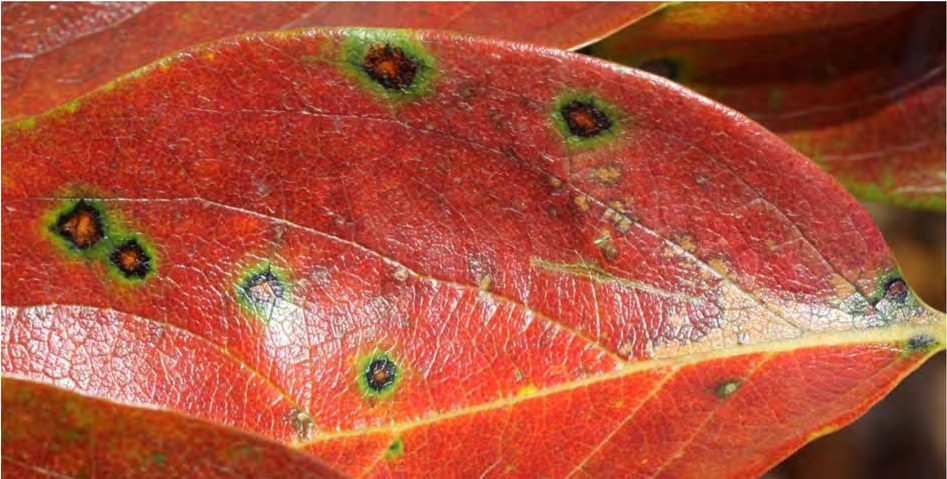
Pests and diseases of persimmon (Diospyros kaki) in Europe and Greece: epidemiology, differential diagnosis and action thresholds
Circular leaf spot (Plurivorosphaerella nawae), the pathogen that adapted to the semi-arid climate of Valencia and is not a quarantine organism, with the comparison between Spain and Korea and the role of drip irrigation. Angular leaf spot, Pestalotiopsis, anthracnose, and the twelve species of Diaporthe, Eutypella and Botryosphaeriaceae identified inside the wood. Postharvest rots: why Alternaria black spot became the limit of storage life after 1-MCP, and how extra irrigation before harvest is paid for in the cold room two months later. Crown gall, vascular wilt, root rots and phytoplasmas. Mealybugs and ants, wax scale, mussel scale, the orange spiny whitefly as a quarantine organism, fruit flies. Herbicide toxicity mistaken for a fungal leaf spot, a differential diagnosis table with fifteen pairs, action thresholds with the sampling method, and the four exotic pathogens threatening the Mediterranean. Thirteen photographs, five from Greek orchards.
The Maxim persimmon cultivar: rights, ripening and key information
A protected Spanish cultivar of the Genesis Exotic group, distributed under licence. The fruit is not astringent at any stage, not even unripe, so no deastringency chamber is needed, the tree resembles Jiro and ripening falls in mid-September.
Removing astringency from Rojo Brillante persimmon
Rojo Brillante is harvested firm and intensely astringent. Astringency goes only when enough acetaldehyde accumulates to make the tannins insoluble. The mechanism, the CO2 and ethanol protocols as applied in Spain, and what goes wrong when the chamber leaks, the batch is uneven or the treatment runs too long.