
Leonardite in agriculture: properties, rates and what the law says
Savvas Pastopoulos, Agronomist MSc, Pastopoulos Agronomic P.C., Neos Mylotopos, Pella, Greece
Leonardite is naturally oxidised lignite, with a humic acid content reaching 85% and the ability to increase nutrient availability. It is, however, neither a fertiliser nor a compost: the raw material has a pH below 3, contains up to 6% sulphur and almost no phosphorus. What follows explains what the analyses and meta-analyses show, where it delivers and where it does not, what European legislation requires, and what is already on the market with approval in Greece.
1. What leonardite is
Leonardite is the product of the natural oxidation of lignite where the deposit came close to the surface and met oxygen and water. It is therefore a mineral material, not an organic residue of recent origin: the humification that produced it counts in tens of millions of years [1]. It is almost always extracted as a by-product of lignite mining and its name comes from A. G. Leonard, a North Dakota geologist.
Oxidation is precisely what makes it useful. While unoxidised lignite is an inert fuel, contact with oxygen creates carboxyl, phenolic and hydroxyl groups on the macromolecules. These groups carry a negative charge and bind cations, and they are what give the material its cation exchange capacity and its chelating action [8] [9].
The fraction that is extracted in alkaline solution and precipitates at acid pH is called humic acids. The fraction that stays soluble in both is called fulvic acids and has a smaller molecular size, hence greater mobility within plant tissues [10]. The separation is operational, that is, it is defined by the extraction method and not by a specific chemical structure, a point that has fuelled a long scientific dispute over what humic substances in soil actually are [18].
2. The composition, with real analyses
The composition of leonardite differs from deposit to deposit. The most complete published series of analyses covers eight sampling points in three mines in northern Thailand [1]. The results show the range that should be expected.
| Parameter | Range of values | What it means in practice |
|---|---|---|
| Humic acids | 22.7 to 85.1% | A fourfold difference determines the value of the material. Always ask for the analysis certificate. |
| Organic matter | 16.3 to 61.0% | The low values correspond to samples mixed with soil. |
| pH | 1.84 to 6.20 | The pure samples were all below 3. Critical for the choice of soil. |
| Total sulphur | 0.40 to 6.36% | The lower the pH, the higher the sulphur. It acidifies further after incorporation. |
| Nitrogen | 0.25 to 0.60% | Very low and in a poorly soluble form. It does not substitute for nitrogen fertilisation. |
| Total phosphorus | 28.6 to 211.2 mg/kg | Essentially nil. Below the threshold for organic fertilisers. |
| Potassium | 0.84 to 2.24% | The only macronutrient present in appreciable quantity. |
| Iron | 1.62 to 5.33% | High. In an acid environment it can become toxic. |
| Silicon (as SiO2) | 16.4 to 48.3% | The predominant mineral constituent, mainly quartz. |
Values from analyses of eight deposits; other deposits give different values. The figures indicate the range and are not a product specification.
Two conclusions follow effortlessly. First, leonardite is bought for its humic acids and its organic matter, not for its nutrients. Second, the raw material is strongly acidic and sulphurous, characteristics that limit where it can go without prior correction.
3. How it acts in the soil and in the plant
In the soil
The action in the soil is the best documented and is due mainly to the charge of the functional groups. Humic substances increase cation exchange capacity, retain ammonium, potassium, calcium and magnesium against leaching, stabilise aggregates and improve water holding capacity [8] [17]. In parallel they chelate iron, zinc and manganese, keeping them soluble at pH values where they would otherwise precipitate as oxides and hydroxides.
This mechanism explains why the most consistent finding in the studies is not a yield increase but an increase in the concentration of micronutrients in the leaf. Indicatively, iron humates from leonardite in calcareous soil increased iron accumulation in soybean roots and were proposed as a treatment for iron deficiency chlorosis [19].
In the plant
The second group of actions is biostimulant. Humic and especially low molecular weight fulvic fractions induce the plasma membrane H+-ATPase, acidify the apoplast and enhance nitrate uptake, while activating enzymes of nitrogen metabolism [9] [10]. An auxin-like action has also been described, manifesting as proliferation of lateral roots.
The distinction has practical significance. Soil action requires substantial quantities of material and appears over time. Biostimulant action appears at very small rates of extract, but is transient and depends strongly on the stage of application.
In the microbial community
The addition of leonardite-derived materials altered the structure of the soil microbiome and was accompanied by an increase in potato yield [12]. The layered structure of the material, with high organic matter, also makes it a candidate as a carrier for biofertilisers, a role traditionally played by peat [1].
4. What the studies show
The overall picture from the meta-analyses
Individual studies almost always report positive results, because negative ones are published less often. Meta-analyses give a soberer picture.
The meta-analysis by Rose and co-workers estimated an increase in shoot dry weight of 22 ± 4% and in root dry weight of 21 ± 6%. Its most important finding, however, is a different one: the response depended primarily on the origin of the humic substances, and humic substances from compost clearly outperformed those derived from lignite and peat [4]. Leonardite belongs to the second, weaker category.
The more recent meta-analysis of the agronomic performance of humic acids gave a mean yield increase of 12%, a nitrogen use efficiency increase of 27% and a nitrogen uptake increase of 17%. The best results appeared in soils with pH between 6 and 8, while the effect weakened in alkaline soils, as well as where total nitrogen was high or organic carbon very low. The optimum accompanying nitrogen fertilisation was 100 to 200 kg N/ha [5].
Sweet cherry: the most complete orchard study
In a ten-year-old sweet cherry orchard, cultivar Ziraat 900 on Gisela 6 rootstock, at Salihli in Manisa, western Türkiye, four rates of granular leonardite (0, 2, 4 and 8 kg per tree) were applied along the drip line at a depth of 20 cm, in two equal applications in December and February, together with normal N-P-K fertilisation. The soil was loamy, slightly alkaline (pH 7.3), with organic matter of just 0.9% and very low available phosphorus and potassium [2].
| Rate per tree | Leaf nitrogen (%) | Leaf iron (ppm) | Soluble solids (%) | Phenolics (mg/100 g) |
|---|---|---|---|---|
| Control | 2.86 | 23.1 | 17.1 | 80.7 |
| 2 kg | 3.19 | 36.1 | 17.9 | 86.5 |
| 4 kg | 3.29 | 84.5 | 18.6 | 89.1 |
| 8 kg | 3.46 | 98.2 | 19.5 | 91.8 |
Values from the Demirer (2019) study. All differences were statistically significant at the 1% level, with the single exception of leaf magnesium.
The most striking change is iron: from 23.1 to 98.2 ppm, that is from deficiency level to sufficiency. In a slightly alkaline soil this is exactly the expected action of chelation. By contrast, magnesium was the only element that did not respond significantly [2].
Other crops
| Crop | Finding |
|---|---|
| Potato | Alteration of the soil microbiome and an increase in yield [12] |
| Sugar beet | Foliar application of a leonardite product in the field; changes in the expression of hormone metabolism genes and in the composition of endophytic bacteria [16] |
| Grapevine | A three-year trial in a commercial calcareous vineyard in a Mediterranean climate at 1 t/ha; soil organic matter increased more than the mass of the material itself explains [13] |
| Soybean | Iron humates against iron deficiency chlorosis in calcareous soil [19] |
| Rice | Reduced bioavailability of cadmium and zinc in a contaminated paddy field; the greatest reduction, however, came from a calcium phosphate and manure mixture rather than from leonardite [20] |
| Kiwifruit | In a two-year Greek study three biostimulants were compared; the clearest improvement in antioxidant characteristics came from the glycine betaine-proline product, not from the humic-fulvic one [11] |
Sources: 2 3 4 5 11 12 13 16 19 20
5. Where it delivers and where it does not
From the above a relatively clear suitability profile emerges, one that does not coincide with the "everywhere and always" of the promotional leaflets.
Where the probability of a response is greatest
- Soils with low organic matter. In the cherry study the starting point was 0.9%, classed as insufficient [2]. In a soil with 3% organic matter the addition has a much smaller margin.
- Calcareous soils with iron chlorosis. There, chelation has a clear, measurable action [2] [19].
- Slightly alkaline soils, up to about pH 8. Above that, the effect weakens according to the meta-analysis [5].
- Light textures with high leaching, where the increase in cation exchange capacity translates directly into smaller losses.
- In acid soils. Material with pH below 3 and 4 to 6% sulphur keeps acidifying after incorporation, through sulphur oxidation. In such a case prior correction with limestone flour or dolomite is required [1].
- In soils with high available iron and low pH. The iron content of the material reaches 5.3% and under acid conditions becomes readily soluble at toxic levels [1].
- As a substitute for fertilisation. It supplies no nitrogen and no phosphorus. All the studies that gave positive results applied it together with normal fertilisation, not instead of it.
6. Forms, rates and what they cost
The forms on the market
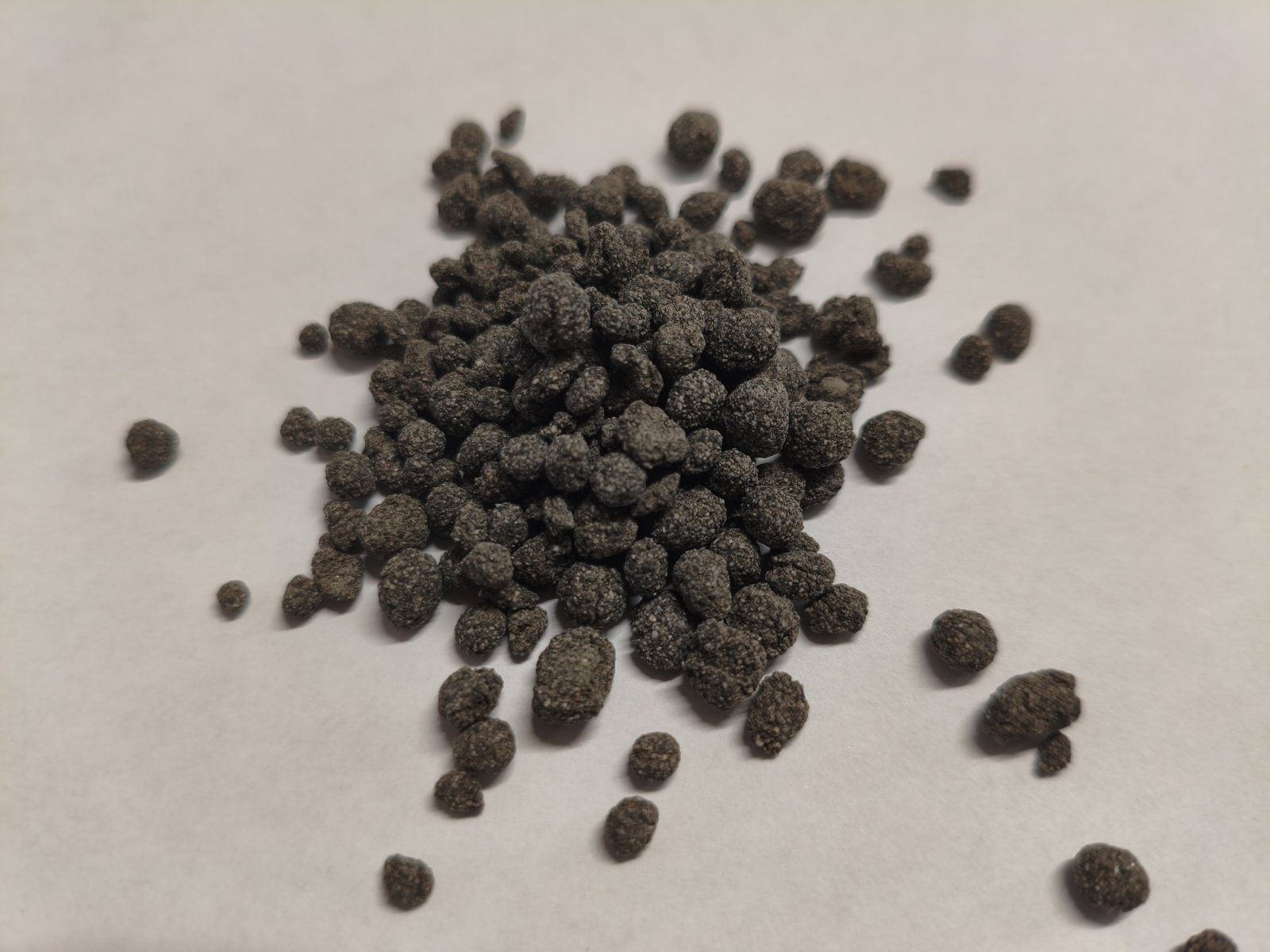
- Powder or granules of raw material. Soil application, base dressing or planting. The cheapest form per unit of organic matter, but the bulkiest.
- Water-soluble humates. Produced by alkaline extraction, usually with potassium hydroxide. Applied through fertigation.
- Liquid concentrates rich in fulvics. Smaller molecular size, greater mobility, also used foliarly [10].
- Organo-mineral blends, where leonardite is combined with N-P-K and micronutrients. This is, as section 8 shows, the prevailing form on the Greek market.
Checking the rate with arithmetic
The rates in foreign studies are given per tree or per unit area and are often converted wrongly. The conversion for the cherry study goes as follows. Planting distances were 5.0 × 2.5 metres [2].
5.0 m × 2.5 m = 12.5 m² per tree10,000 m² ÷ 12.5 m² = 800 trees per hectare8 kg per tree × 800 = 6,400 kg per hectare = 6.4 t/ha
| Experimental rate | Equivalent per hectare | Comment |
|---|---|---|
| 2 kg per tree | 1.6 t/ha | Already higher than the usual rate in arable crops |
| 4 kg per tree | 3.2 t/ha | At this rate leaf iron crossed the sufficiency threshold |
| 8 kg per tree | 6.4 t/ha | Six times the 1 t/ha used in arable studies |
The values concern raw granular leonardite and a density of 800 trees per hectare. At a wider spacing the equivalent per hectare decreases proportionally. They are indicative and do not constitute a recommendation for application.
This calculation is the reason why the spectacular results of orchard studies do not transfer unchanged to the field: 6.4 tonnes per hectare is a quantity with agronomic and also economic weight. In arable studies the usual rate is around 1 t/ha, and in several cases the researchers concluded that this rate was insufficient [3].
Closer to commercial reality is the three-year trial in a commercial calcareous vineyard in a Mediterranean climate, where 1 tonne of leonardite per hectare was applied, alone and in combination with 500 kg/ha of ferrous sulphate heptahydrate. Both treatments increased soil organic matter, and by more than is explained by the mass of material added [13]. An order of magnitude of 1 t/ha annually is, in practice, the realistic starting point for a permanent planting. Before any investment, the comparison is made on cost per unit of humic acids and not per kilogram of product.
Foliar application
7. European legislation
The fertilising products regulation
Regulation (EU) 2019/1009 of the European Parliament and of the Council of 5 June 2019 names leonardite explicitly as a permitted constituent in three product function categories [6]:
- PFC 1(A), organic fertiliser: it may contain peat, leonardite and lignite, but not other materials that are fossilised or embedded in geological formations.
- PFC 1(B), organo-mineral fertiliser: with identical wording.
- PFC 3(A), organic soil improver: also with explicit reference to leonardite.
The contaminant limits differ by category. The differences between the three concern cadmium and zinc.
| Contaminant | Organic fertiliser PFC 1(A) | Organic soil improver PFC 3(A) | Biostimulant PFC 6 |
|---|---|---|---|
| Cadmium (Cd) | 1.5 | 2 | 1.5 |
| Hexavalent chromium (Cr VI) | 2 | 2 | 2 |
| Mercury (Hg) | 1 | 1 | 1 |
| Nickel (Ni) | 50 | 50 | 50 |
| Lead (Pb) | 120 | 120 | 120 |
| Inorganic arsenic (As) | 40 | 40 | 40 |
| Copper (Cu) | 300 | 300 | 300 |
| Zinc (Zn) | 800 | 800 | 1,500 |
All values in mg per kg of dry matter, from Annex I of Regulation (EU) 2019/1009. The table is indicative; the text of the regulation always prevails.
The category PFC 6, plant biostimulant, is defined by function and not by composition: a product that stimulates nutrition processes independently of its nutrient content, with the aim of improving nutrient use efficiency, tolerance to abiotic stress, quality traits or the availability of nutrients in the rhizosphere [6]. The same leonardite extract can be placed on the market either as a soil improver or as a biostimulant, but with different label claims permitted.
Organic farming
- "Leonardite (raw organic sediment rich in humic acids)", only if obtained as a by-product of mining activities.
- "Humic and fulvic acids", only if obtained by inorganic salts or solutions excluding ammonium salts, or obtained from drinking water purification.
8. What is approved and on the market in Greece
The Greek Register of Marketing Authorisations for New Type Fertilisers, as compiled in the fertiliser register database, holds 3,124 entries. Of these [15]:
Three points require attention. First, all 45 products that name leonardite belong to the same approval type in the register, whereas the entries with humic and fulvic acids are spread across six different types, an indication that extracts are marketed in far more roles than the raw material.
Second, the prevailing form is not plain leonardite but the organo-mineral blend: typical compositions in the register are of the order of 10-8-12 plus magnesium, ferrous sulphate, zinc sulphate and boron, with 26 to 44% leonardite, corresponding to 11 to 22% organic matter. This matches exactly the PFC 1(B) category of the European regulation.
Third, the distribution over time shows that the interest is recent: 20 of the 45 approvals were granted in 2023 and 14 in 2019, while the oldest dates from 2007 [15].
9. Practical conclusions
The decline of organic matter and the degradation of soil structure are recorded in the Greek National Action Plan to Combat Desertification as the second stage in the sequence that takes a sloping soil from thinning vegetation cover through to desertification [14]. Increasing organic matter is therefore not a matter of optimising production but of preserving the productive base.
What is retained from all of the above
- Leonardite is a soil improver and a biostimulant, not a fertiliser. It supplies no phosphorus and minimal nitrogen. All the positive studies combined it with normal fertilisation.
- Quality differs fourfold between deposits. Always ask for the humic acid content, the pH, the sulphur and the heavy metal analysis.
- The expected response is moderate. Around 12% in yield on average, with a larger and more consistent benefit in nitrogen use efficiency [5].
- The greatest probability of benefit is found in soils with low organic matter, with iron chlorosis and with pH up to about 8.
- Raw leonardite does not go into an acid soil without prior correction, because of its pH below 3 and sulphur up to 6%.
- Cost comparison is made per unit of humic acids, not per kilogram of product. The rates in orchard studies reach 6.4 t/ha.
- In organic farming the origin decides: a by-product of mining for the mineral, extraction without ammonium salts for the extracts [7].
Including leonardite in a nutrition programme presupposes soil analysis, knowledge of the existing organic matter and pH, and comparison with alternative sources of organic matter. In many cases manure, compost or green manure deliver more organic matter per euro, and, according to the meta-analysis, humic substances from compost gave a stronger response than those from lignite [4]. Leonardite has the advantage where a concentrated quantity of stable humic substances is wanted without a load of nitrogen, phosphorus and weed seeds.
10. Sources
The numbers in the text refer to the list below.
- [1] Ratanaprommanee, C., Chinachanta, K., Chaiwan, F. and Shutsrirung, A. (2017). Chemical characterization of leonardite and its potential use as soil conditioner and plant growth enhancement. Asia-Pacific Journal of Science and Technology 22(4):APST-22-04-01. Source for the composition of eight deposits: humic acids 22.7-85.1%, pH 1.84-2.55, sulphur 0.40-6.36%, nitrogen 0.25-0.60%, phosphorus 28.6-211.2 mg/kg, iron 1.62-5.33%, and for the arsenic, cadmium and lead values.
- [2] Demirer, T. (2019). Effect of leonardite application on leaf nutrient content and fruit chemical parameters of cherry (Prunus avium L.). Journal of Plant Nutrition 42(19):2532-2538. Source for the cherry study: rates of 0-8 kg per tree, spacing 5.0 × 2.5 m, initial organic matter 0.9%, pH 7.3, and for all the leaf and fruit values in the table.
- [3] Demirkıran, A. R. (2023). Agricultural evaluation of organic material: leonardite. In: Agricultural and Environmental Reports for Sustainable Future, chapter 4, pp. 79-100, Iksad Publications. Source for the summary review of responses by crop, for the 1 t/ha rates in arable crops and for the recorded cases of no effect in pepper, lettuce, wheat and grapevine.
- [4] Rose, M. T., Patti, A. F., Little, K. R., Brown, A. L., Jackson, W. R. and Cavagnaro, T. R. (2014). A meta-analysis and review of plant-growth response to humic substances: practical implications for agriculture. Advances in Agronomy 124:37-89. Source for the increase in shoot dry weight of 22 ± 4% and root dry weight of 21 ± 6%, and for the finding that humic substances from compost outperform those from lignite and peat.
- [5] Zhang, Y. et al. (2024). The impact of humic acid fertilizers on crop yield and nitrogen use efficiency: a meta-analysis. Agronomy 14(12):2763. Source for the mean yield increase of 12%, nitrogen use efficiency of 27% and nitrogen uptake of 17%, for the optimum pH 6-8 range, for the weakening of the effect in alkaline soils and for the optimum nitrogen rate of 100-200 kg/ha.
- [6] Regulation (EU) 2019/1009 of the European Parliament and of the Council of 5 June 2019 laying down rules on the making available on the market of EU fertilising products. Official Journal of the European Union L 170:1. Source for the explicit reference to leonardite in PFC 1(A), 1(B) and 3(A), for the contaminant limits of Annex I and for the definition of a plant biostimulant in PFC 6.
- [7] Commission Implementing Regulation (EU) 2021/1165 of 15 July 2021 authorising certain products and substances for use in organic production, Annex II (consolidated text). Source for the condition "only if obtained as a by-product of mining activities" for leonardite and for the condition on non-ammonium salts for humic and fulvic acids.
- [8] Canellas, L. P., Olivares, F. L., Aguiar, N. O., Jones, D. L., Nebbioso, A., Mazzei, P. and Piccolo, A. (2015). Humic and fulvic acids as biostimulants in horticulture. Scientia Horticulturae 196:15-27. Source for the functional groups, the cation exchange capacity and the chelating action of humic substances.
- [9] Nardi, S., Pizzeghello, D., Muscolo, A. and Vianello, A. (2002). Physiological effects of humic substances on higher plants. Soil Biology and Biochemistry 34(11):1527-1536. Source for the induction of the plasma membrane H+-ATPase and for the enhancement of nitrate uptake.
- [10] Trevisan, S., Francioso, O., Quaggiotti, S. and Nardi, S. (2010). Humic substances biological activity at the plant-soil interface. Plant Signaling & Behavior 5(6):635-643. Source for the smaller molecular size and greater mobility of fulvic fractions within plant tissues.
- [11] Papantzikos, V., Stournaras, V., Mpeza, P. and Patakioutas, G. (2024). The effect of organic and amino acid biostimulants on Actinidia deliciosa 'Hayward' cultivation. Applied Biosciences 3(3):360-377. Source for the two-year Greek kiwifruit study and for the finding that the clearest improvement in antioxidant characteristics came from the glycine betaine-proline product.
- [12] Akimbekov, N., Qiao, X., Digel, I., Abdieva, G., Ualieva, P. and Zhubanova, A. (2020). The effect of leonardite-derived amendments on soil microbiome structure and potato yield. Agriculture 10(5):147. Source for the change in soil microbiome structure and the increase in potato yield.
- [13] Olego, M. Á., Quiroga, M. J., Mendaña-Cuervo, C., Cara-Jiménez, J., López, R. and Garzón-Jimeno, E. (2022). Effects of leonardite amendments on vineyard calcareous soil fertility, vine nutrition and grape quality. Plants 11(3):356. Source for the three-year trial in a commercial calcareous vineyard in a Mediterranean climate at 1 t/ha, and for the increase in organic matter beyond that explained by the mass of the material.
- [14] Greek National Action Plan to Combat Desertification, National Committee against Desertification, Ministry of Rural Development and Food (in Greek). Source for classing the decline of organic matter and the degradation of structure as the second stage of the sequence leading to desertification.
- [15] Register of Marketing Authorisations for New Type Fertilisers, Greek Ministry of Rural Development and Food, data release 10 December 2025. Source for the 3,124 register entries, the 45 products naming leonardite from 7 companies, the 318 entries with leonardite or humic and fulvic acids, the distribution of approvals over time and the typical compositions of the organo-mineral blends.
- [16] Della Lucia, M. C. et al. (2021). Novel effects of leonardite-based applications on sugar beet. Frontiers in Plant Science. Source for the change in expression of metabolism and nutrient uptake genes in sugar beet.
- [17] Calvo, P., Nelson, L. and Kloepper, J. W. (2014). Agricultural uses of plant biostimulants. Plant and Soil 383(1-2):3-41. Source for the classification of humic substances among biostimulants and for their effects on soil structure and water holding capacity.
- [18] Lehmann, J. and Kleber, M. (2015). The contentious nature of soil organic matter. Nature 528:60-68. Source for the point that the separation of humic and fulvic acids is operational, defined by the extraction method, and for the related scientific dispute.
- [19] Cieschi, M. T. and Lucena, J. J. (2018). Iron and humic acid accumulation on soybean roots fertilized with leonardite iron humates under calcareous conditions. Journal of Agricultural and Food Chemistry 66(51):13386-13396. Source for iron accumulation in soybean roots under calcareous conditions with leonardite iron humates.
- [20] Saengwilai, P. and Meeinkuirt, W. (2021). Cadmium (Cd) and zinc (Zn) accumulation by Thai rice varieties and health risk assessment in a Cd-Zn co-contaminated paddy field: effect of soil amendments. Environmental Geochemistry and Health 43(9):3659-3674. Source for the comparison of leonardite with a calcium phosphate and manure mixture in a paddy field contaminated with cadmium and zinc, where the greatest reduction in bioavailability came from the mixture with manure.
This text is general technical information and not individualised agronomic advice. The rates and ranges mentioned come from published work, are indicative and do not constitute a recommendation for application. The final rate is determined after soil and leaf analysis and an on-site assessment by a licensed agronomist.
Every fertiliser or soil improver is used in accordance with its marketing authorisation and its label. Plant protection products are used exclusively on the basis of national approvals and the product label; the Greek approvals are checked in the fyto.plantprotect.gr database and the Greek fertiliser authorisations in the fertiliser register database. Those approvals are valid in Greece only; in every other country the corresponding national register applies. For use on an organic holding, the specific product must be checked with the certification body.
Foliar sprays: spraying trees carrying fruit can cause fruit marking and leaf burn. A prior test on a limited number of trees is required, with the same product and the same rate, and a wait of 5 to 7 days before general application. Spraying is done in the late afternoon or early morning, never in a heatwave and never on foliage under water stress.
Every intervention is carried out at the user's own responsibility. Pastopoulos Agronomic P.C. accepts no liability for the use of the information in this article.
Related articles
Nutrient antagonisms and synergies, with a per-element tool
The arrow diagram in every fertiliser leaflet does not stand up scientifically. The antagonisms are real, but they act on two separate levels, in the soil and inside the plant, and the same element can be antagonistic on one and synergistic on the other. With a tool showing the documented relationships of each element.
Zeolite in agriculture: what is documented and what is not
It is a cation exchanger, it holds ammonium and potassium, not nitrate. The rates that work are tens of tonnes per hectare, not hundreds of kilos. And erionite is a Group 1 carcinogen.
Biostimulants: what the science says and what the EU regulation requires
The seven categories, the molecular mechanisms, the EU legal framework since 2022, and the six questions to ask a supplier before buying.