
Scab of stone fruit, with the emphasis on apricot

Savvas Pastopoulos, Agronomist MSc, Pastopoulos Agronomics
Peach scab of stone fruit is a disease of rainy springs. It does not kill the tree and it does not rot the fruit, it simply downgrades it commercially, and it does so at the worst possible moment: shortly before harvest. Its most exasperating feature is that it appears while the orchard is being sprayed. This article explains why that happens, with the emphasis on apricot, and states at every point in which country each figure quoted was measured.
In the search carried out for this article no published Greek measurement was found for peach scab of stone fruit: no temperature threshold, no hours of wetness, no incubation period under Greek conditions, and no efficacy trial in a Greek orchard.
All the figures that follow are Italian or American, and their origin is stated inside the sentence. They are given as a ranking of risk and an order of magnitude, not as a Greek calendar. This gap is a genuine research question and not a detail.
with rain (USA)
the risk declines (USA)
(Italy)
during the rains (Italy)
- The identity of the pathogen
- Symptoms on the fruit
- Shoots and leaves, where the problem hides
- The disease cycle
- When the door to infection opens
- The susceptibility window and the hidden incubation
- Why it appears while the orchard is being sprayed, four reasons
- What is documented about the products, and what is not
- The timing strategy that works
- Prevention from the moment of planting
- Sources
1. The identity of the pathogen
The disease is caused by the ascomycete Venturia carpophila E.E. Fisher, of the order Venturiales and the family Venturiaceae 5. Internationally it is known as peach scab and, for apricot specifically, as apricot scab 5; in the Italian literature as nerume delle drupacee 9.
The accepted name of the species is Venturia carpophila. The literature records as synonyms Fusicladosporium carpophilum, Cladosporium carpophilum Thüm., Megacladosporium carpophilum, Fusicladium carpophilum and Cladosporium americanum 4. The EPPO database lists the species under the same accepted combination and the same synonyms 5.
The Greek common name "kladosporiosi" (peach scab) derives precisely from the old Cladosporium, which referred to the asexual state of the fungus 4.
So, the more recent literature is found under Venturia carpophila or under the international term peach scab. Cladosporium carpophilum leads mostly to older material, and it remains in use in active extension leaflets 1 2.
The sexual state of V. carpophila, the pseudothecia that produce ascospores, has been described only from Australia and has not been described anywhere else, while its role in the epidemiology of the disease remains unknown 4. What is positively documented is where the fungus overwinters: in cankers on one-year-old twigs 4, as mycelium inside the lesions and as chlamydospores on the bark surface 3. That is, the inoculum is already on the tree before it even flowers.
2. Symptoms on the fruit
On the fruit of apricot, peach, nectarine and plum 1 the symptoms begin as small round olive-green spots. In Illinois, USA, they are described as 1.6 to 3.2 mm in diameter, in the source, 1/16 to 1/8 of an inch 1; in Emilia-Romagna they are described as enlarging to 2 or 3 mm, and more so on nectarines, taking on a blackish cast 3. In severe attacks they coalesce 1.
In South Carolina the lesions are described as velvety dark, smaller than 6.4 mm, in the source, a quarter of an inch, accompanied by cracking, and it is expressly noted that they are confined to the outer skin 8. Whatever the shade, the lesions stand out and downgrade the fruit economically.
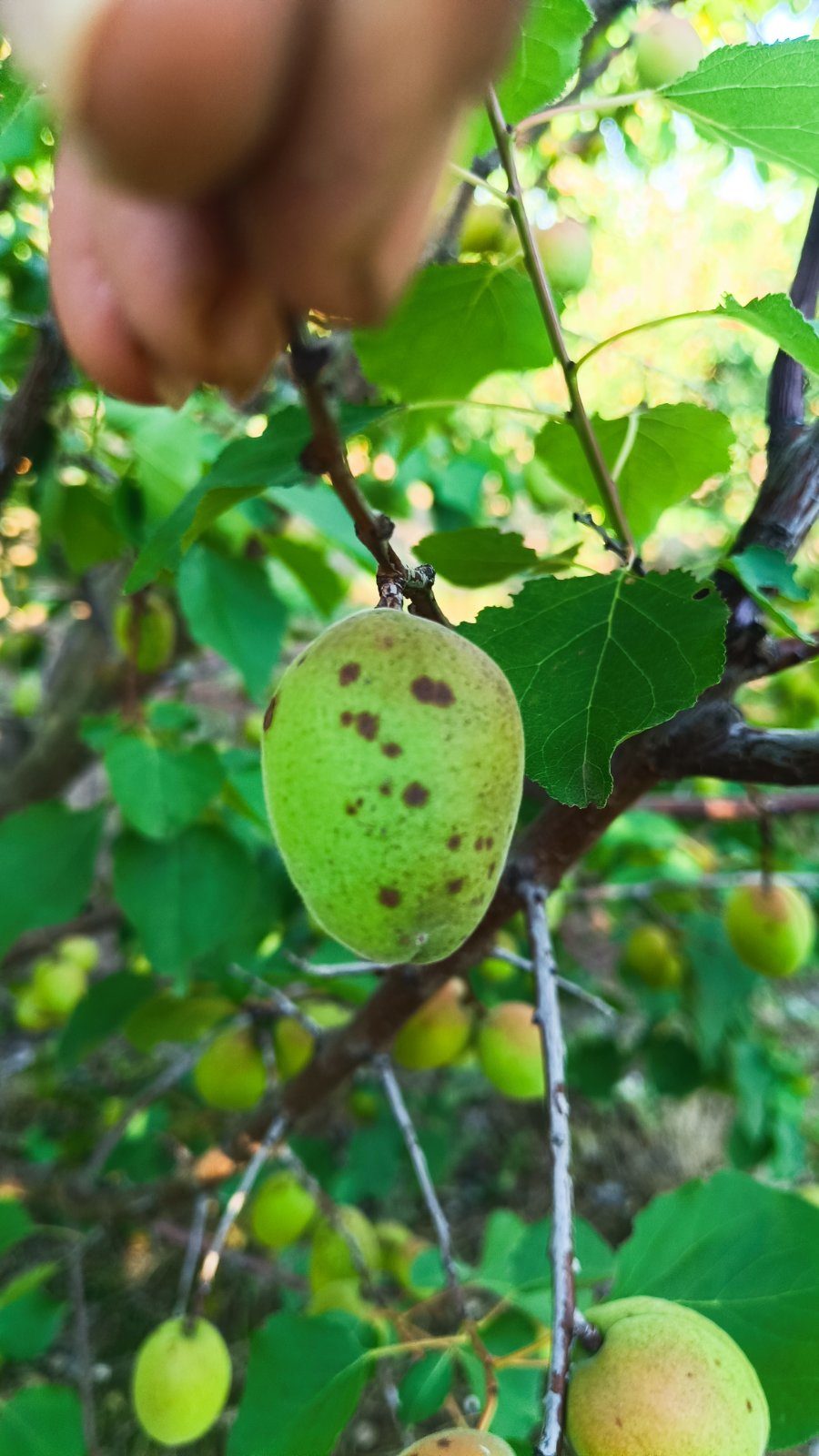
That the lesions concentrate towards the stem is recorded on both sides of the Atlantic. In Emilia-Romagna they are described as appearing "soprattutto nell'area prossima alla cavità peduncolare", that is, chiefly in the area close to the stem cavity 3. In Illinois, near the stem end or on the side of the fruit that faces the sun 1. Three explanations have been published, and they differ from one another:
- Splash dispersal. The conidia are released from the twig cankers and are carried by air and by rain water 7. The measured distribution of the lesions over the fruit surface was found compatible with a splash-dispersed pathogen, the greatest density lying on the most exposed and most easily wetted upper part 6.
- The sunlit side. In the American description the concentration is attributed equally to the side exposed to the sun 1.
- Poor spray penetration. The Florida extension service attributes the concentration at the stem expressly to inadequate penetration of the spray solution into the canopy 2, that is, to a failure of application and not to biology.
The finding that limits all three: in a measurement on four peach cultivars in the USA, the point of maximum infection was not always the stem, up to 40% of the fruit had the maximum at an angle greater than 90° to the stem, which was attributed to the fact that fruit does not always hang upright at the moment of infection 6. The rule is therefore "the most exposed, wettest side", and the stem is its commonest version, not the rule itself.
Beneath the affected areas a thick corky cell layer develops 1, and in heavy attacks the symptoms include cracking of the skin 8. The corky tissue does not follow the swelling of the fruit, and that is where the crack opens.
What follows calls for a reservation. That these cracks act as entry points for brown rot is a field observation and is reported here as such: no published measurement was found that quantifies the link between peach scab and subsequent brown rot, either for Greek or for Italian conditions.
- In Florida, the risk of infection is highest between petal fall and shuck split, and 6 to 8 weeks after petal fall the probability of infection declines, so the intervals can widen 2.
- In Illinois it is reported that peach fruit becomes susceptible at about the time the calyx falls and remains susceptible until harvest, with the critical period running from shuck split to five weeks after flowering 1.
- In Italy the period of maximum risk begins with the scamiciatura and continues for at least two months 9.
The three versions do not coincide. What all three agree on is where the window begins, and that is where protection has to be placed.
3. Shoots and leaves, where the problem hides
Beyond the fruit, the fungus also attacks the twigs and, more rarely, the leaves.
In Emilia-Romagna it is recorded that the fungus can potentially infect both young and mature leaves, but that this happens "assai raramente nei nostri ambienti", that is, very rarely in their own environments 3. The restriction to that country is essential and is not removed.
The twigs, by contrast, are the only documented overwintering site: the fungus overwinters in cankers on one-year-old twigs 4, and the laboratory finding completes the picture, it must pass through the winter before it produces abundant conidia 7. Put simply: this year's shoot infection is next year's inoculum.
How the canker develops on the twig
- On tender green twigs: spots oval to round, slightly raised, yellow-brown, 3.2 to 6.4 mm in diameter, in the source, 1/8 to 1/4 of an inch, with a dark grey or bluish margin 1.
- During the season: in South Carolina the lesions are described as light brown after 30 to 70 days, and as enlarging and turning deep reddish-brown the following year 8.
- Winter: in Emilia-Romagna the lesions are oval, brownish-pink, three to five millimetres in diameter; early infections are walled off by the periderm, but during the winter the fungus grows beyond it and creates a secondary lesion in the form of a raised ring of dark red tissue around the original one 3.
4. The disease cycle
Four steps
- Overwintering. The fungus passes the winter as mycelium inside the twig lesions or as chlamydospores on the bark surface 3 4.
- Conidial production. In spring, on those same lesions, the conidia are produced. In Illinois it is reported that they form in warm, wet weather from the shuck split stage and for the following six weeks on peach 1.
- Infection. The conidia are carried to the new susceptible tissue by air and by rain water 7, and infection requires free water 9.
- Symptom. Much later, see the section on incubation.
The statement that "sporulation coincides with calyx fall" is convenient but inexact. The two measurements that exist give different timings, in different countries:
- In Emilia-Romagna, chlamydospore production begins about two weeks before the scamiciatura of the fruit and then develops over three or four weeks 3.
- In South Carolina, airborne conidial populations peak 2 to 6 weeks after the calyx split stage, with a maximum in early May 7.
The practical conclusion does not change, but it becomes more precise: the inoculum does not begin at the moment of calyx fall, it surrounds that moment, starting shortly before and peaking over the following weeks. Cover has to be in place already when the window opens.
5. When the door to infection opens
Two conditions are needed, always together. If one is missing, no infection takes place.
| Condition | Values, country, and what they mean |
|---|---|
| Temperature | In South Carolina the optimum infection conditions are described as rain periods with 18 to 24 °C, in the source, 65 to 75 degrees Fahrenheit 8. In Illinois spore germination and growth of the fungus are fastest at 18 to 24 °C, but can take place over a wide range, from 2.8 to 35 °C, in the source, 37 to 95 degrees Fahrenheit 1. In Italy the conidia germinate at 15 to 30 °C with an optimum of 25 to 30 °C in the presence of free water, while favourable infection conditions are described as a mean temperature of around 16 °C with prolonged wetness 9. Mycelial growth was measured as optimal at 20 to 30 °C 7. |
| Free water | Germination of the conidia is optimal at 98 to 100% relative humidity, while sporulation on the twig cankers takes place at 80 to 100% and is most abundant at 98 to 100%; at saturation the cankers produce conidia for 20 to 30 hours before releasing them 7. In Florida the condition is expressed as relative humidity of at least 100% for 24 hours together with a temperature above 16 °C, in the source, 60 degrees Fahrenheit 2. Without prolonged wetness there is no infection 9. |
The limiting factor, that is, is not temperature but the duration of wetness 7 9. For Greek conditions no published threshold value and no wetness model were found. The Italian recommendation places the start of applications in the last ten days of April for Emilia-Romagna 3, a date that belongs to that region and does not transfer unchanged to a Greek orchard, where phenology determines the timing.
6. The susceptibility window and the hidden incubation
- On the fruit. In Emilia-Romagna the incubation times are described as "notoriamente dilatati" and reach 40 to 80 days 3. In the USA 40 to 70 days are given, both in Illinois 1 and in Florida 2. An Italian review reports 42 to 77 days 9.
- On the leaves and the shoots. 25 to 45 days on the leaves and about 25 days on the shoots 3, values that are repeated in Illinois for twigs and leaves 1 and in the Italian review for the shoots 9.
The combination with the susceptibility window creates an optical illusion. The lesions that become visible in midsummer come from infections more than two months earlier. The decision "spray now that it has shown up" comes after the battle has ended, not during it.
7. Why it appears while the orchard is being sprayed, four reasons
A programme can look correct and still leave holes. The four typical causes:
1. Wrong targeting with respect to the window
Here the recommendations themselves diverge, and that has to be said plainly. In Florida the risk is placed between petal fall and shuck split, with the applications at the scamiciatura described as critical 2. In Illinois, the important sprays are those from petal fall onwards 1. In South Carolina, however, the recommendation starts at full bloom, with five applications every 10 to 14 days 8.
There is therefore no documentation for a categorical statement of the type "blossom sprays do not catch it". What is documented is that cover must not be missing from petal fall onwards, the point where all three recommendations coincide.
2. Hidden time, incubation conceals when the infection occurred
With 40 to 80 days intervening 3, the intuitive link between symptom and infection is impossible. Judging a spray by the picture of the following week is invalid by definition.
3. Gaps in cover, every rainy window is a fresh infection
Sporulation needs only 20 to 30 hours of saturation to release conidia 7, and infection requires free water 9. That is why the Florida recommendation states expressly that in springs with frequent rainfall the intervals are shortened 2, and the Italian recommendation times the three or four applications according to the rains 3.
4. The source is inside the holding
The cankers on last year's twigs are the documented overwintering site 4 3, and they must pass through the winter in order to give abundant conidia 7. If the critical period is left uncovered, the infection pressure is already present on the tree.
8. What is documented about the products, and what is not
A table with nine active substances and Abbott efficacy percentages, from trials in an apricot orchard of Emilia-Romagna in 2023 and 2024, circulates in Greek and Italian texts. Its source is the article by Rufolo, Franceschelli, Preti and Bugiani, "La giusta strategia per contenere il nerume delle drupacee", L'Informatore Agrario 14/2025.
The full text did not become accessible during the preparation of this article. Consequently none of those percentages is reproduced here: neither the degree of activity per active substance, nor the percentage of affected fruit in the unsprayed control, nor the sulphur rates per hectare that accompanied them. A figure that could not be checked against its own source does not go into an agronomic text.
What is worth keeping from this finding is the regulatory status of those substances, and for that there is documentation.
What is permitted in Italy, where the trials were carried out
In Italy, against nerume of stone fruit, only six active substances are registered: copper hydroxide, tribasic copper sulphate, copper oxychloride, potassium bicarbonate, pyraclostrobin and sulphur 10. The remaining substances that appear in trial tables, carboxamide mixtures, triazoles and anilinopyrimidines, were tested experimentally and do not carry an Italian authorisation for this target 10. An experimental result is not an authorisation, neither in Italy nor anywhere else.
Plant protection product authorisations are national. A substance authorised in Italy is not authorised here, and an Italian trial says nothing about the Greek regulatory position.
During the preparation of this article it was not possible to confirm a Greek authorisation for any active substance against peach scab on apricot: the interactive database of the Greek Ministry of Rural Development and Food operates as an application that does not deliver content to automated retrieval. This fact is stated as it stands, instead of being covered over with a foreign list.
The only valid place to check is the authorisation database of the Greek Ministry of Rural Development and Food 12, whose authorisations are valid in Greece only, where it is checked each time which products are permitted on apricot, against which target, at what rate, with what maximum number of applications and with what pre-harvest interval. In every case the label prevails.
The rates that are documented, and their units
| Substance | Rate as documented | Country and crop |
|---|---|---|
| Wettable sulphur | 500 to 600 g per hectolitre of spray solution, starting in the last ten days of April 3. This is a rate per volume of spray solution and not per unit area, it cannot be converted to an area basis unless the application volume per hectare is known. | Italy, Emilia-Romagna, stone fruit |
| Sulphur, phytotoxicity limit | 300 g per hectolitre, expressly in order to avoid phytotoxicity 9. | Italy, plum |
| Copper salts | An upper limit of 4 kg of copper ion per hectare per year 9. | Italy, stone fruit |
The values in the table are Italian and are quoted as an order of magnitude. They are not a recommendation for application in Greece. The rate in force, the maximum number of applications and the pre-harvest interval are checked each time in the authorisation database of the Greek Ministry of Rural Development and Food 12, valid in Greece only, and on the product label.
In practice, in a year of low infection pressure the picture of any programme is flattered. A strategy is evaluated in a rainy year and on a late cultivar, not in a dry spring.
9. The timing strategy that works
Four steps
- Start around petal fall and shuck split. That is where the recommendations of Illinois 1 and Florida 2 coincide, while the South Carolina recommendation starts as early as full bloom 8.
- Three to four preventive applications, timed to the rains, the Italian recommendation for Emilia-Romagna 3. The American programme of South Carolina provides for five applications 8. The number, that is, depends on the region and on the year.
- Intervals of 10 to 14 days 1 8, which are shortened when the rainfall is frequent and can widen when the risk declines 2.
- Following the weather, not the calendar. The duration of wetness is the limiting factor 7 9.
The important reservation: the same American source reports that peach fruit remains susceptible until harvest 1, and in Italy the risk period is given as at least two months 9. Stopping the applications is therefore justified not by a disappearance of susceptibility, but by the combination of reduced risk with the long incubation: anything infected very late does not have time to show before harvest 3. The pre-harvest interval of each product is binding in any case 12.
- Strobilurins (QoI, group 11), to which pyraclostrobin belongs: high risk, with an explicit requirement for resistance management.
- Carboxamides (SDHI, group 7): medium to high risk, also with a management requirement.
- Triazoles and the other DMI inhibitors (group 3): medium risk.
- Sulphur (group M 02): a group of low risk, with no indications of resistance development.
The practical consequence is the same: the single-site groups are not repeated continuously on their own, and sulphur, which is authorised in Italy against this target 10, has a place as a multi-site partner, at the label rate.
10. Prevention from the moment of planting
The recommendation of the Clemson extension service is explicit and twofold: selection of planting sites that are not low-lying and correct pruning so that there is good air movement, with the aim that leaves, fruit and twigs dry quickly 8.
The reasoning is direct: since infection requires prolonged wetness 9 and sporulation calls for a nearly saturated atmosphere for 20 to 30 hours 7, every hour of faster drying is subtracted from the risk, at no cost in product.
The second cultivar factor is ripening time: the disease is more severe on late cultivars 10. Cultivar choice therefore reduces the damage but does not eliminate it, and it does not substitute for correct timing.
Given that the fungus overwinters in cankers on one-year-old twigs 4 and must pass the winter there in order to give abundant conidia 7, removing heavily infected shoots during winter pruning directly removes part of the initial inoculum.
The lesions are recognisable at the moment of pruning: oval, brownish-pink, three to five millimetres, with a raised ring of dark red tissue around the original spot 3, or deep reddish-brown in their second year 8.
With a reservation: no published measurement was found of how much this practice reduces the final infection of the fruit. The measure rests on the documented biology of the pathogen, not on an efficacy trial.
- No Greek measurement. No Greek temperature threshold, wetness model, incubation measurement or efficacy trial was found for peach scab of stone fruit.
- Greek authorisation position. No authorisation of any active substance against this target on apricot was confirmed, the check is made in the database of the Greek Ministry of Rural Development and Food 12, valid in Greece only.
- Peach scab and brown rot. The link between the cracking and subsequent brown rot remains without published quantification.
- Duration of susceptibility. The published values diverge from "until harvest" 1 to "at least two months" 9, with no common calibration.
11. Sources
The numbers in the text refer to the list below. Where only the abstract and not the full text was used, this is stated expressly.
- [1] Scab of Peach, Nectarine, Plum, and Apricot. Report on Plant Disease No. 811, University of Illinois Extension. The principal American source for the biology and the symptoms on crops that expressly include apricot: fruit lesions of 1/16 to 1/8 inch concentrated at the stem or on the sunlit side, corky layer, twig cankers of 1/8 to 1/4 inch with a dark grey margin, germination and growth fastest at 18 to 24 °C with a range of 37 to 95 °F, sporulation in 20 to 30 hours at 100% relative humidity, incubation of 40 to 70 days on the fruit and 25 to 45 days on twigs and leaves, conidial production from shuck split and for six weeks, a programme from petal fall until 40 days before harvest every 10 to 14 days, and the reservation that the fruit remains susceptible until harvest. Full text.
- [2] Peach Scab. HS1249, University of Florida IFAS Extension. Source for the conditions of conidial production (relative humidity of at least 100% for 24 hours with a temperature above 60 °F), for the incubation of 40 to 70 days, for placing the maximum risk between petal fall and shuck split, for the decline in the probability of infection 6 to 8 weeks after petal fall, for intervals of 7 to 14 days tightened when rainfall is frequent, and for attributing the concentration of the lesions at the stem to inadequate penetration of the spray into the canopy. Full text.
- [3] Franceschelli, F., Ceredi, G., Bugiani, R. and Rossi, R. (2007). Nerume delle drupacee: è importante prevenire. Technical bulletin of the Plant Health Service of the Emilia-Romagna Region, April 2007, pp. 107–108. The principal Italian source of this article: incubation of 40 to 80 days on the fruit, 25 to 45 on the leaves and 25 on the shoots; overwintering as mycelium in the twig lesions and as chlamydospores on the bark; sporulation at 70 to 100% relative humidity and conidial germination with an optimum of 25 to 30 °C; fruit lesions of 2 to 3 mm near the stem cavity that darken; oval brownish-pink cankers of 3 to 5 mm with a winter ring of dark red tissue beyond the periderm; leaf infection very rare in the environments of that region; onset of chlamydospore production about two weeks before the scamiciatura, developing over three to four weeks; a recommendation for three or four preventive applications timed to the rains; wettable sulphur at 500 to 600 g per hectolitre of spray solution starting in the last ten days of April. Full text.
- [4] Chen, C. and co-workers (2017). Draft genome sequence of Venturia carpophila, the causal agent of peach scab. Standards in Genomic Sciences 12:68. Source for the accepted name Venturia carpophila E.E. Fisher and the full list of synonyms (Fusicladosporium carpophilum, Cladosporium carpophilum, Megacladosporium carpophilum, Fusicladium carpophilum, Cladosporium americanum), for the finding that the sexual state has been described only from Australia and that its role in the epidemiology remains unknown, for overwintering in cankers on one-year-old twigs, and for the hosts, which include apricot. Full text, open access.
- [5] Venturia carpophila (VENTCA). EPPO Global Database. Source for the taxonomic position (Venturiales, Venturiaceae), the authority of the species, the recorded synonyms, and the common names, among them expressly apricot scab for apricot, as well as for the relationship with the other species of the genus Venturia. Full text of the datasheet.
- [6] Bock, C.H., Hotchkiss, M.W., Okie, W.R. and Wood, B.W. (2011). The distribution of peach scab lesions on the surface of diseased peaches. European Journal of Plant Pathology 130(3):393–402. Source for the measured distribution of the lesions over the fruit surface on four peach cultivars in the USA: the maximum lies in the most exposed and most easily wetted upper zone, a picture compatible with splash dispersal of the conidia, but up to 40% of the fruit had the maximum at an angle greater than 90° to the stem. Abstract.
- [7] Lawrence, E.G. Jr. and Zehr, E.I. (1982). Environmental Effects on the Development and Dissemination of Cladosporium carpophilum on Peach. Phytopathology 72:773–776. Source for optimal mycelial growth at 20 to 30 °C, for conidial germination at 98 to 100% relative humidity, for sporulation on the cankers at 80 to 100% with abundance at 98 to 100%, for the 20 to 30 hours of conidial production at saturation before release, for the requirement of overwintering before abundant sporulation, for dispersal by air and by rain water, and for the peak of the airborne populations 2 to 6 weeks after calyx split in South Carolina. Abstract.
- [8] Peach Diseases. Home & Garden Information Center, Clemson Cooperative Extension. Source for the optimum infection conditions (rain periods with 65 to 75 °F), for the description of the lesions as velvety dark, smaller than a quarter of an inch, with cracking and confined to the outer skin, for the development of the cankers from light brown after 30 to 70 days to deep reddish-brown the following year, for the programme of five applications every 10 to 14 days starting at full bloom, for the wording that most cultivars are susceptible with some more severely affected, and for the recommendation to avoid low-lying sites and to prune for air movement. Full text.
- [9] Il clima piovoso favorisce il nerume delle drupacee. Terra e Vita, Edagricole. Source for conidial germination at 15 to 30 °C with an optimum of 25 to 30 °C in the presence of free water, for the favourable infection conditions with a mean temperature of around 16 °C and prolonged wetness, for the incubation of 42 to 77 days on the fruit and about 25 days on the shoots, for the period of maximum risk that begins with the scamiciatura and lasts at least two months, for the upper limit of 4 kg of copper ion per hectare per year, and for the 300 g of sulphur per hectolitre on plum as a phytotoxicity limit. Italian values. Full text.
- [10] Le soluzioni per il nerume delle drupacee. AgroNotizie, Image Line Network, February 2024. Source for the Italian authorisation position against this particular target: only six registered active substances, copper hydroxide, tribasic copper sulphate, copper oxychloride, potassium bicarbonate, pyraclostrobin and sulphur, as well as for the association of the severity of the disease with rainy periods from mid-April to harvest and with late cultivars. Full text.
- [11] FRAC Code List 2025. Fungicide Resistance Action Committee. Source for the resistance risk ratings by mode-of-action group: QoI strobilurins of group 11 at high risk with a management requirement, SDHI carboxamides of group 7 at medium to high, DMI inhibitors of group 3 at medium, and sulphur of group M 02 as a low-risk group with no indications of resistance development. Full text.
- [12] Κατάλογοι Φυτοπροστατευτικών Προϊόντων και Βιοκτόνων [Lists of Plant Protection Products and Biocides] (in Greek). Directorate for the Protection of Plant Production, Greek Ministry of Rural Development and Food. The official Greek place to check every authorisation: which products are permitted on apricot, against which target, at what rate, with what maximum number of applications and with what pre-harvest interval. The authorisations are national and valid in Greece only, they change over time, and no foreign trial and no foreign list substitutes for them. Page of lists; the interactive database requires a search by the user.
Plant protection products are used only under the authorisations of the Greek Ministry of Rural Development and Food and in accordance with what is stated on their labels: authorised crops, rates, maximum number of applications, re-entry intervals and pre-harvest intervals. Those authorisations are valid in Greece only. They do not apply in any other country, where the national register of that country applies instead.
This is informative and educational material of a plant pathology nature and summarises published scientific findings. It is not an individual agronomic recommendation, nor a recommendation to apply particular products. The references to active substances and rates describe results and recommendations from particular countries and conditions and do not transfer unchanged to every orchard. Every intervention is carried out at the user's responsibility, following an on-site assessment by a licensed agronomist. Pastopoulos Agronomics accepts no liability for any damage arising from the use of the information in this article.
Related articles
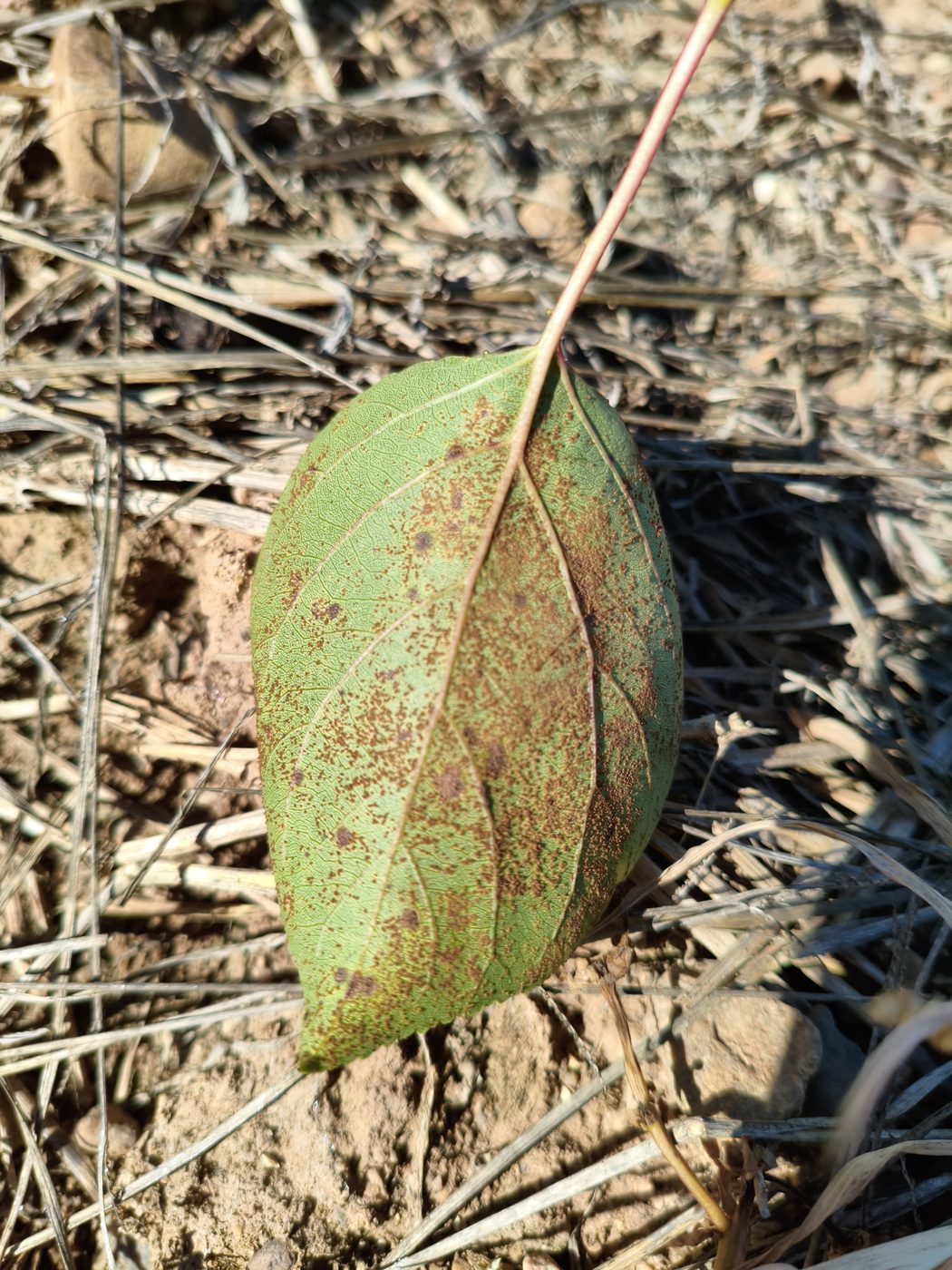
Apricot pests and diseases: identification from symptoms, with a diagnostic tool
Rust with field photographs, brown rot, shot hole, scab, powdery mildew, bacterial spot and canker, Eutypa dieback, silver leaf with and without a fungus, Phytophthora, Armillaria, plum pox and phytoplasma, and the pests: peach twig borer, oriental fruit moth, medfly, flatheaded root borer, mealybug, scale. The pruning dilemma, the three cuts that sort out a dead tree, and a tool that compares symptoms against the profiles of 34 causes.
Nutrient antagonisms and synergies, with a per-element tool
The arrow diagram in every fertiliser leaflet does not stand up scientifically. The antagonisms are real, but they act on two separate levels, in the soil and inside the plant, and the same element can be antagonistic on one and synergistic on the other. With a tool showing the documented relationships of each element.
Zeolite in agriculture: what is documented and what is not
It is a cation exchanger, it holds ammonium and potassium, not nitrate. The rates that work are tens of tonnes per hectare, not hundreds of kilos. And erionite is a Group 1 carcinogen.