
Sweet cherry training systems: what works, what does not, and why
Savvas Pastopoulos, Agronomist MSc, Pastopoulos Agronomics, Neos Mylotopos, Pella
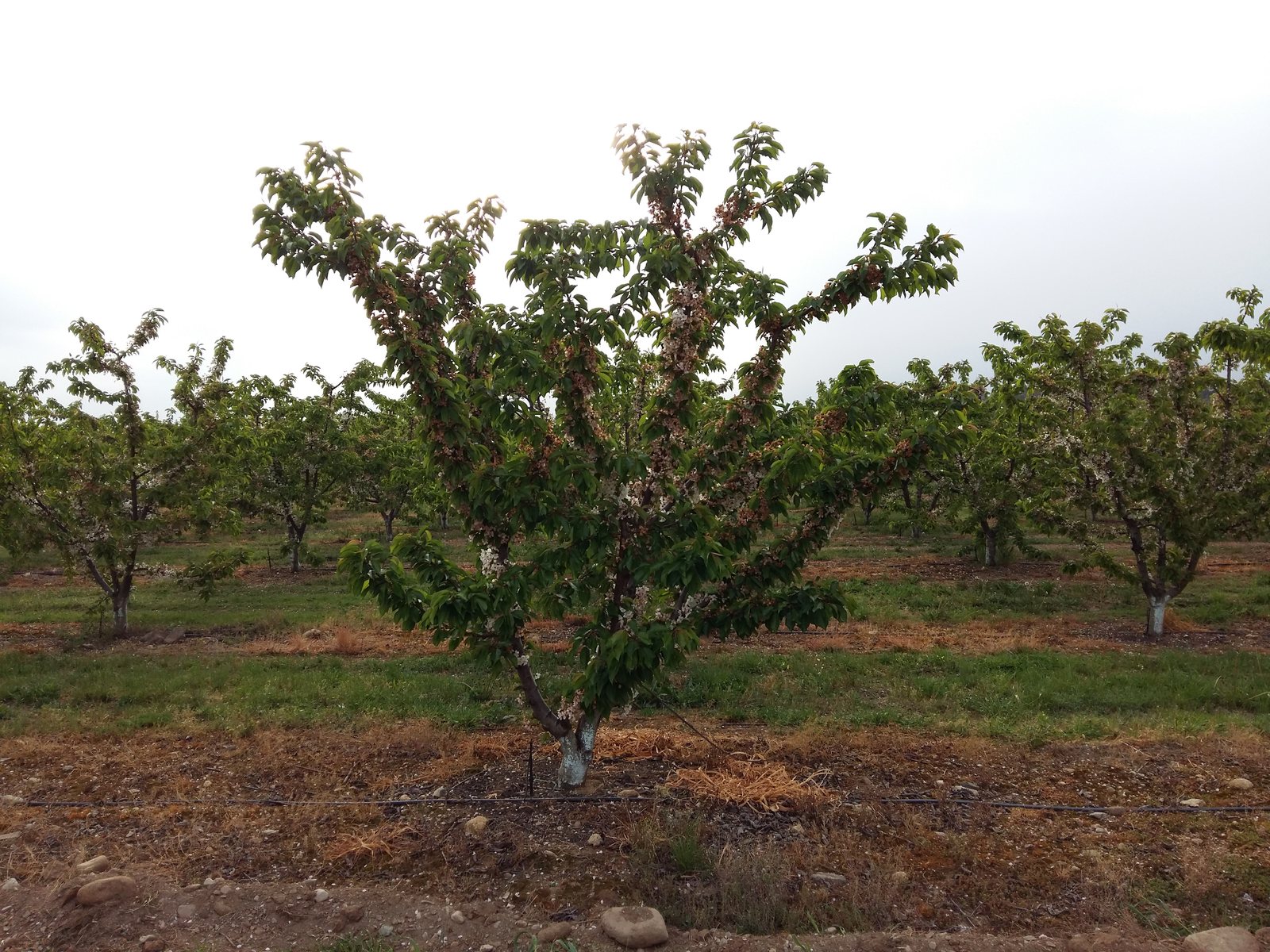
In the wild the sweet cherry is a forest tree: it reaches twelve metres, has strong apical dominance and is in no hurry at all to fruit. Everything done in the orchard is an attempt to override that genetic programme. The training system is not an aesthetic choice; it is the strategy by which vigour, light and the leaf-to-fruit ratio are regulated, and with them the size of the cherry, which is the only thing the market pays for.
This article sets out in detail the eight modern systems of the international manual PNW 667, with planting distances and year-by-year steps, the classical Greek forms, and what the comparative trials in Italy, Tasmania and Türkiye showed. It also includes something rarely written down: harvest labour per system, measured in kilograms per minute, and how much less the training system matters than the rootstock when the two are compared in multi-year trials.
Distances have been converted from feet to metres. Approvals for plant protection products cited here are those of the Greek Ministry of Rural Development and Food and are valid in Greece only; elsewhere the corresponding national register applies.
- The forest tree and the three problems it creates
- The fruiting unit, three years, three leaf types, two fruiting positions
- Where the sugar goes: what carbon-13 showed
- Leaf area and crop load per trunk cross-section: the primary parameter for final fruit size
- The six cutting and manipulation techniques
- The eight modern systems, one by one
- The selection table: which system with which rootstock and cultivar
- The classical Greek forms
- What the comparative trials showed
- Harvest labour, the number that decides the investment
- Pruning timing and bacterial canker
- The picture in the field, what is seen in these orchards
- How a system is chosen for a Greek field
- The mistakes that get paid for
- Sources
1. The forest tree and the three problems it creates
Undisturbed in its native environment, the sweet cherry (Prunus avium) grows as a central leader tree. Growth is rapid and apical dominance is strong: the tree branches only just below the terminal bud of annual growth, can grow to 18 metres, and is non-precocious, so as to establish a competitive footprint in the forest before shifting resources to fruiting [1].
Every problem the cherry grower has follows from that one sentence:
| The trait | What it causes in the orchard |
|---|---|
| Excessive vigour | Without intervention when young, the tree produces long shoots with few lateral branches or fruiting spurs. Canopy development is difficult and fruit production is limited [1] |
| Narrow crotch angles | Branches emerge at acute angles. Such angles are weak and prone to bark inclusion, which makes the attachment brittle [1] |
| Acrotonic growth | New shoots emerge from the upper part of the existing ones. The fruiting zone moves away from the central axes and the interior of the canopy goes bare [2] |
And there is a fourth element, purely arithmetical, that explains why the cherry does not forgive mistakes. Its fruit is small, so a large yield requires a large number of fruit. In peach and apple a fruit set of about 10% is enough for a full crop; in cherry it has to exceed 40% [2]. With such a high fruit set requirement, fruit thinning is practically impossible, and so pruning takes on the role of thinning as well.
2. The fruiting unit, three years, three leaf types, two fruiting positions
This section is the key to the whole article. Without it, the systems are just drawings on paper.
| Year | What is on the shoot | What it means |
|---|---|---|
| 1st | New shoot with a single leaf at each node | Pure investment. No fruiting |
| 2nd | The nodes become non-fruiting spurs with six to eight leaves each. At the basal nodes there may be solitary flower buds with no vegetative bud | A first, small crop at the base. Those positions go blind after fruiting, because there is no vegetative bud |
| 3rd | Each spur becomes fruiting, with 6 to 8 leaves and one to ten flower buds depending on cultivar, vigour and position | The unit is fully operational. Spurs near the shoot terminus have more buds than basal ones |
A detailed account following the PNW 667 manual [1]. Spurs can remain fruitful for many years if managed correctly for light and nutrition, but the best quality comes from young spurs and from the basal, non-spur flowers [1].
- Spur fruiting, on wood two years old and older. Many fruit per position, smaller size, takes three years to start.
- Fruiting on basal buds of one-year-old shoots (non-spur). One to three fruit per position, ripening earlier and with higher quality and larger size than spur fruit [3].
The distinction has direct consequences. KGB and UFO rest mainly on spurs. SSA rests almost entirely on the basal buds of one-year-old shoots. TSA plays on both. Which is why, as will be seen, a cultivar that does not form fertile basal buds simply cannot go into SSA, and one that fruits mainly there, such as Regina, must not go into KGB, because the system removes exactly that wood [1].
The arithmetic that shows why heading is needed
Lang gives an example worth looking at in numbers [4]. A fruiting unit left unpruned:
| Year | Fruit | Leaves | Leaf-to-fruit ratio |
|---|---|---|---|
| 3rd | 75 on spurs + 10 basal | 120 spur + 10 shoot ×2 | 1.65 |
| 4th | 150 on spurs + 10 basal | 180 spur + 10 shoot ×2 | 1.25 |
| 3rd with heading | 40 on spurs + 20 basal | 166 spur + 20 shoot ×2 | 2.75 |
That is, without intervention the leaf-to-fruit ratio gets worse every year, as spurs multiply while leaves do not follow. A heading cut removing 15 to 30% of last year's shoot removes 25 to 40% of the future spur density [4], and at the same time forces new growth, that is, new leaves and new basal fruiting positions.
3. Where the sugar goes: what carbon-13 showed
At Michigan State University, Marlene Ayala and Greg Lang fed cherry trees carbon dioxide labelled with carbon-13 and traced where it ended up. The study answers a question the grower asks constantly without putting it into words: which leaves actually feed the cherry?
The share of its own carbon that each leaf population sends to the fruit, on five dates
On two-year-old fruiting branches of Ulster on Gisela 6, each leaf population was labelled separately, on five dates, 25, 40, 44, 56 and 75 days after full bloom [10]:
| Leaf population | Share of its own carbon that went to the fruit |
|---|---|
| Fruiting spur leaves | 57 to 79% |
| Non-fruiting spur leaves | 31 to 71% |
| Current season shoot leaves | 18 to 59% |
On every date and for every population, most of the carbon ended up in the fruit rather than in vegetative growth [10]. The fruit was a priority sink over new shoot growth throughout its development. Its sink strength peaked in mid-Stage III, at 56 days.
First, the hierarchy. The leaves of fruiting spurs are consistently the strongest source, those of non-fruiting spurs second, and the current season shoot third. At the last labelling, however, at 75 days the shoot became as important as the non-fruiting spurs [10]. That is, the role of new growth grows as harvest approaches.
Second, distance. Carbon fixed by non-fruiting spur leaves went 87 to 96% to the fruit and only 4 to 13% to shoot growth. And proximal fruit took 58 to 61%, distal fruit only 31 to 37% [10]. Distance from the source counts as much as the source itself.
Third, and the most practical. The current season shoot began exporting carbon to the fruit as early as 25 days from bloom, when it was about 10 cm long with ten leaves [10]. New growth competes with the fruit only in its first days and becomes a supplier to it far earlier than is generally assumed.
The effect of crop load on partitioning
In a second study, on Sam on Gisela 5, partitioning was measured at three crop loads, expressed as leaf area per fruit [10]:
140 cm² per fruit, low load · 75 cm², intermediate · 40 cm², high load
At the low load of 140 cm² per fruit, carbon was distributed almost evenly between proximal and distal fruit. At the two higher loads, of 75 and 40 cm², the gap between proximal and distal widened considerably [10].
Put plainly: the heavier the load, the more unevenly the food is shared within the same branch. It is not that every fruit gets less; the distal ones get disproportionately less. That explains why an overloaded tree does not simply produce smaller cherries, but uneven cherries, and it is the unevenness that ruins the pack-out.
The defoliation study, and why no population is enough on its own
Earlier, the same researchers had tried the reverse: instead of labelling, they removed. On branches of Hedelfinger on Gisela 5 and Ulster on Gisela 6, the two main populations were isolated by girdling and defoliation, so that the fruit was supplied either only by the fruiting-spur segment or only by the newly formed non-fruiting segment [11].
The branch that was girdled and had a full complement of leaf populations gave the largest fruit with the highest soluble solids. Fruit supplied exclusively by one population or the other was significantly smaller and less sweet [11].
The authors' conclusion is categorical: both populations are required for full fruit development, and there is no sufficient compensatory effect when one is eliminated [11]. It is not a matter of «how many leaves» but of «which kinds of leaves». Pruning that selectively removes an entire population, as when all the current season shoots are stripped from a branch, costs more than the volume of wood removed suggests.
The Australian guide cites the practical measure from a study in Washington, USA: increasing leaf area up to 100 cm² per fruit, fruit size continued to increase, in practical terms, two healthy leaves per cherry [5].
4. Leaf area and crop load per trunk cross-section: the primary parameter for final fruit size
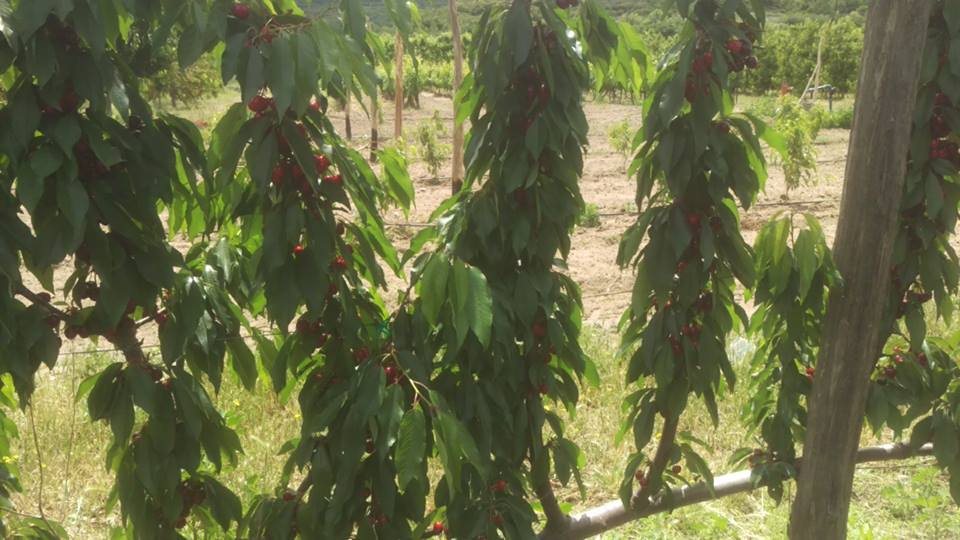
The Australian guide to increasing cherry fruit size puts the rule in a single sentence: the tree can only produce a specific quantity, and that quantity can consist either of a large number of small fruit, or a small number of large fruit, or, preferably, a medium number of medium to large fruit [5].
Yield against cross-sectional area of wood: what the three crop load levels in Sweetheart showed
In four-year-old Sweetheart trees at Orange, Australia, three crop load levels were measured in the same block [5]:
| Index | Light load | Optimum | Heavy load |
|---|---|---|---|
| Trunk cross-section (cm²) | 62.2 | 81.3 | 44.1 |
| Yield per tree (kg) | 6.2 | 18.9 | 16.8 |
| Mean fruit weight (g) | 9.3 | 9.3 | 7.7 |
| Fruit > 26 mm | 80% | 70% | 23% |
| Fruit per cm² of cross-section | 10.7 | 25.1 | 49.8 |
| Yield efficiency (kg/cm²) | 0.100 | 0.233 | 0.381 |
| Net return per tree | 40.68 | 113.20 | 70.85 |
The three trees were not of equal size to begin with, and the light-load tree carried 62.2 cm², that is, less than the optimum. The table therefore does not on its own establish that the crop load halted trunk growth. What it does show clearly is that roughly the same weight of crop carried on a smaller cross-section of wood comes out as smaller fruit and a smaller return.
The target that emerges from the data for this combination was about 25 cherries per square centimetre of trunk cross-section and a yield efficiency of around 0.25 [5].
The practical rule of the eye
Nobody measures trunk cross-sections every spring. The Australian guide gives a rule that works at a glance: if about 20% of the crop is visible among the leaves, the balance is good. If most of the fruit is visible, the tree is overcropped and the cherries will not reach their potential size [5].
The time the tree has
The cherry is characterised by rapid leaf development, rapid fruit development and a long postharvest period. The critical intervals are [5]:
- 50 to 60 days from bloom to harvest in early and mid-season cultivars; 100 days in late ones.
- 30 days from bud burst to full leaf development.
- Shading begins at 30 days from bud burst and peaks at 60.
- 25% of the final fruit weight is gained in the last week.
How poor light is recognised: shade leaves are larger and thinner, shoots longer and thinner. Under the tree, a dappled shadow means good light penetration; a solid, dense shadow means a problem [5].
Sources: 5
5. The six cutting and manipulation techniques
All the systems are built with the same six techniques. What differs is where and when they are applied.
1. Thinning cut
Removes the whole branch at its point of origin, or cuts it back to a lateral large enough to take over the terminal role. It permits better light penetration and does not stimulate as much regrowth as a heading cut, thereby reducing the risk of delayed fruiting in young trees [1].
2. Heading cut into one-year-old wood (tipping)
Stimulates lateral growth and is used in the early stages to force branching. Because it invigorates the area around the cut, it delays fruiting on young trees that have not yet flowered.
On bearing trees, the same cut reduces the following season's crop on highly productive cultivars or rootstocks, removing future flowering sites before they develop on two-year-old wood [1].
3. Stub or renewal cut
A heading cut that leaves a few inches of the branch, so that buds below the cut, or, in older wood, adventitious buds beneath the bark, produce a replacement.
There is a second form, for a branch that is too upright or simply getting old: the primary branch is headed slightly below the terminal of a secondary lateral. Keeping the lateral's terminal higher than the remaining stub discourages vigorous vertical regrowth from the stub and keeps the lateral more horizontal [1].
Timing: stub cuts made late in the dormant season or at bloom give a distinctly higher percentage of regrowth than at other seasons [1].
4. Sectorial double pruning cut
Made during dormancy, at an upright-oriented bud. At bud break the top bud grows very vigorously and vertically. One or two subtending buds, on the sides or bottom, also break, but more slowly and therefore more horizontally.
The vertical shoot is removed later that season or the following dormant season, leaving the less vigorous, more horizontal one to produce fruit [1]. It is an elegant way to obtain horizontal wood without tying.
5. Limb spreading
Improves light penetration, reduces branch growth, encourages precocity and avoids bark inclusion and the weak attachments that follow.
The best moment is while the tissue is still green, once shoots have reached 7 to 10 centimetres. Toothpicks are used, or, in moist climates, where a toothpick raises the risk of bacterial canker, clothespins, attached to the trunk just above the shoot to force it to 90 degrees. On more mature branches, spreader sticks or ties to the ground are used [1].
6. Bud activation
This is the technique that builds the canopy with precision, rather than hoping for chance branching. Three ways [1]:
- A growth regulator based on cytokinin and gibberellin, applied to selected buds at green tip. Sensitive to temperature, prolonged cool weather after application gives poor shoot outgrowth.
- Scoring above the selected bud, with a saw blade about 2.5 mm wide cutting through bark and cambium. A longer window, from bud swell through bud break, and not temperature-sensitive.
- Removal of intervening buds. The longest window of all, from dormancy to after bud break, and not temperature-sensitive.
A caution: scoring and, to a lesser extent, bud removal increase the risk of bacterial canker infection. If practised, they should be timed to a forecast of several dry days, and copper applied before and after helps reduce bacterial populations [1].
Video 1. The sectorial double pruning cut in practice, on two-year-old cherry trees on Gisela 6. It is technique 4 of the list above, as applied in an orchard in this region. Commentary in Greek.
Sources: 1
6. The eight modern systems, one by one
The PNW 667 manual, written by Long, Lang, Musacchi and Whiting, describes eight commercially successful systems [1]. All eight can be achieved starting from a plain whip nursery tree, without feathers, which matters for Greek conditions, where nurseries rarely deliver feathered trees.
The distances below have been converted from feet to metres and rounded. They are ranges that vary with soil fertility, terrain, season length, rootstock vigour, cultivar growth habit, equipment size and management skill [1].
Kym Green Bush (KGB), the pedestrian orchard
What it is: a free-standing tree with multiple temporary vertical fruiting units that distribute vigour. The units are renewed regularly so the spurs stay young. It is the only system in the manual that creates a fully pedestrian orchard, harvested without ladders or platforms.
Spacing: rows 4.9 to 5.5 m on vigorous rootstock, 4.3 to 4.9 m on semi-vigorous. In the row 2.4 to 3.0 m and 1.8 to 2.4 m respectively. Not recommended on semi-dwarfing or dwarfing rootstocks.
Sequence: head the nursery tree at 45 cm with three or four live buds below the cut. First dormant season: head all leaders to 5 to 13 cm, the strong ones shorter than the weak. Target by year two: 20 to 25 leaders on semi-vigorous, 25 to 30 on vigorous; at maturity 12 to 16 and 15 to 20 respectively. The aim is annual elongation of 60 to 90 cm per leader.
Mature pruning: top the tree at 2.4 m. Remove all easily reached lateral branches, leaving stubs of about 7 to 8 cm so that the fruit-bearing axillary buds at the base of the one-year-old wood produce for one season. Renewal: the largest leaders are cut back to a stub of 25 cm with three or four buds; about 15 to 20% of the leaders per year [4].
Limitation: not recommended for cultivars that fruit on basal buds of one-year-old shoots, such as Regina and Attika, the system removes exactly that wood [1].
Spanish Bush (SB), the cousin with permanent leaders
The difference from KGB in one sentence: in the Spanish Bush all the upright leaders are permanent and fruit is produced on small laterals that are renewed; in the KGB the uprights themselves are renewed and the laterals are removed [1].
Spacing: the same as KGB. The first two years of training are almost identical, and the two systems diverge only once the framework is formed.
Mature pruning: top at 2.4 m and hedge the sides annually, in late summer or early autumn. In dormancy or at bloom, stub back about 20% of all fruiting laterals each year, so that no spur is more than five years old. Renew or remove any lateral larger than half the diameter of the primary scaffold. If terminal growth falls below 60 cm, remove one or more scaffolds to increase vigour in the rest [1].
Advantage over KGB: cultivars such as Regina and Attika perform well, because the system retains the one-year-old wood [1].
Steep Leader (SL), three or four leaders, pyramidal form
What it is: a free-standing tree with three or four vertical leaders from the base, with horizontal scaffolds projecting from the base of each. This creates a pyramidal shape with good light distribution. Each leader is treated as an individual one-sided spindle.
Spacing: rows 4.9 to 5.5 m on vigorous, 4.3 to 4.6 m on semi-vigorous. In the row 4.3 to 4.9 m and 3.0 to 3.7 m, that is, the widest system in the list. Because of the limited number of leaders, on vigorous rootstocks the tree reaches 5.5 to 6 metres and more.
The rule of the form: no lateral should exceed half the diameter of its parent branch. From bottom to top, the principle is «big, smaller, smallest». In late dormancy or at bloom, about 20% of all fruiting wood is stubbed back each year [1].
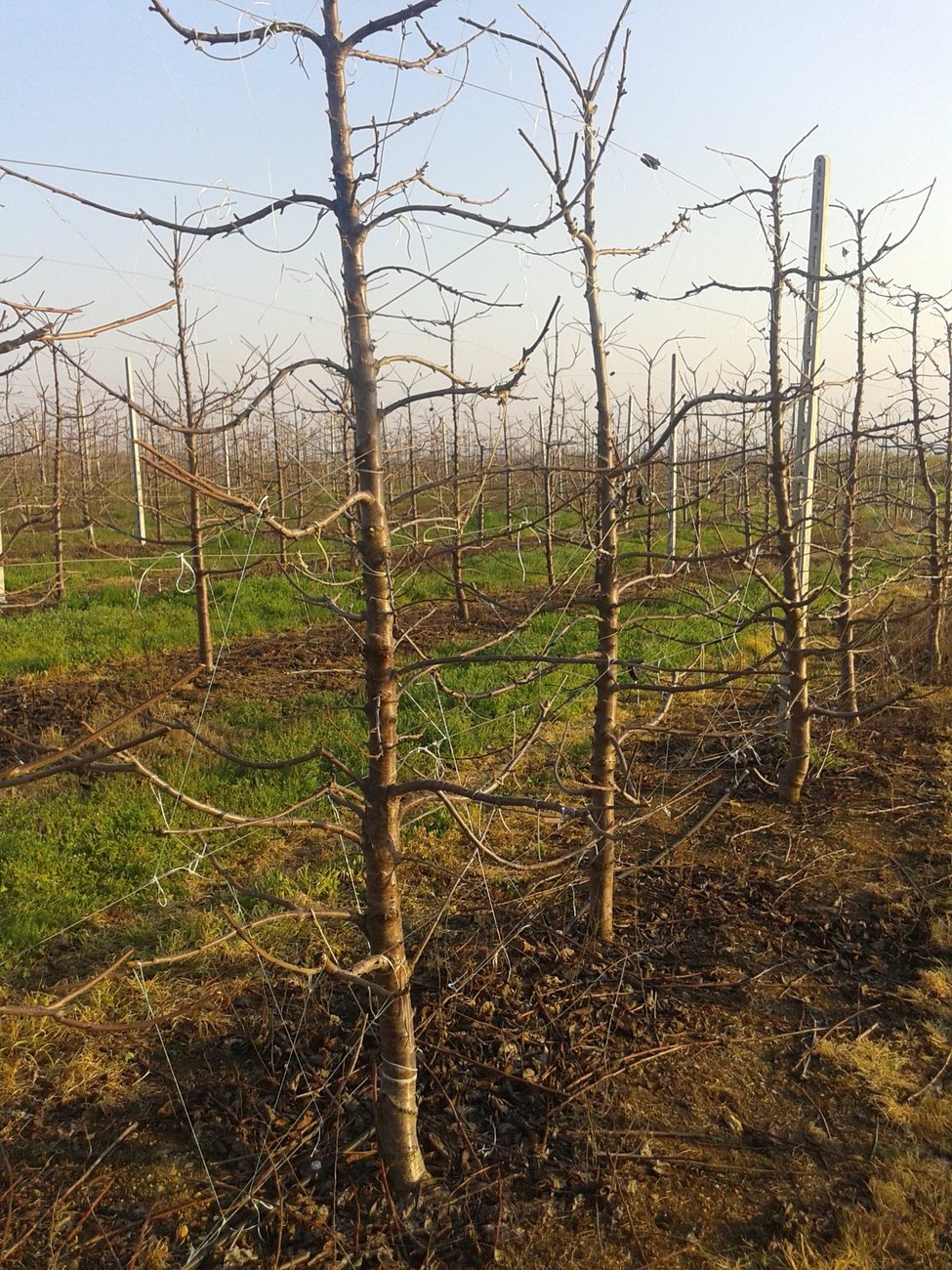
Super Slender Axe (SSA), the densest, with 100% annual renewal
What it is: a very high density, semi-pedestrian system of up to 5,000 trees per hectare, single leader, requiring dwarfing rootstocks and a top-wire trellis.
The radical difference: the fruiting habit. Instead of spurs with multiple small flower buds, the SSA uses the solitary large flower buds at the base of one-year-old shoots. That, combined with the fruiting being close to the axis, gives a favourable fruit-to-leaf ratio and very good size [1].
Spacing: rows 3.0 m on dwarfing or semi-dwarfing, 3.5 m on semi-vigorous precocious. In the row 50 cm on dwarfing, 1.0 m on semi-vigorous. Non-precocious vigorous rootstocks are not recommended.
«Short pruning»: most of the length of every one-year-old shoot is removed, retaining only the basal flower buds plus at least two vegetative buds. It is done best at bud swell, when the rounded flower buds can be told from the pointed vegetative ones. Lower feathers are left slightly longer than upper ones. 100% of the fruiting units are renewed every year.
The critical limitation: not all cultivars form fertile basal flower buds. That trait must be evaluated for every candidate cultivar before planting [1].
Tall Spindle Axe (TSA), the spindle with annual heading
What it is: an evolution of the Vogel and the German Zahn spindle. It replaces annual tiers of four or five strong laterals with a continuously spiralled whorl of moderately vigorous laterals, preferably about ten or more per year, forming a conical shape.
The two ideas that set it apart: (1) annual heading of the laterals to balance the leaf-to-fruit ratio and future crop loads, and (2) annual renewal of the oldest fruiting branches, so that the only permanent structure is the central leader [1].
Spacing: rows 4.0 to 4.3 m on vigorous or semi-vigorous, 3.4 to 3.7 m on dwarfing. In the row 1.8 to 2.4 m and 1.5 to 1.8 m.
Sequence: the nursery tree is not headed. Buds below 45 cm are removed, the most terminal healthy bud is retained and the next five or six removed. Then a bud is selected every 10 to 11 cm and activated. Target for year one: 8 to 12 laterals. First dormant season: the laterals are headed, removing 15 to 25% of their length, less on weaker shoots, more on stronger.
Renewal from year 5: when fruiting branches reach five or six years, the two or three largest are cut back to a weak basal shoot, spur or a 20 cm stub from the leader [1].
Upright Fruiting Offshoots (UFO), the planar fruiting wall
What it is: a fully trellised system. Each tree has a single permanent horizontal trunk (cordon) from which renewable vertical fruiting leaders grow. Fruit is borne predominantly on spurs, but also at the base of one-year-old shoots, always on vertical wood.
Spacing: rows 2.7 to 3.0 m for the vertical UFO, 3.7 to 4.3 m for the UFO-Y. In the row 1.8 to 2.1 m on vigorous, 1.5 to 1.8 m on semi-vigorous, 1.2 to 1.5 m on semi-dwarfing. The UFO-Y is tighter still.
Planting is the critical step: trees are planted at a 45-degree angle with the terminal pointing south in the northern hemisphere, to reduce sunburn risk on the trunk. They are not planted vertically and then bent. They are clipped to the lowest wire, 50 cm above ground. Upper buds are activated every 20 cm (UFO) or every 10 cm (UFO-Y) [1].
Height: topping at 1.1 to 1.2 times the row spacing. Done four to six weeks after harvest, regrowth is minimal and no dormant pruning is needed for height.
Mature pruning, two rules only: (1) renew the largest one or two uprights each year, so that none is more than six or seven years old; (2) remove the laterals, with thinning cuts on highly productive cultivars, with stubs of three to seven buds on moderately productive ones [1].
Vogel Central Leader (VCL), the central leader with minimal early pruning
What it is: a free-standing single leader tree with renewable fruiting scaffolds. The «Christmas tree» shape favours light distribution. It requires a dwarfing rootstock to be held at 3.0 to 3.7 m.
Spacing: rows 4.6 to 4.9 m on semi-vigorous, 4.0 to 4.3 m on dwarfing. In the row 2.4 to 2.7 m and 1.8 to 2.4 m.
Its philosophy: minimal early pruning and flat branch angles. The nursery tree is headed at 75 to 90 cm; at bud swell the top two buds are retained and the next five or six removed. Angles are set with clothespins once shoots reach 7 to 10 cm; the target is about 60 degrees. Fertilisers are avoided until cropping begins, so that growth stays moderate and the angles horizontal [1].
Where it fits: it is particularly suitable for low-productivity cultivars such as Regina, precisely because it does not include branch tipping, which reduces crop load. More productive cultivars on a single leader are better suited to the TSA [1].
7. The selection table: which system with which rootstock and cultivar
The table below reproduces Table 1 of PNW 667 [1]. It is the single most useful page in the whole manual.
| Criterion | Which systems satisfy it |
|---|---|
| Vigorous rootstock Mazzard, Mahaleb, Colt | KGB, Spanish Bush, Steep Leader |
| Semi-dwarfing Gisela 5, Krymsk 6 | KGB, Spanish Bush, Steep Leader only on low vigour sites, SSA, TSA, UFO, UFO-Y, VCL |
| Dwarfing Gisela 3 | SSA, TSA, UFO, VCL |
| Spur-type cultivar | All except SSA |
| Non-spur type cultivar Regina, Attika | Spanish Bush, Steep Leader, SSA, TSA, VCL. Not KGB |
| Precocity | SSA, TSA, UFO, UFO-Y, VCL |
| Low establishment cost | KGB, Spanish Bush |
| Repeatable units that simplify maintenance | KGB, SSA, UFO, UFO-Y |
| Reduced harvest cost | KGB, SSA, TSA, UFO, UFO-Y |
- A vigorous rootstock means three systems only: KGB, Spanish Bush, Steep Leader. All the rest presuppose semi-dwarfing or dwarfing. In Greece, where Mazzard and mahaleb remain dominant, that single row rules out five of the eight.
- Only two have a low establishment cost, and they are the two for vigorous rootstocks. The UFO, which performs best in many trials, is explicitly the most intensive, time-consuming and costly to establish [1].
- Regina is excluded from KGB and fits the VCL, while SSA is excluded for spur-type cultivars. The cultivar acts as a filter in choosing a system.
8. The classical Greek forms
Greek practice did not come from PNW 667. It came from the guide of the Institute of Deciduous Trees at Naoussa, which describes four forms and ranks them by explicit criteria [2].
Open vase
Aim: to direct the canopy sideways, with many scaffolds and sub-scaffolds, instead of vertically around a central axis, which is the species' natural tendency. This limits height, forms many fruiting organs close to the central axes, and reduces harvest cost.
Sequence: the nursery tree is headed at 70 to 90 cm in the spring of planting, at bud break. Four to six shoots are selected, five being the best number, and spread to 45 degrees from the vertical. In the second year the scaffolds are cut to 90 cm, above an outward-facing bud. From each scaffold three or four shoots are selected: one for extension, at an angle greater than 45 degrees, and the rest to form the first sub-scaffolds, at an angle greater than 60 degrees. The sub-scaffold shoots are not headed, so that they begin forming fruiting organs.
Spacing: more than 8 × 8 m on vigorous rootstocks, more than 6.5 × 6.5 m on smaller-tree rootstocks such as Colt, Gisela and CAB 6P, and not less than 5 × 5 m on dwarfing ones [2].
«Kyparissaki», the Greek pyramid spindle
It is combined exclusively with dwarfing rootstocks and should not be used in any other case.
Structure: a vertical central leader with three lateral scaffolds at 90 cm from the ground, three more at 180 cm, and the terminal section. Final height about 2.5 metres. All scaffolds are at an angle greater than 60 degrees from the vertical and 120 degrees apart from one another in the horizontal plane. The second-tier scaffolds emerge into the horizontal gaps left by those of the first [2].
Spherical (free-growing bush)
It requires the fewest interventions of all. On spreading cultivars the nursery tree is not pruned at all in the planting year; it is left to produce as many laterals as possible, and once they reach 30 cm, four to six are selected in a spiral arrangement. On upright cultivars, heading at 90 cm comes first. After that, no further training cuts [2].
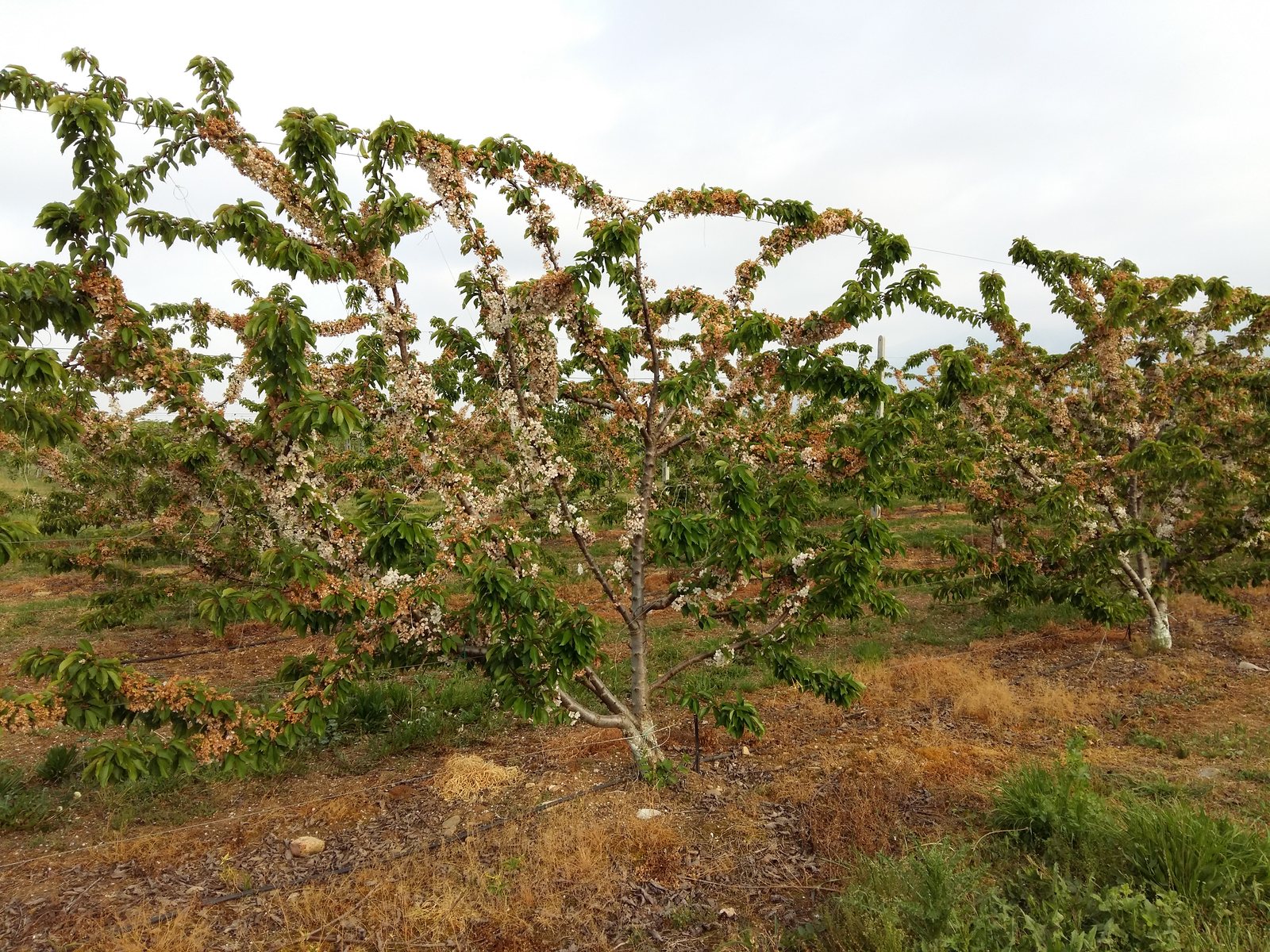
Hedge («fytofraktis»), instead of the palmette
It is combined with small-tree or dwarfing rootstocks and with nothing else. In cherry it is normally used in fully mechanised holdings, harvest included, and mainly where the crop goes for processing [2].
Sequence: heading at 60 cm. Trellis wires at 90, 180 and 270 cm. Three shoots are selected: one vertical and two along the row, spread to 45 degrees. The following spring all three are headed at 90 cm from the branching point.
The detail that decides the form: the sections spread to 45 degrees are now opened to over 60, and the new sections again to 45. If the lateral scaffolds are opened to a wide angle from the first year, they degenerate under apical dominance and turn into sub-scaffolds, ruining the intended form [2]. It is the commonest fault in Greek palmettes.
Video 2. The classical palmette hedge in sweet cherry, benefits and drawbacks, from an orchard in this region. Commentary in Greek.
Sources: 2
9. What the comparative trials showed
Three independent series of trials, on three continents, with different cultivars and rootstocks.
Italy, Ferrara, seven years, 1,720 trees
In the Po valley, on soil with 3 to 6% active lime, Musacchi, Gagliardi and Serra compared spindle, V-system and SSA across twelve cultivar-rootstock combinations, at densities from 1,905 to 5,714 trees per hectare [3].
| Index (on Gisela 5) | Spindle | V-system | SSA |
|---|---|---|---|
| Trunk cross-section at 5 years (cm²) | 26.2 | 21.8 | 20.2 |
| Cumulative pruning wood (kg/tree, 5 years) | 3.0 | 2.0 | 1.9 |
| Cumulative yield over 7 years (t/ha) | 15.9 | 26.9 | 26.6 |
| The same, on Gisela 6 (t/ha) | 31.3 | 46.3 | 43.6 |
The spindle gave the highest yield per tree but the lowest per hectare, 15.9 against 26.9 t/ha on Gisela 5, that is, less than two thirds. The reason is density. The same pattern repeats on Gisela 6.
The top performance was Ferrovia: over 50 t/ha cumulative on both dense systems, with over 90% of the fruit exceeding 28 mm in 2012 [3]. The low yield per tree, 3 to 5 kg, is offset by the number of trees.
- The spindle produced the largest and sweetest fruit in 2010, while the V-system produced the least firm (0.47 kg/cm²) [3]. Density wins on kilos, not necessarily on quality per fruit.
- Some cultivars simply cannot take high density. Sweet Early, Kordia, Black Star, Early Bigi and Summit did not show sufficient sustained production. Kordia and Summit had a high bloom but poor fruit set and heavy fruit drop [3].
- Gisela 5 combined with Summit, Early Bigi and Sylvia gave cross-sections of 16.8, 15.7 and 10.6 cm², values the authors themselves comment on as an indication that the dwarfing effect was too severe [3].
Tasmania, Kordia on Krymsk 5, light and quality
Stone and co-workers measured light interception and quality over two seasons in five planar systems: UFO, SSA, TSA, Bibaum and Steep Leader [6].
| Finding | Value |
|---|---|
| Highest light interception | UFO and Steep Leader, 69%; then Bibaum at 66% |
| Highest yield | SSA 15.1 t/ha, Steep Leader 14.5, UFO 12.7 |
| Crop load and fruit dry matter | Negative correlation, r² = 0.67 and 0.84 in the two seasons |
| Crop load and soluble solids | Negative correlation, r² = 0.92 and 0.42 |
The authors' conclusion is practical and bears directly on anyone planning a UFO: for cultivars fruiting on one-year-old wood, sufficient space is required between the upright leaders, so that optimal light interception and fruit quality are achieved [6].
Türkiye, Samsun, three years, labour
Soysal and co-workers compared five systems on 0900 Ziraat / Gisela 6, planted in 2014, with measurements in 2018 to 2020 [7]:
| Index | Result |
|---|---|
| Smallest canopy volume | UFO, 1.7 and 1.9 m³ |
| Highest yield per hectare | KGB, TSA and UFO |
| Highest harvest efficiency | KGB 36.5 kg/hour and UFO 36.1 |
| Lowest harvest efficiency | SSA, 22.1 kg/hour |
| Shortest pruning times | UFO, winter and summer |
For a Greek holding with expensive and scarce labour, that one line may be more decisive than all the yields put together.
The counterweight of seven years in Bing: the rootstock moved the yield, crown architecture only moderately
A seven-year trial in Washington on Bing, with three rootstocks, Mazzard, Gisela 6 and Gisela 5, and four systems, central leader, multiple-leader bush, palmette and Y-trellis, reached a conclusion worth quoting [13].
Between rootstocks, trees on Gisela 6 yielded 212 to 657% more than those on Mazzard, depending on the year, and 13 to 31% more than Gisela 5 [13].
Between systems, by contrast, only the multiple-leader bush stood out, and downwards: it was about 25% less productive. The other three gave similar cumulative yields, around 102 kg per tree [13].
The conclusion is unwelcome for anyone hoping the training system will solve everything: the rootstock counts several times over. The system regulates light, labour and quality, but yield is decided first at the root [8].
The same paper gives the relationship that ties the whole article together in one line: fruit weight is negatively and very closely related to tree yield efficiency, with a coefficient of r² = 0.84 [13]. That is, the more kilos per square centimetre of cross-section, the smaller the cherry, and the relationship is close to linear.
9b. Harvest labour, the number that decides the investment
In sweet cherry, harvest costs generally account for 50 to 60% of total production costs [12]. Even so, until 2013 there was no empirical study of how the training system affects picking speed.
Ampatzidis and Whiting carried one out, with a real-time labour monitoring system and RFID tags, in eleven commercial orchards of the Pacific Northwest, using the same picking crew so as to eliminate differences in skill [12].
| System | Mean rate (kg per minute) |
|---|---|
| UFO | 0.94 in the best orchard; 0.78 in the second |
| KGB | 0.73, a fully pedestrian orchard |
| Central leader | 0.72 |
| Y-trellis | 0.60 to 0.69 |
| Traditional multi-leader open centre | 0.48 to 0.70, with the lowest at 0.48 |
- The slowest picker of the crew, in the UFO, was 24% faster than the fastest picker of the same crew averaged across the four traditional open-centre orchards [12]. That is, the system more than covered the entire gap in ability between the best and the worst worker.
- The less skilled pickers gained far more than the skilled ones. Moving from the traditional open centre to the pedestrian and planar systems, the rate of slow pickers improved by 132% and of experienced ones by 83% [12]. In a country with scarce and untrained labour, this is the single most important finding of the whole study.
- The planar UFO beat the fully pedestrian KGB. The authors' conclusion is counter-intuitive: «ease of access to fruit is more important than eliminating ladders» [12]. It is not enough, in other words, to lower the tree; the fruit has to be visible and reachable.
Translating picking speed into pickers per shift
At a Washington average of 6 tons per acre, as the source gives it, the authors calculate [12]:
0.94 kg/min: one picker harvests 451 kg in an 8-hour shiftAt
0.48 kg/min: one picker harvests 230 kgSo one acre, that is 0.4047 hectares, needs 12 people in the first case and 24 in the second in a single shift
The authors conclude that piece-rate reimbursement systems are inherently inaccurate. It is an observation that bears directly on Greek practice too.
Sources: 12
10. Pruning timing and bacterial canker
For Greek conditions this section is as important as the choice of system.
The main pruning of the cherry is done in summer, immediately after harvest. The hot, dry conditions of that period do not favour infection and the trees heal faster.
Winter pruning is supplementary and concerns one-year-old shoots only. It is carried out early in spring, shortly before bud break, and may be extended into bloom. Never in autumn or in winter, when the risk of infection is elevated [2].
Making the cut: removal at the base, a 3 to 10 cm stub and protection of the wound
- On mature trees, shortening branches is not indicated; removing them at the base is, always onto a suitable lateral of adequate size. The reason is physiological: in most cases no new shoots emerge from the remaining stub, which atrophies and dies back in the following years [2].
- When removing shoots two years old and older, a stub of 3 to 10 cm is left, depending on thickness. The cut is smoothed and protected. The reason: to give the tree time to form callus before inoculum penetrates into the remaining shoots. The stub is removed in later years, once it dries out [2].
- In renovation pruning, no more than one third of the canopy size is removed within the same year. A larger reduction is spread over two or three successive years [2].
The cost in day-wages, and the condition that keeps it low
From calculations by the Institute of Deciduous Trees, pruning one hectare of cherry requires one third of the labour needed for the same area of peach, on condition that fruiting pruning is carried out properly and without interruption every year [2]. The condition is the critical part of the sentence.
Video 3. Summer pruning of sweet cherry, results and regrowth. How the tree responds to cuts made immediately after harvest. Commentary in Greek.
11. The picture in the field, what is seen in these orchards
What follows does not come from the literature. These are our own observations in cherry orchards in the Giannitsa area, and are presented as such.
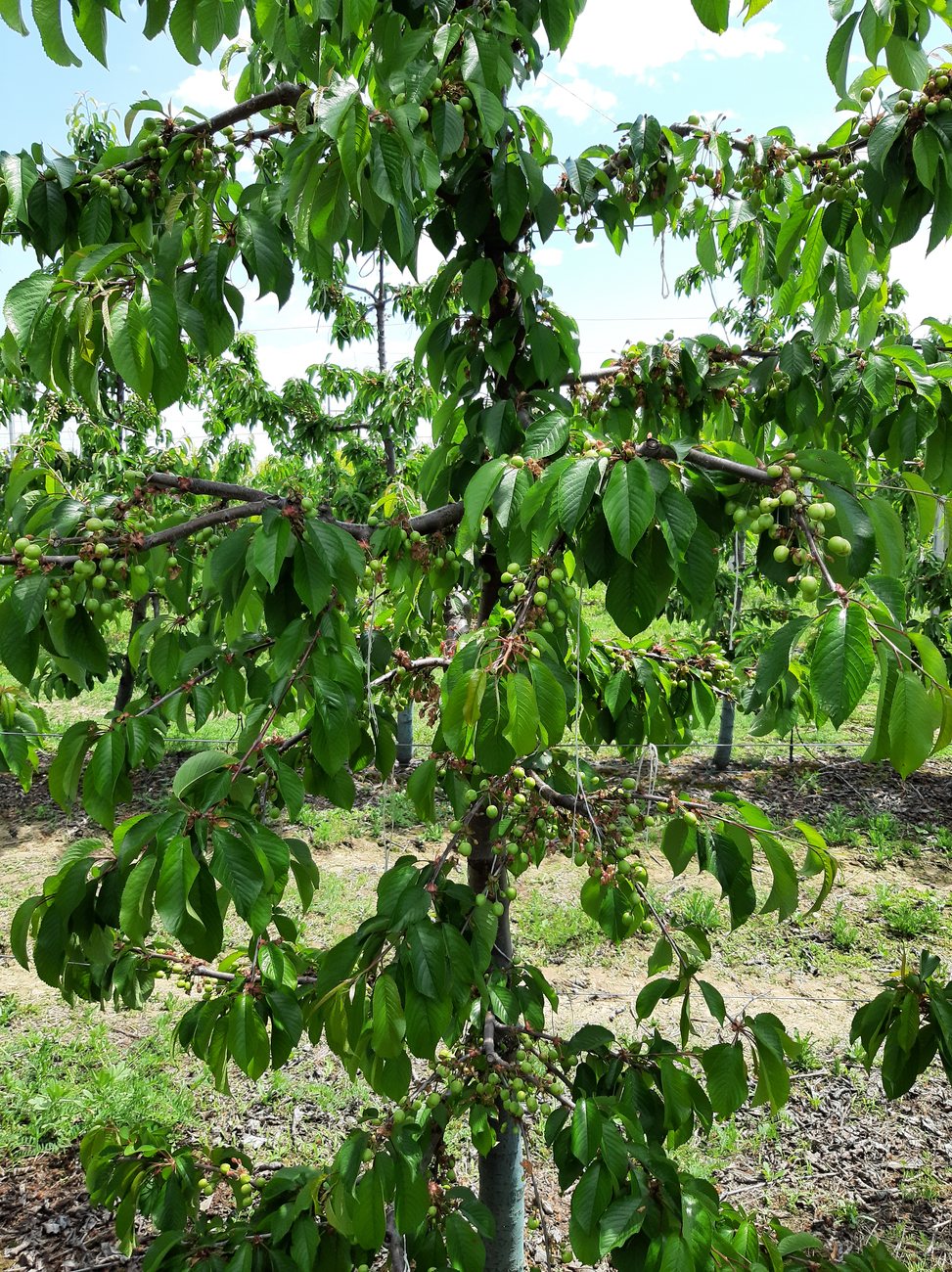


The points the on-site observation in these Pella orchards confirms
- The commonest fault is not the system; it is the absence of renewal. Trees trained correctly but never given annual fruiting pruning end up with spurs eight and ten years old and fruit that never sizes. Spurs four years old and older give smaller fruit [5]; the PNW five-year rule is not decorative.
- Self-fertile cultivars overcrop more easily and are punished harder. Pruning must be heavier precisely where the grower is most afraid to do it.
- The arched curve in tied wood is a permanent source of water sprouts. Wherever a scaffold is tied after it has already lignified, the highest point of the curve becomes a site of vertical growth, and vigour is spent there every year.
- The problem of blind shoots is worse in planar systems, because horizontal wood favours mass flowering at the expense of vegetative break. It is the same phenomenon described in the Hungarian literature for dwarfing rootstocks, where blind wood is corrected only by severe pruning in the early years.
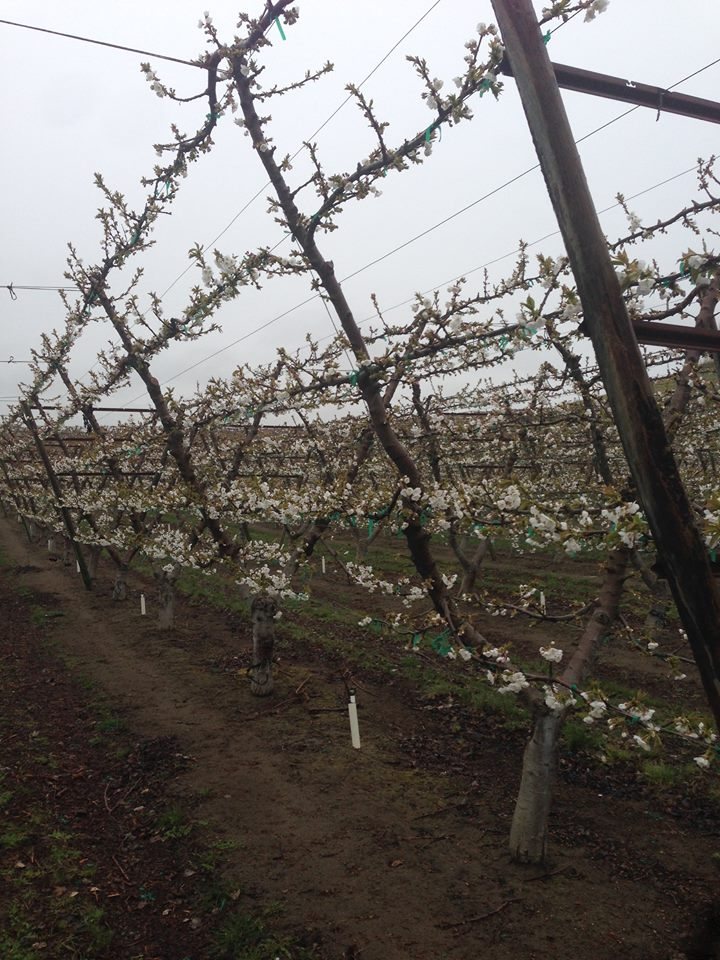
Video 4. Mistakes in pruning and their impact on the crop. What the tree shows once the leaf-to-fruit ratio has been ruined. Commentary in Greek.
12. How a system is chosen for a Greek field
The order of the questions matters, because each answer rules options out.
- Which rootstock? This is the first and strictest filter. A vigorous rootstock means KGB, Spanish Bush or Steep Leader, and, in the Greek version, the open vase. Semi-dwarfing or dwarfing opens up all the rest. The rootstock choice has already chosen half the systems before anyone thinks about them. The subject is covered separately in Cherry rootstocks [8].
- Where does the cultivar fruit? On spurs, or on basal buds of one-year-old wood? Regina and Attika rule out the KGB. Cultivars without fertile basal buds rule out the SSA.
- Is there reliable irrigation? Dense systems, the SSA in particular, require relatively higher levels of water and nutrients [3]. Without them, density becomes competition.
- How much labour is available, and how skilled? The UFO has the shortest pruning times and the fastest harvest, but the most expensive and demanding establishment. The SSA requires 100% renewal every year. The KGB is the simplest: «this simple, repeatable pruning process allows the least skilled workers to quickly learn the system» [1].
- How much bacterial canker pressure is there? High pressure means fewer cuts, longer stubs, summer pruning and, on the Greek guide's view, a preference for the forms requiring the fewest interventions [2].
- Will nets or covers be used? Narrow, planar systems are distinctly easier to protect with covers against rain and birds [4]. If covering is in the plan, it counts in their favour.
- How much height can the holding manage? The KGB is the only fully pedestrian one. The rest are semi-pedestrian or need platforms.
Given hot, dry summers, soils that are often heavy or calcareous, and irrigation that in many fields is marginal, and on the basis of what has been recorded for the rootstocks, the picture that emerges is:
- On a vigorous rootstock, the open vase remains the right choice, and it is the position of both the Greek guide and, under other names, of PNW 667 through the Spanish Bush and the KGB.
- The KGB deserves serious consideration as an upgrade of the vase on vigorous rootstocks: the same logic of diffusing vigour, but with organised renewal of 15 to 20% per year and a pedestrian harvest. It does not suit Regina, however.
- Planar systems are justified only with a semi-dwarfing rootstock, reliable irrigation and a commitment to annual pruning. And there, the UFO looks preferable to the SSA under Greek conditions, because it gives roughly 63% faster harvesting and shorter pruning, 36.1 against 22.1 kg per hour in the Samsun trial [7], at roughly half the tree density.
This assessment is our own reading of the literature adapted to local conditions. There are, as far as is known, no published comparative trials of cherry training systems in Central Macedonia, and that is a gap worth filling.
13. The mistakes that get paid for
The eight commonest mistakes, and what each one costs
- A planar system on a vigorous rootstock. Condemned by both sources, Greek and international [1] [2]. The tree does not fit the space it was given and the system becomes a permanent fight.
- Spreading the laterals to a wide angle from the first year. The scaffolds degenerate and turn into sub-scaffolds under apical dominance [2]. The angle is opened gradually: 45 degrees this year, over 60 the next.
- Pruning in autumn or in winter. The period of maximum risk for wood infections [2].
- Shortening instead of removing on mature trees. The remaining section atrophies and dies back [2].
- No renewal of fruiting wood. Spurs over five years old give consistently smaller fruit. The 20% per year is not a recommendation; it is maintenance.
- Fear of heading. Since fruit thinning is not done in cherry, heading is the only crop-load tool left [2] [5].
- Two cuts within the same year on a young tree. In the KGB, two cuts in year one eliminate the fruiting potential of year two; two cuts in year two eliminate that of year three [4]. It is a deliberate choice, not a mistake, provided it is made deliberately.
- Fertilising during training in systems that need flat angles. In the VCL, fertilisers are explicitly to be avoided until cropping begins, so that growth stays moderate and the angles horizontal [1].
Video 5. Low-production cherry trees, pruning advice. The reverse case: what to do when the problem is not excess crop but its absence. Commentary in Greek.
There is no single best system. The manual itself says so: «growers will be successful who understand the fundamental training rationale and fruiting units for each system, and how to adapt their system management for their specific needs: their orchard site, their variety characteristics, their markets, and their labor situation» [4].
And something that holds for all of them without exception: every modern system has minimal permanent wood and a planned annual renewal of the fruiting units [4]. If a system has no renewal plan, it is not a modern training system but simply a tree that was once pruned.
14. Sources
The numbers in the text refer to the list below. Greek-language sources are marked as such.
- [1] Long L.E., Lang G., Musacchi S. and Whiting M. (2015). Cherry Training Systems. PNW 667, Oregon State University, Washington State University, University of Idaho, in cooperation with Michigan State University. The article's main source. Source for the physiology of the forest tree and the three problems, for the three-year assembly of the fruiting unit, for the six cutting and bud activation techniques, for the detailed instructions and planting distances of all eight systems, for the rootstock and cultivar suitability table, for the exclusion of Regina from the KGB, and for the timing of cuts in areas with bacterial canker pressure.
- [2] Chatzicharisis I. (2009). Pruning of the sweet cherry. Institute of Deciduous Trees, Naoussa. Georgia - Ktinotrofia, issue 4/2009, pp. 30-39. In Greek. The principal Greek source. Source for acrotonic growth and the displacement of the fruiting zone, for the requirement of over 40% fruit set against 10% in peach and apple, for the three to five year life of the spurs, for the detailed training instructions for the open vase, kyparissaki, spherical and hedge forms with their spacings, for the explicit recommendation to avoid planar systems, for pruning timing and the prohibition of autumn and winter pruning, for the 3 to 10 cm stub technique, for the one-third limit in renovation pruning, and for the labour comparison with peach.
- [3] Musacchi S., Gagliardi F. and Serra S. (2015). New Training Systems for High-density Planting of Sweet Cherry. HortScience 50(1):59-67. Source for the seven-year Ferrara trial on 1,720 trees, for the densities from 1,905 to 5,714 trees per hectare, for the trunk cross-sections and pruning wood by system, for the cumulative yields of 15.9 / 26.9 / 26.6 t/ha on Gisela 5 and 31.3 / 46.3 / 43.6 on Gisela 6, for Ferrovia's performance above 50 t/ha with over 90% of fruit above 28 mm, for the spindle's superiority in size and sweetness, for the V-system's lower firmness, for the cultivars that cannot take high density, and for the higher quality of fruit from basal buds of one-year-old shoots.
- [4] Lang G.A. Developing and Optimizing Sweet Cherry Training Systems for Efficiency and High Quality Fruit, Parts 1 and 2, and Sweet Cherry «Fruiting Wall» Training Systems (with Lillrose T.). Michigan State University. Source for the carbon-13 data of Ayala and Lang with the 55% / 29% / 16% partitioning by leaf population, for the leaf area per fruit levels, for the year-by-year arithmetic of the leaf-to-fruit ratio, for the finding that heading 15-30% of the shoot removes 25-40% of future spur density, for the renewal percentages by system, for the fact that two cuts in one year eliminate the following year's fruiting potential, and for the fruiting wall principles.
- [5] Menzies R. (2004). Increasing cherry fruit size. Agfact H5.4.2, NSW Department of Primary Industries, Australia. Source for the table of three crop load levels in Sweetheart with trunk cross-sections, yields, percentages of fruit above 26 mm and net returns, for the target of 25 fruit per cm² of cross-section and a yield efficiency of 0.25, for the 100 cm² leaf area per fruit relationship and the two-leaf rule, for the 20% visible crop rule, for the timing milestones of the fruiting season, for the fact that 25% of the weight is gained in the last week, for the effect of a 10-15% light reduction, for recognising shade leaves, and for the finding that spurs over four years old give smaller fruit.
- [6] Stone C.H., Close D.C., Bound S.A. and Hunt I. (2022). Training Systems for Sweet Cherry: Light Relations, Fruit Yield and Quality. Agronomy 12(3):643. Source for the two-season comparison of five planar systems on Kordia on Krymsk 5, for light interception of 69% in UFO and Steep Leader and 66% in Bibaum, for yields of 15.1 / 14.5 / 12.7 t/ha, for the negative correlations of crop load with dry matter and soluble solids, and for the recommendation of sufficient spacing between uprights for cultivars fruiting on one-year-old wood.
- [7] Soysal D., Demirsoy L., Doğan D.E. and Demirsoy H. (2025). Training System Effect on Fruit Quality, Yield, Harvest Efficiency, Pruning Times and Growth in Sweet Cherries. Applied Fruit Science 67:6. Source for the three-year comparison of five systems on 0900 Ziraat on Gisela 6 at Samsun, for the smallest canopy volume in the UFO (1.7 and 1.9 m³), for the highest yields per hectare in KGB, TSA and UFO, for harvest efficiency of 36.5 kg/hour in the KGB and 36.1 in the UFO against 22.1 in the SSA, and for the shortest pruning times in the UFO.
- [8] Cherry rootstocks, a detailed guide, plantprotect.gr. The detailed account of the rootstocks, their vigour and their soil adaptation, which is the first filter in choosing a training system.
- [9] Plant Protection Products Database, Greek Ministry of Rural Development and Food, and the approvals database at plantprotect.gr. In Greek. The official source of approvals for any product referred to or implied, particularly the copper products that accompany interventions on the wood.
- [10] Ayala M. and Lang G.A. (2008). 13C-Photoassimilate Partitioning in Sweet Cherry on Dwarfing Rootstocks during Fruit Development. Acta Horticulturae 795:625-632. The original carbon-13 work. Source for fruiting spur leaves contributing 57-79% of their carbon to the fruit, non-fruiting spur leaves 31-71% and current season shoot leaves 18-59%; for 87-96% of the carbon of non-fruiting spur leaves going to fruit and only 4-13% to shoots; for the difference between proximal (58-61%) and distal fruit (31-37%); for even partitioning at a low load of 140 cm² per fruit against markedly uneven partitioning at 75 and 40 cm²; for the peak of fruit sink strength in mid-Stage III at 56 days; and for shoots exporting carbon to fruit as early as 25 days, at 10 cm long with ten leaves.
- [11] Ayala M. and Lang G. (2004). Examining the Influence of Different Leaf Populations on Sweet Cherry Fruit Quality. Acta Horticulturae 636:481-488. The defoliation and girdling study on Hedelfinger on Gisela 5 and Ulster on Gisela 6. Source for the girdled branch with a full complement of leaf populations giving the largest and sweetest fruit, for fruit supplied by only one population being significantly smaller and less sweet, and for the absence of a sufficient compensatory effect when one population is eliminated.
- [12] Ampatzidis Y.G. and Whiting M.D. (2013). Training System Affects Sweet Cherry Harvest Efficiency. HortScience 48(5):547-555. Source for harvest costs being 50-60% of total production costs, for the harvest rates by system with 0.94 kg/min in the UFO, 0.73 in the KGB and 0.48 in the slowest traditional open centre, for the 132% improvement in slow pickers and 83% in experienced ones, for the slowest picker in the UFO being 24% faster than the fastest in the open centres, for the conclusion that ease of access matters more than eliminating ladders, for the calculation of 12 against 24 people per acre, and for the 7-13 kg bucket weight variability and the inaccuracy of piece-rate pay.
- [13] Whiting M.D., Lang G. and Ophardt D. (2005). Rootstock and Training System Affect Sweet Cherry Growth, Yield, and Fruit Quality. HortScience 40(3):582-586. A seven-year trial on Bing with three rootstocks and four systems. Source for Gisela 5 and 6 giving 45% and 20% smaller trunk cross-sections than Mazzard, for the superiority of Gisela 6 at 212-657% over Mazzard and 13-31% over Gisela 5, for the critical conclusion that canopy architecture had only moderate effects on vigour and yield, for the multiple-leader bush being 25% less productive while the other three systems gave similar cumulative yields of around 102 kg per tree, and for the negative relationship between fruit weight and yield efficiency at r² = 0.84.
- Cherry rootstocks, a detailed guide, the first filter in choosing a training system
- Calcium and postharvest physiology in sweet cherry
- The classical palmette hedge in sweet cherry, benefits and drawbacks
- Tsolakeika on CAB 6P in a narrow vase
- Sabrina on MaxMa 14, pruning advice for a palmette hedge
- Fatal mistakes in cherry pruning, in orchards with good pollinisers and good fruit set
- Summer pruning of excessively vigorous cherry trees
- How Lapins is pruned
All videos are in Greek.
The planting distances, cutting heights, leader numbers and renewal percentages given are ranges from trials under specific soil and climate conditions, chiefly in the Pacific Northwest of the United States, northern Italy, Tasmania and the Black Sea, and do not transfer unchanged to every field. They vary with soil fertility, terrain, season length, rootstock vigour, cultivar growth habit and available labour.
The choice of training system is a two-decade commitment of significant capital and is settled only after soil analysis, water analysis and on-site assessment by a licensed agronomist, in combination with the rootstock, the cultivar and the irrigation available.
On protecting the cuts: copper or other plant protection products are used solely on the basis of the approvals in force for cherry, in Greece those of the Ministry of Rural Development and Food, elsewhere the corresponding national register, and according to the label [9]. Wound paints and cut sealants are used according to their own instructions.
Every intervention is made at the user's own responsibility. Pastopoulos Geoponiki L.P. accepts no liability for damage or loss of production arising from applying the above information without individual technical guidance.
Related articles
The white Mediterranean snail in tree crops
Theba pisana is native to the Mediterranean, not invasive, so there is no eradication programme to wait for. Identification, life cycle, the damage in tree crops, the single approved target in the Greek register, and why the nematode Phasmarhabditis killed the snail only at five times the label rate.
The Meda sweet cherry series
Six club varieties selected for at least 35 to 40 days of post-harvest life, for sea freight to China. Ripening, size, sugars and S genotypes as published, the two pairs that cannot pollinate each other, chilling figures with no model stated, and the fact that every measurement comes from covered plantings outside Greece.
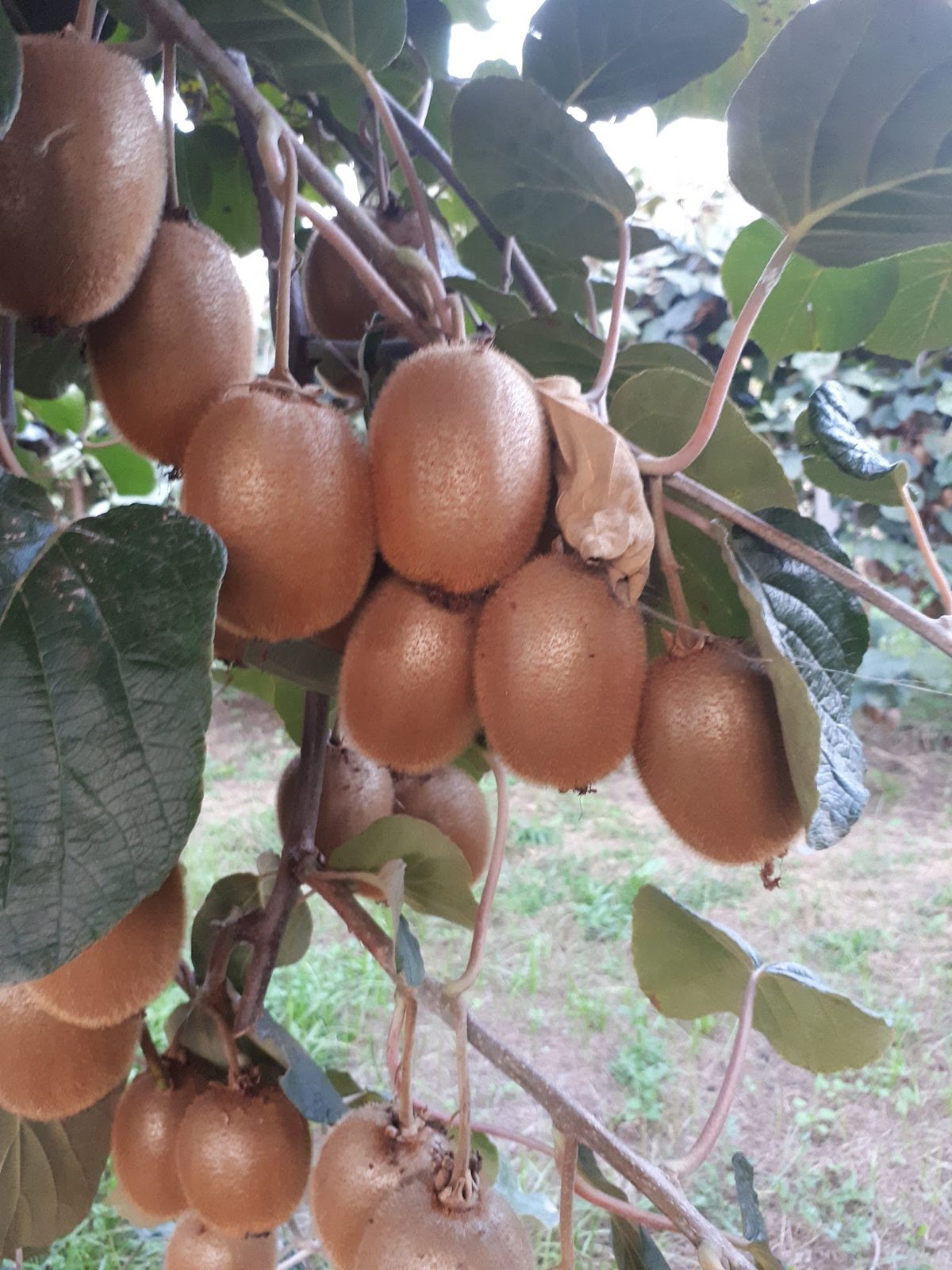
Training kiwifruit: T-bar and pergola
The architecture of the kiwifruit vine and why both training systems follow from it. T-bar and pergola with their dimensions, advantages, costs and a comparison in numbers. Training from the day of planting: planting high, a first season for the root with tipping at one metre, cutting back low the following spring and taking the trunk up in the second season, leaders, winter and summer pruning, males and the support structure. Three diagrams, a table of mistakes, and the gaps that remain for Greece. A field observation from Giannitsa on planting distances.