
Cherry rootstocks, a detailed guide
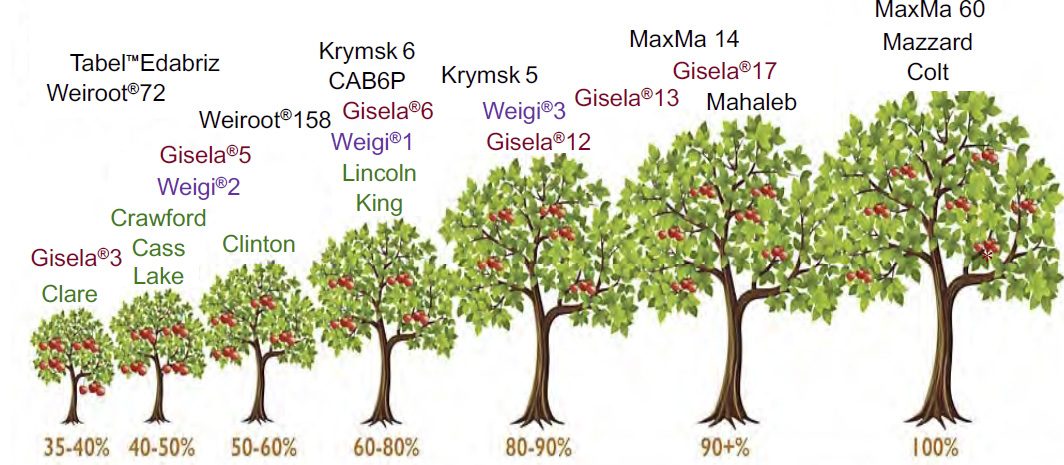
Figure 1. An indicative vigour scale for cherry rootstocks. The values are of European origin and for some rootstocks they differ from the percentages in section 2, which refer to the Pacific Northwest of the United States, Gisela 5 appears here at 60 to 80% whereas there it is 50 to 60%, Krymsk 5 at 90+% whereas there it is 85 to 90%. The discrepancy is not an error: as section 2 explains, the same rootstock gives a different tree size on a different soil and in a different climate.
Savvas Pastopoulos, Agronomist, Pastopoulos Geoponiki L.P.
The cultivar decides what gets sold. The rootstock decides whether the orchard ever gets there. It sets the size of the tree, how quickly it comes into bearing, how many kilos it carries per square centimetre of trunk, how it responds to a heavy or a calcareous field, and how much suckering and staking the grower will have to live with. It is a decision taken once, for twenty years, and it is usually taken by asking «what does the nursery have».
- What the rootstock actually controls
- The vigour scale, the map of the field
- The families and where they come from
- Each one in turn
- Productivity and the number that really counts
- What the trials showed, country by country
- Fruit size, what affects it and what does not
- Soil: lime, depth, drainage, replanting
- The rootstock changes nutrition, and calcium
- Diseases, viruses and nematodes
- Suckers, anchorage and blind wood
- The new rootstocks: the Corette and WeiGi series
- How to choose for a Greek field
- Sources
1. What the rootstock actually controls
Before the names, it is worth setting out what is actually expected of a rootstock. The list of characteristics evaluated in breeding programmes internationally is a specific one and includes the following [3]:
- Ease of propagation, by seed, by cuttings or by tissue culture. It determines the cost and the availability of the young tree.
- Graft compatibility, at times problematic, particularly with Prunus mahaleb, and sensitive to virus-infected scion wood.
- Control of vigour, bearing in mind that in the wild the cherry is a forest tree, that is, a plant with a natural drive towards height.
- Precocity of cropping, usually inversely related to vigour.
- Productivity, likewise inversely related to vigour.
- Soil adaptation, type, drainage, pH, replant conditions, tendency to sucker.
- Climate adaptation, cold hardiness and heat tolerance.
- Tolerance of diseases and pests, soilborne pathogens, bacterial canker, nematodes, rodents.
2. The vigour scale, the map of the field
The first thing to hold in mind is where each rootstock stands relative to the standard, which internationally is Mazzard, the seedling of the wild cherry, Prunus avium. It is held to have been in use as a rootstock for over 2,400 years, by ancient Greek and Roman growers, and it remains the yardstick [1].
The percentages come from the characteristics table of PNW 619 [1] and from the Michigan State University review [3]. They are indicative and they shift considerably with location. The next box explains why.
This is the point systematically overlooked when foreign catalogues are read. The data themselves show it plainly [1]:
- Gisela 6 gives a tree at 60% of standard size in the eastern United States, while in the Pacific Northwest it reaches 90%.
- MaxMa 14 grows far more vigorously on the rich soils of Oregon than on the calcareous soils of southern France.
- Colt was released in Europe as semi-dwarfing and on irrigated American sites gave a full-size tree.
The conclusion is simple and unwelcome: the percentage printed in the catalogue is not the percentage that will appear in the field. It is a starting point, not a prediction.
3. The families and where they come from
Every rootstock carries the characteristics of the species it came from. Parentage is not a catalogue detail, because cold hardiness, tolerance of heavy soil and suckering all follow from it.
| Rootstock | Botanical parentage | Origin |
|---|---|---|
| Mazzard | Prunus avium, seedling or clone F 12/1 | The historical standard |
| Mahaleb | Prunus mahaleb, St Lucie cherry | France, from the 18th century |
| SL 64 | A P. mahaleb selection (Sainte Lucie) | France |
| Colt | P. avium × P. pseudocerasus | East Malling, England, 1970s |
| Gisela series 5, 6, 13 | P. cerasus «Schattenmorelle» × P. canescens | Giessen, Germany |
| Gisela 12 | P. canescens × P. cerasus «Leitzkauer» | Giessen, Germany |
| Gisela 17 | P. canescens × P. avium | Giessen, Germany |
| Krymsk 5 VSL 2 | P. fruticosa × P. lannesiana | Black Sea region, Russia |
| Krymsk 6 LC 52 | P. cerasus × (P. cerasus × P. maackii) | Russia |
| PiKu 1 | P. avium × (P. canescens × P. tomentosa) | Dresden-Pillnitz, Germany |
| PiKu 3 | P. pseudocerasus × (P. canescens × P. incisa) | Dresden-Pillnitz, Germany |
| MaxMa series 14, 60, 97 | P. mahaleb × P. avium | Oregon, from open pollination of mahaleb |
| Weiroot series | P. cerasus clones | Weihenstephan, Germany |
| Tabel Edabriz | A P. cerasus clone | France |
| CAB 6P | A P. cerasus selection | Italy |
| P-HL-A, P-HL-C | P. avium from open pollination with P. cerasus | Czechia |
| Damil | P. dawyckensis from open pollination | Gembloux, Belgium |
| Adara | P. cerasifera, that is, a plum | Spain |
| Corette series Cass, Clare, Clinton, Crawford, Lake, Lincoln, King | Various crosses involving P. cerasus, P. avium, P. fruticosa, P. canescens | Michigan State University |
| WeiGi series 1, 2, 3 | Weiroot selections × a Giessen selection | Weihenstephan, Germany |
- The parent species of the Gisela series, P. cerasus and P. canescens, are both hardier than Mazzard, and they pass that hardiness on [1].
- Mahaleb has a deep root system and is among the most drought-tolerant, but at the same time extremely sensitive to waterlogged soil, even for short anaerobic spells in winter.
- Colt, carrying P. pseudocerasus genes, is the one rootstock less cold-hardy than Mazzard, and that matters in continental Macedonia.
4. Each one in turn
| Rootstock | Size % of full | Precocity | Earlier bloom and ripening | Compatibility | Suckers | Anchorage |
|---|---|---|---|---|---|---|
| Colt | 100 | No | No | Good | No | Good |
| Gisela 5 | 50 to 60 | Yes | 2 to 4 days | Good | No | Fair to good |
| Gisela 6 | 85 to 90 | Yes | 0 to 1 day | Good | No | Fair |
| Gisela 12 | 80 to 100 | Yes | No | Good | No | Good |
| Krymsk 5 | 85 to 90 | Yes | No | Limited data | Moderate | Good |
| Krymsk 6 | 65 to 70 | Yes | No | Limited data | Moderate | Good |
| Mahaleb | 90 | Slight | No | Fair to good | No | Good |
| MaxMa 14 | 100 | Yes | No | Good | No | Good |
| Mazzard | 100 | No | No | Good | Few | Good |
The table reproduces the data of Table 2 of PNW 619 [1], which remains the fullest comparative account. The values refer to conditions in the Pacific Northwest of the United States.
What is worth knowing about each, beyond the table
Mazzard and the F 12/1 clone
No case of incompatibility has ever been recorded, because it belongs to the same species as the cultivated cherry. Its fibrous root system makes it a good choice for wet and heavy soils [9]. Its drawback is serious: it does not come into bearing before the fifth or sixth leaf and does not reach full production before the twelfth [1].
The F 12/1 clone is used in western Oregon for one very specific reason: it has tolerance of bacterial canker. There it is planted and allowed to grow up to the point of branching, and the cultivar is grafted onto the scaffold limbs of the rootstock, so that an infection in one limb does not reach the trunk and kill the tree.
Mahaleb, the rootstock of calcareous and dry soils
It is slightly more precocious and slightly less vigorous than Mazzard, and among the most drought-tolerant thanks to its deep rooting. It is the rootstock of choice for the calcareous soils of Spain and southern Italy [1], and in Hungary it accounts for roughly 70% of sweet cherry plantings [6].
Two serious warnings. First, it is extremely sensitive to waterlogged soil and dies out in low spots where water collects. Second, incompatibility with certain cultivars can appear as late as six years after planting, that is, at the moment when everything has been paid for and nothing has yet been earned.
The Gisela series, the transformative introduction
It is described as the introduction that changed the crop, on three main counts: real control of vigour, marked precocity with high productivity, and cold hardiness [3].
Gisela 5 is the most dwarfing rootstock commercially available. It has been widely accepted in northern Europe and in the northeastern United States, where summers are relatively cool. It failed, however, to establish itself in the major production zones of the west coast, in Chile and in other regions with hot summers [2]. It does not perform on heavy soils and requires good drainage, and it shows sensitivity to replant stress.
Gisela 6 is the most popular choice for new plantings in the Pacific Northwest. It is moderately to highly vigorous but very precocious, giving a marketable crop from the third leaf and full production from the fifth. It suits a wide range of soils, from light to heavy, on the essential condition of good drainage. Its weak point is anchorage on windy sites.
Gisela 12 is adapted to a broad range of soils, anchors better than Gisela 6, resists suckering, and is regarded as better than Gisela 3, 5 and 6 in hot, dry and stressful climates and soils [3]. For Greek conditions that last sentence deserves underlining.
Gisela 12 in the field, our own empirical assessment
Since everything above comes from foreign trials, it is worth seeing the rootstock under real conditions in this region. The video below presents our own assessment of Gisela 12 on the tree.
Video. Gisela 12 rootstock, an empirical assessment in the field. Commentary in Greek.
- Gisela 12 is a hungrier rootstock than Gisela 6 and produces no suckers. It is very productive and is regarded as a replacement for Gisela 6. These points agree with what is recorded internationally.
- It is recommended only on self-incompatible cultivars. This is an observation that will not be found in the foreign catalogues and follows from the logic already described: the rootstock is by itself very productive, so combining it with a self-fertile, and therefore also productive, cultivar leads to overcropping, small fruit and exhaustion of the tree. It is the same principle that makes the Sweetheart on Gisela 6 combination difficult [1].
- Water requirements are lower than those of Gisela 6, but they remain relatively high. This qualifies the recommendation the literature gives for hot and dry environments: Gisela 12 stands up better than the other Giselas, but it is not a rootstock for a field without reliable irrigation. Where irrigation is marginal, the discussion returns to the mahalebs and to MaxMa 14.
The Krymsk series, for heat, cold and heavy soil
Both appear to be adapted to cold as well as hot climates, and to heavier soils [1]. For Krymsk 5 there is one observation that deserves attention in a Greek heatwave: the leaves stay turgid in extreme heat and do not show the characteristic curling of trees on Gisela.
Krymsk 6 gives a tree at only 75 to 80% of the size of Krymsk 5 and Gisela 12, allowing denser plantings, and is more precocious than Krymsk 5. Both anchor well and need no support.
MaxMa 14, the answer to lime
It arose in Oregon from an open-pollinated mahaleb tree, but established itself mainly in France, thanks to its precocity, its semi-dwarfing effect and its resistance to the iron chlorosis induced by calcareous soils [1]. In Chile it is planted because it is held to give some tolerance of bacterial canker. It has good compatibility, wide adaptation and very few suckers. Its limitation is that on rich soils it gives a full-size tree and is not suited to very dense systems.
Colt, the care it needs
It was released as semi-dwarfing but on irrigated sites gives a tree the size of Mazzard, with the same lack of precocity. It is sensitive to dry soils and to low winter temperatures. It does, however, have three real advantages: resistance to bacterial stem pitting, resistance to phytophthora and to bacterial canker, and good performance under replant conditions where cherry follows cherry without fumigation [1]. It is, on the other hand, susceptible to crown gall.
5. Productivity and the number that really counts
When rootstocks are compared, kilos per tree are misleading, because a large tree will naturally give more. The figure used internationally is yield per unit of trunk cross-sectional area, that is, kilos per square centimetre of trunk cross-section. It measures how efficiently the tree converts its own volume into fruit, and it is the criterion that justifies high-density planting.
How much more they yield, in practice
In a trial at The Dalles, Oregon, with three cultivars and three training systems, yields up to the sixth leaf, compared with Mazzard, were as follows [2]:
| Cultivar | Krymsk 6 | Krymsk 5 | Gisela 6 | MaxMa 14 |
|---|---|---|---|---|
| Regina low productivity | ×3.2 | ×3.1 | ×2.6 | ×1.7 |
| Bing moderate productivity | not reported | not reported | ×6.9 | ×5.1 |
| Sweetheart high productivity | not reported | ×1.4 | ×2.3 | ×1.5 |
The gain from the rootstock is inversely related to the productivity of the cultivar. On Regina, which is low-yielding, Gisela 6 gives two and a half times more. On Bing, which is moderate, it gives almost seven times. On Sweetheart, already very productive, the gain falls to under two and a half times.
In practical terms this means that productive rootstocks match better with cultivars of low and moderate productivity, such as Regina and Tieton, which on vigorous rootstocks have not given satisfactory yields [1]. The Sweetheart on Gisela 6 combination is explicitly described as difficult, because both partners are productive.
An independent trial at Washington State University showed that, after seven growing seasons, Bing on Gisela 6 yielded from 212% to 657% more than on Mazzard, depending on the year, and between 13% and 31% more than on Gisela 5. In the same trial, after seven seasons, Gisela 5 and Gisela 6 had 45% and 20% smaller trunk cross-sections than Mazzard respectively [1].
6. What the trials showed, country by country
The value of multiple trials is that they show where the data agree and where they disagree. Five independent series of trials are summarised below.
Norway, the cultivar Lapins on twenty-seven rootstocks
The trial was established in 1999 at Ullensvang, at 2 × 4.5 metre spacing, as part of a European trial. The conclusions after eight growing seasons were as follows [5]:
| Criterion | Which rootstocks stood out |
|---|---|
| Start of cropping | All trees began to crop in the third leaf |
| Greatest vigour | PiKu 3, Colt, Damil |
| Intermediate vigour | Gisela 5, Gisela 6, PiKu 1 |
| Dwarfing | Tabel Edabriz, Weiroot 53 |
| Highest cumulative yield | Colt, PiKu 1, PiKu 3, Damil |
| Highest efficiency yield per trunk cross-section | Gisela 4, Gisela 5 |
| Largest fruit | Colt, Damil, PiKu 1 |
Note the contradiction that is not a contradiction: the highest total yield came from the vigorous rootstocks, while the highest efficiency per unit of tree volume came from the dwarfing ones. Both are correct. Which of the two matters depends on whether the return is counted per hectare or per tree.
Germany, ten rootstocks in the Rhine valley
At Mülheim-Kärlich ten rootstocks were tested with the cultivars Giorgia and Regina, on a sandy loam with 30% pumice and 600 millimetres of annual rainfall, from 2002 [4]. In this trial the rootstocks were ranked for vigour, cumulative yield, efficiency and tendency to sucker, which was scored on a scale from 1, meaning none, to 9, meaning very many.
Hungary, twenty years and an opposite conclusion
Corvinus University of Budapest evaluated rootstocks in seven separate trials from 1989 to 2004. The general conclusion is stated with unusual directness and runs against the prevailing view [6]:
What the Hungarian work concluded
- Twenty years of research proved the opposite of the belief that high-density planting is possible only on dwarfing rootstocks.
- The dwarfing and semi-dwarfing rootstocks performed properly only with irrigation or on very good sites.
- They are very precocious, but the shoots readily form blind wood. This is corrected only by severe pruning in the early years.
- The relatively small leaf area is a drawback, managed through pruning, fruit thinning, irrigation and fertilisation.
- The semi-vigorous rootstocks appear the most suitable for the range of conditions in the country, thanks to rapid early growth and satisfactory precocity.
- Within the vigorous group, clonal or seedling mahalebs are recommended primarily for poor sites, sandy, calcareous soils with high pH.
The numerical results reinforce the conclusion. In the Szigetcsép trial, cumulative yield of the cultivar Axel was highest on Bogdány and Cema, while Gisela 5 gave only half as much, and the other two dwarfing rootstocks did not reach even half of Gisela 5. On the cultivar Vera, the highest cumulative yield was on SL 64, with no significant difference from Cema, Bogdány and Pi-Ku 1 [6].
- Bloom and cropping of trees on dwarfing rootstocks were clearly earlier. That sounds good, but it comes with the next point.
- Sensitivity of buds and flowers to frost was worse on the dwarfing rootstocks. Combined with the fact that the flowers sit lower, where frost damage is greater [1], a dwarfing rootstock raises the risk from spring frost in two independent ways.
- The dwarfing and semi-dwarfing rootstocks gave smaller fruit than the vigorous ones. The highest proportion of fruit over 26 millimetres was measured on Weiroot 72 and the lowest on Gisela 5.
Türkiye, Krymsk 5 against PiKu 1 and Gisela 6
A recent trial at Sivas, on a clay loam with pH 7.5, with the cultivars 0900 Ziraat and Regina, measured the following in the second year of records [7]:
| Rootstock | Tree height (cm) | Trunk cross-section (cm²) | Canopy volume (m³) |
|---|---|---|---|
| Krymsk 5 | 390 | 43.7 | 7.34 |
| Gisela 6 | 346 | 40.8 | 7.33 |
| PiKu 1 | 304 | 28.5 | 5.15 |
In the same trial, trees on Krymsk 5 gave greater fruit weight and higher total phenolic content, while trees on Gisela 6 gave greater fruit firmness. The researchers concluded that Krymsk 5 is a promising rootstock for grafting with local cultivars [7].
Michigan, the new Corette series on two soil types
The Corette series came out of the sour cherry breeding programme at Michigan State University. From several hundred seedlings, 25 were selected after virus susceptibility screening, and finally 12 elite candidates, many of which sucker heavily [3]. The data from the cultivar Benton, after seven years, show something extremely useful:
| Rootstock | Trunk cross-section loam (cm²) | Trunk cross-section sand (cm²) | Loss of vigour |
|---|---|---|---|
| Lake | 85.3 | 85.8 | 0% |
| Clare | 90.7 | 60.7 | 33% |
| Cass | 121.9 | 80.3 | 35% |
| MaxMa 14 | 155.5 | 67.7 | 56% |
| Gisela 5 | 157.6 | 65.6 | 58% |
It shows how far each rootstock collapses when it is put on poor soil. Gisela 5 lost 58% of its vigour in moving from loam to sand. Lake lost nothing, which led the researchers to propose that it tolerates dry soils better than other dwarfing rootstocks [3].
The practical conclusion is a hard one: a rootstock that is already dwarfing on good soil does not merely become smaller on poor soil, it becomes unviable. Hence the international recommendation to avoid the most dwarfing rootstocks where the soil is shallow or poor, and to prefer Gisela 6, Krymsk 5 or MaxMa 14 there, but at increased planting density [1].
7. Fruit size, what affects it and what does not
It is the claim heard most often in the trade: that a given rootstock produces a bigger cherry. It is worth testing against data. In the German trial, fruit weight of the cultivar Giorgia was measured on ten rootstocks over six consecutive years [4]. The means were calculated here:
| Rootstock | Mean weight 6 years (g) | Range by year |
|---|---|---|
| PiKu 1 | 10.15 | 9.3 to 11.5 |
| P-HL-A | 10.05 | 8.9 to 11.0 |
| P-HL-C | 10.03 | 8.8 to 10.9 |
| Victor | 10.03 | 9.1 to 11.1 |
| Gisela 3 | 10.02 | 8.9 to 11.3 |
| Gisela 5 | 10.00 | 8.8 to 11.7 |
| PiKu 4 | 9.83 | 8.6 to 10.9 |
| Weiroot 72 | 9.77 | 8.8 to 11.4 |
| Krymsk 5 | 9.67 | 8.4 to 10.9 |
| Tabel Edabriz | 9.53 | 8.5 to 10.9 |
The difference between the best and the worst rootstock was 0.62 grams, that is, 6.5%. The difference between the best and the worst year, averaged over all rootstocks, was 2.14 grams, that is, 23.7%.
Which is to say, weather, crop load and the management of the season determine fruit size three and a half times more than the choice of rootstock does. Anyone selling a rootstock on the argument that «it makes a bigger cherry» is selling the smallest of the variables. A rootstock is chosen for vigour, precocity and soil adaptation, not for fruit size.
One important clarification, so the above is not misread. That the direct effect of the rootstock on size is small does not mean size is independent of the choice. It means the effect is indirect and runs through crop load: an over-productive rootstock that has not been pruned properly will give small cherries, not because the rootstock shrinks the fruit, but because the leaf-to-fruit ratio has been ruined. The literature stresses this repeatedly: under poor management the trees quickly go out of balance and produce small fruit of poor quality [2].
8. Soil: lime, depth, drainage, replanting
For Greek conditions, where calcareous and heavy soils are the rule rather than the exception, this section is probably the most critical.
| Condition | What suits and what does not |
|---|---|
| Calcareous soil risk of iron chlorosis | Mahaleb and SL 64 are the rootstock of choice on the calcareous soils of Spain and southern Italy [1]. MaxMa 14 established itself in France precisely for its resistance to the iron chlorosis of calcareous soils [1] |
| Heavy soil | Mazzard for its fibrous rooting [9]. Gisela 6 and Gisela 12 suit heavy soils on condition of good drainage. Krymsk 5 and 6 survive on heavier soils than Mahaleb and Mazzard. Gisela 5 does not perform on heavy soil |
| Wet or poorly drained | Mahaleb is ruled out, it dies out in low spots where water collects. No cherry rootstock performs on poor drainage |
| Shallow or poor soil | Avoid the most dwarfing rootstocks, that is, Gisela 5 and Krymsk 6. Prefer Gisela 6, Krymsk 5 or MaxMa 14 at increased density. For the semi-dwarfing rootstocks a soil depth of one to over 1.5 metres is recommended [1] |
| Dry, without adequate irrigation | Mahaleb, thanks to its deep rooting. Krymsk 6 is reported as tolerant of water stress [9]. Colt is sensitive to dry soils |
| Replanting cherry after cherry | Colt performs well under replant conditions without fumigation [1]. Gisela 17 has performed well on replant sites in Germany [2]. Gisela 5 shows sensitivity to replant stress and is recommended only on virgin ground or after fumigation |
9. The rootstock changes nutrition, and calcium
This is an aspect almost never discussed when a rootstock is chosen, and yet it bears directly on fruit quality. In the Norwegian trial a leaf analysis was carried out for each rootstock, with the following results, expressed as a percentage of dry weight [5]:
| Rootstock | Nitrogen | Phosphorus | Potassium | Calcium | Magnesium |
|---|---|---|---|---|---|
| Colt | 2.25 | 0.26 | 1.49 | 1.53 | 0.33 |
| Damil | 2.50 | 0.23 | 1.53 | 1.21 | 0.26 |
| Gisela 5 | 2.60 | 0.29 | 1.71 | 1.10 | 0.21 |
| Gisela 6 | 2.46 | 0.26 | 1.41 | 0.97 | 0.20 |
| PiKu 1 | 2.60 | 0.32 | 2.08 | 1.24 | 0.24 |
| PiKu 3 | 2.51 | 0.31 | 2.07 | 1.36 | 0.25 |
| Optimum range | 2.5 to 3.0 | 0.15 to 0.25 | 1.5 to 2.0 | 1.0 to 1.5 | 0.2 to 0.3 |
- Gisela 6 came out at 0.97 calcium, that is, below the optimum range, together with low nitrogen and low potassium. It was the only rootstock with three parameters below the limits.
- Colt gave the highest calcium, 1.53. Given that calcium is linked to fruit firmness and shelf life, that is not a trivial finding.
- PiKu 1 and PiKu 3 gave potassium above the optimum range, which can compete with calcium and magnesium uptake.
The practical conclusion is not to avoid Gisela 6. It is that the nutrition programme has to be adapted to the rootstock, and that in certain combinations calcium needs monitoring by leaf analysis, not assumption. Calcium in cherry is covered separately.
10. Diseases, viruses and nematodes
Bacterial canker
It is the most serious threat to the orchard, and the rootstock plays a part. The data from the literature and from grower experience give the following ranking [1] [10]:
| Rootstock | Tolerance of bacterial canker |
|---|---|
| F 12/1 | Tolerant. Used as a high graft so that infection is stopped before it reaches the trunk |
| Colt | More tolerant than Mazzard |
| Krymsk 5 | More tolerant than, to similar to, Mazzard |
| Mazzard | The yardstick |
| Gisela 6 | Less tolerant than Mazzard |
| CAB 6P | More susceptible than Mazzard [11] |
For Krymsk 5 there is a real contradiction in the literature. PNW 619 ranks it as similar to or more tolerant than Mazzard [1], while the Washington State University material on bacterial canker states explicitly that the more dwarfing rootstocks are more susceptible, naming Gisela 6 and Krymsk 5 [14]. Both sources are authoritative and both come from the same region.
No side will be taken here without reason. The practical stance is the conservative one: in an area with a history of bacterial canker, Krymsk 5 should not be counted on as protection. It should be treated as neutral, and reliance placed on the measures that work regardless of rootstock: pruning in dry weather, winter copper in hydroxide form, trunk protection and frost management [14].
There is also a mechanism of spread tied directly to vigour that is rarely mentioned. The bacterium is transmitted by grafting and moves systemically within the tree. Vigorous rootstocks have a higher probability of natural root grafting between neighbouring trees, and therefore of carrying the bacterium from tree to tree, compared with dwarfing ones [14]. That is, vigour gives tolerance in the individual tree but eases spread within the orchard. It is one more reason why there is no clean answer.
Prune dwarf virus and prunus necrotic ringspot virus are commonly present in mature orchards. On Mazzard, Mahaleb and Colt they cause almost no symptoms. Krymsk 5 and Krymsk 6, however, are hypersensitive to both [1].
Hypersensitivity means the tree dies quickly once infected. Some scientists argue that this is ultimately beneficial, since the infected tree dies before it can pass the virus to its neighbours. The recommendation, though, is clear and practical: trees on hypersensitive rootstocks should not be planted as replants within a mature orchard or next to old blocks that may be infected.
Nematodes and soilborne pathogens
| Pathogen or pest | What applies by rootstock |
|---|---|
| Nematode Pratylenchus vulnus | Colt is the most susceptible. Mazzard and Mahaleb are also susceptible [12] |
| Meloidogyne nematodes | Mazzard is immune to M. incognita and resistant to M. javanica [12] |
| Phytophthora | Colt has shown resistance. Mazzard is more tolerant than Mahaleb |
| Armillaria | Mazzard is reported as tolerant |
| Crown gall | Colt and F 12/1 are susceptible. Many nurseries avoid propagating F 12/1 for exactly this reason [1] |
| Rodents | Mahaleb is attractive to voles and requires systematic measures |
The general conclusion is stated plainly in the literature: no rootstock is superior in every category of resistance, and the choice is always a compromise between the soilborne pathogens of the particular area and the rest of the requirements.
11. Suckers, anchorage and blind wood
Suckers
Most commercial rootstocks show limited to no tendency to sucker. There are exceptions, though, worth knowing before ordering. Low to moderate levels have been observed on Krymsk 5, Krymsk 6 and on several Weiroot clones, while Mazzard itself may occasionally throw a few [1]. In the Corette series the problem is serious, and it was measured:
| Rootstock | Sandy soil (Michigan) | Heavy soil (New York) |
|---|---|---|
| Clare | 20 times | 15 times |
| Cass | 10 times | 5 times |
| Lake | 10 times | 4 times |
Multiples relative to the control [3]. Clare, the most dwarfing of the series, is also the worst for suckers, and worse on sandy soil than on heavy soil.
Anchorage and support
The question «will it need staking?» carries a direct cost. Trees on Gisela 6 and at times on Gisela 5 often lean away from the prevailing winds, particularly central-leader trees that are top-heavy. Staking or a support system can be worthwhile with these two rootstocks. For all the rest, anchorage is regarded as adequate [1].
Blind wood, the hidden cost of productive rootstocks
The cherry has only simple buds, that is, one bud per node, which is either vegetative or floral. When a lateral bud on one-year-old wood becomes floral, the flowers will either drop or set fruit, and in both cases the position stays blind in later years, supporting neither leaves nor fruit [1].
Many of the new semi-dwarfing rootstocks change cropping behaviour, increasing flower density and the number of spurs. They also tend to produce solitary floral buds on one-year-old wood, which ends in blind wood. The Hungarian work confirms this independently and adds the remedy: severe pruning in the early years [6].
12. The new rootstocks: the Corette and WeiGi series
Two series are in advanced evaluation and will be heard of in the coming years.
Corette, from Michigan State University
Seven selections are currently in coordinated trials: Cass, Clare, Clinton, Crawford, Lake, Lincoln and King. They come from the sour cherry breeding programme and most are at least as dwarfing as Gisela 5, with Clare giving an even smaller tree [2].
Lake, Cass and Clare advance ripening by up to a week, which in some markets means substantially higher prices. Clinton showed the highest cumulative efficiency in the trial with the cultivar Benton [3].
Their limitation is serious and openly stated: on certain soils suckering can be excessive, worst on Clare. In addition, in the trials the same fruit size as on the Giselas was achieved only because the fruit was thinned by 50%, and in many countries labour costs make hand thinning prohibitive [2].
WeiGi, from Weihenstephan
Three selections, WeiGi 1, 2 and 3, from crosses of Weiroot selections with a Giessen selection. WeiGi 2 sits in the more dwarfing range, close to Gisela 5, while WeiGi 3 is the most vigorous of the three, close to Gisela 6 and 12 [3]. They have been under trial since 2013 at three German stations [4].
13. How to choose for a Greek field
There is no rootstock that satisfies every requirement at once. The choice is made through a sequence of questions, and the order matters.
- What soil is there? This comes first, because it rules options out. Calcareous and dry leads to Mahaleb, SL 64 or MaxMa 14. Heavy but well drained allows Gisela 6, Gisela 12, Krymsk 5. Shallow or poor rules out the very dwarfing rootstocks.
- Is there reliable irrigation? If not, the Hungarian experience is unambiguous: the dwarfing rootstocks perform only with irrigation or on very good sites [6].
- How productive is the cultivar? A low-yielding one, such as Regina, gains a great deal from a productive rootstock. A high-yielding one, such as Lapins or Sweetheart, gains less and becomes harder to manage.
- Are there spring frosts? If so, it is worth recalling that a dwarfing rootstock brings the flowers lower and makes them more sensitive.
- Is there a history of bacterial canker in the area? If so, Gisela 6 is less tolerant than Mazzard, and high grafting on F 12/1 is worth considering.
- Is the planting next to an old orchard? If so, avoid the Krymsk rootstocks because of their hypersensitivity to viruses.
- How much pruning can be sustained? It is the question that is rarely asked before planting. A productive rootstock demands correct pruning from the first year and every year after.
On the basis of the above and the conditions of the Giannitsa area, hot, dry summers, soils that are often heavy or calcareous, irrigation that in many fields is marginal, the data point towards the semi-vigorous rootstocks and not the dwarfing ones. Gisela 12 is explicitly reported as better than Gisela 3, 5 and 6 in hot and stressful environments, subject, however, to the qualification our own field observation adds, that its water requirements remain relatively high, so it presupposes reliable irrigation and suits self-incompatible cultivars. Krymsk 5 keeps its leaves turgid through a heatwave. MaxMa 14 is the documented answer to lime. Mahaleb remains a sound choice for dry and calcareous sites, on condition that the field drains.
Gisela 5 is an excellent rootstock in northern Europe. In Greek summers, and particularly on marginal soil or marginal irrigation, data from four independent countries converge on the same point: it is not the safe choice it is presented as.
This assessment is our own reading of the international literature adapted to local conditions, and it does not substitute for an on-site evaluation of the particular field. There are, as far as is known, no published multi-year cherry rootstock trials in Central Macedonia, and that is a gap worth filling.
14. Sources
The numbers in the text refer to the list below.
- [1] Long L.E. and Kaiser C. (2010). Sweet cherry rootstocks for the Pacific Northwest. PNW 619, Oregon State University, Washington State University and University of Idaho. The fullest comparative account: tables of size, precocity, compatibility, suckering and anchorage; the effect of site on vigour; tolerance of bacterial canker; hypersensitivity of the Krymsk rootstocks to viruses; the mechanism of blind wood; and the recommendations by soil type.
- [2] Long L.E., Brewer L.J. and Kaiser C. (2014). Cherry Rootstocks for the Modern Orchard. Compact Fruit Tree, December 2014, IFTA. Source for the yield multipliers against Mazzard by cultivar and rootstock, for the failure of Gisela 5 in hot climates, for the characteristics of Gisela 13 and 17, and for the early ripening of the Corette series.
- [3] Lang G. and Iezzoni A., Department of Horticulture, Michigan State University. Cherry Rootstock Breeding Projects and New Selections. Source for the list of characteristics evaluated, for the relationship of vigour with precocity and productivity, for the vigour scale of all the series, for the parentage and the data of the Corette series on loam and on sand, and for the sucker counts in Michigan and New York.
- [4] Balmer M., DLR Rheinpfalz, Kompetenzzentrum Gartenbau. Training Options and Rootstock Choice for Modern Sweet Cherry Orchards. Source for the ten-rootstock trial at Mülheim-Kärlich, for the six-year fruit weight table of Giorgia, for the sucker scoring and for the new WeiGi series trial from 2013.
- [5] Meland M., Bioforsk Ullensvang, Norwegian Institute for Agricultural and Environmental Research. Performance of the sweet cherry cultivar 'Lapins' on 27 rootstocks growing in a Northern climate. Source for the ranking of vigour, cumulative yield, efficiency and fruit size across twenty-seven rootstocks, and for the leaf analysis by rootstock compared with the optimum range.
- [6] Gyeviki M., Bujdosó G. and Hrotkó K. (2008). Results of cherry rootstock evaluations in Hungary. International Journal of Horticultural Science 14(4):7-10. Source for the conclusion that high-density planting does not necessarily require a dwarfing rootstock, for the dependence of the dwarfing rootstocks on irrigation and site, for blind wood and small leaf area, for the suitability of the semi-vigorous rootstocks and the mahalebs on poor and calcareous sites, for the worse frost sensitivity of buds on dwarfing rootstocks, and for the smaller fruit size on Gisela 5.
- [7] Ozturk B., Belen S. and Aglar E. (2025). Assessing the impact of Krymsk 5, Piku 1 and Gisela 6 rootstocks on morphological and quality characteristics of sweet cherry. BMC Plant Biology 25:512. Source for the tree height, trunk cross-section and canopy volume data on a clay loam at pH 7.5, and for the finding that Krymsk 5 gave greater fruit weight and higher phenolics while Gisela 6 gave greater firmness.
- [8] Vasilev D., Malchev S. and Nacheva L. (2025). New Bulgarian Rootstocks for Sour Cherry Cultivars (Prunus cerasus L.). Plants 14:1352. Source for the new Bulgarian rootstocks Argo 1 and Argo 2, the budding success rates in the nursery and their comparison with mahaleb.
- [9] Washington State University Tree Fruit, Rootstocks for Cherry. Source for the fibrous root system of Mazzard and its suitability on wet and heavy soils, for the drainage requirements of Mahaleb, and for the tolerance of Krymsk 6 to water stress.
- [10] Spotts R.A., Wallis K., Serdani M. and Azarenko A. (2010). Bacterial canker of sweet cherry in Oregon: infection of horticultural and natural wounds, and resistance of cultivar and rootstock combinations. Plant Disease, March 2010. Source for the comparative tolerance of Colt, Krymsk 5, Mazzard and Gisela 6 to bacterial canker.
- [11] Font i Forcada C., Pinochet J., Gogorcena Y. and Moreno M.A. (2017). Effect of eight different rootstocks on agronomic and fruit quality parameters of two sweet cherry cultivars in Mediterranean conditions. Acta Horticulturae 1161:315-320. Source for the thirteen-year trial on the heavy, calcareous soil of the Ebro valley, in north-eastern Spain, for the superiority of Adara in vigour and cumulative yield, and for the conclusion that small fruit size makes Gisela 5 uninteresting under those conditions.
- [12] University of California IPM, Nematodes, Cherry. Source for the susceptibility of Colt to Pratylenchus vulnus and for the immunity of Mazzard to Meloidogyne incognita.
- [13] Seavert C.F. and Long L.E. (2007). Financial and economic comparison between establishing a standard and high density sweet cherry orchard in Oregon, USA. Acta Horticulturae 732:501-504. Source for the payback of establishment costs in eight years with high-density planting against fifteen years with standard density.
- [14] Bacterial canker of stone fruit, Pseudomonas syringae, plantprotect.gr. The detailed account of the disease, of the differential diagnosis and of cultivar and rootstock susceptibility. In Greek.
The vigour percentages, the yields and the recommendations come from trials under specific soil and climate conditions, mainly in northern Europe and North America, and do not transfer unchanged to Greece. As documented within the article, the same rootstock behaves differently in a different place and on a different soil.
The choice of rootstock is a twenty-year commitment of significant capital and is settled only after soil analysis, water analysis and on-site assessment by a licensed agronomist, in combination with the cultivar, the training system and the irrigation available. Pastopoulos Geoponiki L.P. accepts no liability for damage or loss of production arising from the application of the above information without individual technical guidance.
Related articles
The white Mediterranean snail in tree crops
Theba pisana is native to the Mediterranean, not invasive, so there is no eradication programme to wait for. Identification, life cycle, the damage in tree crops, the single approved target in the Greek register, and why the nematode Phasmarhabditis killed the snail only at five times the label rate.
The Meda sweet cherry series
Six club varieties selected for at least 35 to 40 days of post-harvest life, for sea freight to China. Ripening, size, sugars and S genotypes as published, the two pairs that cannot pollinate each other, chilling figures with no model stated, and the fact that every measurement comes from covered plantings outside Greece.
Chilling hours: the three models and when each one tells the truth
Chilling Hours, Utah Chill Units or Dynamic Chill Portions, what each measures, which suits which climate and season, why a chill portion does not convert into hours, and how the divergence between the three is read. The calculation itself lives in a separate tool.