
The olive fruit fly
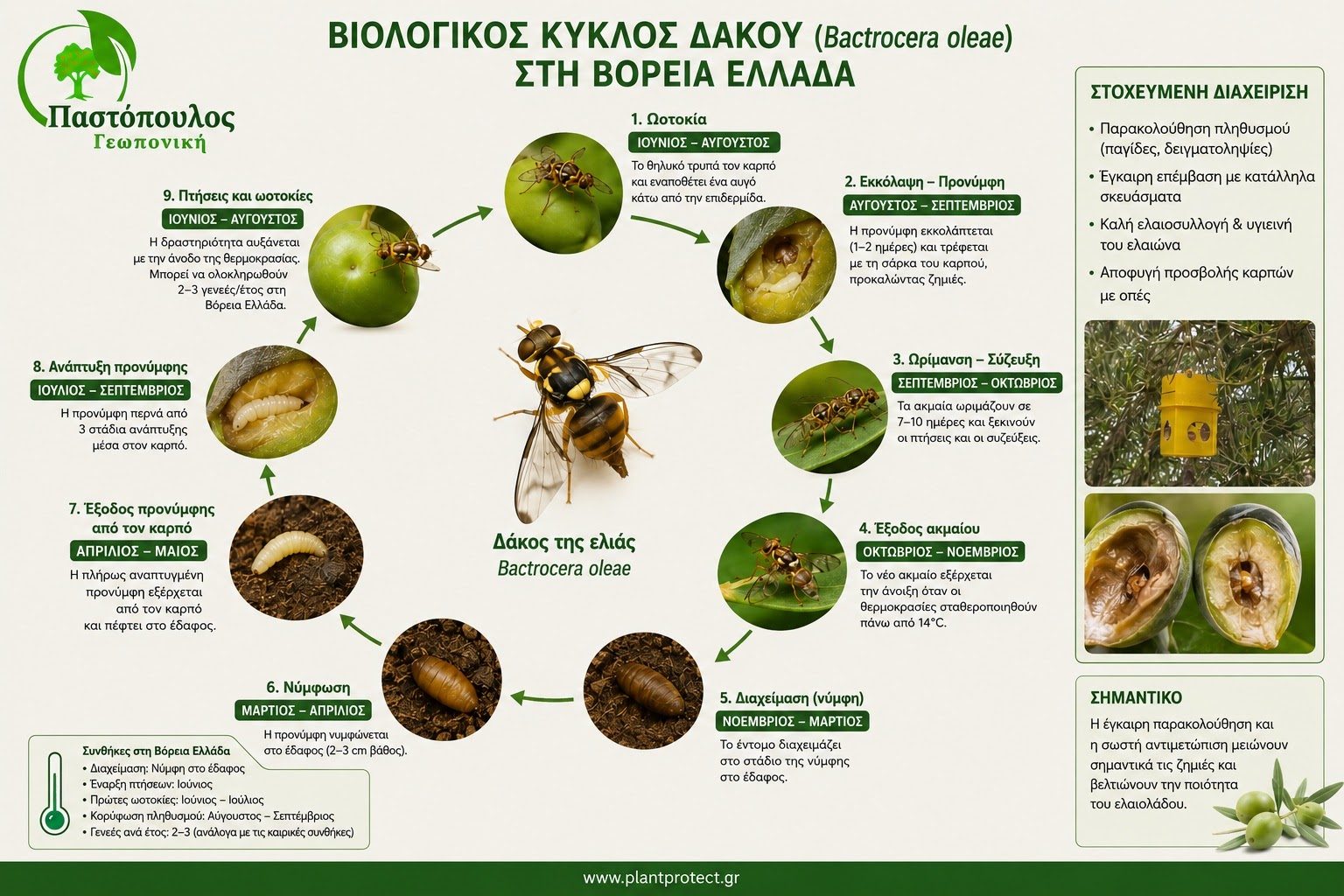
Figure 1. The annual life cycle of the olive fruit fly in northern Greece: egg laying beneath the fruit skin, larval development inside the mesocarp, exit from the fruit and pupation in the soil at a depth of 2 to 3 centimetres, overwintering, and emergence of the adult once temperatures settle above 14 °C. Two to three generations a year are recorded, depending on the weather.
Savvas Pastopoulos, Agronomist MSc, Pastopoulos Agronomics, Neos Mylotopos, Pella, Greece
The olive fruit fly does not take kilos. It takes the grade. An olive grove with 15% infestation yields roughly the same quantity of oil as a clean one, but that oil has already lost the designation «extra virgin», and with it the difference in price. This article explains why that happens, when exactly intervention is required, and why a series of active substances used for decades no longer work in Greece.
This is the counter-intuitive finding of the section, and the most common misunderstanding. Over four months of monitoring in the Chemlal cultivar, with fly infestation rising from 64% to 100% and exit holes from 44% to 92%, acidity stayed within the extra virgin limits in every sample except the last [4].
What broke far earlier was the sensory assessment. Four of the ten samples were downgraded from extra virgin to ordinary virgin, with musty, grubby and winey defects appearing and intensifying [4]. The category is decided by the tasting panel, not by the acidity meter.
- Identity and recognition of the insect
- The life cycle, stage by stage
- The bacterium that makes the fly possible
- Temperature is the real regulator
- The damage, and where exactly the money is lost
- Monitoring, sampling and action thresholds
- Bait sprays
- Mass trapping, kaolin and attract-and-kill
- Biological control and natural enemies
- Resistance, the Greek problem
- The national control programme
- A practical plan for the grove
- Sources
1. Identity and recognition of the insect
The olive fruit fly, Bactrocera oleae (Rossi), belongs to the family Tephritidae of the Diptera, the same family as the Mediterranean fruit fly. It was formerly referred to as Dacus oleae, and that name still appears in older literature. It is a monophagous species: it develops exclusively in fruit of the genus Olea, that is, in cultivated olive and in wild olive.
How the adult is recognised
- Size about 4 to 5 millimetres, that is, smaller than the common house fly.
- Thorax brown, with three greyish longitudinal stripes and two characteristic white or pale-yellow spots at the rear.
- Wings transparent, with a dark spot at the extreme tip. This is the safest field character.
- The female carries an ovipositor, a pointed organ at the tip of the abdomen with which she pierces the fruit. The male has none.
2. The life cycle, stage by stage
| Stage | Characteristics and behaviour |
|---|---|
| Egg | White, elongate, about 0.7 to 0.8 millimetres. Placed beneath the skin of the fruit. One female may lay 200 to 250 eggs over her lifetime, at a rate that depends on temperature and fruit availability. |
| Larva three instars | Legless, white to pale yellow, of typical maggot form. It tunnels within the mesocarp, feeding on the flesh. The third instar is the most destructive and opens the exit hole close to the surface, leaving a thin membrane. |
| Pupa | Barrel-shaped, brown. In summer pupation usually takes place inside the fruit. In autumn and winter the larva leaves the fruit and pupates in the soil, at a depth of a few centimetres. This change of behaviour has a direct practical consequence, as set out below. |
| Adult | Lives from a few weeks to several months in the overwintering generations. It feeds on honeydew, nectar, leaf exudates and micro-organisms, not on the fruit. This detail is the key to bait spraying. |
How many generations a year
The number of generations depends on climate and district. The California integrated pest management manual gives two to four generations, with more under exceptional conditions [8]; the figure refers to Californian conditions and does not transfer unchanged. In Greece the picture differs by zone: in northern Greece two to three generations are recorded, as the cycle in Figure 1 shows, while in coastal and mild districts three to five are reported. Overwintering occurs chiefly as a pupa in the soil, but also as an adult in sheltered positions, and this dual mode of overwintering explains why the population is never reduced to zero.
3. The bacterium that makes the fly possible
This part of its biology explains something every olive grower has observed without knowing the reason: why the fly manages to develop in green, unripe olives, at a time when the fruit is full of bitter, toxic phenolic compounds.
The unripe olive contains high levels of oleuropein, the principal phenolic glycoside of the olive, which acts as a chemical defence and prevents insects from making use of the fruit's proteins. No larva should logically survive in there.
The symbiont «Candidatus Erwinia dacicola»
The olive fruit fly carries a bacterial symbiont, Candidatus Erwinia dacicola. The association had already been observed in 1909, but its identification and significance were clarified only recently [9].
The bacterium lives intracellularly within the blind caeca of the larval midgut, and in the adult it is found extracellularly in the foregut and the ovipositor, from which it passes to the next generation [18]. It multiplies neither in the fruit nor on artificial media.
The critical finding: the symbiont is absolutely necessary for larval development in green, unripe olives. It neutralises the inhibitory action of oleuropein. In ripe, black olives the larva survives without it, but its presence speeds development up [1].
First, it explains why infestation begins early, in unripe fruit, and does not wait for ripening. The margin is smaller than it appears.
Second, it opens a line of control under international investigation: targeting the symbiont rather than the insect. Substances that disrupt the bacterium, among them certain copper formulations applied to the foliage, appear to reduce the success of larval development. This is not established practice with clear dose recommendations, but it is a direction worth following.
4. Temperature is the real regulator
If one thing is understood about population dynamics, let it be this: the olive fruit fly is regulated by temperature more than by any insecticide.
The lower development thresholds
| Stage | Lower thermal threshold |
|---|---|
| Egg | 9.19 °C |
| Larva | 13.94 °C |
| Pupa | 12.36 °C |
Temperature at which the development rate falls to zero, by linear regression across four constant temperatures [7].
How long a generation takes comes from measured development times, not from a calculation. In laboratory rearing at four constant temperatures, the times from egg to adult were as follows [7]:
| Constant temperature | Egg | Larva | Pupa | Total, egg to adult |
|---|---|---|---|---|
| 16 °C | 11.4 | 33.4 | 28.4 | 73 days |
| 22 °C | 4.3 | 14.1 | 12.7 | 31 days |
| 27 °C | 2.7 | 10.9 | 8.3 | 22 days |
| 35 °C | 2.1 | 5.1 | none | no adults |
Days per stage, means of five replicates [7]. Survival was also highest at 27 °C, with 74 adults per 100 eggs. At 35 °C no individual pupated and no adult emerged, even though egg and larva developed faster than at any other temperature.
The values derive from constant laboratory temperatures. In the field, daily fluctuation modifies them, and the autumn pupa moves into the soil, where the thermal environment differs from that of the canopy.
Two different things are often confused here, and they need to be separated.
Sustained heat. Under continuous exposure at 35 °C development stalls: egg and larva run faster than ever, but no pupa completes and no adult emerges [7]. This is the real brake of summer.
Short peaks. Under two-hour exposure the picture is entirely different. Larvae and adults survive in high proportions up to 38 °C, and the pupa is the most tolerant stage, up to 40 °C. The critical limit for the adult is 39 °C, while at 39.5 and 40 °C mortality reaches 100% [6].
Two further findings from the same work matter in practice. Females that survived exposure at 38 °C laid significantly fewer eggs: heat cuts oviposition before it kills. And acclimation counts: one to three days at 33 °C significantly raised survival under the following heat stress [6]. A summer that warms gradually leaves behind a more tolerant population than a summer with an abrupt heatwave.
It is not a rule. The summer gap depends on altitude, distance from the sea and canopy shading. In coastal, cool and irrigated groves it may not appear at all. In a three-year survey of twelve groves on Samos across altitude zones, the highest catches were recorded in August and September, not June and July, and in the hotter months catches shifted towards higher altitudes [13].
5. The damage, and where exactly the money is lost
Direct damage
- Loss of flesh. The larva consumes part of the mesocarp. In table cultivars this alone makes the fruit unmarketable.
- Premature fruit drop. Infested fruit falls before harvest, particularly in the last generation.
- An entry point. The exit hole opens the way to secondary rots and fungi, chiefly olive anthracnose, which degrades the oil further.
Indirect damage, the part that is not visible
This is the most important and the least understood. Infestation accelerates hydrolytic and oxidative rancidity, that is, the two processes that spoil the oil.
| Sample and date | Infestation | Acidity | Peroxides | Sensory category |
|---|---|---|---|---|
| Healthy fruit, 11 Nov | 0% | 0.2 | 6 | Extra virgin |
| As it comes from the field, 11 Nov | 64% | 0.3 | 11 | Extra virgin |
| As it comes from the field, 30 Nov | 68% | 0.3 | 16 | Extra virgin |
| Infested fruit only, 30 Nov | 68% | 0.4 | 19 | Ordinary virgin, downgraded |
| Infested fruit only, 20 Dec | 84% | 0.5 | 20 | Ordinary virgin, downgraded |
| Black fruit, 16 Jan | 100% | 1.1 | 22 | Ordinary virgin, downgraded |
Chemlal cultivar, four harvest dates from November to January [4]. Acidity is expressed as oleic acid and peroxides as meq O2 per kg. The extra virgin limits are 0.80 for acidity and 20 for peroxides [14]: only the last sample, that of 16 January, exceeded them.
Acidity values from experimental infestation data [4]; the classification limits, that is, 0.8 for extra virgin and 2.0 for virgin, from Reg. (EEC) 2568/91 [14].
From 10% to 15% infestation the acidity rises by 150%, and from 10% to 100% by 467%. It is not the percentage that counts, however, but the threshold that is crossed: somewhere between 10% and 15% the oil changes category.
The quantity stays almost the same. The price per kilo does not. That is the real damage done by the olive fruit fly, and the reason the action threshold is set at 5% and not at 15%.
The polyphenols, the silent loss
Less well known, equally serious. In the same samples, total phenols fell from 396 mg/kg in the healthy fruit of the first harvest to 17 mg/kg in the fully infested, over-ripe oil of January, a loss of 96% [4].
That figure combines two causes, infestation and over-ripeness, and so must be read alongside the comparison at matched ripeness: at the 20 December harvest, healthy fruit gave 260 mg/kg and infested fruit 149 mg/kg, so infestation alone cost 43% [4]. Early harvesting is the measure that limits both causes at once.
Polyphenols are not a decorative element. They determine the oxidative stability of the oil, hence its shelf life, and they are the basis of the approved health claim for polyphenol-rich olive oils. Infestation strikes specifically at the O-diphenolic compounds, which are also the most active antioxidants, through hydrolytic and above all oxidative processes that start at the exit hole [4].
The same shows in an independent study on Slovenian cultivars: oil from fruit with completed infestation and exit holes had 377 mg/kg total biophenols, against 755 mg/kg in oil from fruit with active infestation only, that is, stings without a completed cycle [5]. It is the exit hole, not the sting, that costs the quality.
In sensory assessment, infestation produces the defect described internationally as «grubby». An untrained taster does not catch it; the panel that classifies the oil does.
6. Monitoring, sampling and action thresholds
The traps, what they say and what they do not
| Trap type | Function and limitations |
|---|---|
| McPhail trap with a food attractant | An aqueous solution with protein hydrolysate or ammonium phosphate. It catches both sexes, so it gives a picture of the total population and allows examination of female ovaries. It is the trap used by the national control programme [15]. |
| Yellow chromotropic with pheromone | A sticky panel with the sex pheromone. It catches mainly males. Easier to use, but it does not indicate whether the females are mature for egg laying, which is the critical information. |
Fruit sampling, how it is done correctly
One hundred fruit are collected per homogeneous zone of the grove, from different trees and from all four points of the compass, at mid-canopy height. Examination is carried out with a hand lens, distinguishing two things:
- Active infestation: eggs, live first-, second- and third-instar larvae, pupae and exit holes. This is what counts for the decision.
- Dead infestation: unhatched eggs, sterile stings, corked tunnels and dead larvae. This shows what happened in the past and what worked, it does not justify a new intervention.
- Oil cultivars: 5% active infestation [15].
- Table cultivars: 2% active infestation. The stricter threshold is justified because in table olives every infested fruit is a reject, whereas in oil olives it is the total that counts. The oil/table distinction is established practice, but was not found in an official text in this form; the official programme gives staged thresholds, as set out below.
- The threshold applies only when the fruit is receptive, that is, once it has passed pit hardening.
The Greek collective control programme does not work from a single threshold but from staged ones, per spray. Catches are counted per trap per five-day period, not per day [15].
| Spray | Catches per trap per five days | Fertile females | Fertile infestation |
|---|---|---|---|
| 1st | over 1 | over 5% | at the start of pit hardening |
| 2nd | over 3 | over 5% | over 2% |
| 3rd | over 5 | over 7% | over 5% |
| 4th | over 15 | over 8% | over 9% |
Sampling uses 100 randomly collected fruit, and the bait spray is applied at a temperature below 30 °C, relative humidity above 30%, wind below force 4 and with no rain expected [15].
7. Bait sprays
These are the basis of modern control and rest on a simple biological truth noted earlier: the adult does not eat the fruit, it eats sugars and proteins. There is therefore no need to cover the fruit, what is needed is to offer food that contains the insecticide.
Why the bait spray beats the cover spray
- Only part of the canopy is sprayed, typically a patch of one square metre on the south or south-west side, and one tree in two or in four.
- The volume of spray liquid and of active substance per hectare is a fraction of that of a cover spray.
- It kills the adult before egg laying, that is, it prevents the damage instead of chasing it.
- It has a smaller impact on beneficial fauna than a cover spray, since it does not cover the whole canopy. Smaller does not mean none, and section 9 sets out what was actually measured [19].
Practical parameters
- Timing: the bait spray is preventive. It begins on the basis of catches and fruit receptivity, before the threshold is crossed, not after infestation has been confirmed.
- Time of application: morning or late afternoon, never in a heatwave, so that the bait does not dry immediately and remains attractive.
- Repetition: every seven to ten days, and without fail after rain that washes the bait off.
- Uniformity across the district: the fly moves. An isolated grove in an area that does not spray is continually reinfested. Coordination with neighbours reduces reinfestation more than an extra application does.
Dimethoate, for decades the principal active substance against the olive fruit fly, was not renewed in the European Union. The decision rested on an EFSA opinion, according to which a genotoxic risk could not be excluded for dimethoate and its main metabolite, omethoate [10]. Phosmet is likewise not approved in the EU [10].
Active substances used internationally against the fly today include spinosad, deltamethrin, lambda-cyhalothrin, alpha-cypermethrin and acetamiprid. It should be noted that EFSA is reviewing the pyrethroids, particularly lambda-cyhalothrin and deltamethrin, because of effects on aquatic organisms and pollinators [10].
The approval situation changes. Before any purchase, the database of approved plant protection products of the Greek Ministry of Rural Development and Food [17] should be checked for the current approval in olive, the rate and the pre-harvest interval. Those approvals are valid in Greece only. What appears in foreign literature does not mean it is permitted in any given country.
8. Mass trapping, kaolin and attract-and-kill
Mass trapping
Traps are placed at high density, typically one per tree or per two trees, with a combination of food attractant and pheromone, so that a large part of the population is caught before egg laying. It is widely applied in organic olive growing. Its selectivity, however, is limited, as set out below.
- It works under low to moderate population pressure and over large, continuous areas.
- It fails under high pressure and in small, isolated blocks, where continual immigration from neighbouring groves exceeds the trapping capacity.
- It requires early placement, before egg laying begins, and replacement of the attractants at the intervals the product specifies.
Kaolin, and an important correction
Processed kaolin creates a white mineral film that makes the fruit unrecognisable or unattractive for egg laying. It is used in organic growing and is widely regarded as a «gentle» measure.
Kaolin. In a three-year trial in a Spanish olive grove, principal response curve analysis showed a significant deleterious effect on the natural enemy community, with reduced abundance and diversity. The groups affected were coccinellids, mirids, Orius species and the families Philodromidae, Scelionidae, Pteromalidae, Chrysopidae and Aphelinidae [11]. There is a contrary finding as well: in an organic grove, neither kaolin nor spinosad showed a particular deleterious effect on the olive fruit fly's parasitoids [20]. The two studies do not measure the same thing: the first the whole arthropod community, the second the parasitoids alone.
Bait sprays. In a three-year trial by the same group, spinosad bait did not reduce the abundance and diversity of arthropods as a whole. It did, however, show a significant deleterious effect specifically on natural enemies in the third year, and the most affected taxa were Anthocoridae, especially Orius, and Aphelinidae [19].
Mass trapping. It is not selective. In OLIPE-type traps, non-target catches included 2.6% hymenopteran parasitoids, 1.0% spiders and 0.4% lacewings, while an independent survey found 66 species of tachinids inside mass-trapping traps [21].
The conclusion is not that one method is bad and another good. It is that none of the three is neutral, and that all three hit the same group, the Orius bugs and the hymenopteran parasitoids. Kaolin should not be chosen on the reasoning that «it is only clay», nor bait on the reasoning that «it only catches the fly».
Attract-and-kill
Devices that combine an attractant with a surface impregnated with insecticide. In a three-year assessment in olive groves on Lake Garda, at the northernmost boundary of olive cultivation in Europe, both attract-and-kill and mass trapping reduced infestation, but were insufficient to hold it at acceptable levels in years of low fruit set, when control measures are not economically justified [16]. Sampling there was carried out every fifteen days from pit hardening to harvest, with about 338 fruit from 30 trees per plot.
9. Biological control and natural enemies
In the Mediterranean the olive fruit fly has a poor complex of natural enemies compared with its region of origin, thought to be sub-Saharan Africa. This explains why biological control, despite long research, has not produced a stand-alone solution.
| Organism | Role and limitations |
|---|---|
| Psyttalia concolor | The most studied parasitoid. It is mass-reared and has been released in combination with mass trapping [11]. It parasitises larvae. |
| Psyttalia lounsburyi | Specialised on the olive fruit fly: in the trials it was the only parasitoid that probed solely into infested olives. Introduced into California, it produced fewer offspring than the related P. humilis, while survival of both fell sharply at the high summer temperatures of the inland valleys and parasitism was lower in large-fruited cultivars [22]. |
| Native parasitoids Eupelmus urozonus, Pnigalio, Eurytoma martellii | Present in Greek olive groves, with parasitism rates that are usually low and highly variable. They do not hold the population below economic thresholds. |
| Predators and ants | They prey on pupae in the soil. Their contribution increases where cover sprays are not applied and where ground cover is maintained in the alleys. |
- Bait sprays are preferable to cover sprays, because only a minimal part of the canopy is treated. They are not harmless, however: in a three-year trial they showed a significant deleterious effect on natural enemies in the third year, mainly on Orius and Aphelinidae [19].
- Maintain natural vegetation in the alleys as refuge and as a source of nectar.
- The beneficials should not be expected to solve the problem. In the Mediterranean they act as a supplementary, not a principal, mechanism.
10. Resistance, the Greek problem
This chapter bears directly on every Greek olive grower, and the data come from Greek studies on Greek populations.
Resistance to organophosphates
The target of the organophosphates is the enzyme acetylcholinesterase. Mutations in the corresponding gene have been identified in the olive fruit fly that confer insensitivity to the insecticide. The mutations G488S and I214V remain at very high frequency in most Greek populations, despite the reduction in organophosphate use over the past decade [2].
In measurements of resistance to dimethoate, the resistance ratios ranged from 6.3 to 64.4, with the highest values in the populations of Crete and the lowest in Cyprus [3].
Resistance to pyrethroids
Up to 2012, low to moderate levels of resistance to alpha-cypermethrin were recorded. After 2013 an increase was observed, particularly in the populations of Crete, with resistance reaching up to 55-fold in field populations from southern Greece and Crete [2]. This resistance is associated with increased cytochrome P450 activity, that is, with enhanced metabolic detoxification [2].
It means that to achieve the same mortality that the standard rate once achieved, sixty-four times the quantity would be required. That is a rate which is illegal, economically impossible and environmentally unacceptable all at once.
Consequently, the active substance has stopped working, whatever the label promises. Where spraying produces no result, the most likely explanation is not a mistake in the rate.
First recommendation: rotate modes of action, not trade names. Two products with different names and the same mode of action are the same insecticide as far as the insect is concerned.
11. The national control programme
In Greece, control of the olive fruit fly is not exclusively an individual matter. A collective control programme operates, organised by Region and implemented at the level of municipal and local communities.
- Monitoring through a network of McPhail traps in the groves [15].
- The decision to intervene is taken on the basis of catches, the developmental stage of the fruit and prevailing and expected weather [15].
- Implementation by ground-applied bait sprays.
- Modernisation with electronic traps, GPS systems on the sprayers and automated monitoring of the applications [15].
In practice this means that the timing of the state sprays may not coincide with the needs of an individual block, particularly in an early cultivar or an irrigated, cool grove. Sampling by the grower remains essential.
Sources: 15
12. A practical plan for the grove
| Period | What is done |
|---|---|
| Winter | No control is carried out; preparation is. A record is made of what worked last year and what did not. Rotation of modes of action is planned. Neighbours are consulted. |
| Spring | Monitoring traps are placed. Catches are recorded weekly in a notebook or on a phone. Without a series of counts there is no decision. |
| Pit hardening | The starting point. From here the fruit becomes receptive. Sampling of 100 fruit per zone begins. |
| Summer | Monitoring. The summer gap is no reason for complacency, in cool and irrigated groves it may not occur. |
| Late summer and autumn | The critical period. Temperatures fall into the optimum, the fruit grows, the generations overlap. Sampling every seven days, bait sprays on the basis of the threshold. |
| Before harvest | Check the pre-harvest intervals. Where infestation is running, early harvest is a tool: it stops the progression and forestalls the rise in acidity. |
| Harvest | Milling within 24 hours. Infested fruit deteriorates rapidly in the sack. Fallen fruit is not harvested together with sound fruit. |
- Measure, do not guess. One hundred fruit, a hand lens, active infestation.
- Intervene at the threshold, not when the damage is visible. The category is lost on the tasting panel long before acidity shows it.
- Bait sprays, not cover sprays. Less active substance and a better target. They are not harmless to beneficials either.
- Rotate modes of action. Resistance in Greece is already a fact, not a forecast.
- Coordinate with neighbours. The olive fruit fly does not respect block boundaries.
13. Sources
The numbers in the text refer to the list below.
- [1] Ben-Yosef, M., Pasternak, Z., Jurkevitch, E. and Yuval, B. (2015). Symbiotic bacteria enable olive fly larvae to overcome host defences. Royal Society Open Science 2(7):150170. Source for the symbiont being indispensable for larval development in unripe olives, whereas in ripe olives it merely accelerates development. Full text, open access. The paper says "unripe" and "ripe", not "green" and "black": no aposymbiotic larva reached pupation in unripe fruit, while in ripe fruit development was merely about two days slower and the pupae 12% lighter.
- [2] Kampouraki, A. et al. (2018). Recent evolution and operational impact of insecticide resistance in olive fruit fly Bactrocera oleae populations from Greece. Journal of Pest Science 91(4):1429-1439. Source for the high frequency of the G488S and I214V mutations despite reduced organophosphate use, for the rise in alpha-cypermethrin resistance after 2013, and for the involvement of cytochrome P450. Abstract used. The 55-fold figure could not be verified against the full text, which the publisher does not make freely available; the companion paper by the same group (Pavlidi et al., 2018) reports a twenty-fold loss of efficacy in Cretan populations and over-expression of CYP6 P450s.
- [3] Skouras, P. J., Margaritopoulos, J. T., Seraphides, N. A., Ioannides, I. M., Kakani, E. G., Mathiopoulos, K. D. and Tsitsipis, J. A. (2007). Organophosphate resistance in olive fruit fly, Bactrocera oleae, populations in Greece and Cyprus. Pest Management Science 63(1):42-48. Source for the dimethoate resistance ratios of 6.3 to 64.4, with ED50 values of 12.5 to 128.7 ng per insect, and for the highest values being recorded in Crete and the lowest in Cyprus. Note:Vontas is not an author; 2006 is the electronic pre-publication.
- [4] Tamendjari, A., Angerosa, F., Mettouchi, S. and Bellal, M. M. (2009). The effect of fly attack (Bactrocera oleae) on the quality and phenolic content of Chemlal olive oil. Grasas y Aceites 60(5):507-513. Source for the table of acidity, peroxides and sensory classification by harvest date, for fly infestation rising from 64% to 100% with exit holes from 44% to 92%, for the fall in total phenols from 396 to 17 mg/kg and the comparison of 260 against 149 mg/kg at matched ripeness, and for the selective destruction of the O-diphenolic compounds. Full text. The study compared healthy, unselected and infested fruit at four ripening stages, not graded infestation levels.
- [5] Valenčič, V., Butinar, B., Podgornik, M. and Bučar-Miklavčič, M. (2021). The effect of olive fruit fly Bactrocera oleae (Rossi) infestation on certain chemical parameters of produced olive oils. Molecules 26(1):95. Source for the distinction between active and damaging infestation, and for the 755 against 377 mg/kg total biophenols in the Istrska belica cultivar. Full text, open access. Note:Neither exists in the paper, which does not work with infestation percentages and did not measure volatile compounds at all.
- [6] Pappas, M. L., Broufas, G. D., Koufali, N., Pieri, P. and Koveos, D. S. (2011). Effect of heat stress on survival and reproduction of the olive fruit fly Bactrocera (Dacus) oleae. Journal of Applied Entomology 135(5):359-366. Source for the results of two-hour exposure to high temperatures: high survival of larvae and adults up to 38 °C, greater heat tolerance of the pupa up to 40 °C, a critical limit for the adult at 39 °C with 100% mortality at 39.5 and 40 °C, significantly reduced oviposition after exposure at 38 °C, and increased survival after acclimation for one to three days at 33 °C. Full text. Note:The paper shows the opposite: the pupa is the most tolerant stage under brief heat stress. The 35 °C claim holds only for continuous exposure and is now attributed to source [7].
- [7] Genç, H. and Nation, J. L. (2008). Survival and development of Bactrocera oleae Gmelin (Diptera: Tephritidae) immature stages at four temperatures in the laboratory. African Journal of Biotechnology 7(14):2495-2500. Source for the lower thermal thresholds of 9.19 °C for the egg, 13.94 °C for the larva and 12.36 °C for the pupa, for the measured development times at 16, 22, 27 and 35 °C, for 74 adults per 100 eggs at 27 °C, and for no pupation being completed and no adult emerging at 35 °C. Full text. Note:The first four values belong to a different species, Neoceratitis cyanescens, after Brévault and Quilici (2000), and the paper quotes them only for comparison. The thermal constant of 432.6 degree-days does not appear in the paper, which does not calculate degree-days.
- [8] University of California IPM, Pest Management Guidelines: Olive, Olive Fruit Fly, and the home and landscape page. Source for the morphology of the stages and the general biology, and for "at least three, possibly four" generations per year in California, with continuous development in coastal areas. The number of generations refers to California and does not transfer unchanged to Greece. Full text.
- [9] Blow, F., Gioti, A., Starns, D., Ben-Yosef, M., Pasternak, Z., Jurkevitch, E., Vontas, J. and Darby, A. C. (2016). Draft genome sequence of the Bactrocera oleae symbiont "Candidatus Erwinia dacicola". Genome Announcements 4(5):e00896-16. Source for the identification of the symbiont through a 2.1 Mb draft genome, and for the first observation of the symbiosis in 1909 by Petri. Full text, open access. Note:The paper gives neither a number of caeca nor any claim of exclusivity; the localisation is now attributed to source [18].
- [10] Commission Implementing Regulation (EU) 2019/1090 of 26 June 2019 concerning the non-renewal of approval of the active substance dimethoate; Commission Implementing Regulation (EU) 2022/94 of 24 January 2022 concerning the non-renewal of approval of phosmet; and EFSA (2018), Peer review of the pesticide risk assessment of the active substance dimethoate, EFSA Journal 16(10):5454. Source for the non-renewal of dimethoate with withdrawal of authorisations by 17 January 2020 and expiry of the grace period by 17 July 2020 for crops other than cherries, for the non-renewal of phosmet with withdrawal by 1 May 2022 and expiry of grace by 1 November 2022, and for the genotoxicity of omethoate, which the majority of experts concluded to be an in vivo mutagen. Full texts. Both substances remain unapproved as of September 2026. For the pyrethroids there is no restriction but an administrative extension of the approval periods: deltamethrin to 30 June 2028 and lambda-cyhalothrin to 31 January 2029, under Commission Implementing Regulation (EU) 2026/1421.
- [11] Pascual, S., Cobos, G., Seris, E. and González-Núñez, M. (2010). Effects of processed kaolin on pests and non-target arthropods in a Spanish olive grove. Journal of Pest Science 83(2):121-133. Source for the significant deleterious effect of Surround WP kaolin on the natural enemy community, with reduced abundance and diversity, and for the list of groups affected: coccinellids, mirids, Orius species, Philodromidae, Scelionidae, Pteromalidae, Chrysopidae and Aphelinidae. Note:The trial, run for three years at Villarejo de Salvanés, Spain, from 2005 to 2007, compared kaolin against an untreated control only: it had no bait spray or mass trapping arm whatsoever.
- [12] Daane, K. M. and Johnson, M. W. (2010). Olive fruit fly: managing an ancient pest in modern times. Annual Review of Entomology 55:151-169. Source for the Psyttalia parasitoids and for the general biology and biological control. Abstract used. The explicit comparison of P. lounsburyi and P. humilis is now attributed to source [22].
- [13] Katsikogiannis, G., Kavroudakis, D., Tscheulin, T. and Kizos, T. (2023). Population dynamics of the olive fly, Bactrocera oleae (Diptera: Tephritidae), are influenced by different climates, seasons, and pest management. Sustainability 15(19):14466. Department of Geography, University of the Aegean. Source for the effect of altitude and microclimate on population dynamics, for the highest catches in August and September, and for the shift of catches towards higher altitudes in the hotter months. Full text, open access. Note:Neither appears in the paper, which covers twelve plots on Samos only and where the hottest month reaches 32.5 °C. The "different climates" of the title are microclimates of altitude zones, not different countries.
- [14] Commission Delegated Regulation (EU) 2022/2104 of 29 July 2022 supplementing Regulation (EU) No 1308/2013 as regards marketing standards for olive oil, Annex I; together with Regulation (EU) No 1308/2013, Annex VII, Part VIII and Commission Implementing Regulation (EU) 2022/2105 on conformity checks. Source for the classification limits: free acidity up to 0.80% as oleic acid for extra virgin and up to 2.0% for virgin olive oil, and a peroxide value up to 20 meq O2 per kg for extra virgin. Full texts. Note:
- [15] Programme for the Collective Control of the Olive Fruit Fly, Greek Ministry of Rural Development and Food and the Regions, and the ministry-hosted document V. Bournakas, "Integrated control of the olive fruit fly by the preventive method of bait sprays" (in Greek). Source for the organisation of the programme and the use of McPhail traps, for the staged thresholds per spray (over 1, 3, 5 and 15 flies per trap per five-day period, with fertile females over 5, 5, 7 and 8% and fertile infestation over 2, 5 and 9%), for the 100-fruit sampling, and for the application conditions: temperature below 30 °C, relative humidity above 30%, wind below force 4 and no rain expected. Electronic traps and GPS relate to pilot applications, not established practice.
- [16] Ortis, G., Santoiemma, G., Marangoni, F., Sanna, F., Fidanza, M. R., Baldessari, M. and Mori, N. (2025). Efficacy of attract-and-kill techniques in controlling Bactrocera oleae (Diptera: Tephritidae) in a highly variable olive production scenario. Insects 16(11):1161. Source for the fruit sampling methodology, that is, about 338 fruit from 30 trees per plot every fifteen days from pit hardening to harvest, and for attract-and-kill and mass trapping being insufficient in years of low fruit set. Full text, open access. These are Italian data from Lake Garda, at the northernmost boundary of olive cultivation in Europe. Note:Neither appears in the paper, which in fact sums active and dead infestation into a single measure. The thresholds are now attributed to source [15].
- [17] Greek Ministry of Rural Development and Food, Directorate of Plant Production Protection, database of approved plant protection products, with the ministry catalogue page as the portal. Accessed September 2026. The only authoritative source for what is permitted in olive in Greece today, at what rate and with what pre-harvest interval.Approvals are valid in Greece only.
- [18] Estes, A. M., Hearn, D. J., Bronstein, J. L. and Pierson, E. A. (2009). The olive fly endosymbiont, "Candidatus Erwinia dacicola", switches from an intracellular existence to an extracellular existence during host insect development. Applied and Environmental Microbiology 75(22):7583-7594. Source for the symbiont living intracellularly within the blind caeca of the larval midgut and extracellularly in the foregut and ovipositor of the adult. Full text.
- [19] Pascual, S., Cobos, G., Seris, E., Sánchez-Ramos, I. and González-Núñez, M. (2014). Spinosad bait sprays against the olive fruit fly (Bactrocera oleae (Rossi)): effect on the canopy non-target arthropod fauna. International Journal of Pest Management 60(4):258-268. Source for spinosad bait sprays not reducing the abundance and diversity of arthropods as a whole, but showing a significant deleterious effect on natural enemies in the third year, with Anthocoridae, especially Orius, and Aphelinidae as the most affected groups. Full text.
- [20] Vizzarri, V., Lombardo, L., Novellis, C., Rizzo, P., Pellegrino, M., Cruceli, G., Godino, G., Zaffina, F. and Ienco, A. (2023). Testing the single and combined effect of kaolin and spinosad against Bactrocera oleae and its natural antagonist insects in an organic olive grove. Life 13(3):607. Source for the contrary finding that neither kaolin nor spinosad showed a particular deleterious effect on the natural parasitoids of the olive fruit fly. Full text, open access.
- [21] Incidence of the OLIPE mass-trapping on olive non-target arthropods and Tachinidae (Diptera) collected in traps used for mass-trapping of Bactrocera oleae in olive groves in Central Spain. Spanish Journal of Agricultural Research. Source for the composition of non-target catches in OLIPE traps, with 2.6% hymenopteran parasitoids, 1.0% spiders and 0.4% lacewings, and for the 66 species of tachinids caught in mass-trapping traps, with an explicit conclusion on the poor selectivity of the method. Full texts, open access.
- [22] Wang, X.-G., Johnson, M. W., Yokoyama, V. Y., Pickett, C. H. and Daane, K. M. (2011). Comparative evaluation of two olive fruit fly parasitoids under varying abiotic conditions. BioControl 56(3):283-293. Source for the comparison of P. lounsburyi and P. humilis: the latter produced more offspring, survival of both fell sharply at the high summer temperatures of the inland valleys, and parasitism was lower in large-fruited cultivars. Abstract used.
This text is informational and educational and does not replace an on-site agronomic assessment, nor is it a prescription for the application of plant protection products.
No trade names are given. Approvals of active substances, rates and pre-harvest intervals change and differ between countries and crops. As documented in the article, active substances used for decades are no longer approved. The choice is made solely on the basis of the approvals in force from the Greek Ministry of Rural Development and Food (ΥΠΑΑΤ), and the label instructions always prevail. Those approvals are valid in Greece only and do not apply in other countries; readers elsewhere must follow their own national register.
For any foliar spray: application to trees carrying fruit may cause fruit marking and leaf scorch. A trial on a limited number of trees is required first, with the same product and the same rate, followed by 5 to 7 days of observation before any general application. Spraying is done in late afternoon or early morning, never in a heatwave and never on foliage under water stress.
Any intervention is made at the user's own responsibility, following an on-site assessment by a licensed agronomist. Pastopoulos Agronomics accepts no liability for damage or loss of production arising from the application of the above information without individual technical guidance.
Related articles
Olive dormancy
The olive keeps its leaves all winter, and that changes what the word dormancy means. What stops shoot growth in the autumn, what chilling does to the buds that will flower…
The white Mediterranean snail in tree crops
Theba pisana is native to the Mediterranean, not invasive, so there is no eradication programme to wait for. Identification, life cycle, the damage in tree crops, the single approved target in the Greek register, and why the nematode Phasmarhabditis killed the snail only at five times the label rate.

Boron in olive: foliar and soil application, rates and the toxicity threshold
The nutrient with the narrowest safety margin: 35 ppm separate sufficiency from toxicity. How boron moves inside the olive through mannitol, what the July leaf analysis shows, foliar and soil rates worked out per hectare, the trials that found no benefit, and a tool that separates deficiency from toxicity.