
Root-knot nematodes in kiwifruit
Savvas Pastopoulos, Agronomist, Pastopoulos Agronomics
Nematodes are the enemy that is never seen. They work under the soil, the symptoms they produce above it resemble fifteen other things, and by the time they are recognised the root system has already taken years of damage. This article sets out which species actually matter in kiwifruit, how to tell them apart from vine decline, and why soil temperature decides whether the nematicide that was paid for will work or be wasted.
Approvals for plant protection products cited here are those of the Greek Ministry of Rural Development and Food and are valid in Greece only. In any other country the corresponding national register applies. Rates are given per hectare; the Greek edition of this article uses stremmata, where 1 ha = 10 stremmata.
In Greece, for nematodes in kiwifruit, there is one and only one conventional nematicide, fosthiazate, and four biological products [18]. The active substances that dominate the international literature, such as fluopyram and oxamyl, are not approved here for this crop.
And for both of the tools that remain, soil temperature is decisive: fosthiazate breaks down faster in warm and alkaline soil [21], while the fungus in the biological product does not survive above 36 °C [22]. Meanwhile the species that dominates in kiwifruit, Meloidogyne hapla, is already active from 8.8 °C [6].
- Which species actually matter in kiwifruit
- The symptoms, and why they mislead
- Nematodes or vine decline? The differential diagnosis
- Soil temperature as the regulator
- Sampling, when, where, how deep
- What the laboratory numbers mean
- What is approved in Greece, and how temperature plays in
- Soil fumigants
- Solarisation, biofumigation and organic matter
- Biological control, fungi, bacteria and plants
- A new planting, where everything is decided
- A practical plan
- Sources
1. Which species actually matter in kiwifruit
Hundreds of nematode species live in the soil of any orchard, and the vast majority are harmless or even beneficial, feeding on bacteria and fungi. Only the plant-parasitic ones matter, those carrying a mouth stylet that punctures root cells.
| Genus | What it does in kiwifruit |
|---|---|
| Meloidogyne root-knot nematodes | The main problem. The female establishes permanently inside the root and induces the formation of galls, that is, swellings. In kiwifruit the most important species are M. hapla and M. incognita [1] [12]. |
| Pratylenchus lesion nematodes | They migrate within the root cortex and leave elongated brown necroses. They produce no galls, which is why they easily escape a cursory inspection. |
| Xiphinema dagger nematodes | They feed from the root surface. Their significance is mainly as virus vectors in other crops. |
| Helicotylenchus, Paratylenchus, Paratrichodorus | Frequently found in the soil around kiwifruit, with less demonstrated damage [1]. Their presence is not in itself a reason to intervene. |
What the Mediterranean data show
In an extensive survey of kiwifruit orchards in Portugal, Meloidogyne hapla dominates in the main production zones and occasionally co-occurs with M. arenaria and M. hispanica [1] [2].
In Türkiye, in kiwifruit orchards of Samsun and Ordu, M. incognita and more recently M. ethiopica were recorded [12] [13]. In China a new species was described, M. aberrans, exclusively from kiwifruit [14].
Why species identification matters: M. hapla is a species of cool and temperate regions, while M. incognita and M. javanica are thermophilic. As section 4 shows, that difference changes the timing of interventions completely.
Consequently, the male is not always the tough one. When roots are examined or a sample is sent, the female vines should not be the only ones checked. A male with a damaged root system gives less and poorer pollen, and fruit set falls across the whole row.
2. The symptoms, and why they mislead
Above ground
- Stunting in patches, not across the whole block. This is the most characteristic feature. Nematodes are distributed in clusters, so what appears is islands of weak vines among normal ones.
- Small, chlorotic leaves and reduced annual growth.
- Wilting in the hot hours, recovering at night, even with adequate soil moisture. The root cannot take up water fast enough.
- Smaller fruit and a gradual fall in yield.
- Unexplained deficiencies despite correct fertilisation, particularly of nitrogen, potassium and micronutrients.
Below ground, what to look for

Figure 1. Root-knot nematode galls on fine kiwifruit roots. The pale swellings are enlargements of the root tissue itself and do not rub off, which is how they are distinguished from the nodules of legumes. Also visible is the proliferation of short, deformed rootlets around each knot.
| Finding on the root | What it means |
|---|---|
| Galls swellings on the fine roots | Characteristic of Meloidogyne. They do not rub off, they are a swelling of the tissue itself, not an external body. That is how they are distinguished from legume nodules. |
| Elongated brown necroses | Indicative of Pratylenchus, but also of oomycetes. A laboratory is needed. |
| Poor, short root system without fine absorbing roots | A general sign of below-ground stress. Not diagnostic on its own. |
3. Nematodes or vine decline? The differential diagnosis
This is the most important section for the region, because the two problems give almost the same picture from above and are handled entirely differently.
The kiwifruit vine decline syndrome, known as moria del kiwi or KVDS, is multifactorial and is attributed mainly to oomycetes of the genus Phytopythium. In a survey of Italian kiwifruit orchards 71 isolates were obtained, dominated by P. vexans and followed by P. litorale, P. chamaehyphon and P. helicoides [9] [10].
The main predisposing factors are waterlogging, soil compaction and high soil temperatures, which leave the root vulnerable to colonisation. Waterlogging acts twice over: it stresses the plant with temporary asphyxiation and at the same time favours the release of the infective zoospores of the oomycetes [11].
| Criterion | How they differ |
|---|---|
| Distribution in the block | Nematodes: patches that expand slowly, year by year, following the planting row or the machinery. Vine decline: follows the low, poorly drained spots and often appears after a period of excess water. |
| Speed | Nematodes: slow, progressive weakening over years. Vine decline: a vine can collapse within a single season. |
| Appearance of the root | Nematodes: galls or elongated necroses, with the rest of the root system alive. Vine decline: bark shedding and rotting of the roots, a characteristic smell, loss of the entire absorbing system. |
| Relationship with water | Nematodes: damage is worse under drought, because the truncated root cannot keep up. Vine decline: damage is worse under excess water. |
Vine decline syndrome is covered separately: Kiwifruit vine decline syndrome [19], in Greek. For soil drainage and infiltration, which are the common denominator, see the hydrological study for a kiwifruit planting [20], in Greek.
4. Soil temperature as the regulator
The nematode is a poikilothermic organism. It has no temperature of its own, it has the temperature of the soil. Every species has a lower thermal threshold, below which it simply does not develop.
| Species and stage | Lower thermal threshold |
|---|---|
| M. hapla, embryogenesis | 6.74 °C |
| M. hapla, juvenile development | 8.80 °C |
| M. incognita, juveniles | 10.08 °C |
| M. incognita, full cycle | 11.10 °C |
| M. javanica | 12.90 °C |
Values from comparative studies of thermal requirements [6] [7]. M. hapla starts 4.1 °C earlier than M. javanica, and it is precisely the species that dominates in kiwifruit.
How fast a cycle closes
For M. incognita the thermal constant of the full cycle is calculated, in a model calibrated on common bean, at 476 degree-days above 11.1 °C [7]. From this follows:
| Soil temperature | Degree-days per day | Days per cycle | Cycles in 6 months |
|---|---|---|---|
| 12 °C | 0.9 | 529 | 0.3 |
| 14 °C | 2.9 | 164 | 1.1 |
| 16 °C | 4.9 | 97 | 1.9 |
| 18 °C | 6.9 | 69 | 2.6 |
| 20 °C | 8.9 | 53 | 3.4 |
| 22 °C | 10.9 | 44 | 4.1 |
| 25 °C | 13.9 | 34 | 5.3 |
| 28 °C | 16.9 | 28 | 6.4 |
5. Sampling, when, where, how deep
The five rules
- When: at the end of the growing season, that is, late summer or autumn, when the population has peaked. A winter sample from cold soil underestimates the population.
- Where: at the boundary between the affected and the healthy part, never in the centre of the dead spot. In the dead spot the nematode has already left, because there is nothing to feed on.
- How deep: 20 to 40 cm, in the zone of active roots. The surface is not representative.
- How many: at least 15 to 20 subsamples per uniform zone, mixed into one composite sample of 2 to 3 litres. Together with fine roots, for Meloidogyne the useful material is inside the root, not in the soil.
- How: in a sealed plastic bag, kept cool. Never in the sun or in a car boot. Nematodes are living organisms and the laboratory has to receive them alive.
6. What the laboratory numbers mean
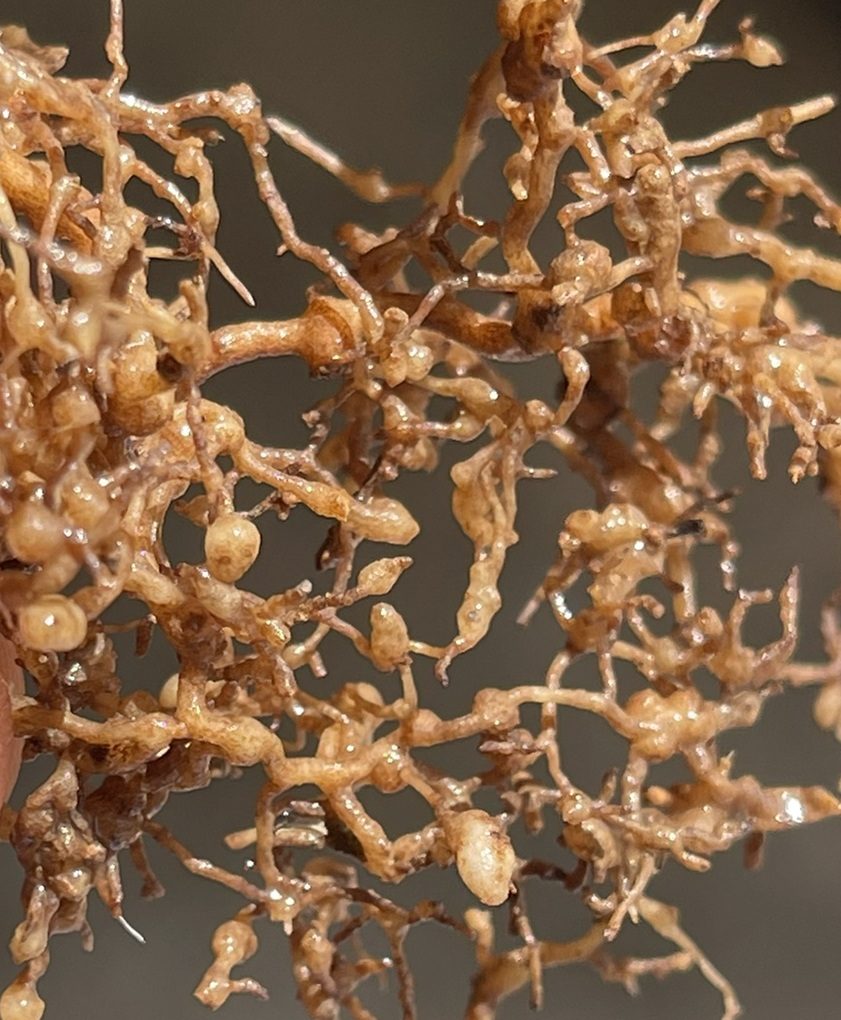
Figure 2. An advanced infestation. The root system has turned into a solid mass of knots and short, coarse rootlets. The fine absorbing roots have essentially been lost, and in this state the plant does not take up anything, regardless of what is applied to the soil. Here fertiliser and extra water do not help; they add to the burden.
Greek laboratories usually report individuals per 100 mL or per 100 g of soil. The international literature often uses second-stage juveniles per mL of soil. The table makes the conversion:
| Experimental level | Per 100 mL of soil | Per litre of soil |
|---|---|---|
| 0.5 juveniles/mL | 50 | 500 |
| 1 juvenile/mL | 100 | 1,000 |
| 5 juveniles/mL | 500 | 5,000 |
| 15 juveniles/mL | 1,500 | 15,000 |
Therefore, two blocks with the same number on paper can suffer very different damage. The laboratory result is one input to the decision, not the decision.
7. What is approved in Greece, and how temperature plays in
The international literature on nematicides revolves around the active substances fluopyram, fluensulfone, oxamyl and fluazaindolizine. None of them is approved on kiwifruit in Greece. Oxamyl has in fact been withdrawn across the entire European Union, with the grace period expiring on 30 September 2023 [5].
Reading a foreign study and asking for the product at the shop will not find it, and rightly so. The temperature finding presented [3] remains valuable as a principle, because it shows that soil temperature changes efficacy. It is not, however, a purchasing guide. The purchasing guide is the register of the Greek Ministry of Rural Development and Food [18].
The Greek register for kiwifruit
| Product and active substance | What it is and how it acts |
|---|---|
| Fosthiazate Nemathorin 150 EC, emulsifiable concentrate | The only conventional nematicide on the register. An organophosphate, not a fumigant. It acts on the nematode's acetylcholinesterase, paralysing it so that it cannot locate and penetrate the root [21]. |
| Purpureocillium lilacinum strain 251 BioAct Prime DC, biological | A living fungus that parasitises the eggs of the nematode. It was originally isolated from infected nematode eggs. Egg parasitism rates of up to 60 to 70% against M. incognita are recorded [22]. It appears on the register as Paecilomyces lilacinus, the older name of the same fungus. Pre-harvest interval: 0 days. |
| Garlic extract NEMguard SC, Velsinum, biological | It acts through the diallyl polysulphide compounds of garlic, which arise from enzymatic hydrolysis of sulphur-containing amino acids [23]. These are volatile and unstable compounds, and that is exactly what makes them dependent on soil conditions. |
| Geraniol and thymol Cedroz, microencapsulated suspension | Two plant terpenes in microcapsules, with synergistic action. They accumulate in the nematode's cell membranes and cause loss of membrane integrity and cell lysis [24]. |
The table reproduces the products shown as approved against nematodes on kiwifruit in the register of the Greek Ministry of Rural Development and Food [18]. Approvals change, check the register before every purchase. No rates are given; only the label instructions apply.
How soil temperature affects each one
Before the analysis, a summary table of the documented temperatures. Measure at 20 to 30 centimetres, in the zone of active roots, at the same hour each time, preferably early in the morning, which is the most stable reading of the day.
| Tool or organism | Documented temperature range and what it means for application |
|---|---|
| Meloidogyne hapla the target | Begins to develop at 8.8 °C [6]. Below that it does not develop and does not move to meet the product. An application to such soil is pointless whatever the active substance. |
| Fosthiazate | There is no published lower limit of activity. The limit is set by the nematode: apply once the soil has stabilised above 10 to 12 °C, so that the nematode is active. Warm soil does not help, it shortens persistence [21]. |
| Purpureocillium lilacinum 251 the approved biological | Optimum growth 21 to 27 °C. Does not survive above 36 °C [22]. It is the narrowest window of all and the only one with an absolute upper limit. |
| Pochonia chlamydosporia | Optimum 24 to 28 °C, best at 25 °C. It grows from 15 to 30 °C, but at the low end the rate falls sharply [25]. |
| Solarisation | Targets 40 to 50 °C [15]. Lethal to nematodes, and to beneficial fungi. |
The label instructions always apply. The above is the biology of the organisms, not a substitute for the product's instructions.
Fosthiazate, temperature does not change the action, but the persistence
Degradation of fosthiazate in soil is due to both chemical and microbial processes. Sterilising the soil doubles the half-life, which demonstrates the involvement of microorganisms [21].
And microbial activity increases with temperature. So in warm soil the product breaks down faster and protects for less time. This is the reverse of what applies to fluopyram: there warm soil helps, here it shortens.
The half-life ranges from half a month to a month and a half in natural soil [21]. In the field, one application does not cover a whole season, and its timing must coincide with the period when the nematode is moving and seeking a root.
An important detail for reading the numbers: the published half-lives were measured at 22 °C, where they ranged from 12 to 87 days depending on the soil [21]. The values above apply around that temperature. In warmer soil they shorten further.
| Limit | Soil temperature and why |
|---|---|
| Lower limit | About 12 to 15 °C. M. hapla starts at 8.8 °C [6], but a little more warmth is needed for the juveniles to move actively and meet the active substance. The technical literature for the product places the start of reliable performance at 15 °C [31]. |
| Ideal zone | 15 to 25 °C. Here the nematode is fully active and degradation remains at the level of the published values, which were measured at 22 °C [21]. This is where activity and persistence coexist. |
| Upper limit | About 30 to 35 °C. The active substance still works, but persistence collapses, as microbial degradation accelerates with temperature [21] [31]. The dose and the cost stay the same, the duration of protection is shorter. |
Practical summary: target 15 to 25 °C at 20 to 30 centimetres. In this region that typically means spring, from mid-April, or early autumn. Not midsummer, and not early spring with cold soil.
A note on sources: the 15 to 35 °C range comes from manufacturer technical literature, not from a peer-reviewed publication [31]. The remaining data are from scientific papers. The label instructions and the approvals of the Greek Ministry always apply [18].
It is the time needed for half the quantity of the active substance to break down in the soil. The critical point is that degradation is not linear: a fixed amount is not lost each day, but half of whatever remains each time.
With a half-life of 30 days: at 30 days 50% remains, at 60 days 25%, at 90 days 12.5%. Protection does not stop abruptly, it fades, and at some point falls below the level that kills the nematode, while the product still nominally «exists» in the soil.
Why it matters: it explains why one application does not cover a whole season, and why its timing has to coincide with the period when the nematode is moving, not with when it is convenient.
This is the most practical finding for fosthiazate and is rarely mentioned:
- In acid soils, pH below 6: half-life 53.3 to 57.7 days.
- In alkaline soils, pH above 7: half-life only 14.1 to 20.7 days [21].
| Days after application | Acid soil pH < 6 | Alkaline soil pH > 7 |
|---|---|---|
| 15 | 83% | 54% |
| 30 | 69% | 29% |
| 60 | 47% | 9% |
| 90 | 32% | 2.5% |
Calculated from the published half-lives, starting from 100 units of active substance. At 60 days the difference is more than fivefold.
That is, in alkaline soil the product lasts about a third as long. Kiwifruit prefers slightly acid soil, but many fields in this region are neutral to alkaline. Where pH is above 7, do not expect the persistence the label promises, and do not mistake rapid degradation for failure of the product.
Purpureocillium lilacinum, here temperature is an absolute limiting factor
This is not a chemical but a living fungus that has to establish and grow in the soil. It therefore has thermal requirements of its own:
- Optimum growth: 21 to 27 °C.
- It does not grow and does not survive above 36 °C [22].
In cold soil the fungus does not establish. In very hot soil it dies. The application window is real and narrower than it is generally imagined to be.
The biological product should not be applied to soil that has just been solarised, or to exposed, hot soil in midsummer. That is paying for a fungus that will die before it can work. Let the soil cool, or apply in the shade of the canopy and with irrigation that brings the temperature down.
Garlic extract and terpenes, volatile, therefore sensitive
Both categories rest on volatile compounds: garlic polysulphides, terpenes in Cedroz. The behaviour of volatiles in soil depends on temperature and moisture, by the same logic described for the fumigants: too cold means slow release, too hot means rapid loss before they can act.
Cedroz is a microencapsulated formulation, designed precisely to slow release and extend activity. That is an advantage in warm soil.
Kiwifruit in Greece is grown to a large extent on alluvial lowland soils, which are often exactly that: silty. Check the particle-size analysis before choosing a garlic product, it is not a matter of rate but of soil suitability.
- A soil thermometer at 20 to 30 cm. Without it, everything that follows is guesswork.
- Fosthiazate: apply when the nematode is active, that is, with soil that has stably passed 10 °C. In alkaline soil, expect markedly shorter protection.
- Fungal biological: apply in the 21 to 27 °C window. Spring or autumn, not midsummer on bare soil.
- Volatiles, garlic and terpenes: soil with good moisture so that they do not escape, and immediate irrigation after application to carry them into the root zone. The method of application counts as much as the active substance: it has been shown experimentally that the arrangement of drip lines and the distribution of the product in the soil significantly change the outcome [4].
- None of the four eradicates the population. All are tools of suppression. The strategy is organic matter, drainage and healthy planting material; the products delay the progression.
8. Soil fumigants
Fumigants such as metam-sodium and dazomet act by converting in the soil into methyl isothiocyanate, the genuinely active substance [17]. That conversion is a chemical process, and therefore depends on temperature.
- Very cold soil: a reduction in efficacy at low temperature is recorded [17]. Conversion is slow and the gas is not produced in sufficient quantity.
- Very hot soil: the gas escapes too quickly to the atmosphere, before it can act at depth, and at the same time the risk to the operator rises.
- Moisture is equally critical. Soil in good moisture is needed so that the pores close and the gas is retained; excessive moisture, however, delays the conversion [17].
Fumigants are pre-plant treatments. They are not applied to an existing planting, because they kill the root along with the nematode. Their opportunity is one and only one: before planting.
They also require a special licence, equipment, film cover and observance of buffer zones, and their use is being progressively restricted. Check the current regulatory position before planning anything.
9. Solarisation, biofumigation and organic matter
Solarisation
Covering moist soil with transparent polyethylene film during the hot month, so that maximum soil temperature rises and pathogens and nematodes are killed [15]. It is a method based entirely on soil temperature.
Solarisation raises the temperature enough to kill to a depth of about 15 to 20 centimetres [15]. Nematodes, however, unlike weed seeds which sit in the top 7 centimetres, occur at greater depths, down to 50 centimetres [17].
That is, roughly 65% of the profile of interest is left untreated. In vegetables the method performs; in a perennial crop with a deep root system it is complementary, not a solution.
Biofumigation
Incorporating readily degradable organic material into the soil, crop residues, manure, olive mill by-products or plants of the Brassicaceae, followed by immediate irrigation and covering [15]. On degradation the brassicas release volatile compounds with suppressive activity [16].
- Biofumigation increases the effectiveness of solarisation, allowing satisfactory control at lower temperatures or over a shorter period [16]. That matters in regions where the summer is not hot enough or long enough.
- In intensive Mediterranean vegetable production, biofumigation with poultry manure gave a 73% reduction in root-knot nematode populations [15].
- Organic matter works on its own too, in the long term: it feeds antagonistic microorganisms and predatory nematodes, and improves structure so that the root holds out longer.
10. Biological control, fungi, bacteria and plants
The continuing withdrawal of chemical active substances across the European Union makes biological control increasingly central. This is not a second-rank alternative: plant-parasitic nematodes cost world agriculture over 80 billion dollars, and research has invested accordingly [26].
Nematophagous fungi, a much larger family than is generally supposed
Nematophagous fungi were first identified in 1888, and to date more than 650 species have been described. Their mechanism is as follows: they locate nematodes from the chemical signals the nematodes themselves release [26]. They do not wait for a chance encounter, they hunt.
| Category | How it acts and which species matter |
|---|---|
| Predatory fungi about 380 species | They trap their prey with specialised mycelial structures resembling nets. In the presence of a nematode the hyphae swell, penetrate the cuticle and feeding begins. Main genus: Arthrobotrys [26] [27]. |
| Toxin-producing fungi about 270 species | They act through nematotoxic metabolites rather than by direct contact. |
| Endoparasitic fungi about 120 species | They develop inside the body of the nematode. Species: Nematophthora gynophila, Hirsutella spp., Acrostalagmus spp. |
| Egg-parasitic fungi | They parasitise the eggs and the females. This is where Pochonia and Purpureocillium belong, the two most important here. |
The categorisation and the species numbers follow the Greek review of the literature [26]. Some species belong to more than one category, Arthrobotrys, for example, is regarded as both predatory and endoparasitic.
Pochonia, the second major egg-parasitic fungus
Pochonia chlamydosporia is, along with Purpureocillium, the second pillar. It was formerly called Verticillium chlamydosporium, and will be found under that name in older texts.
It does not work like a pesticide. It is a soil saprophyte and an excellent rhizosphere coloniser: it lives around the root, feeds on root exudates, and from there parasitises eggs and females. Some strains also establish endophytically inside the root [25].
It has a second, indirect action: it promotes plant growth and induces systemic resistance against nematodes [25]. It does not only kill; it also makes the plant a more difficult host.
- Optimum growth and sporulation: 24 to 28 °C, best at about 25 °C.
- It grows over a range of 15 to 30 °C, but low temperatures sharply reduce its growth rate [25].
Its window is almost identical to that of Purpureocillium, whose optimum is 21 to 27 °C [22]. Both of the major biological agents want warm, not hot, soil, which reinforces the central conclusion of this article: without a soil thermometer, a biological product is a lottery.
It is mentioned for completeness and because the regulatory position changes, not as a recommendation to apply.
Arthrobotrys, the fungus that sets nets
It is the most studied genus of predatory fungi and has been tested extensively against Meloidogyne incognita [27].
The interesting point is why it has been studied so much: its effectiveness in curative and not only preventive use [26] [27]. Most biological agents are preventive, this one shows activity against an established population as well. No approved product exists for kiwifruit in Greece, but it is a direction worth watching.
The bacteria
Bacterial biological nematicides are classified into rhizobacteria, symbiotic, egg-parasitic, Cry protein-producing and endophytic [26] [28]. They act either as living strains or through their products.
Approved Bacillus firmus products are available in Greece and achieve a reduction in population [26].
It was widely known that it attacks the eggs. More recent research showed, however, that its secondary metabolites are also toxic to juveniles and to adults, that is, it acts at more than one stage [30].
And the critical point here: that work concerns specifically Meloidogyne hapla and Xiphinema americanum [30], that is, exactly the species that dominates in kiwifruit orchards. Most biological control data concern the thermophilic M. incognita; here there are data for the cool-climate species that actually matters.
Predatory nematodes, and their limitation
There are hundreds of species of predatory nematodes, in the genera Mononchida, Aphelenchida, Dorylaimida and others. Some swallow the prey whole, others suck it out with their stylet [26].
Plants and plant products
| Plant or substance | What is known |
|---|---|
| Tagetes marigold | An antagonistic plant with documented activity. The active substances isolated are alpha-terthienyl, thiophene and dithienyl [26]. It is used as a cover crop or in rotation. |
| Brassicas mustard and others | They release isothiocyanate compounds [26]. They are the basis of the biofumigation described in section 9. |
| Garlic Allium sativum | The polysulphides of garlic prevent infestation and also reduce an existing one [23] [26]. An approved product is available for kiwifruit. |
| Thymol and geraniol | Essential oils with documented nematicidal activity [24]. The activity of thymol against Meloidogyne javanica was documented by a Greek research group [29]. An approved product is available for kiwifruit. |
- They are living organisms or unstable substances. They require warm soil, moisture and organic matter, that is, they too depend on temperature, just as the synthetics do.
- They act suppressively and cumulatively, over time. They should not be judged by the standard of a fumigant.
- Inoculating the soil at the establishment of the crop gives the best results, prevention is clearly superior to cure [26].
- Combining strains can give control of both eggs and adults, while some species also activate the acquired defences of the plant [26].
- In difficult cases the biologicals can be applied after a chemical treatment, for a longer-lasting effect [26].
Biological nematode control is not one application. It is a state of the soil that gets built.
11. A new planting, where everything is decided
What is done before planting is worth more than anything done after
- A nematological analysis before buying or renting the land. It costs very little relative to a twenty-year planting.
- The history of the parcel. A previous crop susceptible to root-knot nematodes, vegetables, kiwifruit, vines, means elevated risk.
- Healthy propagation material from a certified nursery. The commonest way for the nematode to enter a clean field is inside the root ball of the young plant.
- Correcting drainage before planting. This simultaneously covers the risk of vine decline [20].
- Cleaning machinery when moving from an infested to a clean parcel. Soil on the tyres is the main means of spread.
12. A practical plan
| Period | Action |
|---|---|
| Autumn | Sampling of soil and roots, at the population peak. Mapping of the patches with photographs. |
| Winter | Results and planning. Incorporation of organic matter. Correction of drainage and compaction. |
| Spring | Measurement of soil temperature at 20 to 30 cm. No nematicide application while the soil is cold. |
| Late spring | Application once the soil has warmed and the root is in active growth, with sufficient moisture to move the active substance. |
| Summer | Avoidance of water stress. A damaged root system cannot cope; more frequent, smaller irrigations. |
| Throughout | Cleaning of machinery. Do not carry soil from the patches to the rest of the block. |
- A sample, not a guess. And ask for both nematodes and oomycetes.
- A soil thermometer. It is the cheapest tool with the highest return in this job.
- Never apply to cold soil with the active substances that depend on temperature.
- Organic matter every year. The one investment that works on both problems.
- Drainage. It solves vine decline and raises tolerance of nematodes.
- Clean planting material. It is far cheaper than disinfestation.
13. Sources
The numbers in the text refer to the list below.
- [1] Gonçalves M. et al. (2025). Meloidogyne hapla dominates plant-parasitic nematode communities associated with kiwifruit orchards in Portugal. Plant Pathology. Source for the dominance of M. hapla in Mediterranean kiwifruit orchards and for the distinction between the genera found in the roots and those found in the soil.
- [2] Conceição I.L. et al. (2026). Meloidogyne spp. Population Diversity and Inoculum Density Influence Parasitism of Kiwifruit Plants. Agronomy 16:426. Source for the inoculum levels of 0.5 to 15 juveniles per mL, for the increase in galls with density, for the intraspecific variability of M. hapla, and for the different responses of the female Hayward and the male Tomuri.
- [3] Bui H.X. and Desaeger J.A. (2021). Efficacy of nonfumigant nematicides against Meloidogyne javanica as affected by soil temperature under pasteurized and natural soil conditions. Pest Management Science. The article's main source on temperature: fluopyram and fluensulfone are less effective in cold soil, while oxamyl and fluazaindolizine are unaffected; and that in natural soil control was distinctly worse than in sterilised soil.
- [4] Bui H.X. et al. (2023). Efficacy of five nematicides against root-knot nematode when applied via single and double drip tapes in a Florida sandy soil. Pest Management Science. Source for the importance of the method of application through drip lines and of the distribution of the active substance in the soil.
- [5] Oxamyl, non-renewal of EU approval. Source for the withdrawal of authorisations and the expiry of the grace period on 30 September 2023, and for the reasons: exceedance of the acceptable operator exposure level and of the acute reference dose.
- [6] Comparative thermal-time requirements for development of Meloidogyne species. Nematropica. Source for the lower thermal thresholds: 6.74 °C for embryogenesis and 8.80 °C for juveniles of M. hapla, against 10.08 °C for M. incognita and 12.90 °C for M. javanica.
- [7] Creation and Validation of a Temperature-Based Phenology Model for Meloidogyne incognita on Common Bean. Source for the thermal constant of 476 degree-days and the 11.1 °C threshold for completion of the cycle, and for the individual stages.
- [8] Wallace H.R. (1961). The Effect of Soil Temperature on the Survival of the Root-Knot Nematodes Meloidogyne javanica and M. hapla. Nematologica 6(4). A foundational paper on the different survival of the two species as a function of soil temperature.
- [9] Characterization of Phytopythium Species Involved in the Establishment and Development of Kiwifruit Vine Decline Syndrome. Source for the isolation of 71 Phytopythium strains from Italian kiwifruit orchards, dominated by P. vexans.
- [10] Pathogens Associated to Kiwifruit Vine Decline in Italy. Agriculture 10:119. Source for the range of pathogens associated with kiwifruit vine decline.
- [11] Kiwifruit Vine Decline Syndrome: etiology, mechanisms, and management of a multifactorial disease. Source for the multifactorial character of the syndrome and for the dual role of waterlogging, plant asphyxiation and zoospore release.
- [12] Prevalence of root-knot nematodes and their effects on fruit yield in kiwifruit orchards in Samsun Province (Türkiye). Turkish Journal of Entomology. Source for the frequency of root-knot nematodes in Turkish kiwifruit orchards and their effect on yield.
- [13] Felek A.F. et al. (2024). First report of root-knot nematode Meloidogyne ethiopica on kiwifruit Actinidia deliciosa in Türkiye. Journal of Phytopathology. Source for the widening range of species attacking kiwifruit in this region.
- [14] Meloidogyne aberrans sp. nov., a new root-knot nematode parasitizing kiwifruit in China. Source for the description of a new species exclusively from kiwifruit.
- [15] A Cost-Benefit Analysis of Soil Disinfestation Methods against Root-Knot Nematodes in Mediterranean Intensive Horticulture. Source for the 73% population reduction from biofumigation with poultry manure, for the depth reached by solarisation, and for the cost-benefit comparison of the methods.
- [16] Reaction of Commercial Cultivars of Kiwifruit to Infection by Root-knot Nematode and Its Biocontrol Using Endophytic Bacteria. In combination with the literature on biofumigation with brassicas. Source for biological control specifically in kiwifruit and for the fact that biofumigation permits control at lower temperatures or over a shorter period.
- [17] Conversion of metam sodium and emission of fumigant from soil columns, in combination with technical manuals on fumigant application. Source for the conversion of metam-sodium into methyl isothiocyanate, for the reduction in efficacy at low temperature, for the role of moisture, and for the fact that nematodes occur down to 50 cm while weed seeds sit in the top 7 cm.
- [18] Greek Ministry of Rural Development and Food, database of approved plant protection products. In Greek. The only authoritative source for what is currently permitted on kiwifruit in Greece, at what rate, by what method of application and with what pre-harvest interval.
- [19] Kiwifruit vine decline syndrome, Moria del kiwi, KiDS, plantprotect.gr. In Greek. The detailed account of the syndrome against which the differential diagnosis is made.
- [20] Hydrological study for a kiwifruit planting, plantprotect.gr. In Greek. The methodology for assessing infiltration and drainage, which is the common predisposing factor for both problems.
- [25] Biology and Management of Pochonia chlamydosporia and Plant-Parasitic Nematodes, in combination with Ecology of Pochonia chlamydosporia in the Rhizosphere and the species overview. Source for optimum growth and sporulation at 24 to 28 °C with a best value of 25 °C, for the 15 to 30 °C range and the sharp drop in growth rate at low temperatures, for rhizosphere colonisation and endophytic establishment, and for the induction of systemic resistance.
- [26] Pastopoulos S.S., Agronomist MSc. Biological control of nematodes in fruit growing. Neos Mylotopos, Giannitsa. In Greek. Source for the global cost of over 80 billion dollars, for the identification of nematophagous fungi from 1888 and the more than 650 species, for the location of nematodes through chemical signals, for the classification into toxin-producing, egg-parasitic, endoparasitic and predatory with the corresponding species numbers, for the limitation of predatory nematodes that cannot locate prey, for the classification of bacterial products, for the active substances of Tagetes and the brassicas, and for the recommendation of inoculation at establishment and combination with chemical treatment.
- [27] Eken C. et al. (2023). Use of Arthrobotrys spp. in biocontrol of the root-knot nematode Meloidogyne incognita. European Journal of Biological Research 13:173-180. Source for the trapping mechanism using net-like mycelial structures and for the effectiveness of the genus in curative and not only preventive use.
- [28] Plant Nematode Biopesticides, Chapter 3: Types of plant nematode biopesticides. Elsevier, 2022. Source for the classification of bacterial biological nematicides into rhizobacteria, symbiotic, egg-parasitic, Cry protein-producing and endophytic.
- [29] Nasiou E. and Giannakou I.O. (2023). Nematicidal Potential of Thymol against Meloidogyne javanica (Treub) Chitwood. Plants 12:1851. A Greek research paper; source for the nematicidal activity of thymol.
- [30] Valencia L.M. (2016). Bacillus firmus for the biological control of Meloidogyne hapla and Xiphinema americanum. Thesis, West Virginia University. Source for the finding that secondary metabolites of Bacillus firmus are toxic to juveniles and adults as well, with the data concerning specifically M. hapla, the species that dominates in kiwifruit. This is a master's thesis, not a peer-reviewed journal publication.
- [21] Karpouzas D.G. et al. Influence of soil physicochemical and biological properties on the degradation and adsorption of the nematicide fosthiazate, and Degradation and Adsorption of Fosthiazate in Soil. Journal of Agricultural and Food Chemistry. Source for the fosthiazate half-life of half a month to a month and a half in natural soil, for its doubling after sterilisation which demonstrates microbial involvement, and for the difference between acid soils at 53.3 to 57.7 days and alkaline soils at 14.1 to 20.7 days.
- [31] Technical data for the active substance fosthiazate, manufacturer technical literature. Source for the stated effective operating range of 15 to 35 °C. Note that this is commercial technical documentation and not a peer-reviewed publication; it is cited as an indication and not as proof.
- [22] Paecilomyces lilacinus strain 251, Fact Sheet, in combination with the EFSA assessment of the active substance Purpureocillium lilacinum strain 251. Source for optimum growth at 21 to 27 °C, for the fact that it does not grow and does not survive above 36 °C, and for egg parasitism rates of up to 60 to 70%.
- [23] Polysulfides Applied as Formulated Garlic Extract to Protect Tomato Plants against the Root-Knot Nematode Meloidogyne incognita. Plants 10:394, and Nematicidal Activity of a Garlic Extract Formulation against the Grapevine Nematode Xiphinema index. Source for the action through diallyl polysulphide compounds, for the lethal concentration values, and for the limitation that silt inhibits the action of the polysulphides and use on silty soils is not recommended.
- [24] Technical data for the geraniol and thymol product, in combination with the Review of the Potency of Plant Extracts and Compounds as an Alternative to Synthetic Nematicides. Source for the synergistic action of thymol and geraniol and for the mechanism: accumulation in cell membranes, loss of integrity and cell lysis.
This text is informational and educational and does not replace on-site agronomic assessment, nor does it constitute a prescription for the application of plant protection products.
No rates are given. Approvals of active substances change: as documented within the article, oxamyl is no longer approved in the European Union. Selection is made solely on the basis of the approvals in force for kiwifruit, in Greece those of the Ministry of Rural Development and Food, elsewhere the corresponding national register, and the label instructions always apply.
For soil-applied products: application is made to soil with adequate moisture and at a suitable temperature, never to plants under water stress. Fumigants are pre-plant treatments, are not applied to an existing planting, and require a special licence, equipment and observance of buffer zones. Before general application of a new product, a test on a limited number of vines and a waiting period are advisable before extending it.
Every intervention is made at the user's own responsibility, following laboratory analysis and on-site assessment by a licensed agronomist. Pastopoulos Geoponiki L.P. accepts no liability for damage or loss of production arising from applying the above information without individual technical guidance.
Related articles
Copper nanoparticles for kiwifruit bacterial canker
A Chinese study compared three copper nanomaterials with a conventional bactericide. On the plate they needed concentrations at least sixty four times lower. On the plant the control efficacies fell into the same range…
Training kiwifruit: T-bar and pergola
The architecture of the kiwifruit vine and why both training systems follow from it. T-bar and pergola with their dimensions, advantages, costs and a comparison in numbers. Training from the day of planting: planting high, a first season for the root with tipping at one metre, cutting back low the following spring and taking the trunk up in the second season, leaders, winter and summer pruning, males and the support structure. Three diagrams, a table of mistakes, and the gaps that remain for Greece. A field observation from Giannitsa on planting distances.
Chilling hours: the three models and when each one tells the truth
Chilling Hours, Utah Chill Units or Dynamic Chill Portions, what each measures, which suits which climate and season, why a chill portion does not convert into hours, and how the divergence between the three is read. The calculation itself lives in a separate tool.