
Peach fungal gummosis, Botryosphaeria dothidea
Savvas Pastopoulos, Agronomist, Pastopoulos Agronomics, Neos Mylotopos, Pella, Greece
Botryosphaeria dothidea is among the most misunderstood pathogens of the orchard. It is not an aggressive fungus that "attacks" healthy trees, it is endophytic: the prolonged latent or endophytic phase is its defining characteristic, and infections generally become apparent only under conditions of host stress [2]. That determines what is worth doing in the orchard. This article deals with this fungus alone: how it is recognised, why spraying disappoints, and which measures have a genuinely measured effect.
Where this article refers to the approvals database of the Greek Ministry of Rural Development and Food, those approvals are valid in Greece only and say nothing about what is permitted in any other country. Approval of an active substance at Union level does not mean a given product is authorised for a given crop anywhere in particular. No dose is given anywhere in this article.
Doses of copper are stated per hectare, as the Union legislation states them. The figures measured abroad carry the country and the conditions of measurement inside the sentence, because almost none of this literature was produced under Mediterranean conditions.
| What produces gum | What distinguishes it in the field |
|---|---|
| Gummosis caused by Botryosphaeria | Raised blisters 1 to 6 mm over natural openings, lenticels and stomata, on the young bark of vigorous trees; later sunken necrotic lesions and cankers on the trunk and the scaffold limbs [1] [17] |
| Bacterial canker (Pseudomonas syringae) | A separate cause of gummosis according to the Pacific Northwest handbook [20]. The distinctions are examined in the article on bacterial canker of stone fruits |
| Wood-boring insects (goat moth, sesia, flatheaded borer) | Position and residues decide: "if the gum is coming out high on the trunk or on the scaffolds and not near the crown, it is unlikely to be due to larvae; borers also leave frass in the gum" [18]. Details in the articles on the goat moth and the flatheaded root borer |
| Abiotic causes | Mechanical, winter and chemical injury; spontaneous gummosis on growth forced by excess water or nitrogen [20] |
| Constriction canker (Phomopsis amygdali) | A different disease of the one-year shoots, with its own cycle and its own points of entry, separate article |
over lenticels
in Georgia, USA
severe water deficit against
full irrigation (Spain)
yield in susceptible
cultivars (USA)
- The identity of the pathogen, and why it matters
- An endophytic fungus, not an invader
- What the gum actually is
- The symptoms, in the order they appear
- The disease cycle
- Stress wakes an infection that is already there
- What the spray trials showed
- What all this means for Greece
- The management that is documented
- Cultivars and susceptibility
- What should not be expected
- Sources
1. The identity of the pathogen, and why it matters
Botryosphaeria dothidea is the type species of the genus Botryosphaeria, in the family Botryosphaeriaceae and the order Botryosphaeriales. The fungi of that order are among the most widespread and important canker and dieback pathogens of trees worldwide, and B. dothidea one of the commonest species across a large number of hosts [2]. Its asexual morph is reported as Fusicoccum aesculi [11] [12].
The current name is confirmed in the EPPO database and in Index Fungorum: Botryosphaeria dothidea (Mougeot) Cesati & de Notaris, 1863, with the basionym Sphaeria dothidea Mougeot (1823) [13] [16].
Care is needed here, because this is the commonest source of confusion in the gummosis literature. The syndrome called "peach gummosis" is not caused by one fungus. The University of Florida fact sheet attributes the disease to B. dothidea and notes that other Botryosphaeria species, B. rhodina and B. obtusa, have been associated with gummosis and dieback symptoms on peach in the USA [1]; a Chinese paper names all three as the main pathogens of the disease [12]; another Chinese paper describes the same complex as Lasiodiplodia theobromae, Diplodia seriata and Fusicoccum aesculi [11]. These are the same species under different names:
| Current name | Earlier name in the literature | What is documented about aggressiveness |
|---|---|---|
| Botryosphaeria dothidea (Mougeot) Cesati & de Notaris | none, type species of the genus [2] | The subject of this article. The commonest species in almond decline in southern Spain, isolated from 50.0% of the trees in the study [8] |
| Lasiodiplodia theobromae (Patouillard) Griffon & Maublanc | Botryosphaeria rhodina (Berkeley & Curtis) von Arx [15] | In China it "has been shown to be the most virulent, causing the largest lesions and the most abundant gummosis" [12] |
| Diplodia seriata de Notaris | Botryosphaeria obtusa (Schweinitz) Shoemaker [14] | On apricot in Türkiye, second in virulence after L. mediterranea and ahead of N. parvum [10] |
| Neofusicoccum parvum (Pennycook & Samuels) Crous, Slippers & Phillips | Botryosphaeria parva Pennycook & Samuels | Recorded on peach in Greece, but as a cause of fruit rot and shoot blight, not of gummosis [9] |
Molecular taxonomy separated these species from the genus Botryosphaeria, which is why the older literature still speaks of "B. rhodina" and "B. obtusa". The taxonomic description of B. dothidea itself changed substantially over the past decade, "a fact that complicates the interpretation of the large body of literature associated with the name" [2]. The distinction has a direct practical bearing: as the table above shows, the ranking in virulence changes from study to study and from host to host, and there is no single order that holds everywhere.
Sources: 1 2 8 9 10 11 12 13 14 15 16
2. An endophytic fungus, not an invader
This is the point that explains almost every disappointment with this disease. The review of B. dothidea in Molecular Plant Pathology states it plainly: "the prolonged latent infection or endophytic phase is of particular importance" and "infections typically become apparent only under conditions of host stress, when symptoms develop" [2].
The same phenomenon has been measured in the field. In the Spanish study on almond, Botryosphaeriaceae were the most consistently isolated fungi and B. dothidea the commonest; and most species "were recovered from both asymptomatic and symptomatic trees, with the isolation frequency increasing with disease severity" [8]. The fungus, in other words, is already inside the tree long before the first gum appears.
The latent phase has a second, serious consequence that the literature emphasises: "the fungus can easily pass undetected through quarantine systems on live plants, fruit and other plant parts in trade", precisely because the material looks healthy [2].
So when gummosis appears in a young planting, the two possible scenarios are: either it came with the material, or infection took place on site and a stress woke it. Both call for an answer other than "let us spray".
3. What the gum actually is
The gum is a product of the tree, not of the fungus. The detailed anatomical study of the gum ducts was done on almond fruit, where the ducts form schizolysigenously in the vascular bundles of the mesocarp: secretory cells differentiate first, then separate schizogenously to delimit the lumen, and finally their cytoplasm and walls dissolve. The authors' conclusion: "the gum is primarily a secretory product of the specialised secretory cells, but the dissolving cell walls also appear to be incorporated into the gum during the lysigenous stage" [21]. No corresponding study for the bark of the peach trunk was found.
The composition of the gum, as given by fact sheet HS1265 of the University of Florida, is chiefly carbohydrate:
| Component | Proportion |
|---|---|
| Carbohydrates | 85.67 ± 0.37% |
| Protein and minerals | 1.74 ± 0.04% |
| Moisture | 3.80 ± 0.19% |
The values are as published in HS1265 [1]. The sum is less than 100%; the fact sheet does not account for the remaining fraction.
Chemical analysis of gum from the peach trunk showed a polysaccharide with arabinose, xylose, mannose, galactose and uronic acids in a molar ratio of 36:7:2:42:13, and a protein content below 1% [22].
That the gum is almost entirely sugars says something important: every drop of gum is lost carbon. A tree that is "weeping" at dozens of points does not merely have a cosmetic problem, it is spending photosynthate on defence instead of on fruit and on reserves. The measurement of that cost in peach is indirect and is given in section 11.
4. The symptoms, in the order in which they appear
Stage 1, the blister on the lenticel
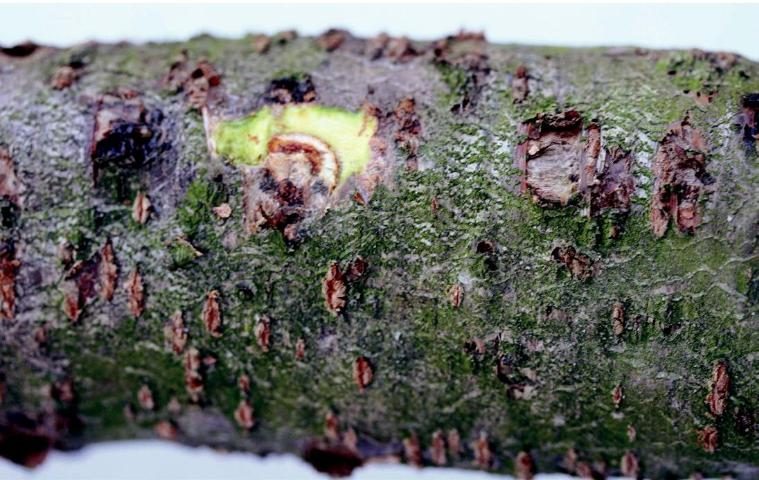
The first symptoms are raised blisters 1 to 6 mm in diameter which appear over the natural openings of young shoots, over the stomata and the lenticels, or close to wounds [1]. The Clemson fact sheet places this in time: "the earliest symptoms appear on the young bark of vigorous trees as small blisters, usually at the lenticels" [17].
A useful field sign: the blisters develop on or beside lenticels [1] [17]. That is where the fungus entered. The raising itself is due to hyperplasia, the "abnormal multiplication of plant cells" of the periderm and the cortical tissue around the lenticel [1]. The original description of the disease from Georgia in the United States, in 1974, already reported "sunken lesions around lenticels, circular to oval necrotic areas in the bark beneath infected lenticels, and blisters on the surface of shoots and twigs" [4].
Stage 2, the necrosis beneath the bark
After the initial infection the necrotic lesions extend beneath the bark, and on trees two or three years old sunken affected areas, cankers, become apparent on the trunk and the scaffold limbs; some of these areas exude gum [17].


Stage 3, the wood and the dieback
The progression leads to dieback of scaffold limbs and the formation of cankers, and the disease "can kill limbs or entire trees" [17]. On trees with fungal gummosis, "necrotic areas of the limb extend into the xylem forming a black to brown discolouration" [20], and that is the sign visible in a cut section.
A useful field sign out of season: fact sheet HS1265 recommends the use of "bark lesions from previous years to assess the distribution and the relative intensity of the disease" [1]. That is, the scars of last year's exudations remain visible and allow the orchard to be mapped in winter, with the trees bare.

What it costs
The long-running work of USDA-ARS in Georgia, in the United States, concludes that gummosis "can significantly reduce growth and yield by up to 40% in susceptible peach cultivars" [7]. Fact sheet HS1265 cites in addition, from work in Israel, reductions of up to 25% [1].
No published Greek measurement of yield loss from peach gummosis was found.
5. The cycle of the disease
The fungus produces two types of spore with different behaviour. The measurements which follow were made with a Burkard trap and by collection of rain runoff in a peach orchard at Byron, Georgia, in the United States, in 1984 and 1985 [3].
| Ascospores (sexual) | Conidia (asexual) | |
|---|---|---|
| Means of transport | "Botryosphaeria spores collected in the Burkard trap were almost exclusively ascospores and rarely conidia" [3] | Chiefly in water; in rain runoff both conidia and ascospores were found [3] |
| When it peaks | Mid March to mid May in 1985, April in 1984, in Georgia; lower levels in winter [3]. The corresponding window for northern Greece has not been measured | Detected in rain runoff almost all year round [3] |
| What triggers release | "Ascospore release occurred during or immediately after wetting periods", even without measurable rain, from dew or fog [3] | In water, found in rain runoff [3] |
| When they fly | "Peak periods of air dispersal occurred during daylight hours, when relative humidity was generally lower, temperature higher and air movement greater" [3] | During the wet episode itself [3] |
The detail in the last row is counter-intuitive and deserves attention: moisture releases the ascospores, but their flight happens afterwards, once it has dried, warmed and started to blow. The dangerous moment for a fresh pruning cut is not the rain itself; it is the sunny, windy day that follows the rain.
Overwintering takes place as pycnidia, the asexual fruiting bodies packed with spores [1]. On peach in Imathia, in northern Greece, N. parvum overwintered as subepidermal pycnidia on blighted shoots or on mummified fruit which had remained on the tree [9].
6. Stress awakens an infection that is already there
If one thing only is to be kept from this article, let it be this.
The best documented field study on the relationship between water and disease was done on almond at Cordoba, in southern Spain, not on peach. Trees were subjected to four irrigation regimes: full cover of requirements, two intermediate regimes at 65%, and a severe deficit at 30%. Symptoms of branch dieback and general decline appeared "mainly in the plots subjected to high water deficit" [8]:
| Irrigation regime | Relative area under the disease progress curve | Final disease intensity |
|---|---|---|
| Full irrigation (control) | 22.2 ± 1.5% | 42.2 ± 4.1% |
| Severe deficit, 30% of requirements | 47.2 ± 8.7% | 80.4 ± 3.6% |
In the same study B. dothidea was the most frequent species, isolated from 50.0% of the trees sampled, and most species were recovered from asymptomatic trees as well [8]. The two findings together say the same thing as the general statement of the review: the fungus is there, and water decides whether it shows.
What this means in practice
- The question is not only "how is infection avoided" but "how is the fungus denied the occasion to express itself", since infections become apparent under stress [2].
- The Clemson fact sheet puts it as follows: "keep trees healthy, because the most severely affected trees are those suffering from water stress" [17].
- Fact sheet HS1265 reports that symptom severity is aggravated by drought periods from August to October, for the conditions of Florida in the United States, that is after harvest of the cultivars grown there [1]; post-harvest irrigation as a measure is included explicitly in the management conclusions of USDA-ARS [5]. The corresponding period for any given Greek district and ripening group follows from the local harvest calendar, not from those dates.
- This is why post-harvest irrigation appears in the USDA-ARS conclusions as a measure against gummosis, alongside assessment of inoculum, choice of cultivar and reduction of inoculum [5], something which does not look at all like plant protection, but is.
There is a second factor of susceptibility. Fact sheet HS1265 calls for the adjustment of nutrients and pH so as to "avoid excessive new growth and succulent tissue, which is prone to infection" [1]. Young, tender growth is the weak entry point, which is why excessive nitrogen fertilisation works against the grower.
7. What the spray trials showed
Honesty is needed here, because the data are not flattering to the chemical approach. What follows comes from the long-running trials of USDA-ARS at Byron, Georgia, with collaborators from the University of Georgia [5]. The rating scale is 0 to 5 and it counts the number of sites of gum exudation on the trunk and the scaffold limbs: 0 = no site and no lesion, 3 = 11 to 25 sites, 5 = more than 50 sites. Lower is better.
The 1998 trial, ten applications
| Treatment | Rating (0 to 5) | Group |
|---|---|---|
| Control (water) | 3.5 | a |
| Acibenzolar-S-methyl (Actigard) | 3.4 | a |
| Garlic extract | 3.3 | a |
| Fosetyl-Al (Aliette) | 2.7 | b |
| Propiconazole (Orbit) | 2.4 | b |
| Captan + propiconazole | 2.2 | b |
| Azoxystrobin (Abound) | 2.2 | b |
| Propiconazole + paint, 1 application | 1.3 | c |
| Captafol (Difolatan) | 0.9 | cd |
| Propiconazole + paint, 3 applications | 0.8 | d |
With ten applications, the fungicides gave a moderate improvement over the control. The two best treatments, however, included paint, that is a physical barrier [5].
The 2008 trial, three applications, under high inoculum pressure
This is the trial every grower should see. Fourteen fungicides, three applications, analysis by Waller's method [5]:
| Treatment | Rating (0 to 5) | Group |
|---|---|---|
| Dicloran (Botran) | 3.6 | A |
| Ferbam | 3.5 | A |
| Propiconazole, captan, chlorothalonil, fosetyl-Al | 3.3 to 3.4 | AB |
| Iprodione, cyprodinil | 3.2 | AB |
| Azoxystrobin | 3.0 | ABC |
| Control (water) | 2.9 | ABC |
| Thiophanate-methyl, ziram | 2.9 | ABC |
| Sulphur | 2.8 | ABC |
| Painting with latex paint, 2 applications | 2.4 | BCD |
| Captafol (Difolatan) | 2.1 | CD |
| Painting with latex paint, 1 to 2 applications | 1.7 to 1.8 | DE |
| Cultivar Redskin | 1.3 | E |
The table renders the treatments of the trial by the name of the active substance. Two further products in the trial, with code names and no declared active substance, were rated 3.1 and 2.9 and were likewise placed in group ABC [5].
The conclusion of the researchers is summarised in the following: assessment of inoculum levels, choice of cultivar, reduction of inoculum through detailed pruning and orchard sanitation, and post-harvest irrigation. Painting with latex paint appears in their list with a question mark [5]. The 2011 review puts it as follows: no registered fungicide provides effective suppression, while certain barrier treatments show promise [7].
Correspondingly, the fact sheet of the University of Florida is categorical: "at present there are no effective or registered fungicides for the control of peach fungal gummosis dieback"; the fungicides applied for fruit and leaf diseases may assist in suppression, but protecting trees throughout the long annual period of possible infection becomes "rapidly impractical and prohibitively expensive" [1]. Clemson agrees: "no practical chemical control is available" [17]. And the Chinese work on genetic resistance concludes that "no orchard management or fungicide effectively controls the disease in the field" [12].
8. What all of this means for Greece
A large part of the literature on gummosis comes from the United States and refers to active substances which are no longer available in the European Union. This has to be said plainly, because older texts continue to present them as options:
| Active substance | What the source that was checked says | What was documented for the Union |
|---|---|---|
| Captafol (Difolatan) | The most effective fungicide in the Byron trials (0.9 in 1998; 2.1 in 2008), surpassed in both trials by paint treatments or by the resistant cultivar [5], and the only one with a documented benefit in growth and yield [6] | No approval act in force was found. It is not mentioned either in the current stone fruit pest management guide of the southeastern consortium of universities (2026 edition) [19] |
| Propiconazole (Orbit) | 2.4 against 3.5 for the control with ten applications; 3.4 with three applications, inseparable from the control [5] | Non-renewal of approval, Reg. (EU) 2018/1865. The metabolite NOA436613 is predicted above 0.1 µg/L in groundwater in all scenarios, and the substance was classified as toxic for reproduction category 1B under Reg. (EC) 1272/2008, following an opinion of the ECHA Committee for Risk Assessment. Withdrawal of authorisations by 19 June 2019, grace period until 19 March 2020 [23] |
| Thiophanate-methyl (Topsin M) | 2.9 in the 2008 trial, the same rating as the control [5] | Non-renewal of approval, Reg. (EU) 2020/1498, following concerns and data gaps identified by EFSA and withdrawal of the renewal application. Withdrawal of authorisations by 19 April 2021, grace period until 19 October 2021 [24] |
| Captan | "The fungicide of choice for suppression of gummosis" according to the guide of the southeastern consortium [19]; 3.3 in the 2008 trial, inseparable from the control [5] | No act of non-renewal was found. The approval in force for peach, the dose, the maximum number of applications and the last intervention before harvest are checked in the database of the Greek Ministry of Rural Development and Food before any use, and that database applies to Greece alone |
| Copper compounds | Not named in any of the trials or recommendations for gummosis that were checked. Protection of cuts is described in general terms as a "wound protectant spray" [1] | Approved, as candidates for substitution, subject to the condition that "only uses leading to a total application of maximum 28 kg of copper per hectare over a period of 7 years" are permitted [25]. The approval was extended to 30 June 2029 by Implementing Regulation (EU) 2025/1489 of 24 July 2025 [26] |
Other active substances which were not separated from the control are also named in the 2008 trial: dicloran, ferbam, chlorothalonil, iprodione, cyprodinil, azoxystrobin, ziram, sulphur [5]. None of them is mentioned here as an option: they gave no result in the trial, and quite apart from that, the approval status of each one in the Union and in Greece is checked separately and changes.
The presence of the pathogen in the Mediterranean basin
No European work specifically on peach gummosis was found. There are, however, three Mediterranean records which delimit the problem:
- Greece. Neofusicoccum parvum was isolated from peach trees in the prefecture of Imathia, the main peach producing district of the country, as the cause of fruit rot and shoot blight, not of gummosis. At the site "Ammos-Mesi-Meliki, Veria" the frequency was 30% in rotten fruit and 8% in blighted shoots in the first year, and below 3% in 2006 in a wider sampling. The optimum temperature for mycelial growth and conidial germination was 25 °C. In inoculation trials on detached shoots from 25 cultivars of peach and nectarine, Big Top was the most susceptible and Maria Bianca the least susceptible [9].
- Spain. At Cordoba in Andalusia, the Botryosphaeriaceae were the most consistently isolated fungi from declining almond trees, and B. dothidea the most frequent species, in 50.0% of the trees [8].
- Turkey. In 44 apricot orchards in Adana and Mersin, 128 Botryosphaeriaceae strains were isolated from 232 symptomatic samples of limbs with dieback and gummosis, a frequency of 55.2%. Diplodia seriata, Neofusicoccum parvum and Lasiodiplodia mediterranea were identified, with optimum growth temperatures of 26.2 °C, 27.4 °C and 28.9 °C respectively; L. mediterranea was the most virulent [10].
No published Greek record of B. dothidea as the cause of peach gummosis was found. The values above concern the countries and the species named and do not transfer unchanged to a Greek peach orchard. The full list of the diseases and pests of the crop is in the article on the diseases and pests of peach.
Sources: 1 5 6 8 9 10 19 23 24 25 26
9. The management that has documentation
The measures which follow are, with one exception that is noted, the management list of fact sheet HS1265 [1].
A. Pruning, the largest lever
- Not in wet weather. Pruning immediately before or after rain or irrigation, while the growth is wet, is avoided; the planning is done on the basis of the forecast, not of the calendar [1]. The reason is apparent in section 5: the fresh cut is exposed precisely when the ascospores are flying [3].
- Not on stressed trees. Trees suffering from a shortage of water and nutrients are not pruned [1].
- The affected trees last. Affected trees or cultivars are pruned at the end, so that inoculum is not carried to the healthy ones [1].
- Disinfection of tools. Periodically, with alcohol, a quaternary ammonium solution or 10% bleach (sodium hypochlorite) [1].
- Removal and destruction. Removal of as much unproductive and affected wood as possible at winter pruning, and chipping with a shredder for faster decomposition and reduced spore production [1]. This measure is supported also by Pusey's conclusion: "because of the abundance of spores disseminated from dead peach bark, sanitation measures are important" [3].
- Protection of the cuts. Dead and affected wood is removed only in a dry period, with a protective spray of the fresh cuts to follow [1]. The choice of product for a Greek orchard is determined by the approvals of the Greek Ministry of Rural Development and Food.
B. Water, and especially after harvest
- Steady, adequate irrigation. Prevention of drought conditions in the months after harvest; the fact sheet specifies the period from August to October for Florida [1], and post-harvest irrigation is included explicitly in the management conclusions of USDA-ARS [5]. The Spanish study shows what is at stake: severe irrigation deficit, almost double the final intensity of decline [8].
- No wetting of the trunk. Modification of the sprinklers or a move to drip irrigation so that the trunk is not wetted; microsprinklers with a sector of less than 360° set so as to avoid direct contact with the trunk [1].
- No overhead irrigation after pruning or harvest [1].
C. Vigour, without excess
- Balanced nutrition. Adjustment of nutrients and pH so as to avoid excessive new growth and succulent tissue, which is prone to infection [1]. Here "more nitrogen" works in reverse.
- Ventilation. Pruning that opens the canopy, removal of suckers from the base of the trunk, and control of the weeds around the trunk so that air circulates and moisture is not retained [1].
- Less vigorous cultivars which need less pruning, hence fewer wounds [1].
D. Wounds, every wound is an entry point
- Monitoring for wood-boring insects and other damage which allows the pathogen to enter [1]. The relevant distinctions and the frass within the gum are described at the beginning of the article [18].
- Restriction of herbicide applications close to the trunk, of planting at the wrong depth and of injury from machinery [1].
- Choice of site. Sites with good air circulation and good drainage at establishment [1].
E. Mapping
The bark lesions from previous years are used to assess the distribution and the relative intensity of the disease in the orchard [1]. This is done in winter, with the trees bare, and it gives the map on which the order of pruning is planned.
10. Cultivars and susceptibility
Susceptibility to gummosis differs markedly between cultivars. In the 2008 trial the resistant cultivar Redskin was rated 1.3 against 2.9 for the control and was the only treatment in group E, better than every fungicide [5]. The 2011 review notes that many of the newer American cultivars are extremely susceptible, which makes genetic resistance steadily more important [7].
The rankings which follow concern cultivars of the southeastern American programme and do not transfer unchanged to Greek conditions, where Italian and French selections predominate. They are given because they show the extent of the difference [5]:
| Low susceptibility | High susceptibility |
|---|---|
| Bounty, Harvester, Redskin, Cary Mac, June Gold, Springcrest, Flordaking, Juneprince, Springprince, Goldprince, Majestic, Sunprince, Gulfprince, Suwanee | Autumnprince, Gulfking, Summergold, Blazeprince, Julyprince, Summerprince, Contender, Monroe, Sunland, Flameprince, O'Henry, Sureprince, Flordadawn, Parade, Topaz, Gulfcrimson, Rubyprince, Winblo, Scarletprince |
For cultivars grown in Greece, the only published susceptibility ranking that was found concerns a different pathogen of the same complex and a different symptom: in inoculations of detached shoots with N. parvum, Big Top was the most susceptible and Maria Bianca the least susceptible of 25 peach and nectarine cultivars [9]. No published Greek ranking of susceptibility to gummosis caused by B. dothidea was found.
The Chinese research on genetic resistance identified nine genetic resources with high resistance, with "Nan Shan Tian Tao" and "Sunfre" showing stable resistance at more than one location [12].
11. What should not be expected
Five realistic expectations
- There is no cure. The disease can kill limbs or entire trees, and practical chemical control does not exist [17]. The affected part is removed.
- There is no spray programme that solves the problem. There are no effective or registered fungicides for the control of gummosis dieback [1], and no registered fungicide gave effective suppression in the multiple field trials under high inoculum pressure [7].
- Gum on its own is not an indicator of success. The judgement is made from the number of new sites in the new season, with last year's scars as the basis of comparison [1].
- Sanitation alone is neither sufficient nor superfluous. A significant part of the conidia of B. dothidea comes from living tissue [1], but the abundance of spores from dead bark is exactly the reason sanitation measures remain important [3].
- Improvement takes years. The only trial with a clear benefit in growth and yield showed it over eight growing seasons, with a five-year spray programme, and the benefit receded gradually after the programme was discontinued [6].
What is encouraging is that control of gummosis increases growth and yield: trees 18% larger and yield 40% to 60% higher in mature trees, in the eight-year trial in Georgia [6]. It is simply that, with the means available today, the road runs through water, pruning and the cultivar, not through the sprayer.
12. Sources
The numbers within the text refer to the list below. Where only the abstract and not the full text was used, this is stated explicitly.
- [1] Mancero-Castillo, D., Sarkhosh, A., Sherman, S., Olmstead, M., Harmon, P. & Beckman, T. Fungal Gummosis in Peach (HS1265). UF/IFAS Extension, University of Florida. The principal modern source for the biology, the symptoms and the management: blisters 1 to 6 mm at stomata and lenticels, hyperplasia, gum composition 85.67 / 1.74 / 3.80%, the cycle of ascospores and conidia, overwintering as pycnidia, "there are no effective or registered fungicides", reductions of up to 40% and 25%, and the whole list of cultural measures, 10% bleach, chipping of prunings, microsprinklers below 360°, avoidance of drought from August to October in Florida, avoidance of succulent tissue, mapping from the previous year's lesions. Full text.
- [2] Marsberg, A., Kemler, M., Jami, F., Nagel, J.H., Postma-Smidt, A., Naidoo, S., Wingfield, M.J., Crous, P.W., Spatafora, J.W., Hesse, C.N., Robbertse, B. & Slippers, B. (2017). Botryosphaeria dothidea: a latent pathogen of global importance to woody plant health. Molecular Plant Pathology 18(4):477-488. Source for B. dothidea being the type species of the genus, for the prolonged latent or endophytic phase, for symptoms being expressed under host stress, for escape from quarantine systems in living material in trade, and for the substantial change in the taxonomic description. Abstract only.
- [3] Pusey, P. L. (1989). Availability and Dispersal of Ascospores and Conidia of Botryosphaeria in Peach Orchards. Phytopathology 79:635-639. Source for all the epidemiological data of section 5: the site at Byron, Georgia, the Burkard trap catching almost exclusively ascospores, the peak from mid March to mid May in 1985 and in April in 1984, release after a wetting period even without measurable rain, flight during daylight hours with lower humidity and more air movement, spore composition by species in runoff from living trees and from dead prunings, and the conclusion that sanitation measures are important. Full text.
- [4] Weaver, D. J. (1974). A Gummosis Disease of Peach Trees Caused by Botryosphaeria dothidea. Phytopathology 64:1429-1432. The original description of the disease in the Fort Valley area of Georgia: sunken lesions around lenticels, necrotic areas in the bark beneath infected lenticels, blisters on shoots and twigs, stromata with pycnidia and perithecia at the lenticels, reproduction of symptoms 18 months after inoculation. Abstract only.
- [5] Beckman, T. G. Managing Fungal Gummosis on Peach. USDA-ARS, Byron, Georgia, with collaborators of the University of Georgia. Source for the 0 to 5 scale and its definitions, for all the ratings and statistical groups of the 1998 and 2008 trials, for the cultivar susceptibility lists, and for the four points of the management conclusion, where post-harvest irrigation is included explicitly and painting with latex paint appears with a question mark. Full text of the presentation.
- [6] Beckman, T. G., Pusey, P. L. & Bertrand, P. F. (2003). Impact of Fungal Gummosis on Peach Trees. HortScience 38(6):1141-1143. Source for the single trial with a clear benefit: an intensive five-year programme with captafol on Summergold peach, trees 18% larger and yield 40% to 60% higher after eight growing seasons, captan far less effective, gradual increase of intensity after discontinuation. Abstract only.
- [7] Beckman, T. G., Reilly, C. C., Pusey, P. L. & Hotchkiss, M. W. (2011). Progress in the management of peach fungal gummosis (Botryosphaeria dothidea) in the Southeastern U.S. peach industry. Journal of the American Pomological Society 65(4):192-200. Source for the reduction of growth and yield by up to 40% in susceptible cultivars, for no registered fungicide having given effective suppression in multiple trials under high inoculum pressure while certain barrier treatments showed promise, and for the high susceptibility of many newer American cultivars. Abstract and the USDA-ARS interpretive summary.
- [8] Agustí-Brisach, C., Moldero, D., Raya, M. del C., Lorite, I. J., Orgaz, F. & Trapero, A. (2020). Water Stress Enhances the Progression of Branch Dieback and Almond Decline under Field Conditions. Plants 9(9):1213. Source for the Spanish field study on almond: four irrigation regimes, values of 22.2 ± 1.5% and 42.2 ± 4.1% in the fully irrigated control against 47.2 ± 8.7% and 80.4 ± 3.6% in the severe deficit at 30%, B. dothidea the most frequent species in 50.0% of the trees, and recovery of the fungi from asymptomatic trees as well. Full text.
- [9] Thomidis, T., Michailides, T. J. & Exadaktylou, E. (2011). Neofusicoccum parvum associated with fruit rot and shoot blight of peaches in Greece. European Journal of Plant Pathology 131(4):661-668. The only Greek source that was found for a species of the complex on peach: the prefecture of Imathia, frequencies of 30% in rotten fruit and 8% in blighted shoots, below 3% in 2006, overwintering as subepidermal pycnidia on shoots and mummified fruit, optimum temperature 25 °C, Big Top the most susceptible and Maria Bianca the least susceptible of 25 cultivars. It concerns fruit rot and shoot blight, not gummosis. Abstract only.
- [10] Kayim, M., Bustamante, M. I., Endes, A. & Eskalen, A. (2025). Botryosphaeriaceae fungi associated with apricot dieback and gummosis in Türkiye. Phytopathologia Mediterranea 64(2):205-218. Mediterranean data for apricot gummosis: 44 orchards in Adana and Mersin, 232 symptomatic samples, 128 strains, a frequency of 55.2%, identification of Diplodia seriata, Neofusicoccum parvum and Lasiodiplodia mediterranea by ITS, beta-tubulin and EF1-alpha, optimum temperatures of 26.2 / 27.4 / 28.9 °C, L. mediterranea the most virulent. Abstract only.
- [11] Li, G., Wang, Y., Li, Z., Zhang, H., Ye, J. & Li, G. (2016). Gene expression changes during the gummosis development of peach shoots in response to Lasiodiplodia theobromae infection using RNA-Seq. Frontiers in Physiology 7:170. Source for the formulation of the complex as Lasiodiplodia theobromae, Diplodia seriata and Fusicoccum aesculi, and for the stronger virulence of L. theobromae compared with the other species. Full text.
- [12] Ye, J. et al. (2021). Single Nucleotide Polymorphism Detection for Peach Gummosis Disease Resistance by Genome-Wide Association Study. Frontiers in Plant Science 12:763618. Source for the imperfect form Fusicoccum aesculi of B. dothidea, for L. theobromae having been shown in China to be the most virulent species with the largest lesions and the most abundant gummosis, for the finding that no orchard management or fungicide effectively controls the disease in the field, and for the nine resistant genetic resources. Full text.
- [13] EPPO Global Database, Botryosphaeria dothidea (BOTSDO). Source for the name in force and the authority (Mougeot) Cesati & de Notaris and for the taxonomic position: Ascomycota, Dothideomycetes, Botryosphaeriales, Botryosphaeriaceae. Full record.
- [14] EPPO Global Database, Diplodia seriata (BOTSOB). Source for the name in force being Diplodia seriata de Notaris and for Botryosphaeria obtusa (Schweinitz) Shoemaker being a synonym of it. Full record.
- [15] EPPO Global Database, Lasiodiplodia theobromae (PHYORH). Source for the name in force being Lasiodiplodia theobromae (Patouillard) Griffon & Maublanc and for Botryosphaeria rhodina (Berkeley & Curtis) von Arx being a synonym of it. Full record.
- [16] Species Fungorum / Index Fungorum, Botryosphaeria dothidea. Source for the year and the form of the authority, (Moug.) Ces. & De Not. 1863, for the basionym Sphaeria dothidea Moug. 1823 and for the name remaining the accepted one. Full record.
- [17] Peach Diseases. Home & Garden Information Center, Clemson University, South Carolina. Source for the disease being able to kill limbs or trees, for the first blisters on the young bark of vigorous trees usually at the lenticels, for infection late in the season becoming apparent in the autumn or the following spring, for cankers on trees two and three years old, for no practical chemical control being available and for the most severely affected trees being those suffering from water stress. Full text.
- [18] Sappy Peaches. UGA Cooperative Extension, Bartow County, Georgia. Source for the name "gummosis" not defining a specific cause and for the field separation from the wood borers: gum high on the trunk or on the scaffold limbs and not near the crown is unlikely to be due to larvae, and borers leave frass within the gum. Full text.
- [19] Blaauw, B. R., Brannen, P. M., Lockwood, D., Schnabel, G. & Ritchie, D. Southeastern Peach, Nectarine and Plum Pest Management and Culture Guide (B 1171), 2026 edition. A joint publication of Auburn University, Clemson University, Mississippi State University, North Carolina State University, Texas A&M University, University of Arkansas, University of Florida, University of Georgia, University of Tennessee and USDA-ARS Byron. Source for the single mention of a fungicide against gummosis in the guide in force: "captan is the fungicide of choice for suppression of gummosis", and for no other active substance, captafol included, being mentioned for that purpose. Full text.
- [20] Peach (Prunus persica), Gumming. Pacific Northwest Plant Disease Management Handbook. Source for the list of causes of gum exudation, mechanical, winter and chemical injury, insects, fungal diseases, bacterial canker caused by Pseudomonas syringae, unsuitable growing conditions and spontaneous gummosis on growth forced by excess water or nitrogen, and for the black to brown discolouration of the xylem in fungal gummosis. Full text.
- [21] Morrison, J. C. & Polito, V. S. (1985). Gum Duct Development in Almond Fruit, Prunus dulcis (Mill.) D. A. Webb. Botanical Gazette 146(1):15-25. Source for the formation of the gum ducts in almond fruit: schizolysigenous development in the vascular bundles of the mesocarp, differentiation of secretory cells, and the conclusion that the gum is primarily a secretory product but also incorporates dissolving cell walls at the lysigenous stage. Abstract only.
- [22] Simas, F. F., Gorin, P. A. J., Wagner, R., Sassaki, G. L., Bonkerner, A. & Iacomini, M. (2008). Comparison of structure of gum exudate polysaccharides from the trunk and fruit of the peach tree (Prunus persica). Carbohydrate Polymers 71(2):218-228. Source for the chemical structure of gum from the peach trunk: arabinose, xylose, mannose, galactose and uronic acids in a molar ratio of 36:7:2:42:13 and a protein content below 1%. It does not contain the percentage composition table of fact sheet HS1265. Abstract only.
- [23] Commission Implementing Regulation (EU) 2018/1865 of 28 November 2018. Source for the non-renewal of the approval of propiconazole, for the reason, the metabolite NOA436613 above 0.1 µg/L in groundwater in all scenarios and the proposed classification as toxic for reproduction cat. 1B, and for the dates: withdrawal of authorisations by 19 June 2019, expiry of the grace period on 19 March 2020. Full text.
- [24] Commission Implementing Regulation (EU) 2020/1498 of 15 October 2020. Source for the non-renewal of the approval of thiophanate-methyl, for the concerns and data gaps identified by EFSA and the withdrawal of the renewal application on 10 July 2020, and for the dates: withdrawal of authorisations by 19 April 2021, expiry of the grace period on 19 October 2021. Full text.
- [25] Commission Implementing Regulation (EU) 2018/1981 of 13 December 2018. Source for the renewal of the approval of copper compounds as candidates for substitution and for the restrictive condition that only uses leading to a total application of a maximum of 28 kg of copper per hectare over a period of 7 years are permitted. Full text.
- [26] Commission Implementing Regulation (EU) 2025/1489 of 24 July 2025, amending Implementing Regulation (EU) No 540/2011 as regards the extension of the approval periods of certain active substances. Source for the extension of the approval of copper compounds until 30 June 2029 and for the date of entry into force, 28 July 2025. Full text.
Plant protection products are used only on the basis of the approvals of the Greek Ministry of Rural Development and Food and in accordance with what is stated on their labels: approved crops, doses, maximum number of applications, re-entry intervals and pre-harvest intervals. Those approvals are valid in Greece only and say nothing about what is authorised in any other country; in every other country the national register of that country applies.
This is informative and educational material of a plant pathology nature and summarises published scientific findings. It is not an individualised agronomic recommendation, nor a recommendation to apply specific products. The references to active substances describe the results of experimental trials under specific conditions and in countries with a different approval regime; they do not transfer unchanged to every orchard. Any intervention is made at the responsibility of the user, following an on-site assessment by a licensed agronomist. Foliar sprays on trees carrying fruit can cause staining of the fruit and burning of the foliage: a prior test on a limited number of trees, with the same product and the same dose, and a wait of 5 to 7 days before general application are required. Spraying is done in the late afternoon or early in the morning, never in a heatwave and never on foliage under water stress. Pastopoulos Agronomics bears no responsibility for any damage that may arise from the use of the information herein.
Related articles

The dry shoot disease of peach
Dead annual shoots with the leaves still attached, buds that fail to break, and since 2021 an epidemic on the plain of Giannitsa. The cause is the fungus Diaporthe amygdali. In detail: the distinction from the blind shoot, the fusicoccin that kills the shoot, the entry points at leaf fall, the susceptibility of ten clingstone cultivars and the year’s programme.

Peach diseases and pests: identification from symptoms, with a diagnostic tool
Brown rot, leaf curl, shot hole, scab, rust, bacterial spot and canker, Armillaria, Phytophthora, Diaporthe amygdali, plum pox, and the pests: peach twig borer, oriental fruit moth and summer fruit tortrix with degree-days from orchards in Pella, spider mites, Comstock mealybug, flat-headed root borer, goat moth. A tool that compares field symptoms against the profiles of 33 causes, with photographs and the one feature that separates them.
Chilling hours: the three models and when each one tells the truth
Chilling Hours, Utah Chill Units or Dynamic Chill Portions, what each measures, which suits which climate and season, why a chill portion does not convert into hours, and how the divergence between the three is read. The calculation itself lives in a separate tool.