
Capnodis tenebrionis, the flat-headed root borer of stone fruit

Savvas Pastopoulos, Agronomist MSc, Pastopoulos Agronomics, Neos Mylotopos, Pella, Greece
The flat-headed root borer is one of the few insects that kill apparently healthy trees, and it does so unnoticed until it is too late: a few larvae are enough to kill a large tree within two years [1]. The damage is done below ground, in the roots and at the crown. What follows is its biology, the signs to look for in the field, why irrigation remains the strongest measure, and what the experimental data show about chemical control of the adults, where effectiveness is decided not by a single active substance but by the combination of modes of action and modes of application.
1. Identity of the insect
The insect is Capnodis tenebrionis, a beetle of the family Buprestidae, known in English as the flat-headed root borer or peach flat-headed root borer. Its main hosts are the stone fruits, apricot, peach, plum, almond, cherry, and the adults also feed on other Rosaceae [3]. Its distribution covers North Africa, southern and central Europe, the Near East and the regions around the Black and Caspian Seas [3].
The adult is 12 to 30 mm long, flat, compact and black, with pale patches on the pronotum [3].
The patches do not always look the same, and this does not mean a different insect. At low temperatures the thorax appears almost entirely black, whereas above 24 °C it turns greyish with six dark patches [3]. A black beetle in the morning and a greyish patched one at midday are, in all probability, the same individual at a different temperature.
The larva is the dangerous stage. It is white and legless, with the first body segment broad and flattened, hence the name flat-headed. It starts at a few millimetres and, when fully developed, reaches 90 to 120 mm [3]. The head darkens over time and turns brown.
Sources: 3
2. Its life cycle, step by step
The cycle lasts one or two years, depending on conditions. Both adults and larvae of various instars overwinter [1].
The adult
The first adults appear in the orchard from early May. The highest density, and particularly the young adults, is observed in July. Between December and late March they are usually not found in the orchards at all [3]. Israeli data give the adult of C. tenebrionis a life of three to four months [3], while Italian observations record individuals that live more than a year and overwinter twice [9]. Either way this is an insect with a long activity period, feeding and laying throughout.
Adults disperse by flight in hot weather, from 30 °C upwards, and usually do not fly below 24 °C [1]. In spring, when they leave their overwintering refuge, they are sluggish and climb the trunk on foot to reach their feeding sites [1]. This is why applications targeting the trunk in spring are worth making, and why hand collection is easiest then.
Italian work established a lower thermal threshold for adult movement of 14.21 °C and showed that the rate of movement increases linearly with temperature up to 25 °C [9].
On the same model, 50% of overwintering adults had appeared at 726 degree-days with 1 March as the biofix, and 50% of the newly emerging adults of the year at 801 degree-days with 1 July as the biofix [9]. In a temperate climate the peak of overwintered adults was in mid-June and the new generation emerged in August; in warmer semi-arid regions emergence was one month earlier, in mid-July, with the generations overlapping and adults present continuously through the summer [9]. Warm semi-arid conditions correspond to the second pattern, so waiting for a clean flight peak on which to hang an intervention is the wrong approach: the intervention is timed by degree-days and by visual inspection.
Oviposition, where everything is decided
The female lays her eggs in summer, in small clusters, close to the base of the trunk, on weakened trees. In light soils she leaves them in the ground; in heavy soils in cracks or under stones. A single female can lay more than a thousand eggs per year [3].
Oviposition depends on two factors that bear directly on orchard management:
- Temperature. It can begin in spring once the temperature reaches 23 °C and can continue until September, but the bulk of the eggs is laid in the optimal range of 30 to 34 °C, that is in July and August [1]. Israeli data give a threshold above 26 °C [3].
- Dry soil. Females systematically avoid soils with more than 10% moisture. If the soil around the trunk is wet they move away and look for a dry spot even more than 120 cm from the base of the tree [3].
The same avoidance behaviour is recorded for soil dusted with insecticidal powder: the female moves off and lays in dry, untreated ground, again at more than 120 cm from the trunk [3]. Part of the effectiveness of dusting is therefore not mortality but repellency, which means that dusting is effective only when the treated band is wide enough.
The larva
The neonate larva does not enter the trunk but heads for the roots, able to locate a root up to 60 cm from the hatching site [3]. Once it finds one it penetrates and feeds on the cortex, opening galleries that widen as it grows and leaving compressed frass behind. Development takes six to eighteen months, depending on temperature and rootstock [1].
The pupa
Pupation takes place preferentially at the base of the trunk, inside the wood, and lasts three to four weeks [3].
3. The two different kinds of damage
The same insect causes two entirely different kinds of damage, at two different places on the tree, at two different stages of its life.
| Stage | Where | What it does |
|---|---|---|
| Adult | Above ground, in the canopy | Feeds on the bark of young shoots and buds and gnaws leaf petioles [1] [3]. The leaf is severed and falls. Large trees tolerate this damage, but it is serious in nurseries and on small trees [1]. When the feeding occurs at the base of a tender shoot, the part above that point dries out. |
| Larva | Below ground, in the roots and at the crown | Opens galleries in the cortex of the roots and crown, progressively cutting off the flow of water and nutrients. This is the lethal damage. A single larva is enough to kill a young tree [3], while a few kill a mature tree within two years [1]. |
This is also why the problem is underestimated. The adult's damage is visible and irritating, but it does not kill. The larva's damage is not visible at all, and it kills.
4. Symptoms in the field
Because the main damage is underground, identification rests on indirect signs. They follow in order of priority:
- Drying of the tip of young shoots, while the remaining leaves on the branch stay green. It results from adult feeding at the base of the shoot.
- Leaves severed at the petiole, falling to the ground while still green.
- Individual trees wilting in an otherwise healthy orchard, especially in July and August.
- Gum and frass at the base of the trunk. Digging around the crown and finding galleries packed with compressed frass makes the diagnosis certain.
- The adults themselves, motionless on the branches during the hot hours, with the body turned towards the sun [1]. They drop to the ground and play dead as soon as anyone approaches, so collection needs care.

The same excavation may also turn up the larva of Cossus cossus, which likewise bores galleries in the wood at the base of the trunk. The two are told apart by eye without any doubt: the goat moth larva is a caterpillar, pink to reddish, with a dark head and legs, and its attack gives coarse wood chips and a strong vinegar smell. The flat-headed borer larva is whitish, legless, with a broad first segment, and gives no smell. The two pests can occur on the same tree, so finding one does not rule out the other.


Shoot tips also dry from other causes: bacterial canker, sunburn, frost damage, drought, and the shoot-boring moths. The difference is that with the flat-headed borer the drying is local and abrupt, with healthy growth immediately below, it follows external gnawing at the base of the shoot rather than a gallery inside it, and it is usually accompanied by severed leaf petioles on the ground. Final confirmation always comes from digging at the crown.
There is at present no pheromone or coloured trap for this pest, monitoring is by visual inspection and collection [1]. In olfactometer trials 3-methyl-1-butanol attracted both sexes, while cis-3-hexen-1-ol attracted only females [1]. In parallel, multispectral remote sensing from an unmanned aerial vehicle is being tested for the early detection of infested trees, with encouraging initial results but also the limitation that many other causes produce a similar spectral change [1].
Sources: 1
5. Dry soil and a thirsty tree, the combination that invites the beetle
The original text of this article stated, from experience, that regularly irrigated orchards are less affected. The international literature confirms the observation and adds a second mechanism.
First mechanism: moist soil prevents oviposition and hatching
Females lay exclusively in dry soil [3]. Moisture also reduces the hatching rate, and in fully water-saturated soil no egg hatches at all [1]. An irrigated orchard is not merely less attractive, it is unsuitable as a breeding site.
Second mechanism: a vigorous tree is less attractive
Females prefer weakened trees for oviposition [1], so adequate irrigation and nutrition act as a deterrent in themselves. A tree under water stress is at once the preferred target and less able to respond to the attack.
Good water supply and conversion to sprinkler irrigation have been associated with reduced severity. Conversely, conversion to drip irrigation and reduced watering after harvest were accompanied by increased outbreaks, because drip leaves dry zones around the trunk, exactly where the female lays [1]. The answer is not to abandon drip but to increase the number of emitters per tree and adjust the schedule so that the crown zone does not dry out in summer [1].
These mechanisms explain the intensification of recent years, particularly in semi-lowland areas with hot dry summers, incomplete irrigation on dry or semi-dry holdings, and trees that enter the summer already stressed. The same is described internationally: in Spain recurrent droughts and neglected orchards act as a population source for neighbouring holdings, while in Italy and southern France a northward shift of the pest is being recorded [1].
It is not the borer that makes trees weak. It is weak trees that call in the borer. Any strategy that ignores the condition of the tree and focuses only on the insecticide is bound to fail.
6. Management
6.1 Cultural measures, the foundation
- Adequate and regular irrigation, especially in summer and especially around the base of the trunk. It is the measure with the highest return, because it strikes at oviposition, hatching and the attractiveness of the tree at the same time [3] [1].
- Correct nutrition. Deficiencies weaken the tree and make it a preferred oviposition target [1].
- Immediate removal and destruction of dead or heavily infested trees, and of pruning debris. Larvae survive inside such trees and produce next year's adults [1].
- Particular care in new plantings and nurseries. Young trees are more vulnerable, since one larva is enough [3], and there the adult's feeding damage also counts [1].
- Collective action. A neglected neighbouring orchard cancels out the work of an individual grower, because it supplies adults to the whole neighbourhood [1].
6.2 Mechanical measures
- Hand collection of the adults and their destruction. Done in spring, when the insects do not fly and are found on the sunlit sides of the trees [1]. A good technique is to spread a sheet under the tree and shake the branches. It is labour-intensive and unsuited to large areas or high populations [1].
- Covering the ground with plastic. Polyethylene sheets in a band about one metre wide on either side of the tree row prevented neonate larvae from reaching the roots [3].
6.3 Biological control
Natural predators and parasitoids are few and insufficient [1]. In a ten-year study in southern Italy no predator was recorded, while in Sicily the parasitoid Spathius erythrocephalus was found parasitising up to 35% of last-instar larvae, but only those longer than 5.5 cm, that is after the damage has already been done [1]. Biological control therefore rests on products:
- Entomopathogenic nematodes. This is the most mature tool, with field results. In Valencia, a strain of Steinernema carpocapsae in combination with a 1.25% chitosan formulation, at a dose of one to one and a half million infective juveniles per tree, gave 75 to 90% control in apricot, irrespective of the delivery method [4] [1]. In cherry, a strain of S. feltiae isolated from an infected larva gave 88.3 to 97% when applied weekly at one million per tree for four or eight weeks [1]. An important advantage: nematodes locate larvae inside infested roots, so they also work curatively, treated apricot trees recovered in the following years [1].
- Entomopathogenic fungi. Metarhizium brunneum applied to the soil gave complete protection against neonate larvae [5]. Application is preventive, about one month before oviposition begins, so that the fungus establishes in the soil [1]. Trials against the egg stage are also under way [6].
- Bacillus thuringiensis. Although several strains are active against larvae in the laboratory, two commercial formulations were found completely ineffective against adults, zero mortality [1]. It is not a tool for this pest.
Nematodes are aquatic organisms. Application is recommended when soil moisture is high, in spring and autumn; in summer the soil must be kept moist by irrigation during and after the application [4]. S. carpocapsae and some S. feltiae strains tolerate drought better, while S. feltiae also works at lower temperatures, from 8 °C, and can therefore target overwintering larvae [1].
6.4 Chemical control, the combination is what controls the adults
Chemical control of the larva inside the root is practically impossible: the damaging stage is protected within its galleries [1]. The realistic target is the adult, before and while it lays. And here the experimental data show something that does not appear on a product label: control of adults is achieved by combinations, not by a single application. The combination is twofold.
A combination of modes of action. In the comparative trials the active substances fall into two groups. Pyrethroids and some organophosphates, deltamethrin, cypermethrin, chlorpyrifos, malathion, have high contact toxicity but are ineffective by ingestion. By contrast, methiocarb, carbosulfan and azinphos-methyl are highly toxic both by contact and by ingestion, and only these passed the threshold of 85% adult mortality used as the criterion of effectiveness [2] [1]. The explanation is biological: the adult is not merely swept by the spray but eats the bark, so an active substance that also acts through the gut reaches it even when direct contact has been avoided.
A combination of modes of application. In the study that evaluated nine active substances and three modes of application in stone-fruit orchards, the best result against adults came from the foliar spray, while dusting of the trunk and soil with methiocarb 5%, carbosulfan 2% or azinphos-methyl 8% gave complete protection of the roots of young apricot trees from larval infestation; deltamethrin 2% and chlorpyrifos 5% also significantly reduced infestation [2]. In another study, soil treatment with chlorpyrifos 7.5% caused 83.3% larval mortality with good residual activity [1]. The programme that follows is not one spray but a sequence: one or two foliar applications in spring, in April and May, as the adults leave overwintering and feed vigorously; dusting before oviposition begins; and a final application in late summer against the young adults of the year [1].
The figures above come from work carried out with active substances most of which have since been withdrawn in the European Union: azinphos-methyl, methiocarb, carbosulfan, malathion, imidacloprid, and chlorpyrifos, banned in 2020 [1]. They are not given as recommendations. They are given because they show what a working scheme has to achieve: activity by ingestion as well as contact, and coverage of both the foliage and the trunk zone.
Today, for foliar application against this pest, acetamiprid is approved in Spain and spinosad and spinetoram in Italy, the latter also permitted in organic production [1]. For soil treatment there is currently no approved product in either Italy or Spain [1]. Approvals differ by member state and by crop. The approvals of the Greek Ministry of Rural Development and Food are searchable at fyto.plantprotect.gr [8], are valid in Greece only, and application is made solely for an approved combination of crop and pest; readers outside Greece must consult their own national register.
The adult activity period coincides with fruit picking. Repeated foliar applications throughout that period are not recommended, because they lead to unacceptable residues on the fruit, something that has already cost rejected consignments [1]. For precisely that reason the weight falls on the spring applications and on dusting, which is carried out irrespective of harvest date [1].
Because in spring the adults do not fly and climb the trunk on foot, wrapping the trunk with fibre bands saturated with entomopathogenic fungal conidia has been proposed as a delivery method. In contact tests Beauveria bassiana gave 100% adult mortality and Metarhizium anisopliae 86.7%, with mortality uncorrelated with exposure time [1]. These are laboratory and semi-field data, not available practice; they are given because they show where research is heading for a tool compatible with organic production too.
6.5 Rootstocks
Susceptibility differs: apricot and cherry rootstocks are seriously damaged, peach, plum and peach × almond hybrids moderately, and almond rootstocks only occasionally [1]. The older explanation, that the resistance of bitter almonds rests on a high content of cyanogenic glycosides, has been disputed: tolerance was found not to correlate with prunasin content, and in one study the correlation was in fact inverse [7]. Two rootstocks, Rootpac-40 Nanopac and PAC 00-05, gave promising preliminary results, with the researchers themselves stating explicitly that more work is required [1].
And one condition has to be stated plainly: under water stress all rootstocks become susceptible to some degree [3]. Rootstock resistance is no substitute for irrigation.
7. A monitoring calendar
| Period | What is done |
|---|---|
| April | Inspection of trees that entered spring in poor condition. Irrigation planning so that the orchard does not find itself with dry soil in July. Check of the number of emitters in the crown zone [1]. Degree-day accumulation starts, with 1 March as the biofix [9]. |
| May | First adults appear [3]. Visual monitoring and hand collection begin, while the insects still do not fly. Around 726 degree-days half of the overwintered adults have appeared [9]. Window for a foliar application, where one is approved. |
| June to August | Peak period, culminating in July [3], with the bulk of oviposition at 30 to 34 °C [1]. Soil at the base of the trunk kept moist, intensive hand collection, nematode application with moisture maintained during and after. |
| September to October | Recording of the trees that showed symptoms. Digging at the crown for confirmation. Irrigation is not cut off abruptly after harvest [1]. |
| Winter | Uprooting and burning of dead trees and removal of pruning debris, before the adults emerge in spring [1]. It is the most neglected and one of the most productive operations. |
The essentials
- This is an insect of drought. It lays only in dry soil, its eggs do not hatch in saturated soil, and the females prefer weakened trees.
- Irrigation is not merely good practice against it, it is the principal control method, and drip irrigation needs adjusting so that it does not leave the crown zone dry.
- Control of the adults is achieved by combination: active substances that also act by ingestion, and coverage of both the foliage in spring and the trunk zone before oviposition.
- Nematodes are the only biological tool with field results, and the only one that also acts curatively on already infested trees.
- Uprooting dead trees in winter cuts off the next generation. It costs nothing but time.
8. Sources
The numbers in the text refer to the list below.
- [1] Nasouri, H. (2024). Capnodis tenebrionis (Coleoptera: Buprestidae), an important pest of stone fruits in the Mediterranean basin: current management strategies and prospects for integrated pest management. Journal of Integrated Pest Management 15(1):20. The fullest current review, open access and studied in full text. Source for the division of active substances into contact-toxic and ingestion-toxic and for the 85% adult mortality threshold (Table 1), for the scheme of one or two spring applications in April to May plus one in late summer, for dusting before oviposition, for the 83.3% larval mortality with chlorpyrifos 7.5% in soil, for the withdrawal of most of these substances from the EU and the 2020 ban on chlorpyrifos, for acetamiprid in Spain and spinosad-spinetoram in Italy, for the 75-90% and 88.3-97% field control with nematodes, for the 100% and 86.7% adult mortality from Beauveria bassiana and Metarhizium anisopliae, for the zero activity of Bacillus thuringiensis against adults, for the 23 °C and 30-34 °C limits of oviposition, for the absence of flight below 24 °C and the climbing of the trunk on foot, for the comparison of sprinkler and drip irrigation, and for rootstock susceptibility and the dispute over the role of prunasin.
- [2] Ben-Yehuda, S., Assael, F. and Mendel, Z. (2000). Improved chemical control of Capnodis tenebrionis and C. carbonaria in stone-fruit plantations in Israel. Phytoparasitica 28(1):27-41. The study that evaluated nine active substances and three modes of application in stone-fruit orchards. Source for the finding that the foliar spray with azinphos-methyl gave the best result, for the complete protection of roots by dusting with methiocarb 5%, carbosulfan 2% and azinphos-methyl 8%, and for the lower susceptibility of C. tenebrionis compared with C. carbonaria. The publisher's abstract was used; the detailed percentages were taken from review [1], which reproduces its data.
- [3] Mendel, Z. Capnodis tenebrionis L. and C. carbonaria Klug, Plant Pests of the Middle East, Hebrew University of Jerusalem, Department of Entomology. Source for the morphology (adult 12-30 mm, larva 90-120 mm, black thorax below 24 °C and greyish with six patches above it), for adult phenology (first individuals in early May, peak in July, absence from December to March, a life of 3-4 months), for oviposition above 26 °C and only in dry soil, for the 10% moisture limit and the move of more than 120 cm, for the avoidance of insecticide-dusted soil, for the location of a root at 60 cm, for a single larva being enough to kill a young tree, for the one-metre polyethylene band, and for all rootstocks becoming susceptible under water stress.
- [4] Martínez de Altube, M.M., Strauch, O., De Castro, G.F. and Peña, A.M. (2008). Control of the flat-headed root borer Capnodis tenebrionis (Linné) (Coleoptera: Buprestidae) with the entomopathogenic nematode Steinernema carpocapsae (Weiser) (Nematoda: Steinernematidae) in a chitosan formulation in apricot orchards. BioControl 53:531-539. Source for the combination of the nematode with a chitosan formulation in apricot orchards in Valencia and for the need to maintain soil moisture during and after application. The publisher's abstract was used; the control percentages were taken from review [1].
- [5] Ment, D. et al. (2020). Preventative Approach to Microbial Control of Capnodis tenebrionis by Soil Application of Metarhizium brunneum and Beauveria bassiana. Insects 11(5):319. Source for the preventive soil application of entomopathogenic fungi and for the complete protection against neonate larvae.
- [6] Effectiveness of local entomopathogenic fungal isolates against eggs of Capnodis tenebrionis. Egyptian Journal of Biological Pest Control (2025). Source for the fact that entomopathogenic fungi are also being tested against the egg stage. The abstract was used.
- [7] Mendel, Z., Assael, F. and Ben-Yehuda, S. (2003). Host selection and root colonization of cyanogenic stonefruit species by Capnodis spp. (Coleoptera: Buprestidae). Annals of the Entomological Society of America 96(2):127-134. Source for the dispute over the correlation between resistance and prunasin content, and specifically for the inverse correlation found. Cited as reproduced in review [1].
- [8] Database of approved plant protection products, Greek Ministry of Rural Development and Food. Source for the approval status in force in Greece, by crop and by pest. In Greek, and valid in Greece only.
- [9] Bonsignore, C.P. (2012). Effects of Environmental Temperature on Capnodis tenebrionis Adult Phenology. Psyche 2012:586491. Source for the lower movement threshold of 14.21 °C, for the linear increase of movement rate up to 25 °C, for the 726 degree-days from a 1 March biofix corresponding to 50% of overwintering adults and the 801 degree-days from a 1 July biofix for 50% of the newly emerged, for the one-month difference between temperate and warm semi-arid regions and the overlapping of generations, and for adults that live more than a year and overwinter twice. Full text studied.
Photographs: archive of Pastopoulos Agronomics, from peach and cherry orchards in the area.
This text is informative and does not constitute a recommendation for application. The active substances and percentages mentioned come from the international literature and for the most part concern products that are no longer approved in the European Union. They are not instructions for use.
Plant protection products must be used solely in accordance with the approvals in force of the Greek Ministry of Rural Development and Food and the product label, for the approved crop, rate and pre-harvest interval. These approvals are valid in Greece only and do not apply in other countries; readers outside Greece must consult their own national register. The same applies to products based on beneficial organisms.
Every foliar spray carries a risk of marking on the fruit and scorch on the foliage: a prior test on a limited number of trees is required, with the same product and the same rate, and a wait of 5 to 7 days before general application; spraying is done in the late afternoon or early morning, never in a heatwave and never on foliage under water stress. Every intervention is carried out under the responsibility of the user, following an on-site assessment by a licensed agronomist. Pastopoulos Agronomics bears no responsibility for the use of this information.
Related articles
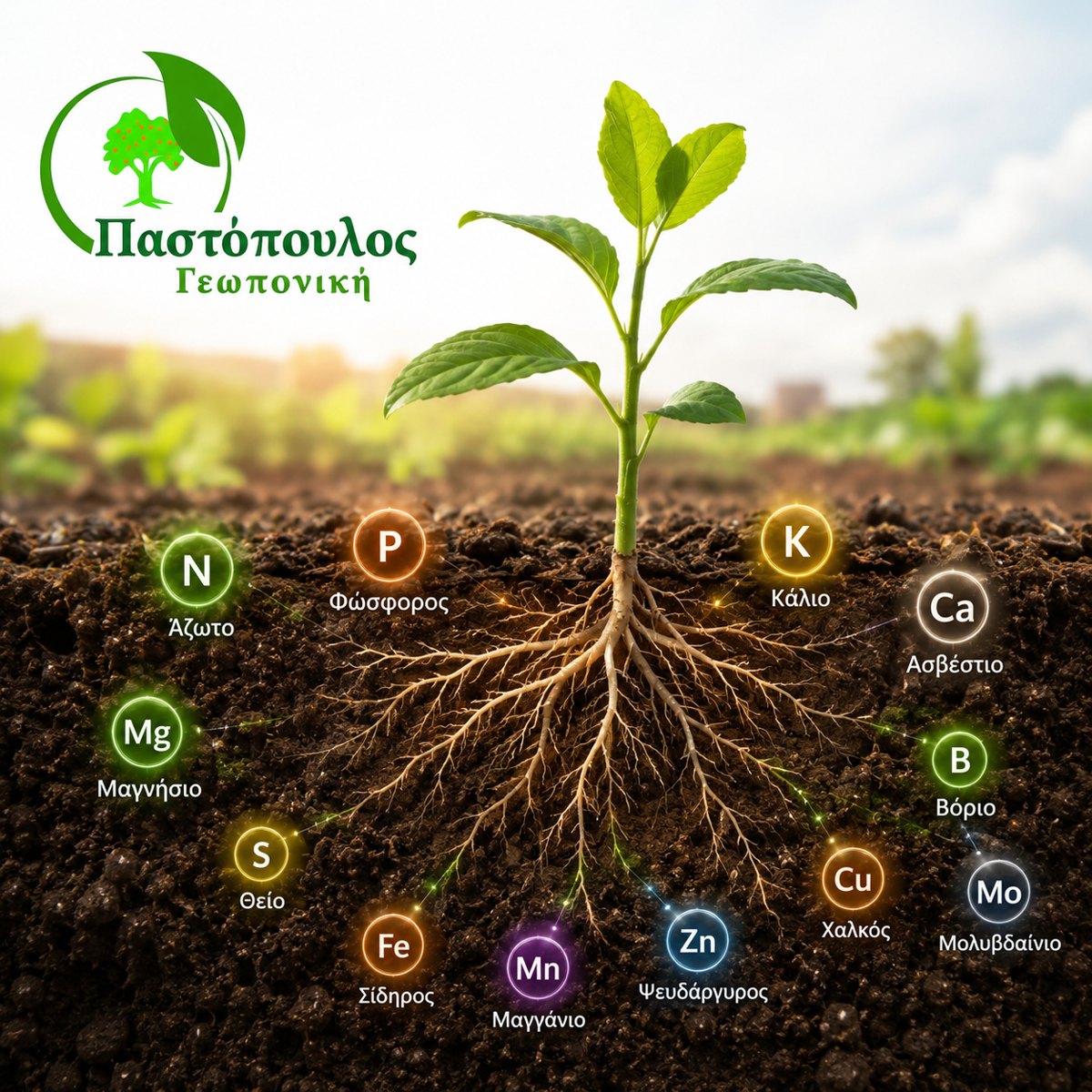
Nutrient antagonisms and synergies, with a per-element tool
The arrow diagram in every fertiliser leaflet does not stand up scientifically. The antagonisms are real, but they act on two separate levels, in the soil and inside the plant, and the same element can be antagonistic on one and synergistic on the other. With a tool showing the documented relationships of each element.
Zeolite in agriculture: what is documented and what is not
It is a cation exchanger, it holds ammonium and potassium, not nitrate. The rates that work are tens of tonnes per hectare, not hundreds of kilos. And erionite is a Group 1 carcinogen.
Leonardite in agriculture: properties, rates and what the law says
Leonardite is oxidised lignite with up to 85% humic acids, but pH below 3, up to 6% sulphur and almost no phosphorus. What the analyses and meta-analyses show, where it delivers and where it does not, and what Regulation (EU) 2019/1009 and the organic farming rules require.