
Cossus cossus, the goat moth that hollows out fruit trees
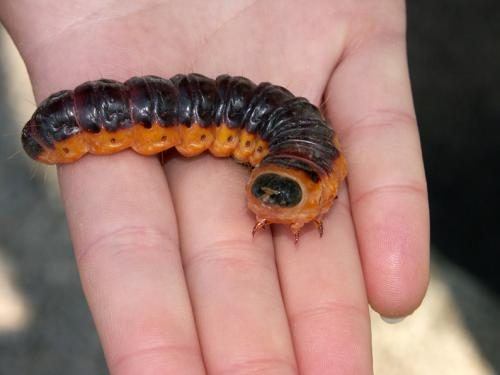
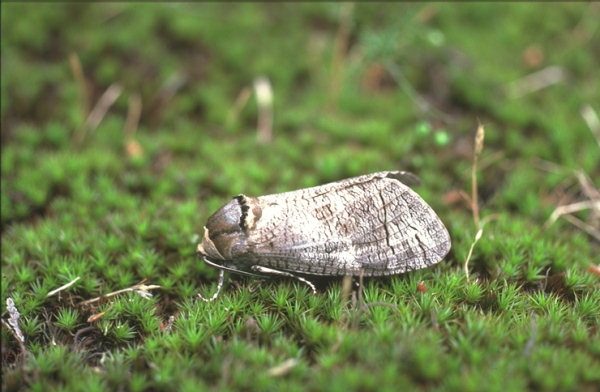 Probably the largest insect attacking fruit trees in Greece. Females have a wingspan of up to 100 mm; males are smaller. The moth is ash-grey to brown and on many hosts is an exact match for the bark of the trunk. The larva — the damaging stage — reaches 10 cm in length. It is pink on the back and flanks, with a black prothoracic plate. Take care: the larva can bite and the bite is painful. Do not handle it without gloves.
2) Kill mechanically every larva that is visible, doing as little damage to the wood as possible.
3) Use a length of wire to reach and kill those still inside the galleries.
4) Where damage is severe, a trunk drench may be considered. The organophosphate named in the original Greek text (chlorpyrifos) has not been approved in the European Union since 2020 and must not be used. Any trunk treatment has to rely on a product currently authorised in Greece for the crop and the pest; the approvals are searchable at fyto.plantprotect.gr.
5) In Italy, cotton buds are dipped in an insecticide and pushed into the galleries.
6) Entomopathogenic nematodes are an alternative to a chemical treatment. The nematodes are suspended in water in a bottle and delivered through a fine tube into the holes in the trunk where the larva is working.
7) Where the attack is in a scaffold limb rather than the trunk, remove the limb and burn it.
Related articles
Nutrient antagonisms and synergies — with a per-element tool
The arrow diagram in every fertiliser leaflet does not stand up scientifically. The antagonisms are real, but they act on two separate levels — in the soil and inside the plant — and the same element can be antagonistic on one and synergistic on the other. With a tool showing the documented relationships of each element.
Zeolite in agriculture: what is documented and what is not
It is a cation exchanger — it holds ammonium and potassium, not nitrate. The rates that work are tens of tonnes per hectare, not hundreds of kilos. And erionite is a Group 1 carcinogen.
Leonardite in agriculture: properties, rates and what the law says
Leonardite is oxidised lignite with up to 85% humic acids — but pH below 3, up to 6% sulphur and almost no phosphorus. What the analyses and meta-analyses show, where it delivers and where it does not, and what Regulation (EU) 2019/1009 and the organic farming rules require.