
Annual cultural practice for kiwifruit
Savvas Pastopoulos, Agronomist MSc, Pastopoulos Agronomics
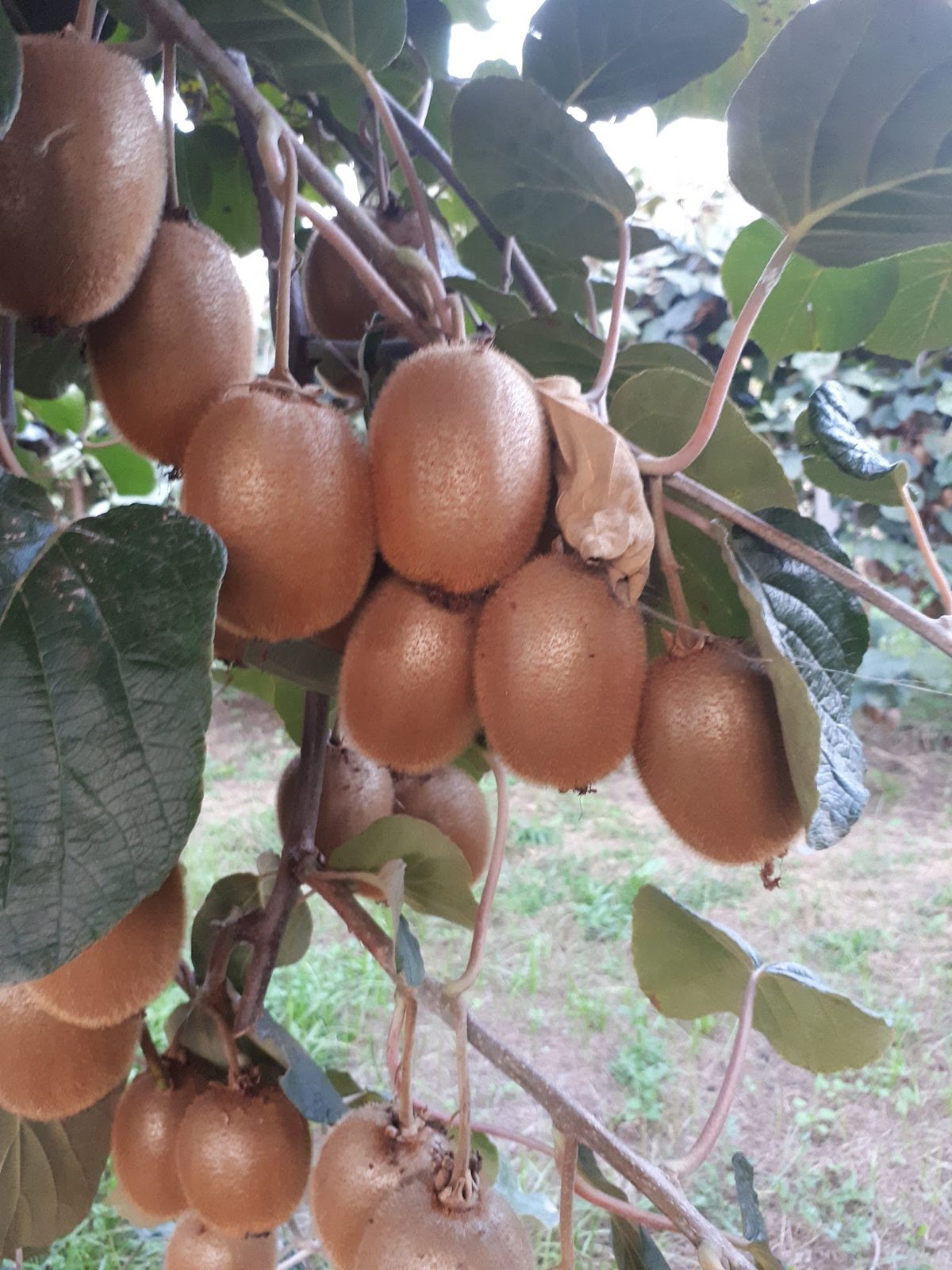
Kiwifruit is a subtropical species with high soil requirements. It needs support on posts and wires, and it is trained in two systems, the T-bar and the pergola. The crop is expensive to run and demands a high level of technical skill in training, summer pruning and fertilisation.
1. Soil, water and nutrition
Kiwifruit requires soils that are fertile and slightly acid. The Oregon State University kiwifruit growing guide for the Pacific Northwest of the United States gives an optimum soil pH in the range 5.6 to 6.0 [23]. Tolerance of active calcium carbonate is limited and the threshold applied in practice on Greek holdings sits low; no published Greek threshold value for calcium carbonate was found, and the limit is set case by case from the soil analysis.
It is a water-loving species and its water requirements are large. Through the summer it needs regular irrigation, applied more frequently during heatwaves. No published Greek irrigation programme with a fixed interval was found, and the interval follows from the soil, from the irrigation system and from the evapotranspiration of the area. Because of the shallow root system, regular fertilisation is essential, since the leaching of elements such as nitrogen is heavy.
Base fertilisation is covered in the dedicated article on kiwifruit nutrition.
2. Where and how the vine fruits
Kiwifruit carries its fruit on the shoots of the current season, which emerge from one-year-old canes, that is, from the previous season's growth. The PNW 507 guide puts it directly: "flowers and fruit are produced on shoots that grow from one-year-old canes, that is, last year's growth" [23]. Understanding this two-step sequence is the key to pruning.
The same guide notes that, while many buds on the one-year-old cane are fruitful, "the most basal buds on many canes are often vegetative and will produce a shoot with no flowers" [23]. That is the documented reason why very short pruning retains precisely the buds that will not flower.
The only detailed node-by-node measurement that was found concerns a different species and a different country, and it is given as such: in Actinidia arguta "Ananasnaya" in Oregon, United States, budbreak rose from 2% at the 1st node to 71% at the 18th node of the cane, while the flowers on the shoot appeared mainly from the 6th to the 12th node [24]. No corresponding published measurement for Hayward under Greek conditions was found; the node positions used in practice on Greek holdings rest on field experience.
On cane length, an experimental study on kiwifruit found that pruning to up to 12 nodes per cane, combined with thinning to up to 6 fruit per fruiting shoot, gave the greatest cane diameter and a budbreak percentage of 86.79% [30].
The inflorescences carry either a single flower or three flowers, a central one and two smaller ones to the right and left, which are removed at thinning. Each kiwifruit flower carries about 40 stigmas, as recorded in a study on Hayward in Japan [6].
3. Pollination, the decisive factor
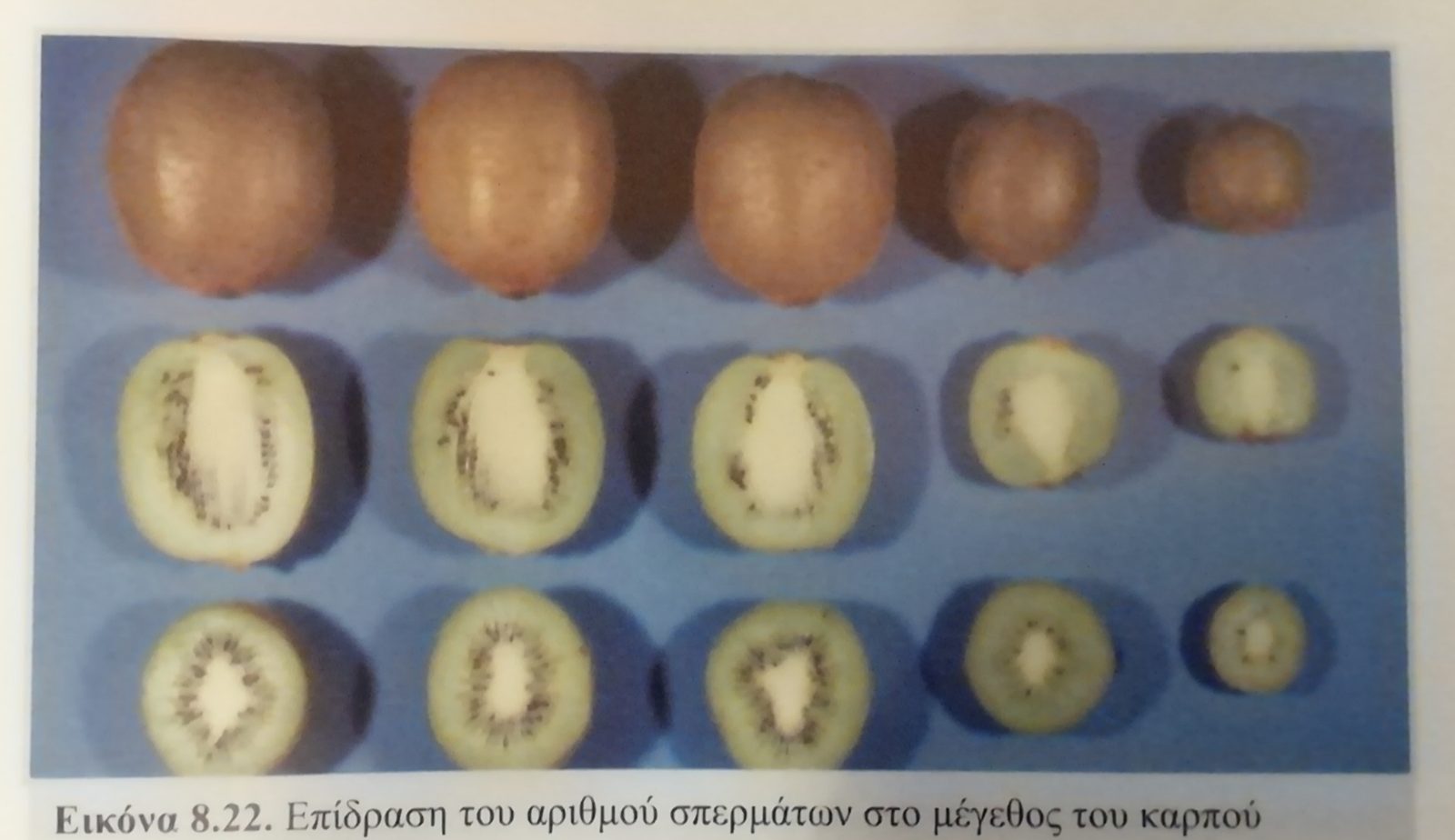
Correct pollination is among the most important parameters for a crop that is good in both quality and quantity. The number of seeds per fruit is directly linked to the final size.
This relationship has been measured in Greece as well. In a two-year study in the area of Pieria on the factors that determine fruit size in Hayward, a strong correlation was found between the number of seeds per fruit and fruit size, with r = 0.816, while "fruits containing more than 1,000 seeds can reach a very good size" [1].
- The relationship is confirmed quantitatively elsewhere too: in the yellow-fleshed kiwifruit "Haegeum" in South Korea, each additional seed added 0.063 to 0.072 grams of fruit weight (R² = 0.68–0.72, N = 1,800) [7].
- In the same study, once seed number was equalised within the range 500–700, the weight differences between pollination methods ceased to be statistically significant [7], that is, the method counts only through the seeds it achieves.
- In an experiment on Hayward in Japan, the fully pollinated controls carried on average about 979 seeds per fruit [6]. The figure of 1,200 seeds that circulates as typical for Hayward was not confirmed in any source that opened, and for that reason it has been removed.
In practice, a small kiwifruit is not always a matter of fertilisation or irrigation. Very often it is a matter of pollination, and the diagnosis is easily made, by cutting open a few fruit and counting the seeds.
How many bee visits a flower needs
This number is not a single value and differs sharply between cultivars. According to the New Zealand literature, as summarised in an open-access paper: "the pollination requirements of green-fleshed kiwifruit such as Hayward can be met with a single bee visit (Donovan & Read, 1992), but may require up to 40 visits (Goodwin & Haine, 1995)", while "yellow-fleshed kiwifruit requires only six visits" [2].
The figure of "30 visits" that appeared in the earlier text has been removed, because it corresponds to no published measurement that was found. What stands is the range and its conclusion: in Hayward, pollination may demand several times more visits than in the yellow-fleshed cultivars, so every factor that reduces bee activity costs disproportionately.
Artificial pollination
Where natural pollination is not sufficient, artificial pollination is applied. The pollen rates given in the earlier text (1.5 grams per 1,000 flowers, 1.6 kg per hectare, 400 grams per hectare in Chile) have been removed: none of them was found in a source that opened. In their place stand the rates that are actually published, with the country and the method inside the sentence.
- In New Zealand trials on Hayward with a pollen blower, rates from 200 to 1,800 grams of pollen per hectare were tested. The finding was that "increasing the rate of pollen blown onto the flowers did not increase mean fruit weight or seed number" [3].
- With pollen dispensers at the hive entrance, at 16 grams per hive per hour and with eight hives per hectare over a five-day flowering peak, the quantity required was calculated at 640 grams per hectare. Bees with dispensers gave on average 515 seeds per fruit, against 156.6 seeds with unassisted bee pollination [3].
- For wet pollination on Hayward in Italy, a rate of 600 grams of pollen per hectare in a single application is reported [4].
On the relationship between pollen and seeds, the same source notes that, for a 100-gram fruit with more than 1,000 seeds, "about ten times as many pollen grains are required" [4]. The figure of "2,000 to 3,000 pollen grains per stigma" has been removed: the study to which it was attributed does not contain it.
4. Table 1. Operations and sprays by phenological stage
Operations are tied to the phenological stage and not to a date. The months that follow are indicative for the northern Greek growing zones and shift by area and by year. No date in this text constitutes a published phenological datum for Greek conditions.
Dormancy, before bud swell
- Sprays with copper products for protection against bacterial canker of kiwifruit and against fungal diseases. Bacterial canker is a very serious disease and is analysed in section 5.
- Sprays with calcium polysulphide (lime sulphur) on holdings where mealybug has been detected. The 25-day interval from oil applications that was previously stated has been removed, because it was not found in any source; the incompatibility interval in force is set by the label of each product and is checked in the approvals database of the Greek Ministry of Rural Development and Food (YPAAT), which is valid in Greece only [29].
- Towards the end of dormancy the base fertilisation is applied, on the basis of the soil analysis.
On Greek kiwifruit holdings with insufficient winter chill, hydrogen cyanamide has historically been used to break dormancy. The substance is not approved in the European Union: in the Pesticide Properties Database of the University of Hertfordshire, cyanamide appears with the status "Not approved" and the date "Expired" under Regulation (EC) 1107/2009, the earlier national authorisations of Member States being no longer in force [28].
The only lawful route for such a substance is Article 53 of Regulation (EC) 1107/2009, which, as quoted verbatim in a judgment of the Court of Justice of the European Union, provides: "By way of derogation from Article 28, in special circumstances a Member State may authorise, for a period not exceeding 120 days, the placing on the market of plant protection products, for limited and controlled use, where such a measure appears necessary because of a danger which cannot be contained by any other reasonable means" [27].
Consequently, such a use is lawful only where a national emergency authorisation is in force, only for the 120 days that it specifies and only on its terms. The check is made separately each year in the approvals database of the Greek Ministry of Rural Development and Food (YPAAT), which is valid in Greece only [29]. An authorisation granted in a past year does not apply to the next.
Bud swell to budbreak
- Before bud swell the last copper spray is placed.
- As soon as the bud reaches the woolly stage, the spray against mealybug with summer oil is made.
- On holdings with a high pH, phosphate fertilisation is applied in a form of increased availability, since the solubility of phosphorus falls. The rate of 50 to 100 kg per hectare that was previously stated has been removed: no source documenting it was found, and the quantity follows from the soil and leaf analysis of the particular holding.
Start of growth
- At the start of growth, and where low temperatures prevail, amino acids are applied as a foliar spray or through the soil by fertigation. No published measurement of the performance of this practice on kiwifruit was found and the application is described as field experience.
- Irrigation begins in this period, and it has to remain regular right through to harvest.
- In areas with a history of bacterial canker the first preventive copper application is made. In rainy periods the applications are repeated, always within the annual copper limit analysed in section 5 [12].
Pre-flowering and flowering
- The first shoot tipping is done before flowering, leaving two leaves above the last fruit, on all shoots arising from the wire downwards. The practice rests on the fact that the flowers are carried at the first nodes of the current season's shoot [24].
- At the bud stage, thinning is carried out, removing the lateral fruit and the flat "butterflies". The dates for the start of flowering have been removed and replaced by the phenological stage: the start of flowering shifts by area and by year, and no published Greek phenological calendar was found.
This rule is sound as practice, but its documentation is more complex than it is often presented to be. In the earlier text, three "documented mechanisms" were attributed to sources which, when opened, do not say that. What those sources do say is set out below.
The practical conclusion does not change: given that the final size of the fruit is set to a large degree by the number of seeds [1] [7], and the number of seeds by the success of pollination, the risk from an intervention during flowering is disproportionate to its benefit.
Mechanism 1, Water on the stigma reduces the performance of artificial pollination
In an artificial pollination experiment on tetraploid yellow-fleshed cultivars in South Korea, the authors conclude: "immediate pollination after water spraying resulted in low pollen viability, owing to the high moisture of the pistil", and the treatments with immediate water spraying gave "the lowest fruit weight, dry matter, firmness and seed number" by comparison with waiting one hour after the spray [5].
The same study recommends that pollination work should not be carried out early in the morning, "as dew is often formed on the pistil at dawn", and notes that "raindrops or dew on the stigma may reduce the effectiveness of artificial pollination with dry pollen" [5]. The wording about a "sunny versus a rainy day" has been removed: the study made no such comparison.
A serious correction. In the earlier text, the complete inhibition of pollen germination by copper products was attributed to the Pacific Northwest plant disease management handbook. That text does not deal with copper products in relation to pollen at all, and its conclusion is in fact the opposite of absolute: "fungicides applied during bloom do not pose a significant risk to fruit set in the cropping systems studied" [8]. What it does report is that "captan and ferbam reduced cherry pollen germination, while sulphur did not", and that "apple pollen returned to normal levels within 24 to 48 hours of the fungicide application" [8]. The percentages "12–31%" have been removed, as has the claim that wet residues act more strongly: neither of the two values was found in a source that opened.
Complete inhibition of pollen germination by copper products has indeed been measured, but in a different species and a different country, and it is given as such: in pollen of date palm (Phoenix dactylifera) in Morocco, where germination of the control pollen was 85.52% and 87.23% depending on the genotype, "in vitro pollen germination was completely inhibited in all fungicide-treated samples, from the first assessment onwards", with three copper products [9]. No corresponding published measurement for kiwifruit pollen was found. The precaution over copper products during kiwifruit flowering remains reasonable, but it is described here as a precaution and not as a measured quantity.
Mechanism 3, Protection of the bees
The documented rule concerns insecticides more than fungicides. UC IPM in California states as a best management practice that "the application of any pesticide to plants that are in bloom is to be avoided, especially insecticides and miticides", and that "tank mixing of insecticides or miticides with fungicides is not permitted in an application where plants, including weeds, are in bloom" [10].
For the cases where an intervention is unavoidable, the same source gives a specific way out: "if a fungicide or herbicide application is warranted during bloom and is permitted by the label and by law, the application is made between sunset and midnight, when bees are not active" [10]. Given that Hayward may demand up to forty bee visits per flower [2], every reduction in bee activity translates into fewer seeds and smaller fruit.
After petal fall
- Soil application of calcium, where calcium is deficient. The time window is analysed in section 6.
- Large amounts of potassium are avoided in this period, because of the antagonism with calcium.
- At the cherry-size fruit stage, a foliar application may be made of products containing cytokinin of natural origin. For any product based on Bacillus amyloliquefaciens or on another microorganism, the existence of a national authorisation for kiwifruit and for the specific target is checked before application in the approvals database of the Greek Ministry of Rural Development and Food (YPAAT), which is valid in Greece only [29].
Fruit swelling
- At this stage, where it is used, the application of the plant growth regulator forchlorfenuron (CPPU) is placed, sprayed directly onto the fruit.
- Fertilisation with a compound crystalline fertiliser is placed at this stage.
- The foliar calcium applications follow. The programme tested on a commercial Hayward holding at Naoussa comprised sprays every 30 days, starting on 2 June [20]. The interval of "ten days after the hormone" has been removed as undocumented.
Timing and method of application. The CPPU label for kiwifruit in the United States specifies: "The single application is made when fruit length averages 30 to 45 millimetres. Fruit are generally in this range 2 to 3 weeks after bloom", with an explicit prohibition on dipping the fruit [32]. The figure of "21 days from petal fall" has been replaced by the measurable criterion of fruit size, which is what the label states.
It does not move. Coverage has to be meticulous and aimed at the fruit itself, since the label provides for application in a dilute spray directly onto the fruit [32]. No published measurement of movement of the substance from the leaves to the fruit was found, and the claim is stated here as a practical consequence of the application instructions.
Approval of the active substance is not approval of a product. The active substance is approved in the European Union and its approval was renewed by Commission Implementing Regulation (EU) 2018/679 [26]. Product authorisations, however, are national: before any application, a check is made in the approvals database of the Greek Ministry of Rural Development and Food (YPAAT), valid in Greece only, for whether a product is authorised in Greece on kiwifruit and on what terms [29]. The maximum residue level of 0.05 mg/kg that was previously stated has been removed: it could not be confirmed in a source that opened, and the limit in force is checked in the residues database of the European Commission. The same holds for every growth regulator: approval of the substance in the European Union implies neither the existence of a product in Greece nor an authorisation for kiwifruit. The label always prevails.
Summer period of high temperatures
- Very high temperatures occur more frequently in this period. The foliar application of amino acids ahead of the heatwaves is used as stress support; no published measurement for kiwifruit was found and the practice is stated as field experience.
- The last soil application of fertiliser is placed well before the start of ripening, so that growth is not prolonged. The date "10 July" has been removed, because the operation is tied to the phenological stage and not to the calendar.
- The foliar calcium products continue. In the Greek experiment at Naoussa, all treatments raised the calcium concentration in leaves and fruit relative to the control, and firmness rose from 6.49 to between 7.44 and 7.58 kg/cm² [20].
- Where it is judged necessary, a second shoot tipping is carried out.
- If the brown marmorated stink bug appears, a spray is made with a product authorised in Greece for kiwifruit and for that specific pest [29]. The subject is analysed in our article on Halyomorpha halys.
Ripening, before harvest
- Irrigation continues normally. The fruit is still in the phase of swelling and of dry matter accumulation, and dry matter is the index that determines the flavour on the shelf [22].
- Monitoring of ripening with sample measurements of soluble solids and dry matter, so that the harvest date is determined against the limits in section 7 [21].
- Monitoring for the brown marmorated stink bug continues. The claim of a "second peak" in the population has been removed: no published Greek datum on generations was found.
- Inspection of the canopy for botrytis and bacterial attacks, especially after rain [13].
Harvest and postharvest
- The pre-harvest intervention against botrytis carries particular weight, because the damage shows up after the produce has left the orchard. UC IPM in California specifies for kiwifruit: "One to two applications beginning 14 days before harvest, with a seven- to ten-day interval before harvest" [25]. The figure of "20 days" has been replaced by the published recommendation, with the country stated.
- Careful handling at harvest governs postharvest behaviour. According to UC IPM, "infections often develop from the stem end, where the stalk breaks off at harvest, or from surface wounds created during harvest and handling", and "wound curing", that is drying of the stem end before packing and cooling, is proposed as a measure that reduces the incidence of grey mould [25].
- After harvest a copper application is made; the wounds of harvest and of leaf fall are a main entry point for the bacteria [13].
- Postharvest fertilisation is optional and is placed before the first frost.
Sources: 1 2 5 7 8 9 10 12 13 20 21 22 24 25 26 27 28 29 31 32
5. Bacterial canker (Psa)
Bacterial canker of kiwifruit is caused by Pseudomonas syringae pv. actinidiae, known internationally as Psa. According to the EPPO datasheet, "P. syringae pv. actinidiae was first observed in 1992 in central Italy", while "severe outbreaks of the disease were repeatedly observed in Italy in the summer of 2007 and in the following years, causing massive crop losses" [13]. The date "2008" that was previously stated has been corrected to 2007, in line with the source. In Greece, the same datasheet reports that outbreaks of the disease were recorded in 2014 [13].
The symptoms
- Leaf spots: according to EPPO, "minute angular and water-soaked spots may develop early in the season, later they become necrotic and develop into a coalescent necrosis; chlorotic haloes may surround the developing spots" [13].
- Cankers with exudates on the arms and the trunk: "the plant exudates are at first whitish and creamy, later they turn yellowish or yellow-orange and then reddish to brown" [13].
- Necrosis of the flowers: "flowers and flower buds may turn dark, dry up and drop" [13].
- Dieback of shoots and arms: "extensive dieback of twigs and vines is common" [13].
The evidence in favour of copper. In field trials on a kiwifruit holding in northern Italy in 2011 and 2012, "copper hydroxide and the mixtures of copper hydroxide with copper oxychloride significantly reduced foliage symptoms by 70–80% compared with the control", with "low phytotoxicity" [14].
The threat is not in the future and it is not far away. In a study of 22 Psa strains from the Prefecture of Pella in northern Greece, all of the strains grew at copper concentrations of at least 200 μg/mL (0.8 mM), that is they were resistant by the threshold applied in the study; two strains (9.1%) survived at 400 μg/mL, and 27.3% in total showed values above 400 μg/mL. In the same tests, three commercial copper products "were not able to fully control Psa, most probably due to the observed resistance", while defence activators "showed promising results in reducing symptom severity" without eliminating the disease [15]. This changes the strategy: in northern Greece, copper cannot be taken as reliably effective.
The phenomenon is not Greek alone. On two organic kiwifruit holdings in north-western Portugal, "copper resistance was widespread (53.3% of the isolates with MIC ≥ 0.8 mM)", with the recording of "the first indication of a highly copper-resistant Psa strain in Portuguese kiwifruit orchards" [17]. The Pacific Northwest plant disease management handbook notes more generally that "bacterial resistance to copper products has been documented and limits their usefulness" [11].
Where research is heading: towards biological agents and combinations. In trials in New Zealand, "the combination of ASM + CG163 had greater efficacy (75%) than ASM (55%) or CG163 (40%) alone", that is the combination of a defence activator with the antagonistic fungus Aureobasidium pullulans [16]. In the Portuguese study, Bacillus pumilus "consistently suppressed the growth of the pathogen" with "strong antagonism across all methods" [17]. The available solutions change continuously, and the authorised option is checked each time in the database of the Greek Ministry (YPAAT), whose authorisations are valid in Greece only [29].
The legal limit. Commission Implementing Regulation (EU) 2018/1981 provides explicitly: "Only uses resulting in a total application of maximum 28 kg of copper per hectare over a period of 7 years may be authorised" [12]. That works out at an average of 4 kg of metallic copper per hectare per year.
Phytotoxicity. The Pacific Northwest handbook reports that "phytotoxicity may occur on some crops", that Bordeaux mixture "is generally used as a dormant spray because it can burn young tissue", and that "good, quick drying conditions are important" in order to avoid damage [11]. No published record of splitting of kiwifruit bark caused by painting the trunk with copper mixtures was found; avoiding the practice remains a reasonable precaution and is stated here as a field observation, not as a measured finding.
Sources: 11 12 13 14 15 16 17 29
6. The calcium window
Calcium moves towards the fruit essentially only through the xylem. In a review of the role of calcium in kiwifruit: "the mobility of Ca²⁺ through the phloem is negligible, the accumulation of Ca²⁺ in above-ground sink organs depends on the xylem flow", which in turn is "regulated by the transpirational water flow" [19].
The measurements of the functionality of the xylem bundles in the kiwifruit fruit are clear: "the dye method revealed high functionality of the bundles until about day 10 after flowering. A drastic reduction in the number of functional bundles was recorded around day 20 and, again, around day 55 and day 90. Some recovery was observed between these steps. Almost complete permanent dysfunction was evident at about day 120 and until harvest" [18].
The practical rule is therefore confirmed: calcium moves from the soil into the fruit essentially only during the first 10 to 20 days from flowering, the upper end is set by the drastic fall at day 20 and not by rounding. After that, the calcium concentration in the fruit falls, not because calcium is lost, but because the inflow stops while the fruit keeps growing in volume [18] [19].
What the foliar applications achieve. In the Greek experiment on a commercial Hayward holding at Naoussa, with five calcium products in sprays every 30 days from 2 June, all treatments raised calcium in leaves and fruit, firmness rose from 6.49 kg/cm² in the control to between 7.44 and 7.58 kg/cm², dry matter reached 18.67 to 19.02% in the product combinations against 16.88 to 17.35% in the single products, while the soluble solids remained unchanged (6.79 to 6.92%) [20]. Put another way, the foliar application works on firmness and on storage life, not on sweetness.
7. Harvest indices
The harvest date is not a matter of the calendar but of measurement. The European marketing standard for kiwifruit, in Annex I Part B of Commission Implementing Regulation (EU) 543/2011, sets out two alternative maturity criteria at packing, and a target for entry into the distribution chain [21].
| Index | Minimum value |
|---|---|
| Soluble solids content at packing (alternative criterion A) | 6.2 °Brix |
| Average dry matter content at packing (alternative criterion B) | 15% |
| Soluble solids on entry into the distribution chain | 9.5 °Brix |
The same standard further requires the fruit to be "sufficiently firm; neither soft, nor shrivelled, nor water-soaked" [21].
On some holdings particular plant protection needs may arise, such as dealing with Phytophthora, with root rot, or even with the pest known in northern Greece as zina. In every case, the choice of product is made from those authorised for kiwifruit and for the specific pest in the database of the Greek Ministry (YPAAT), which is valid in Greece only [29].
8. Sources
The numbers in the text refer to the list below. Where only the abstract and not the full text was used, this is stated explicitly.
- [1] Factors affecting the fruit size of "Hayward" kiwifruit. Acta Horticulturae 444:65, International Society for Horticultural Science. A two-year study in the area of Pieria, Greece. Source for the correlation between seed number and fruit size with r = 0.816, and for the finding that fruit with more than 1,000 seeds reach a very good size, under Greek conditions. Abstract.
- [2] Pollinator identity and behavior affect pollination in kiwifruit (Actinidia chinensis Planch.). PeerJ 10:e12963. New Zealand, Hayward and Zesy002. Source for the range of bee visits required per flower: one visit according to Donovan & Read (1992) and up to 40 according to Goodwin & Haine (1995) for Hayward, and six visits for the yellow-fleshed cultivar. Full text.
- [3] Use of pollen blowers and pollen dispensers to pollinate kiwifruit, Kiwifruit Vine Health, New Zealand. Source for the pollen rates of 200–1,800 grams per hectare tested with a blower, for the calculation of 640 grams per hectare with hive dispensers, and for the 515 against 156.6 seeds per fruit. Full text.
- [4] Artificial Pollination in Kiwifruit and Olive Trees, IntechOpen. Experiments on Hayward in Italy (Verona, Cuneo, Latina). Source for the rate of 600 grams of pollen per hectare in single-application wet pollination and for the relationship of "about ten times as many pollen grains" relative to the seeds required. Full text.
- [5] Pollen application methods affecting fruit quality and seed formation in artificial pollination of yellow-fleshed kiwifruit. Horticulturae 8(2):150. South Korea (Jeju), the tetraploid cultivars "Halla Gold" and "Sweet Gold". Source for the finding that pollination immediately after a water spray gives low pollen viability and the lowest values of weight, dry matter, firmness and seed number, and for the recommendation to avoid working while dew is on the pistil. Full text.
- [6] Effects of pollination of some stigmas in kiwifruit flowers on seed distribution and fruit quality. The Horticulture Journal 94(2). Japan, Hayward. Source for the finding that the kiwifruit flower carries about 40 stigmas and for the roughly 979 seeds per fruit in the fully pollinated controls. Full text. Note: this study does not
- [7] Pollination method affects gold kiwifruit (Actinidia chinensis) fruit weight predominantly through seed set. Horticulturae 12(6):739. South Korea, "Haegeum". Source for the 0.063–0.072 grams of weight per additional seed (R² = 0.68–0.72, N = 1,800) and for the finding that, with seed number equalised at 500–700, the weight differences between pollination methods cease to be significant. Full text.
- [8] Fungicide and pollen interactions, Pacific Northwest Plant Disease Management Handbook. Source for the finding that captan and ferbam reduced cherry pollen germination while sulphur did not, for the recovery of apple pollen within 24 to 48 hours, and for the conclusion that fungicides applied during bloom did not pose a significant risk in the systems studied. Full text. Note: this source does not deal with copper products in relation to pollen.
- [9] Effects of copper-based fungicides on pollen viability and germination of date palm (Phoenix dactylifera L.). Vegetos. Morocco. Source for the complete in vitro inhibition of date palm pollen germination by three copper products, with control germination of 85.52% and 87.23%, and for the finding that cytological viability was not affected. Abstract.
- [10] Best management practices to protect bees from pesticides, UC Statewide IPM Program, California. Source for the recommendation to avoid any spray on plants in bloom, especially insecticides and miticides, for the prohibition on tank mixing insecticides with fungicides during bloom, and for application between sunset and midnight where an intervention is unavoidable. Full text.
- [11] Copper-based bactericides and fungicides, Pacific Northwest Plant Disease Management Handbook. Source for the phytotoxicity of copper, for the finding that Bordeaux mixture can burn young tissue, for the importance of quick drying conditions, and for the documented bacterial resistance to copper products. Full text.
- [12] Commission Implementing Regulation (EU) 2018/1981, renewal of the approval of the copper compounds. Source for the limit of 28 kg of copper per hectare over a period of 7 years, from which the average of 4 kg per hectare per year follows. Full text.
- [13] EPPO Datasheet: Pseudomonas syringae pv. actinidiae, EPPO Global Database. The main source for the biology and the symptoms of bacterial canker: first observation in 1992 in central Italy, severe outbreaks from the summer of 2007, recording in Greece in 2014, and the verbatim descriptions of the symptoms on leaves, cankers, flowers and shoots. Full text.
- [14] Efficacy of different chemical and biological products in the control of Pseudomonas syringae pv. actinidiae on kiwifruit. Australasian Plant Pathology. Field trials on a holding in northern Italy in 2011 and 2012. Source for the 70–80% reduction of foliage symptoms by copper hydroxide and its mixtures with copper oxychloride, with low phytotoxicity. Abstract.
- [15] Copper resistance in Pseudomonas syringae pv. actinidiae strains from the Prefecture of Pella, northern Greece, and a comparison of the effectiveness of several commercial products to control it. Agriculture 15(2):157. Source for the finding that all 22 Psa strains from the Prefecture of Pella grew at at least 200 μg/mL of copper, for the percentages of 9.1% and 27.3% at higher concentrations, and for the inability of three commercial copper products to fully control Psa under those Greek conditions. Full text.
- [16] Integrated use of Aureobasidium pullulans strain CG163 and acibenzolar-S-methyl for management of bacterial canker in kiwifruit. Plants 8(8):287. New Zealand. Source for the 75% efficacy of the combination, against 55% for the defence activator and 40% for the biological agent alone. Full text. Note: the study was published in Plants and not in Plant Disease, as was previously stated.
- [17] Functional profiling of kiwifruit phyllosphere bacteria: copper resistance and biocontrol potential. Microorganisms 14(2):321. Two organic kiwifruit holdings in north-western Portugal. Source for the spread of copper resistance to 53.3% of the isolates, for the first recording of a highly resistant Psa strain in Portugal, and for the consistent suppressive action of Bacillus pumilus. Full text.
- [18] Developmental changes in xylem functionality in kiwifruit fruit: implications for fruit calcium accumulation. Acta Horticulturae 610:25, ISHS. Source for the timetable of xylem functionality in the fruit: high until day 10 after flowering, a drastic reduction around day 20 and again at days 55 and 90, and almost complete permanent dysfunction at about day 120 until harvest. Abstract.
- [19] Understanding the role of calcium in kiwifruit: ion transport, signaling, and fruit quality. Horticulturae 11(3):335. Source for the finding that calcium mobility in the phloem is negligible and that its accumulation in the fruit depends on the xylem flow, which is regulated by transpiration, and for the link between the decline in calcium inflow and the fall in hydraulic conductivity. Full text.
- [20] Foliar calcium fertilizers impact on several fruit quality characteristics and leaf and fruit nutritional status of the "Hayward" kiwifruit cultivar. Agronomy 11(2):235, copy hosted by the Institute of Deciduous Trees. A commercial kiwifruit holding at Naoussa in northern Greece. Source for the programme of sprays every 30 days starting on 2 June, for the increase in firmness from 6.49 to 7.44–7.58 kg/cm², for the dry matter of 18.67–19.02% in the combinations against 16.88–17.35% in the single products, and for the unchanged soluble solids of 6.79–6.92%. Full text.
- [21] Commission Implementing Regulation (EU) 543/2011, Annex I, Part B, specific marketing standard for kiwifruit (consolidated text). Source for the two alternative maturity criteria at packing, at least 6.2 °Brix or an average dry matter of 15%, for the target of 9.5 °Brix on entry into the distribution chain, and for the requirement of sufficient firmness. Full text.
- [22] Harvest and postharvest practices, New Zealand Kiwifruit Growers Incorporated, Kiwifruit Book, chapter 6. Source for the finding that dry matter consists largely of starch which is converted into sugars during ripening, and for why a higher dry matter predicts a tastier fruit. Full text.
- [23] PNW 507, Growing kiwifruit: a guide to kiwiberries and fuzzy kiwifruit for Pacific Northwest producers, Oregon State University Extension Service. The main source for the fruiting structure and for pruning: flowers and fruit on shoots from one-year-old canes, basal buds often vegetative and giving a shoot with no flowers, and an optimum soil pH of 5.6 to 6.0. Full text.
- [24] Flowering and fruiting morphology of hardy kiwifruit, Actinidia arguta, Tiyayon & Strik, Oregon State University. Actinidia arguta "Ananasnaya", Oregon, United States. Source for the rise in budbreak from 2% at the 1st node to 71% at the 18th node of the cane and for the appearance of the flowers mainly from the 6th to the 12th node of the shoot, in a different Actinidia species and a different country. Full text.
- [25] Botrytis fruit rot / Kiwifruit, Pest management guidelines, UC Statewide IPM Program, California. Source for the finding that infections start at flowering and continue through ripening and storage, for their origin at the stem end and in the wounds of harvest, for the recommendation of one to two applications beginning 14 days before harvest with a seven- to ten-day interval, and for the drying of the stem end before packing. Full text.
- [26] Commission Implementing Regulation (EU) 2018/679 of 3 May 2018, renewing the approval of the active substance forchlorfenuron. Source for the fact that the approval of the active substance forchlorfenuron was renewed at Union level, and for that alone; the regulation does not constitute a product authorisation in any Member State. Metadata and title of the act.
- [27] Judgment of the Court of Justice of the European Union in Case C-162/21, in which Article 53(1) of Regulation (EC) 1107/2009 is quoted verbatim. Source for the provision that a Member State may, by way of derogation from Article 28, authorise for a period not exceeding 120 days the placing on the market of a plant protection product for limited and controlled use, where this is necessary because of a danger which cannot be contained by any other reasonable means. Full text.
- [28] Cyanamide, Pesticide Properties Database (PPDB), Agriculture & Environment Research Unit, University of Hertfordshire. Source for the fact that cyanamide is not an approved active substance in the European Union under Regulation (EC) 1107/2009, with the status "Not approved" and the date "Expired", and for the fact that the earlier Member State authorisations are no longer in force. Full text.
- [29] Κατάλογοι φυτοπροστατευτικών προϊόντων και βιοκτόνων [Lists of plant protection products and biocides], Διεύθυνση Προστασίας Φυτικής Παραγωγής, Υπουργείο Αγροτικής Ανάπτυξης και Τροφίμων [Directorate for the Protection of Plant Production, Ministry of Rural Development and Food, YPAAT] (in Greek). The only valid source for whether a product is authorised in Greece on kiwifruit, for which pest, at what rate and with what pre-harvest interval. Every rate and every active substance in this article is checked there before any application. These authorisations are valid in Greece only and do not apply in any other country. Full text, dynamic database.
- [30] Appraisal of extended cane length and fruit thinning strategies on the performance of growth, yield and quality of kiwifruit. Heliyon. Source for the finding that pruning to up to 12 nodes per cane, with thinning to up to 6 fruit per fruiting shoot, gave the greatest cane diameter and a budbreak percentage of 86.79%. Abstract; the country in which the work was carried out is not stated in the freely accessible part and for that reason it is not stated here.
- [31] Adjustment of respiration strategies in roots contributes to the waterlogging resistance in Actinidia valvata "Shuixiu". International Journal of Molecular Sciences 27(7):3147. Source for the characterisation of kiwifruit as one of the fruit species most sensitive to waterlogging and for the destruction of 2,866.67 hectares of kiwifruit in Sichuan Province, China, by the rainfall of 2018. Full text.
- [32] CPPU plant growth regulator label, forchlorfenuron, US Environmental Protection Agency. Source for the timing and method of application of forchlorfenuron on kiwifruit in the United States: one application when fruit length averages 30 to 45 millimetres, generally 2 to 3 weeks after bloom, in a dilute spray and with an explicit prohibition on dipping the fruit. Full text. This is a United States label and it does not apply in Greece; the Greek label is checked in [29].
Related articles
Training kiwifruit: T-bar and pergola
The architecture of the kiwifruit vine and why both training systems follow from it. T-bar and pergola with their dimensions, advantages, costs and a comparison in numbers. Training from the day of planting: planting high, a first season for the root with tipping at one metre, cutting back low the following spring and taking the trunk up in the second season, leaders, winter and summer pruning, males and the support structure. Three diagrams, a table of mistakes, and the gaps that remain for Greece. A field observation from Giannitsa on planting distances.
Chilling hours: the three models and when each one tells the truth
Chilling Hours, Utah Chill Units or Dynamic Chill Portions, what each measures, which suits which climate and season, why a chill portion does not convert into hours, and how the divergence between the three is read. The calculation itself lives in a separate tool.

Kiwifruit bud physiology and flower differentiation
Flowering is decided in June and July of the previous year. What is inside the bud, why the first five nodes do not count, the confusion between chilling hours and chilling units, and how the annual 120-day emergency authorisation actually works.