
Spotted wing drosophila (Drosophila suzukii) in cherries
Savvas Pastopoulos, Agronomist MSc, Pastopoulos Agronomics, Neos Mylotopos, Pella, Greece
There are not many words needed to describe one of the most destructive fruit insects in the world. This fruit fly is a dipteran that establishes itself wherever it first appears. It was detected in Greece a few years ago and has spread widely, into almost every cherry-growing district.
1. Identifying the insect
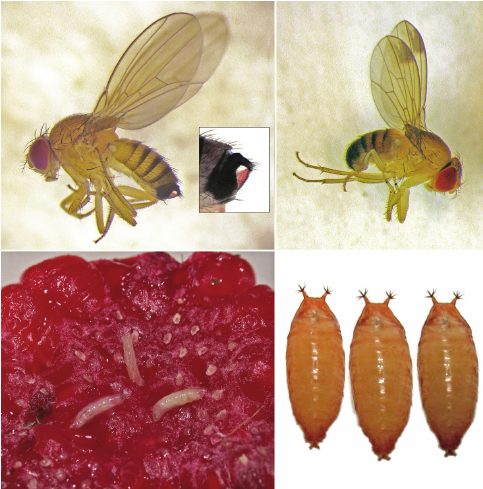
The species is Drosophila suzukii (Matsumura), known internationally as spotted wing drosophila or SWD. Identification has to be careful, so that it is not confused with the other, harmless species of the same genus present in every orchard.
The distinguishing features
- Colour: light brown, with darker transverse bands on the abdomen.
- Eyes: strongly red.
- The male: mean length 2.5 mm, with a single dark spot near the tip of each wing, on the leading edge. This is the feature that gave the species its name and the easiest one to see in the field with a hand lens. The male also carries two rows of black bristles, the so-called sex combs, on the first pairs of legs.
- The female: mean length 3.1 mm, with no wing spots, but with a large serrated ovipositor.
2. Why it differs from every other drosophila
All the other drosophilids seen on fruit are secondary: they visit fruit that has already split, rotted or gone over. They cannot pierce sound skin, so they cause no damage. They simply exploit damage caused by something else.
Drosophila suzukii has a hard, serrated ovipositor with which it cuts the skin of sound, intact fruit in the ripening phase and lays its eggs inside.
That single anatomical feature accounts for the whole difference. The insect does not wait for existing damage, it opens the entry itself. And it attacks the fruit at exactly the moment it is most valuable, shortly before harvest, when the scope for intervention has narrowed because of pre-harvest intervals.
3. Reproductive potential
This fly works like a machine gun. The numbers explain why control is so difficult.
| Parameter | Value |
|---|---|
| Generations per year | up to 12 to 13 in warm regions of the United States; for Greek conditions no published number of generations was found, and the summer sterility threshold described below restricts it |
| Eggs per female over its lifetime | up to 300 |
| Eggs per oviposition site | 1 to 3 |
| Adults emerging from a single fruit | up to 70, where several females have laid |
| Egg hatch | at most 60 to 70 hours |
| Larval stage | 3 to 13 days |
| Pupal stage | 3 to 10 days |
| Generation time under laboratory conditions | 7 days at 28 °C (Dreves et al., 2009) |
When it appears
The first adults are seen in our orchards from mid-May. The insect overwinters as an adult, in sheltered positions within and around the orchard, and becomes active once the temperature reaches about 10 °C. In a mild season, therefore, it can start earlier than expected.
4. The temperature ceiling
There is one point at which the biology of the insect works in the grower's favour: males become sterile at 30 °C, and at higher temperatures the sterility is complete. In districts that reach those temperatures consistently, the population limits itself through high summer. The finding comes from laboratory measurements on foreign populations; no equivalent measurement on a Greek population was found. It also matters that the threshold refers to the temperature the insect experiences inside the shaded canopy, not the one recorded at the weather station.
The practical consequence: the period of real risk is not high summer but spring and the first part of summer, when temperatures are still favourable and coincide with cherry ripening. The insect also seeks out shaded, cooler positions inside the canopy; that is where it gathers when it is hot outside, and that is where traps and sprays have to be aimed.
5. The damage and the hosts
The damage is the collapse of the fruit after oviposition. The larva feeds on the flesh, and secondary infections by fungi and bacteria complete the destruction.
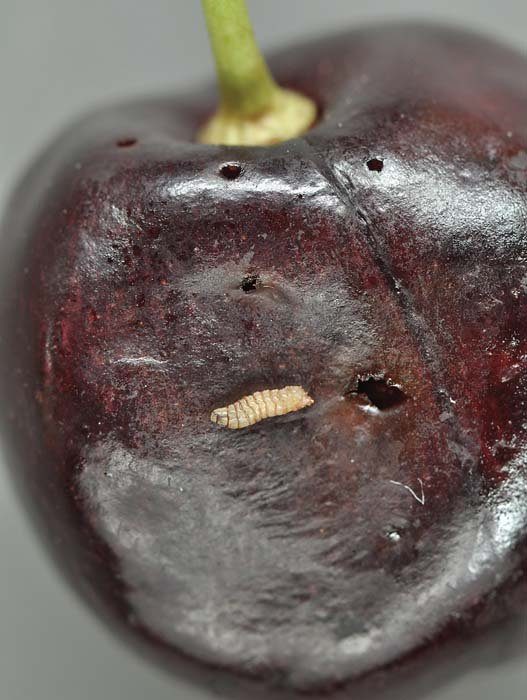
How an attack is recognised on the fruit
- Minute oviposition punctures in the skin, often with two fine filaments protruding, the breathing tubes of the egg.
- Local softening and a sunken area around the site, developing within a few days.
- Leakage of juice and finally collapse of the flesh.
- The fruit may look perfectly sound at harvest and collapse in the coolroom or on the shelf. That is the worst version, because the damage appears after the produce has left the orchard.
The most susceptible fruits are cherries, strawberries and berries. Blackberries, raspberries, blueberries, grapes and figs are also attacked, as are plums and peaches at advanced ripeness. What they share is a thin, soft skin.
6. Monitoring with traps
Once the insect has been detected, monitoring must start immediately with traps containing a liquid attractant, apple juice, yeast with sugar, or a proprietary food lure.
This has to be understood clearly: traps do not reduce the population. At 300 eggs per female, no realistic trap density can compete with the rate of reproduction. Their role is to establish when the insect has arrived, so that interventions start at the right moment.
Where they go: in shaded positions inside the canopy, at fruit height, and as a priority around the perimeter of the block and near wild vegetation or woodland edges, that is where the insect comes from. Checking is weekly, with the attractant renewed.
7. Management
Control of this insect is particularly difficult and demands continuous monitoring of the population. No single measure is sufficient on its own.
7.1 Cultural measures, underrated and decisive
Orchard sanitation
- Removal of all fallen and over-ripe fruit after harvest. Every fruit left on the ground is a factory producing new adults.
- Note: composting and burial do not reliably destroy eggs and larvae. The larvae complete their development inside the fruit and the adults emerge normally.
- The method that works: placing infested fruit in sealed plastic bags exposed to the sun for one week. The temperature that develops kills all eggs and larvae.
Harvest and postharvest handling
- Frequent picking rounds. The less time ripe fruit spends on the tree, the narrower the oviposition window.
- Immediate cooling of the produce. A rapid drop in temperature halts larval development and limits the damage that shows up after harvest.
7.2 Chemical control
The programme
- Weekly bait sprays to hold the population down, from the moment the insect is detected in the traps.
- During periods of high pressure, cover sprays are required.
- On cherries, cover has to begin at colour change, at the white-to-red stage. That is the point at which the fruit becomes attractive for oviposition, not when it has fully coloured.
- Applications must also cover the interior of the canopy, where the insect shelters during the hot hours.
The formidable reproductive potential calls for constant vigilance, but repeated use of the same active substances against an insect with 12 generations a year is the fastest imaginable route to resistance.
The rules: rotation of active substances from different IRAC mode-of-action groups, no more than two consecutive applications from the same group, and integration of the cultural measures so that selection pressure is reduced. Particular care is needed with the spinosyns, which are among the most effective materials and for that very reason have to be protected.
8. Sources
- Dreves, A.J., Walton, V. and Fisher, G. 2009. A New Pest Attacking Healthy Ripening Fruit in Oregon. Spotted Wing Drosophila: Drosophila suzukii (Matsumura). Oregon State University Extension.
- Spotted-Wing Drosophila, UC Statewide Integrated Pest Management Program, University of California.
- Spotted Wing Drosophila, Management, Cornell Fruit Resources, Cornell University. Source for exclusion netting and trap management.
- Spotted Wing Drosophila, Part 4: Management, Penn State Extension.
- Spotted wing drosophila, University of Minnesota Extension. Source for solarisation of infested fruit.
- Resource use by individual Drosophila suzukii reveals a flexible preference for oviposition into healthy fruits. Scientific Reports (2020).
- Oviposition activity of Drosophila suzukii as mediated by ambient and fruit temperature. PLOS One. Source for the effect of temperature.
Related articles
Nutrient antagonisms and synergies, with a per-element tool
The arrow diagram in every fertiliser leaflet does not stand up scientifically. The antagonisms are real, but they act on two separate levels, in the soil and inside the plant, and the same element can be antagonistic on one and synergistic on the other. With a tool showing the documented relationships of each element.
Zeolite in agriculture: what is documented and what is not
It is a cation exchanger, it holds ammonium and potassium, not nitrate. The rates that work are tens of tonnes per hectare, not hundreds of kilos. And erionite is a Group 1 carcinogen.
Leonardite in agriculture: properties, rates and what the law says
Leonardite is oxidised lignite with up to 85% humic acids, but pH below 3, up to 6% sulphur and almost no phosphorus. What the analyses and meta-analyses show, where it delivers and where it does not, and what Regulation (EU) 2019/1009 and the organic farming rules require.