
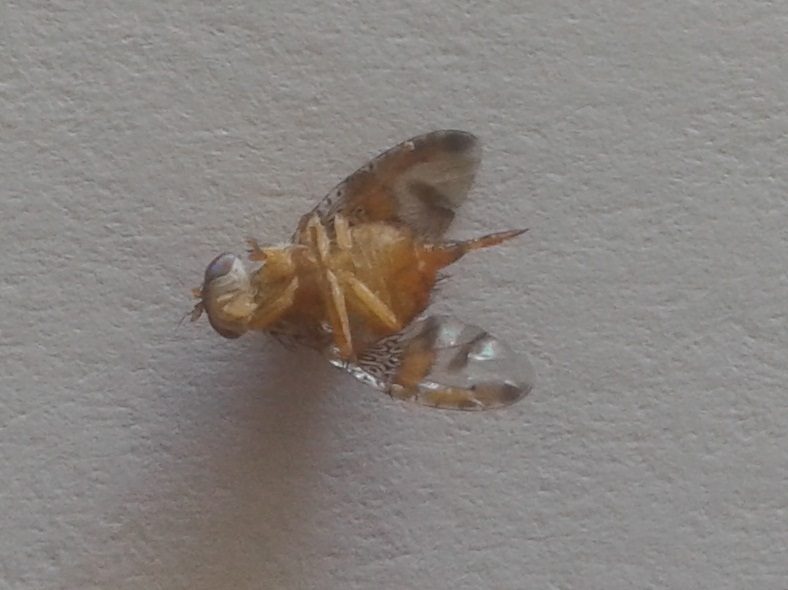
The Mediterranean fruit fly, Ceratitis capitata
Savvas Pastopoulos, Agronomist MSc, Pastopoulos Agronomics, Neos Mylotopos, Pella, Greece
The Mediterranean fruit fly, Ceratitis capitata, is among the most important insect pests of fruit growing in many parts of the world. It attacks half-ripe and ripe fruit, which is destroyed. In northern Greece it is not a pest that strikes with the same intensity every year, and the reason for that swing is one of the more interesting chapters in the biology of the insect.
in 70 plant
families
at 25 °C
over winter in
northern Greece
90% of individuals
move
1. Identity and host range
The insect originates in sub-Saharan Africa and spread from there first to the Mediterranean and then to Latin America, Australia and Hawaii. In Europe it is established mainly in the Mediterranean zone and is listed on the EPPO A2 list, that is, on the list of organisms already present in the EPPO region for which the Organization recommends regulation to its member countries. The EPPO list is a recommendation and not law: quarantine status in the Union is set by Regulation (EU) 2019/2072. In Greece the insect is established and is handled as a common pest of the crop, not as a quarantine organism.
Its polyphagy is among the broadest found in any insect pest. It is recorded on more than 350 confirmed hosts worldwide, belonging to 70 plant families, and the list keeps growing. Among them are practically all the crops of interest here:
- Stone fruit, sweet cherry, apricot, plum, peach, almond
- Pome fruit, apple, pear, quince, loquat
- Citrus, all species
- Persimmon, fig, pomegranate, kiwifruit, walnut, olive, grapevine
2. How it is recognised
The adult, the fly
- Smaller than the house fly, about 4 to 6 mm long.
- Its colouring is distinctive: it carries black, brown and yellow markings on the thorax.
- The wings are transparent and carry transverse brown, yellow and black bands. This is the most reliable feature visible without a microscope.
- The female is told by the ovipositor at the tip of the abdomen, with which it pierces the fruit skin.

The larva, the "maggot"
- Headless, with no distinct head capsule.
- Narrow at the front and cylindrical behind, the anterior end slightly curved downward and the posterior end flattened.
- It reaches 9 mm in length.
- It carries mouth hooks with which it tunnels through the flesh.
A caution: identification to species is not possible from the larva. Where certainty is needed, the larvae must be reared through to the adult stage.
3. The life cycle
Step by step
- After emergence the adults feed on substances such as nectar or insect honeydew. That feeding is essential for the eggs to mature.
- Within 3 to 6 days of emergence the females are ready to reproduce, and once they have mated their destructive work begins.
- The female pierces the skin and lays the eggs beneath it. She usually lays 1 to 6 eggs per oviposition puncture, while in large fruit the number per puncture can be considerably higher.
- After hatching, the larvae develop at the expense of the ripe fruit, side by side. They pass through three larval instars inside the fruit.
- The mature larva leaves the fruit, enters the soil and pupates there, inside a hard puparium.
- The new adult emerges from the puparium.
The durations that follow come from rearing at constant laboratory temperatures and show the extent of the temperature effect, not field durations.
| Stage | Duration |
|---|---|
| Larval | 5 days at 30 °C to 21 days at 15 °C |
| Pupal | 8 days at 30 °C to 35 days at 15 °C |
| Full cycle | about 32 days at 25 °C |
| Adult lifespan | on average 11 weeks for males, 9 weeks for females |
4. How many generations it completes
In Greece it reaches as many as 7 generations a year in the warmest districts of the south. The number is not fixed, however: it depends on temperature, host availability and the local bioclimate.
In the Giannitsa area my own reading is that it completes 2 generations, according to the weather of the season. The constraint is not food, hosts are abundant. The constraint is the winter, and that is explained in the next chapter.
5. How it overwinters in northern Greece
This is the key to understanding why the insect behaves so differently in Macedonia from the way it behaves in Crete or in the Peloponnese. And the answer is not conjecture: it has been studied over three consecutive winters in an orchard in northern Greece, at the northern limit of the insect's establishment.
Larvae inside naturally infested fruit, pupae and adults were exposed to natural temperature conditions in late autumn and early winter. The results:
- 100% mortality for pupae and for adults. No survival at all.
- Mortality above 60% for the larvae, but not complete.
- Those larvae that did survive suffered high mortality at the following, pupal stage as well. And a clear rule held: the earlier they left the fruit during winter and spring, the lower their survival.
- Females that emerged between March and May laid fertile eggs in late spring and early summer. Mean adult lifespan was about 90 days and mean fecundity 247 eggs per female.
From this it follows that in northern Greece the population does not overwinter as a pupa in the soil, there it dies out completely. What overwinters is a proportion of the larvae, inside infested fruit, prolonging their larval development; and it is that proportion which regenerates the population the following spring.
The interpretation is now obvious. The following year's population hangs by a thread: the few larvae that manage to survive inside fruit left on the tree or on the ground. A hard winter cuts that thread too, and the season starts effectively from zero. Conversely, a mild winter means an early and dense first flight.
6. The damage to the fruit
Infested fruit carries minute oviposition punctures which, like the other symptoms, are often hard to find in the early stages. Substantial damage may already have been done inside the fruit before anything shows on the outside, in the form of a network of tunnels accompanied by rot.
The fruit is then colonised by fungi and rots. The damage is therefore not only the larva: it is the entry point that the puncture opens.

7. Monitoring with traps
Without monitoring there is no correct timing, and without timing every intervention is a matter of luck. There are two different trapping logics and they do not do the same job:
| Type of lure | What it catches | What it is good for |
|---|---|---|
| Parapheromone (trimedlure) or ginger root oil | Only the males | Early detection of the start of flight. Sensitive and clean to read. |
| Protein lures (food based) | Both sexes | Estimating the real size of the population and the proportion of females, which are the ones that do the damage. |
In the Giannitsa area, on the trapping system I run, the start of the first flight is normally detected between 15 August and 5 September.
8. How far it travels
Mark and recapture experiments found that 90% of individuals move only 400 to 700 metres, and that a new focus is as a rule contained within a radius of 1 kilometre of the point of entry. Only a very small proportion disperses beyond 10 kilometres.
The first is encouraging. The population that matters to any given orchard is overwhelmingly local. What that orchard and its immediate neighbours do counts for something real. A coordinated effort across a neighbourhood of holdings has a measurable effect.
The second is a warning. The main route into new areas is not flight, it is the movement of infested fruit. The insect travels in crates, not on its wings.
9. Control, the three tools
Control of the insect in central and southern Greece is particularly difficult. It demands continuous monitoring of the population and careful synchronisation of the control measures. There are three tools:
1. Bait sprays
These combine a protein lure with an insecticide. Their advantage over cover sprays is substantial: they are applied as a spot treatment on patches, the flies are drawn to the insecticide, and the effect on beneficials and natural enemies is minimal. In the Mediterranean the active substance that has come to dominate baits is spinosad.
2. Cover sprays
These cover the whole canopy and target the adults arriving at the fruit. They are the most drastic tool but also the most burdensome, with the greatest effect on beneficial insects and the strictest pre-harvest intervals, a critical point, since these are applications onto ripe fruit shortly before harvest.
3. Mass trapping
A dense network of lure traps, to bring the population down directly. It has been proposed that bait stations, devices combining lure and insecticide in a fixed position, are as effective as bait sprays and cheaper. The measure performs better when it is applied across a district rather than on a single holding.
The agronomist on the ground judges which of the three is appropriate, on the basis of the crop, the stage of the fruit, the size of the population and the pre-harvest intervals.
Dimethoate, the organophosphate on which fruit fly control rested for decades, is no longer approved in the European Union. Non-renewal was decided by Commission Implementing Regulation (EU) 2019/1090, and member states were required to withdraw authorisations for the relevant products by 17 January 2020.
The reason was that, according to EFSA, a risk from exposure to residues of dimethoate, whose genotoxic potential could not be ruled out, and of its main metabolite omethoate, which was considered mutagenic in vivo, could not be excluded. The gap it left is filled today mainly by spinosad baits and by mass trapping.
10. The resistance question
A small armoury creates the familiar problem: when few active substances are used continuously and on a large scale, the population adapts.
The practical consequence: the non-chemical measures, orchard sanitation, mass trapping, correct timing based on the traps, are not supplementary. They are what keeps the few available active substances working.
11. The picture in the Giannitsa area
- Which crops are at risk. Around Giannitsa the insect threatens mainly persimmon and some late plum cultivars. The reason is timing: these are the fruits that ripen exactly when the population reaches its peak.
- When flight starts. Normally between 15 August and 5 September.
- How many generations. About 2, according to the weather of the season.
- What decides the season. The preceding winter. Severe frosts mean a late and sparse flight; a mild winter means an early and dense one.
- What comes first. Traps from mid-August, and thorough removal of infested and fallen fruit after harvest.
12. Sources
- EPPO (2021). Datasheet: Ceratitis capitata. EPPO Global Database. Source for the >350 hosts in 70 families, the A2 listing, the life cycle and pupation in the soil, the stage durations at 15–30 °C, adult lifespan, the lures and the rationale of bait sprays.
- Papadopoulos, N.T., Carey, J.R., Katsoyannos, B.I. and Kouloussis, N.A. (1996). Overwintering of the Mediterranean Fruit Fly (Diptera: Tephritidae) in Northern Greece. Annals of the Entomological Society of America 89(4):526–534. The key study for this region. Three winters in an orchard in northern Greece, at 40.3°N. Source for the 100% mortality of pupae and adults, the >60% mortality of larvae, the relationship between survival and the timing of exit from the fruit, and the 90-day adults with 247 eggs per female.
- Commission Implementing Regulation (EU) 2019/1090 of 26 June 2019, concerning the non-renewal of approval of the active substance dimethoate. Source for the withdrawal and for the deadline of 17 January 2020 for revoking authorisations.
- Kakani, E.G. et al. (2018). Susceptibility of Ceratitis capitata to deltamethrin and spinosad in Greece. Journal of Pest Science 91:1015–1023. Source for resistance to lambda-cyhalothrin and for spinosad resistance alleles in field populations.
- Toxicity of spinosad in protein bait to three economically important tephritid fruit fly species and their parasitoids. Journal of Economic Entomology (2004). Documentation of spinosad as a bait active substance.
- Meats, A. and Smallridge, C.J. (2007). Short- and long-range dispersal of medfly, Ceratitis capitata, and its invasive potential. Journal of Applied Entomology 131:518–523. Source for 90% of individuals moving 400–700 m.
- Piñero, J.C., Enkerlin, W. and Epsky, N.D. (2014). Recent developments and applications of bait stations for integrated pest management of tephritid fruit flies. In Trapping and the Detection, Control, and Regulation of Tephritid Fruit Flies, Springer, pp. 457–492. Source for bait stations being as effective and cheaper.
- Carey, J.R., Papadopoulos, N.T. et al. (2008). Age structure changes and extraordinary lifespan in wild medfly populations. Aging Cell 7:426–437. Source for adult lifespan.
- Duyck, P.F. and Quilici, S. (2002). Survival and development of different life stages of three Ceratitis spp. reared at five constant temperatures. Bulletin of Entomological Research 92:461–469. Source for the stage durations by temperature.
Related articles
The brown marmorated stink bug, BMSB, Halyomorpha halys
Two overlapping generations a year, 538 degree-days from egg to adult, and a chemical toolbox that keeps shrinking. Greek monitoring data from Imathia and Pieria, the native egg parasitoids already at work, and where the samurai wasp stands today.
Nutrient antagonisms and synergies, with a per-element tool
The arrow diagram in every fertiliser leaflet does not stand up scientifically. The antagonisms are real, but they act on two separate levels, in the soil and inside the plant, and the same element can be antagonistic on one and synergistic on the other. With a tool showing the documented relationships of each element.
Zeolite in agriculture: what is documented and what is not
It is a cation exchanger, it holds ammonium and potassium, not nitrate. The rates that work are tens of tonnes per hectare, not hundreds of kilos. And erionite is a Group 1 carcinogen.