
Apricot cultivars, an evaluation (upd. 05/08/2026)
Savvas Pastopoulos, Agronomist MSc, Pastopoulos Agronomics, Neos Mylotopos, Pella, Greece
The table apricot has begun to climb steeply in growers' preferences. The observations that follow come from several years of following dozens of apricot orchards with modern cultivars in the Pella district of northern Greece, cultivar by cultivar. The author does not trade in planting material.
The field observations in this article were made under the soil and climate conditions of Giannitsa and Skydra, in central Macedonia, northern Greece. They do not transfer unchanged anywhere else: the same cultivar ripens on one date in Murcia, on another in the Rhône valley and on another in Pella.
Yields and rates are given per hectare. Where the article refers to approvals, those of the Greek Ministry of Rural Development and Food are valid in Greece only. Figures taken from breeders' datasheets or from foreign trials carry the country inside the sentence.
The greater part of the text is a personal evaluation of cultivars in orchards of the Pella district; it is not experimental data and it does not come from a trial network with replicates. The observations concern the soil and climate conditions of the Giannitsa and Skydra area and do not transfer unchanged elsewhere.
So that the two kinds of information stay distinct, the following rule holds throughout: anything coming from the breeder or rights holder, from an institute or from a published evaluation carries a reference number, such as [9]. Anything that is a field observation by the author is placed in a yellow box marked "Field observation" or is stated as such within the sentence.
Where the field observation disagrees with the breeder's datasheet, both are given. The disagreement does not mean the breeder is wrong: it may be due to a different climate, a different rootstock or different strains of the virus.
In the Pella orchards followed here, the problems that require regular intervention in apricot are few and recurrent: brown rot and shot hole among the fungi, bacterial canker among the bacteria and the peach twig borer among the insects. That does not mean the crop has few enemies in absolute number; the California apricot pest management guidelines cover more than twenty insects and mites and eleven diseases, those four among them [25].
Apricot requires a great deal of irrigation. Its tendency to hold its leaves until late in the autumn extends the irrigation season considerably. In effect, as long as it has leaves, even in October, it has to be irrigated if drought conditions prevail. The importance of that stage is documented: in a controlled stress experiment on apricot trees of the cultivar Portici in Italy, withholding irrigation in summer and autumn slowed the differentiation of the flower buds and raised the proportion of abnormal buds from 2% in the control to 16% to 22% in the stressed treatments, and the July stress was the one from which the trees did not recover after water was restored [28].
In the orchards followed here, when the tree becomes dehydrated in autumn it kills fruiting buds and those do not flower the following year. No published measurement of the phenomenon for Greek conditions and for the cultivars named here was found.
Several new cultivars have been planted in recent years and their behaviour is being followed. The most important question is tolerance of the disease caused by plum pox virus (PPV): many cultivars introduced as tolerant or resistant develop symptoms as time passes.
In apricot, unlike peach, there is genuine genetic resistance to plum pox virus (Potyvirus plumpoxi, PPV) and there are breeding programmes that transfer it into commercial cultivars. The evaluation scale used in the international literature has, however, three grades and not two: 0 = resistant (no symptoms and negative by ELISA), 1 = tolerant (no symptoms but positive by ELISA, that is the plant carries the virus), 2 = susceptible [21].
Breeders do not always keep the distinction. The Spanish breeder PSB, for example, writes "resistencia a Sharka" on the pages of the cultivars Nelson, Madrigal and Domino [3] [4] [5], while its own 2025 catalogue marks the same cultivars with the legend "SHARKA TOLERANCE", that is tolerance [2]. Resistance is one thing, tolerance another, and neither source gives an ELISA result; the placement of those three cultivars on the scale therefore remains undetermined. The characterisation given below for each cultivar is always the one declared by the breeder, not a measured one.
The practical consequence is that the absence of symptoms does not mean the absence of the virus. A tolerant tree remains a source of infection for its neighbourhood. For sharka there is no curative intervention in the field, transmission is by aphids and by planting material, and control rests on the removal of infected trees; the virus is a regulated non-quarantine pest under Regulation (EU) 2019/2072 and it is present in mainland Greece [22].
For that reason, where it is stated below that a cultivar "has shown no sharka", that is an observation of symptoms and not a laboratory test.
Summary ripening table
The dates and the ripening order in the second column are field observations in the Giannitsa and Skydra area, not data from the breeder: the same cultivar ripens on one date in Murcia, on another in the Rhône valley and on another in Pella. The third column, by contrast, comes exclusively from the datasheets of the holders of the cultivars and carries a reference.
| Cultivar | Ripening in Pella (field observation) | Flower fertility according to the holder |
|---|---|---|
| Cebas Red | 1 to 10 May | Self-fertile [19] |
| Mikado | 3 days before Mogador | Self-fertile [33] |
| Mogador | First ten days of May | Self-fertile [32] |
| Wonder Cot | First ten days of May | Not self-fertile [18] |
| Pricia | Second ten days of May | Self-fertile [10] |
| Spring Blush | May | Not self-fertile [16] |
| Tsunami | May | Not self-fertile [16] |
| Primidi | 6 days before Bora | Self-fertile [14] |
| Mediabel | 1 to 6 June | Self-fertile [11] |
| Medflo | Early June | Self-fertile [15] |
| Rouge Cot | After 10 June | Self-fertile [17] |
| Domino | 4 days before Kioto | Self-fertile [5] |
| Bergeval | 15 June | Self-fertile [8] |
| Kioto | 16 June | Self-fertile [16] |
| Cocot | The Kioto period | Self-fertile [17] |
| Lady Cot | 23 June | Self-fertile [17] |
| Anegat | 10 July | Self-fertile [7] |
| Farbela | 2 days before Farbaly | Self-fertile [13] |
| Nelson | Mid July | Self-fertile [3] |
| Farbaly | After 15 July | Self-fertile [12] |
| Madrigal | At the end of Farbaly | Self-fertile [4] |
Self-fertility in apricot is not a property of the crop but of the genotype: it is controlled by the multiallelic S locus, and self-compatibility is due to the Sc allele. In a review that assembled the S genotype for 235 accessions, of the 66 cultivars genotyped in the same work 49 were found self-compatible and 12 self-incompatible, while the authors note that "about half of the new releases are self-compatible", that is modern breeding is moving in that direction, something visible in the table above as well [20]. For the three cultivars in the table that are not self-fertile, the choice of pollinator is not made by eye: two cultivars of the same incompatibility group are mutually incompatible [20].
Sources: 3 4 5 7 8 10 11 12 13 14 15 16 17 18 19 20 32 33
The cultivars one by one
1Mogador
Breeder / rights holder: PSB Producción Vegetal, Murcia, Spain, official apricot cultivar page [1]
The cultivar is of Spanish origin. The Italian commercial catalogue that describes it reports very early bloom, self-fertility, a vigorous tree of semi-open habit, fruit with a dominant size of 2A and a light red blush over an orange ground, and low chilling requirements [32]. Tree growth is strong and it can come into production from the third year. The cultivar requires regular summer pruning for correct training of the tree, severe summer pruning to achieve large fruit size and an early harvest, and equally severe winter pruning to avoid overcropping.
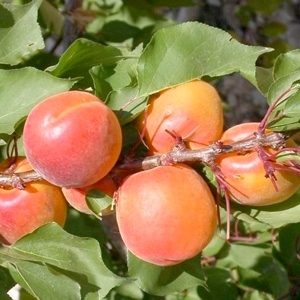
Bloom is very early and can begin on 15 February, while ripening takes place in the first ten days of May in the Giannitsa area.
On the evidence here the cultivar behaves as partially self-fertile, whereas the breeder's catalogue gives it as self-fertile [32]. The tree is semi-spreading in habit.
Susceptibility to fruit cracking has been found, which can be a serious problem in wet years or with late fertilisation. Here the disagreement with the catalogue is head on: the catalogue characterises it as "fairly resistant to cracking" [32].
In the orchards followed here, infection by PPV has been found. No breeder datasheet and no published evaluation was found that classifies Mogador with respect to sharka, so its characterisation as susceptible remains an observation of symptoms.
* Abroad it is being withdrawn gradually, because of the opening of the suture that develops as the fruit ripens; it is being replaced by Nestor. What is confirmed is that the current PSB apricot catalogue no longer includes Mogador, but it does include Nestor-cov [1] [2]. The opening of the suture as the reason for the withdrawal is market information and is not documented by the breeder.
The information concerning the resistance or the susceptibility of the cultivar to PPV (sharka) comes from field observation and from statements by third parties, it is not the result of a laboratory test, and it may change with the appearance of new strains of the virus. Pastopoulos Agronomics bears no responsibility for its accuracy or for its use.
2Mikado
Breeder / rights holder: PSB Producción Vegetal, Murcia, Spain, official apricot cultivar page [1]
An early and self-fertile cultivar, with abundant early bloom, a very vigorous tree of semi-open habit, very good production, fairly large fruit with a dominant size of 2A, a light red blush over a glossy orange ground and firm flesh; it has low chilling requirements [33]. As with Mogador, it is no longer included in the current PSB apricot catalogue [1].
In the orchards followed here it ripens 3 days before Mogador. The Italian catalogue gives the reverse order, Mogador 62 days before San Castrese, Mikado 58 days before the same reference cultivar, that is Mikado about four days after Mogador [32] [33]. The difference is real and is not explained here; the order given above holds for Pella.
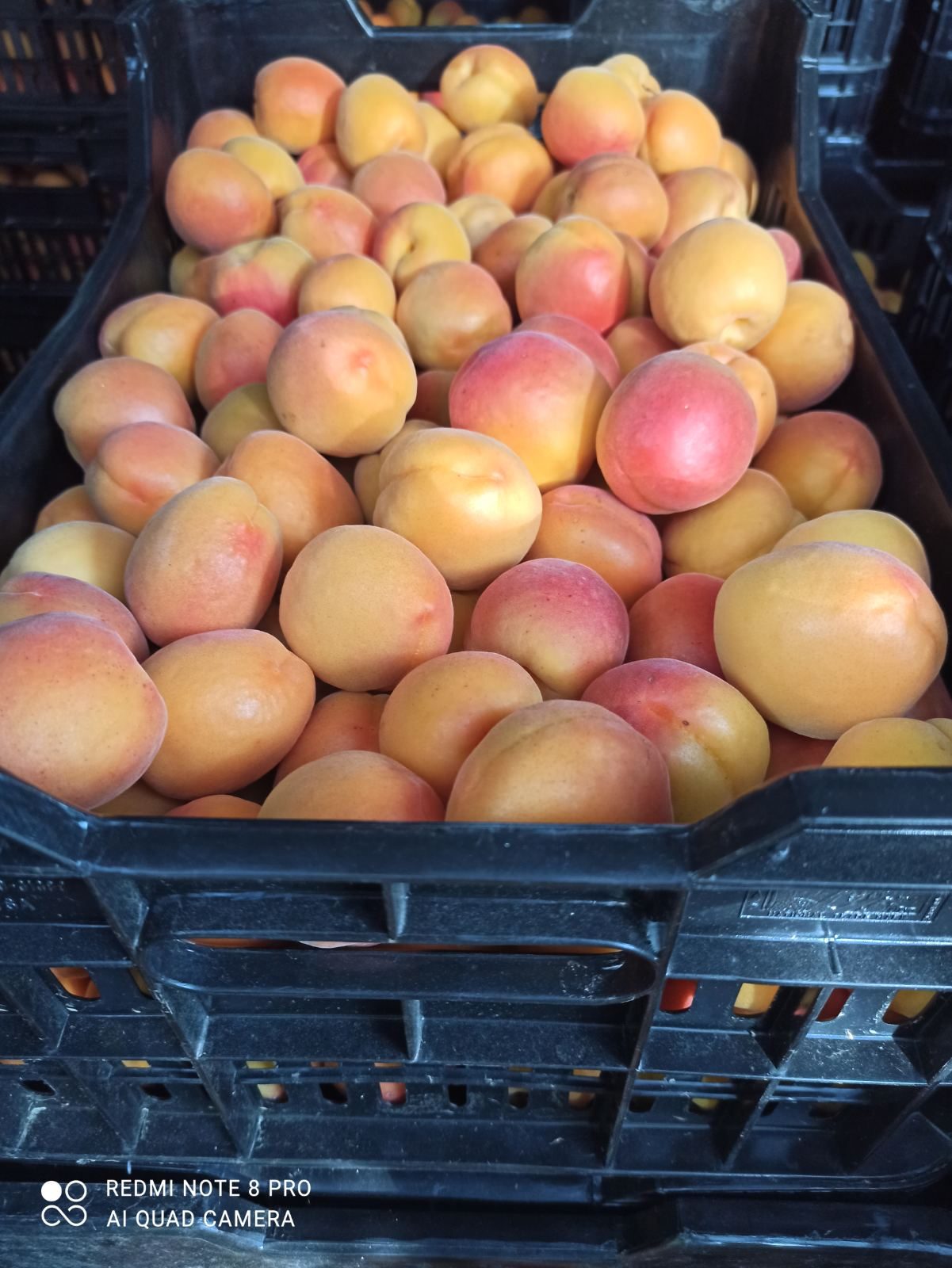
It is very productive and produces large fruit, tasty for the season. It does, however, show sharka symptoms, and its planting is no longer recommended except in areas free of PPV and with clean certified material. No breeder datasheet and no published evaluation classifying Mikado with respect to sharka was found.
The information concerning the resistance or the susceptibility of the cultivar to PPV (sharka) comes from field observation and from statements by third parties, it is not the result of a laboratory test, and it may change with the appearance of new strains of the virus. Pastopoulos Agronomics bears no responsibility for its accuracy or for its use.
3Pricia
Breeder: NEWCOT (France) · licence manager: International Plant Selection, official Carmingo® Pricia (cov) datasheet [10]
Correction of attribution: in an earlier form of this text Pricia was attributed to CEP Innovation / INRAE. The cultivar is not part of the CEP Innovation range [6]; it is a Carmingo®, bred by NEWCOT with IPS as licence manager [10].
The cultivar is self-fertile, with late bloom, a semi-upright tree of medium to strong vigour, elongated red fruit, size 2A/3A and sugars of 10 to 12 °Brix; the holder places it about ten days before Orangered® and characterises it as better suited to areas of medium to high chilling requirements [10]. In the French cultivar presentation of 2021, Pricia ripens from 21 to 28 May with a mean fruit weight of 84.5 g and a dominant size of 3A [9].
Sharka: the holder states that the cultivar is "resistant to sharka according to the CTIFL protocol 2017 to 2019" [10], and the French presentation of 2021 classifies it as a "resistant type" [9]. That classification concerns the strains of the virus circulating in France; for the Greek strains no published test of this particular cultivar was found.
It ripens in the second ten days of May, with bloom later than Mogador. It has an intense red colour, especially on the fruit exposed to the sun, and medium or even large size if it is thinned well. It is resistant to fruit cracking and so far has shown no sharka symptoms.
The main drawback is the sharp acid taste during ripening, which makes it difficult to judge the right harvest date, consistent with the low sugars of 10 to 12 °Brix given by the holder [10]. In 2020 there were reports that the fruit at the tops softens easily. Some early cultivars require several picks to avoid that problem.
In several orchards a marked incompatibility with the rootstock C29 was observed. The plants dry back extensively from the graft union upwards, while the rootstock suckers continuously. No published compatibility trial of Pricia on C29 was found; it is documented, however, that Myrobalan 29C is a Prunus cerasifera clone with a strong tendency to sucker [31] and that incompatibility of apricot with plum and myrobalan rootstocks is dependent on the particular cultivar and rootstock pair and not general [30].
The information concerning the resistance or the susceptibility of the cultivar to PPV (sharka) comes from field observation and from statements by third parties, it is not the result of a laboratory test, and it may change with the appearance of new strains of the virus. Pastopoulos Agronomics bears no responsibility for its accuracy or for its use.
4Spring Blush
Breeder / rights holder: Pépinières Escande, France (EA 3126TH), apricot cultivar catalogue (PDF) [16]
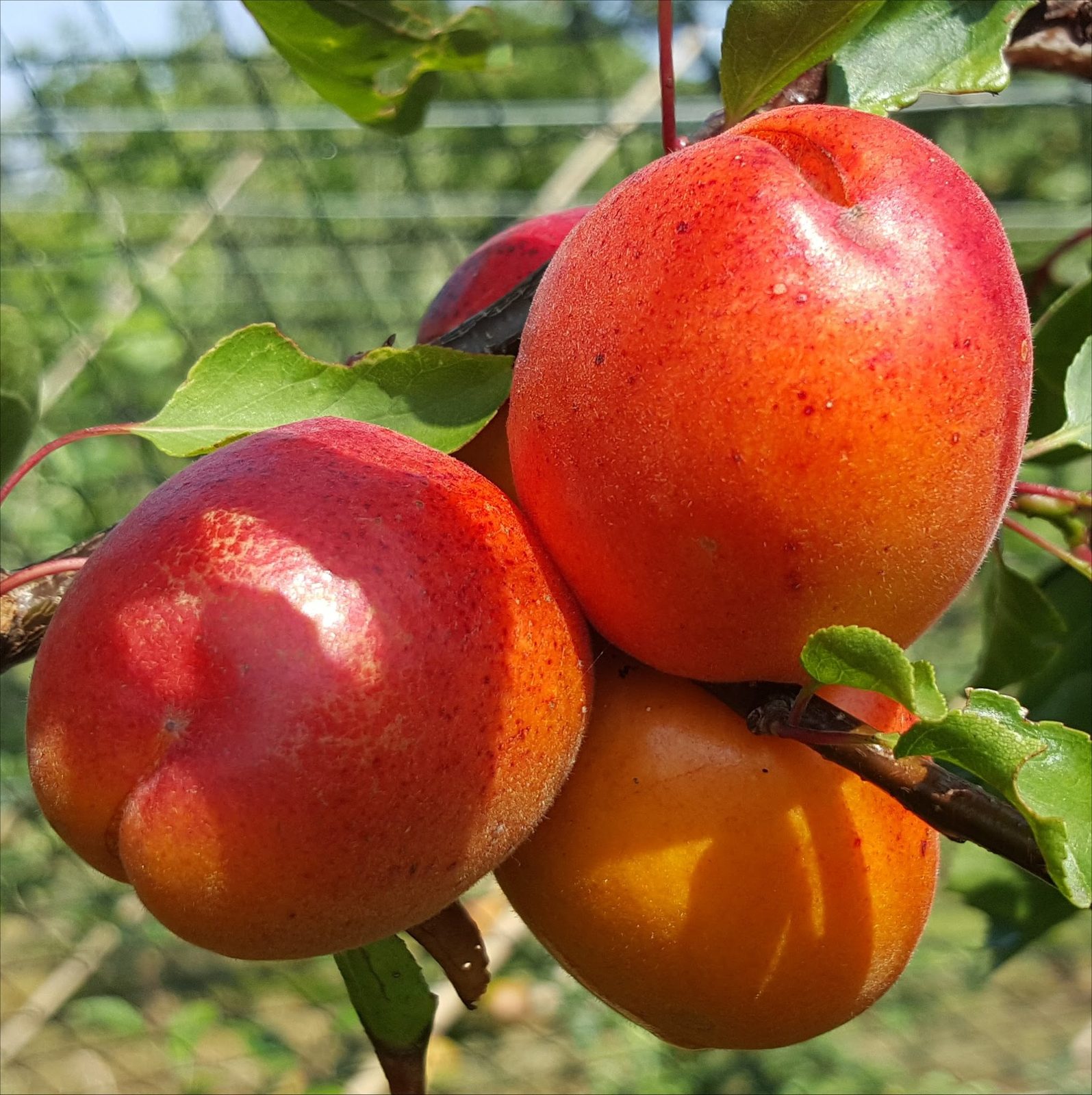
Of French origin, a cultivar that is not self-fertile: the breeder describes pollination as "compulsory" and gives as pollinators Tsunami®, Tom Cot®, Solédane, Pinkcot®, Sylred, Big Red®, Early Blush® and Sweet Red® [16]. Bloom is early, in the same period as Tom Cot®, and ripening very early, 1 to 2 days after Early Blush® Rutbhart [16]. The fruit is graded 2A in 55% and 3A in 35%, with an orange ground and a red blush over 60% to 70% of the surface, and juicy, firm orange flesh; the yield potential is given as 20 tonnes per hectare in full production [16].
Sharka: the breeder classifies Spring Blush as susceptible to PPV [16]. That is the most important piece of information for a planting decision and it outweighs the absence of symptoms in one orchard or over a few years.
It is very productive in warm orchards with good pollination. The pollinators used in the district are Mogador, Lilly Cot and Pin Cot; of the three, only Pinkcot® appears in the breeder's list of pollinators [16], so the choice of the other two rests on local experience and not on a datasheet. There are orchards where, because of the weather at bloom, the bees do not fly properly, with the result that fruit set is not satisfactory.
The red blush observed in Pella is of the order of 20%, far lower than the 60% to 70% of the catalogue [16]. The fruit has a good specific weight. It also has a marked problem with cracking when there is rain close to harvest.
No sharka symptoms have been seen in this cultivar so far; that does not cancel its classification as susceptible by the breeder [16] and does not mean the trees are free of the virus [21].
For the cracking, borax is applied to the soil in the district in winter. The per-tree rate that was formerly given here has been removed, because it does not rest on a published trial. The documented framework is that boron deficiency in stone fruit causes cracking, shrivelling and deformation of the fruit and corking around the stone, that for soil correction a rate of 3 lb of actual boron per acre every three years is cited, that is about 3.4 kg of actual boron per hectare every three years, and that the margin between deficiency and toxicity is narrow, which is why the rate is set after soil and leaf analysis [29]. Those values come from the Washington State guidelines for pome and stone fruit in the United States and not from a Greek trial on apricot.
The information concerning the resistance or the susceptibility of the cultivar to PPV (sharka) comes from field observation and from statements by third parties, it is not the result of a laboratory test, and it may change with the appearance of new strains of the virus. Pastopoulos Agronomics bears no responsibility for its accuracy or for its use.
5Mediabel
Breeder: NEWCOT (France) · licence manager: International Plant Selection, official Carmingo® Mediabel (cov) datasheet [11]
Addition: in an earlier form of this text the breeder of Mediabel was given as unconfirmed. The cultivar is Carmingo® Mediabel (cov), bred by NEWCOT, with IPS as licence manager [11].
The holder gives it as self-fertile, bicoloured, with an orange ground and a blush of 30% to 60%, size 2A/3A, oval shape, good firmness, 12 °Brix, a semi-spreading tree of medium vigour and "regular, strong and reliable production"; it ripens four days before Orangered® [11]. In the French presentation of 2021 it ripens from 8 to 18 June with a mean weight of 88.5 g and a dominant size of 3A to 4A [9].
Sharka: the holder states the cultivar to be "resistant to sharka, validated with the PPV-CTIFL protocol 2017 to 2019" [11], and the French presentation of 2021 characterises it as a "resistant type" [9].
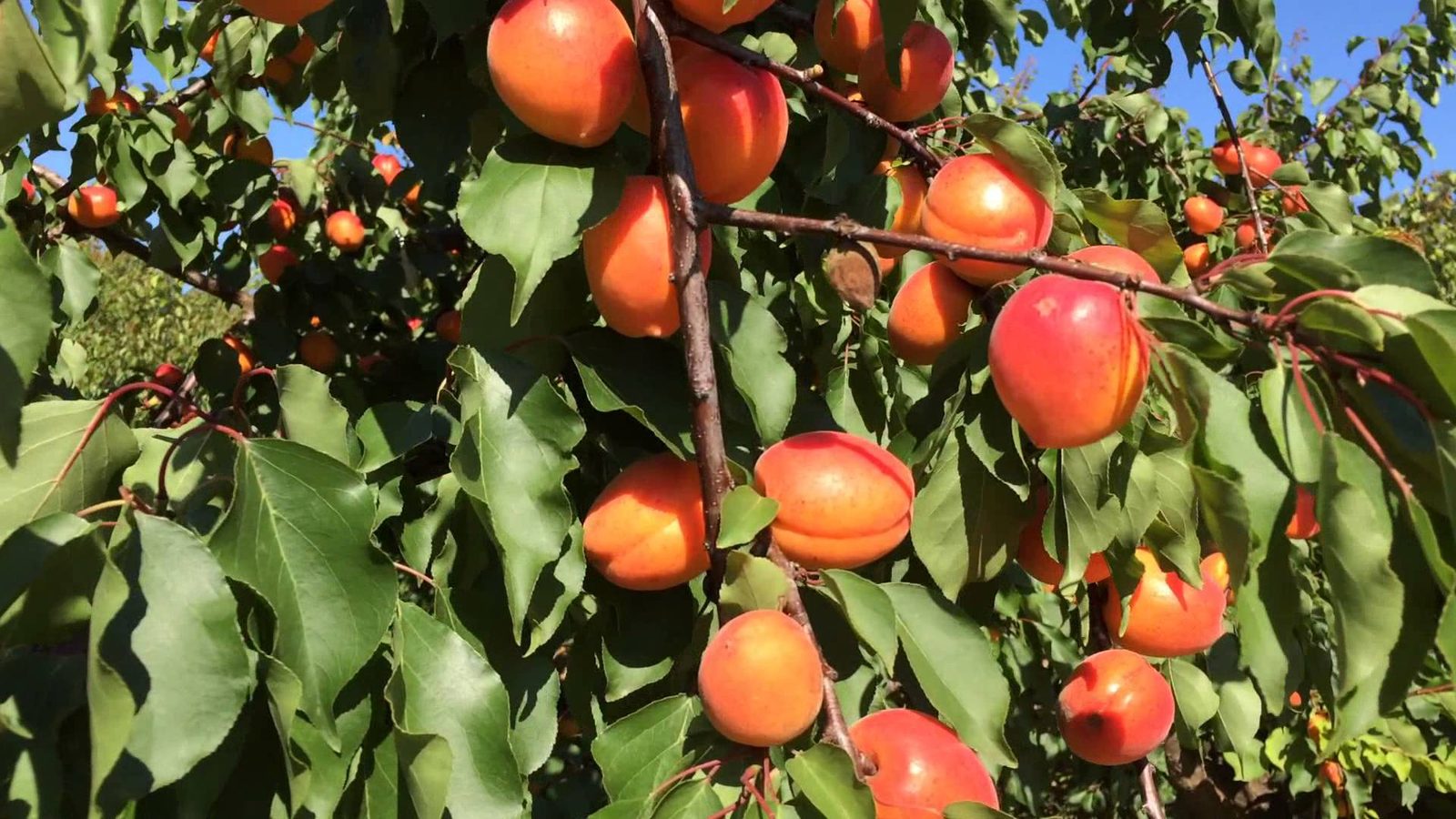
It ripens from 1 to 6 June, with large, oval fruit of an intense orange-red colour. Bloom is early and fruit set is moderate: for that reason it was formerly described here as partially self-fertile, while the holder's datasheet gives it as self-fertile [11]. In the table of this article the holder's classification has been kept.
No sharka symptoms have been found so far on fruit or trees.
Some sensitivity in cold storage has been reported; some buyers report unexplained darkening of the fruit skin. In recent years a susceptibility of the trees to wood diseases has been followed (esca, eutypa dieback, bacterial canker). The trees are of a lighter colour and show vigorous lateral and disorderly growth.
The information concerning the resistance or the susceptibility of the cultivar to PPV (sharka) comes from field observation and from statements by third parties, it is not the result of a laboratory test, and it may change with the appearance of new strains of the virus. Pastopoulos Agronomics bears no responsibility for its accuracy or for its use.
6Wonder Cot
Breeder: SDR Fruit LLC (United States) · rights holder: Cot International, France, official cultivar datasheets [17]
A cultivar that is not self-fertile. The Australian licence holder gives the incompatibility alleles S5S7 and as pollinators Lilly Cot, Magic Cot and Tom Cot, with fruit 50 to 55 mm in diameter and an intense orange colour with a blush [18]. The pollinator used in Pella, Lilly Cot, is within that list [18]. The choice of pollinator has to be made on the basis of the alleles and not on simultaneous bloom alone, because two cultivars of the same incompatibility group are mutually incompatible [20].
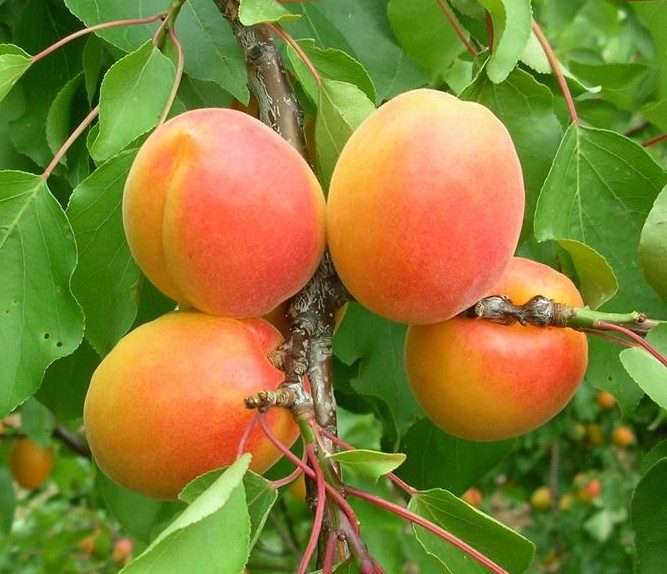
It ripens in the first ten days of May. The fruit is large for the season and very aromatic. No sharka symptoms have been seen so far, and it appears not to crack; no statement by the rights holder about the behaviour of the cultivar towards PPV was found [17].
It requires bloom in warm weather and a strong presence of bees. The choice of site has to be made on the basis of the weather conditions that prevail at bloom. Even so, the cultivar remains high risk as far as its productivity is concerned.
The information concerning the resistance or the susceptibility of the cultivar to PPV (sharka) comes from field observation and from statements by third parties, it is not the result of a laboratory test, and it may change with the appearance of new strains of the virus. Pastopoulos Agronomics bears no responsibility for its accuracy or for its use.
7Tsunami
Breeder / rights holder: Pépinières Escande, France (EA 5016), apricot cultivar catalogue (PDF) [16]
A cultivar that is not self-fertile, very early: it ripens 5 to 7 days before Early Blush® Rutbhart and blooms 2 to 3 days earlier than Tom Cot® Toyaco. The breeder gives as pollinators Goldrich, Tom Cot®, Solédane, Pinkcot®, Sylred, Big Red®, Spring Blush® and Flopria, size 2A/3A, a red blush over 60% to 70% of the surface, firm juicy flesh and a potential of 20 tonnes per hectare; it also characterises it as "not susceptible to pedicel and perifruit necrosis" [16].
Sharka: the breeder characterises Tsunami as tolerant of PPV [16], tolerant, not resistant; on the scale used internationally, tolerance means the absence of symptoms with a positive laboratory test [21].
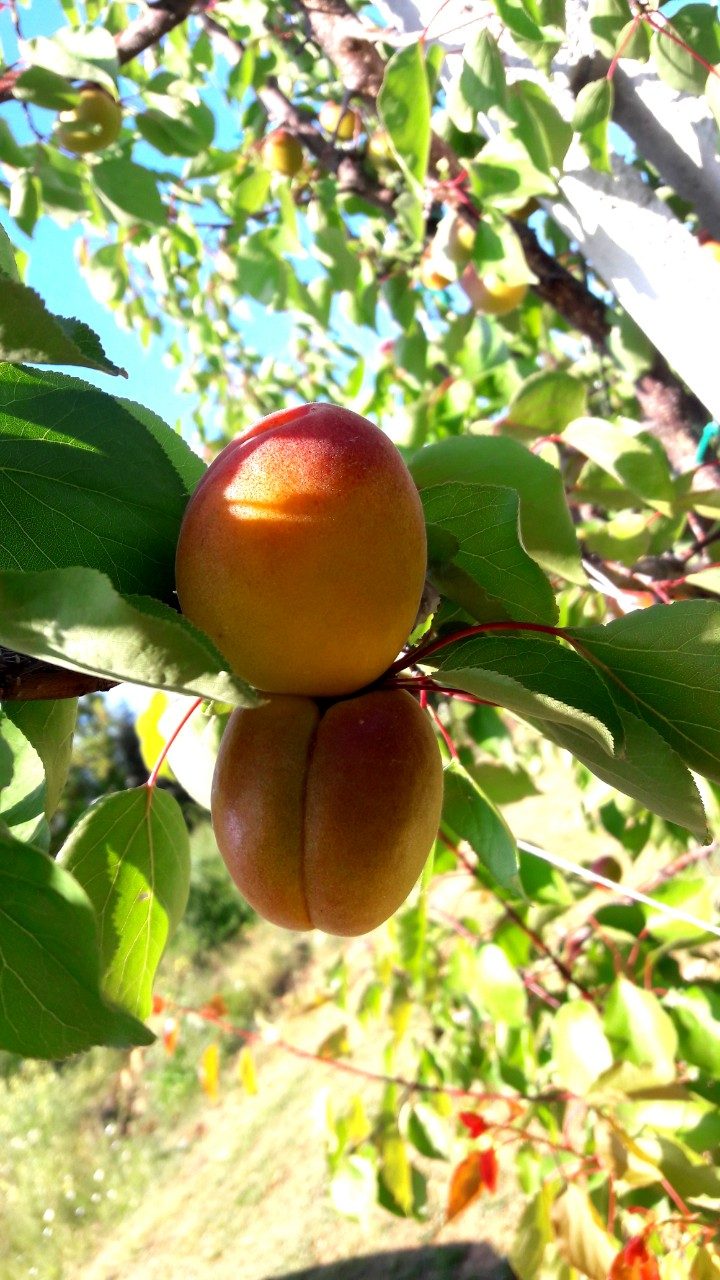
It has excellent eating quality for its season. The red blush recorded here is of the order of 30%, lower than the 60% to 70% of the catalogue [16].
It requires a number of pollinators within the orchard for satisfactory fruit set. Spring Blush, Colorado and Big Red appear to combine satisfactorily and ripen at the same time; of the three, Spring Blush and Big Red are included in the breeder's list of pollinators, Colorado is not [16].
It is fairly tolerant of handling and of postharvest, but it requires careful management of fertilisation, especially as regards nitrogen. Among its drawbacks is a gap, like a crack, that forms at the suture of the fruit. Supplying the trees with boron in winter reduces the problem on the evidence here; boron deficiency does indeed cause cracking and deformation of the fruit in stone fruit, but the margin up to toxicity is narrow and the rate is set after analysis [29].

The information concerning the resistance or the susceptibility of the cultivar to PPV (sharka) comes from field observation and from statements by third parties, it is not the result of a laboratory test, and it may change with the appearance of new strains of the virus. Pastopoulos Agronomics bears no responsibility for its accuracy or for its use.
8Kioto
Breeder / rights holder: Pépinières Escande, France, apricot cultivar catalogue (PDF) [16]
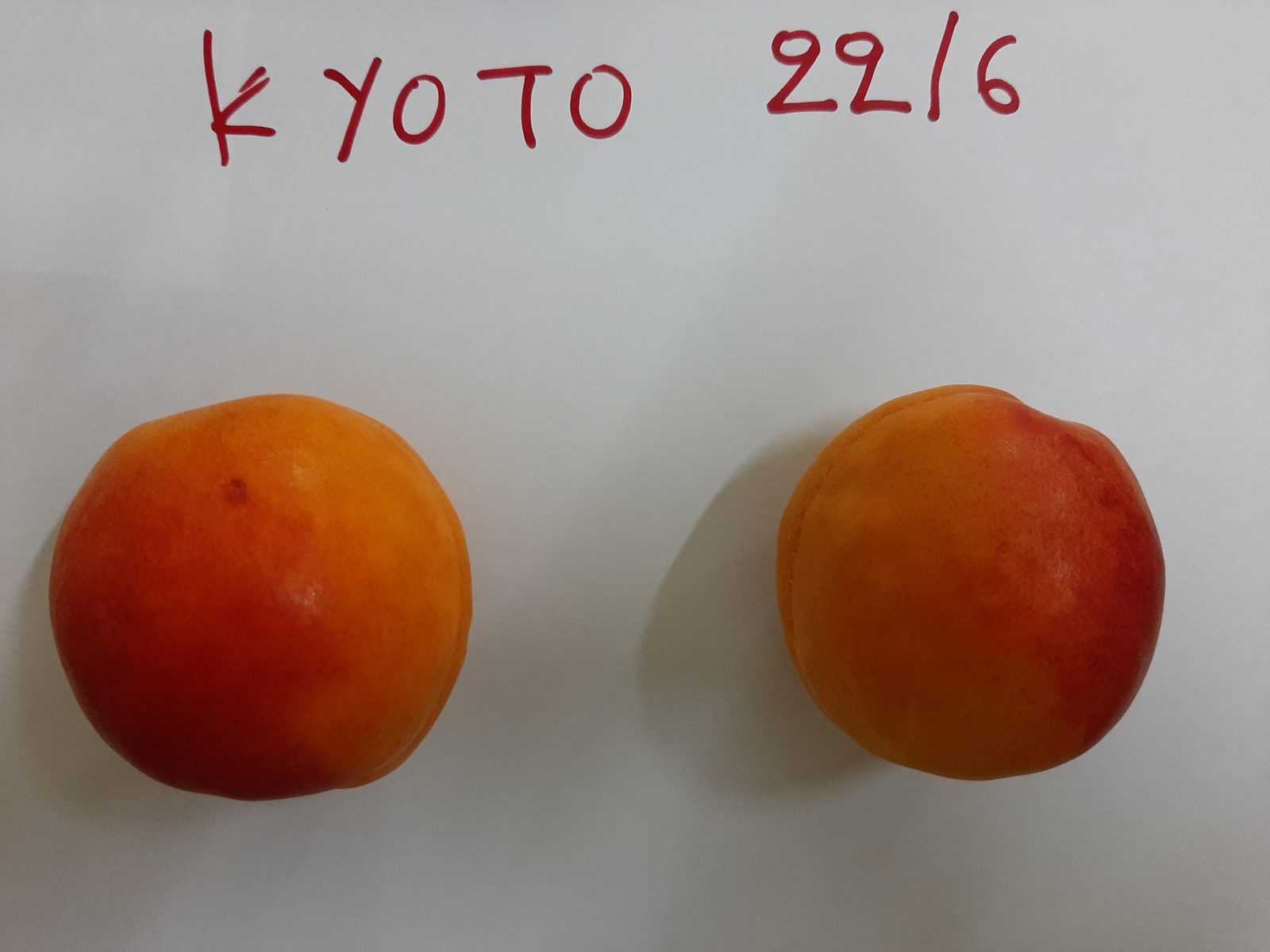
A self-fertile cultivar, with the breeder's qualification that "30% of the flowers are fertile"; it blooms semi-late, in the Hargrand period, and ripens 2 to 3 days after Goldrich. The fruit is graded 3A to 2A, with a potential of 3A to 4A after thinning, an orange ground and a red blush over two thirds to three quarters of the surface, firm juicy flesh, and no susceptibility to cracking; the yield is given as 25 to 30 tonnes per hectare [16].
Sharka: the breeder classifies Kioto as susceptible to PPV [16].
The cultivar is susceptible to the bacterium Xanthomonas arboricola pv. pruni, which has apricot (Prunus armeniaca) among its hosts and causes on the fruit "small circular brown spots that become sunken, often with water-soaked margins and light green haloes"; in the Union it is a regulated non-quarantine pest for planting material and a quarantine pest for the protected zones, under Regulation (EU) 2019/2072 [23]. It is also susceptible to the peach twig borer (Anarsia lineatella): the larvae feed on the fruit "mostly from the stem side", and later-harvested cultivars are attacked more than early ones, which concerns directly a cultivar that ripens in mid June [24].
Bloom from 5 to 15 March, ripening on 16 June, moderate growth of the tree. The production seen here reaches and exceeds 30 tonnes per hectare, where the breeder gives a potential of 25 to 30 tonnes per hectare [16]. The tree does not grow with particular vigour and requires 3 to 4 years to reach its final size. The fruit size is very large, but that presupposes severe pruning, thinning and correct fertilisation. The fruit keeps particularly well.
A point to watch. It has been observed that with certain treatments, applications of molybdenum and potassium, the expression of sharka symptoms on the fruit is reduced, to the point where it is not easy to tell whether the tree is infected. There is no published work documenting this and it is not a method of control. The opposite: the disappearance of the symptoms does not make the virus disappear, a plant without symptoms may be positive by ELISA and remains a source of infection [21], and for sharka there is no curative intervention in the field [22]. Masking the symptoms in a nursery or in an orchard that is for sale is a very serious plant health problem.
Kioto is at a disadvantage in compatibility with the usual rootstocks. Planting on the rootstock C29 is not advisable, because of the marked incompatibility after the fourth year. More generally, it is the cultivar with the greatest tree losses in the field recorded here. Planting on GF677 or Mirared or Montclair with an interstem reduces the problem. No published trial of Kioto on C29 was found; the general principle, that incompatibility of apricot with plum and myrobalan rootstocks depends on the particular cultivar and rootstock pair, is documented [30].
The information concerning the resistance or the susceptibility of the cultivar to PPV (sharka) comes from field observation and from statements by third parties, it is not the result of a laboratory test, and it may change with the appearance of new strains of the virus. Pastopoulos Agronomics bears no responsibility for its accuracy or for its use.
9Lady Cot
Breeder: Marie-Laure Etève · rights holder: Cot International, France, official cultivar datasheets [17]
A self-fertile cultivar of the mid to late season, with colour, firmness and eating quality that the rights holder characterises as "remarkable" [17]. In the French cultivar presentation of 2021 it ripens from 25 June to 5 July, with a mean fruit weight of 74 g and a dominant size of 2A, and it is classified as a "resistant type" to sharka [9].
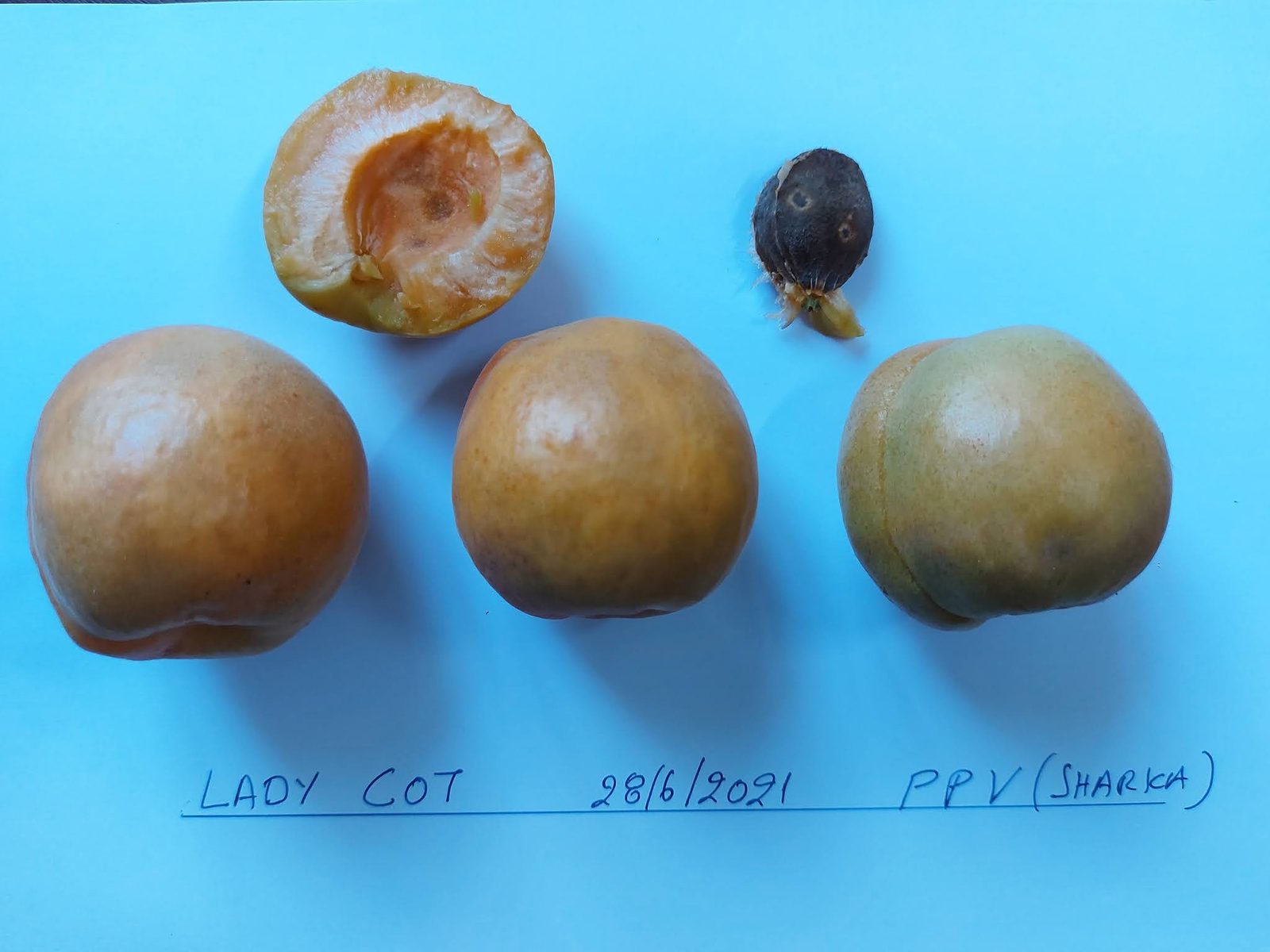
Bloom from 5 to 15 March, ripening on 23 June, vigorous upright growth, extremely productive. The yield potential seen here exceeds 30 tonnes per hectare; no published yield figure for the cultivar was found. A slight dark discolouration of the flesh around the stone has been observed during ripening. It has intensely green foliage and markedly upright growth; it often requires the scaffold limbs to be opened out in the second and third years. In training it is better to leave at least 6 limbs, because the main crop is carried on them. It can be regarded as the flagship of the apricot cultivars.
A warning: in June 2021 Lady Cot fruit infected by PPV was found. It does not show epidemic characteristics in this cultivar and most probably it was a rare occurrence. That observation is in conflict with the French classification of the cultivar as a "resistant type" [9]. It is not accompanied by laboratory identification of the strain and it is not enough to overturn the classification; it is enough, however, to justify sample testing, given that resistance is always evaluated against particular strains [21].

The information concerning the resistance or the susceptibility of the cultivar to PPV (sharka) comes from field observation and from statements by third parties, it is not the result of a laboratory test, and it may change with the appearance of new strains of the virus. Pastopoulos Agronomics bears no responsibility for its accuracy or for its use.
10Anegat
Breeder / rights holder: CEP Innovation / Novadi, France, official cultivar datasheet [7]
A self-fertile cultivar, with late bloom and low flower density, good productivity and "excellent fruit set", a vigorous semi-spreading tree, a size potential of 3A/4A and a "bright orange copper skin colour with a variable red blush"; it ripens at the start of Bergeron, after Vertige [7]. In the French presentation of 2021 it ripens from 6 to 13 July with a mean weight of 106.1 g, a dominant size of 4A and 14.2 °Brix [9].
Sharka: the breeder declares it a "PPV resistant cultivar" [7] and places it in the ARAMIS® series, which it describes explicitly as a range of apricots resistant to plum pox virus, of eight cultivars [6]; the French presentation of 2021 characterises it as a "resistant type" [9]. The classification concerns the strains circulating in France.
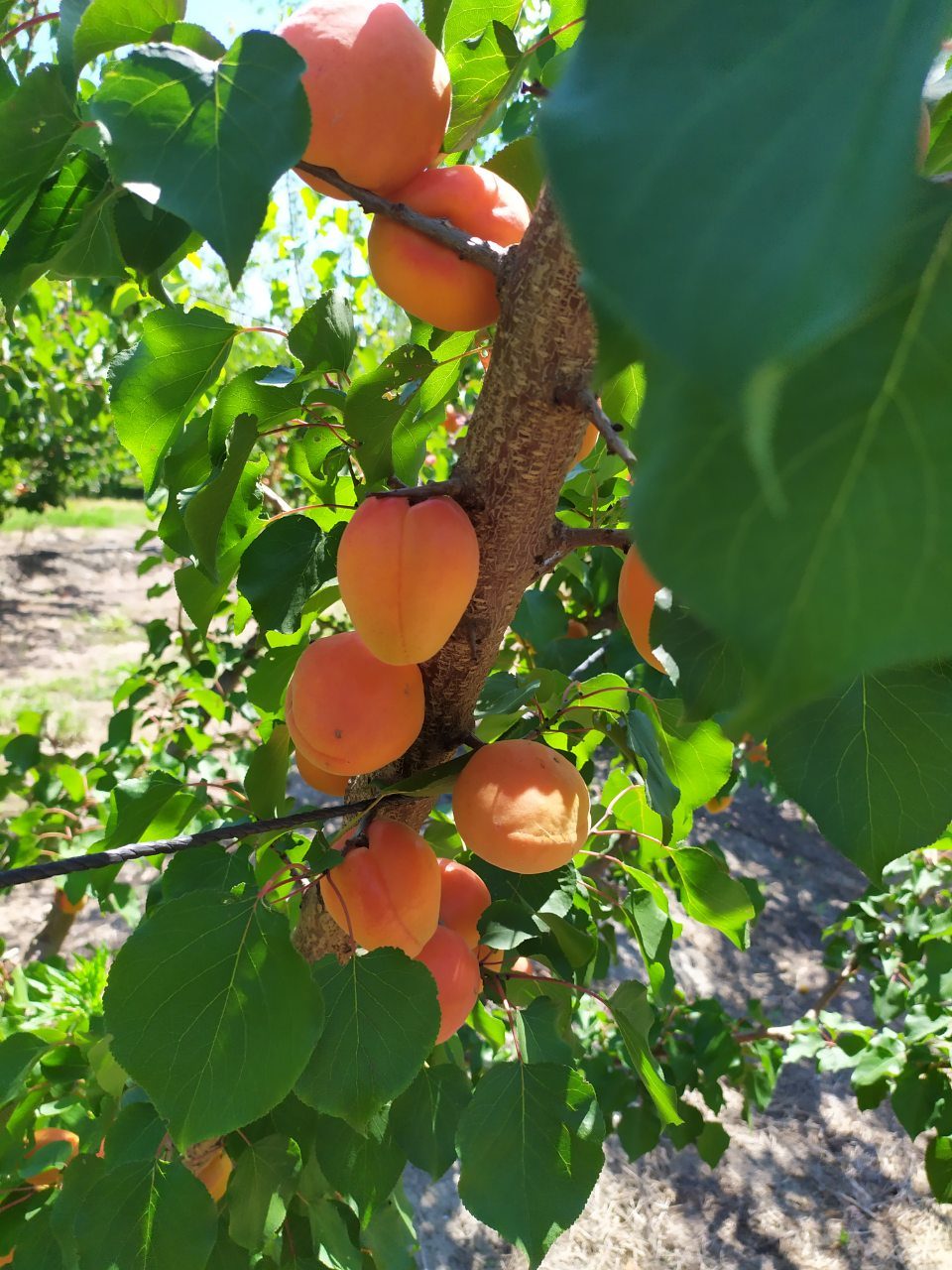
Bloom from 10 to 20 March, very late ripening, on average on 10 July. The cultivar is very new in the district, so no yield potential is given here; the first impression is very good. The tree appears vigorous and semi-upright, whereas the breeder describes it as semi-spreading [7]. The fruit size is large and the colour slightly orange. Because of its ripening season it will probably be planted a great deal in the coming years.
It does not hold well on the tree (more recent data). It has a tendency to abort the buds on the central limbs and requires particular pruning. These points are not mentioned in the breeder's datasheet.
The information concerning the resistance or the susceptibility of the cultivar to PPV (sharka) comes from field observation and from statements by third parties, it is not the result of a laboratory test, and it may change with the appearance of new strains of the virus. Pastopoulos Agronomics bears no responsibility for its accuracy or for its use.
11Farbela
Breeder: NEWCOT (France) · licence manager: International Plant Selection, official Carmingo® Farbela (cov) datasheet [13]
A late, self-fertile cultivar, bicoloured, with size 3A/2A, firmness of 70 to 75, 12 °Brix and an oval shape; the holder characterises it as "regular and productive, with very good size potential" and places its ripening in the same period as Farbaly [13]. In the French presentation of 2021 it ripens from 13 to 27 July with a mean weight of 85.6 g [9].
The fruit is large and juicy, with an intense orange colour and a curious shape, with one side slightly flattened. Bloom is late and ripening is 2 days before Farbaly, where the holder gives them on the same day [13]. It is a cultivar worth having and it can be recommended to anyone who does not want to plant Farbaly. It is very productive, though not as productive as Farbaly.
The trees have shown no sharka symptoms so far. Given its classification as not resistant in France [9], the absence of symptoms here has to be read as a provisional picture and not as a property of the cultivar.
* In the checks made in recent years, split stones were found at harvest. The matter is under investigation. No published report of the phenomenon for Farbela was found.
The information concerning the resistance or the susceptibility of the cultivar to PPV (sharka) comes from field observation and from statements by third parties, it is not the result of a laboratory test, and it may change with the appearance of new strains of the virus. Pastopoulos Agronomics bears no responsibility for its accuracy or for its use.
12Farbaly
Breeder: NEWCOT (France) · licence manager: International Plant Selection, official Carmingo® Farbaly (cov) datasheet [12]
A self-fertile and late cultivar: the holder places it about 30 days after the reference cultivar Bergeron, with late bloom, size 3A, an oval elongated shape, a bicoloured skin with a blush of 30% to 50%, 13 °Brix and "excellent firmness, with perfect behaviour on the tree and postharvest"; it characterises it as "regular and particularly productive, the reference cultivar in its ripening period" [12].
It blooms in the first fortnight of March and usually ripens after 15 July. The yields seen here easily exceed 40 tonnes per hectare, of the same order as the 31.2 tonnes per hectare, 24.9 of them marketable, of the French trial in the eighth leaf [9]; the holder of the cultivar gives only a qualitative characterisation of productivity [12].
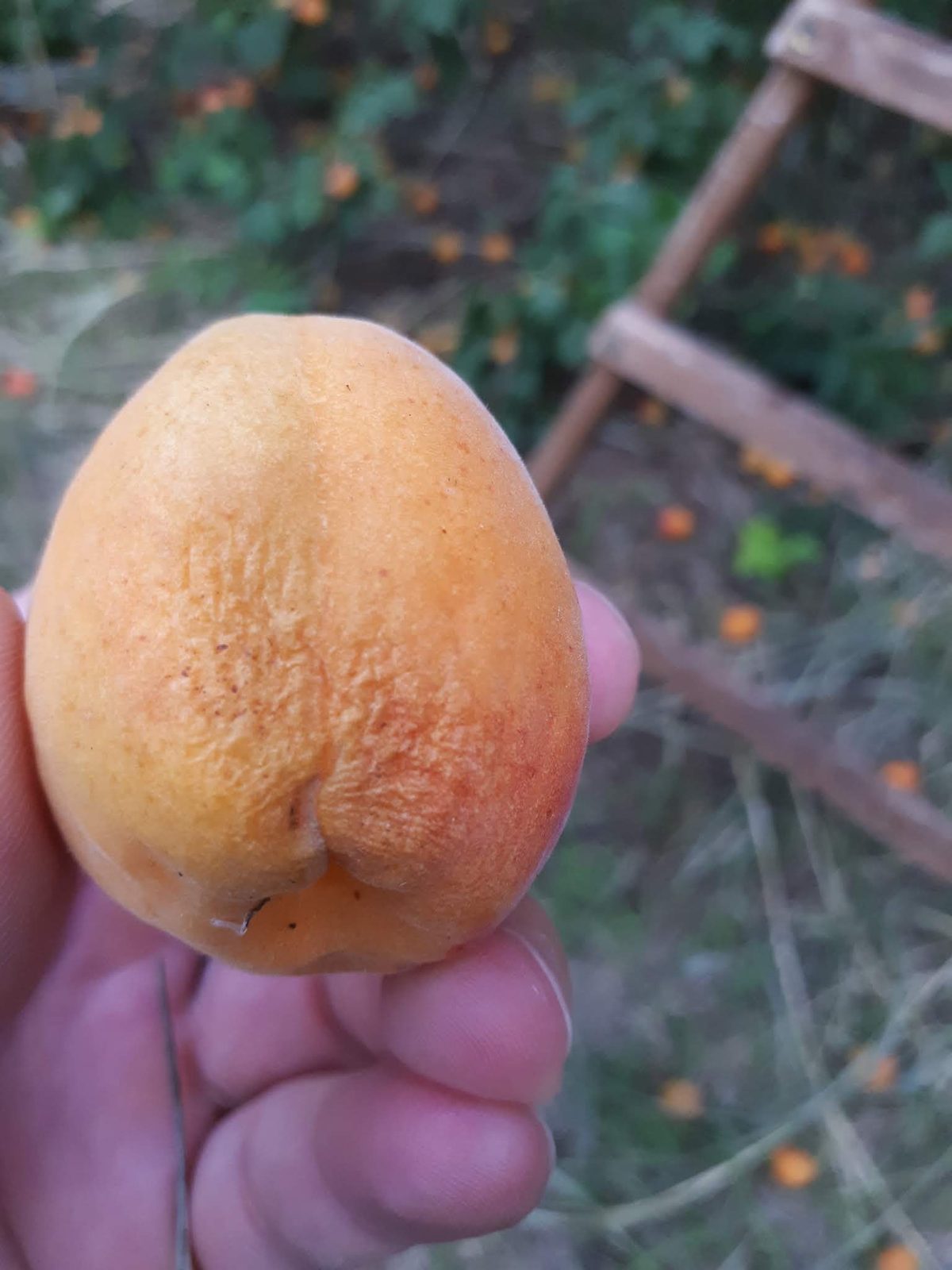
The fruit is of medium to large size and keeps well postharvest; it does not soften easily, which agrees with the "firmness" of the datasheet [12]. The flesh clings to the stone and acquires a soft texture during ripening. The fruit is susceptible to excessive rainfall during ripening, because it shrivels. Conversely, in very hot summers it shows dark necrotic spots, chiefly on the side exposed to the sun, though in a small proportion. Opinions on the commercial interest of the cultivar differ; for a good many years, however, it has commanded high grower prices.
The information concerning the resistance or the susceptibility of the cultivar to PPV (sharka) comes from field observation and from statements by third parties, it is not the result of a laboratory test, and it may change with the appearance of new strains of the virus. Pastopoulos Agronomics bears no responsibility for its accuracy or for its use.
13Domino
Breeder / rights holder: PSB Producción Vegetal, Murcia, Spain, official cultivar page [5]
A Spanish cultivar, self-fertile, with fruit size A/AA, orange skin and orange flesh, high production and a tree of moderate vigour and open habit; ripening is placed 10 days before Flopria-cov [5] [2]. The cultivar page declares it "resistencia a Sharka" [5], while the 2025 catalogue marks it as "SHARKA TOLERANCE" [2], as it does Nelson and Madrigal; the same catalogue describes the fruit as "intense orange with a red blush", without giving a percentage [2].
It ripens 4 days before Kioto and blooms in the first ten days of March. The fruit seen here is large and firm, with a red blush over about 50% of the surface. Both of those last two points differ from the datasheet: the breeder gives moderate firmness and does not report a blush percentage [5] [2]. It is an interesting cultivar for its ripening season.
In Greece its behaviour towards the local strains of the virus has not been established. The breeder's declaration of resistance [5] concerns Spanish conditions; resistance to PPV is always evaluated against particular strains [21].

The information concerning the resistance or the susceptibility of the cultivar to PPV (sharka) comes from field observation and from statements by third parties, it is not the result of a laboratory test, and it may change with the appearance of new strains of the virus. Pastopoulos Agronomics bears no responsibility for its accuracy or for its use.
14Cebas Red
Breeder / rights holder: CEBAS-CSIC, Murcia, Spain, official Cebasred cultivar datasheet [19]
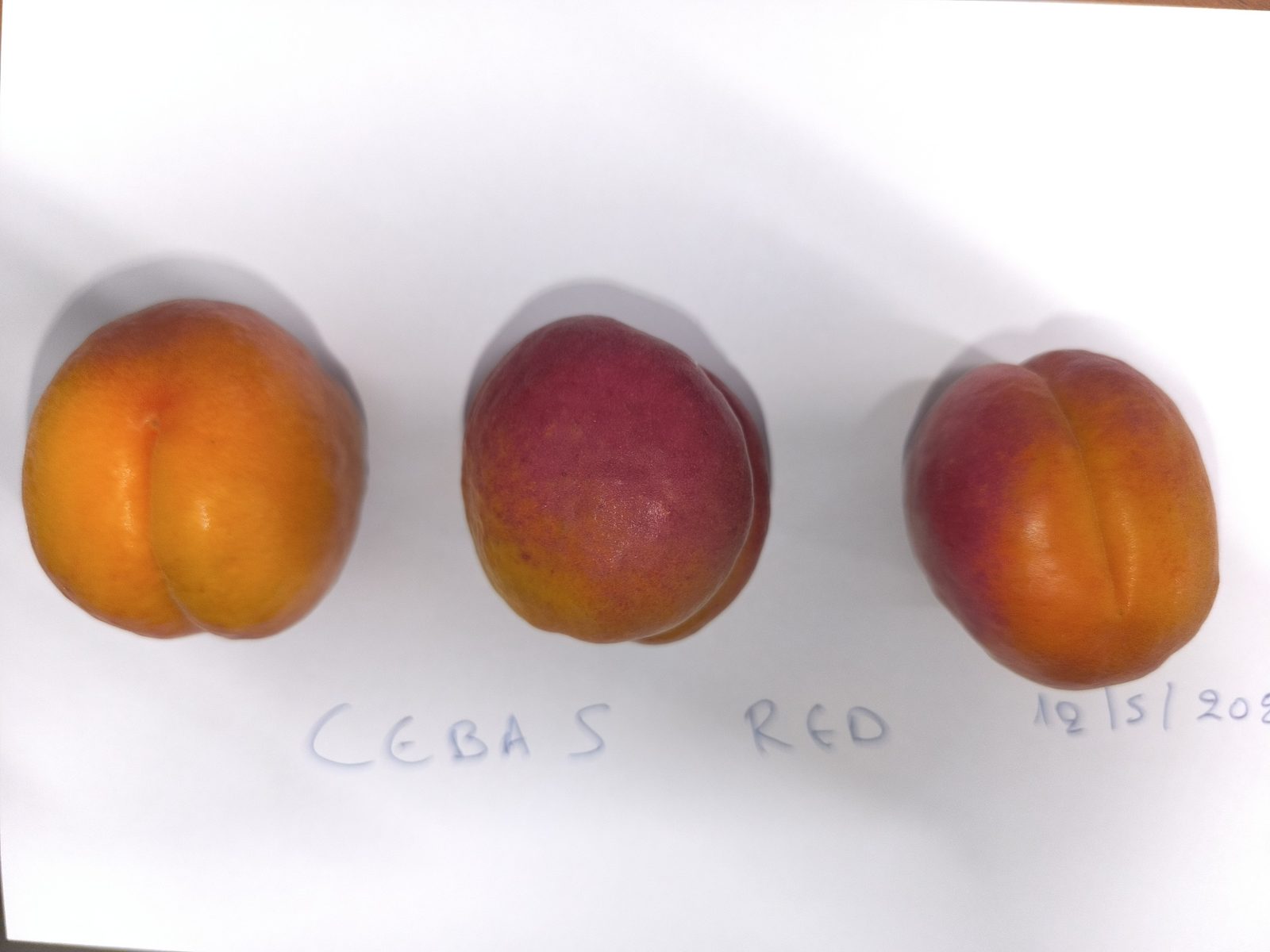
An extra-early cultivar, with very early bloom. The breeder's datasheet gives bloom at about 18 February with low chilling requirements, ripening at about 30 April in Murcia, self-compatibility, a mean fruit weight of 64 g, a dark orange colour with a red blush, orange flesh, 11.3 °Brix, acidity of 1.34 g per 100 ml, very high firmness, high vigour and high productivity [19]. In central Macedonia ripening is observed later, from 1 to 10 May. Because bloom is so early, areas with late frosts are avoided.
Sharka: the breeder gives resistance to sharka as "high" [19]. CEBAS-CSIC maintains a dedicated apricot breeding programme for resistance to sharka, so the characterisation is not a commercial claim but the result of a programme; it concerns, however, the strains that were evaluated in Spain.
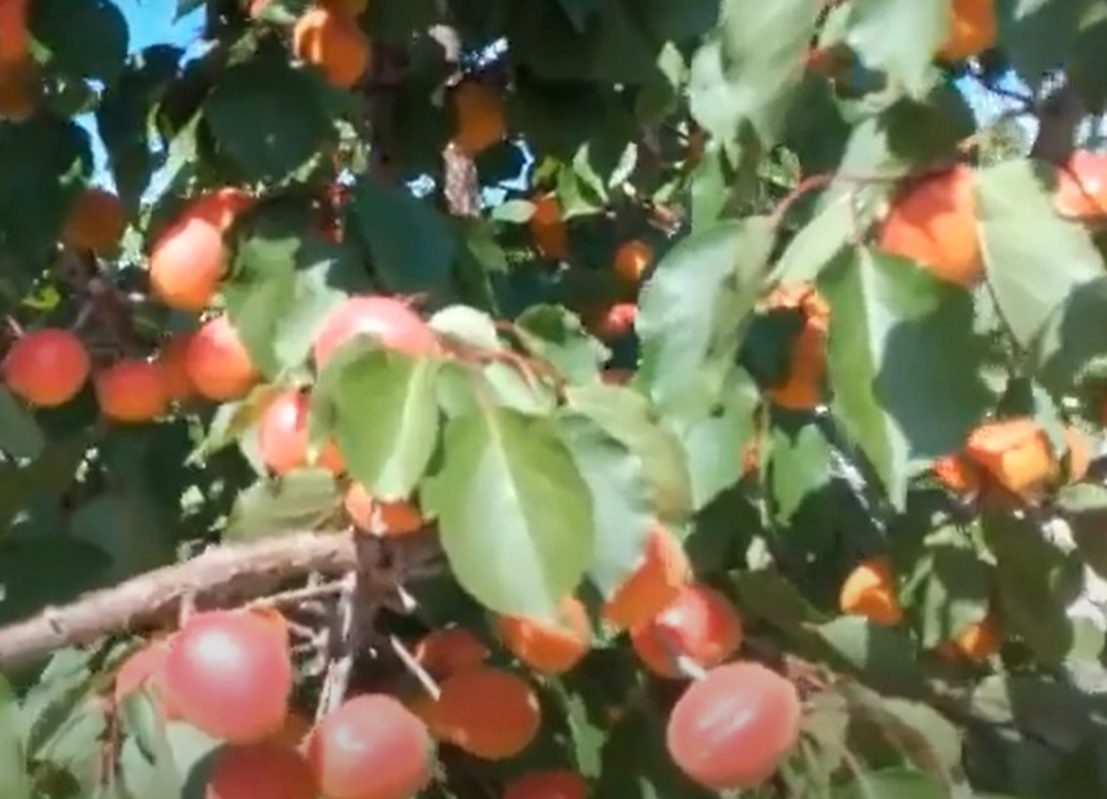
In the district it blooms around 20 to 25 February, a few days after the date in the datasheet [19]. The fruit is handsome, large for the season, with a red blush of the order of 40%, a percentage that the datasheet does not give [19]. It is impressive and superior to all the other early cultivars seen here. It can be regarded as a cultivar carrying great risk because of its bloom date, which may, however, return high income to the grower.
Resistance to sharka has not been established in Greece; symptoms appear to be present in some orchards. That finding requires laboratory confirmation before it is treated as refuting the breeder's declaration, because the distinction between resistant, tolerant and susceptible is made by ELISA and not by eye [21]. It matters that the susceptibility of apricot cultivars to PPV in the same district has been measured in the past: in a four-year evaluation of 42 cultivars at Skydra in central Macedonia, Early Orange and Stella were found resistant, the Greek cultivars Yperproimo Porou, Proimo Tirynthos and Diamantopoulou were among the most susceptible, while Bebekou was placed at medium susceptibility [26].
The information concerning the resistance or the susceptibility of the cultivar to PPV (sharka) comes from field observation and from statements by third parties, it is not the result of a laboratory test, and it may change with the appearance of new strains of the virus. Pastopoulos Agronomics bears no responsibility for its accuracy or for its use.
15Bergeval
Breeder / rights holder: CEP Innovation / Novadi, France, official cultivar datasheet (Bergeval® Aviclo) [8]
A self-fertile cultivar, with late bloom in the same period as Bergeron, a mean fruit weight of 65 to 75 g and dominant sizes of 2A/3A, a slightly elongated shape, "very firm, crisp, subacid and juicy flesh" and "regular and steady productivity, with early cropping thanks to the setting of short shoots from the second year" [8].
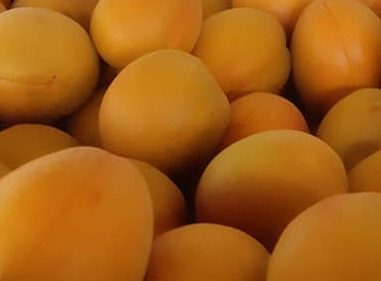
1. Red blush. The breeder describes "an attractive bicoloured, very bright apricot with 60% red overall over an intense orange ground" [8]. In the Pella orchards the blush recorded is of the order of 10%.
2. Sharka. The breeder declares Bergeval a "PPV resistant cultivar" and a "bicoloured ARAMIS® cultivar resistant to PPV" [8]; the ARAMIS® series is defined as a range of apricots resistant to the virus [6]. The impression from the field here is that there is a serious possibility that it is susceptible. That impression is not supported by a laboratory test and is not enough to overturn the breeder's declaration; it is recorded as a reason for sample testing by ELISA, not as a recommendation to avoid the cultivar.
It is very productive, with fruit of medium to large size, consistent with the 65 to 75 g of the datasheet [8]. The tree is semi-upright and forms a vase shape easily. The fruit is tasty and firm. Ripening in the district is usually on 15 June. The cultivar has shown signs of small fruit in some years; no published report of small fruit for the cultivar was found.
The information concerning the resistance or the susceptibility of the cultivar to PPV (sharka) comes from field observation and from statements by third parties, it is not the result of a laboratory test, and it may change with the appearance of new strains of the virus. Pastopoulos Agronomics bears no responsibility for its accuracy or for its use.
16Primidi
Breeder: NEWCOT (France) · licence manager: International Plant Selection, official Carmingo® Primidi (cov) datasheet [14]
Addition: in an earlier form of this text the breeder was given as unconfirmed. The cultivar is Carmingo® Primidi (cov), bred by NEWCOT, with IPS as licence manager [14].
A self-fertile cultivar, with early bloom, a semi-upright tree of strong vigour, elongated fruit of size 3A, 14 °Brix and "an intense aroma"; the holder places it 7 days before Carmingo® Mediabel and characterises it as adapted to areas of medium chilling requirements and to southern zones [14]. The datasheet makes no reference at all to its behaviour towards PPV [14], nor was the cultivar found in the French presentation of 2021 [9].
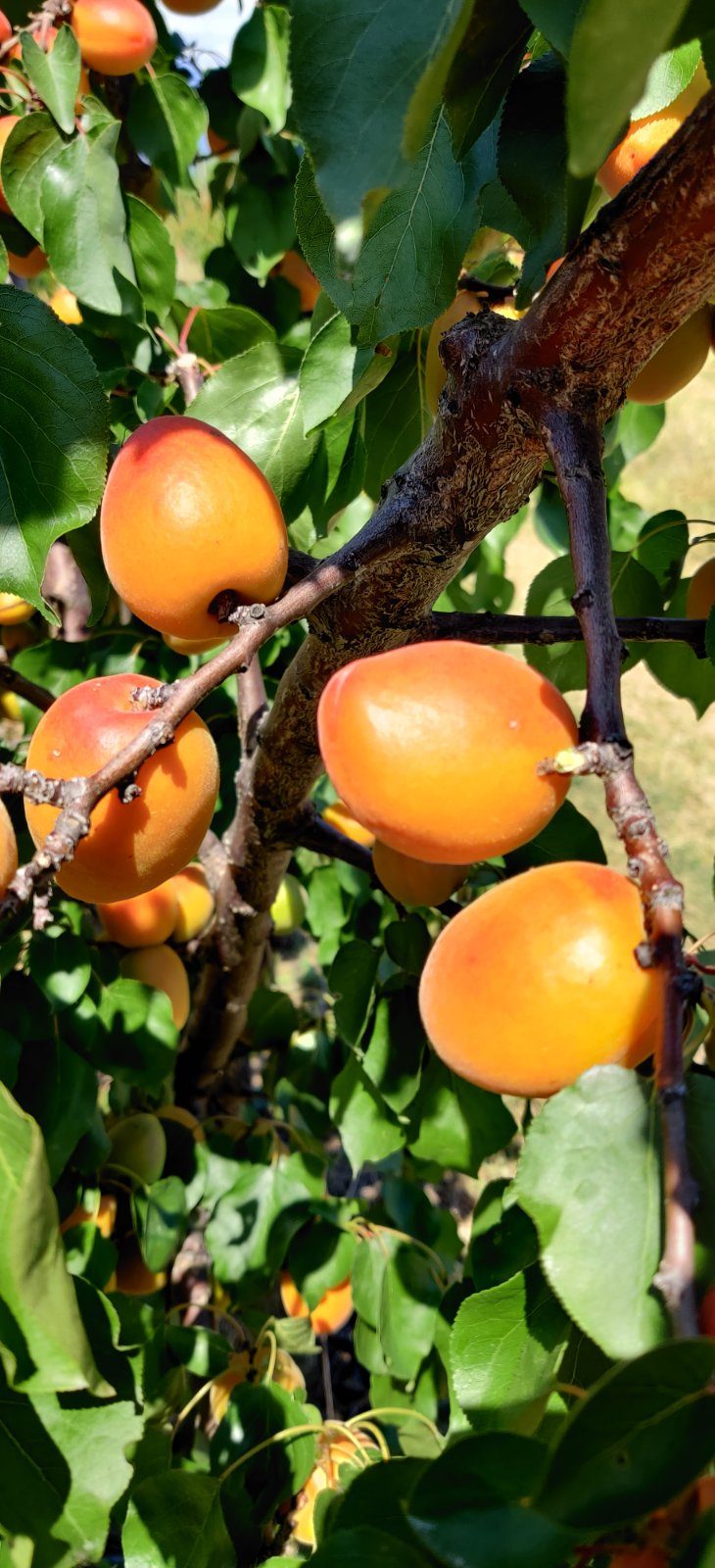
An excellent mid-early cultivar, with a little red blush and an orange colour. It ripens 6 days before Bora, at a good moment given the shortage of mid-early cultivars. Bloom is around the beginning of March, depending on the weather. It can be regarded as a good and reliable cultivar for the period between Pricia and Bora.
The fruit is large and moderately tolerant of handling; with poor management it shows darkening and sensitivity in cold storage. It also shows problems of poor cropping in some years, although the datasheet gives it as self-fertile [14].
It has shown no sharka symptoms so far. Because there is no classification of the cultivar, that picture must not be read as resistance [21].
The information concerning the resistance or the susceptibility of the cultivar to PPV (sharka) comes from field observation and from statements by third parties, it is not the result of a laboratory test, and it may change with the appearance of new strains of the virus. Pastopoulos Agronomics bears no responsibility for its accuracy or for its use.
17Medflo
Breeder: NEWCOT (France) · licence manager: International Plant Selection, official Carmingo® Medflo (cov) datasheet [15]
Addition: in an earlier form of this text the breeder was given as unconfirmed. The cultivar is Carmingo® Medflo (cov), bred by NEWCOT, with IPS as licence manager [15].
A self-fertile cultivar, with early bloom, a bicoloured skin, an elongated shape, size 3A, 14 °Brix and a taste described as "aromatic and juicy"; the tree is given as semi-spreading and of strong vigour, and ripening 7 days after Carmingo® Mediabel [15]. The datasheet makes no reference at all to PPV [15].
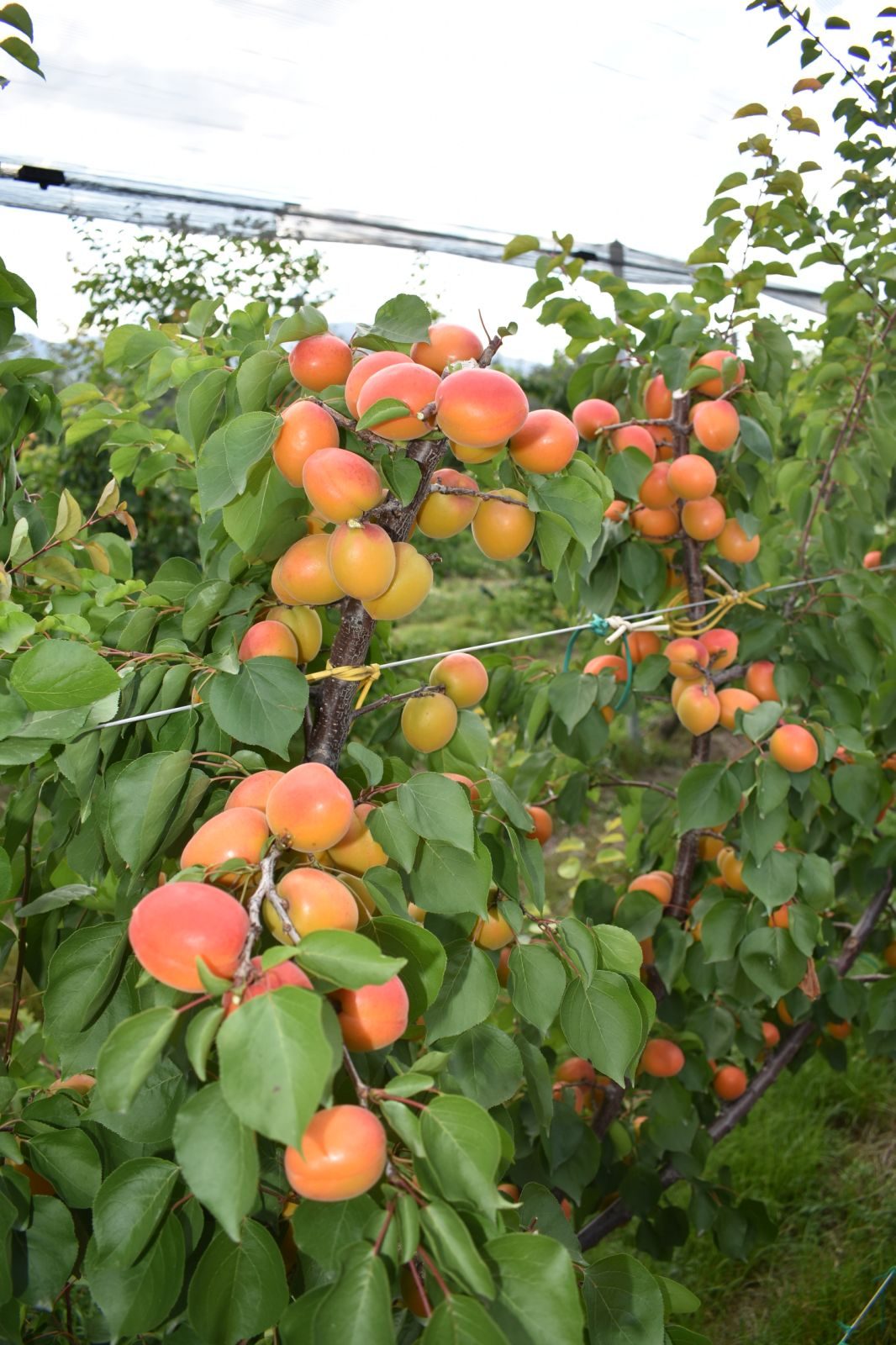
A new and very good cultivar. Bloom is in the first ten days of March and ripening around the beginning of June. The fruit is very large and extremely tasty, a picture consistent with the 14 °Brix of the datasheet [15]. The tree is easy to train. The fruit does not hold on the tree once it is ripe. It can be regarded as a very worthwhile cultivar for the period before Bebekou; Bebekou is the main Greek cultivar and is placed at medium susceptibility to sharka [26].
No symptoms of sharka infection have been seen so far. Since there is no classification of the cultivar, that is not an indication of resistance [21].
The information concerning the resistance or the susceptibility of the cultivar to PPV (sharka) comes from field observation and from statements by third parties, it is not the result of a laboratory test, and it may change with the appearance of new strains of the virus. Pastopoulos Agronomics bears no responsibility for its accuracy or for its use.
18Rouge Cot
Breeder / rights holder: Cot International, France, official cultivar datasheets [17]
A self-fertile cultivar of mid bloom, ripening in mid June, with a uniform red colour and good size according to the rights holder [17]. In the French presentation of 2021, Rougecot® 2011.72 ripens from 18 to 29 June, with a mean weight of 64.2 g, a dominant size of 2A and 14.1 °Brix [9]; the high sugars explain its taste.
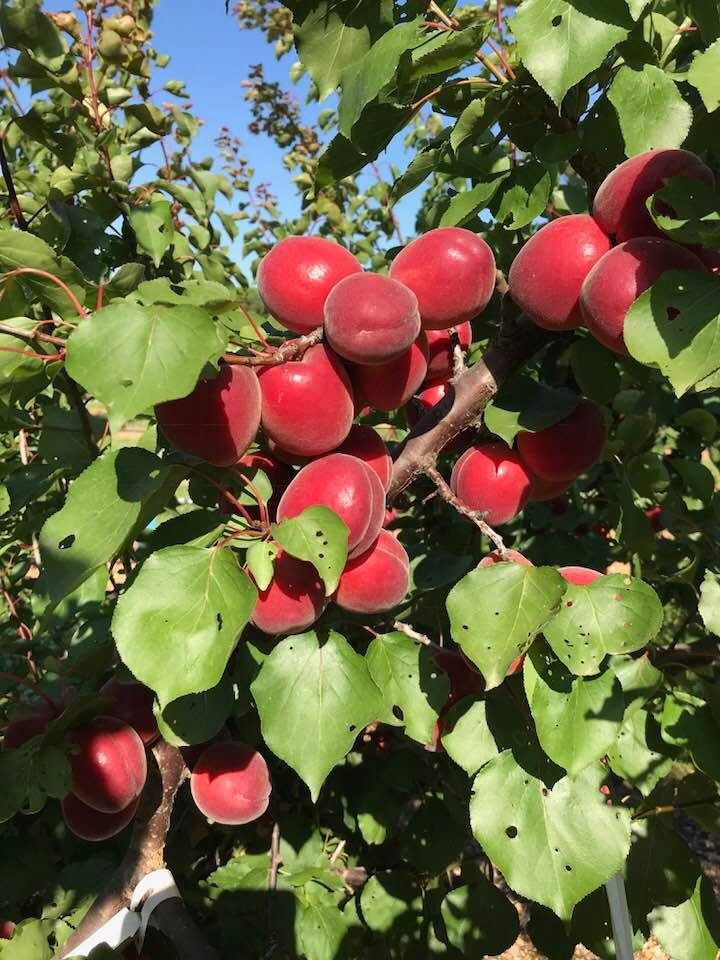
It is probably the most worthwhile red cultivar. The fruit is deep red over about 90% of its surface; the rights holder reports a uniform red colour without giving a percentage [17]. Ripening here is after 10 June and the fruit behaves well under handling. The fruit is very tasty and the flavour resembles that of plums.
No sharka symptoms have been seen so far. It is susceptible to rain during the ripening period. It is a cultivar of medium fruit size, which agrees with the 64.2 g and the size 2A of the French evaluation [9]. It needs severe thinning, and high yields cannot be the aim. It can be regarded as a worthwhile cultivar, to be planted by anyone looking for something different.

The information concerning the resistance or the susceptibility of the cultivar to PPV (sharka) comes from field observation and from statements by third parties, it is not the result of a laboratory test, and it may change with the appearance of new strains of the virus. Pastopoulos Agronomics bears no responsibility for its accuracy or for its use.
19Nelson
Breeder / rights holder: PSB Producción Vegetal, Murcia, Spain, official cultivar page [3]
A late cultivar, self-fertile, with very large fruit size (3A/AA), orange skin and flesh, "very firm" texture, no tendency to crack, high production and a tree of moderate vigour and semi-open habit; it ripens 5 days before Milord-cov and the plant variety right is NELSON-cov CEE no. 2016/2619 [3] [2].
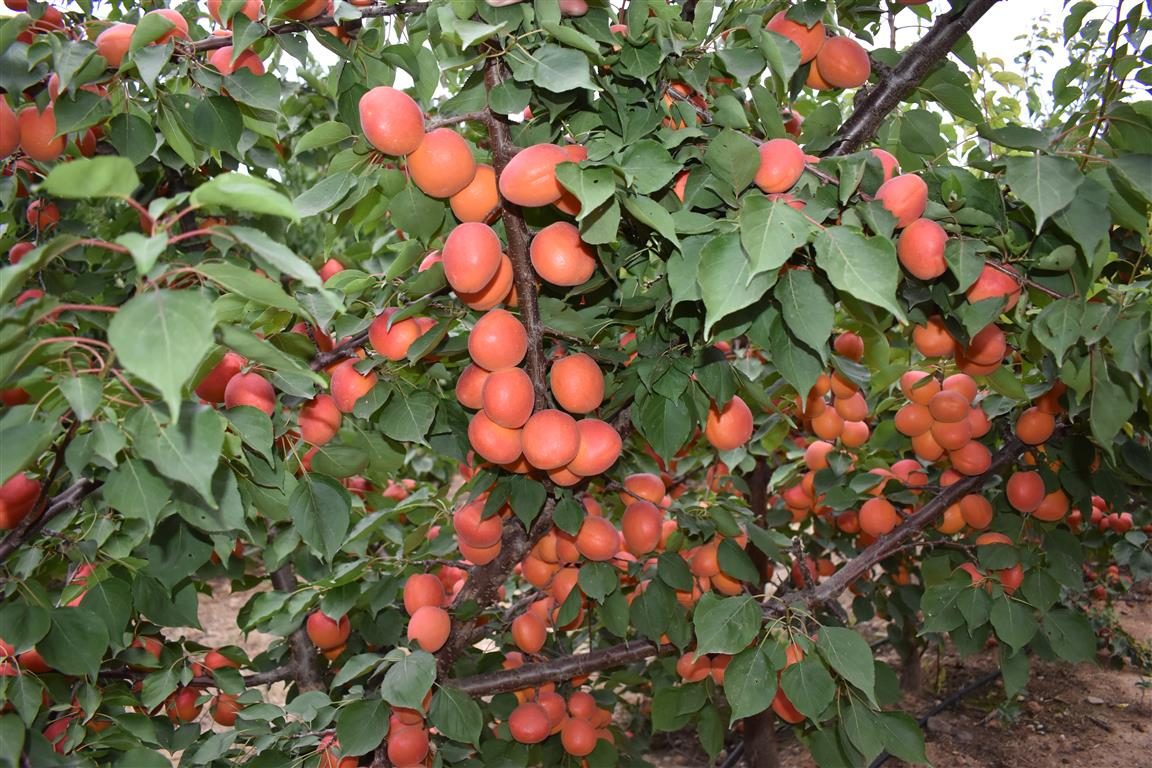
Ripening takes place around mid July. Bloom is mid to late. The fruit is orange, with the barest red colour, juicy and tasty, perhaps the tastiest cultivar of July. It can be regarded as a worthwhile cultivar for its season, with very good production and quality. In the coming years the apricot appears likely to become a fruit of the whole summer, taking a large slice of the pie from the other summer fruits.
It appears to show a straight mark of 1 to 2 cm at the start of the suture, especially in years of low production, for example after frost. The breeder's datasheet does not report such a defect [3].
The information concerning the resistance or the susceptibility of the cultivar to PPV (sharka) comes from field observation and from statements by third parties, it is not the result of a laboratory test, and it may change with the appearance of new strains of the virus. Pastopoulos Agronomics bears no responsibility for its accuracy or for its use.
20Madrigal
Breeder / rights holder: PSB Producción Vegetal, Murcia, Spain, official cultivar page [4]
A new cultivar, self-fertile, with mid bloom, a vigorous tree of open habit, elongated firm fruit with no tendency to crack, size AA/3A and high production; it ripens 5 to 10 days after Farbaly-cov and the plant variety right is MADRIGAL-cov CEE no. 2018/2667 [4] [2]. For sharka the breeder gives, as with Nelson, two different characterisations: "resistencia a Sharka" on the cultivar page [4] and "SHARKA TOLERANCE" in the 2025 catalogue [2]. The difference is not a matter of wording and is not settled without ELISA [21].
Ripening takes place at the end of Farbaly, a picture consistent with the "Farbaly +5 to +10 days" of the datasheet [4] [2]. The fruit is large, with juicy and sweet flesh. Its productivity is high, but does not appear to reach that of Farbaly; it is, however, superior in taste. No measurement of sugars for the two cultivars under Greek conditions has been made.
So far it has not been observed to be infected by PPV, in agreement with the breeder's declaration [4]. The cultivar has been in the district only a few years and the picture has not been checked in a laboratory [21].
The information concerning the resistance or the susceptibility of the cultivar to PPV (sharka) comes from field observation and from statements by third parties, it is not the result of a laboratory test, and it may change with the appearance of new strains of the virus. Pastopoulos Agronomics bears no responsibility for its accuracy or for its use.
21Cocot
Breeder / rights holder: Cot International, France, official cultivar datasheets [17]
A cultivar of the COT series, self-fertile, semi-early, with good size potential according to the rights holder [17]. In the French presentation of 2021 it ripens from 15 to 22 June, with a mean weight of 68.5 g, a dominant size of 3A and 14.5 °Brix, and it is classified as a "resistant type" to sharka [9].
It ripens in the Kioto period and so far shows good fruit set. The fruit is round and large, and it usually requires severe thinning. The colour is orange, with a red blush over about 50% of the skin; no blush percentage is given in the rights holder's datasheet [17]. It shows no signs of cracking, although it has been studied in Greece for only a few years.
The French classification as a "resistant type" [9] concerns the strains circulating in France; in Greece a few more years of growing are needed before its behaviour towards the local strains becomes apparent [21].
The information concerning the resistance or the susceptibility of the cultivar to PPV (sharka) comes from field observation and from statements by third parties, it is not the result of a laboratory test, and it may change with the appearance of new strains of the virus. Pastopoulos Agronomics bears no responsibility for its accuracy or for its use.
The data reported here from the field rest on empirical evaluation and the characteristics may change from district to district. Behaviour towards PPV differs from cultivar to cultivar. Some may initially show no symptoms, but in time become infected by new strains and express the disease.
In apricot, resistance is not a commercial slogan: there is a genetic basis, the main resistance locus has been localised to a 236 kb region of chromosome 1 and it is evaluated with protocols that combine visual symptoms with a serological test [21]. There is a Greek breeding programme as well: at the Institute of Deciduous Trees, "20 families with 1,480 hybrids" were produced over six years, with Harlayne, Orangered, Early Blush, Stark Early Orange and Sunglo as resistance donors and with crosses of Bebekou with Orangered, so that quality and local adaptation would be retained [27].
Breeders and rights holders: the links lead to official pages of breeders or rights holders and not to nurseries. Where confirmation was not possible, this is stated explicitly. The sole exception is the cultivars Mogador and Mikado, which are no longer included in the catalogue of their breeder and for which the descriptive data come from an Italian commercial catalogue, something that is stated in the source list as well.
The information concerning the resistance or the susceptibility of the cultivar to PPV (sharka) comes from field observation and from statements by third parties, it is not the result of a laboratory test, and it may change with the appearance of new strains of the virus. Pastopoulos Agronomics bears no responsibility for its accuracy or for its use.
Sources
The numbers within the text refer to the list below. Where only the abstract and not the full text was used, this is stated explicitly. The two links to CTIFL cultivar datasheets that appeared in an earlier form of this text have been removed: the server does not open and the corresponding pages at www.ctifl.fr require an account.
- [1] PSB Producción Vegetal, Apricots (apricot cultivar catalogue). Source for the fact that the current PSB apricot catalogue includes 31 cultivars, no longer includes Mogador and Mikado, and does include Nestor-cov. Full text.
- [2] PSB Producción Vegetal (2025). Catalogue: Nectarine, Flat nectarine, Peach, Flat peach, Apricot, Plum (PDF, 60 pages). Source for the comparative ripening seasons, the fruit sizes and the "SHARKA TOLERANCE" legend with which Nelson-cov, Madrigal-cov, Domino-cov and Nestor-cov are marked, and for the description of the blush of Domino. Full text.
- [3] PSB Producción Vegetal, Nelson-cov. Source for the self-fertility, the size 3A/AA, the very high firmness, the absence of cracking, the high production, the plant variety right CEE no. 2016/2619 and the characterisation "resistencia a Sharka" for Nelson. Full text.
- [4] PSB Producción Vegetal, Madrigal-cov. Source for the self-fertility, the size AA/3A, the ripening 5 to 10 days after Farbaly, the high production, the plant variety right CEE no. 2018/2667 and the characterisation "resistencia a Sharka" for Madrigal. Full text.
- [5] PSB Producción Vegetal, Domino-cov. Source for the self-fertility, the size A/AA, the moderate firmness, the high production and the characterisation "resistencia a Sharka" for Domino. Full text.
- [6] CEP Innovation / Novadi, Apricots (apricot cultivar range). Source for the definition of the ARAMIS® series as a range of eight cultivars resistant to plum pox virus, and for the fact that Pricia does not belong to the CEP Innovation range. Full text.
- [7] CEP Innovation / Novadi, Anegat p.v.r. Source for the self-fertility, the late bloom with low flower density, the size potential 3A/4A, the strong vigour and the semi-spreading habit, the ripening season and the declaration "PPV resistant cultivar" for Anegat. Full text.
- [8] CEP Innovation / Novadi, BERGEVAL® Aviclo p.v.r. Source for the mean weight of 65 to 75 g, the 60% red blush, the very firm crisp flesh, the late Bergeron-type bloom, the self-fertility and the declaration "bicoloured ARAMIS® cultivar resistant to PPV" for Bergeval. Full text.
- [9] Guiraud, M. & Crestin, C. (2021). Présentation variétale Abricot, part 2 (PDF, in French; CTIFL Balandran trials, France). Source for the French ripening dates, the mean fruit weights, the sizes and the sugars of Pricia, Mediabel, Anegat, Cocot, Lady Cot, Rougecot and Farbela, and above all for the sharka column: "resistant type" for the first six and "not resistant" for Farbela. Full text.
- [10] International Plant Selection, Carmingo® Pricia (cov). Source for the breeder NEWCOT and the licence manager IPS, the self-fertility, the late bloom, the size 2A/3A, the 10 to 12 °Brix, the ripening ten days before Orangered® and the declaration "resistant to sharka according to the CTIFL protocol 2017 to 2019". Full text.
- [11] International Plant Selection, Carmingo® Mediabel (cov). Source for the breeder NEWCOT, the self-fertility, the blush of 30% to 60%, the size 2A/3A, the 12 °Brix, the oval shape and the declaration "resistant to sharka, validated with the PPV-CTIFL protocol 2017 to 2019" for Mediabel. Full text.
- [12] International Plant Selection, Carmingo® Farbaly (cov). Source for the breeder NEWCOT, the self-fertility, the ripening about 30 days after Bergeron, the size 3A, the blush of 30% to 50%, the 13 °Brix, the excellent firmness, and for the fact that the datasheet contains no reference to sharka. Full text.
- [13] International Plant Selection, Carmingo® Farbela (cov). Source for the breeder NEWCOT, the self-fertility, the size 3A/2A, the 12 °Brix, the ripening at the same time as Farbaly, and for the fact that the datasheet contains no reference to sharka. Full text.
- [14] International Plant Selection, Carmingo® Primidi (cov). Source for the breeder NEWCOT, the self-fertility, the early bloom, the size 3A, the 14 °Brix, the vigorous semi-upright tree, the ripening seven days before Mediabel, and for the absence of any reference to sharka. Full text.
- [15] International Plant Selection, Carmingo® Medflo (cov). Source for the breeder NEWCOT, the self-fertility, the early bloom, the size 3A, the 14 °Brix, the vigorous semi-spreading tree, the ripening seven days after Mediabel, and for the absence of any reference to sharka. Full text.
- [16] Pépinières Escande (2016). Apricots, our range of varietal creation (PDF). Source for the compulsory pollinators and the lack of self-fertility of Spring Blush and Tsunami, the self-fertility of Kioto with 30% fertile flowers, the sizes and the blushes of 60% to 70% and two thirds to three quarters, the potentials of 20 and of 25 to 30 tonnes per hectare, and the sharka classifications: Spring Blush "susceptible", Tsunami "tolerant", Kioto "susceptible". Full text.
- [17] COT International, Varieties sheets. Source for the self-fertility of Lady Cot, Rouge Cot and Cocot, for the ripening season of Rouge Cot in mid June and of Cocot as semi-early, and for the fact that none of those datasheets makes any reference to sharka. Full text, with limited technical data per cultivar.
- [18] ANFIC (Australian Nurserymen's Fruit Improvement Company), Wonder Cot apricot. Source for the fact that Wonder Cot requires cross pollination, for the incompatibility alleles S5S7, for the pollinators Lilly Cot, Magic Cot and Tom Cot and for the fruit diameter of 50 to 55 mm. Full text; the harvest dates on the page concern the southern hemisphere and are not used here.
- [19] CebasFruit (CEBAS-CSIC, Murcia), Cebasred. Source for the bloom at about 18 February with low chilling requirements, the ripening at about 30 April in Murcia, the self-compatibility, the fruit weight of 64 g, the 11.3 °Brix, the acidity of 1.34 g per 100 ml, the very high firmness and the characterisation "high" for resistance to sharka. Full text.
- [20] Herrera, S. et al. (2022). Self-Incompatibility in Apricot: Identifying Pollination Requirements to Optimize Fruit Production. Plants. Source for the gametophytic self-incompatibility mechanism and the multiallelic S locus, for the Sc allele of self-compatibility, for the 49 self-compatible and 12 self-incompatible out of 235 accessions, for the finding that about half of the new releases are self-compatible, and for the rule that cultivars of the same incompatibility group are mutually incompatible. Full text.
- [21] De Mori, G. et al. (2019). Resistance to Sharka in Apricot: Comparison of Phase-Reconstructed Resistant and Susceptible Haplotypes of 'Lito' Chromosome 1 and Analysis of Candidate Genes. Frontiers in Plant Science 10:1576. The principal source for the distinction between resistant (0, no symptoms and negative ELISA), tolerant (1, no symptoms but positive ELISA) and susceptible (2), and for the localisation of the PPVres locus to a 236 kb region of chromosome 1 of apricot. Full text.
- [22] EPPO Global Database, Potyvirus plumpoxi (PPV000), datasheet. Source for the symptoms on apricot fruit and stone, the transmission by aphids and by planting material, the fact that there is no curative intervention in the field, the control by removal of infected trees, the classification of the virus as a regulated non-quarantine pest under Regulation (EU) 2019/2072 and its presence in mainland Greece. Full text.
- [23] EPPO Global Database, Xanthomonas arboricola pv. pruni (XANTPR), datasheet. Source for the fact that apricot (Prunus armeniaca) is a host, for the description of the circular sunken brown spots on the fruit with water-soaked margins and light green haloes, and for the regulatory status of the bacterium in the Union under Regulation (EU) 2019/2072. Full text.
- [24] UC IPM, Peach Twig Borer, Apricot (Pest Management Guidelines, California). Source for the fact that the larvae of Anarsia lineatella feed on the fruit mostly from the stem side and that later-harvested cultivars are attacked more than early ones, and also for the overwintering in a hibernaculum and the three to four generations. Full text; the data concern California.
- [25] UC IPM, Apricot, Pest Management Guidelines. Source for the fact that the apricot pest management guidelines cover more than twenty insects and mites and eleven diseases, among them brown rot, shot hole, bacterial canker and the peach twig borer, that is that the crop does not have "few enemies" in absolute number. Full text.
- [26] Karayiannis, I. (1989). Susceptibility of apricot cultivars to plum pox virus in Greece. Acta Horticulturae 235:271–274. Source for the four-year evaluation of 42 apricot cultivars at Skydra in central Macedonia, with Early Orange and Stella resistant, Yperproimo Porou, Proimo Tirynthos and Diamantopoulou among the most susceptible and Bebekou at medium susceptibility. Abstract only.
- [27] Karayiannis, I. (2006). Progress in apricot breeding for resistance to sharka disease (Plum pox virus, PPV) in Greece. Acta Horticulturae 717:93–96. Source for the Greek apricot breeding programme for resistance to sharka: 20 families with 1,480 hybrids over six years, resistance donors Harlayne, Orangered, Early Blush, Stark Early Orange and Sunglo, and crosses of Bebekou with Orangered. Abstract only.
- [28] Bartolini, S., Lo Piccolo, E. & Remorini, D. (2020). Different Summer and Autumn Water Deficit Affect the Floral Differentiation and Flower Bud Growth in Apricot (Prunus armeniaca L.). Agronomy 10(6):914. Source for the finding that summer and autumn water stress on apricot trees of the cultivar Portici in Italy slowed the differentiation of the flower buds and raised the abnormal buds from 2% in the control to 16% to 22%, with the July stress not reversing after water was restored. Full text.
- [29] WSU Tree Fruit (Washington State University), Boron. Source for the fact that boron deficiency in stone fruit causes cracking, shrivelling and deformation of the fruit and corking around the stone, for the soil rate of 3 lb of actual boron per acre every three years (about 3.4 kg per hectare every three years) and for the leaf and fruit thresholds in apricot, below 20 mg/kg deficiency and above 200 mg/kg excess, and also for the recommendation not to apply boron when soil boron exceeds 1.0 mg/kg or when symptoms of toxicity are present. Full text; the data concern Washington State in the United States.
- [30] Reig, G., Zarrouk, O., Font i Forcada, C. & Moreno, M.Á. (2018). Anatomical graft compatibility study between apricot cultivars and different plum based rootstocks. Scientia Horticulturae 237:67–73. Source for the fact that the compatibility of an apricot scion with plum and myrobalan rootstocks depends on the particular cultivar and rootstock pair, with certain cultivars compatible with all the rootstocks and others incompatible with the myrobalan types. Abstract only.
- [31] UC Davis, Fruit & Nut Research and Information Center, Plum Rootstock & Scion Selection. Source for the fact that Myrobalan 29C is a Prunus cerasifera clone, vigorous and long-lived, adapted to a wide range of soils, with a strong tendency to produce suckers. Full text.
- [32] Battistini Vivai (Italy), Mogador®. Source for the fact that the breeder of Mogador is PSB Producción Vegetal, for the very early bloom, the self-fertility, the dominant size 2A, the light red blush, the characterisation "fairly resistant to cracking" and the ripening 62 days before San Castrese. Full text; this is a nursery's commercial catalogue and not a datasheet of the breeder, who no longer includes the cultivar.
- [33] Battistini Vivai (Italy), Mikado®. Source for the fact that the breeder of Mikado is PSB Producción Vegetal, for the abundant early bloom, the self-fertility, the very vigorous tree, the dominant size 2A, the firm flesh and the ripening 58 days before San Castrese. Full text; this is a nursery's commercial catalogue and not a datasheet of the breeder, who no longer includes the cultivar.
Plant protection products and fertilisers are used only on the basis of the approvals of the Greek Ministry of Rural Development and Food and in accordance with what is stated on their labels: approved crops, doses, maximum number of applications, re-entry intervals and pre-harvest intervals. Those approvals are valid in Greece only and say nothing about what is authorised in any other country; in every other country the national register of that country applies.
Any spray on trees carrying fruit can cause staining of the fruit and burning of the foliage. A prior test on a limited number of trees with the same product and the same dose, and a wait of 5 to 7 days before general application, are required. Spraying is done in the late afternoon or early in the morning, never in a heatwave and never on foliage under water stress.
This is informative and educational material. It is not an individualised agronomic recommendation, nor a recommendation to apply specific products. The rates cited are indicative and the final rate is set after analysis and an on-site assessment. Any intervention is made at the responsibility of the user, following an on-site assessment by a licensed agronomist. Pastopoulos Agronomics bears no responsibility for damage that may arise from the use of the information herein.
Related articles
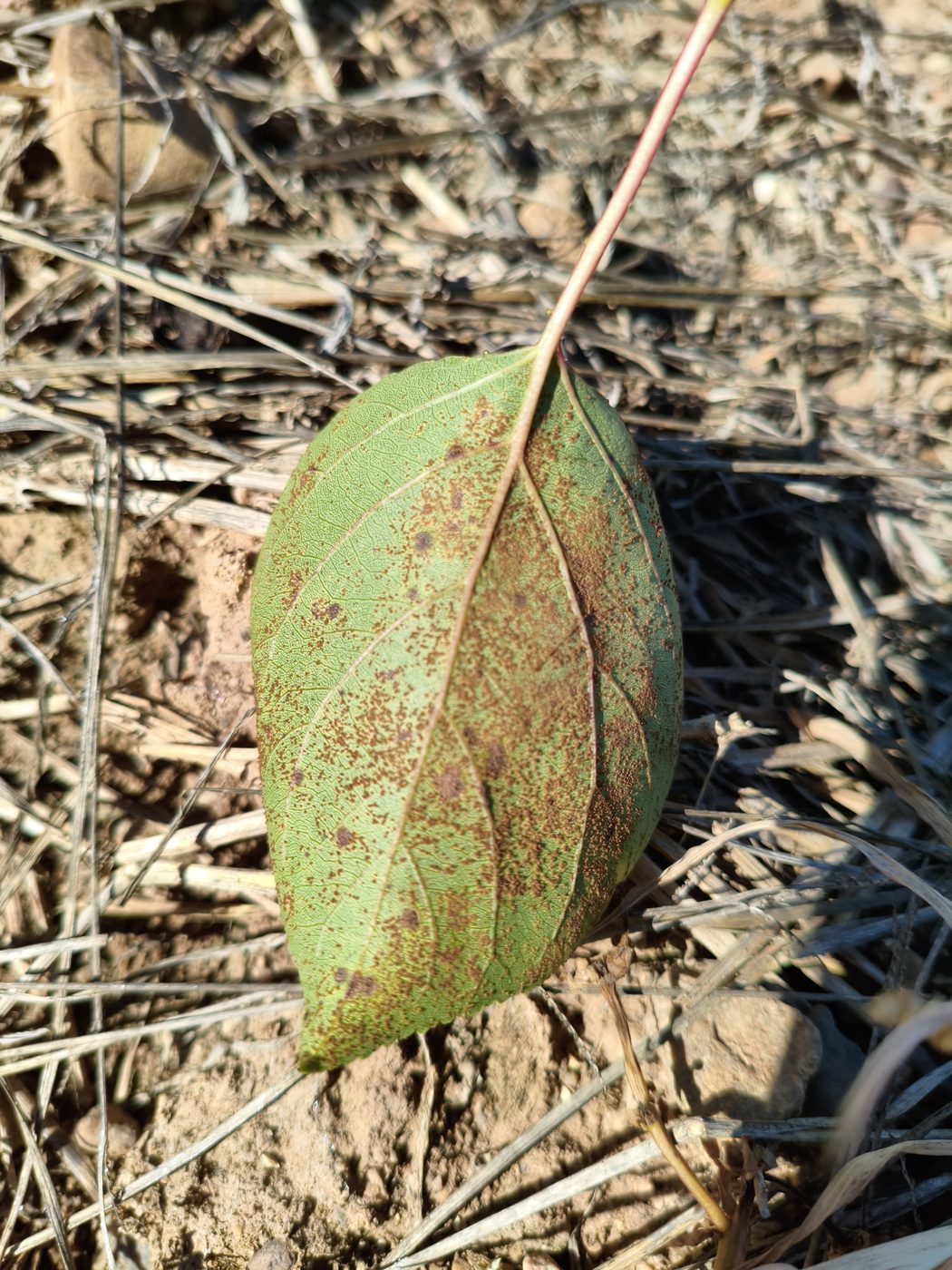
Apricot pests and diseases: identification from symptoms, with a diagnostic tool
Rust with field photographs, brown rot, shot hole, scab, powdery mildew, bacterial spot and canker, Eutypa dieback, silver leaf with and without a fungus, Phytophthora, Armillaria, plum pox and phytoplasma, and the pests: peach twig borer, oriental fruit moth, medfly, flatheaded root borer, mealybug, scale. The pruning dilemma, the three cuts that sort out a dead tree, and a tool that compares symptoms against the profiles of 34 causes.
Nutrient antagonisms and synergies, with a per-element tool
The arrow diagram in every fertiliser leaflet does not stand up scientifically. The antagonisms are real, but they act on two separate levels, in the soil and inside the plant, and the same element can be antagonistic on one and synergistic on the other. With a tool showing the documented relationships of each element.
Zeolite in agriculture: what is documented and what is not
It is a cation exchanger, it holds ammonium and potassium, not nitrate. The rates that work are tens of tonnes per hectare, not hundreds of kilos. And erionite is a Group 1 carcinogen.