
5 tips for larger cherries
Savvas Pastopoulos, Agronomist MSc, Pastopoulos Agronomics, Neos Mylotopos, Pella, Greece
Every cherry grower wants the largest possible quantity of fruit at the largest possible size. Unfortunately those two are inversely related: the more fruit the tree carries, the smaller the size each one will reach.
Where this article refers to approvals, those of the Greek Ministry of Rural Development and Food are valid in Greece only and say nothing about what is permitted in any other country. The doses quoted come from foreign experimental work and are given as documentation, not as a recommendation for application. Figures measured abroad carry the country inside the sentence.
Overproduction with small fruit is a common phenomenon, chiefly in self-fertile cultivars. The same happens on dwarfing rootstocks with cultivars that are not self-fertile.
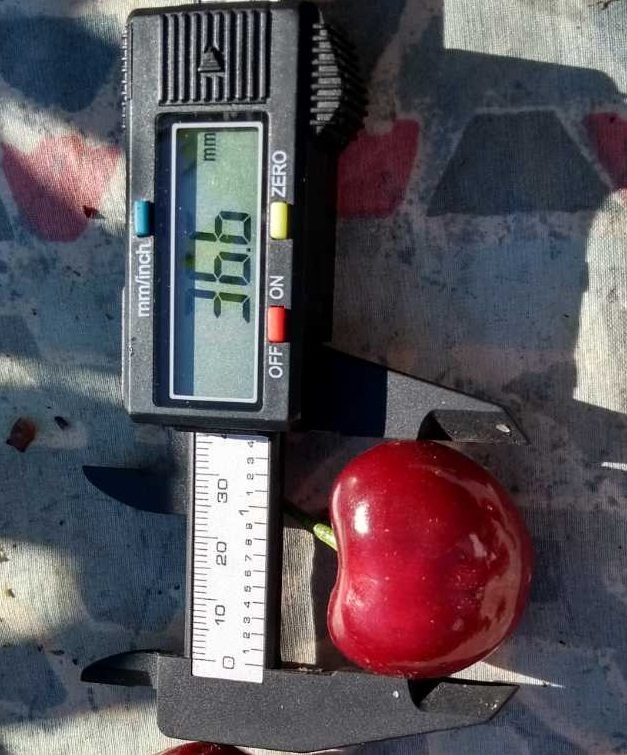
Before the five points themselves, one thing has to be stated: to a large extent size is a genetic characteristic. Each cultivar has a different maximum fruit size, provided the fruit is produced under ideal conditions, which never happens. For example the cultivar Early Lory can give fruit of up to 32 mm, while Sweet Aryana reaches up to 34 mm. The maximum being aimed at is therefore different for each cultivar.
the minimum
translation
fruit, in Japanese trials
in the foreign trials
1. Pruning, the beginning and the end of it
Pruning is the beginning and the end of the regulation of quantity and quality in any orchard. Every combination of cultivar and rootstock has its own pruning. A self-fertile cultivar, for example, is pruned severely from the moment it comes into production. The same applies to cultivars grown on Gisela rootstocks.
In general terms, all thin shoots below 6 mm are removed, together with those oriented towards the ground. Each year annual shoots parallel to the ground have to be left, which will act as production lines of nutrients for the fruit and will also be the fruiting shoots of the future.
The leaf to fruit ratio, the figures
The ratio of leaf area to fruit is cited in every scientific text: the fewer the leaves relative to the number of fruit, the smaller the fruit. The literature also gives specific figures, and they are worth knowing.
| Leaf area per fruit | What the measurements show |
|---|---|
| 244 cm² | The value proposed for mid-early Bing on Gisela 5 as the threshold for high quality fruit [1] |
| 200 cm² | The general minimum for a quality cherry. In practical translation, about five leaves per fruit [1] |
| 117 to 128 cm² | In the cultivar Bellise on Gisela 5, the area required for a 28 mm fruit. On whole trees, at 117 cm² the soluble solids reached 16% [2] |
| 99 cm² | In Lapins on Gisela 5, at this value size collapses: mean fruit weight below 8 grams, and ripening is delayed [3] |
Summer pruning on its own is not enough. Management of irrigation to reduce regrowth is needed as well, because a cut on a tree that continues to receive abundant water answers with new vigorous growth and the operation is cancelled. Water after harvest is given at the rate that keeps the foliage active, without excess, and the reduction is made gradually and with monitoring of soil moisture, never as an abrupt cut-off that brings water stress.
2. The organic matter of the soil
Maintenance of the soil organic matter at satisfactory levels. Organic matter plays an important part in the quality of cherry fruit, because it gives the soil fertility and a sound structure.
That does not of course mean that any manure at hand is applied. Organic matter is chosen from well composted animal or plant residues. The application of leonardite, either as a solid material in winter or through fertigation in summer, has a considerable effect on the availability of the soil's mineral elements to the plant.
3. Correct irrigation through the whole year
Cherry requires irrigation throughout the summer. In the hot months in particular, regular irrigation is needed every 9 to 12 days. Without irrigation, cherry trees produce double fruit or fruit of reduced quality, and at the same time become susceptible to diseases and insects.
For the cherry tree to enter dormancy correctly, it has to be irrigated late into the season. In that way a high metabolism is maintained until late autumn, which will also increase the reserve substances for the following year.
International research has shown something worth making clear: the double fruit is not formed in the year in which it is seen. It is formed the previous summer, during the period when the flower buds differentiate, when the pistil splits into two.
The experimental measurements, from Japanese trials on the cultivar Satohnishiki, are categorical. At 25 °C all the buds gave a single pistil. Above 30 °C the proportion of doubles rises sharply, and at 35 °C it exceeds 80% [4]. Susceptibility differs between cultivars and no Greek measurement has been published. The window of susceptibility, from late July to early September with a peak in early August, is given for the state of Washington in the United States [5].
Furthermore, when the researchers separated temperature from drought, they found that the factor responsible is the high temperature and not water stress as such [6]. That does not cancel the recommendation to irrigate, it strengthens it and explains why it works. A tree with adequate water transpires normally and keeps its foliage cooler. A thirsty tree closes its stomata, stops transpiring and its canopy heats up. The water given in August is not for this year's cherries. It is for next year's.
4. Adequate and rational fertilisation
Once all of the above holds, fertilisation can be addressed. As set out in a separate article, the fertilisation of cherry is a difficult puzzle, because it varies by cultivar, rootstock, soil and other factors.
The idea has taken hold in the minds of most growers that cherry wants a great deal of potassium, without that being correct. Cherry requires more nitrogen than potassium, which does not mean that excessive nitrogen is good.
Nitrogen is applied to cherry in two doses: one before bloom and one after harvest, around the middle of June. The purpose is to avoid excessive vegetative growth and competition between growth and the crop.
Control of the soil pH and the organic matter are important variables for the availability of the remaining elements. It is worth keeping in mind that fertiliser is nothing until it has passed through the cells of the leaves, to be converted into the substances the plant's metabolism and the growth of the fruit require.
5. Biostimulants and gibberellin
The application of gibberellins increases the size and the firmness of cherries, when applied at the change of colour to white-pink. It does, however, push the harvest date back by about five days.
The foreign trials confirm both parts. In the cultivar Sweetheart, the sprayed fruit were larger, heavier and firmer than the unsprayed, and reached harvest maturity five days later [7].
The use of biostimulants, seaweed, amino acids, vitamins and others, gives the plants vigour and the fruit quality. These products have to be applied within the framework of a nutrition programme and not in isolation and sporadically.
The doses cited come from foreign experimental work and are given as documentation, not as a recommendation for application. Any product is used only where there is an approval for cherry from the Greek Ministry of Rural Development and Food, at the dose on the label, and that approval is valid in Greece only. The check is made in the database of approved plant protection products. In any other country the national register of that country applies.
What is worth keeping
- Size is decided at pruning. The target is a leaf area above 200 cm² per fruit, that is about five leaves per cherry [1].
- Double fruit are made the previous summer, above 30 °C in Japanese trials [4], with a peak in early August in American data [5]. The Greek window has not been measured and is expected to be earlier, since harvest here is earlier. Summer irrigation, from harvest onwards, is an investment in the following year.
- With gibberellin, a higher dose does not mean a larger fruit [7].
- The order matters. Pruning, soil, water, fertilisation, biostimulants, in that order. Each step presupposes the one before it.
The text above sets out five proposals for increasing the size of cherry fruit. Even so, the quality of cherries depends on many factors, and every orchard has to be examined on its own by the agronomist.
Sources
The numbers within the text refer to the list below.
- [1] Whiting, M.D. and Lang, G.A. (2004). "Bing" sweet cherry on the dwarfing rootstock "Gisela 5": thinning affects fruit quality and vegetative growth but not net CO2 exchange. Journal of the American Society for Horticultural Science 129(3):407–415. Source for the value of 244 cm² per fruit in Bing on Gisela 5 and for the general minimum of 200 cm², corresponding to about five leaves per fruit.
- [2] Fruit quality response to varying leaf area to fruit ratio on girdled branches and whole trees of "Bellise" sweet cherry (Prunus avium L.). Acta Horticulturae 1327. Source for the 128 cm² per fruit on individual girdled branches and the 117 cm² on whole trees for a 28 mm fruit, and for the soluble solids of 16%.
- [3] Low leaf to fruit ratio delays fruit maturity of "Lapins" sweet cherry on Gisela 5. Scientia Horticulturae. Source for the finding that at 99 cm² per fruit the mean weight falls below 8 grams and that a low leaf to fruit ratio delays ripening.
- [4] Effect of high temperature exposure time during flower bud formation on the occurrence of double pistils in "Satohnishiki" sweet cherry. Scientia Horticulturae. Source for the finding that at 25 °C all the buds gave a single pistil, that above 30 °C the proportion of doubles rises sharply and that at 35 °C it exceeds 80%.
- [5] Washington State University, Tree Fruit, When and how to reduce doubling in sweet cherry. Source for the finding that bud susceptibility extends from late July to early September, with a peak in early August. See also University of California IPM, Fruit doubling and spurs on cherry.
- [6] High temperature rather than drought stress is responsible for the occurrence of double pistils in "Satohnishiki" sweet cherry. Scientia Horticulturae. Source for the separation of the two factors: the factor responsible is the high temperature and not water stress as such.
- [7] Gibberellic acid increases fruit firmness, fruit size, and delays maturity of "Sweetheart" sweet cherry. Journal of the American Pomological Society. Source for the delay of ripening by five days, for the fruit at 20 ppm being larger than those at 30 ppm, for repeated applications of 10 ppm adding no effect, and for the delay in colouring.
- [8] Washington State University, Tree Fruit, Gibberellic acid doesn't need to be applied at high volume to be effective. Source for the finding that the critical quantity is the total amount of active substance per tree and not the volume of the spray solution.
Plant protection products and growth regulators are used only on the basis of the approvals of the Greek Ministry of Rural Development and Food and in accordance with what is stated on the label: approved crops, doses, maximum number of applications, re-entry intervals and pre-harvest intervals. Those approvals are valid in Greece only and say nothing about what is authorised in any other country; in every other country the national register of that country applies. The doses cited from foreign experimental work record foreign practice and do not constitute a recommendation for application.
Any spray on trees carrying fruit carries a risk of staining of the fruit and burning of the foliage. A prior test on a limited number of trees and a wait of at least 5 to 7 days before general application are required. Spraying is done in the late afternoon or early in the morning, never in a heatwave.
This is general technical information and not individualised agronomic advice. Every orchard differs in cultivar, rootstock, soil, climate and the nutritional status of the trees. Before any intervention an on-site assessment by a licensed agronomist is recommended. Pastopoulos Agronomics bears no responsibility for damage or loss of production arising from application of this information without individualised technical guidance.
Related articles
The white Mediterranean snail in tree crops
Theba pisana is native to the Mediterranean, not invasive, so there is no eradication programme to wait for. Identification, life cycle, the damage in tree crops, the single approved target in the Greek register, and why the nematode Phasmarhabditis killed the snail only at five times the label rate.
The Meda sweet cherry series
Six club varieties selected for at least 35 to 40 days of post-harvest life, for sea freight to China. Ripening, size, sugars and S genotypes as published, the two pairs that cannot pollinate each other, chilling figures with no model stated, and the fact that every measurement comes from covered plantings outside Greece.
Chilling hours: the three models and when each one tells the truth
Chilling Hours, Utah Chill Units or Dynamic Chill Portions, what each measures, which suits which climate and season, why a chill portion does not convert into hours, and how the divergence between the three is read. The calculation itself lives in a separate tool.