
Xylella fastidiosa, a bacterium that threatens tree fruit growing as a whole
Savvas Pastopoulos, Agronomist MSc, Pastopoulos Agronomics, Neos Mylotopos, Pella, Greece
Xylella fastidiosa is a Union quarantine pest and the pathogen that laid waste to the olive groves of southern Apulia. The territory of the European Union is considered free of the bacterium, with the exception of limited parts of Italy, France, Spain and Portugal, on the basis of the annual official surveys carried out since 2014 [4]. Its presence has not been established in Greece [28], and 99.2 to 99.8% of the Greek olive-growing area is climatically suitable for the subspecies that causes the Apulian syndrome [20]. A suspected case is notified to the competent authority immediately and as a matter of obligation; diagnosis is not made by eye, nor by a private party [1] [26].
The plant protection product approvals cited in this article come from the database of the Greek Ministry of Rural Development and Food and are valid in Greece only. Approval of an active substance at Union level does not mean that a given product, crop, target and dose are authorised in any particular country. The national register of the country of use is what applies.
Figures measured abroad are given here with the country and the conditions of measurement stated inside the sentence, because they do not transfer unchanged from one olive-growing region to another.
in Apulia
area in Apulia
in the EFSA database
the infected plant
The first two figures are an estimate by Coldiretti and not an official record [29]; the third refers to version 14 of the EFSA host plant database, of 29 June 2026 [8].
- The bacterium and its history
- How the plant falls ill, the biofilms
- The vectors, where the battle is decided
- Olive quick decline syndrome
- Symptoms in the other crops
- How large the problem is today
- Where Greece stands and what the law requires
- Management, and why there is no cure
- What actually works
- What the grower does
- Sources
1. The bacterium and its history
Xylella fastidiosa was described and named as a new genus and a new species in 1987, from twenty-five strains that had been isolated from ten different diseases: Pierce's disease of grapevine, phony disease of peach, periwinkle wilt, and the leaf scorches of almond, plum, elm, sycamore, oak and mulberry [10]. The year 1987 is therefore not the year in which the organism was first recognised as a pathogen, but the year in which it acquired its present name and these ten disorders were tied to one single bacterium.
In the EPPO database the species is listed on the A2 list of quarantine pests [6]. In Europe the known outbreaks were found in this order: Italy, October 2013, in Apulia; France, July 2015, in Corsica and in mainland Provence; Spain, November 2016, in the Balearic Islands and from June 2017 in Alicante; Germany, July 2016, on oleander in Saxony, an outbreak officially declared eradicated in March 2018 [7]. Portugal is recorded today as a country of limited distribution, together with Italy [5].
The species is divided into subspecies. According to the EPPO datasheet, only two of them are formally valid taxonomically, fastidiosa and multiplex, while pauca, sandyi, morus and tashke have not been formally recognised by the competent taxonomy committee for plant pathogenic bacteria [6]. In practice the scientific community works with three main subspecies: fastidiosa, multiplex and pauca [18], and these are precisely the three named in the annexes of the Union legislation that define the "specified plants" for each subspecies [2].
| Subspecies | Hosts attributed to it |
|---|---|
| fastidiosa | Grapevine and coffee |
| multiplex | Many woody species, such as elm, maple, oak and sycamore, as well as blackberry, olive and peach |
| pauca | Almond, citrus, coffee and olive |
| morus | Mulberry |
| sandyi | Oleander |
The table comes from the Pacific Northwest plant disease management handbook [11]. It needs care at two points. First, olive appears under two subspecies, under multiplex and under pauca. Second, phony disease of peach is attributed to subspecies multiplex [24], not to the Apulian subspecies. Matching host to subspecies is not a decorative detail: it determines which plants count as "specified" and therefore which are removed in the event of a detection [2].
The strain responsible for olive quick decline syndrome in Apulia is ST53 of subspecies pauca [6]. ST87 of subspecies multiplex has also been recorded in Italy [6]. In France subspecies multiplex predominates, with one case of pauca at Menton, while in Spain all three subspecies have been detected [7].
The most important development since 2019: in early 2024, at Sencelles in central Mallorca, the same ST53 of subspecies pauca that is responsible for the Apulian syndrome was found. Within a radius of about one kilometre, more than 184 plants of eight species tested positive, among them 124 wild olives and 40 cultivated olives, with necrotic patches on the wild olives [21]. The olive strain is therefore no longer an exclusively Italian problem.
Sources: 2 5 6 7 10 11 18 21 24
2. How the plant falls ill, the biofilms
The bacterium is Gram-negative and xylem-limited, with slow and fastidious growth on culture medium [10]. It colonises the xylem vessels of roots, shoots and leaves and obstructs the movement of water and nutrients by forming bacterial aggregates, the biofilms [18].
Inside the xylem vessels the bacterium forms aggregates that block the path of the water. The resulting shortage of water and nutrients is responsible for the symptoms in the canopy [18]. The plant does not die from a toxin, it dies of thirst, with the soil wet.
That structure is also the reason there is no cure: this is not a bacterium circulating freely and struck down by a contact product, but an organised colony inside a tissue that no surface product reaches. The current review states it plainly: this is a rapidly spreading pathogen "with no effective treatment available" [18].
The figures in circulation for the maturation time of the biofilm and for the number of its proteins were not confirmed in a source accessible in full text, and for that reason they are not given here.
Infection is not expressed at once. Under controlled conditions, young olive plants of the highly susceptible cultivar Cellina di Nardò showed the first symptoms about twelve months after inoculation [12]. That latent period is the reason an outbreak can grow silently before it becomes visible.
3. The vectors, where the battle is decided
The bacterium is transmitted exclusively by insects that feed on xylem, in a semi-persistent manner [11]. In Europe Philaenus spumarius is described as the only vector proven effective under natural conditions, extremely polyphagous and univoltine, that is with one generation a year [6]. Neophilaenus campestris and Philaenus italosignus have also been confirmed as vectors under experimental conditions [6]. In the Greek briefing for obligated parties issued by the Region of Central Macedonia, the same two species, P. spumarius and N. campestris, are named as those with the most significant role [28].
In the first Italian transmission study, adult P. spumarius collected in November 2013 from the ground vegetation of infected olive groves in Apulia were found 67% positive by PCR, forty out of sixty individuals. In the transmission tests those same insects infected two out of five periwinkle plants and none of the seven olive plants within thirty days [14].
In a later study, the proportion of infected P. spumarius in the field ranged from 25% to 71%, and transmission succeeded on every plant tested except grapevine [15].
The nymphs of P. spumarius develop on the ground vegetation and not in the trees. They are therefore a concentrated and accessible target, unlike the adults, which fly. The Union legislation recognises this and requires, within the demarcated areas, agronomic practices to control the vector population "at all its stages", with effective chemical, biological or mechanical treatments at the most appropriate time of year [2].
Research has also shown the size of the difference. In olive groves in Abruzzo, in central Italy, in late spring and after the population peak, soil tillage reduced the density of P. spumarius by 60%, while frequent mowing of the vegetation reduced it by only 20% relative to the controls [16].
Tillage at the right moment is therefore three times as effective as mowing. The figures come from Italian olive groves; no corresponding Greek measurement was found published, and the timing in Greece would have to be tied to the local phenology of the insect.
4. Olive quick decline syndrome
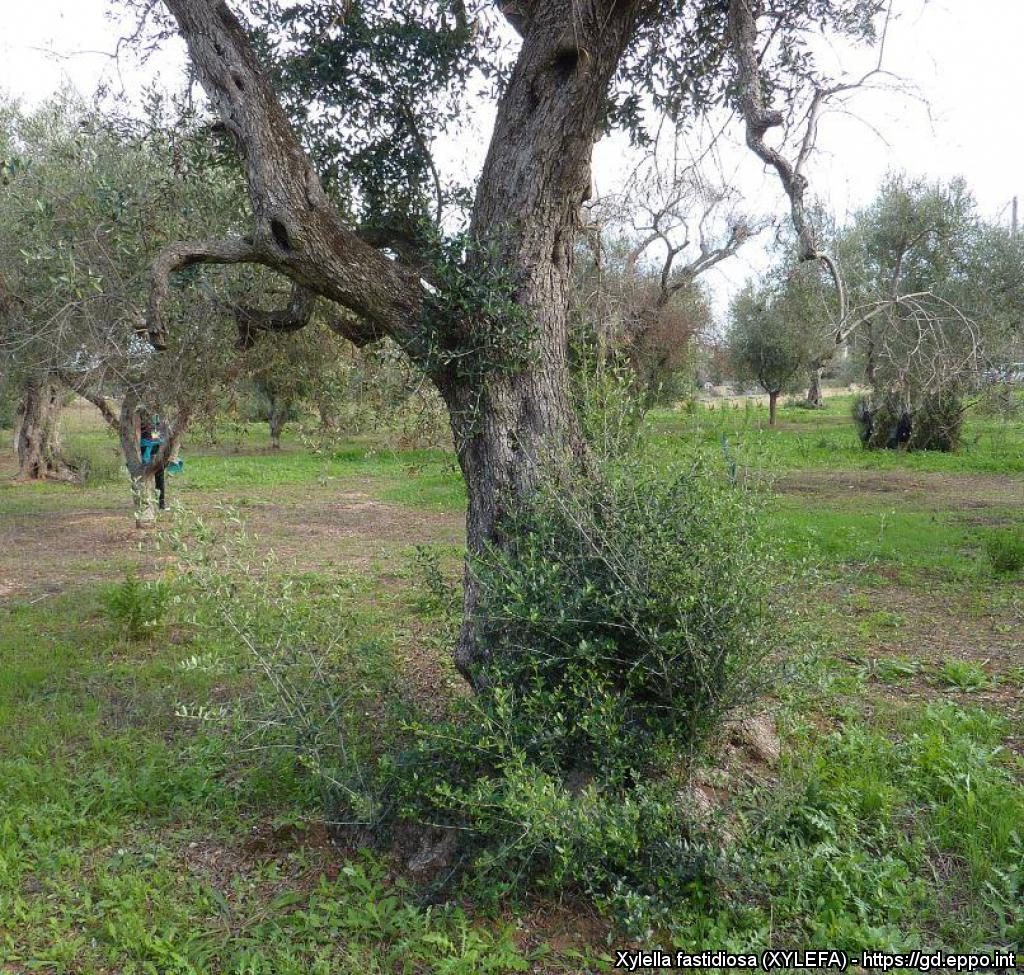
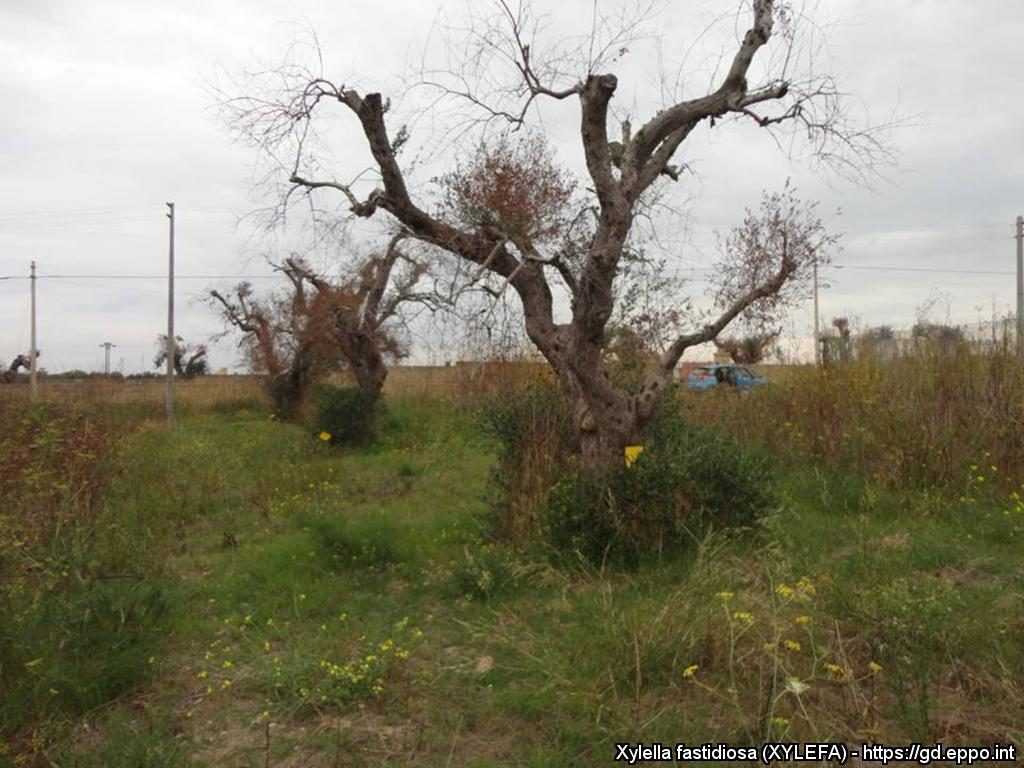
The symptoms appear as desiccation that begins at the tips and moves inward, and they look like a nutrient deficiency or like water stress. As it progresses, the tips of the tree dry out and finally the whole plant. In the Greek Ministry's information material the picture is described as "chlorosis, leaf scorch, necrosis of the tips and of the branches" and finally death of the plant [27].
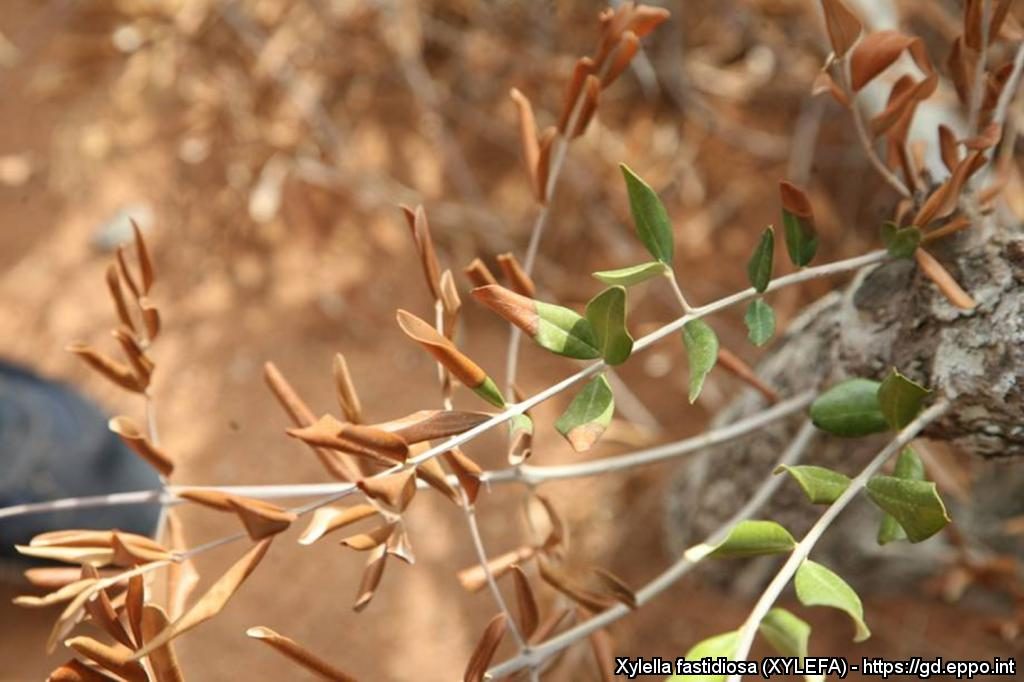
When the syndrome appeared, it was discussed as a complex of bacterium, fungi and wood-boring insects. That question has been answered experimentally. Inoculations with the Salento isolate De Donno, which belongs to subspecies pauca, showed that the bacterium multiplies, invades systemically and reproduces the symptoms seen in the field, satisfying Koch's postulates [12]. The bacterium, in other words, is sufficient on its own.
That does not mean it acts alone in the field. Surveys in Salento recorded three patterns: trees infected only by the bacterium, trees infected only by fungi of the genus Neofusicoccum, and trees with co-infection, which was the most frequent case. Neofusicoccum mediterraneum and N. stellenboschiana cause dieback of branches and twigs in their own right, and the discolouration of the wood comes exclusively from the fungal attack [13]. In the same work Zeuzera pyrina is reported as present in the first surveys, without any causal role being attributed to it [13].
The bacterium colonises the entire xylem, from the root to the leaves [18]. Cutting back the canopy does not remove the pathogen. The same finding has been stated explicitly for oleander as well: pruning the symptomatic branches does not save the plant, because the bacterium has already spread throughout the xylem [25].
The same logic applies to grapevine: vines with persistent symptoms "are unlikely to recover or to produce a worthwhile crop", and the recommendation is to remove them [22].
5. Symptoms in the other crops
Beyond olive, the Greek Ministry's information material names as hosts grapevine, almond, peach, apricot, plum and citrus, as well as certain ornamentals [27].
Grapevine, Pierce's disease
On chronically affected vines the leaves turn yellow or red along the margin and the margins dry in concentric zones. The bunches shrivel and raisin. The dry leaf blades fall, leaving the petiole still attached to the cane, a picture described internationally as matchsticks, while on the wood of the new canes green islands remain within the mature brown bark [22]. In California the vectors differ from the European ones: blue-green, green and red-headed sharpshooters, and since the early 1990s Homalodisca vitripennis [22].
Peach, phony peach disease
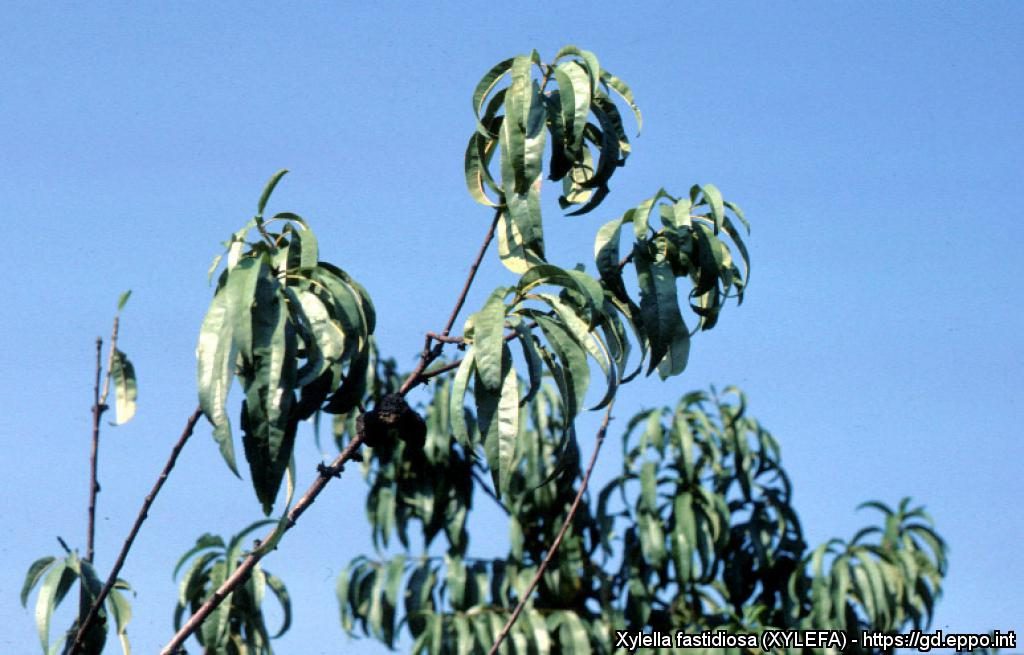
The cause is subspecies multiplex. The symptoms are short internodes, a flat and dense canopy, dark green or bronze leaves, early bud break and smaller fruit of lower quality. The difference in growth is quantitative and visible: a healthy tree produces about 1.2 to 1.8 metres of new growth a year, while an affected tree produces 15 centimetres or less. The trees decline over years without dying abruptly. The vectors are Homalodisca vitripennis and Oncometopia orbona, and there is no cure: management rests on healthy propagating material and on removal of the symptomatic trees [24].
Almond, almond leaf scorch
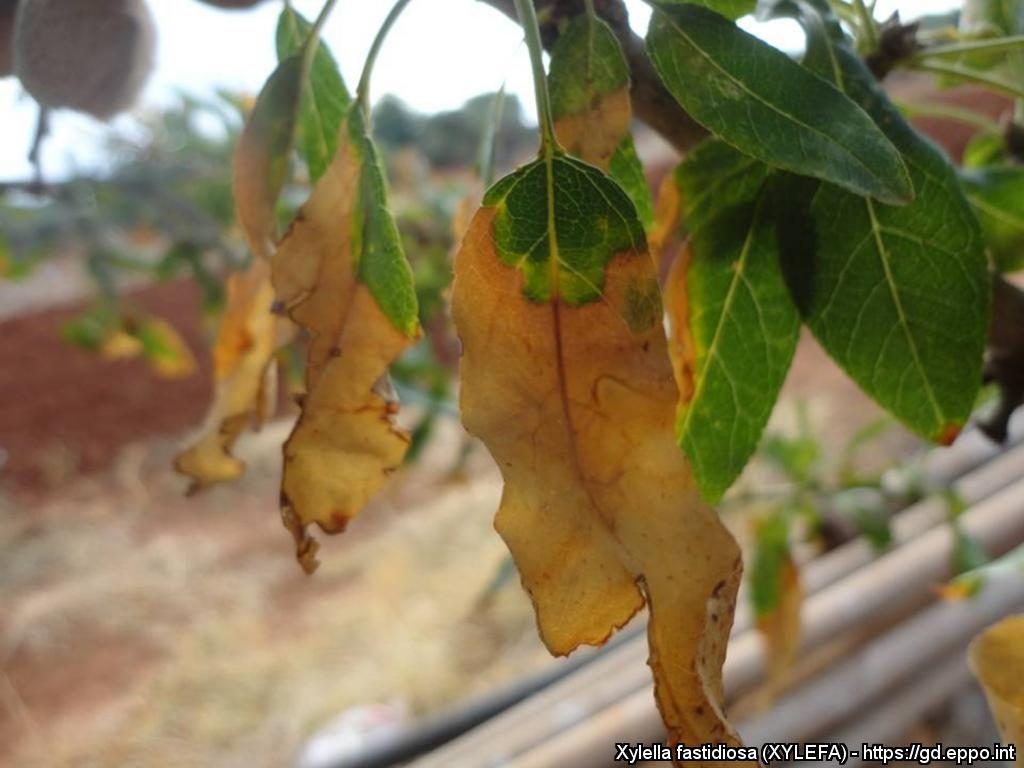
Marginal scorching of the leaves begins as early as June under Californian conditions. Between the brown dead margin and the inner green tissue a golden-yellow band appears, the diagnostic feature that separates the picture from simple salt damage. The symptoms often start on one scaffold limb and take over the whole canopy gradually. The trees become stunted and less productive, but they usually survive for many years [23].
Oleander, leaf scorch of ornamentals
The leaves turn yellow and droop, while their margins take on a more intense yellow or brown colour; the chlorosis advances from the tip or the margins inward, a picture that is distinguishable from simple drought stress. There is no cure, and the recommendation is timely removal of the affected plants so that inoculum sources are reduced [25].
6. How large the problem is today
The host list is not closed and is updated regularly. In version 14 of the EFSA host plant database, of 29 June 2026, with a literature search up to December 2025, the figures are:
| Listing criterion | Species | Genera | Families |
|---|---|---|---|
| Confirmation by at least two detection methods, or a positive result by sequencing or isolation in culture | 471 | 213 | 72 |
| By any detection method | 755 | 329 | 93 |
These figures [8] replace the 463 and 727 species that circulated from the version whose literature search ran to the end of 2024. The European Commission, on its page for the measures against the disease, uses the more conservative formulation that the bacterium "has been detected or isolated from more than 500 plant species worldwide" [4].
- Italy. According to the Coldiretti estimate, 21 million olive trees over 8,000 square kilometres became infected, that is over 40% of the area of the region, with a spread rate of about 20 kilometres a year since 2013, when the affected area was still 80 square kilometres [29]. The same order of magnitude, "more than 21 million olive trees, among them thousands of monumental trees", is repeated in a scientific paper on the agricultural regeneration of Salento [34]. This is an estimate by a growers' organisation and not an official census; the older figure of 183,000 hectares was not found in any source and is withdrawn.
- Spain, mainland. In Alicante, where the pathogen was first detected in the summer of 2017, the infected area is about 3,000 hectares within a demarcated area of almost 140,000 hectares, and 187,400 almond trees over 2,620 hectares have been eradicated. Only sequence type ST6 of subspecies multiplex has been detected [30]. The same demarcated area was recorded at 137,995 hectares, with infected zones of 2,864 hectares, in March 2022 [31].
- Spain, Balearic Islands. 1,306 infected plants had been recorded, of which 746 on Mallorca, 346 on Ibiza and 214 on Menorca [31]. In 2024 the ST53 outbreak at Sencelles was added [21].
In the EPPO database Italy and Portugal are recorded as countries of limited distribution, while France and Spain are recorded as transient, with limited distribution in Corsica and in the Balearic Islands respectively [5].
Sources: 4 5 8 20 21 29 30 31 34
7. Where Greece stands and what the law requires
In a briefing for obligated parties issued by the Region of Central Macedonia, dated 7 February 2024, the position is stated explicitly: "in our country the presence of the harmful quarantine bacterium X. fastidiosa has not to date been established" [28]. In the EPPO database Greece does not appear in the distribution table of the organism at all, which is to say there is no record of presence [5]. The European Commission puts the general picture as follows: the territory of the Union is considered free of Xylella fastidiosa, with the exception of limited parts of Italy, France, Spain and Portugal, on the basis of the annual official surveys carried out since 2014 [4].
That statement has an expiry date. It holds for as long as the annual surveys keep returning negative results. The Greek Ministry maintains a contingency plan for the organism, in a second edition of 2024, and records the surveys on a dedicated platform [26].
The legal framework in force
The general framework is Regulation (EU) 2016/2031 on protective measures against pests of plants [4]. Article 5(1) provides that a Union quarantine pest "shall not be introduced into, moved within, or held, multiplied or released in, the Union territory" [1].
The specific measures for Xylella are set by Commission Implementing Regulation (EU) 2020/1201 of 14 August 2020, which repealed Implementing Decision (EU) 2015/789 [2]. That regulation has been amended repeatedly; the latest amendment is Commission Implementing Regulation (EU) 2025/2231 of 3 November 2025, which updated the list of infected zones subject to containment measures and entered into force on 24 November 2025 [3].
| Element | What the legislation in force provides |
|---|---|
| Demarcated area | Established without delay once the presence of the organism is officially confirmed, and consists of an infected zone and a surrounding buffer zone |
| Infected zone | A radius of at least 50 metres around the plant found to be infected |
| Buffer zone for eradication | A width of at least 2.5 kilometres |
| Buffer zone for containment | A width of at least 5 kilometres |
| Reduced buffer zone | May be reduced to at least 1 kilometre, provided that strict cumulative conditions are met on sampling, on survey within a radius of 2.5 kilometres and on vector control twice a year |
| Eradication | Immediate removal, from the infected zone, of the infected plants, of the symptomatic or suspect ones, and of all plants of the same species irrespective of their state of health |
| Vector control | Agronomic practices against the vector at all its stages, with chemical, biological or mechanical treatments |
| Surveys | Annual surveys of the host plants across the whole territory of each member state |
| Plant passport | Required for the movement of the specified plants, marked "Infected Zone - XYLEFA" or "Buffer Zone - XYLEFA" as applicable |
All of the above comes from the consolidated text of Implementing Regulation 2020/1201 as in force from 24 November 2025 [2]; the same radii of 50 metres, 2.5 and 5 kilometres are repeated on the European Commission page [4]. The radii of 1 and 10 kilometres that still circulate in some Greek information texts belong to the repealed Decision 2015/789 and are not in force.
Regulation 2016/2031 leaves no room for choice. Article 14(1) provides that a professional operator who suspects or becomes aware of the presence of a Union quarantine pest in plants under their control "shall immediately notify the competent authority". Article 15(1) extends the same obligation to any person other than a professional operator: anyone who becomes aware of the presence, or has reason to suspect it, "shall immediately notify the competent authority" [1].
In Greece, the competent authorities are the Regional Centres for Plant Protection, Quality and Phytosanitary Control of the Ministry of Rural Development and Food [26]. The Ministry's information material puts it the same way: in case of suspicion, immediate contact with the competent phytosanitary services [27].
The diagnosis and the notification of a quarantine pest are made by the competent authority alone. The grower, the agronomist at the farm supply shop and the private laboratory do not announce a case and do not take measures on their own. Sampling, laboratory confirmation, demarcation of the area and eradication are expressly provided for as actions of the service [2]. The obligation of the private party stops, and starts, at the notification.
The first and strongest argument is climatic and measured: 99.2 to 99.8% of the Greek olive-growing area lies in conditions climatically suitable for the subspecies that caused the destruction in Apulia, the highest proportion among the three large olive-producing countries of the Union [20].
The second is geographical. The Ministry's own information material places Greece, together with the Iberian Peninsula and Italy, among the countries that run the greatest risk of spread because of their climatic conditions [27].
The third is structural and has no published measurement: centuries-old olive groves in difficult terrain, without planting in rows and without access for machinery, make any eradication operation harder. It is recorded here as an observation from practice and not as a documented quantity.
Sources: 1 2 3 4 5 20 26 27 28
8. Management, and why there is no cure
There is no cure for the infected plant. The EFSA assessment stated it explicitly as early as April 2016: "no treatment was found able to eliminate the pathogen from plants grown in the open field" [9]. The wording has not changed: the 2025 review describes the bacterium as a rapidly spreading pathogen with no effective treatment available [18]. The measures are therefore preventive and phytosanitary.
The preventive measures in order of importance
- Preventing entry. The bacterium is expressly prohibited from being introduced into, moved within, or held, multiplied or released in the territory of the Union [1], and the specified plants move only with a plant passport [2].
- Annual surveys. Each member state is obliged to carry out annual surveys of the host plants across its whole territory [2]; in Greece these are recorded on a dedicated Ministry platform [26].
- Awareness and recognition. Delay in diagnosis was the decisive factor in Apulia, precisely because the latent period in olive exceeds a year [12].
- Immediate notification to the competent authority by anyone, professional operator or not [1], that is to the Regional Centre for Plant Protection, Quality and Phytosanitary Control [26].
- Control of propagating material. The movement of specified plants out of demarcated areas is subject to strict conditions and to marking of the passport with the zone of origin [2].
Copper is widely used on olive for other diseases. In the Union the copper compounds, hydroxide, oxychloride, oxide, Bordeaux mixture and tribasic sulphate, are approved as candidates for substitution, and only uses are permitted that lead to up to 28 kilograms of copper per hectare over a period of seven years, with the option for member states to set an annual upper limit of 4 kilograms per hectare [32]. The approval period has since been extended by regulations amending Regulation 540/2011, among them Commission Implementing Regulation (EU) 2025/1489 of 24 July 2025; the expiry date in force is to be checked each time on EUR-Lex [35].
For Xylella, however, copper is not a tool. The bacterium is introduced directly into the xylem vessels by the mouthparts of the vector [11] and establishes itself in a tissue that no surface product reaches [18]. A copper spray protects surfaces; here the surface is bypassed entirely.
In Italy a commercial product containing zinc, copper and citric acid was tested; all the treated plants survived the summer of 2015 and the following winter. EFSA concluded, however, that such treatments "may improve the health of plants but cannot cure them or prevent them from being infected", and that the purpose of the trials was suppression of symptoms and not elimination of the pathogen [9].
The systematic review of control attempts reaches the same conclusion: "none of the approaches based on inorganic elements proved sufficient to control the bacterium inside the plant". Even with endotherapy using N-acetylcysteine, where progression of the disease appeared to slow, the qPCR measurements showed no significant reduction in the bacterial population. On biological control, the same review notes that "no validated solution based on microorganisms is currently available to growers" [19].
For the grower, a plant that appears to be recovering remains infected and remains a source of inoculum. Removal of the infected plants is not the grower's choice but an obligation carried out within the framework of the Union measures, together with the plants of the same species inside the infected zone [2].
Within the demarcated areas the regulation requires treatments against the vector at all its stages [2]. The relevant review reports that neonicotinoids and pyrethroids effectively reduced nymph populations [19], while mechanical management of the ground cover gives the largest reduction when it is carried out after the population peak [16].
At Union level, two of the pyrethroids used against sucking insects have approvals that were recently extended: deltamethrin to 30 June 2028 and lambda-cyhalothrin to 31 January 2029 [33]. Approval at Union level does not imply approval for a specific use in any individual country: the approved product, the crop, the target and the dose are checked each time in the national register, which for Greece is the plant protection products database of the Ministry of Rural Development and Food. There is today no active substance with an indication for curing the infected plant of the bacterium, neither in Greece nor anywhere else [9] [19].
Sources: 1 2 9 11 12 16 18 19 26 32 33 35
9. What actually works
Two olive cultivars have been shown to be resistant to the bacterium:
- Leccino
- FS-17, also known as Favolosa
The mechanism: the resistance of these two cultivars is associated with reduced growth of the bacterium inside the xylem vessels [17]. Leccino trees host populations up to one hundred times lower than the susceptible cultivars, and show fewer occlusions of the xylem vessels, while in the susceptible ones the occlusions with tyloses, gum and pectin deposition are more frequent [18]. This is not immunity but tolerance that keeps the tree alive and productive.
The consequence is already institutional: the regulatory measures in force permit only Leccino and FS-17 for the reconversion of olive groves in the infected areas [17]. Replanting with resistant genotypes is described as "the most feasible and promising strategy" for control of the bacterium [17], and it is the strategy on which the regeneration of Salento rests [34].
A more recent finding: in the same screening of olive biodiversity, the cultivars Frantoio and Nocellara Messinese showed significantly lower symptom severity than the susceptible controls, without however reaching the level of resistance of Leccino [17].
No evaluation under Greek soil and climate conditions has been published. The results come from Apulia, against the strain of subspecies pauca circulating there, and under Italian growing conditions [17]. The behaviour of Leccino and FS-17 in a Greek olive grove, their yield and the quality of their oil under local conditions do not follow from those data.
The resistance concerns a specific pathogen, not the species as a whole. Three main subspecies of the bacterium are recognised [18], and the resistance of the two cultivars is not immunity: the trees do become infected, they host the bacterium and they remain a source of inoculum, and they may also show symptoms [17]. The emergence of a strain or a variant against which the two cultivars will not be resistant cannot be ruled out, and no published work rules it out.
For that reason, replanting with Leccino or FS-17 is a measure for the reconversion of infected areas within the official framework and not a preventive measure for an area without confirmed cases. It replaces neither control of the origin of the propagating material nor the obligation to notify every suspicion [1] [2].
10. What the grower does
In an area without confirmed cases, which today means the whole of Greece
- Propagating material only with a plant passport and documented origin. Specified plants that come from a demarcated area carry the zone of origin on the passport [2], and that marking is the item to be checked before any purchase.
- Attention to ornamentals. Oleander is a documented host, with a subspecies of its own [11] and a leaf scorch of its own for which there is no cure [25]; in the Greek information material ornamentals are expressly named among the affected plants [27]. An ornamental plant in a yard is as much a gateway as an olive sapling.
- Observation with the right distinguishing features. Every unexplained dieback of the tips on olive, every marginal scorch on almond with a golden-yellow band between the dead and the green tissue [23], every vine with petioles left attached to the cane [22], deserves a second look.
- A sample, not a spray. On any suspicion, immediate notification to the Regional Centre for Plant Protection, Quality and Phytosanitary Control [26], as Regulation 2016/2031 expressly requires of professional operators and of every other person alike [1]. No product is going to cure the plant [9].
- No improvised action. Eradication, demarcation and treatments against the vector are actions provided for and carried out within the framework of the Union measures [2]. Pruning or burning a suspect tree before sampling destroys the evidence and stops nothing [25].
Sources: 1 2 9 11 12 18 22 23 25 26 27
Note: the phytosanitary situation changes. For the official and up-to-date picture of the demarcated areas, the announcements of the European Commission and of the Greek Ministry of Rural Development and Food are what apply. The data in this article were checked in September 2026.
11. Sources
The numbers in the text refer to the list below. Where only the abstract was used and not the full text, this is stated explicitly.
- [1] Regulation (EU) 2016/2031 of the European Parliament and of the Council on protective measures against pests of plants. EUR-Lex. Source for Article 5(1) (prohibition on introduction, movement, holding, multiplication and release of a Union quarantine pest), for Article 14(1) (the professional operator immediately notifies the competent authority on suspicion or awareness) and for Article 15(1) (any person other than a professional operator immediately notifies the competent authority). Full text.
- [2] Commission Implementing Regulation (EU) 2020/1201 of 14 August 2020 as regards measures to prevent the introduction into and the spread within the Union of Xylella fastidiosa (Wells et al.), consolidated text, in force from 24.11.2025. EUR-Lex. The principal legal source: repeal of Implementing Decision 2015/789, infected zone with a radius of at least 50 metres, buffer zone of at least 2.5 kilometres for eradication and at least 5 kilometres for containment, the option of reduction to at least 1 kilometre under conditions, immediate removal of the plants of the same species irrespective of health, control of the vector at all its stages with chemical, biological or mechanical treatments, annual surveys, plant passport marked with the zone, and the naming of subspecies fastidiosa, multiplex and pauca in the annexes. Full text.
- [3] Commission Implementing Regulation (EU) 2025/2231 of 3 November 2025 amending Implementing Regulation (EU) 2020/1201 as regards the list of infected zones for the containment of Xylella fastidiosa. EUR-Lex. Source solely for the fact that the latest amendment of the framework is of 3 November 2025, that it concerns the list of infected zones subject to containment measures, and that it applies from 24 November 2025. Full text.
- [4] Xylella fastidiosa, European Commission, Directorate-General for Health and Food Safety. Source for the statement that the territory of the Union is considered free of the bacterium with the exception of limited parts of Italy, France, Spain and Portugal, on the basis of annual official surveys since 2014, for the independent confirmation of the radii of 50 metres, 2.5 and 5 kilometres, for the connection of the framework with Regulation 2016/2031, and for the statement that the bacterium has been detected or isolated from more than 500 plant species worldwide. Full text.
- [5] EPPO Global Database. Xylella fastidiosa (XYLEFA), World distribution. Updated 31 July 2026. Source for the fact that Greece does not appear in the distribution table, that is that there is no record of presence, and for the status of the other European countries: Italy and Portugal of limited distribution, France and Spain transient with limited distribution in Corsica and the Balearic Islands, Germany with the organism eradicated. Full text.
- [6] EPPO Global Database. Xylella fastidiosa (XYLEFA), Datasheet. Source for the listing on EPPO A2, for the fact that only subspecies fastidiosa and multiplex are formally valid taxonomically while pauca, sandyi, morus and tashke have not been formally recognised, for the attribution of the olive syndrome to ST53 of subspecies pauca and for the presence of ST87 of subspecies multiplex in Italy, and for the description of Philaenus spumarius as the only effective vector under natural conditions, polyphagous and univoltine, with Neophilaenus campestris and Philaenus italosignus confirmed experimentally. Full text.
- [7] Xylella fastidiosa in the EPPO region. European and Mediterranean Plant Protection Organization. Source for the chronology of the European outbreaks: Italy October 2013 in Apulia with subspecies pauca, France July 2015 in Corsica and mainland Provence mainly with subspecies multiplex and one case of pauca at Menton, Spain November 2016 in the Balearic Islands and June 2017 in Alicante with all three subspecies, Germany July 2016 on oleander in Saxony with official declaration of eradication in March 2018. Full text.
- [8] EFSA. Update of the Xylella spp. host plant database, version 14, 29 June 2026. Zenodo. Source for the host figures in force, with a literature search up to December 2025: 471 species, 213 genera and 72 families with confirmation by at least two detection methods or by sequencing or isolation, and 755 species, 329 genera and 93 families by any detection method. Full text of the description and metadata of the dataset.
- [9] EFSA (20 April 2016). Treatments "do not eliminate Xylella from olive trees but can reduce disease symptoms", news item on the statement "Treatment solutions to cure Xylella fastidiosa diseased plants", EFSA Journal 14(4):4456. Source for the statement that no treatment was found able to eliminate the pathogen from plants grown in the open field, for the results of the product containing zinc, copper and citric acid (survival of all the plants through the summer of 2015 and the following winter) and for the conclusion that such treatments may improve plant health but do not cure the plants or prevent them from being infected. Full text of the news item.
- [10] Wells, J.M., Raju, B.C., Hung, H.Y., Weisburg, W.G., Mandelco-Paul, L. and Brenner, D.J. (1987). Xylella fastidiosa gen. nov., sp. nov: Gram-Negative, Xylem-Limited, Fastidious Plant Bacteria Related to Xanthomonas spp. International Journal of Systematic Bacteriology 37(2):136 to 143. Source for the year of description and naming of the genus and the species, for its characterisation as a Gram-negative, xylem-limited and fastidious bacterium, and for the ten disease sources from which the twenty-five strains originated: Pierce's disease of grapevine, phony disease of peach, periwinkle wilt and the leaf scorches of almond, plum, elm, sycamore, oak and mulberry. Abstract.
- [11] Xylella fastidiosa issues for the Pacific Northwest. Pacific Northwest Plant Disease Management Handbook. Source for the matching of hosts to subspecies: fastidiosa with grapevine and coffee, multiplex with elm, maple, oak, sycamore, blackberry, olive and peach, pauca with almond, citrus, coffee and olive, morus with mulberry and sandyi with oleander; also for the statement that the pathogen is transmitted exclusively by xylem-feeding insects, in a semi-persistent manner. Full text.
- [12] Saponari, M., Boscia, D., Altamura, G. et al. (2017). Isolation and pathogenicity of Xylella fastidiosa associated to the olive quick decline syndrome in southern Italy. Scientific Reports 7:17723. Source for the experimental demonstration that the Salento isolate De Donno of subspecies pauca multiplies, invades the artificially inoculated hosts systemically and reproduces the symptoms seen in the field, satisfying Koch's postulates, and for the latent period of about twelve months in the susceptible cultivar Cellina di Nardò. Full text.
- [13] Scortichini, M., Manetti, G., Brunetti, A., Lumia, V., Sciarroni, L. and Pilotti, M. (2023). Xylella fastidiosa subsp. pauca, Neofusicoccum spp. and the Decline of Olive Trees in Salento (Apulia, Italy): Comparison of Symptoms, Possible Interactions, Certainties and Doubts. Plants 12(20):3593. Source for the three patterns of attack in Salento, bacterium only, Neofusicoccum spp. only, and co-infection as the most frequent case, for the capacity of Neofusicoccum mediterraneum and N. stellenboschiana to cause dieback of branches and twigs in their own right, for the origin of the wood discolouration exclusively in the fungal attack, and for the fact that no causal role is attributed to Zeuzera pyrina. Full text.
- [14] Saponari, M., Loconsole, G., Cornara, D. et al. (2014). Infectivity and Transmission of Xylella fastidiosa by Philaenus spumarius (Hemiptera: Aphrophoridae) in Apulia, Italy. Journal of Economic Entomology 107(4):1316 to 1319. Source for the fact that adult P. spumarius collected in November 2013 from the ground vegetation of infected olive groves in Apulia were 67% positive by PCR (forty out of sixty), and for the fact that in the transmission tests they infected two out of five periwinkle plants and none of the seven olive plants within thirty days. Abstract.
- [15] Cornara, D., Saponari, M., Zeilinger, A.R. et al. (2017). Transmission of Xylella fastidiosa by naturally infected Philaenus spumarius (Hemiptera, Aphrophoridae) to different host plants. Journal of Applied Entomology. Source for the fact that the proportion of infected P. spumarius in the field ranged from 25% to 71%, for the fact that transmission succeeded on every plant tested except grapevine, and for the fact that the bacterial load in the European vector is lower than that in the American sharpshooters. Abstract.
- [16] Sanna, F. et al. (2021). Ground Cover Management in Olive Groves Reduces Populations of Philaenus spumarius (Hemiptera: Aphrophoridae), Vector of Xylella fastidiosa. Journal of Economic Entomology 114(4):1716 to 1725. Source for the measurement in olive groves in Abruzzo, central Italy: in late spring, after the population peak, soil tillage reduced the density of P. spumarius by 60%, while frequent mowing of the vegetation reduced it by only 20% relative to the controls. Abstract.
- [17] Pavan, S. et al. (2021). Screening of Olive Biodiversity Defines Genotypes Potentially Resistant to Xylella fastidiosa. Frontiers in Plant Science 12:723879. Source for the resistance of the cultivars Leccino and FS-17 (Favolosa), for the association of that resistance with reduced growth of the bacterium inside the xylem vessels, for the fact that the regulatory measures in force permit only these two cultivars for the reconversion of olive groves in the infected areas, for the description of replanting with resistant genotypes as the most feasible and promising strategy, and for the partial resistance of the cultivars Frantoio and Nocellara Messinese. Full text.
- [18] Mourou, M. et al. (2025). Insight into biological strategies and main challenges to control the phytopathogenic bacterium Xylella fastidiosa. Frontiers in Plant Science 16:1608687. The principal current review: colonisation of the xylem vessels in roots, shoots and leaves with obstruction of water and nutrient movement through biofilms, the explicit statement that no effective treatment is available, bacterial populations up to one hundred times lower in Leccino with more frequent xylem vessel occlusions in the susceptible cultivars (tyloses, gum, pectin), recognition of three main subspecies, the reporting of Philaenus spumarius as the principal vector, and the experimental approaches with Paraburkholderia phytofirmans, with the bacteriophage Mate 2 and with transgenic grapevines expressing cecropin B. Full text.
- [19] Morelli, M., García-Madero, J.M., Jos, Á. et al. (2021). Xylella fastidiosa in Olive: A Review of Control Attempts and Current Management. Microorganisms 9(8):1771. Source for the conclusion that none of the approaches based on inorganic elements proved sufficient to control the bacterium inside the plant, for the fact that with endotherapy using N-acetylcysteine the qPCR measurements showed no significant reduction in the bacterial population, for the finding that no validated solution based on microorganisms is available to growers, and for the effective reduction of vector nymphs by neonicotinoids and pyrethroids. Full text.
- [20] Schneider, K., van der Werf, W., Cendoya, M., Mourits, M.C.M., Navas-Cortés, J.A., Vicent, A. and Oude Lansink, A.G.J.M. (2020). Impact of Xylella fastidiosa subspecies pauca in European olives. Proceedings of the National Academy of Sciences 117(17):9250 to 9259. Source for the proportion of the olive-growing area that is climatically suitable for subspecies pauca, Greece 99.2 to 99.8%, Italy 95.5 to 98.9%, Spain 84.6 to 99.1%, and for the projection of Italian losses over fifty years at 1.9 to 5.2 billion euros without replanting and at 0.6 to 1.6 billion euros with replanting of resistant cultivars. Abstract and the data of the institutional record.
- [21] Moralejo, E. et al. (2024). Outbreak of Xylella fastidiosa subsp. pauca ST53 affecting wild and cultivated olive trees on the island of Mallorca, Spain. Phytopathologia Mediterranea 63(3):475 to 480. Source for the detection, in early 2024 at Sencelles in central Mallorca, of the same sequence type ST53 of subspecies pauca that is responsible for olive quick decline syndrome in Apulia, with more than 184 positive plants of eight species within a radius of about one kilometre, among them 124 wild olives and 40 cultivated olives. Abstract.
- [22] Pierce's Disease, UC IPM Pest Management Guidelines: Grape, UC ANR Publication 3448, Statewide Integrated Pest Management Program, University of California. Source for the symptoms of Pierce's disease in grapevine: yellowing or reddening of the margin, drying in concentric zones, raisining of the bunches, fall of the leaf blade with the petiole remaining on the cane ("matchsticks") and green islands in the wood; also for the Californian vectors and for the statement that vines with persistent symptoms are unlikely to recover or to produce a worthwhile crop. Full text.
- [23] Almond Leaf Scorch, UC IPM Pest Management Guidelines: Almond, UC ANR Publication 3431, University of California. Source for the symptoms in almond under Californian conditions: marginal scorching as early as June, a golden-yellow band between the brown necrotic margin and the inner green tissue, gradual extension from one scaffold limb to the whole canopy, stunting and reduced productivity, and for the finding that the trees usually survive for many years. Full text.
- [24] Brannen, P.M. and Johnson, K.A. Phony Peach Disease, Circular 1253, University of Georgia Extension, revised 17 June 2026. Source for the attribution of phony disease of peach to subspecies multiplex, for the symptoms (short internodes, flat canopy, dark green or bronze leaves, early bud break, smaller fruit), for the difference in new growth (about 1.2 to 1.8 metres on a healthy tree against 15 centimetres or less on a diseased one), for the vectors Homalodisca vitripennis and Oncometopia orbona, and for the absence of a cure, with management resting on healthy propagating material and on removal of the symptomatic trees. Full text.
- [25] Wilen, C.A., Hartin, J.S., Henry, M.J., Blua, M. and Purcell, A.H. Oleander Leaf Scorch, Pest Notes Publication 7480, University of California Agriculture and Natural Resources, revised April 2008. Source for the symptoms in oleander (yellowing and drooping of the leaves, a more intense yellow or brown margin, progression of the chlorosis from the tip or the margins inward), for the explicit statement that there is no known cure, for the fact that pruning the symptomatic branches does not save the plant because the bacterium has already spread throughout the xylem, and for the recommendation of timely removal of the affected plants. Full text.
- [26] Greek Ministry of Rural Development and Food, Phytosanitary Control. The Greek institutional source: the competent authorities are the Regional Centres for Plant Protection, Quality and Phytosanitary Control of the Ministry; the existence of a Contingency Plan for the quarantine pest Xylella fastidiosa in a second edition of 2024; the carrying out of surveys to establish the presence or absence of harmful organisms, recorded on a dedicated platform. Full text. Available in Greek only.
- [27] Greek Ministry of Rural Development and Food. Xylella fastidiosa information leaflet. Source for the Greek list of affected crops (olive, grapevine, almond, peach, apricot, plum, citrus and certain ornamentals), for the description of the symptoms as chlorosis, leaf scorch, necrosis of tips and branches and finally death of the plant, for the instruction to contact the competent phytosanitary services immediately in case of suspicion, and for placing Greece, together with the Iberian Peninsula and Italy, among the countries at greatest risk of spread because of their climatic conditions. Full text. Available in Greek only.
- [28] Region of Central Macedonia. Xylella fastidiosa, briefing for obligated parties, 7 February 2024. Source for the official Greek statement that in Greece the presence of the harmful quarantine bacterium X. fastidiosa has not to date been established, for the reference to Implementing Regulation (EU) 2020/1201 as the framework in force, and for naming Philaenus spumarius and Neophilaenus campestris as the most important vectors. Note: the same document gives radii of 1 and 10 kilometres which belong to the repealed Decision 2015/789 and were not used here. Full text. Available in Greek only.
- [29] In Apulia Xf infected 21 million olive trees, new estimates suggest. BeXyl Project, a research project of the Horizon Europe programme. Source for the Coldiretti estimate: 21 million infected olive trees over 8,000 square kilometres, that is over 40% of the area of the region, with a spread rate of about 20 kilometres a year since 2013, when the affected area was 80 square kilometres. This is an estimate by a growers' organisation and not an official census. Full text.
- [30] The Xf outbreak in Alicante, a talk with Antonio Vicent. BeXyl Project, 31 May 2023. Source for the figures of the Spanish outbreak in Alicante: an infected area of about 3,000 hectares within a demarcated area of almost 140,000 hectares, eradication of 187,400 almond trees over 2,620 hectares, detection of sequence type ST6 of subspecies multiplex only, and first detection in the summer of 2017. Full text.
- [31] Update of the situation of Xylella fastidiosa in Spain. EPPO Reporting Service no. 05-2022, article 2022/112. Source for the extent of the demarcated area in Alicante at 137,995 hectares with infected zones of 2,864 hectares in March 2022, and for the 1,306 infected plants in the Balearic Islands, of which 746 on Mallorca, 346 on Ibiza and 214 on Menorca. Full text.
- [32] Commission Implementing Regulation (EU) 2018/1981 of 13 December 2018 renewing the approval of the active substances "copper compounds" as candidates for substitution. EUR-Lex. Source for which copper compounds are covered (hydroxide, oxychloride, oxide, Bordeaux mixture, tribasic sulphate), for their classification as candidates for substitution, for the restriction of uses to a total application of up to 28 kilograms of copper per hectare over a period of seven years and for the option for member states to set an annual upper limit of 4 kilograms per hectare. Full text.
- [33] Commission Implementing Regulation (EU) 2026/1421 of 30 June 2026 amending Implementing Regulation (EU) No 540/2011 as regards the extension of the approval periods of certain active substances. EUR-Lex. Source solely for the expiry dates in force for the approval of two pyrethroids used against sucking insects: deltamethrin to 30 June 2028 and lambda-cyhalothrin to 31 January 2029. The copper compounds are not included in that regulation. Full text.
- [34] The Agricultural Regeneration of Salento (Apulia, Italy) After the Xylella fastidiosa Crisis: Managing the Shocks Through Multi-Criteria Decision-Making Methods. Sustainability 17(19):8812, 2025. Source for the second, independent statement of the order of magnitude of the destruction ("more than 21 million olive trees, among them thousands of monumental trees") and for the fact that the regeneration of the area rests on replanting with resistant cultivars, named as Leccino and FS-17 Favolosa. Full text.
- [35] Commission Implementing Regulation (EU) 2025/1489 of 24 July 2025 amending Implementing Regulation (EU) No 540/2011 as regards the extension of the approval periods of certain active substances. EUR-Lex. Source solely for the fact that a regulation of 24 July 2025 exists extending approval periods of active substances and that the copper compounds are among the substances it concerns. The annex table with the new dates was not legible at the time of retrieval, so no specific expiry date is attributed to this source here. Metadata of the act.
Related articles

Capnodis tenebrionis, the flat-headed root borer of stone fruit
The flat-headed root borer kills apparently healthy trees, with the damage done below ground. Biology, a degree-day model for timing the intervention, why drip irrigation needs adjusting, and what the experimental data show: control of the adults comes from combinations of modes of action and application, not from a single active substance.
The white Mediterranean snail in tree crops
Theba pisana is native to the Mediterranean, not invasive, so there is no eradication programme to wait for. Identification, life cycle, the damage in tree crops, the single approved target in the Greek register, and why the nematode Phasmarhabditis killed the snail only at five times the label rate.
Chilling hours: the three models and when each one tells the truth
Chilling Hours, Utah Chill Units or Dynamic Chill Portions, what each measures, which suits which climate and season, why a chill portion does not convert into hours, and how the divergence between the three is read. The calculation itself lives in a separate tool.