
Authorisation expiry dates for plant protection products: what they mean and what to check before spraying
Savvas Pastopoulos, Agronomist MSc, Pastopoulos Agronomics, Neos Mylotopos, Pella, Greece
Hundreds of products in the Greek Ministry's approval database carry an authorisation expiry date that has already passed, with no withdrawal recorded against them. This is neither a database error nor a set of illegal products: the European regulation expressly provides for the authorisation to be extended while the renewal decision is pending. This article explains what that date means, when an expiry really is the end, and what must be checked before every application.
1. What the expiry date of an authorisation is
Every plant protection product on the Greek market holds an authorisation issued for a fixed term. That term is not arbitrary: it is tied to the approval of the active substance at European level. When the approval of the active substance is renewed, Member States re-examine the authorisations of the products containing it, and the regulation requires the competent authority to decide at the latest twelve months after the renewal of that approval [1].
The date on the authorisation is therefore the point by which a re-examination is expected to have been completed. It is not an expiry date in the sense a foodstuff carries one. It is an administrative milestone.
2. Why a product with a past date is still on the market
The regulation addresses the case where the authority does not keep up. Where, for reasons beyond the control of the authorisation holder, no decision on renewal has been taken before the authorisation expires, the competent authority shall extend the authorisation for the period necessary to complete the examination and adopt a decision [1].
An equivalent provision exists one level up, at the active substance. Where an approval appears likely to expire before a renewal decision has been taken, the approval period is extended for a period sufficient to examine the application [2]. These extensions are issued through Commission implementing regulations and cover dozens of substances every year.
The practical result is that a product may carry a 2022 date and be placed on the market entirely lawfully in 2026, because the renewal of its active substance is still pending at European level. The Ministry's database shows it as active, because active is what it is.
3. When expiry really is the end
There are three cases in which a product genuinely leaves the market: the authorisation is withdrawn, amended, or not renewed. In all three, the competent authority may grant a grace period for the disposal, storage, placing on the market and use of existing stocks [3].
Where the reason for withdrawal is unrelated to the protection of health or the environment, the grace period is limited and shall not exceed six months for sale and distribution, plus a maximum of one further year for disposal, storage and use of existing stocks [3]. Where the reason does relate to health or the environment, the margins are shorter or are not granted at all.
| Situation | What it means | What is permitted |
|---|---|---|
| Past date, no withdrawal | The renewal decision is pending | Normal placing on the market and use, in accordance with the decision in force and the label |
| Withdrawal for non-health reasons | The authorisation has ceased to apply | Up to six months of sale and distribution, and up to one further year of use of stocks, where a grace period has been granted |
| Withdrawal on health or environmental grounds | The authorisation has ceased to apply | A short grace period or none, as the withdrawal decision specifies |
| Expired emergency authorisation | The time window has closed | No use under that authorisation |
4. Emergency authorisations are a different matter
Alongside ordinary authorisations sit emergency ones. Where a danger cannot be contained by any other reasonable means, the competent authority may authorise the placing on the market of a product for a period not exceeding 120 days, for limited and controlled use [5].
Here the expiry date is binding. It is not silently extended and it does not renew automatically. Once it passes, that particular use is no longer permitted, even if the product is still on the shelf. This distinction carries the most weight in the whole article: the expiry of an ordinary authorisation is an administrative matter, the expiry of an emergency authorisation is a legal limit.
5. What must be checked before every application
The practical list
- The product label. It is the legally binding text. Crop, target, dose, pre-harvest interval and restrictions apply exactly as written there.
- The authorisation decision in force. It is published by the Ministry [6] and accompanies every product in the database. The most recent decision overrides every earlier one.
- The withdrawal field. A product flagged as withdrawn is not used, whatever date the packaging carries.
- The grace period, where one exists. If a withdrawal has been issued, the decision states until when sale is permitted and until when stocks may be used.
- Agronomic advice. Product choice, dose and timing are set after an on-site assessment.
A product with a past approval date is neither discarded nor used without checking. It is checked.
6. How the approvals page shows it
In the plantprotect.gr approvals database every product carries its own marking, which is calculated at the moment of viewing rather than at the moment the data file was built [7]. The picture is therefore always the current one. The database itself is in Greek and covers Greek authorisations only.
| Marking | When it appears | What it means |
|---|---|---|
| Expired approval, please check (red) | The date passed more than four months ago | Renewal has been pending for some time. The product is on the market, but checking the authorisation in force is essential |
| Approval expired dd/mm/yyyy (red) | The date passed recently, within four months | The re-examination is within the expected interval |
| Expires dd/mm/yyyy (amber) | The date is approaching, within the next three months | Useful for planning purchases |
| Emergency authorisation (amber) | A 120-day authorisation under Article 53 | Valid only within the stated window. After it closes, the use is not permitted |
No product is hidden and none is filtered out by a criterion of our own. Whatever the Ministry publishes is displayed; the marking is added so that the check gets made, not to stand in place of the official decision.
7. Sources
The numbers in the text refer to the list below.
- [1] Regulation (EC) No 1107/2009, Article 43, Renewal of authorisation. Source for the twelve-month deadline (paragraph 5) and for the mandatory extension of the authorisation where the decision is delayed for reasons beyond the holder's control (paragraph 6). Full text of the article was used.
- [2] Regulation (EC) No 1107/2009, Article 17, Extension of the approval period for the duration of the procedure. Source for the extension of an active substance approval while the renewal decision is pending. Full text of the article.
- [3] Regulation (EC) No 1107/2009, Article 46, Grace period. Source for the ceilings of six months on sale and distribution and one further year on disposal, storage and use of stocks. Full text of the article.
- [4] Regulation (EC) No 1107/2009, Article 44, Withdrawal or amendment of an authorisation. Source for the cases in which an authorisation is withdrawn or amended.
- [5] Regulation (EC) No 1107/2009, Article 53, Emergency situations in plant protection. Source for the 120-day maximum of an emergency authorisation and for the condition of limited and controlled use. Full text of the article.
- [6] Greek Ministry of Rural Development and Food, plant protection product legislation. Source for the national framework and for the published authorisation and withdrawal decisions.
- [7] Plant protection product approvals database, plantprotect.gr. Source for the marking described in section 6, as generated from the Ministry's official data.
Read also
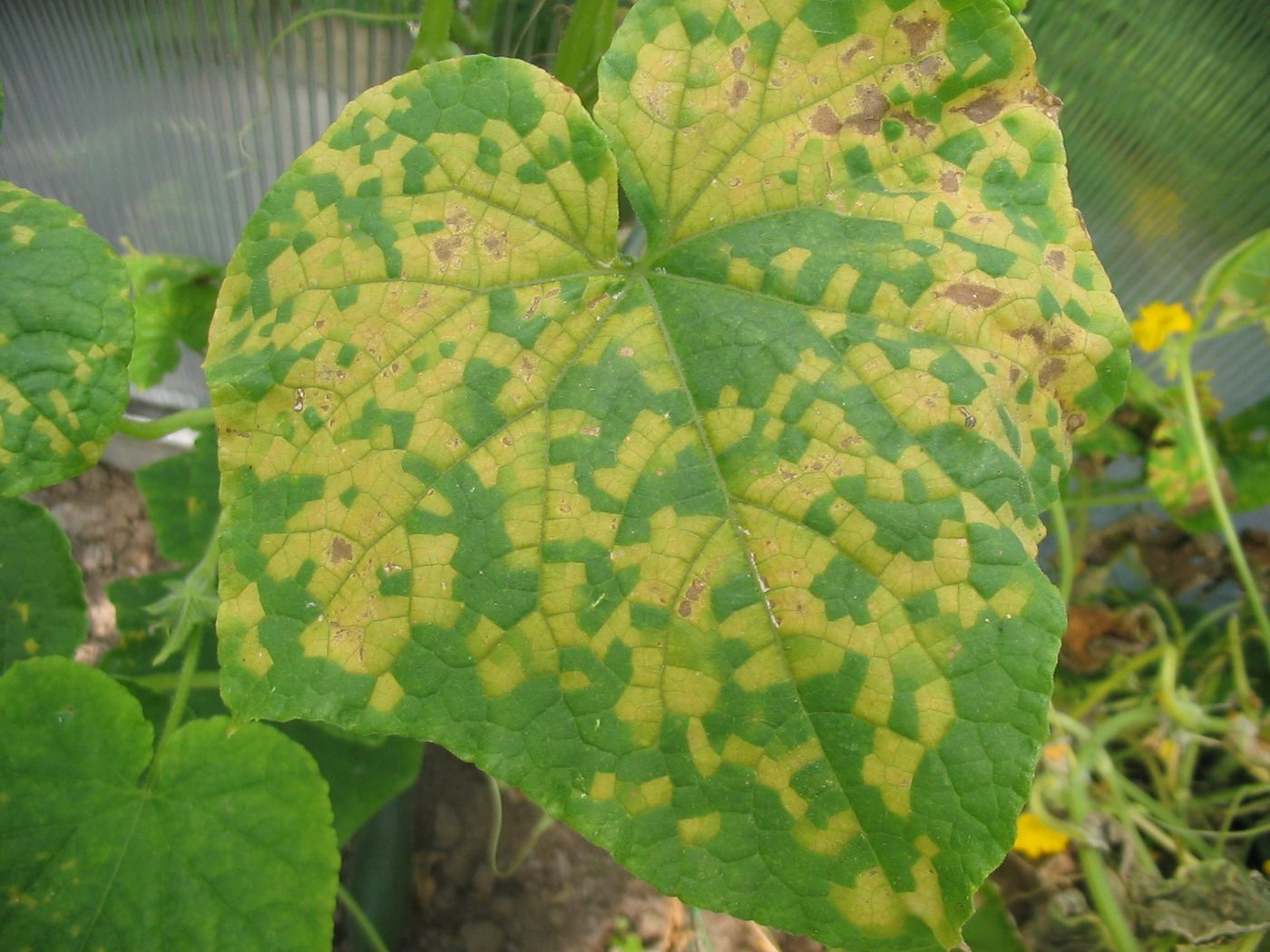
Pests and diseases of cucumber in Greece and Europe: symptom description, epidemiology and quarantine status
Downy mildew, powdery mildew with two causal agents and opposite temperature optima, scab, anthracnose, Didymella with a one-hour free-water limit, Botrytis, Sclerotinia. The two fusarium diseases of cucumber: f.sp. radicis-cucumerinum, described in Heraklion with an optimum of 17 degrees and stopping at 32, and fusarium wilt, which starts where that one stops. Pythium, Phytophthora and angular leaf spot. The aphid-borne and the whitefly-borne viruses, with the three criniviruses that cannot be separated without a laboratory, CYSDV in 49.9% of Greek samples, CVYV absent from Greece but present in Cyprus and Türkiye, and ToLCNDV as the only Union quarantine pest, with the Greek chronology from Ileia in 2018. CGMMV, the virus that needs no insect and that stayed infective in Greek soil at 4 degrees for ten months. Whiteflies, spider mite, thrips, aphids, leafminers, lepidoptera and nematodes, with the Greek resistance data, the Ierapetra nematode populations that overcome the Mi gene, and an explicit statement for every threshold that does not exist. A table of temperature optima by season of the Greek greenhouse. Seven photographs, eighty-four references, each declared as full text or abstract only.
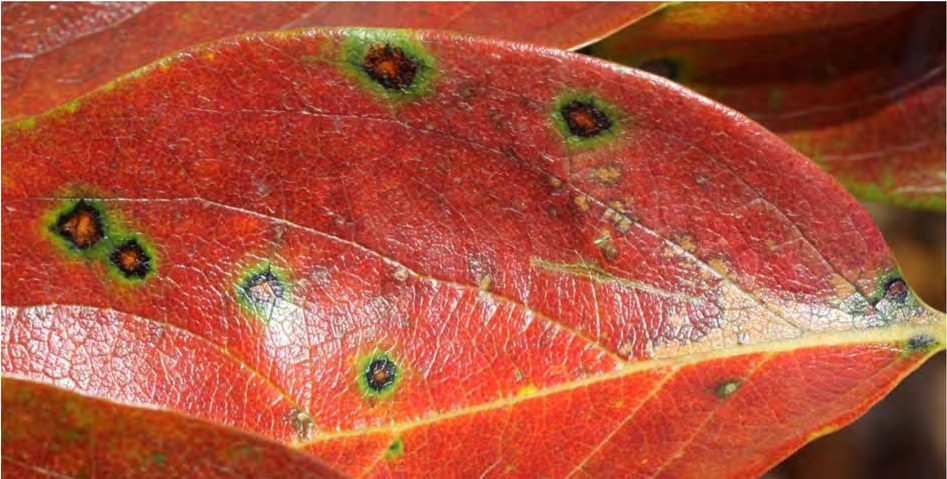
Pests and diseases of persimmon (Diospyros kaki) in Europe and Greece: epidemiology, differential diagnosis and action thresholds
Circular leaf spot (Plurivorosphaerella nawae), the pathogen that adapted to the semi-arid climate of Valencia and is not a quarantine organism, with the comparison between Spain and Korea and the role of drip irrigation. Angular leaf spot, Pestalotiopsis, anthracnose, and the twelve species of Diaporthe, Eutypella and Botryosphaeriaceae identified inside the wood. Postharvest rots: why Alternaria black spot became the limit of storage life after 1-MCP, and how extra irrigation before harvest is paid for in the cold room two months later. Crown gall, vascular wilt, root rots and phytoplasmas. Mealybugs and ants, wax scale, mussel scale, the orange spiny whitefly as a quarantine organism, fruit flies. Herbicide toxicity mistaken for a fungal leaf spot, a differential diagnosis table with fifteen pairs, action thresholds with the sampling method, and the four exotic pathogens threatening the Mediterranean. Thirteen photographs, five from Greek orchards.
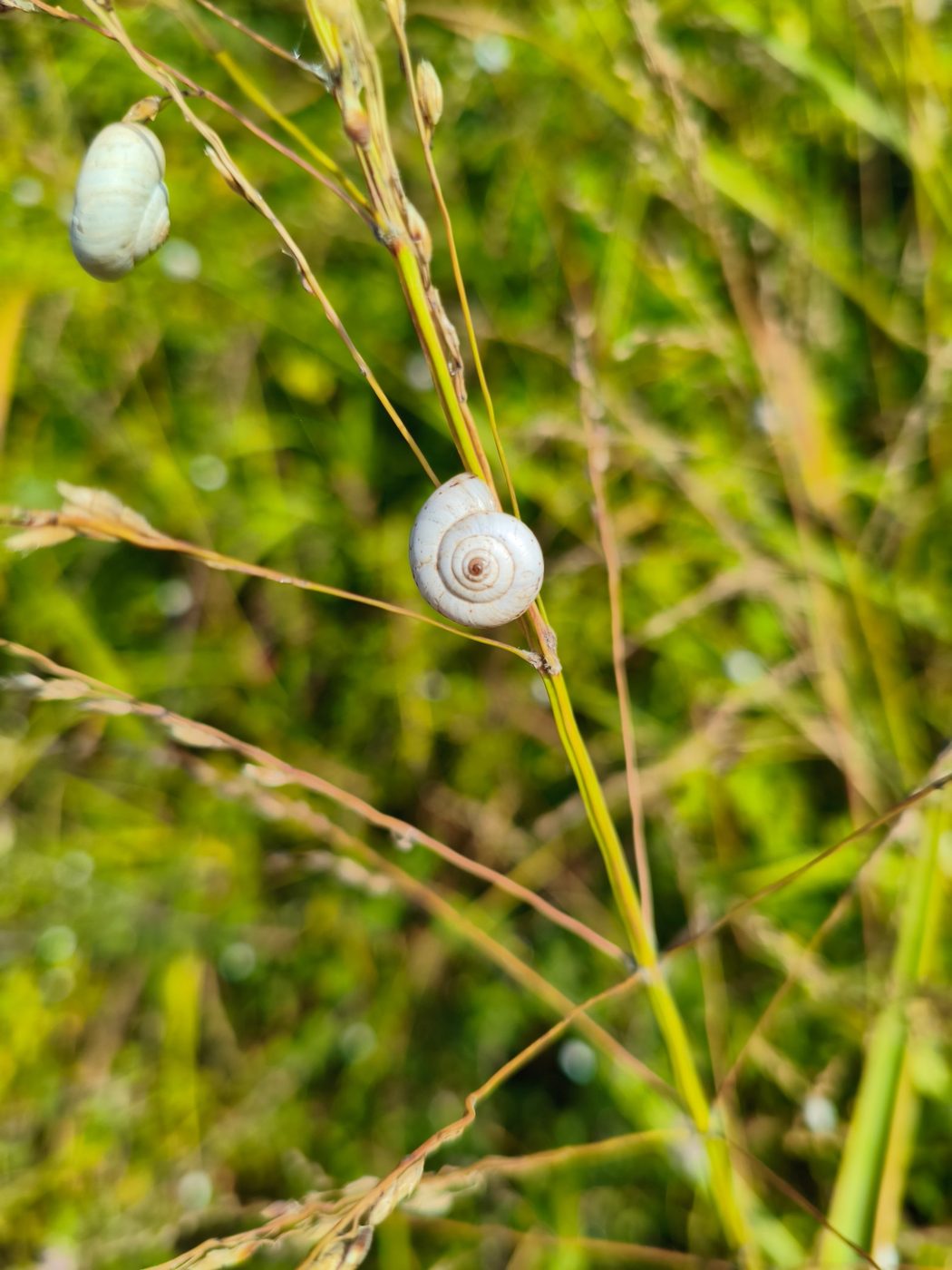
The white Mediterranean snail in tree crops
Theba pisana is native to the Mediterranean, not invasive, so there is no eradication programme to wait for. Identification, life cycle, the damage in tree crops, the single approved target in the Greek register, and why the nematode Phasmarhabditis killed the snail only at five times the label rate.