
The orange spiny whitefly, Aleurocanthus spiniferus
Savvas Pastopoulos, Agronomist, Pastopoulos Agronomics, Neos Mylotopos, Pella, Greece
An exotic quarantine insect has been spreading through Greece since 2016. It is not controlled effectively by spraying, and in fact spraying makes the problem worse. The way out runs through biological control, and over the past two years developments have taken place that have not yet reached the grower.
The orange spiny whitefly, Aleurocanthus spiniferus Quaintance (Hemiptera, Aleyrodidae), originates in South-East Asia. It is a quarantine pest for the European Union and for Greece, and it is distinctly difficult to control. In the areas it has entered there are no specialised natural enemies capable of holding its populations in check [1].
Greece, Corfu
species
generations a year
Greek precedent
- How it got here, step by step
- How it is recognised
- The life cycle and the generations
- Hosts, it is not only citrus
- The damage and how it is done
- Quarantine status and the legal obligations
- Why spraying does not solve the problem
- Biological control and the Greek precedents
- What changed after 2023, the new developments
- What all of this means for the grower
- Sources
1. How it got here, step by step
| Year | Where it was found |
|---|---|
| 2008 | Italy, the first European record, at Supersano in Apulia. Campania, Lazio and Basilicata followed [2] |
| 2012 | Croatia [1] |
| 2013 | Montenegro, on the Adriatic coast, and Albania [1] |
| September 2016 | Greece, Corfu. In the north-eastern part of the island, on orange trees. It was also found on citrus, grapevine and roses, widely dispersed and at high population levels [3] |
| September 2017 | Igoumenitsa, within the town, on lemon and orange trees. Since then it has been found in many citrus-growing districts of mainland Greece [1] |
| To date | Present in France as well. The EU continues to update the demarcated containment areas for the insect, most recently amended in June 2025 [4] |
2. How it is recognised
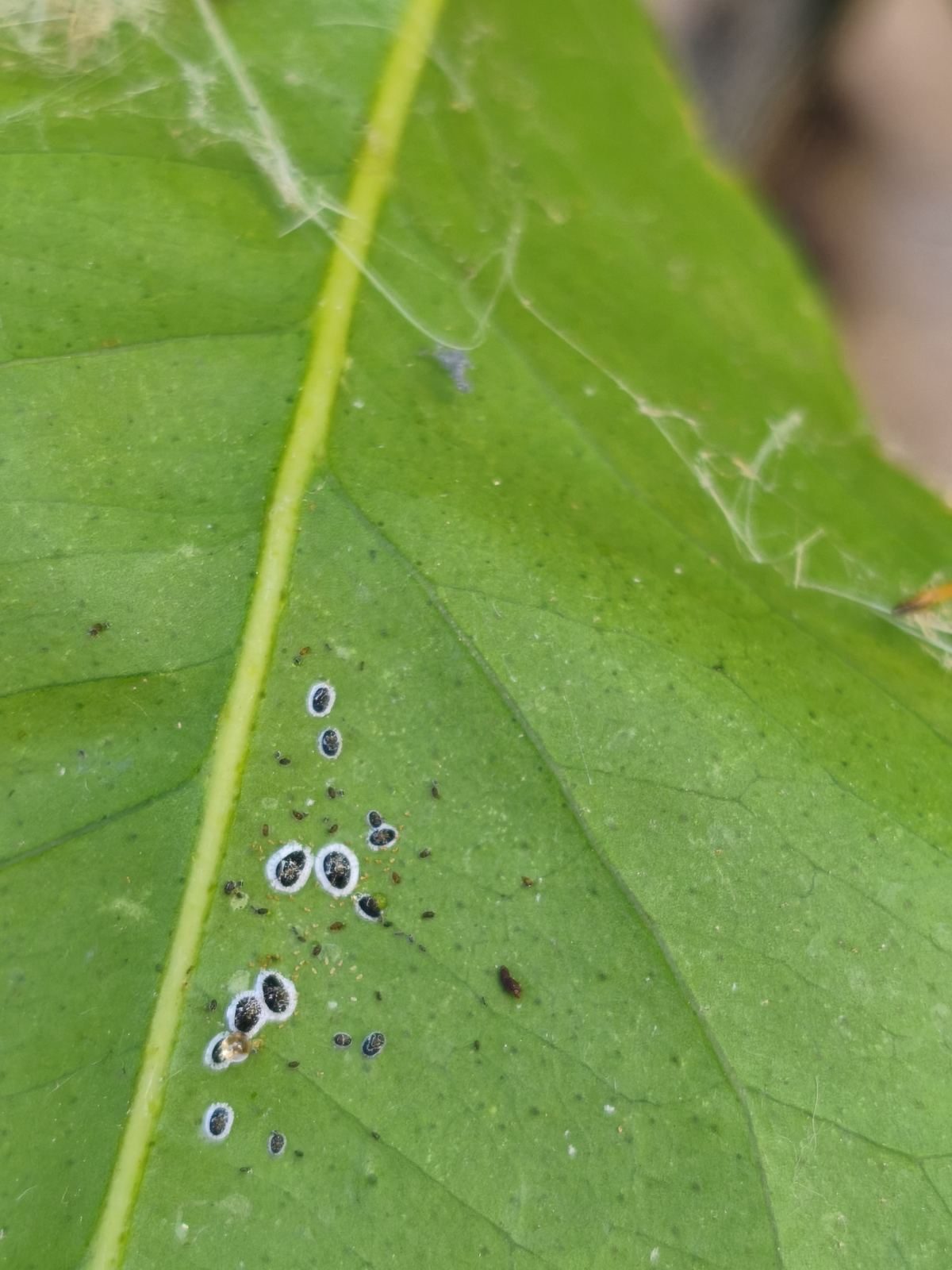
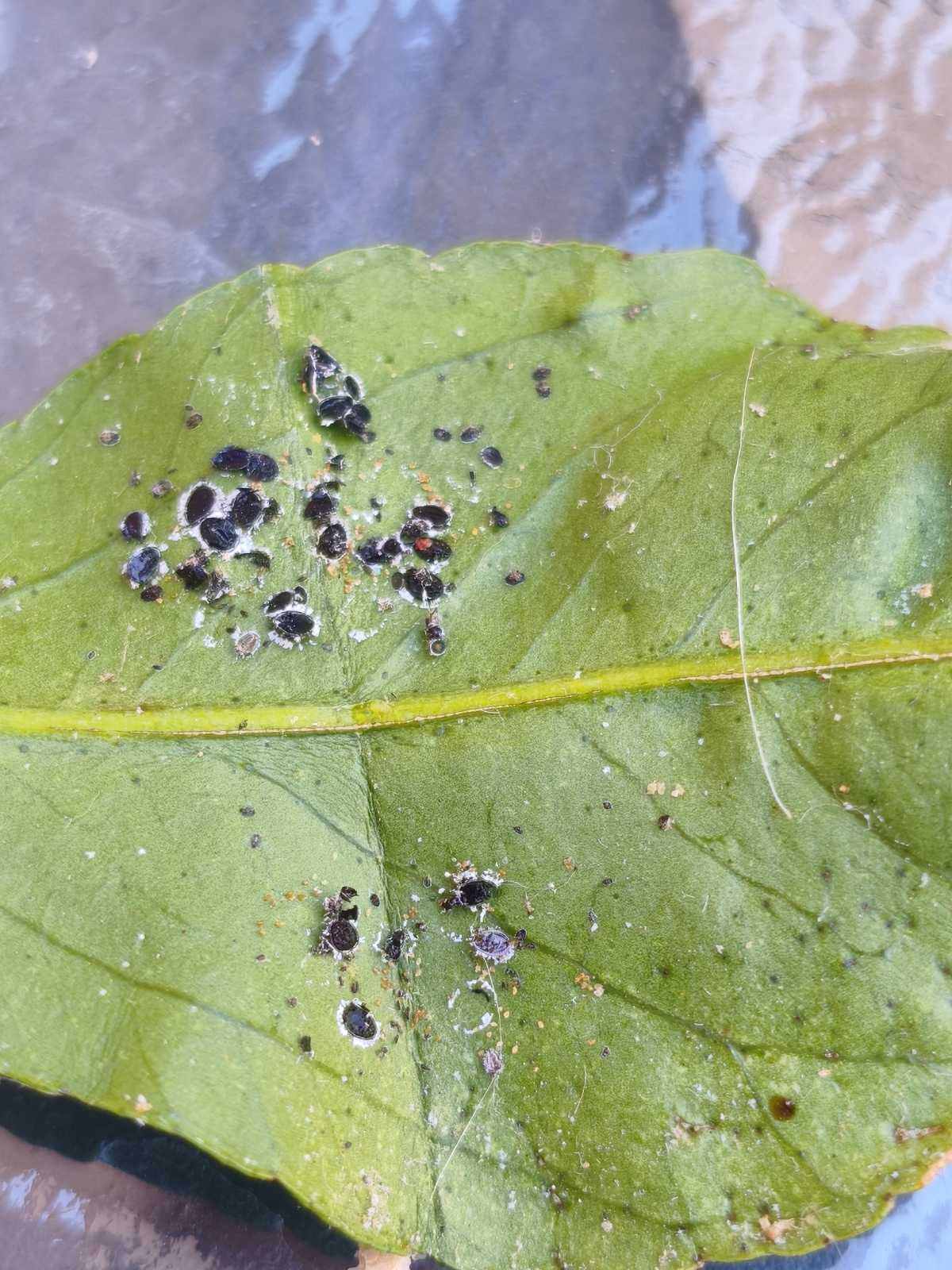
The feature that gives it away is that the leaf looks as if it has been dusted with black pepper, on the underside. The nymphs are black, immobile, and ringed by white waxy processes.
| Stage | What is seen |
|---|---|
| Egg | Elongate, oval, about 0.2 mm long. Laid on the underside of the leaves in a characteristic sigmoid arrangement, that is, forming a curved or spiral pattern. Yellow at first, darkening as the embryo develops [1] |
| First instar nymph | Elongate, with legs, and mobile. Active in the shaded parts of the canopy. Once it finds a suitable spot it inserts its mouthparts, loses its legs, becomes oval and settles permanently [1] |
| Later instars | Immobile, black, with white waxy processes around the margin. In heavy infestations they form dense colonies on the leaf underside [1] |
| Adult | Winged, small but visible to the naked eye. Females are 1.33 to 1.7 mm long. The eyes are red; the antennae and legs white with pale yellow markings. The wings cover most of the body and give a metallic blue-grey colour with white markings [3] |
3. The life cycle and the generations
The cycle lasts two to four months and the number of generations depends on the climate. Anywhere from three to more than six overlapping generations a year are recorded. In areas with mild temperatures and high relative humidity five to six generations are reported, while in Japan four are [1].
Each female lays 35 to 100 eggs, and more in some records, on the underside of the young, tender leaves [1] [5]. Reproduction is restricted when temperatures are low [5].
4. Hosts, it is not only citrus
It is a markedly polyphagous species. It has been observed feeding on more than 90 plant species [1], belonging to more than 38 plant families [5].
Citrus is the economically most important host. Other species of major economic importance that it attacks are grapevine, rose, pomegranate, mulberry, certain stone fruits and species of the genus Malus, that is, apple [1]. It also attacks ornamentals such as ivy and bay laurel, as well as wild weeds.
5. The damage and how it is done
The damage has two components, and the second is the more serious.
First, sap removal. The nymphs and the adults suck sap from the leaves of the host plants. Sap removal can affect even the availability of nitrogen in the tree, reducing flowering and fruit set [5].
Second, honeydew and sooty mould. They produce large quantities of honeydew, which favours the development of sooty mould. In heavy infestations the tree literally turns black [5].
The chain that follows is this: sooty mould reduces the photosynthetic capacity of the leaves. That reduction leads to leaf drop and, in the end, to complete decline of the plant. In more severe infestations there is shoot dieback and premature fruit drop [1] [5].
And the commercial outcome: fruit coated with sooty mould is downgraded and loses its market value [1].
Video 1. Footage from the field. Note the extent of the infestation on the foliage and how uniformly the underside of the leaves is covered.
6. Quarantine status and the legal obligations
The insect is on the EPPO A2 list of quarantine pests [2] and in Part B of Annex II to Commission Implementing Regulation (EU) 2019/2072, under Regulation (EU) 2016/2031 [1] [4].
In practice this means that reporting a find is not a matter of choice. The phytosanitary measures aim at eradication and containment, and they provide for:
- Use of healthy certified propagation material.
- Avoiding movement of infested plant material, nursery stock, fruit from infested trees, flowers.
- Pruning and burning of infested branches.
- Systematic inspection of crops for any symptoms.
- Reliable identification. The orange spiny whitefly is not always easy to separate from related species by eye. A real-time molecular identification method has been developed, which makes phytosanitary checks faster and more reliable [10]. Where there is doubt, the sample goes to the laboratory.
- Immediate notification of the competent authorities, in Greece the regional agricultural directorate (ΔΑΟΚ) and the Regional Centre for Plant Protection, Quality and Phytosanitary Control, on detection [1]. In other countries, the corresponding national plant protection organisation.
7. Why spraying does not solve the problem
This is the point that has to be stated plainly, because it runs against the grower's instinct.
Insecticide use is generally ineffective, because of the particular biology of the insect, which also makes it uneconomic [1]. The scientific literature itself confirms that in the case of A. spiniferus chemical control is not particularly effective and disrupts the natural enemies [5].
The use of neonicotinoids must be avoided, and the reason is specific: it disrupts the effective classical biological control already operating against the woolly whitefly Aleurothrixus floccosus and against other pests such as the scales.
The outcome is secondary resurgence of those pests and further development of resistance. In effect, a spray goes out against one whitefly, it does not control it, and a second problem is created at the same time from pests that the beneficials had been holding down until the day before.
In addition, the use of neonicotinoids is restricted by EU legislation [1].
Where, then, is there any scope? In infested areas, interventions with plant protection products that are soft on beneficial insects could limit the impact to some degree, provided they are made:
- at the early stages of the infestation, and
- during the winter to spring period, before the adults appear [1].
No active substances and no rates are given here. The choice is made solely on the basis of the approvals in force for the crop concerned [11], and in consultation with the competent authority, since this is a quarantine organism under a special management regime.
8. Biological control and the Greek precedents
In its area of origin the insect is held in check by natural enemies. The problem arises when it is introduced into new areas where those enemies are absent [1].
Classical biological control with hymenopteran parasitoids has proved economical and effective in various parts of the world. The two most effective species are Encarsia smithi (Silvestri) (Aphelinidae) and Amitus hesperidum (Platygastridae).
The international results
| Country and year | Result |
|---|---|
| Japan, 1925 | With the introduction of E. smithi from China, A. spiniferus was brought rapidly under control, with parasitism rates of 65 to 90% |
| Guam, 1952 | Control on citrus through the introduction and establishment of E. smithi and A. hesperidum from Mexico. Similar results later in Micronesia |
| South Africa | With releases of E. smithi in commercial orchards, parasitism reached around 80% within eight months |
The Greek precedents, why they count
This is not a theoretical proposition. Greece has already done it, twice, successfully.
- 1976: the parasitoid Encarsia lahorensis (Howard) was introduced against the whitefly Dialeurodes citri. It established successfully.
- 1991: Cales noacki Howard (Aphelinidae) was introduced into Greece from Spain against the woolly whitefly. Mass rearing at the Benaki Phytopathological Institute followed, with an intensive release programme from 1992 to 1995. C. noacki established successfully and in less than a year parasitism exceeded 97% [1].
How the two parasitoids differ
| Characteristic | Amitus hesperidum | Encarsia smithi |
|---|---|---|
| Specificity | Fairly specific to the genus Aleurocanthus | Broader range: it parasitises other whiteflies as well, and has also been found on a scale insect |
| Cycle length | 45 to 60 days under ideal laboratory conditions | About 30 days |
| Adult female lifespan | Only 4 to 5 days under field conditions | At least 15 days |
| When it performs | When the host is at high density. It has poor host-finding ability, and once the host is reduced its own population collapses | Effective at low densities as well. It kills the host both by laying eggs in the puparia and by feeding on it, that is, as a predator too |
Where the Greek effort stands
The Benaki Phytopathological Institute is seeking these parasitoids for introduction and evaluation under Greek conditions. Contacts have been made with institutions in the United States (Texas, Florida, Hawaii), South Africa, Eswatini, Trinidad and Tobago, Japan, Vietnam, China, Uganda, Réunion, Guam, Iran and Australia. As at the time of publication:
- Two expeditions to Hawaii, no species parasitising the orange spiny whitefly were found. Only Encarsia perplexa was found, which parasitises A. woglumi but not A. spiniferus.
- One expedition to Vietnam, various parasitoid species were found, currently under evaluation at the Institute's facilities.
- Further expeditions are planned to Vietnam, the area of origin of both the whitefly and its parasitoids, and to Japan [1].
Sources: 1
9. What changed after 2023, the new developments
Between the 2023 publication and today the picture has changed substantially, and in a direction nobody had planned.
- Eretmocerus iulii Laudonia et Melone (Aphelinidae): a parasitoid of A. spiniferus described in Italy. Parasitism activity has been recorded in Sicily [8] and recently a first record in Montenegro [9].
- Encarsia nipponica: an Asian parasitoid found attacking A. spiniferus in northern Italy [7].
- Co-occurrence of E. smithi and E. iulii: assessment of how the two parasitoids behave through the season indicates that their ecology may be complementary, which favours greater suppression of whitefly populations [6].
And a piece of Greek experimental work
In 2025 a field experiment in an orange orchard on the plain of Aetolia-Acarnania was published, with laboratory work at the Department of Agriculture of the University of Ioannina. Three treatments were compared [5]:
- A combination of the entomopathogenic fungi Beauveria bassiana and Cordyceps fumosorosea.
- A tetramic acid based product.
- An untreated control.
The results, as the authors themselves put it, encourage further investigation of the use of these treatments and highlight the potential of entomopathogenic fungi in integrated citrus management [5].
Note the wording carefully: these are encouraging first results from one experiment, not an established recommendation for application. The researchers themselves call for further investigation.
10. What all of this means for the grower
The points to take away
- Recognition: black "peppercorns" with a white waxy margin on the underside of the leaf, eggs in a sigmoid arrangement, adults with red eyes and metallic blue-grey wings.
- It is a quarantine organism. A find must be reported to the competent plant health authority.
- No solution will come from the sprayer. Chemical control is ineffective and uneconomic, and the neonicotinoids create a second problem by wiping out the beneficials.
- The window, where there is one, is early. Early stages of infestation, and winter to spring before the adults appear.
- Clean propagation material. The insect arrived in Greece on plants and spreads on plants. That much is controllable.
- The solution will come from the beneficials. And three parasitoids have already turned up on their own in neighbouring Italy and in Montenegro.
11. Sources
The numbers in the text refer to the list below.
- [1] Milonas, P., Papachristos, D., Kapranas, A. and Giakoumaki, V-M. (2023). The orange spiny whitefly in Greece. The "black threat" to citrus. Georgia-Ktinotrofia, issue 06/2023: 32–35. In Greek. Scientific Directorate of Entomology and Agricultural Zoology, Benaki Phytopathological Institute, and Laboratory of Applied Zoology and Parasitology, School of Agriculture, Aristotle University of Thessaloniki. The principal source for this article: morphology and biology, generations, hosts, damage, quarantine status, all the biological control data and the progress of the Greek parasitoid-collecting expeditions. The full reference list of that article is available at bibliography.agrotypos.gr, year 2023, issue 06/2023.
- [2] EPPO Global Database, Aleurocanthus spiniferus (ALECSN), Datasheet. Source for the A2 quarantine listing, for the first European record at Supersano in Apulia in 2008 and for the subsequent spread to Campania, Lazio and Basilicata.
- [3] Kapantaidaki, D.E. et al. (2019). Presence of the invasive whitefly Aleurocanthus spiniferus (Hemiptera: Aleyrodidae) in Greece. EPPO Bulletin. The scientific record of the insect's presence in Greece and the source for the morphological characters of the adults, female length 1.33 to 1.7 mm, red eyes, metallic blue-grey wings with white markings.
- [4] Commission Implementing Regulation (EU) 2025/1075 of 2 June 2025, amending the list of demarcated areas for the containment of Aleurocanthus spiniferus. Read together with Regulation (EU) 2016/2031 and Commission Implementing Regulation (EU) 2019/2072, Annex II Part B. Evidence that the quarantine regime remains active and is being kept up to date.
- [5] Patakioutas, G. et al. (2025). Biological Control Potential of Entomopathogenic Fungi Against Aleurocanthus spiniferus: Field Trials on Citrus sinensis in Agroforestry Ecosystems. Agronomy 15(11): 2488. DOI: 10.3390/agronomy15112488. A Greek field experiment in an orange orchard on the plain of Aetolia-Acarnania, with treatments of the entomopathogenic fungi Beauveria bassiana and Cordyceps fumosorosea, a tetramic acid product and an untreated control. Also the source for the six developmental stages, for hosts in more than 38 plant families, for the role of the sooty mould Capnodium citri, for the reduction in nitrogen and for the finding that chemical control is not particularly effective and disrupts the natural enemies.
- [6] First Detection of Encarsia smithi in Italy and Co-Occurrence with Eretmocerus iulii: A Case of Unintentional Introductions and New Associations with the Invasive Species Aleurocanthus spiniferus. The first discovery of Encarsia smithi in Europe, parasitising fourth-instar nymphs of the whitefly, as the result of an unintentional introduction most probably through the plant trade. Also the source for the complementary ecology of the two parasitoids. See also the corresponding EPPO report.
- [7] A European Début: The Asian Parasitoid Encarsia nipponica Targets the Invasive Aleurocanthus spiniferus in Northern Italy. Insects 16(11): 1181. Source for the detection of a third parasitoid, of Asian origin, in northern Italy.
- [8] Parasitization Activity by Eretmocerus iulii over the Orange Spiny Whitefly, Aleurocanthus spiniferus, in Sicily. Insects 16(10): 1074. Source for the parasitism activity of Eretmocerus iulii in Sicily.
- [9] Radonjić, S. et al. First record of Eretmocerus iulii Laudonia et Melone (Hymenoptera: Aphelinidae), parasitoid of Aleurocanthus spiniferus Quaintance (Hemiptera: Aleyrodidae) in Montenegro. EPPO Bulletin. Evidence that the parasitoid is spreading through the Balkans on its own, following its host.
- [10] Streamlining the Identification of the Orange Spiny Whitefly, Aleurocanthus spiniferus (Hemiptera: Aleyrodidae), with Real-Time PCR Probe Technology. Agriculture 15(4): 414. A molecular method for rapid and reliable identification of the species, useful in phytosanitary checks where morphological separation from related species is difficult.
- [11] Greek Ministry of Rural Development and Food, database of approved plant protection products. The only authoritative source for what is permitted on each crop in Greece at any given moment. In Greek, and valid in Greece only.
Related articles
Pests and diseases of persimmon (Diospyros kaki) in Europe and Greece: epidemiology, differential diagnosis and action thresholds
Circular leaf spot (Plurivorosphaerella nawae), the pathogen that adapted to the semi-arid climate of Valencia and is not a quarantine organism, with the comparison between Spain and Korea and the role of drip irrigation. Angular leaf spot, Pestalotiopsis, anthracnose, and the twelve species of Diaporthe, Eutypella and Botryosphaeriaceae identified inside the wood. Postharvest rots: why Alternaria black spot became the limit of storage life after 1-MCP, and how extra irrigation before harvest is paid for in the cold room two months later. Crown gall, vascular wilt, root rots and phytoplasmas. Mealybugs and ants, wax scale, mussel scale, the orange spiny whitefly as a quarantine organism, fruit flies. Herbicide toxicity mistaken for a fungal leaf spot, a differential diagnosis table with fifteen pairs, action thresholds with the sampling method, and the four exotic pathogens threatening the Mediterranean. Thirteen photographs, five from Greek orchards.
The white Mediterranean snail in tree crops
Theba pisana is native to the Mediterranean, not invasive, so there is no eradication programme to wait for. Identification, life cycle, the damage in tree crops, the single approved target in the Greek register, and why the nematode Phasmarhabditis killed the snail only at five times the label rate.
The Maxim persimmon cultivar: rights, ripening and key information
A protected Spanish cultivar of the Genesis Exotic group, distributed under licence. The fruit is not astringent at any stage, not even unripe, so no deastringency chamber is needed, the tree resembles Jiro and ripening falls in mid-September.