
Persimmon fruit infested by Pseudococcus comstocki
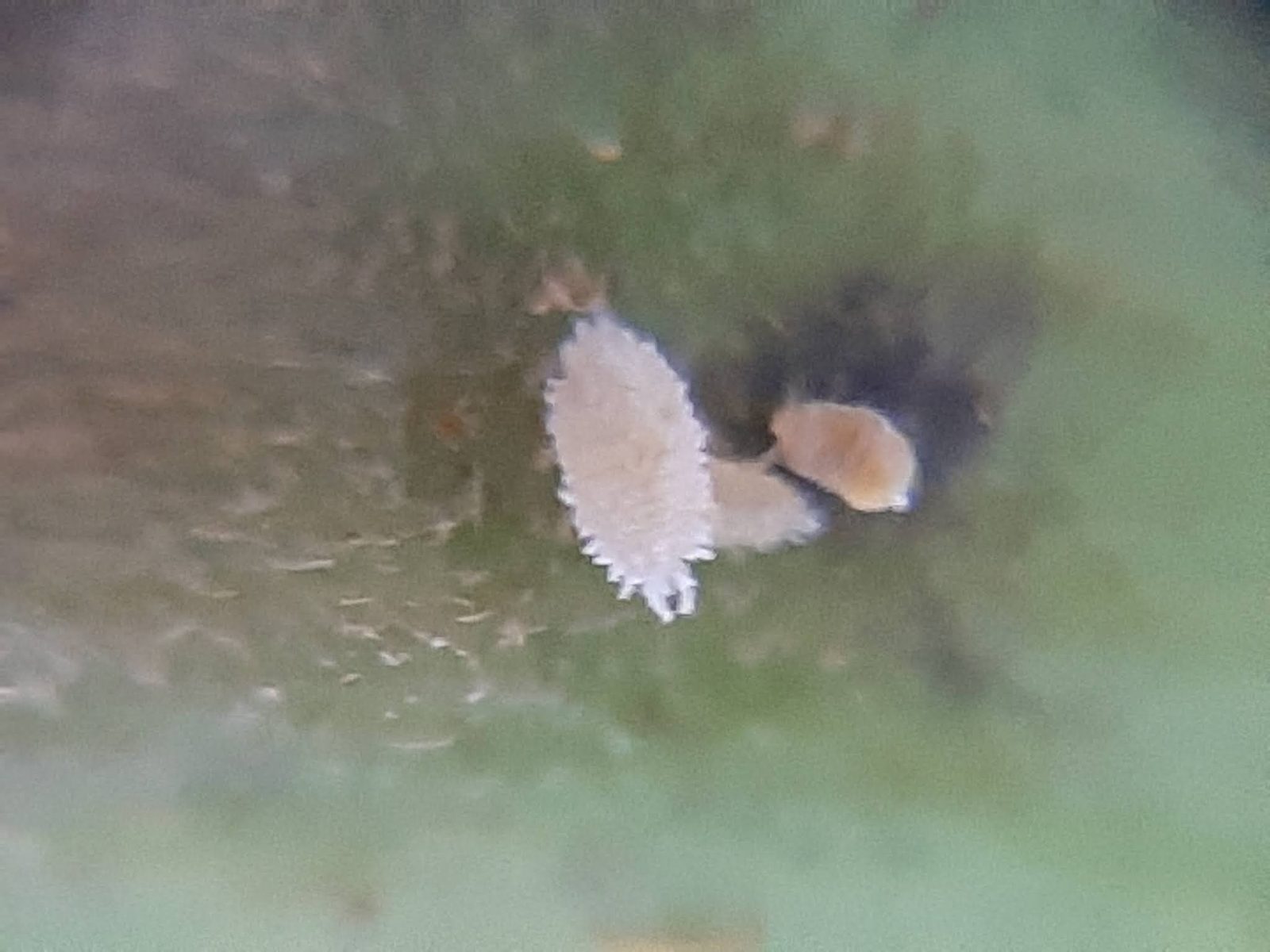
Savvas Pastopoulos, Agronomist MSc, Pastopoulos Agronomics, Neos Mylotopos, Pella, Greece
A mealybug that settles on the peduncle of the fruit, beneath the leaf-like calyx is developing into a significant pest of persimmon in Macedonia, in northern Greece. There the fruit blackens from the feeding activity of the insect and is destroyed, and premature fruit drop often follows.
Where this article refers to approvals, those of the Greek Ministry of Rural Development and Food are valid in Greece only and say nothing about what is permitted in any other country. No active substance and no dose is named anywhere in this article. The phenological dates come from northern Italy and carry that origin inside the sentence; they have not been measured in Greece.
in Italy
stage
western Europe
wax filaments
1. The identity of the insect and how it arrived here
Pseudococcus comstocki (Kuwana) (Hemiptera, Pseudococcidae) is a species of east Asian origin. In western Europe it was recorded for the first time in 2004, in Italy and France. In the summer of 2006 new foci were found in north-eastern Italy, on ornamental plants and in peach orchards [2].
It is a markedly polyphagous species. It attacks apple, pear, peach, plum, quince, almond, pomegranate, date palm, hawthorn, poplar and a great many ornamentals [1]. Persimmon belongs on that host list. In the Greek literature, the presence and the control of mealybugs on peach and persimmon has been described as a re-emerging serious threat [10].
One detail that passes unnoticed and matters further on: the species does not feed only on the above-ground parts. The literature reports feeding activity explicitly on buds, shoots, leaves, fruit and rootlets [5]. That is, it can maintain a population below the soil surface as well.
2. How the two species are told apart in the field
Both species are white, waxy and resemble cotton wool. The distinction is nevertheless made with a hand lens, without a laboratory, and rests on three points.
| Feature | Pseudococcus comstocki | Planococcus citri citrus mealybug |
|---|---|---|
| Lateral filaments | 17 pairs. Most of them about one quarter of the width of the body, straight and slender [3] | 18 pairs. Short and often slightly curved [4] |
| Caudal filaments the safest criterion | The last two pairs are clearly longer. The last one reaches from one quarter to two thirds of the body length [3] | The last pair is barely longer, about one eighth of the body [4] |
| Dorsal line | It has no longitudinal line on the back [3] | It has a characteristic dark longitudinal dorsal stripe, where the wax is absent [4] |
| Wax cover | Thicker. The body is not easily made out beneath it [1] | Thinner; the pinkish body shows through the powder [8] |
| Overwintering | As an egg, in ovisacs within the crevices of the bark [2] | In all stages, in sheltered positions |
These features assist the distinction in the field, but identification of mealybugs to species level requires microscopic examination by a specialist and is not replaced by a hand lens.
3. The damage on persimmon
In recent years the insect has been found causing damage in the persimmon crop. More specifically, it was found settling on the peduncle of the fruit, beneath the leaf-like calyx. There the fruit blackens from the feeding activity of the insect and is destroyed, and it often also shows premature fruit drop.
This behaviour is not accidental and is confirmed by the Italian work: in infested orchards the females are often found hidden inside the calyx of the fruit on apple and pear, or in the cavity of the peduncle on peach [2]. The young nymphs seek positions where their body has the greatest possible contact with the plant tissues, and they prefer damp and shaded places. The calyx of the persimmon is, by its nature, an ideal refuge.
Beyond the weakening of the tree caused by the removal of sap, the damage is chiefly commercial. The fruit is downgraded or it drops. And because the insect sits beneath the calyx, the infestation does not show on visual inspection unless the calyx is lifted. Many growers discover it at grading.
4. The annual cycle, and what it changes about the spray
Here lies the reason why correct identification has practical value.
Planococcus citri overwinters in all stages, in sheltered positions. There is therefore no single, vulnerable point of the winter to be targeted.
Pseudococcus comstocki works differently. In Italy it develops three generations a year and overwinters in the egg stage. The overwintering eggs hatch from April onwards, and the young nymphs attack leaves and flowers. The adult females of the three generations appear in June, in late July and August, and from late September to November [2]. In autumn the females lay their ovisacs in the crevices of the bark [1].
| Period in northern Italy | Where the insect is | What it means in the orchard |
|---|---|---|
| Winter | Ovisacs in the crevices of the bark, on the scaffold limbs and the trunk. Possibly also low down at the collar or in the soil, see the box below | A sanitation target. Scraping of old bark, cleaning of the collar, removal of the residues from the orchard |
| April onwards | Hatching of the overwintering eggs. The young nymphs move about | The critical window. The young nymphs are still uncovered by wax and exposed. It is the only moment at which the insect is unprotected |
| June | Adult females of the first generation | Monitoring. The populations begin to hide inside the calyces |
| Late July and August | Adult females of the second generation, inside the calyces | The period at which the damage is usually noticed. Intervention here is difficult: the spray liquid does not reach beneath the calyx |
| Late September to November | Adult females of the third generation; egg laying on the bark | This determines the load of the following year. Whatever is not struck now overwinters |
The published literature on the species places overwintering in the egg stage, in ovisacs within the crevices of the bark, with the females moving from the leaves towards the older limbs and the trunk to lay [2]. Hatching is followed by movement of the young nymphs towards the new growth.
No published documentation was found for overwintering of this particular species within the soil, with the nymphs climbing the trunk in spring.
Two findings, however, do not allow it to be excluded. First, the literature itself reports that the species also feeds on rootlets [5], so an underground population may exist. Second, related mealybug species are known to maintain populations on the roots and at the collar, with their nymphs climbing into the canopy in spring; it is a known behaviour of the family.
Accordingly, the observation of nymphs climbing from the base of the trunk is entirely plausible and should not be dismissed because it has not been published for this species. The practical conclusion does not change: the inspection covers both the bark and the collar with the surface soil, and the base of the trunk is treated as an active front. The cost of the inspection is zero, the cost of omitting it is not.
With citri there was no reason to pay particular attention to the bark in winter, nor to the April hatch.
With P. comstocki, the whole population of the orchard passes the winter in one stage, the egg, concentrated in a few protected positions. That is the narrowest point of its cycle and the greatest opportunity against it. The control is done in winter and early spring, not in August when the insect is already tucked beneath the calyx and out of reach.
5. Control
Monitoring
- Winter inspection of the bark. Examination with a hand lens of the crevices of the bark on trunk and limbs. The ovisacs show as white cottony masses; the eggs are orange and oval, about 0.3 mm long [1]. This inspection establishes the population that is present before the season starts.
- Inspection of the collar and the surface soil. In winter and early spring, light digging around the base of the trunk and examination of the collar, the first roots and the plant residues. Where white waxy masses or moving nymphs are found, the population does not start from the canopy and the measures change.
- Trapping of climbing nymphs. A sticky band around the trunk, placed early in spring, shows whether there is movement up from the base and how large it is. It is cheap, it harms nothing, and it answers the question definitively for the particular orchard. At the same time it also blocks the ants.
- Inspection of the calyx. From June onwards, the calyx is lifted on a sample of fruit per row. External visual inspection is not enough.
- Pheromone traps. A sex pheromone exists for the species and has been used for monitoring the flight of the males [1]. It is the most accurate tool for timing the interventions.
Cultural measures
- Cleaning of the bark in winter. Removal of loose bark and its removal from the orchard. This targets the overwintering eggs directly.
- A clean collar. Removal of weeds, plant residues and soil that has piled up at the base of the trunk. It gives shade, moisture and refuge exactly where nobody looks.
- Control of the ants. Without it, the beneficial insects do not work.
- Care with planting material. The species moves with plants. Inspection of new young trees before planting.
- Ventilation of the canopy. The insect prefers damp and shaded spots. A dense, unpruned tree gives it exactly that.
- Removal of the infested fruit from the ground and from the tree.
Biological control
The species has a history of successful biological control. Programmes in central Asia and in North America, in the second half of the twentieth century, succeeded with the parasitoids Allotropa burrelli and Acerophagus malinus [5]. In Europe, corresponding solutions are under investigation today for the invasive populations, among them Anagyrus vladimiri [6].
Chemical control
Effectiveness is decided almost exclusively by the timing, not by the product. The adult female is protected by a thick waxy layer and sits tucked beneath the calyx. The spray liquid simply does not reach it.
The target is the young nymph at hatching, from April onwards, while it is still uncovered and moving. A second opportunity is given by winter interventions on the bark, when the insect is in the egg stage.
No active substances are listed. The choice is made exclusively on the basis of the approvals in force of the Greek Ministry of Rural Development and Food for persimmon [9], at the dose on the label, and those approvals are valid in Greece only; in any other country the national register of that country applies. Persimmon is a minor crop in Greece and the approvals are limited, so the check is repeated every year, in the database of approved plant protection products and with the local Directorate of Rural Economy. The addition of a wetter is a matter for the agronomist on the spot, because the waxy cover repels water.
What is worth keeping
- The insect on persimmon is Pseudococcus comstocki and not Planococcus citri, with which it is often confused.
- It is distinguished by the two long caudal filaments and by the absence of a dark dorsal line.
- It overwinters as an egg, chiefly in the crevices of the bark. There it is more vulnerable than at any other time. The collar and the surface soil are inspected as well, since the species also feeds on rootlets [5].
- The window for intervention is the hatch from April onwards, not August.
- In August, when the damage becomes visible, the insect is already out of reach beneath the calyx.
6. What remains unanswered
- How extensive is the infestation in Greece? The species is officially recorded in the Greek fauna [11] and the presence of mealybugs on peach and persimmon has been described in the Greek agronomic literature [10], but there is no systematic mapping of the spread by district and crop. Samples sent to the Benaki Phytopathological Institute and to the Department of Deciduous Fruit Trees of Naoussa would help complete the picture.
- Does it overwinter in the soil in this district? The literature documents overwintering as an egg on the bark [2], but also reports feeding activity on rootlets [5]. Field observations show nymphs climbing from the base of the trunk. One season with sticky bands would answer it definitively, and would change the measures.
- How many generations does it complete in Macedonia? The data on three generations come from northern Italy [2]. The dates here most probably differ and have not been measured.
- When exactly do the overwintering eggs hatch in this district? The whole timing depends on it. One season with pheromone traps would answer it.
- Are beneficials already present in the district? Before anything is introduced, it is worth checking whether parasitoids are already working in the orchards.
7. Sources
The numbers within the text refer to the list below.
- [1] CABI Compendium, Pseudococcus comstocki (Comstock mealybug). Source for the host list, for the size and colour of the eggs (0.3 mm, orange, in cottony masses), for the laying of the ovisacs in the crevices of the bark in autumn, for the thicker waxy cover, and for the use of a sex pheromone in monitoring.
- [2] Phenology, ethology and distribution of Pseudococcus comstocki, an invasive pest in northeastern Italy. The principal source of this article. It documents the first record in western Europe in 2004 in Italy and France, the new foci of 2006 on ornamentals and peach, the three generations a year, overwintering in the egg stage, the hatch from April onwards, the three periods in which the adult females appear, and, critically, that the females hide inside the calyx of the fruit on apple and pear and in the cavity of the peduncle on peach.
- [3] Scale Insects Identification Tools, Pseudococcus comstocki. Source for the 17 pairs of lateral wax filaments, for the last two pairs being longer with the last reaching from one quarter to two thirds of the body length, and for the absence of longitudinal lines on the back.
- [4] Scale Insects Identification Tools, Planococcus citri. Source for the 18 pairs of short filaments, for the caudal pair at about one eighth of the body, and for the characteristic longitudinal dorsal stripe without wax, which is the safest distinguishing feature of the species.
- [5] Investigating Biological Control Agents for Controlling Invasive Populations of the Mealybug Pseudococcus comstocki in France. Source for the successful biological control programmes in central Asia and North America, for the parasitoids Allotropa burrelli and Acerophagus malinus, and for the feeding activity on buds, shoots, leaves, fruit and rootlets.
- [6] Old Parasitoids for New Mealybugs: Host Location Behavior and Parasitization Efficacy of Anagyrus vladimiri on Pseudococcus comstocki. Source for the current investigation of parasitoids against the European populations of the species.
- [7] Integrative method to detect invasive mealybug species on highways in Hungary: evidence for northward spread of Comstock mealybug. Source for the documented spread of the species northwards along the transport corridors.
- [8] University of California, Statewide IPM Program, Mealybugs, Citrus. Source for the field morphological characteristics of Planococcus citri and for the effect of broad-spectrum sprays on mealybug populations through the destruction of the beneficials.
- [9] Υπουργείο Αγροτικής Ανάπτυξης και Τροφίμων, Βάση δεδομένων εγκεκριμένων φυτοπροστατευτικών προϊόντων (Greek Ministry of Rural Development and Food, database of approved plant protection products; interface in Greek). The only valid source for what is permitted on persimmon at any given moment, and it is valid for Greece only.
- [10] Pastopoulos, S. and Kazantzis, K. (2023). Mealybugs in peach and persimmon crops. A re-emerging serious threat, biology and control. Georgia-Ktinotrofia, issue 7:42–46, published by AgroTypos in collaboration with the Department of Deciduous Fruit Trees of Naoussa, ELGO-DIMITRA. Article in Greek. The Greek publication on the presence and the control of mealybugs on peach and persimmon in Greece.
- [11] Data on the scale insect (Hemiptera: Coccomorpha) fauna of Greece, with description of two new species. Zootaxa 4329(5). The official taxonomic documentation of the presence of the species in Greece. From the records of the years 2013 and 2014, 93 species of scale insects were collected, of which 38 were new to the Greek fauna. Among them two invasive species, Phenacoccus graminicola and Pseudococcus comstocki (Kuwana).
Plant protection products are used only on the basis of the approvals of the Greek Ministry of Rural Development and Food and in accordance with what is stated on their labels: approved crops, doses, maximum number of applications, re-entry intervals and pre-harvest intervals. Those approvals are valid in Greece only and say nothing about what is authorised in any other country; in every other country the national register of that country applies.
Any spray on trees carrying fruit, and especially a paraffin oil, carries a risk of staining of the fruit and burning of the foliage. A prior test on a limited number of trees with the same product and the same dose, and a wait of 5 to 7 days before general application, are required. Spraying is done in the late afternoon or early in the morning, never in a heatwave and never on foliage under water stress.
This is informative and educational material and summarises published findings together with field observations, which are identified as such where they appear. It is not an individualised agronomic recommendation. The phenological dates given come from northern Italy and have not been measured in Greece. Any intervention is made at the responsibility of the user, following an on-site assessment by a licensed agronomist. Pastopoulos Agronomics bears no responsibility for damage that may arise from the use of the information herein.
Related articles
Pests and diseases of persimmon (Diospyros kaki) in Europe and Greece: epidemiology, differential diagnosis and action thresholds
Circular leaf spot (Plurivorosphaerella nawae), the pathogen that adapted to the semi-arid climate of Valencia and is not a quarantine organism, with the comparison between Spain and Korea and the role of drip irrigation. Angular leaf spot, Pestalotiopsis, anthracnose, and the twelve species of Diaporthe, Eutypella and Botryosphaeriaceae identified inside the wood. Postharvest rots: why Alternaria black spot became the limit of storage life after 1-MCP, and how extra irrigation before harvest is paid for in the cold room two months later. Crown gall, vascular wilt, root rots and phytoplasmas. Mealybugs and ants, wax scale, mussel scale, the orange spiny whitefly as a quarantine organism, fruit flies. Herbicide toxicity mistaken for a fungal leaf spot, a differential diagnosis table with fifteen pairs, action thresholds with the sampling method, and the four exotic pathogens threatening the Mediterranean. Thirteen photographs, five from Greek orchards.
The Maxim persimmon cultivar: rights, ripening and key information
A protected Spanish cultivar of the Genesis Exotic group, distributed under licence. The fruit is not astringent at any stage, not even unripe, so no deastringency chamber is needed, the tree resembles Jiro and ripening falls in mid-September.
The fig wax scale, Ceroplastes rusci, on fig and persimmon
No synthetic active substance is authorised against it on fig or persimmon in Greece - only paraffin oils, maltodextrin and potassium salts of fatty acids, all of which act physically. That makes the crawler stage the whole of the treatment window, and coverage more important than dose.